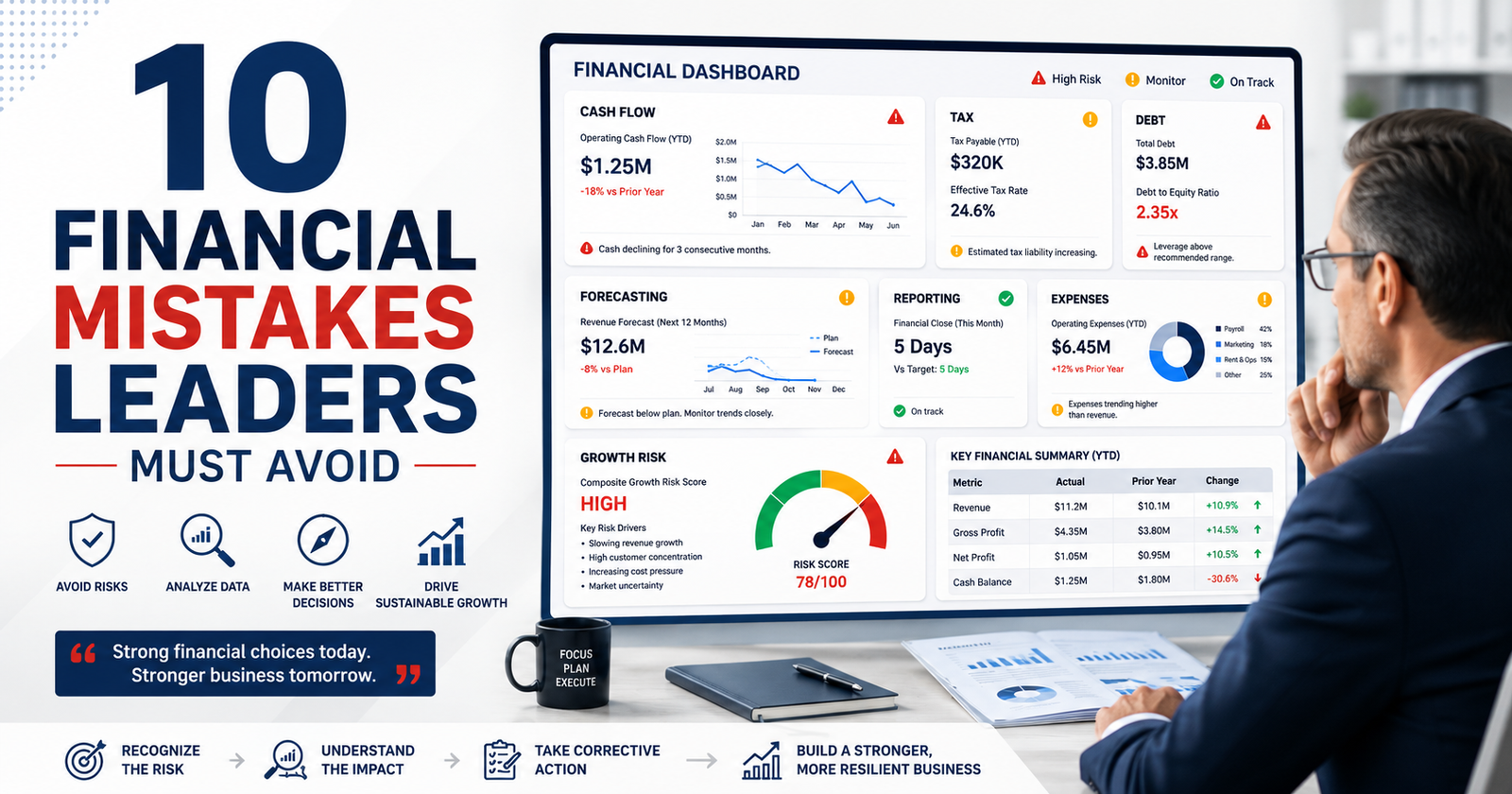
A practical guide to spotting weak financial signals, avoiding costly decisions, and building a stronger business through better cash flow, planning, reporting, and leadership judgement.
Financial mistakes rarely happen all at once. They usually begin as weak signals: tight cash flow, optimistic forecasts, late reports, rising costs, tax surprises, or debt taken on too quickly. This guide shows business leaders how to spot 10 common financial mistakes early and make better decisions before the damage grows.
Financial mistakes do not usually arrive wearing a sign that says, “Hello, I am about to ruin your week!”
That is why financial mistakes are not only accounting problems.
They are decision problems.
What this article covers
This article explains:
- what financial mistakes in business really are
- why profitable businesses can still run out of cash
- why leaders overestimate revenue
- how small costs damage profit
- why financial planning fails without scenarios
- why tax bills catch businesses by surprise
- when business debt becomes dangerous
- why relying on one customer is risky
- which financial reports leaders should review
- why financial literacy matters for leaders
- when to get professional financial advice
- what to review each month to avoid costly mistakes
Table of contents
- What are financial mistakes in business?
- What is the biggest financial mistake small businesses make?
- Mistake 1: Poor cash-flow management
- Mistake 2: Overestimating revenue
- Mistake 3: Weak expense tracking
- Mistake 4: Planning with only one forecast
- Mistake 5: Ignoring tax obligations
- Mistake 6: Poor debt management
- Mistake 7: Relying too much on one customer
- Mistake 8: Ignoring financial reports
- Mistake 9: Avoiding financial education
- Mistake 10: Waiting too long to get professional advice
- What this looks like in real business
- Where this goes wrong
- What you should actually do
- FAQ
- Most financial mistakes are missed signals before they become expensive consequences.
- Cash flow is often the first warning sign, even when sales and profit look healthy.
- Leaders often overestimate revenue and underestimate timing risk.
- Financial reports only help when leaders review them, understand them, and act on them.
- Better financial decisions come from understanding behaviour, signals, environment, and consequences.
What are financial mistakes in business?
Financial mistakes in business are decisions, habits, or missed signals that weaken cash flow, profit, control, resilience, or growth. They include poor forecasting, weak expense tracking, tax surprises, unmanaged debt, late reporting, underpricing, over-hiring, and making decisions without enough financial evidence.
A financial mistake is not always a dramatic error.
It is often a repeated habit.
It may be:
- not checking cash flow often enough
- treating sales as cash
- building forecasts from hope
- ignoring rising costs
- delaying tax planning
- taking on debt without testing repayment pressure
- failing to review reports
- relying too much on one customer
- waiting too long to get advice
- making growth decisions before checking the numbers
In my experience, financial mistakes often start as small acts of avoidance.
The leader knows something needs checking, but there is always another urgent problem.
A customer issue.
A staff issue.
A supplier issue.
A meeting.
A meeting about a meeting.
Then one day the “small” finance issue becomes the main issue.
Financial mistakes are not just accounting errors. They are decision errors that show up in the numbers.
The numbers are often the evidence. The real cause is usually poor timing, weak signals, unclear ownership, overconfidence, or decisions made without enough financial context.
Concept Definition: financial mistakes are like dashboard warning lights
Financial mistakes are like dashboard warning lights in a car.
One warning light does not mean the car is finished.
But if you ignore it long enough, the repair usually becomes more expensive.
Cash flow, debtor days, rising costs, tax pressure, weak margins, and debt repayments are business warning lights.
They are not there to embarrass you.
They are there to help you act earlier.
As the Finnish saying goes: “Ei vara venettä kaada.” It means, “Being prepared does not sink the boat.”
That is exactly how leaders should think about finance.
Good preparation does not slow the business down. It keeps the business afloat.
Idea Bridge: from mistakes to signals
Most leaders do not get into financial trouble because they cannot read numbers.
They get into trouble because they miss what the numbers are trying to tell them.
That is why this article is not just a list of common financial mistakes.
It is a guide to spotting weak signals earlier and making better decisions before the damage grows.
What is the biggest financial mistake small businesses make?
The biggest financial mistake many small businesses make is confusing profit, sales, and cash. A business can be profitable on paper and still run out of cash if customers pay late, costs rise early, tax is due, debt repayments continue, or growth consumes working capital.
Sales are not cash.
Profit is not cash.
A bank balance is not a forecast.
Those three points are simple, but they cause a lot of pain when ignored!
A business may have strong sales and still struggle because:
- customers take too long to pay
- wages must be paid before invoices are settled
- tax is due
- suppliers need paying
- stock has increased
- debt repayments continue
- new work requires upfront spending
- equipment needs replacing
- growth has used up working capital
That is why cash-flow management should sit near the centre of every leadership decision.
The most common financial mistakes business leaders make include poor cash-flow management, overestimating revenue, weak expense tracking, poor planning, ignoring tax, misusing debt, relying on one customer, ignoring reports, avoiding financial education, and waiting too long to get professional advice.
Mistake 1: Poor cash-flow management
Why do profitable businesses run out of cash?
Profitable businesses run out of cash when money leaves faster than it comes in. This can happen because customers pay late, costs rise before revenue arrives, tax is due, debt repayments continue, stock increases, or growth needs funding before cash catches up.
The mistake
The mistake is assuming that profit means the business has enough cash.
It may not.
Profit is an accounting result.
Cash is what pays wages, suppliers, rent, finance, tax, and the people who become strangely less cheerful when payment is late.
What this looks like in real business
A business has a healthy order book.
Sales look strong.
The profit and loss report looks acceptable.
But the bank balance is tight.
Payroll feels stressful.
Suppliers are being paid later.
VAT is due soon.
Customers owe money, but the money has not arrived.
This is one of the most common financial mistakes business owners make.
Why leaders miss it
Leaders often miss cash-flow pressure because they focus on revenue.
They think:
“We are busy, so we must be fine.”
But busy is not the same as liquid.
What I’ve seen many times is that leaders check the bank balance, but not the forward cash position.
That is like checking the weather by looking out of the window, while ignoring the storm forecast.
The consequence
Poor cash-flow management can lead to:
- missed supplier payments
- urgent borrowing
- stressed payroll
- weaker supplier trust
- poor negotiation position
- delayed tax payments
- rushed decisions
- business failure even when demand exists
This is why cash flow matters more than vanity revenue.
What you should actually do
Build a simple 13-week cash-flow forecast.
Review it weekly if cash is tight.
Track:
- cash in the bank
- expected customer receipts
- wages
- supplier payments
- tax payments
- loan repayments
- rent
- regular subscriptions
- upcoming large costs
- expected cash balance each week
Also review aged debtors.
That means checking who owes you money, how much they owe, and how late they are.
Useful related reading:
Cash Flow Forecasting as an Early-Warning Decision ToolA business can be profitable on paper and still run out of cash. Always check payment timing, debtor days, tax, debt repayments, and working capital before making spending decisions.
Mistake 2: Overestimating revenue
Why do leaders overestimate revenue?
Leaders overestimate revenue when optimism, pressure, recent success, or best-case thinking replaces evidence. A strong forecast should use historical data, pipeline quality, customer behaviour, market conditions, and three scenarios: cautious, expected, and stretch.
The mistake
The mistake is building next year’s budget around your best month this year.
That may feel ambitious.
It may also be financial fiction.
Optimism is useful in leadership.
But optimism without evidence is just a spreadsheet wearing a party hat.
What this looks like in real business
A leader looks at the best sales month of the year and assumes the business can repeat it every month next year.
They hire.
They spend.
They increase overheads.
They launch new plans.
Then sales return to normal.
The cost base stays high.
Why leaders miss it
Leaders miss this because of:
- optimism bias
- pressure to grow
- recent-success bias
- confidence from a few good months
- confusing pipeline interest with committed revenue
- wanting the numbers to support a decision already made
This is where behavioural economics matters.
People do not always forecast what is likely.
They often forecast what they want to be true.
The consequence
Overestimating revenue can lead to:
- hiring too early
- spending too fast
- cutting too late
- weak cash flow
- stock build-up
- debt pressure
- disappointed lenders or investors
- loss of confidence inside the team
What you should actually do
Use three scenarios:
- Cautious
- Expected
- Stretch
For each scenario, estimate:
- likely revenue
- gross margin
- staff costs
- overheads
- cash-flow impact
- debt or funding needs
- trigger points for action
Ask:
- What if sales are 15% lower than expected?
- What if customers delay decisions?
- What if conversion rates fall?
- What if one large customer pauses work?
- What if costs rise before revenue arrives?
This is not pessimism.
It is adult supervision for ambition.
Useful related reading:
Small Business Budgeting: 7 Steps to Build a Smarter BudgetMistake 3: Weak expense tracking
Why do small costs damage profit?
Small costs damage profit when they are repeated, ignored, or spread across subscriptions, suppliers, overtime, software, travel, stock, and admin spend. One small cost rarely hurts the business. Many small costs, left unchecked, quietly reduce margin and cash flow.
The mistake
The mistake is treating small costs as harmless.
A £30 subscription.
A small supplier increase.
A little extra overtime.
A few extra delivery miles.
A new tool nobody cancels.
Individually, they seem too small to worry about.
Together, they eat margin.
PayPal’s personal finance guidance highlights overspending and weak budgeting as common money mistakes, and the same behaviour appears in business finance when recurring costs are not reviewed properly.
PayPal UK: Common financial mistakesWhat this looks like in real business
A business keeps adding:
- software subscriptions
- unused apps
- supplier add-ons
- small equipment purchases
- overtime
- travel costs
- storage costs
- admin tools
- finance charges
- “temporary” services that become permanent
Nobody owns the full view.
The costs feel too small to challenge.
Then profit margin falls…
Why leaders miss it
Leaders miss weak expense tracking because:
- each cost looks minor
- the business is busy
- nobody reviews recurring costs
- costs sit in different categories
- suppliers increase prices quietly
- software renews automatically
- bank balance hides the pattern
This is not only a finance issue.
It is a system issue.
If nobody owns the review, the costs own themselves.
And they are very generous to themselves…
The consequence
Weak expense tracking can lead to:
- falling profit margins
- weaker cash reserves
- unclear cost base
- budget drift
- underpricing
- poor decisions about hiring or investment
- pressure to cut suddenly later
What you should actually do
Run a monthly cost review.
Check:
- recurring subscriptions
- supplier increases
- overtime
- travel
- fuel
- stock waste
- software tools
- insurance
- finance charges
- repairs
- small card payments
- “temporary” services
Ask three questions:
- Do we still need this?
- Does it support revenue, quality, control, or customer value?
- Could we reduce, renegotiate, cancel, or replace it?
Useful related reading:
Financial Dashboards That Help Leaders Make Better DecisionsMistake 4: Planning with only one forecast
Why does financial planning fail?
Financial planning fails when leaders build one neat forecast and treat it as certainty. Real business rarely follows one path. Sales may slow, costs may rise, customers may pay late, or tax may arrive sooner than expected. A better plan shows what happens if things go better, worse, or as expected.
The mistake
The mistake is building one financial plan and believing it is “the plan”.
That may feel organised.
But it is only one version of the future.
And business has a rude habit of not following the version we liked best.
A single forecast often says:
Sales will grow.
Costs will behave.
Customers will pay on time.
No major supplier will change terms.
No key customer will delay an order.
No unexpected tax or repair bill will appear.
Lovely.
Also, not always real life.
What this looks like in real business
A service business creates next year’s budget.
The plan assumes:
- revenue will grow by 20%
- customers will keep paying within 30 days
- wages will rise slightly
- fuel and supplier costs will stay steady
- no major customer will leave
- no new equipment will be needed
- tax will be manageable
Based on that plan, the leader hires two more people, increases marketing spend, and takes on another vehicle.
Then reality changes.
One customer delays a project.
Another customer starts paying after 60 days instead of 30.
Wage costs rise faster than expected.
A vehicle needs replacing.
VAT is due.
The original forecast still says the business is fine.
The bank account disagrees.
And the bank account tends to have the final say…
Why leaders miss it
Leaders miss this because a single forecast feels clean and professional.
It gives a clear number.
It supports the growth story.
It helps people feel confident.
But confidence is not the same as evidence.
What I’ve seen is that many leaders use forecasts to confirm a decision they already want to make.
They want to hire.
They want to expand.
They want to invest.
So the forecast quietly becomes a permission slip.
That is where the risk starts.
Do not build your plan around the best possible version of next year. That is not forecasting. That is hoping with a spreadsheet.
The consequence
Planning with only one forecast can lead to:
- hiring too early
- spending too fast
- borrowing without enough margin for error
- weak cash flow
- rushed cost-cutting
- late supplier payments
- tax pressure
- missed warning signs
- poor growth timing
The business may still be viable.
But the timing becomes painful.
And in business finance, timing is often the difference between “manageable” and “urgent”.
What you should actually do
Use three simple scenarios before making a major financial decision.
You do not need complex modelling.
You need three versions of the future.
Scenario 1: Cautious case
This is the “what if things are harder than expected?” case.
Ask:
- What if sales are 15% lower than planned?
- What if customers pay 15 days later?
- What if costs rise by 10%?
- What if one customer delays work?
- What if a new hire takes longer to become productive?
Scenario 2: Expected case
This is your most realistic view based on evidence.
Use:
- past sales
- current pipeline
- real conversion rates
- known costs
- payment patterns
- current staff capacity
- confirmed customer demand
Scenario 3: Stretch case
This is the better-than-expected case.
But keep it sensible.
Ask:
- What if sales grow faster?
- What extra cash will growth need?
- Will we need more staff, stock, vehicles, or equipment?
- Will growth improve cash flow or strain it?
- Can operations cope?
A simple example
A business wants to hire a new operations manager at £45,000 per year.
Before hiring, the leader tests three scenarios.
Cautious case
Sales grow by only 5%.
Customers pay slower.
Cash gets tight by month four.
Decision: delay the hire or use part-time support first.
Expected case
Sales grow by 12%.
Cash remains stable.
The hire is affordable if costs are controlled.
Decision: hire, but review after three months.
Stretch case
Sales grow by 25%.
The hire is needed, but growth creates more working-capital pressure.
Decision: hire, but also secure better payment terms and monitor cash weekly.
The same decision now looks different in each future.
That is the point!
The plan is no longer just a number.
It becomes a decision tool.
Before a major financial decision, ask: “What would make this plan fail?”
That one question can reveal cash-flow gaps, weak assumptions, cost pressure, customer risk, and timing problems before money is committed.
Practical rule
Before hiring, borrowing, expanding, buying equipment, or increasing overheads, test the decision against:
- lower sales
- slower customer payments
- higher costs
- tax due
- debt repayments
- staff delays
- customer loss
- working-capital pressure
Then decide:
- continue
- pause
- reduce
- stage the decision
- gather more information
- set a trigger point
A trigger point could be:
- “Hire only if monthly revenue stays above £80,000 for three months.”
- “Buy equipment only if cash stays above £50,000 after tax.”
- “Increase marketing spend only if conversion rate stays above 12%.”
- “Pause recruitment if debtor days go above 45.”
That is how planning becomes practical.
Not a document.
Not a wish list.
A decision system.
Mistake 5: Ignoring tax obligations
Why do tax bills catch businesses by surprise?
Tax bills catch businesses by surprise when leaders treat tax as an annual event instead of a cash-flow obligation. VAT, corporation tax, PAYE, National Insurance, and other tax payments should be planned throughout the year, not discovered when payment is due.
The mistake
The mistake is treating tax money as available cash.
It is not.
Some of the money in the bank may already belong to HMRC.
It is just visiting.
Handpicked Accountants highlights neglected tax obligations as one of the common financial mistakes business owners make, warning that missed tax duties can lead to fines, legal trouble, and avoidable pressure.
Handpicked Accountants: Financial mistakes business owners makeWhat this looks like in real business
A business has a strong bank balance.
The owner feels confident.
They invest, hire, or pay down another cost.
Then VAT is due.
Corporation tax is due.
PAYE is due.
The bank balance suddenly looks less friendly.
Why leaders miss it
Leaders miss tax pressure because:
- tax deadlines feel far away
- tax estimates are not reviewed monthly
- the bank balance looks stronger than it is
- accounting records are behind
- the accountant is contacted too late
- tax is treated as compliance, not planning
The consequence
Ignoring tax obligations can lead to:
- penalties
- interest
- HMRC pressure
- cash-flow stress
- emergency borrowing
- reduced trust
- poor decision timing
- personal stress for the owner
What you should actually do
Create a tax planning routine.
Use:
- a tax calendar
- a separate tax reserve account
- monthly tax estimates
- regular accountant check-ins
- VAT review before spending decisions
- payroll tax visibility
- corporation tax forecast
Ask:
- What tax is likely to be due?
- When is it due?
- Is the money set aside?
- Are records up to date?
- Does our cash-flow forecast include tax?
Tax should not be a surprise guest.
It should be on the calendar.
Mistake 6: Poor debt management
When does business debt become dangerous?
Business debt becomes dangerous when it is used without a clear repayment plan, cash-flow forecast, return expectation, or downside scenario. Debt can support growth, but it can also weaken flexibility if repayments continue while revenue, cash flow, or margins fall.
The mistake
The mistake is using debt to cover weak habits instead of funding clear value.
Debt is not automatically bad.
Good debt can support growth, equipment, working capital, or useful investment.
Bad debt hides poor cash-flow management, weak margins, or overspending.
The difference is not the loan itself.
The difference is the decision behind it.
What this looks like in real business
A business takes on debt to cover:
- late customer payments
- rising costs
- tax pressure
- stock build-up
- weak margins
- owner drawings
- overheads that are too high
- growth that has not been tested
The debt brings short-term relief.
Then repayments start.
The underlying problem remains.
Why leaders miss it
Leaders miss debt risk because debt can feel like a solution.
Money arrives.
Pressure eases.
The bank balance improves.
But the business may now have less flexibility.
In a Reddit entrepreneur thread I read in my research, one repeated practical warning was about taking loans or credit blindly without studying return and risk. That is exactly the real-world version of this mistake.
The consequence
Poor debt management can lead to:
- cash-flow squeeze
- rising interest costs
- weaker business credit score
- limited future borrowing options
- lender pressure
- reduced resilience
- difficult refinancing
- poor growth timing
What you should actually do
Before taking on debt, write down:
- why the debt is needed
- what return it should create
- how repayments will be funded
- what happens if sales are lower
- what happens if customers pay later
- what happens if costs rise
- what security is required
- how it affects cash flow
- how it affects future borrowing
Build a debt schedule.
Include:
- lender
- amount borrowed
- interest rate
- monthly repayment
- final payment date
- security
- purpose
- repayment source
Useful related reading:
Business Credit Score: 7 Ways to Build Borrowing PowerMistake 7: Relying too much on one customer, market, or income stream
Why is relying on one customer risky?
Relying on one customer, market, or income stream is risky because one lost contract, delayed payment, pricing change, or relationship problem can quickly damage revenue and cash flow. Concentration risk is often invisible while things are going well.
The mistake
The mistake is confusing a large customer with a safe business.
A big customer can be a blessing.
It can also become a dependency.
If one customer controls too much revenue, the business may have less power than it thinks.
What this looks like in real business
A business has one customer worth 35% or 40% of revenue.
The relationship is strong.
The work is regular.
The team is busy.
Everyone feels safe.
Then the customer:
- delays payment
- reduces orders
- changes supplier
- renegotiates price
- brings the work in-house
- gets acquired
- changes strategy
Suddenly, the business has a gap.
Why leaders miss it
Leaders miss concentration risk because large customers feel reassuring.
They create revenue.
They keep people busy.
They make forecasts look good.
They reduce the pressure to sell.
But comfort can become fragility.
As the Chinese saying goes: “未雨绸缪” (Wèiyǔchóumóu). It literally means “repair the roof before it rains.” (“Take precautions before it rains; plan ahead.”)
Do not start diversifying only after the main customer leaves.
The consequence
Over-reliance can lead to:
- sudden revenue loss
- cash-flow pressure
- weaker negotiation power
- rushed sales activity
- staff underuse
- panic discounting
- lower valuation
- lender concern
What you should actually do
Review customer concentration quarterly.
Ask:
- What percentage of revenue comes from our largest customer?
- What percentage comes from our top three customers?
- What would happen if the largest customer left?
- How long would cash last?
- Which costs would need adjusting?
- What new markets or customer types should we develop?
- Are margins healthy on large accounts?
- Are payment terms fair?
Create a simple risk trigger.
For example:
If one customer exceeds 25–30% of revenue, create a diversification plan.
Useful related reading:
Customer Intent MarketingMistake 8: Ignoring financial reports
What financial reports should business leaders review?
Business leaders should regularly review cash flow, profit and loss, balance sheet, aged debtors, aged creditors, budget vs actual, gross margin, EBITDA where relevant, and key operating metrics. Reports are useful only when they lead to action.
The mistake
The mistake is treating financial reports as accountant documents rather than leadership tools.
Reports are not there only for tax.
They are there to help you understand what is happening.
A business without useful reporting is often managed by mood.
And mood is not a KPI.
What this looks like in real business
Reports are reviewed once a year.
The accountant explains them.
The owner nods politely.
Everyone moves on.
During the year, decisions are made from:
- bank balance
- gut feeling
- sales activity
- customer noise
- pressure
- habit
- urgency
No one checks the deeper signals.
Why leaders miss it
Leaders avoid reports because:
- finance feels technical
- reports arrive too late
- numbers are not linked to decisions
- leaders do not know what to ask
- the dashboard is too complex
- nobody owns the review rhythm
This is where good reporting should become simple.
Not simplistic.
Simple.
The consequence
Ignoring reports can lead to:
- missed warning signs
- weak pricing decisions
- late cost control
- poor hiring timing
- cash-flow surprises
- tax pressure
- poor lender conversations
- slow correction
- lower confidence
What you should actually do
Create a monthly finance review.
Review:
- cash-flow forecast
- profit and loss
- balance sheet
- aged debtors
- aged creditors
- gross margin
- budget vs actual
- tax estimate
- debt repayments
- key operational metrics
Keep it practical.
For each report, ask:
- What changed?
- Why did it change?
- Does it matter?
- What decision does it affect?
- What action is needed?
Useful related reading:
Financial Dashboards That Help Leaders Make Better DecisionsMistake 9: Avoiding financial education
Why does financial literacy matter for leaders?
Financial literacy matters because leaders do not need to be accountants, but they do need to understand the numbers behind cash flow, profit, debt, tax, pricing, reports, and growth decisions. Without that understanding, leaders become too dependent on others or make choices from instinct alone.
The mistake
The mistake is saying:
“I’m not a numbers person.”
You do not need to become an accountant.
You do need to understand the financial signals that affect your decisions.
There is a difference.
A leader should understand enough to ask better questions.
What this looks like in real business
The leader avoids finance meetings.
Reports are delegated completely.
The accountant or finance person explains the numbers.
The leader agrees, but does not fully understand.
Then major decisions are made from instinct, pressure, or confidence rather than evidence.
Why leaders miss it
Leaders avoid financial education because of:
- time pressure
- fear of looking foolish
- bad past experiences with numbers
- ego
- over-reliance on advisers
- belief that finance is “someone else’s job”
PayPal’s guidance includes neglecting financial education as one of the common financial mistakes, and that lesson applies strongly to business leaders too.
PayPal UK: Common financial mistakesThe consequence
Low financial literacy can lead to:
- poor questions
- weak decision-making
- over-reliance on others
- missed warning signs
- poor pricing
- bad debt decisions
- tax surprises
- weak growth planning
What you should actually do
Learn one finance concept each month.
Start with:
- cash flow
- gross margin
- net profit
- working capital
- debtor days
- budget vs actual
- balance sheet
- break-even point
- EBITDA
- business credit score
Connect each concept to a decision.
For example:
Break-even helps you decide how many sales you need.
Cash flow helps you decide whether you can afford growth.
Debtor days help you decide whether payment terms are working.
Useful related reading:
11 Key Business Acumen Skills You NeedBreak-Even Analysis for Better Business DecisionsMistake 10: Waiting too long to get professional advice
When should a business leader get financial advice?
A business leader should get financial advice before major decisions involving tax, borrowing, hiring, expansion, restructuring, business sale, investment, or cash-flow pressure. Advice is most useful before a decision is made, not after the consequences become expensive.
The mistake
The mistake is waiting until the problem is urgent.
Many leaders delay advice because they want to save money.
That is understandable.
But advice is often cheapest before the mistake.
After the mistake, it becomes repair work.
Repair work is usually more expensive, more stressful, and less fun. Rather like dental treatment after pretending the toothache was “probably nothing”.
What this looks like in real business
A leader waits until:
- cash is already tight
- tax is already due
- debt pressure is already high
- a sale is already being negotiated
- a key customer has already left
- staff have already been hired
- costs have already risen
- HMRC has already contacted them
Then they seek advice.
Options are fewer.
Pressure is higher.
Why leaders miss it
Leaders delay advice because of:
- cost concerns
- pride
- fear of bad news
- belief they can fix it later
- poor past experience
- not knowing who to ask
- seeing advice as admin, not strategy
The consequence
Waiting too long can lead to:
- higher costs
- fewer options
- rushed decisions
- poor finance terms
- tax penalties
- weak negotiation position
- avoidable stress
- business damage
What you should actually do
Create an advice trigger list.
Get advice before:
- taking on major debt
- hiring senior staff
- buying equipment
- expanding premises
- entering a new market
- selling the business
- restructuring
- changing company structure
- dealing with tax uncertainty
- cash-flow pressure becomes urgent
Good advice should not replace leadership judgement.
It should improve it.
The KrisLai Decision Framework™ and financial mistakes
A practical model for better business decisions in complex environments. It focuses on four essential elements:
- Human Behaviour — how people actually think and decide
- Signals — what people are trying to do right now
- Environment — whether the system supports good decisions
- Consequences — what happens next, and after that
Strong decisions consider all four — not just one.
Financial mistakes fit the KrisLai Decision Framework very clearly.
Human Behaviour:
Leaders can be optimistic, avoid awkward numbers, trust gut feeling, chase growth, or delay advice.
Signals:
Cash flow, debtor days, margins, tax, debt, costs, forecasts, and budget variances show what is changing.
Environment:
Customer payment habits, supplier costs, interest rates, tax rules, market uncertainty, AI-driven search changes, and competition all shape the decision.
Consequences:
Poor financial decisions can lead to weak cash, rushed borrowing, delayed cuts, lower resilience, and damaged growth.
This approach is part of the KrisLai Decision Framework, a practical method for improving business decisions.
Better decisions come from understanding behaviour, signals, environment, and consequences.
What this looks like in real business
A growing business can look successful while financial pressure builds underneath. Sales may rise, but cash can still tighten if customers pay late, costs rise, tax is not reserved, debt repayments increase, or leaders hire and spend before testing the financial impact.
Imagine a small service business.
Sales are rising.
The team is busy.
The owner feels confident.
A new contract has been won.
The business hires two more people.
New equipment is bought.
Marketing spend increases.
Everything looks like growth.
But underneath:
- customers are paying later
- overtime is rising
- tax has not been reserved
- supplier costs have increased
- debtor days are worsening
- the cash forecast is not updated
- the new contract pays 45 days after delivery
Insight:
The business is not failing because it lacks demand.
It is under pressure because decisions are being made from optimism rather than signals.
Real example:
The leader builds the plan around expected sales, not expected cash timing.
Decision:
Pause further hiring.
Build a 13-week cash-flow forecast.
Review debtor days.
Create a tax reserve.
Test cautious, expected, and stretch scenarios.
Review margins by contract.
Consequence:
The business still grows, but with more control.
It avoids a cash crunch, protects supplier trust, and makes better hiring decisions.
Growth does not remove financial risk. It often changes the type of risk. Good leaders check whether growth is creating stronger cash flow or simply creating a bigger version of the same pressure.
Where this goes wrong
Financial mistakes go wrong when leaders normalise weak signals. Cash gets tight, but the business keeps spending. Reports arrive late, but nobody changes the review rhythm. Sales rise, but margin falls. Tax is due, but no reserve exists. Debt grows, but repayments are not stress-tested.
What I’ve seen is that leaders often miss financial mistakes for very human reasons:
They do not want to look negative.
They want to believe the growth story.
They are busy.
They assume the accountant will catch it.
They think the bank balance is enough.
They avoid reports because reports feel uncomfortable.
They wait for certainty.
But certainty often arrives late.
And it usually sends an invoice.
The bank balance tells you what is there today. It does not show what is due next week, which customers are late, what tax is coming, whether margins are falling, or whether growth is using more cash than expected.
Financial mistakes and decision-making under uncertainty
Financial mistakes become more dangerous when leaders make fixed decisions in uncertain conditions. Better decisions use scenarios, trigger points, pre-mortems, and regular review. This helps leaders adapt when sales, costs, payment timing, customer behaviour, or market conditions change.
Business decisions are rarely made in calm conditions.
Customers delay decisions.
AI changes how people search and compare providers.
Suppliers change terms.
Costs move.
Lenders become more cautious.
Technology shifts.
Markets become noisier.
That is why a single forecast is not enough.
Before a major financial decision, ask:
- What if sales are 15% lower?
- What if customers pay 15 days later?
- What if costs rise by 10%?
- What if a key customer leaves?
- What if a loan takes longer to arrange?
- What if hiring takes longer to pay back?
- What information would reduce uncertainty?
- What trigger tells us to pause?
This is where scenario planning, pre-mortem thinking, and monitor-and-adapt reviews become useful.
Plain English version:
Do not only ask, “What do we expect?”
Ask:
“What could make this decision fail?”
That one question can save a lot of money!
What you should actually do
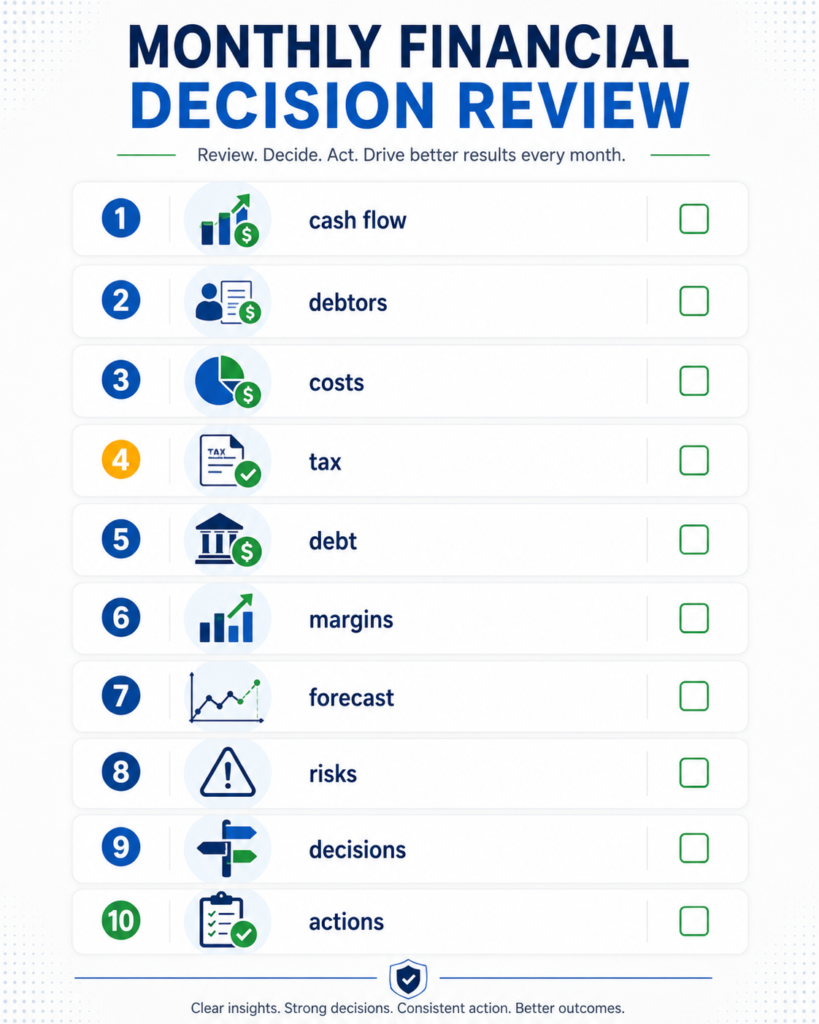
Start with a monthly financial decision review. Check cash flow, revenue assumptions, costs, tax, debt, customer concentration, reports, and upcoming decisions. Then decide what to continue, pause, fix, or investigate before small mistakes become expensive.
This is the practical routine I would use:
Step 1: Review cash flow
Check:
- current bank balance
- 13-week cash-flow forecast
- expected customer receipts
- upcoming bills
- payroll
- tax
- loan repayments
- planned spending
Ask:
Is cash improving, stable, or tightening?
Step 2: Review aged debtors
Check:
- who owes money
- how much they owe
- how late they are
- whether payment terms are working
- which customers need chasing
- whether one customer creates too much risk
Ask:
Are customers paying in time to support the business?
Step 3: Review revenue assumptions
Check:
- forecast vs actual revenue
- sales pipeline quality
- conversion rate
- repeat customer behaviour
- customer delays
- cautious, expected, and stretch scenarios
Ask:
Are we forecasting from evidence or hope?
Step 4: Review costs
Check:
- budget vs actual costs
- supplier increases
- subscriptions
- overtime
- stock
- travel
- finance charges
- admin spend
Ask:
Which costs are rising faster than value?
Step 5: Review tax and debt
Check:
- tax due
- tax reserve
- loan repayments
- interest costs
- debt schedule
- repayment pressure
- upcoming finance needs
Ask:
Are we treating future obligations as if they already exist?
Step 6: Review profit and margin
Check:
- gross margin
- net profit
- EBITDA where relevant
- margin by customer
- margin by service
- margin trend
Ask:
Are we becoming stronger, or just busier?
Step 7: Review concentration risk
Check:
- largest customer percentage
- top three customer percentage
- key supplier risk
- sector reliance
- contract renewal risk
Ask:
What would hurt us most if it changed?
Step 8: Review upcoming decisions
List the decisions coming in the next 30–90 days:
- hiring
- borrowing
- equipment
- marketing spend
- pricing
- customer terms
- new contracts
- supplier changes
- expansion
- software or systems
Ask:
What information do we need before deciding?
Once a month, review these 10 signals:
- Cash-flow forecast
- Aged debtors
- Budget vs actual costs
- Revenue forecast
- Gross margin
- Tax reserve
- Debt repayments
- Customer concentration
- Upcoming major decisions
- Actions agreed and owned
The goal is not to create more admin. The goal is to spot weak signals before they become expensive consequences.
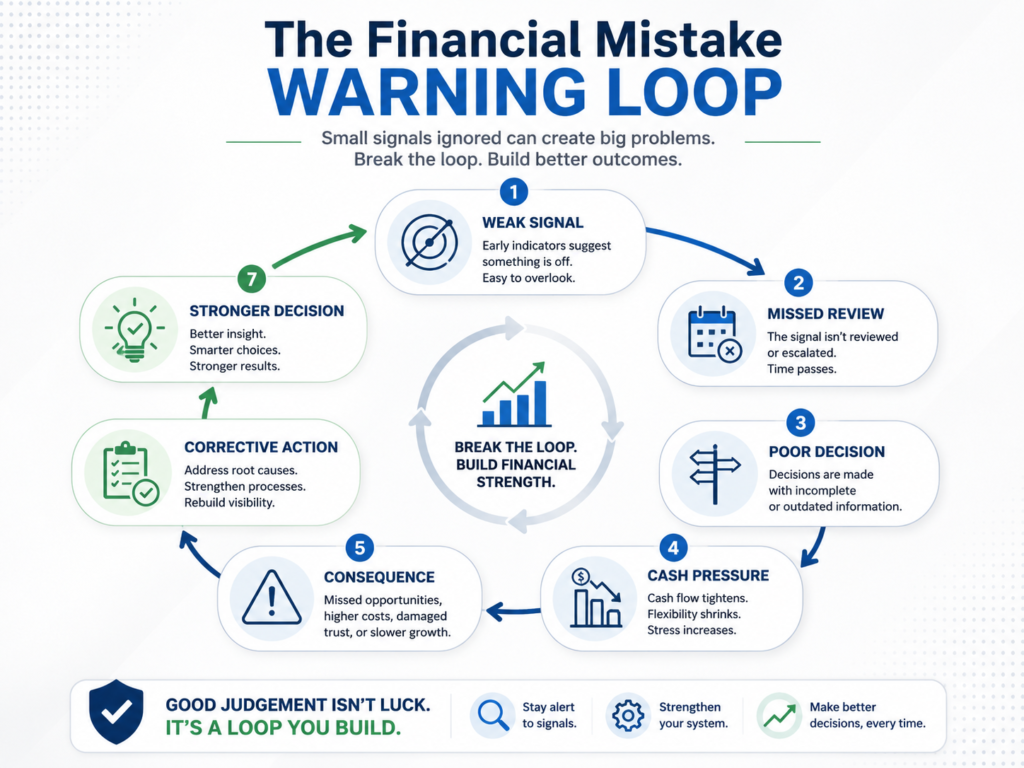
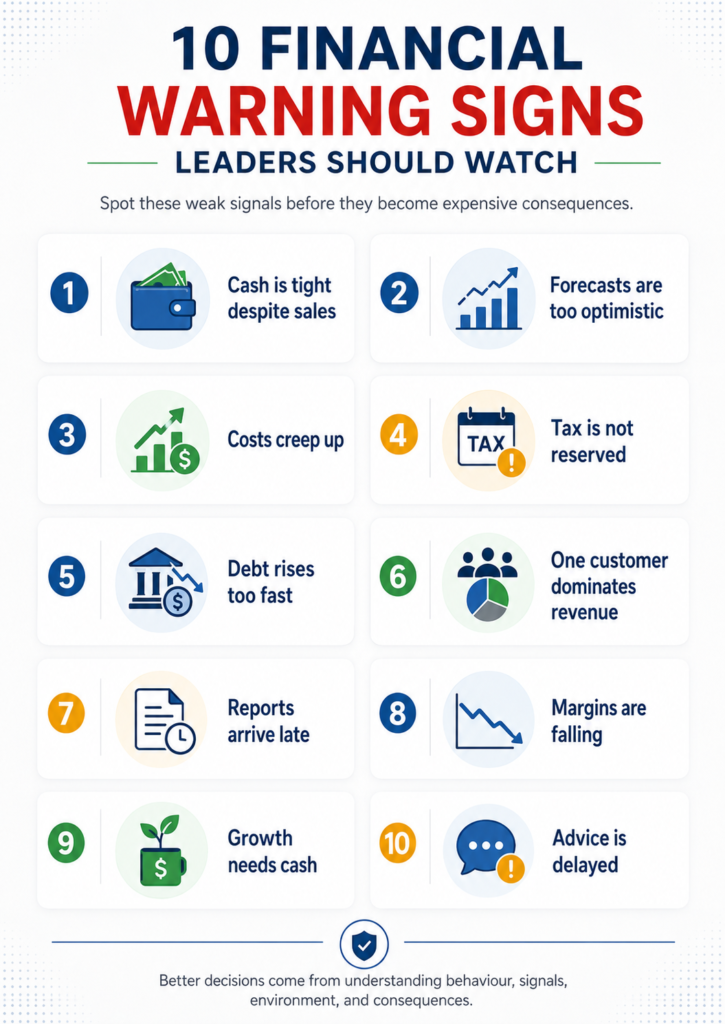
Before you move on, here is a simple visual summary of the 10 financial warning signs leaders should watch most closely:
Research and experience note
This article is based on practical experience, independent research, and analysis and synthesis of common financial mistakes business leaders and small business owners make.
Useful reference sources include:
PayPal UK: Common financial mistakesHandpicked Accountants: Five common financial mistakes business owners make
Investopedia: Most common financial mistakes
OneFamily: Common money mistakes and how to avoid them
Google Search Central: Creating helpful, reliable, people-first content
I write about how better decisions are made in business — combining strategy, behaviour, and practical thinking. Financial mistakes are a good example of why this matters. The numbers matter, but the thinking around the numbers matters even more.
What are the most common financial mistakes?
Common financial mistakes include poor cash-flow management, weak budgeting, overspending, poor tax planning, taking on debt too quickly, ignoring reports, not saving for emergencies, and making decisions without enough financial information.
What is the biggest financial mistake business owners make?
One of the biggest financial mistakes business owners make is confusing sales, profit, and cash. A business can be profitable on paper and still run out of cash if payments, tax, debt, and working capital are poorly managed.
How can small businesses avoid financial mistakes?
Small businesses can avoid financial mistakes by reviewing cash flow monthly, tracking expenses, using realistic forecasts, reserving for tax, managing debt carefully, reviewing financial reports, and getting advice before major decisions.
Why do profitable businesses run out of cash?
Profitable businesses run out of cash when customers pay late, costs rise before income arrives, tax is due, debt repayments continue, stock increases, or growth consumes working capital faster than cash comes in.
What are signs of poor financial management?
Signs of poor financial management include tight cash despite good sales, late supplier payments, tax surprises, rising debt, weak reports, falling margins, no cash-flow forecast, and decisions based mainly on bank balance.
How often should business leaders review finances?
Most business leaders should review key financial signals monthly. If cash is tight, a weekly cash-flow review may be needed. The review should include cash flow, debtors, costs, tax, debt, margins, forecasts, and major upcoming decisions.
FAQ
What are financial mistakes in business?
Financial mistakes in business are decisions, habits, or missed warning signs that weaken cash flow, profit, control, resilience, or growth. They include poor forecasting, weak expense tracking, tax surprises, unmanaged debt, late reporting, and making decisions without enough financial evidence.
What are the most common financial mistakes business leaders make?
The most common financial mistakes business leaders make include poor cash-flow management, overestimating revenue, weak expense tracking, poor planning, ignoring tax obligations, poor debt management, relying on one customer, ignoring reports, avoiding financial education, and delaying professional advice.
What is the biggest financial mistake small businesses make?
The biggest financial mistake many small businesses make is confusing sales, profit, and cash. Sales may be strong and profit may look healthy, but the business can still run out of cash if customers pay late or costs arrive first.
Why do profitable businesses run out of cash?
Profitable businesses run out of cash when cash leaves faster than it comes in. This can happen because customers pay late, tax is due, debt repayments continue, stock increases, wages must be paid, or growth needs funding before customer payments arrive.
How can leaders avoid overestimating revenue?
Leaders can avoid overestimating revenue by using cautious, expected, and stretch forecasts. They should base forecasts on real sales history, pipeline quality, conversion rates, customer behaviour, payment timing, and market conditions rather than the best month of the year.
What financial reports should leaders review?
Business leaders should review cash flow, profit and loss, balance sheet, aged debtors, aged creditors, budget vs actual, gross margin, tax estimates, debt repayments, and key business metrics. Reports only help when they lead to action.
How can businesses avoid tax surprises?
Businesses can avoid tax surprises by using a tax calendar, setting aside tax reserves, reviewing VAT and corporation tax estimates monthly, keeping records up to date, and speaking to an accountant before major financial decisions.
When does business debt become dangerous?
Business debt becomes dangerous when it is used without a clear repayment plan, cash-flow forecast, return expectation, or downside scenario. Debt can support growth, but it can also weaken the business if repayments continue while revenue or margins fall.
How often should leaders review business finances?
Most leaders should review business finances monthly. If cash flow is tight, they should review cash weekly. A monthly review should cover cash flow, debtors, costs, tax, debt, margins, forecasts, customer concentration, and upcoming major decisions.
When should a business leader get professional financial advice?
A business leader should get professional financial advice before major decisions involving tax, borrowing, hiring, expansion, restructuring, business sale, investment, or cash-flow pressure. Advice is most useful before the decision, not after the consequences become expensive.
Financial mistakes connect closely to cash flow, budgeting, forecasting, business credit, financial dashboards, and decision-making under uncertainty.
These articles may help you go deeper:
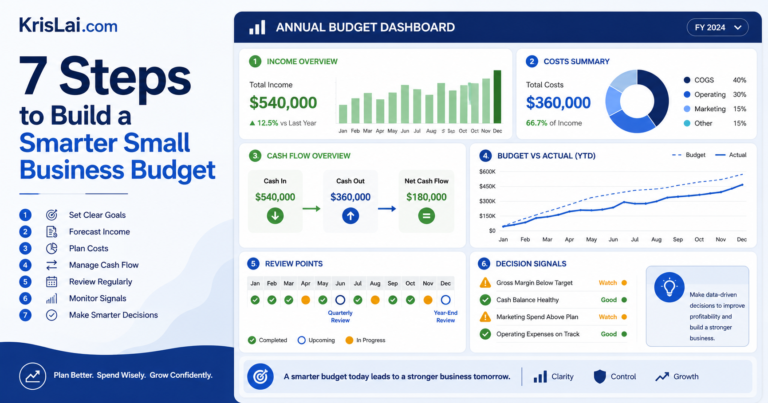
- Small Business Budgeting: 7 Steps to Build a Smarter Budget
- Cash Flow Forecasting as an Early-Warning Decision Tool
- Financial Trend Analysis: 7 Financial Trends Leaders Should Watch
- Break-Even Analysis for Better Business Decisions
- EBITDA Explained: 7 Uses and 5 Risks for Business Leaders
- Business Credit Score: 7 Ways to Build Borrowing Power
Financial mistakes are not only finance problems. They are also behaviour, judgement, and decision-making problems. These articles support the wider thinking behind better business decisions:
Conclusion and final thought: catch the weak signals earlier
Most financial mistakes are not caused by one bad number.
They are caused by leaders missing weak signals until the consequences become expensive.
Cash flow tightens.
Revenue forecasts become too hopeful.
Costs creep up.
Tax is not reserved.
Debt grows.
Reports arrive late.
Advice is delayed.
None of these signs means the business is doomed.
But each one deserves attention.
Over time, I’ve found that good decisions rarely come from data alone. They come from understanding people, reading signals, creating the right environment, and thinking beyond the immediate outcome.
I help people make better business decisions through psychology, strategy, and practical thinking. Financial mistakes are a perfect example of why this matters: the numbers tell a story, but leaders still need to read it properly.
Run one monthly financial decision review this week.
Review cash flow, debtors, costs, tax, debt, margins, forecasts, customer concentration, and upcoming major decisions.
This one routine will help you spot weak signals earlier, avoid costly financial mistakes, and make stronger decisions before pressure builds.
Free PDF guide + worksheets
A clearer way to make your next business decision
Get the KrisLai Decision Framework™ Guide and explore the people, evidence, conditions and consequences behind your next choice.
- A practical five-step decision process
- Hiring, pricing and strategy examples
- A decision checklist and two fillable worksheets
Enter your email on the next page to request your copy.
10-page PDF · By Kris Lai
If you enjoy exploring the ideas behind better business decisions, you may find the Business Thinking Hub useful.
About the author
Kris Lai is a business operator and managing director with experience in land and building surveying, facilities management, logistics, and service delivery.
Earlier in his career, he worked as a Search Engine Evaluator (via Lionbridge, supporting Google), where he assessed search result relevance, user intent, and content quality using structured evaluation frameworks. This experience gives him a rare, practical understanding of how search systems interpret signals and make ranking decisions.
In parallel, whilst working with a charity organisation, he has delivered 1000’s of structured presentations in English, Finnish, and Chinese to audiences ranging from small groups to more than 600 people, and has spent decades mentoring and developing others. This experience informs his approach to clarity, communication, and decision-making under pressure.
He writes about AI, search behaviour, business strategy, and decision-making from a practical, real-world perspective.
👉 Explore ideas connected to better business decisions:
- Digital Transformation for SMEs: 7 Questions Before You Invest
- Cybersecurity for Businesses: 7 Decisions Leaders Must Make

- How AI Is Changing Search Behaviour (And What Businesses Must Do Now)
- 7 Decision-Making Framework Examples for Business Leaders
- Business Decision-Making Framework: The KrisLai Method