Good ideas are easy to agree with.
Good decisions are harder to make.
I’ve sat in meetings where everyone nodded along to a sensible plan, only for it to unravel a few weeks or months later.
The problem was not always that the original idea was bad.
Often, something important had been missed.
Perhaps nobody had tested the assumptions.
Perhaps too many people were involved and nobody knew who actually had the final say.
Perhaps the decision looked good financially but ignored how customers or employees would respond.
Or perhaps everyone concentrated on the immediate result and failed to ask what would happen next.
This is where a decision-making framework can help.
A decision-making framework gives managers and business owners a structured way to understand a decision, compare options and decide what to do next.
But there is no single framework that is right for every situation.
A decision matrix can help you compare suppliers.
DACI can clarify who has the authority to decide.
SPADE can bring structure to a difficult strategic choice.
A pre-mortem can expose risks before a project starts.
And sometimes the best approach is simply to recognise that the decision is reversible, make it quickly, learn and adjust.
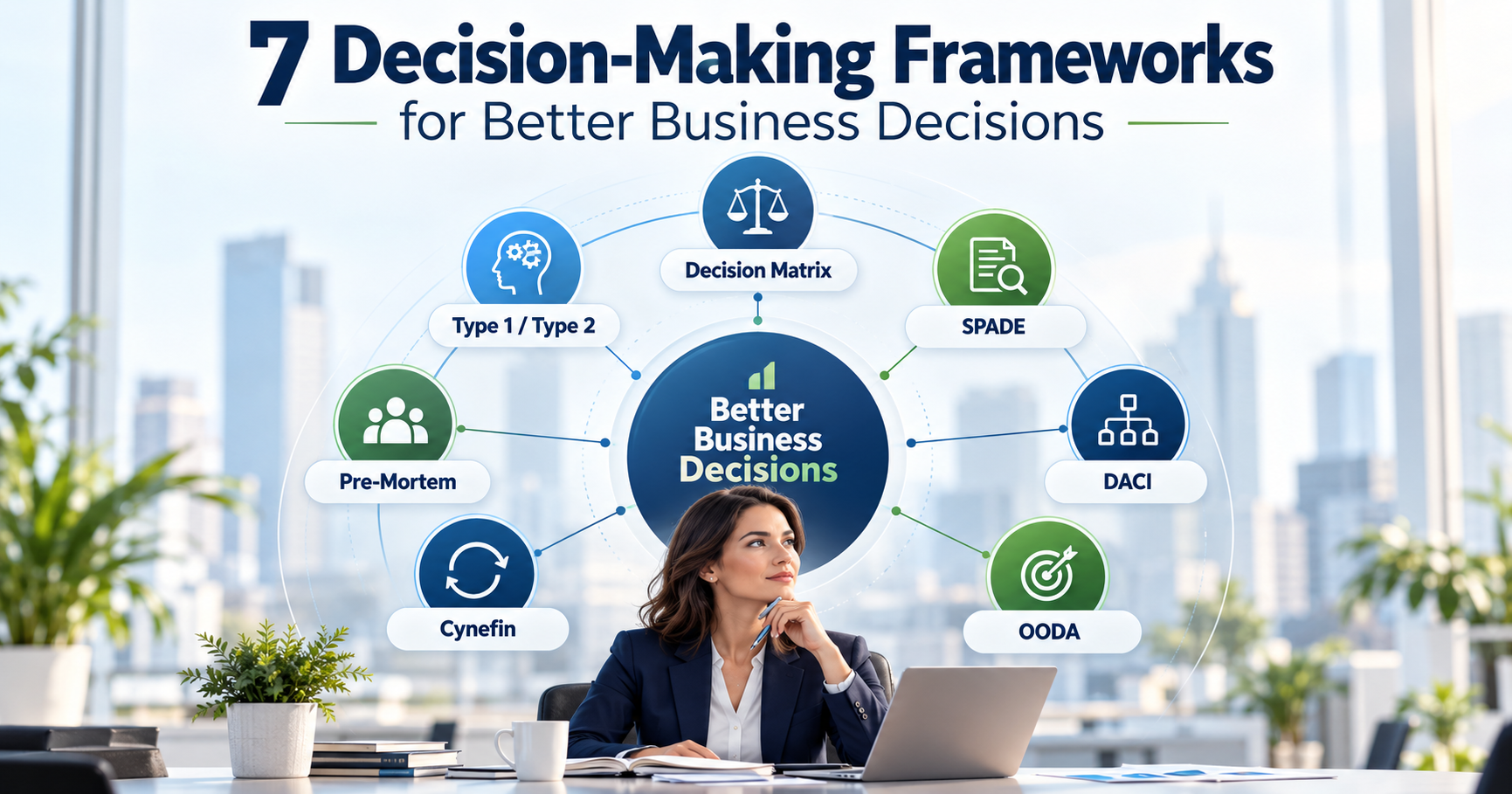
In this guide, I will explain seven useful decision-making frameworks, show decision-making framework examples in business, and help you decide which model fits the situation in front of you.
The goal is not to find the “best” decision-making framework. The goal is to use enough structure for the importance, uncertainty and consequences of the decision you are making.
Table of Contents
- What Is a Decision-Making Framework in Business?
- Why Use a Decision-Making Framework?
- Which Decision-Making Framework Should I Use?
- 7 Decision-Making Framework Examples
- What Is a Simple Decision-Making Framework?
- The Missing Layer: Test the Decision
- Business Example: Should We Raise Prices?
- Ethics in Decision-Making
- Decision Framework Template
- 7 Common Decision-Making Framework Mistakes
- How AI Is Changing Decision-Making
- How to Improve Your Decision-Making Process
- Frequently Asked Questions
What Is a Decision-Making Framework in Business?
A decision-making framework is a structured way to understand a problem, compare choices and decide what to do.
It creates a repeatable process instead of relying entirely on instinct.
That matters because business decisions often involve several things at once:
- money
- customers
- employees
- risk
- time
- capacity
- competing priorities
- incomplete information
A framework helps bring those factors into view.
It does not remove judgement.
It improves the conditions in which judgement is used.
I think this distinction is important.
A framework is not an automatic answer machine.
You can follow a decision-making process perfectly and still make a poor decision if the information is weak, the assumptions are wrong or the people involved are influenced by bias.
The framework creates structure.
The quality of thinking still matters!
Why Use a Decision-Making Framework?
A decision-making framework is useful when a decision is important enough that relying on instinct alone feels risky.
Structured decision-making can help you:
- define the real decision
- compare alternatives
- make assumptions visible
- clarify who decides
- identify missing evidence
- challenge bias
- consider risk
- think about consequences
- explain why a decision was made
- review whether it worked
However, I would not use a formal model for every choice.
Deciding which printer paper to buy does not need a two-hour workshop!
Choosing whether to enter a new market might.
The amount of decision process should match the importance of the decision.
That brings us to the first question:
Which Decision-Making Framework Should I Use?
Choose a decision-making framework by looking first at the importance, reversibility, uncertainty, people involved and speed required.
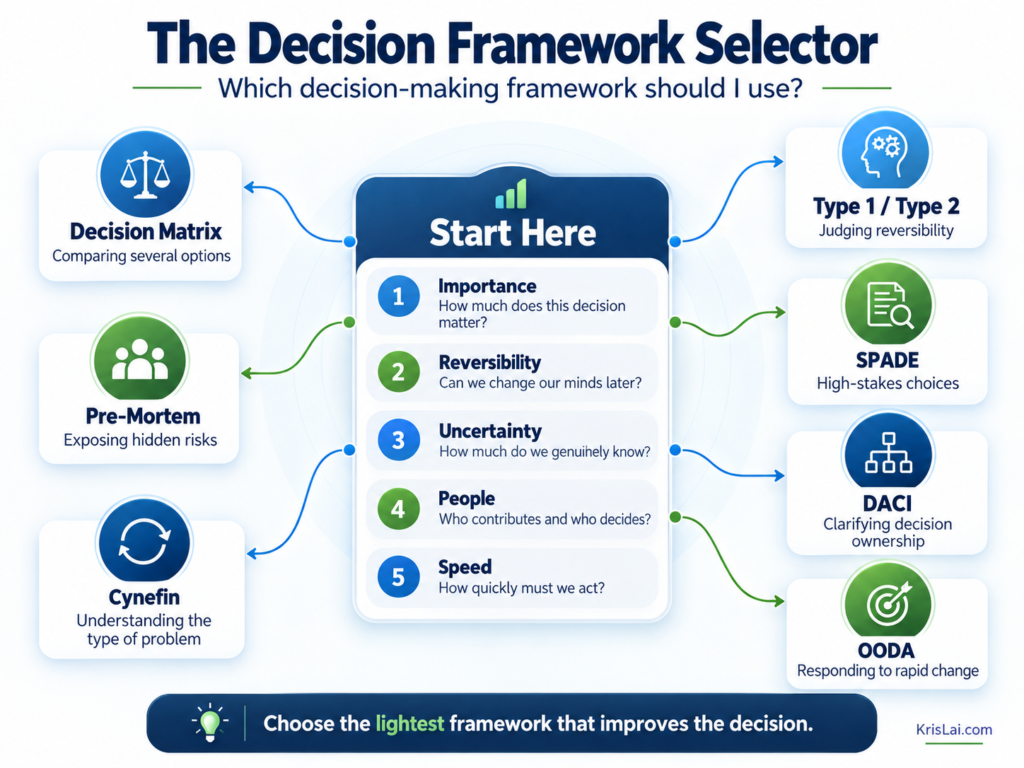
Before choosing any model, I suggest asking five questions:
1. How important is the decision?
What happens if you get it wrong?
A low-cost, reversible experiment needs much less analysis than a five-year lease, acquisition or major hiring decision.
2. Can you reverse it?
Some decisions can be undone easily.
Others create commitments that are expensive or difficult to reverse.
That difference should affect how much evidence and discussion you require before acting.
3. How uncertain is the situation?
Do you understand the cause and effect?
Or are you dealing with customer behaviour, new technology, an unfamiliar market or another situation where the outcome is difficult to predict?
High uncertainty often calls for testing rather than pretending you can calculate the perfect answer.
4. How many people need to be involved?
A decision may fail because too few people were consulted.
It can also fail because everybody was consulted and nobody knew who had authority to decide.
Those are different problems.
5. How quickly must you act?
Some decisions reward careful analysis.
Others become worse while you wait.
Before choosing a framework, ask:
Importance — How much does this decision matter?
Reversibility — Can we change our minds later?
Uncertainty — How much do we genuinely know?
People — Who should contribute and who decides?
Speed — How quickly must we act?
These five questions usually tell you how much structure the decision actually needs.
Decision-Making Framework Examples: Quick Comparison
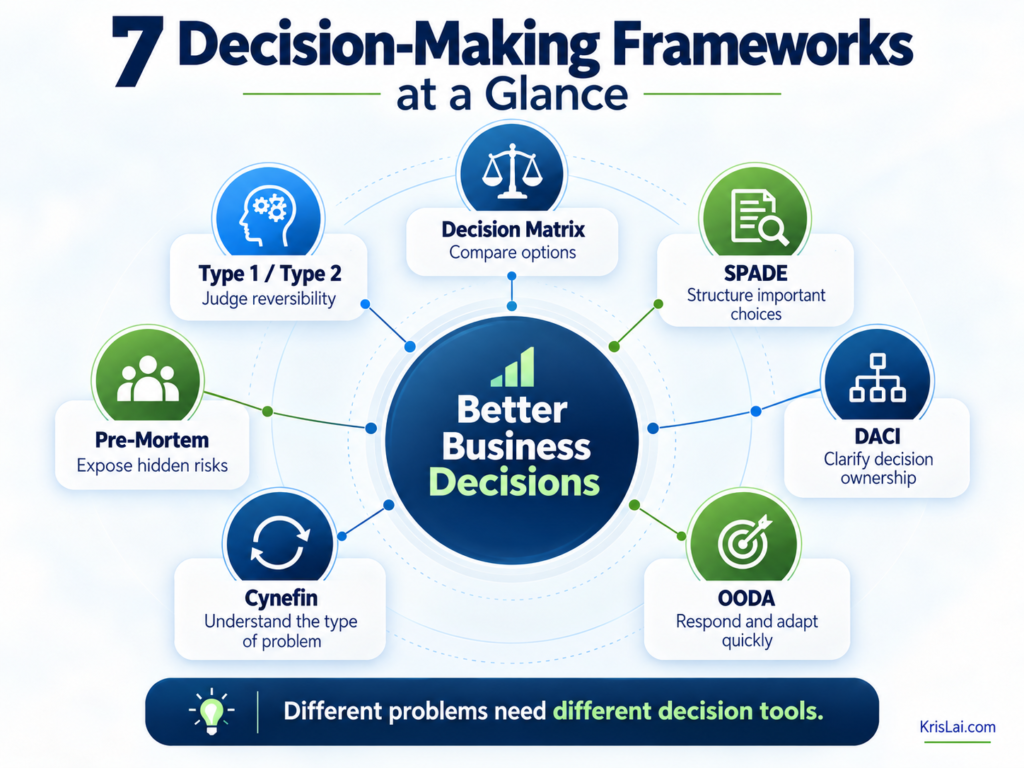
Here is the simple version before we examine each model in detail:
| Framework | Best Used For | Main Question |
|---|---|---|
| Decision Matrix | Comparing several options | Which option performs best against our priorities? |
| Type 1 / Type 2 | Matching speed to reversibility | Can we undo this decision? |
| SPADE | Important decisions with several alternatives | How do we structure a difficult choice? |
| DACI | Decisions involving several people | Who drives, decides, contributes and needs to know? |
| OODA Loop | Fast-changing situations | What changed, and how should we respond? |
| Cynefin | Complex or unclear problems | What kind of situation are we actually dealing with? |
| Pre-Mortem | Exposing hidden risks | If this fails, what probably caused it? |
None of these is universally better than the others.
They solve different decision problems.
1. Decision Matrix: Compare Options Against Clear Criteria
A decision matrix helps you compare several choices against the factors that matter most.
It is one of the simplest decision-making tools for business.
You list your options.
Then you list the criteria you care about.
You can score each option and, where useful, give more important criteria a higher weighting.
Best used when
Use a decision matrix when:
- you have several realistic options
- the criteria can be stated clearly
- trade-offs matter
- people are arguing from different priorities
- you want to make the reasoning visible
Do not rely on it when
Be careful when:
- the scores are mostly guesses
- important factors cannot be reduced sensibly to numbers
- the environment is changing quickly
- one serious risk could outweigh every other criterion
A spreadsheet can make a weak assumption look impressively precise.
The numbers should support judgement, not disguise uncertainty.
Business example: Choosing a supplier
Imagine you are choosing between three suppliers.
The cheapest quote looks attractive.
But price is only one criterion.
You might compare:
- price
- reliability
- quality
- lead time
- payment terms
- customer support
- capacity
- switching risk
Supplier A may be cheapest.
Supplier B may cost slightly more but offer much better reliability.
If delays cause overtime, customer complaints and missed deadlines, the cheapest supplier may not actually be the cheapest business decision.
That is business acumen in practice.
If you are making decisions like this regularly, my guide to business acumen for managers goes deeper into how financial, customer and operational consequences connect.
2. Type 1 and Type 2 Decisions: Match the Process to Reversibility
The Type 1 / Type 2 approach separates difficult-to-reverse decisions from decisions you can change later.
This is one of the most useful ideas for managers who tend to over-analyse.
A Type 1 decision is difficult or expensive to reverse.
Think of it as a one-way door.
A Type 2 decision is easier to change.
You can walk back through the door if the result is poor.
Best used when
Use this distinction when deciding how much analysis, consultation and approval a decision actually deserves.
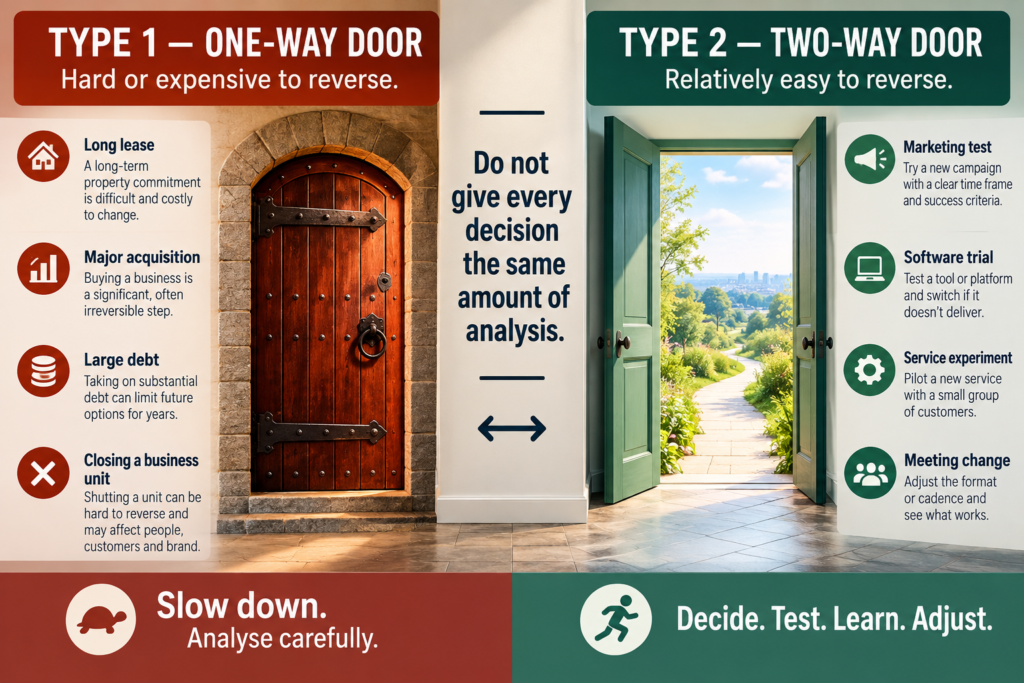
Type 1 examples
These might include:
- signing a long commercial lease
- making a major acquisition
- changing the core business model
- taking on large long-term debt
- closing an important business unit
These decisions deserve care.
Type 2 examples
These might include:
- testing a different email subject line
- changing a small advertising campaign
- trialling new scheduling software
- experimenting with a meeting format
- testing a revised service package with a small customer group
These usually deserve faster action.
The business lesson
Managers often make one of two mistakes:
They rush a one-way-door decision.
Or they treat every two-way-door decision as if the future of the company depends on it.
Both are costly.
If a choice is reversible and the downside is controlled, making a reasonable decision quickly can produce more useful information than another month of discussion.
More analysis does not automatically produce a better decision. If a decision is reversible, a small controlled test may teach you more than another meeting.
3. SPADE Decision-Making Framework: Structure Difficult Choices
The SPADE decision-making framework provides a structured process for important decisions involving several alternatives and stakeholders.
SPADE stands for:
- Setting
- People
- Alternatives
- Decide
- Explain
Setting
Define what is being decided and why it matters.
This sounds obvious, but organisations often begin discussing solutions before they agree on the actual decision.
People
Decide who needs to contribute, who is responsible for making the decision and who has approval authority.
Alternatives
Develop genuine alternatives.
Do not make the process:
“Here is the option we already want. Shall we approve it?”
A useful decision needs real choices.
Decide
Evaluate the alternatives and make the choice.
Explain
Communicate the decision and why it was made.
This final stage matters because people are more likely to support a decision when they understand the reasoning, even if their preferred option was not selected.
Best used when
SPADE works particularly well for:
- major strategic choices
- market entry
- product decisions
- significant investments
- large contracts
- decisions where several senior people have different views
Business example: Should we take the contract?
Imagine a service business is offered a large contract.
The headline revenue looks attractive.
But the decision could require recruitment, vehicles, equipment, supervision and working capital.
Using SPADE:
Setting: Should we accept this contract at the proposed price and conditions?
People: Operations, finance and the account manager contribute. The managing director makes the final call.
Alternatives: Accept as offered, renegotiate, accept only part of the scope, or decline.
Decide: Compare margin, capacity, risk and strategic fit.
Explain: Record why the business accepted, renegotiated or rejected the work.
This produces something much more useful than simply asking:
“Do we want another £100,000 of revenue?”
4. DACI Decision-Making Framework: Make Ownership Clear
DACI is useful when the main problem is not choosing between options but deciding who does what in the decision-making process.
DACI stands for:
- Driver
- Approver
- Contributors
- Informed
Driver
The Driver keeps the decision moving.
They gather information, involve the right people and make sure the decision happens.
Approver
The Approver makes the final decision.
This should normally be one person.
That matters because a decision owned by everybody can easily become a decision owned by nobody.
Contributors
Contributors provide knowledge, evidence and recommendations.
They have a voice.
They do not all have a veto.
Informed
These are people who need to know what was decided because the outcome affects them.
Best used when
DACI is particularly useful for:
- cross-functional decisions
- technology implementation
- product launches
- projects involving several departments
- resource allocation
- decisions that repeatedly stall because authority is unclear
Business example: Installing a new operational system
Imagine a company wants to replace its scheduling software.
Operations wants one system.
Finance prefers another.
IT has security concerns.
Managers want better reporting.
Employees want something simple.
Without decision ownership, this can turn into weeks of meetings!
DACI might define:
Driver: Operations manager
Approver: Managing director
Contributors: Finance, IT, supervisors and selected users
Informed: Wider employees and customers affected by the change
Everyone can contribute.
But everyone does not need equal decision authority.
That difference can save enormous amounts of time.
5. OODA Loop: Make Decisions in Fast-Changing Situations
The OODA Loop is useful when circumstances are changing and decisions need to adapt quickly.
OODA stands for:
- Observe
- Orient
- Decide
- Act
Then the loop begins again.
Observe
What is happening?
Gather the most useful current information.
Orient
What does it mean in this situation?
This is often the most important stage.
Two businesses can observe the same event and interpret it very differently because they have different customers, resources and risks.
Decide
Choose what you will do next.
Act
Take action and observe what happens.
Then update your understanding.
Best used when
OODA is useful for:
- operational disruption
- competitive moves
- fast-changing markets
- customer-service incidents
- cyber incidents
- supply problems
- rapidly changing technology
Business example: A competitor cuts prices
Suppose your largest competitor suddenly cuts prices by 15%.
The instinctive response might be:
“We need to cut ours too.”
OODA encourages a different process.
Observe: Which prices changed? Which customers are responding? Has volume actually shifted?
Orient: Is the competitor clearing stock? Fighting for market share? Struggling financially? Targeting a different customer segment?
Decide: Hold prices, improve the offer, test a selective response or change positioning.
Act: Make the change and watch the signals.
This is much better than reacting to the first headline.
It also connects closely with customer intent, because good decisions depend on what customers are actually doing rather than what we assume they will do.
6. Cynefin Framework: Understand the Situation Before Choosing the Response
The Cynefin framework helps leaders recognise that different kinds of problems require different approaches.
This is particularly useful when somebody says:
“Why don’t we just use the process that worked last time?”
Sometimes you can.
Sometimes that is exactly the wrong response.
Cynefin distinguishes between different contexts, commonly described as clear, complicated, complex and chaotic, with disorder when you do not yet know which context applies.
Clear
Cause and effect are easy to understand.
There is a known way of doing the work.
Standard procedures and checklists can work well.
Example:
Routine invoice processing.
Complicated
There is a relationship between cause and effect, but expertise or analysis may be needed.
Example:
Diagnosing why a piece of specialist equipment keeps failing.
Complex
Cause and effect cannot be understood reliably in advance.
You may need to test, observe and learn.
Example:
Launching an unfamiliar service into a new market.
You cannot calculate every customer reaction beforehand.
Chaotic
The immediate priority is to stabilise the situation.
Example:
A major operational failure or emergency.
You may need to act first, establish control and then analyse what happened.
Best used when
Cynefin is valuable when:
- the problem itself is unclear
- familiar solutions keep failing
- leaders disagree about how predictable the situation is
- experimentation may be more useful than planning
- the organisation is treating a complex problem as if it were simple
Business example: Falling employee performance
Imagine employee performance is declining.
A simple response might be:
“Create a stricter procedure.”
That may work if the problem is clear and procedural.
But what if the real causes involve:
- workload
- unclear priorities
- incentives
- leadership behaviour
- staffing
- customer pressure
- trust
- poor systems
That is a different kind of problem.
The mistake is not choosing the wrong solution.
It is misunderstanding the nature of the situation before choosing any solution at all.
7. Pre-Mortem: Find the Risks Before They Find You
A pre-mortem asks you to imagine that a decision or project has already failed and then work backwards to identify what probably caused the failure.
Instead of asking:
“What could go wrong?”
you say:
“It is twelve months from now. This project failed badly. What happened?”
That change in wording can make it easier for people to raise concerns.
Best used when
A pre-mortem is useful before:
- major projects
- investments
- launches
- hiring decisions
- restructures
- technology changes
- entering new markets
- signing large contracts
How to run a simple pre-mortem
Ask everyone involved to imagine the project failed.
Then ask them independently to list the reasons.
Bring the answers together.
Look for repeated concerns.
Then decide:
- which risks can be prevented
- which can be reduced
- which need contingency plans
- which risks might make you change the decision entirely
Business example: Launching a new service
Imagine you plan to launch a new service.
The forecast looks encouraging.
A pre-mortem might uncover:
- customers do not value the service enough
- pricing is too low
- employees need more training than expected
- equipment costs are underestimated
- the sales process is too slow
- existing customers receive less attention
- competitors respond quickly
- cash is tied up before revenue arrives
None of these automatically means “do not launch”.
They give you a better decision before you commit.
A framework becomes dangerous when it creates false confidence. Scores, templates and diagrams can make a decision look rigorous while weak assumptions remain untouched. Always ask what evidence the framework is using and what it may be leaving out.
What Is a Simple Decision-Making Framework?
A simple decision-making framework can be reduced to five questions: what are we deciding, what matters, what evidence do we have, what could go wrong, and what happens next?
You do not need SPADE, DACI or Cynefin for every business decision.
For everyday choices, I would start here:
1. What are we deciding?
Write the decision as one sentence.
If you cannot do that clearly, you may not understand the problem yet.
2. What matters most?
List the three to five criteria that genuinely affect the outcome.
3. What evidence do we have?
Separate evidence from assumptions.
4. What could go wrong?
Look for risk, missing information and unintended effects.
5. What happens next?
Consider the immediate result and the consequences that could follow.
That final question connects closely with second-order thinking.
The first result of a decision is rarely the final one.
The Missing Layer: Test the Decision, Not Just the Framework
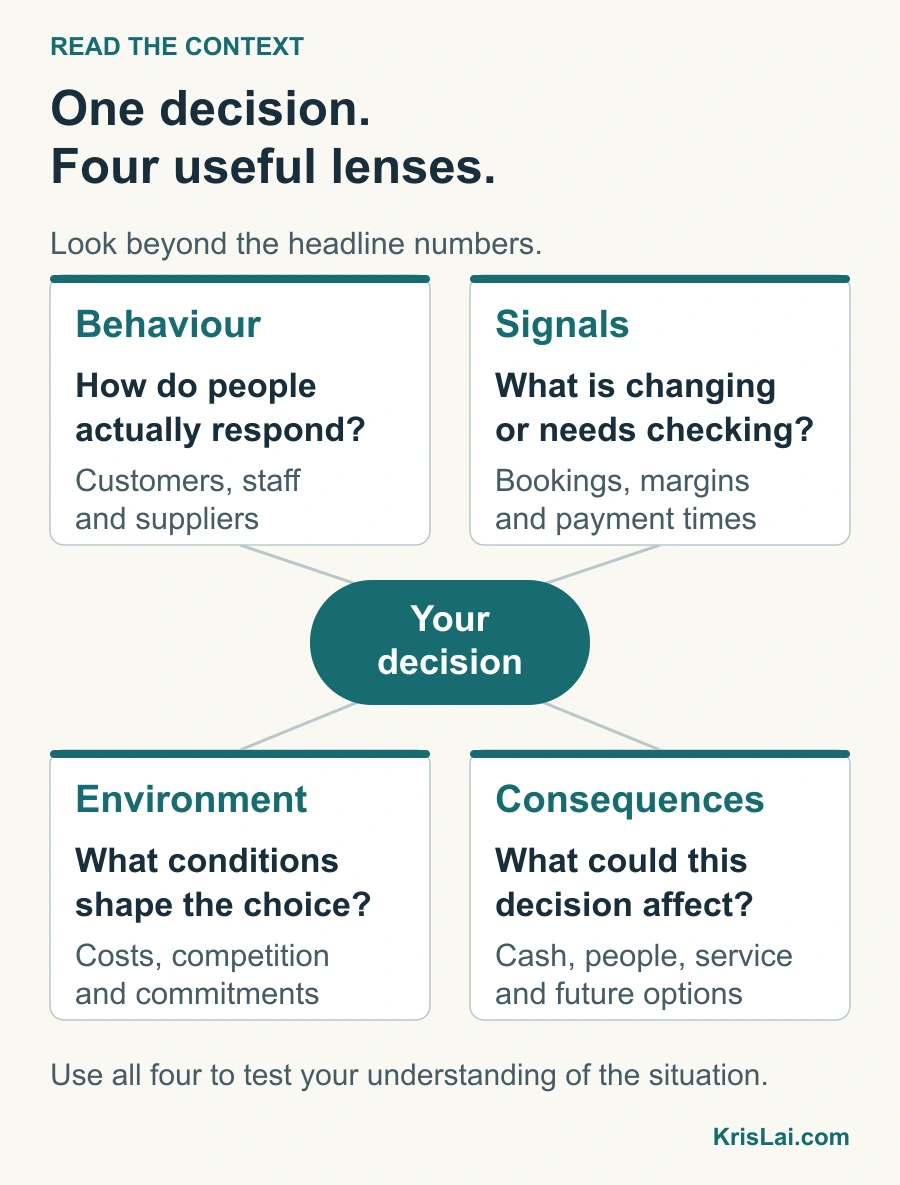
A decision-making framework helps structure a decision. It does not guarantee that you are looking at the right behaviour, evidence, environment or consequences.
This is where I use the KrisLai Decision Framework™.
My framework asks leaders to examine four things:
- Human Behaviour — how people are likely to think and act
- Signals — what current actions and evidence are telling us
- Environment — the conditions shaping the decision
- Consequences — what happens next and after that
You can read the full explanation in The KrisLai Decision Framework™.
I do not see this as a replacement for every other decision-making model.
I use it as a judgement test.
A decision matrix may tell you which supplier scores highest.
The KrisLai Decision Framework asks:
How will employees and customers actually experience that supplier?
What warning signals are we seeing?
Does the operating environment support the choice?
What consequences might appear later?
DACI may tell you who has authority.
The KrisLai framework asks whether the decision they are making makes sense.
SPADE may organise the alternatives.
The KrisLai framework helps pressure-test the assumptions behind them.
Use the right framework to structure the decision. Then test the judgement behind it.
Behaviour → Signals → Environment → Consequences
This approach is part of the KrisLai Decision Framework, a practical method for improving business decisions.
Free Download: The KrisLai Decision Framework
Want a simple, practical version you can use immediately?
Better decisions come from understanding behaviour, signals, environment, and consequences.
A Decision-Making Framework Example in Business: Should We Raise Prices?
Let us bring the ideas together using a real-world style business decision.
A company wants to increase prices.
Costs have risen.
Margins are under pressure.
On paper, the answer seems obvious:
Increase prices.
First-order thinking
Higher prices → more revenue per sale → improved margin.
That may be correct.
But it is incomplete.
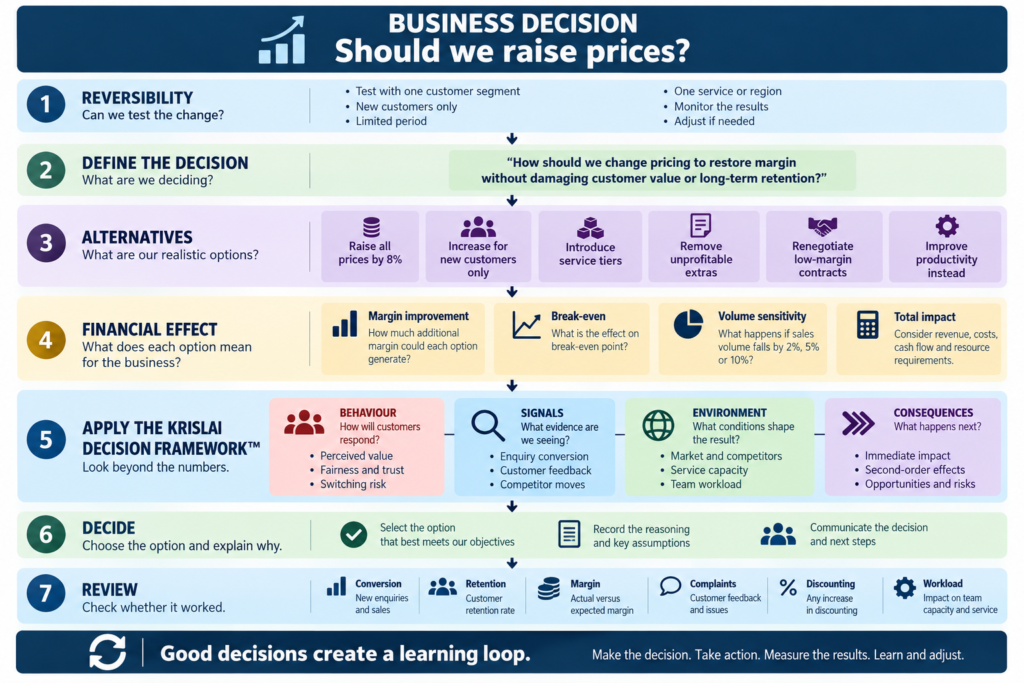
Step 1: Is this a Type 1 or Type 2 decision?
A price change does not necessarily need to be permanent.
The business could test a new price with:
- one customer segment
- one service
- new customers only
- one geographic area
- a limited period
That makes at least part of the decision reversible.
We do not necessarily need months of analysis.
We may need a controlled experiment.
Step 2: Define the decision
Instead of asking:
“Should we increase prices?”
ask:
“How should we change pricing to restore margin without damaging customer value or long-term retention?”
That is a much better decision question.
Step 3: Develop alternatives
The options might include:
- increase all prices by 8%
- increase prices only for new customers
- introduce service tiers
- remove unprofitable extras
- renegotiate low-margin contracts
- improve productivity instead
- combine a smaller price increase with clearer value communication
Now we have a real decision rather than a yes/no argument.
Step 4: Look at the financial effect
What margin improvement does each option create?
What happens to break-even?
What if sales volume falls by 2%, 5% or 10%?
This is where financial analysis becomes useful.
If you need a practical introduction, see my guide to break-even analysis for business decisions.
But finance is only one part of the decision.
Step 5: Apply Behaviour
How are customers likely to respond?
Customers do not react to price in isolation.
They respond to:
- perceived value
- fairness
- alternatives
- switching effort
- previous expectations
- trust
- how the change is communicated
A 10% increase with no explanation may feel very different from a 10% increase accompanied by a clearer service package and stronger value.
Step 6: Look at Signals
What evidence do we already have?
For example:
- customers asking more price questions
- falling enquiry conversion
- competitors discounting
- strong retention
- complaints about service
- customers requesting higher-value options
- increased demand despite previous price rises
These signals help test the assumptions.
Step 7: Examine the Environment
Can the business support the decision?
If customer service is already poor, a price increase may increase expectations at exactly the wrong moment.
If staff are overloaded, promising more value may make the problem worse.
If competitors have excess capacity, they may react aggressively.
The same price decision can produce different outcomes in different environments.
Step 8: Consider the Consequences
Ask:
What happens immediately?
And then what?
And then what?
Perhaps:
Price increase
→ some customers complain
→ weaker customers leave
→ workload falls
→ service quality improves
→ remaining customers receive more attention
→ retention improves.
Or perhaps:
Price increase
→ complaints rise
→ sales team discounts to compensate
→ pricing becomes inconsistent
→ customers discover the differences
→ trust falls.
The point is not to predict perfectly.
The point is to think further than:
“Higher prices mean higher margin.”
Step 9: Decide and review
Suppose the company chooses:
- a smaller increase
- clearer service tiers
- renegotiation of weak contracts
- a test with new customers first
The final step is to define what will tell you whether the decision worked.
Track:
- conversion
- customer retention
- margin
- complaints
- discounting
- service workload
- customer feedback
That closes the loop.
A good decision-making process does not finish when the decision is announced.
It finishes when you learn from what happened.
What Does Ethics Mean in a Decision-Making Framework?
Ethical decision-making means considering not only whether a decision is profitable or legal, but also who may be affected, what harm could result and whether the decision can be justified fairly.
You do not need a separate ethics workshop for every ordinary business choice.
But some decisions deserve an explicit ethical check.
Ask:
- Who benefits?
- Who carries the downside?
- Could anyone be harmed unfairly?
- Are we withholding information people reasonably need?
- Would we be comfortable explaining this decision publicly?
- Are vulnerable customers or employees affected?
- Are legal and professional duties involved?
- What happens if everyone in the industry behaves this way?
This matters increasingly when decisions involve:
- AI
- employee monitoring
- customer data
- pricing
- recruitment
- redundancies
- vulnerable consumers
- automation
- environmental impact
An ethical decision-making framework should improve the questions being asked.
It should not be used to manufacture a convenient answer.
Decision Framework Template
A practical decision framework template should capture the decision, alternatives, evidence, assumptions, risks, ownership and review process.
You can use this structure for many business decisions:
Decision:
What exactly are we deciding?
Objective:
What outcome are we trying to achieve?
Decision owner:
Who makes the final call?
Deadline:
When does the decision need to be made?
Reversibility:
How difficult would it be to undo?
Alternatives:
What realistic options exist?
Criteria:
What matters most?
Evidence:
What do we actually know?
Assumptions:
What are we assuming to be true?
Risks:
What could go wrong?
Stakeholders:
Who is affected?
Behaviour:
How are people likely to respond?
Signals:
What current evidence or behaviour should we pay attention to?
Environment:
What conditions could help or hinder the decision?
Consequences:
What happens first? What happens next?
Decision:
What have we chosen and why?
Review date:
When will we check whether it worked?
A decision record does not need to be complicated. Writing down the decision, assumptions, evidence and expected consequences creates something extremely valuable: a record you can return to later and compare with what actually happened.
7 Common Decision-Making Framework Mistakes
Decision frameworks fail when the process becomes more important than the quality of thinking.
Here are the mistakes I see as most important:
1. Using a heavy framework for a small decision
Not every decision needs a committee, spreadsheet and presentation.
Match effort to importance.
2. Starting with the answer
If someone has already decided what they want, a framework can become theatre.
The purpose is to improve the decision, not justify it afterwards.
3. Confusing consultation with consensus
People should have the right to contribute where their knowledge matters.
That does not mean everybody needs to agree.
4. Having no clear decision owner
Discussion can continue indefinitely when nobody knows who has the final authority.
5. Treating numbers as objective truth
A weighted decision matrix still contains human assumptions about:
- criteria
- weights
- scores
- evidence
Numbers can organise judgement.
They do not remove judgement.
6. Ignoring human behaviour
A technically perfect plan can fail if customers reject it or employees do not use it.
Human behaviour belongs inside the decision.
7. Never reviewing what happened
This may be the biggest missed opportunity.
If you never compare the expected outcome with the actual outcome, your decision-making process does not improve.
How AI Is Changing Decision-Making Frameworks
AI can make decision analysis faster, but it does not remove the need for human judgement.
Used well, AI can help you:
- generate alternatives
- summarise large amounts of information
- challenge assumptions
- model scenarios
- identify possible risks
- compare criteria
- organise meeting input
- find contradictions
- draft a decision record
- ask questions you may have missed
That can be extremely useful.
But AI also creates a new danger.
An answer can look confident, complete and professional while being based on:
- poor data
- missing context
- outdated information
- wrong assumptions
- invented facts
So I would use AI as a thinking partner rather than a decision authority.
Ask it:
“What assumptions am I making?”
“What evidence would change this decision?”
“What stakeholder have I overlooked?”
“What could cause this plan to fail?”
“What are the second-order consequences?”
Then bring the answers back into human judgement.
In the AI era, access to analysis is becoming cheaper.
The ability to judge that analysis becomes more valuable.
How to Improve Your Decision-Making Process
You do not need to introduce seven frameworks across your business next Monday!
Start smaller.
Choose one important decision.
Then:
- Write the decision clearly.
- Decide whether it is reversible.
- Identify what you know and what you are assuming.
- Choose the lightest framework that fits the situation.
- Make sure the right people are involved.
- Examine behaviour, signals, environment and consequences.
- Record why the decision was made.
- Set a review date.
That is structured decision-making without turning business into bureaucracy.
Do not ask, “Which framework should our company use?”
Ask, “What kind of decision is this, and what is the simplest framework that will improve it?”
Frequently Asked Questions
What is a decision-making framework?
A decision-making framework is a structured approach for understanding a problem, comparing alternatives and choosing what to do. It can help managers make assumptions visible, clarify responsibilities, consider risks and make decisions more consistently.
What is an example of a decision-making framework?
Examples include a decision matrix, SPADE, DACI, the OODA Loop, Cynefin, Type 1 and Type 2 decisions, and the pre-mortem technique. Each is designed for a different type of decision problem.
What is the best decision-making framework for business?
There is no single best framework for every business decision. The right model depends on the importance of the decision, whether it can be reversed, how uncertain the situation is, how many people need to be involved and how quickly you need to act.
What is a simple decision-making framework?
A simple decision-making framework can use five questions: What are we deciding? What matters most? What evidence do we have? What could go wrong? What happens next? This is often enough for everyday business decisions.
What is the SPADE decision-making framework?
SPADE is a structured decision process built around Setting, People, Alternatives, Decide and Explain. It is useful for important decisions involving several stakeholders and genuine alternative choices.
What is the difference between DACI and RACI?
DACI is designed mainly to clarify decision-making roles. It identifies a Driver, Approver, Contributors and people who are Informed. RACI is more commonly used to clarify responsibility for tasks and work, using Responsible, Accountable, Consulted and Informed.
How do I choose a decision-making framework?
Start by considering importance, reversibility, uncertainty, stakeholder involvement and speed. Then choose the simplest framework that addresses the main problem. For example, use DACI when ownership is unclear, a decision matrix when comparing options, or a pre-mortem when hidden risk is the concern.
What should a decision framework template include?
A useful decision framework template should include the decision, objective, owner, alternatives, criteria, evidence, assumptions, risks, stakeholders, expected consequences and a review date.
How do ethics affect business decision-making?
Ethics requires leaders to consider who is affected by a decision, possible harm, fairness, transparency and wider consequences rather than looking only at financial or operational results.
Can AI help with business decision-making?
Yes. AI can help generate alternatives, summarise evidence, test assumptions, explore scenarios and identify risks. However, leaders remain responsible for checking the information, understanding context and judging the consequences.
Conclusion and Final Thoughts
Decision-making frameworks are useful because they force us to slow down in the right places and speed up in others.
But the framework itself is never the real objective.
The objective is better judgement.
A decision matrix can help organise alternatives.
Type 1 and Type 2 thinking can stop you over-analysing reversible decisions.
SPADE can bring discipline to an important choice.
DACI can stop ownership becoming blurred.
OODA can help when the environment is changing quickly.
Cynefin can help you understand what kind of problem you are actually facing.
A pre-mortem can expose risks before they become expensive.
But after all of that, I still want to know:
How will people actually behave?
What signals are we seeing?
What conditions are shaping the outcome?
And what happens next?
That is why I use the KrisLai Decision Framework™ as the final judgement layer.
Behaviour. Signals. Environment. Consequences.
The framework you use may change.
Those four questions remain useful.
Better decisions come from understanding behaviour, signals, environment, and consequences.
This connects closely to how I approach decisions using the KrisLai Decision Framework™.
The KrisLai Decision Framework™ helps you examine behaviour, signals, environment and consequences before acting.
Explore the KrisLai Decision Framework™ →
Don’t forget your FREE download!
Free Download: The KrisLai Decision Framework
Want a simple, practical version you can use immediately?
If you enjoy exploring the ideas behind better business decisions, you may find the Business Thinking Hub useful.
About the author
Kris Lai is a business operator and managing director with experience in land and building surveying, facilities management, logistics, and service delivery.
Earlier in his career, he worked as a Search Engine Evaluator (via Lionbridge, supporting Google), where he assessed search result relevance, user intent, and content quality using structured evaluation frameworks. This experience gives him a rare, practical understanding of how search systems interpret signals and make ranking decisions.
In parallel, whilst working with a charity organisation, he has delivered 1000’s of structured presentations in English, Finnish, and Chinese to audiences ranging from small groups to more than 600 people, and has spent decades mentoring and developing others. This experience informs his approach to clarity, communication, and decision-making under pressure.
He writes about AI, search behaviour, business strategy, and decision-making from a practical, real-world perspective.
👉 Explore ideas connected to better business decisions:
- Digital Transformation for SMEs: 7 Questions Before You InvestDigital transformation for SMEs should start with better decisions, not more technology. This guide explains seven questions to ask before investing in AI, automation, data systems, or new software, helping you improve processes, reduce risk, and prove value before you scale.
- Cybersecurity for Businesses: 7 Decisions Leaders Must MakeCybersecurity for businesses is not just an IT issue. It is a leadership decision about protecting email, accounts, devices, backups, staff behaviour, customer data, supplier access, trust, and business continuity. This guide explains the seven cyber decisions leaders should make before a small problem becomes a costly incident.
- How AI Is Changing Search Behaviour (And What Businesses Must Do Now)AI is changing how people search, compare, and buy. Learn what this means for visibility, trust, and growth — and what businesses must do now.
- 7 Decision-Making Framework Examples for Business LeadersSeven practical decision-making frameworks for managers and business owners, with real business examples, guidance on when to use each model, a simple framework selector and a decision template.
- Business Decision-Making Framework: The KrisLai MethodMake more informed business decisions under uncertainty with the KrisLai Decision Framework. Explore four complementary lenses, follow a practical five-step process, and learn from my real pricing decision that reduced workload while increasing revenue and profit.