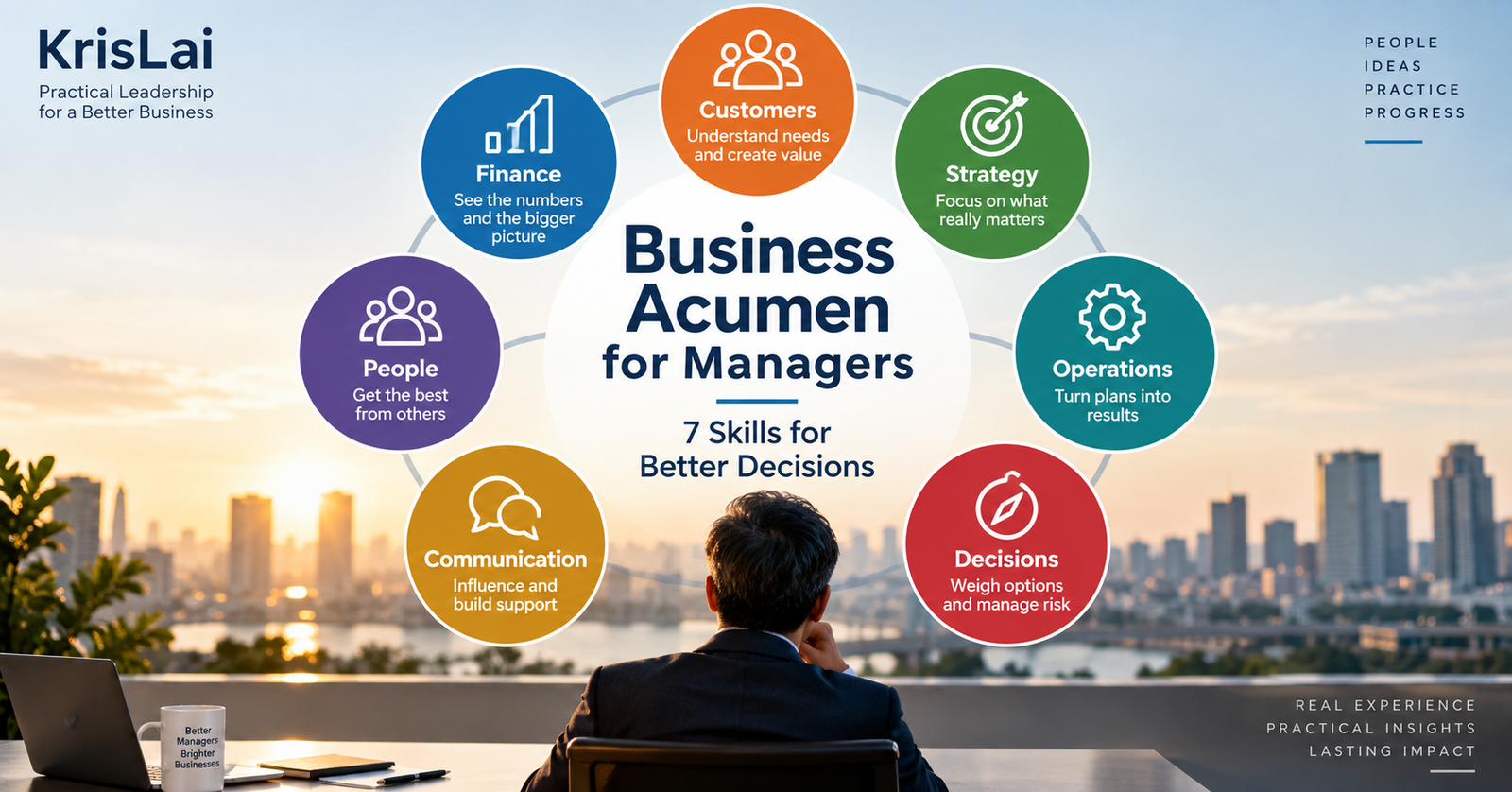
Business acumen is not just about knowing business terms. It is about understanding how a business really works — and using that understanding to make better decisions.
For managers and business owners, that means seeing beyond your own task or department.
You need to understand how customers, money, people, operations, strategy and risk connect.
More importantly, you need to understand what happens when you change one of them.
A decision that looks sensible from one angle can create problems somewhere else.
A new customer can increase revenue but damage margin.
A new employee can increase capacity but weaken cash flow.
A cost saving can improve this month’s numbers but damage customer experience.
A new technology can save time but create new risks.
That is why I see business acumen as more than knowledge.
It is judgement applied to real business decisions.
This guide is written mainly for managers, business owners and professionals who are taking on wider business responsibility.
You do not need to become an expert in every part of business.
But you do need to understand how the important parts fit together.
Business acumen is the ability to understand how a business creates value, makes money, serves customers and uses resources — then use that understanding to make sound decisions.
It is not simply business knowledge. It is knowing what matters, what is changing, what trade-offs are involved and what is likely to happen next.
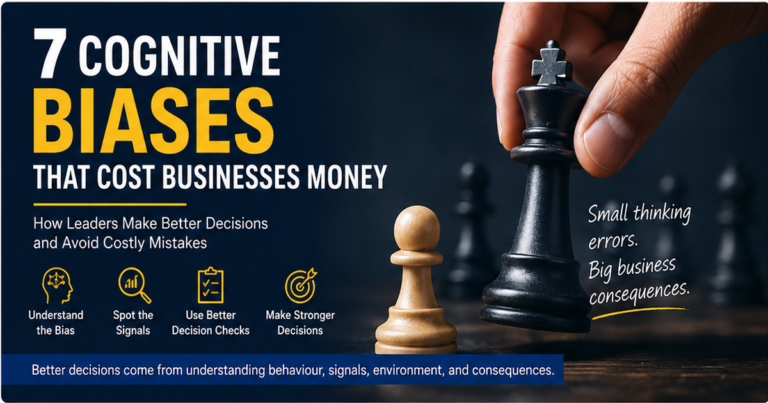
Better decisions come from understanding behaviour, signals, environment, and consequences.
This connects closely to how I think about decisions more broadly in the KrisLai Decision Framework™.
What Is Business Acumen in Simple Terms?
Business acumen means understanding how a business works well enough to make sensible decisions about it.
That includes seeing the connections between:
- revenue and cost
- customers and value
- pricing and margin
- people and capacity
- strategy and execution
- risk and opportunity
- short-term pressure and long-term consequences
A person with strong business acumen does not look at these things separately.
They ask how they affect each other.
Imagine someone suggests taking on a large new customer.
The first reaction may be:
“Great. More revenue.”
Someone with stronger business acumen asks more questions:
- What margin will we make?
- What will it cost to deliver?
- Do we have enough capacity?
- What payment terms will the customer expect?
- Will it put pressure on existing customers?
- How much management time will it require?
- What happens if the customer leaves after we invest in extra staff or equipment?
That is business acumen in action.
The person is not trying to make the decision complicated.
They are trying to see the whole decision.
Why Business Acumen Matters for Managers
Managers sit in an important position.
They are close enough to day-to-day work to see what is really happening, but they are also expected to support wider business goals.
That means managers often have to translate between two worlds.
Senior leaders may talk about:
- strategy
- growth
- margin
- productivity
- customer retention
- investment
- risk
Teams are more likely to experience:
- workloads
- schedules
- service problems
- staffing shortages
- customer complaints
- unclear priorities
- inefficient processes
A manager with strong business acumen can connect the two.
They understand why the wider business goal matters and how it affects the practical work people do every day.
They can also recognise when a seemingly sensible business target creates an operational problem.
For example, increasing sales may sound positive.
But if the operation is already at full capacity, more sales could cause:
- slower service
- more mistakes
- overtime
- employee stress
- customer complaints
- higher costs
The manager with business acumen sees those consequences before they become serious.
That is why business acumen should not be treated as something only directors and executives need.
Managers make decisions every day that affect business performance.
A technically good manager asks, “How do we get this done?”
A manager with strong business acumen also asks, “Should we do it this way, what will it cost, what else will it affect, and does it support the wider goal?”
Business Acumen for Small Business Owners
For a small-business owner, business acumen becomes even more important because the decisions are rarely separated into neat departments.
The same person may be thinking about:
- pricing
- recruitment
- customers
- marketing
- cash
- suppliers
- service delivery
- equipment
- tax
- competitors
Sometimes all before lunch!
In a larger organisation, a finance department may challenge an investment decision.
An operations manager may question capacity.
A commercial team may assess customer profitability.
A small-business owner may have to ask all of those questions alone.
That makes broad business judgement extremely valuable.
A business owner with good acumen does not simply ask:
“Can we win this work?”
They also ask:
“Should we want this work?”
Those are very different questions.
Business Acumen vs Commercial Acumen vs Financial Acumen
These terms are often used as if they mean the same thing.
They overlap, but I find it more useful to separate them.
Business acumen
Business acumen is the broadest idea.
It is the ability to understand how the whole business works and use that understanding to make better decisions.
It includes finance, customers, markets, strategy, operations, people and risk.
Commercial acumen
Commercial acumen focuses more closely on how the business earns value in the market.
It includes areas such as:
- customers
- contracts
- pricing
- sales
- competition
- revenue
- negotiation
- profitability
Financial acumen
Financial acumen is the ability to understand the financial effect of business decisions.
It includes:
- revenue
- costs
- gross margin
- contribution
- cash flow
- budgets
- profit
- return on investment
You can therefore have good financial knowledge without having complete business acumen.
A person may understand a spreadsheet perfectly but misunderstand the customer, the operation or the strategic risk.
Likewise, someone may be an excellent salesperson but agree to commercially poor terms because they do not understand margin or delivery cost.
Strong business acumen connects these different views.
The 7 Business Acumen Skills That Matter Most
I prefer to think of business acumen as seven connected capabilities rather than a long list of unrelated skills.
Each one strengthens the others.
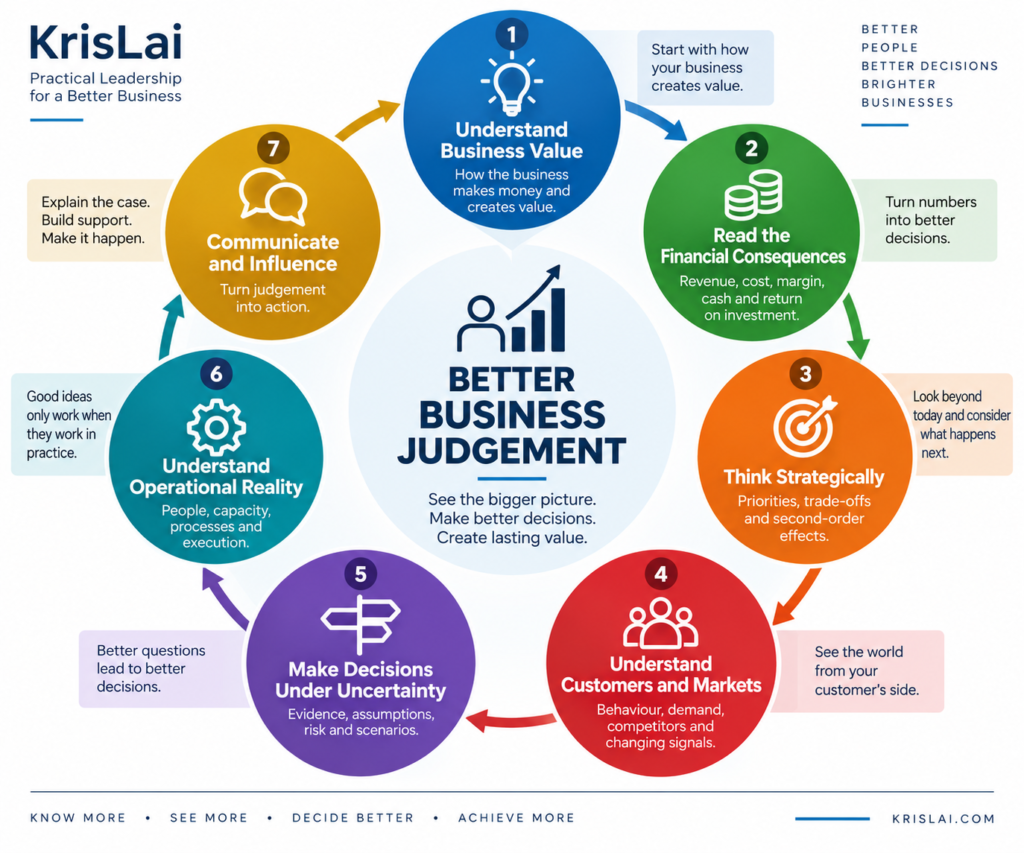
1. Understand How the Business Creates Value
The first skill is understanding how the business actually works.
Not what the organisation chart says.
Not what the brochure says.
How does it really create value?
Ask:
- Who are the customers?
- What problem are they paying us to solve?
- Why do they choose us?
- Where does revenue come from?
- Which products or services create the most value?
- What drives our costs?
- What protects our margins?
- What creates repeat business?
- What could make customers leave?
This sounds basic, but it is surprisingly easy for people to become disconnected from it.
A manager may know their department extremely well but have little idea how the business makes money.
That creates blind spots.
For example, an operations manager might try to maximise efficiency without understanding that a premium service is intentionally designed to offer more flexibility.
A salesperson may win revenue without understanding how expensive the work is to deliver.
A finance manager may push for lower costs without understanding what customers value enough to pay for.
Business acumen starts by understanding the value system around the business.
Before trying to improve a business, understand how it creates value.
If you do not know why customers pay, where profit comes from and what makes the operation work, optimisation can easily improve the wrong thing.
2. Read the Financial Consequences
You do not need to be an accountant to have strong business acumen.
But you do need to understand what business decisions do to money.
At a minimum, managers should understand:
- revenue
- costs
- margin
- cash flow
- pricing
- budgets
- break-even
- return on investment
A decision that increases sales but damages margin is not automatically a good business decision.
A project that looks profitable but creates a serious cash-flow problem may put the business under pressure.
A cheaper supplier may reduce purchasing costs but create more failures and rework.
The important skill is not simply reading financial numbers.
It is connecting the numbers to the decision.
For example:
Revenue increased by 10%.
That sounds good.
But business acumen asks:
- Did profit increase too?
- Did we have to discount heavily?
- Did labour costs rise faster?
- Did debtor days increase?
- Did we need more stock?
- Did customer service suffer?
- Did the extra sales create enough cash?
The headline number rarely tells the whole story.
If financial statements are unfamiliar to you, my guide to understanding financial statements provides a useful starting point.
You may also find my guide to break-even analysis for non-financial managers useful.
3. Think Strategically
Strategic thinking is the ability to look beyond the immediate task and understand the bigger picture.
It asks:
“If we choose this, what happens next?”
And then:
“What happens after that?”
A manager with weak strategic thinking may focus only on solving today’s visible problem.
A manager with stronger business acumen looks for the wider cause and consequence.
Suppose a team is overloaded.
The obvious answer may be:
Hire another person.
That could be correct.
But the underlying problem could also be:
- poor scheduling
- inefficient systems
- unclear roles
- too much low-value work
- underpriced customers
- excessive rework
- weak prioritisation
Hiring without understanding the cause may simply make the same inefficient system more expensive.
Strategic thinking helps you decide what to do, what not to do, and what deserves attention first.
I explore this in more detail in my guide to strategic thinking in business.
4. Understand Customers and Markets
Businesses do not operate in isolation.
Business acumen therefore requires you to look outside the organisation.
You need to understand:
- what customers value
- how customers decide
- what frustrates them
- why they stay
- why they leave
- what competitors are changing
- whether demand is shifting
- what new alternatives are appearing
This is where many internally focused organisations get into trouble.
They become very good at measuring their own activity while missing what is happening around them!
Customer understanding also means looking beyond what people say.
Behaviour matters.
A customer may say price is their main concern but repeatedly choose the supplier they trust most.
A buyer may say they want more options but consistently choose the simplest package.
A long-term client may appear satisfied while slowly reducing how much work they give you.
These are signals.
Good business acumen means noticing them.
My article on customer intent and buying signals looks at this idea in more detail.
5. Make Decisions Under Uncertainty
Business acumen ultimately shows up in decisions.
And real business decisions rarely come with perfect information.
Managers often need to decide while:
- information is incomplete
- customer behaviour is changing
- costs are moving
- competitors are reacting
- employees disagree
- time is limited
Waiting for certainty can become its own risk.
Strong decision-making therefore means asking:
- What do we know?
- What do we not know?
- What assumptions are we making?
- What is most likely?
- What could go wrong?
- What happens if we do nothing?
- Is the decision reversible?
- What early signals should we watch?
People sometimes think strong decision-makers feel certain.
Often they do not.
They simply have a better process for dealing with uncertainty.
That distinction matters.
Confidence is not the same as business acumen.
A confident person can still make a poor decision if they misunderstand the numbers, ignore customer behaviour, underestimate operational pressure or refuse to question their assumptions.
6. Understand Operational Reality
This skill is often missing from generic discussions about business acumen.
A decision can look excellent in a meeting and fail completely in delivery.
That is why managers need to understand:
- capacity
- processes
- people
- systems
- scheduling
- quality
- bottlenecks
- dependencies
- practical constraints
In my experience, many poor business decisions happen because the idea and the operation are considered separately.
They cannot be separated!
Across surveying, facilities management, delivery services and commercial cleaning, I have seen how apparently small decisions can create a chain of consequences.
A pricing decision affects margin.
Margin affects what resources you can afford.
Resources affect service quality.
Service quality affects customer satisfaction.
Customer satisfaction affects retention and reputation.
That is business acumen because the decision is being seen as part of a system.
7. Communicate and Influence
The final capability is communication.
Business acumen has little practical value if you cannot turn your thinking into action.
Managers need to explain:
- what they recommend
- why it matters
- what evidence supports it
- what it will cost
- what risks are involved
- what trade-offs are being accepted
- what people need to do next
Good communication is not about sounding clever.
It is about making the decision easier to understand.
A useful test is this:
Can you explain the business case for your recommendation in a few clear sentences?
For example:
Weak explanation:
“We should invest in the new system because it will improve efficiency.”
Stronger explanation:
“We currently spend about 20 staff-hours each week repeating this admin. The new system should remove around half of that work. If the estimate is correct, it pays back within eight months and gives the team more capacity without another hire.”
The second version connects action to business consequence.
That is what commercially useful communication looks like.
What Does Strong Business Acumen Look Like in Practice?
When I think about business acumen, I do not first think about spreadsheets or business jargon.
I think about behaviour.
It is the manager who notices that a team is overloaded before performance falls.
It is the owner who realises that the biggest customer is not necessarily the most profitable customer.
It is the leader who understands that chasing revenue without protecting margin can create the illusion of growth.
It is the operations manager who knows that cutting labour hours may damage service quality.
It is the salesperson who checks whether the business can actually deliver what has been promised.
It is the person who asks the question nobody else has asked yet.
Business acumen is rarely flashy.
Often, it looks like calm, grounded judgement.
A Real Business Acumen Example: The £4,000 Contract
Imagine a service business wins a contract worth £4,000 a month…
At first glance, the decision looks simple.
The business has gained £48,000 of annual revenue.
Good news!
But now apply business acumen…
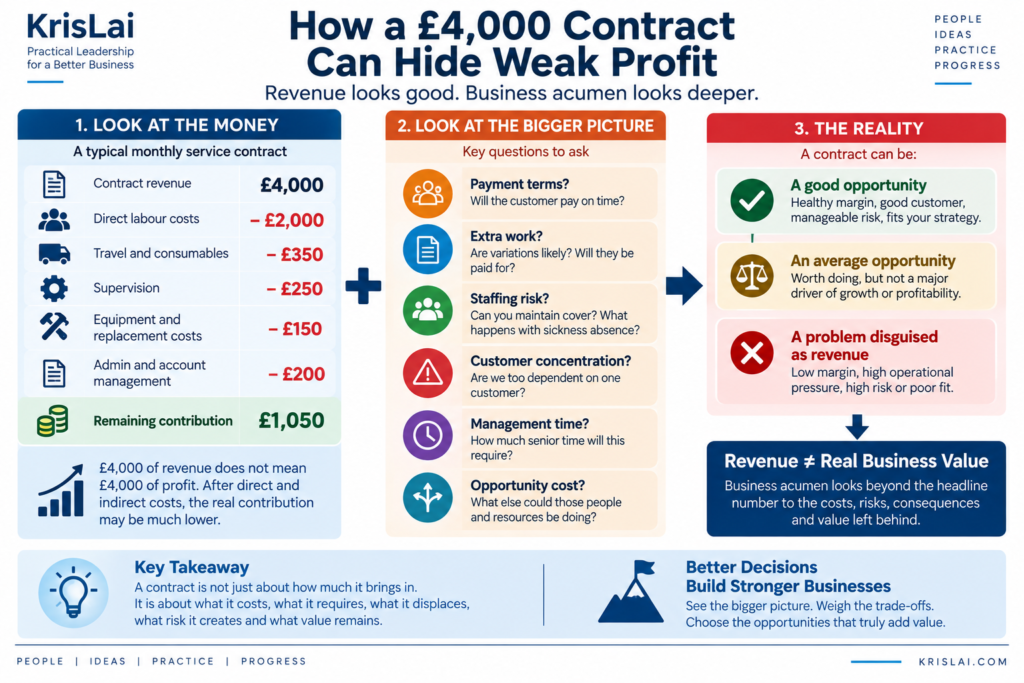
Look at the money
Suppose direct labour costs £2,000 a month.
Travel and consumables cost £350.
Supervision costs £250.
Equipment and replacement costs average £150.
Admin and account management add another £200.
The £4,000 contract is already contributing much less than £4,000.
Look at the customer
Does the customer pay on time?
Do they frequently request extra work?
Are expectations clear?
Are complaints unusually time-consuming?
Look at operations
Can the work fit into existing schedules?
Will you need another vehicle?
Is the location difficult to staff?
Will one sickness absence create a crisis?
Look at risk
Does the contract represent too much dependence on one customer?
Could the client terminate quickly?
Have prices been fixed for several years while wages rise?
Look at opportunity cost
What other work could those people and resources be doing?
A £4,000 contract can therefore be:
- an excellent piece of business
- an average piece of business
- or a problem disguised as revenue
The number alone does not tell you.
Business acumen connects the number to everything around it.
Revenue tells you how much business came through the door.
Business acumen asks what that revenue required, what it displaced, what risk it created and what value remained afterwards.
The Business Acumen Decision Test
When I want to test whether a proposal makes business sense, I find six questions useful:
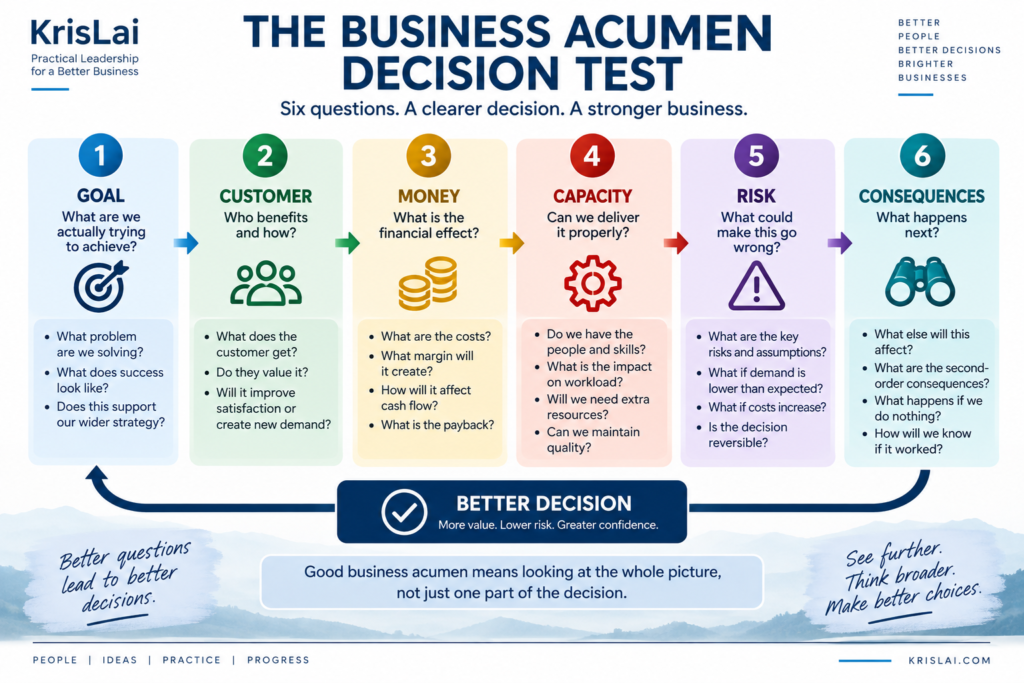
1. Goal — What are we actually trying to achieve?
Do not start with the solution.
Start with the purpose.
A new employee, new technology, new supplier or new marketing campaign is not a goal.
Ask what problem it is supposed to solve.
2. Customer — Who benefits and how?
What will improve for the customer?
Does the change solve something they actually value?
3. Money — What is the financial effect?
Ask about:
- revenue
- cost
- margin
- cash
- investment
- payback
- ongoing commitment
4. Capacity — Can we deliver it properly?
Do we have the:
- people
- time
- skills
- systems
- equipment
- management capacity
A good idea badly delivered is still a poor outcome.
5. Risk — What could make this go wrong?
What assumption is carrying the most risk?
What would happen if demand is weaker than expected?
What happens if costs increase?
What happens if the person, supplier or technology does not perform as expected?
6. Consequences — What happens next?
Every decision changes something else.
Ask:
“If we do this, what becomes easier, harder, cheaper, more expensive, faster or riskier?”
This is where business acumen connects naturally to the KrisLai Decision Framework™.
Better decisions come from understanding behaviour, signals, environment, and consequences.
Business Acumen for Managers: What Good Looks Like
For a manager, business acumen does not mean behaving like a chief executive.
It means understanding enough of the wider business to make better decisions in your own area.
A commercially strong manager:
- knows the team’s main business priorities
- understands the important numbers
- connects work to customer outcomes
- asks why before jumping to how
- understands capacity and constraints
- challenges weak assumptions
- weighs risk and opportunity
- prioritises rather than treating everything as urgent
- explains recommendations clearly
- reviews whether decisions actually worked
They also understand trade-offs.
A manager may need to choose between:
- speed and quality
- cost and resilience
- customer flexibility and operational efficiency
- short-term profit and longer-term investment
There is rarely a perfect answer.
The skill is understanding what is being traded and making the choice deliberately.
Business Acumen for Business Owners
An owner-manager needs all of the above, but there is an extra difficulty:
You are close to the business emotionally as well as financially.
That can make some decisions harder.
A service may have been your idea.
A customer may have been with you from the beginning.
An employee may be loyal but no longer right for the role.
A product may once have been successful but now be declining.
Business acumen requires the ability to separate:
“I like this”
from:
“This still makes business sense.”
That does not mean becoming cold or purely financial.
People, trust, reputation and relationships matter.
It means seeing them as part of the decision rather than letting one factor dominate everything else.
What Business Acumen Is Not
Business acumen is often misunderstood.
It is not:
- sounding confident in meetings
- using business jargon
- focusing only on profit
- knowing lots of financial terms
- having a senior job title
- being highly analytical but disconnected from reality
- relying on gut instinct without testing it
- saying yes to every growth opportunity
- cutting costs without understanding consequences
Real business acumen combines awareness, judgement and action.
Why Business Acumen Often Fails in Real Business
On paper, business skills often look separate.
In real life, they fail in combination.
I have seen people communicate well but misunderstand the financial impact of what they were proposing.
I have seen analytical people build logical recommendations that ignored customer reality.
I have seen growth create operational pressure because nobody asked whether the team had capacity.
I have seen talented teams lose focus because every new idea became a priority.
This is why business acumen is not about collecting skills like badges.
The skills need to work together.
Common failure pattern: growth without margin
Sales rise.
Everyone celebrates!
But labour, service and delivery costs rise even faster.
The business becomes busier but not healthier.
Common failure pattern: analysis without action
Management keeps asking for more data.
More reports are produced.
The decision keeps moving backwards.
At some point, the cost of delay becomes greater than the value of more information.
Common failure pattern: customer focus without evidence
A business says:
“Our customers want this.”
But nobody has checked.
Internal assumptions slowly become accepted as facts.
Common failure pattern: cost cutting without consequences
A lower-cost option looks attractive.
But it may create:
- rework
- complaints
- delays
- lower quality
- staff frustration
- customer loss
The saving can disappear elsewhere.
Common failure pattern: activity mistaken for progress
Everyone is busy.
Meetings are full.
Projects are moving.
Emails are being answered.
But the important business outcome is not improving.
Busyness is not the same as value.
One of the clearest signs of weak business acumen is optimising one part of the business while ignoring what happens elsewhere.
A saving, sale, hire or new project should never be judged only by its immediate benefit.
How to Assess Your Own Business Acumen
You do not need a complicated test to start identifying gaps.
Answer these ten questions honestly.
Give yourself:
2 points = Yes, confidently
1 point = Partly
0 points = No
Business Acumen Self-Assessment
- Can I explain clearly how my organisation makes money?
- Do I understand the main costs and margin drivers?
- Can I explain how my work affects customers?
- Do I know the main strategic priorities of the business?
- Can I identify the biggest operational constraint in my area?
- When making a decision, do I consider likely second-order consequences?
- Can I distinguish facts from assumptions?
- Do I understand the financial effect of the decisions I recommend?
- Can I explain the business case for an idea clearly?
- Do I review important decisions afterwards to learn what worked?
Your score
16–20: Strong foundation
You are already connecting different parts of the business. The next step is to deepen your judgement under uncertainty and become better at spotting weak signals.
10–15: Developing business acumen
You probably understand your own area well but may have gaps across finance, customers, operations or strategy.
0–9: Build the foundations
Start with how the business creates value, how it makes money, what customers care about and how your work contributes.
This is not a formal psychometric assessment.
It is simply a practical way to identify where to focus your learning.
How to Develop Stronger Business Acumen
Business acumen can be learned.
It develops through exposure, practice, reflection and curiosity.
1. Learn how the business makes money
Understand:
- where revenue comes from
- what drives costs
- what protects margin
- what weakens cash
- what creates repeat value
Do not stop at your own department.
2. Strengthen your financial basics
You do not need an accounting qualification.
Learn enough to understand:
- profit and loss
- balance sheets
- cash flow
- margins
- break-even
- budgets
- return on investment
Then connect those numbers to everyday decisions.
3. Read outside your own function
If you work in operations, learn something about marketing and finance.
If you work in marketing, learn something about margin, capacity and service delivery.
If you work in finance, learn more about customer behaviour and operations.
Business acumen grows when you can see across boundaries.
4. Ask better questions
Instead of asking:
“Do we like this idea?”
ask:
“What problem does it solve?”
Instead of:
“Will this increase sales?”
ask:
“Will these sales create enough value after the cost of delivering them?”
Instead of:
“Can we afford it?”
ask:
“Compared with the alternatives, is this the best use of our money and attention?”
Better questions improve the quality of the decision before the answer is even found.
5. Review decisions afterwards
One of the fastest ways to develop judgement is to look back.
Ask:
- What did we expect?
- What actually happened?
- Which assumption was wrong?
- What signal did we miss?
- What would we do differently next time?
Experience does not automatically create expertise.
Reflected experience does.
6. Pay closer attention to behaviour
Watch what customers and employees actually do.
Not only what they say.
Repeated behaviour often provides stronger information than a single opinion.
This is one reason I write so often about behavioural economics and decision-making.
Understanding people improves business judgement because businesses are ultimately built around human choices.
7. Learn from people with broad judgement
Look for people who can connect:
- finance
- customers
- strategy
- operations
- people
Watch the questions they ask.
Often, the question reveals more than the answer.
How AI Is Changing Business Acumen
AI is changing how people find information, compare options, analyse data and create recommendations.
That does not make business acumen less important.
I think it makes it more important!
Information is becoming easier to produce.
Judgement is not.
AI can help you:
- summarise reports
- analyse trends
- model scenarios
- generate options
- research competitors
- organise information
But managers still need to ask:
- Is the information reliable?
- What context is missing?
- What assumption is hidden inside the answer?
- Does this fit our business?
- What does the data not show?
- What are the consequences if we act on it?
Fast answers can create false confidence.
That is particularly dangerous when the answer looks professional.
Business acumen therefore becomes less about possessing information and more about interpreting information wisely.
AI can make information faster.
It does not remove the need for judgement.
When everyone can access similar tools, the advantage increasingly comes from asking better questions, spotting weak assumptions and understanding consequences.
Signs Your Business Acumen Is Improving
You are probably developing stronger business acumen when:
- you think more in trade-offs
- you ask better questions
- you understand financial consequences more quickly
- you notice operational constraints earlier
- you challenge assumptions without becoming obstructive
- you connect customer behaviour to business decisions
- you distinguish activity from progress
- you become more selective about opportunities
- you explain decisions more clearly
- uncertainty feels easier to handle because your thinking has more structure
You may also notice something else.
You become less impressed by simple answers to complicated business problems.
That is usually a good sign!
Business Acumen and the KrisLai Decision Framework™
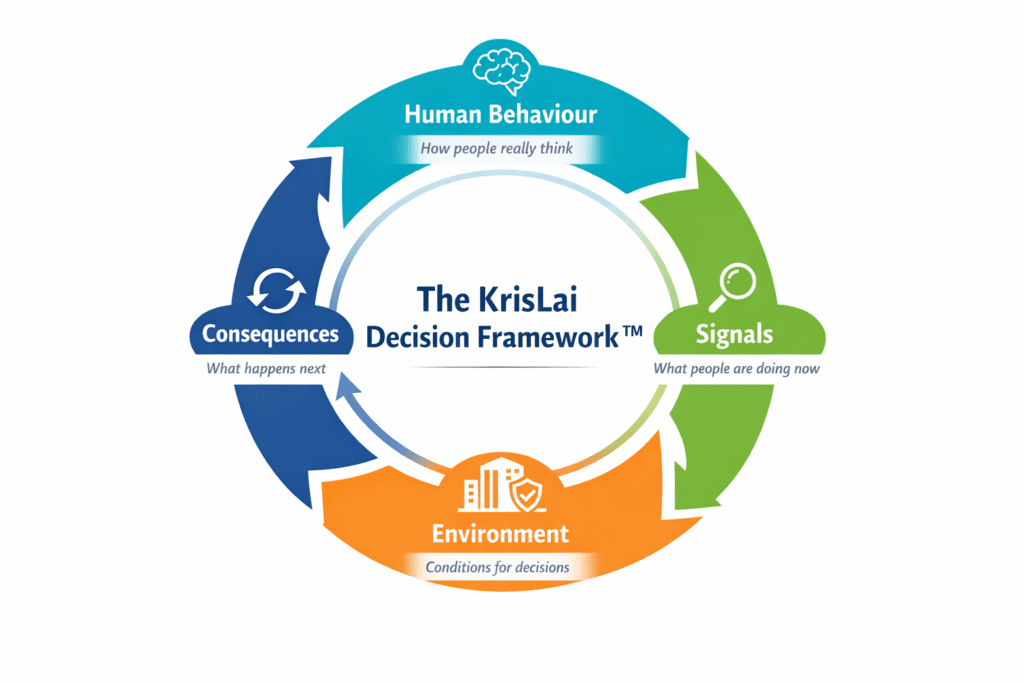
Business acumen does not sit separately from decision-making.
It is one of the things that improves decision quality.
The KrisLai Decision Framework™ looks at four connected areas:
Behaviour
How are customers, employees, managers or competitors actually behaving?
Signals
What evidence suggests that something is changing?
Environment
What conditions are shaping the decision?
This could include:
- price
- regulation
- competition
- workload
- technology
- culture
- economic conditions
Consequences
What happens if we act?
What happens if we do not?
And what might happen after the immediate result?
Strong business acumen helps you interpret all four.
This approach is part of the KrisLai Decision Framework, a practical method for improving business decisions.
You can see practical examples in Decision-Making Framework Examples: The KrisLai Method in Action.
A Simple Business Acumen Checklist for Managers
Before supporting an important decision, ask:
- Do I understand the goal?
- Do I understand the customer impact?
- Do I understand the financial effect?
- Do I understand the operational requirement?
- Have I checked the important assumptions?
- What trade-off are we accepting?
- What could go wrong?
- What happens if we do nothing?
- What happens next if we say yes?
- How will we know whether the decision worked?
If you cannot answer several of those questions, you may not need a decision yet.
You may need better information.
Frequently Asked Questions About Business Acumen
What is business acumen?
Business acumen is the ability to understand how a business creates value, makes money, serves customers and uses resources, then apply that understanding to sound decisions.
What are examples of business acumen skills?
Examples include financial literacy, strategic thinking, customer understanding, market awareness, decision-making, operational awareness and communication.
The real value comes from connecting those skills rather than using them separately.
Why is business acumen important for managers?
Managers make decisions about people, priorities, resources, customers and performance.
Business acumen helps them understand how those decisions affect the wider organisation rather than focusing only on their own function.
What is an example of business acumen?
Imagine a customer offers you a large contract.
Instead of looking only at the revenue, you assess margin, payment terms, staffing, capacity, risk and the effect on existing customers.
That wider judgement is an example of business acumen.
What is the difference between business acumen and commercial acumen?
Business acumen is broader.
It covers how the whole business creates value and operates.
Commercial acumen focuses more closely on markets, customers, contracts, pricing, competition, revenue and profit.
What is financial acumen?
Financial acumen is the ability to understand how business decisions affect financial outcomes such as revenue, cost, margin, cash flow and return on investment.
It is an important part of business acumen, but it is not the whole picture.
Can business acumen be learned?
Yes.
Business acumen develops through practical experience, financial understanding, wider exposure to different business functions, reflection on past decisions and learning to ask better questions.
How can I improve business acumen quickly?
Start with three things:
- Learn how your business makes money.
- Understand the important financial numbers.
- Review important decisions and their consequences.
Then expand your understanding into customers, operations, strategy and risk.
Is business acumen a leadership skill?
Yes, but it is useful before someone reaches senior leadership.
Managers and specialists who understand wider business consequences are better prepared for roles involving greater responsibility and more complex decisions.
How do I demonstrate business acumen as a manager?
Show that you can connect your recommendation to business outcomes.
Explain the customer impact, financial effect, operational requirement, risks and likely consequences.
Business acumen is demonstrated through the quality of your judgement, not through using impressive terminology.
Final Thought: Business Acumen Is Really About Better Judgement
Business acumen is not simply knowing more about business.
It is knowing what matters.
It is being able to connect:
- customers
- money
- people
- operations
- strategy
- risk
- consequences
The strongest managers are rarely strong because they know every answer.
They are strong because they understand the situation well enough to ask better questions and make sensible decisions when the answer is not obvious.
That matters even more as AI makes information quicker and easier to access.
Information is becoming cheaper.
Good judgement remains valuable.
That is why I believe business acumen should be developed as a practical decision skill rather than treated as another item on a leadership competency list.
Better decisions come from understanding behaviour, signals, environment, and consequences.
This connects to how I approach decisions using the KrisLai Decision Framework™.
If you want to explore how strategy, financial thinking, human behaviour and decision-making connect, visit my Business Thinking Hub.
It brings together practical guides designed to help managers and business owners think more clearly and make better decisions.
About the author
Kris Lai is a business operator and managing director with experience in land and building surveying, facilities management, logistics, and service delivery.
Earlier in his career, he worked as a Search Engine Evaluator (via Lionbridge, supporting Google), where he assessed search result relevance, user intent, and content quality using structured evaluation frameworks. This experience gives him a rare, practical understanding of how search systems interpret signals and make ranking decisions.
In parallel, whilst working with a charity organisation, he has delivered 1000’s of structured presentations in English, Finnish, and Chinese to audiences ranging from small groups to more than 600 people, and has spent decades mentoring and developing others. This experience informs his approach to clarity, communication, and decision-making under pressure.
He writes about AI, search behaviour, business strategy, and decision-making from a practical, real-world perspective.
The following are affiliate links. If you buy through them, I may earn a commission at no extra cost to you. I only include affiliate links where they are genuinely relevant.


👉 Explore ideas connected to better business decisions:
- Digital Transformation for SMEs: 7 Questions Before You InvestDigital transformation for SMEs should start with better decisions, not more technology. This guide explains seven questions to ask before investing in AI, automation, data systems, or new software, helping you improve processes, reduce risk, and prove value before you scale.
- Cybersecurity for Businesses: 7 Decisions Leaders Must MakeCybersecurity for businesses is not just an IT issue. It is a leadership decision about protecting email, accounts, devices, backups, staff behaviour, customer data, supplier access, trust, and business continuity. This guide explains the seven cyber decisions leaders should make before a small problem becomes a costly incident.
- How AI Is Changing Search Behaviour (And What Businesses Must Do Now)AI is changing how people search, compare, and buy. Learn what this means for visibility, trust, and growth — and what businesses must do now.
- Decision-Making Framework Examples: The KrisLai Method in ActionSee the KrisLai Decision Framework in action with real business examples. Learn how behaviour, signals, environment, and consequences improve decisions.
- The KrisLai Decision Framework: A Better Way to Make Business DecisionsMaster better business decisions with the KrisLai Decision Framework. Learn how behaviour, signals, environment, and consequences shape smarter outcomes.

Honestly, the focus on financial literacy is usually overrated compared to just understanding how a product actually makes money. Most people get bogged down in the spreadsheets and miss the big picture entirely.
Thanks — I think that is a very fair point.
Financial literacy matters, but I agree that it should support business understanding rather than replace it. Someone can be very comfortable with spreadsheets and still miss the more important question: how does this product, service or customer actually create value for the business?
For me, strong business acumen starts with understanding how the business makes money, what customers value, what drives the costs and where the real profit comes from. The financial numbers then help us test whether our assumptions are right.
In fact, I have recently updated this article to make that distinction much clearer. I now put understanding how the business creates value before financial literacy.
Thanks for raising it — it is a useful distinction.