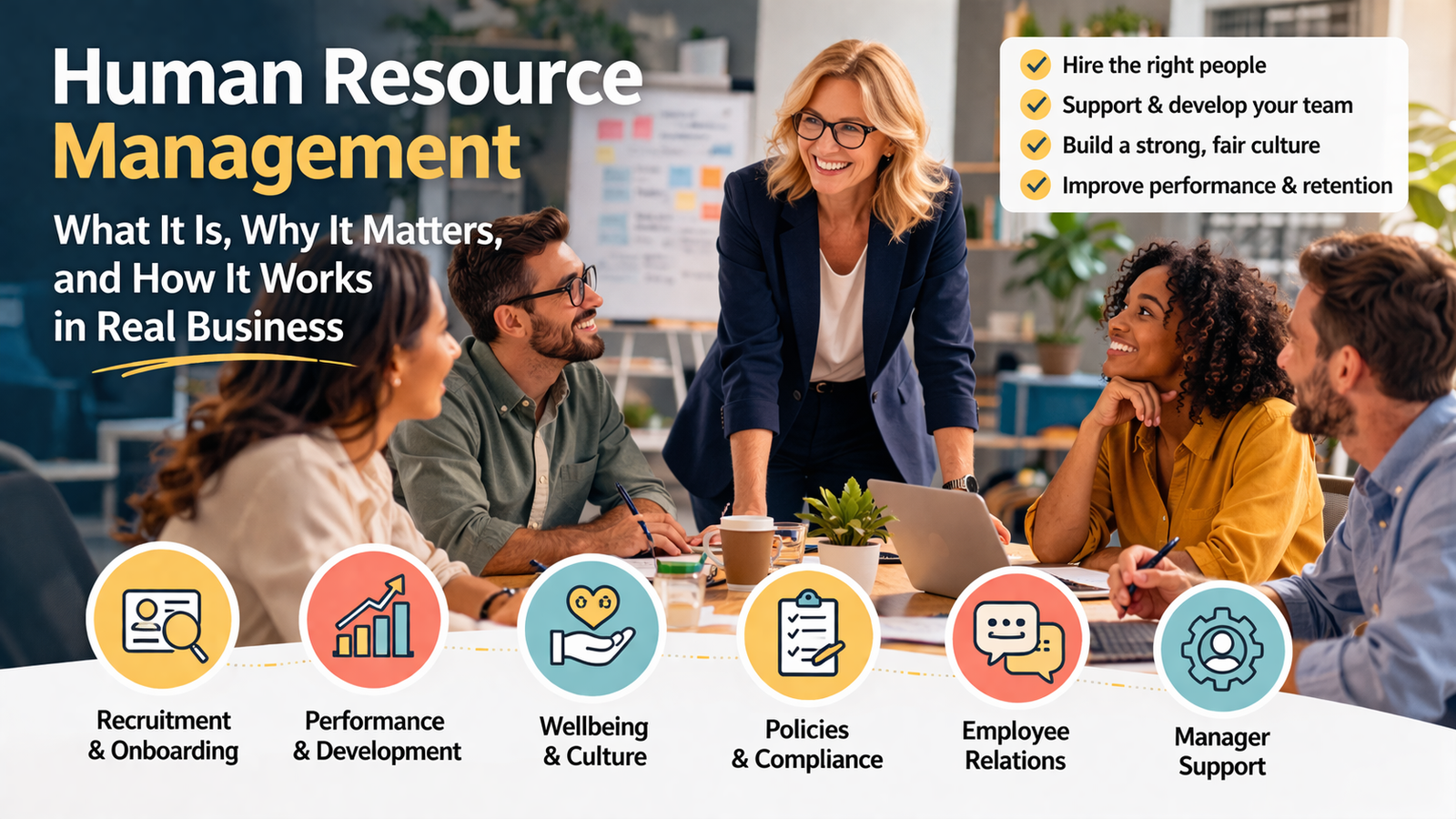
Human resource management, often called HRM, is the way a business hires, supports, develops, and keeps its people. In simple terms, it is about helping the right people do good work in a fair, safe, and well-managed environment. Good HRM supports performance, culture, compliance, and employee wellbeing.
HR also plays a crucial role when the business faces disruption. Clear policies, fair processes, and crisis communication with employees help protect trust when pressure rises.
What this article covers
In this article, I will explain what human resource management means in everyday business, what HR actually does, why it matters so much, where it often goes wrong, and what good HRM looks like in practice. I will keep it practical, clear, and focused on the real workplace rather than theory alone.
This article is based on practical business thinking, independent research, and my own analysis and synthesis of how people management affects business performance.
People problems rarely stay as people problems.
They become performance problems, culture problems, customer problems, and sometimes legal problems too.
That is one reason I think human resource management matters far more than many businesses realise.
A lot of people still hear “HR” and think of forms, policies, interviews, or holiday requests. Those things matter, of course. But good HRM is much bigger than that. It shapes how a business hires, how it sets expectations, how it develops people, how it handles problems, and how fair and consistent it feels to work there.
In my view, good HRM helps a business make better people decisions.
And better people decisions often lead to better business results.
Better decisions come from understanding behaviour, signals, environment, and consequences.
I write about how better decisions are made in business — combining strategy, behaviour, and practical thinking.
Key Ideas
- Human resource management is about much more than hiring. It shapes performance, culture, communication, and trust.
- Good HRM helps businesses make better people decisions.
- Strong HR practices improve retention, morale, and consistency.
- Weak HRM often leads to avoidable mistakes, conflict, and high staff turnover.
- The best HRM supports both people and business goals at the same time.
A practical model for better business decisions in complex environments. It focuses on four essential elements:
- Human Behaviour — how people actually think and decide
- Signals — what people are trying to do right now
- Environment — whether the system supports good decisions
- Consequences — what happens next, and after that
Strong decisions consider all four — not just one.
Employee wellbeing is the cornerstone of a successful organization. By nurturing the physical, mental, emotional, and financial health of your people, and fostering a sense of purpose and belonging, you create a workplace where everyone can thrive and achieve their best. See what Wellhana can do for you NOW.
Disclosure: This article may contain affiliate links. If you purchase through these links, I may earn a commission at no extra cost to you. Any such links are included only where relevant and will always be clearly disclosed.
What is human resource management?
Human resource management is the part of a business that deals with people at work.
That includes:
- hiring
- onboarding
- training
- performance
- pay and benefits
- employee relations
- workplace issues
- policies
- compliance
- staff development

Put simply, HRM is about helping people join the business, settle in, do their job well, grow where possible, and be treated fairly along the way.
It is also about helping managers make sound decisions.
That matters because many workplace problems do not begin with bad intentions. They begin with unclear expectations, weak communication, poor hiring, inconsistent treatment, or managers avoiding problems for too long.
What is human resource management, in simple terms?
Human resource management is the way a business hires, supports, develops, and keeps its people. It helps create a workplace where expectations are clear, people are treated fairly, and the business can perform well over time.


What human resource management means in day-to-day business
In day-to-day business, HRM is not just about policies sitting in a handbook.
It shows up in practical things like:
- writing a clear job description
- giving a new employee a proper welcome
- training someone well
- holding a fair performance review
- dealing with conflict early
- making sure pay and benefits feel fair
- supporting managers with difficult people issues
- keeping the business on the right side of employment rules
That is why I see HRM as a working part of the business, not a side function.
Why HRM is more than admin
Admin matters, but it is not the whole story.
A business can have contracts, handbooks, and records in place and still manage people badly.
Good HRM is also about:
- culture
- fairness
- consistency
- communication
- support
- development
- judgement
This is where the real value lies.
A workplace runs better when people know what is expected, feel respected, and trust that decisions will be handled properly.
What are the main functions of human resource management?
The main functions of HRM are the core people-management tasks that keep a business working well.
These functions often overlap, but it helps to break them down clearly.
Recruitment and onboarding
This starts with bringing the right people into the business.
That includes:
- planning the role
- writing the job description
- advertising the role
- screening candidates
- interviewing
- making the offer
- helping the new starter settle in
A weak hire can be costly.
A weak start can also be costly.
I have seen businesses put great effort into recruitment, then lose the new person’s trust in the first few weeks because onboarding was rushed, confusing, or poorly planned.
A good first impression matters.
It helps people feel welcome, useful, and clear about what comes next.
Learning, development, and performance management
People need support after they join.
That means:
- training
- feedback
- performance reviews
- coaching
- skills development
- career conversations
A good business does not only ask, “Are people performing?”
It also asks, “Have we given them a fair chance to perform well?”
That is an important difference!
Because sometimes poor performance is not only an employee issue. Sometimes it is a weak systems issue, a poor training issue, or an unclear management issue.
What I’ve seen in practice
I have often seen businesses blame employees for poor performance when the real problem was weak onboarding, unclear expectations, or lack of proper support. Good HRM helps a business see the difference.
Pay, benefits, and reward systems that feel fair
Pay is never just about money.
It is also about fairness, trust, and how valued people feel.
This area includes:
- salary
- bonuses
- pensions
- holiday
- sick pay
- flexible working
- rewards
- recognition
A business does not need the most generous package in the market to be a good employer.
But it does need fairness, clarity, and honesty.
If people feel pay decisions are random, secretive, or unfair, trust weakens quickly.
Employee relations, wellbeing, and workplace issues
This is one of the most important areas of HRM.
It covers:
- day-to-day communication
- employee concerns
- grievances
- disciplinary matters
- conflict resolution
- wellbeing
- mental health support
- respectful behaviour
In plain terms, this is about how a workplace feels.
Do people feel safe raising concerns?
Do managers handle problems early?
Are people treated with respect?
Can the business address issues before they become much bigger?
That is where HR often proves its value.
Compliance, records, and risk management
This part may seem less exciting, but it matters.
HRM helps a business:
- follow employment law
- keep proper records
- apply policies fairly
- document decisions
- reduce legal risk
- avoid costly disputes
I would not frame this in a frightening way.
But I would say this: many avoidable workplace problems become serious because the basics were weak.
No records.
No clear policy.
No fair process.
No consistent communication.
That is where good HRM quietly protects the business.
What this means in real business
Good HRM is not only about keeping records or filling vacancies. It helps a business hire better, onboard properly, support managers, handle problems fairly, and reduce costly mistakes that grow from weak people decisions.
Why is human resource management important to business performance?
This is the part many people miss.
HRM is not only about helping employees.
It is also about helping the business work better.
Strong HRM can support:
- better hiring
- lower staff turnover
- stronger morale
- clearer expectations
- better manager behaviour
- stronger culture
- fewer avoidable disputes
- more stable performance
Better retention, stronger morale, and healthier culture
People are more likely to stay when they feel:
- respected
- clear about their role
- properly managed
- supported when needed
- treated fairly
- able to grow
Good HRM supports these things.
And when people stay longer, a business usually gains:
- more continuity
- less disruption
- less hiring cost
- stronger teamwork
- better knowledge retention
Culture grows from repeated everyday behaviour.
HR helps shape that behaviour.
Better manager decisions and fewer avoidable mistakes
This is where I think the business value becomes very real.
Managers often need help with:
- performance issues
- difficult conversations
- absence problems
- team conflict
- role clarity
- fairness
- documentation
- policy decisions
Without support, some managers avoid problems.
Others overreact.
Some become inconsistent.
Some rely too much on instinct.
Good HR helps managers make better decisions.
And that is often where a workplace becomes calmer, fairer, and more effective.
Stronger compliance and lower organisational risk
This part is often quiet, but important.
A business that applies policies properly, keeps records, communicates clearly, and follows fair process is less likely to face avoidable claims, disputes, or reputational harm.
In simple terms, HR helps reduce mess.

What this means in real business
A lot of HRM value is invisible until something goes wrong.
You really notice it when:
- the wrong person gets hired
- a new starter leaves in week three
- a grievance is mishandled
- one manager treats people very differently from another
- a performance issue drags on for months
- nobody is sure what the policy actually says
- culture becomes tense but nobody deals with it
That is why I think good HRM is not a luxury.
It is part of running a stable, fair, and effective business.
The KrisLai People Decision Lens™
- Behaviour – how are people actually acting, not just how policies say they should act?
- Signals – what do turnover, absence, conflict, complaints, and performance patterns reveal?
- Environment – what workload, leadership, pressure, or culture is shaping behaviour?
- Consequences – what happens if the people issue is ignored, delayed, or handled badly?
Good HRM helps a business make better people decisions by looking at behaviour, signals, environment, and consequences together.
Common human resource management challenges and how to handle them
No business gets this right all the time.
There are always people challenges.
But strong HRM helps handle them earlier and more calmly.
Hiring in a competitive market and finding the right fit
Many businesses struggle because:
- the job description is vague
- the process is slow
- the candidate experience is poor
- the business is not clear on what it really needs
- the focus is too much on experience and not enough on fit
Practical ways to improve this include:
- clearer role profiles
- better communication with candidates
- faster decisions
- stronger onboarding
- a more honest view of what success in the role looks like
Managing change, hybrid work, and rising employee expectations
Work has changed.
People now expect more:
- flexibility
- clarity
- respect
- communication
- work-life balance
- fairness
That creates pressure for businesses, especially when change is happening quickly.
HR helps by supporting:
- clear communication
- policy updates
- manager guidance
- trust-building
- realistic expectations
Keeping managers consistent and fair
This is one of the biggest real-world issues.
A business may have decent policies, but if managers apply them inconsistently, people stop trusting the system.
That is why HR should not only create policies.
It should also help managers use them properly.
A simple real-world example
Imagine two employees in different teams make the same mistake. One manager handles it calmly and fairly. The other reacts harshly and inconsistently. The issue is no longer just the mistake. It becomes a trust problem, a fairness problem, and possibly a culture problem. Good HRM helps prevent that kind of damage.

Where HRM often goes wrong
This is where I think many articles on the this topic stay too polite.
Good HRM matters, but weak HRM causes real problems!
Confusing policy with people leadership
A handbook is helpful.
But a handbook is not the same as good management.
Some businesses believe that once a policy exists, the issue is solved.
It is not!
People still need:
- explanation
- consistency
- support
- fairness
- sound judgement
Hiring fast, onboarding weakly, and paying for it later
Many businesses focus heavily on filling the role.
But the first few weeks matter just as much.
A rushed or confusing start can create:
- early resignation
- poor confidence
- weak performance
- bad habits
- avoidable frustration
Treating HR as a support function only
This is a big mistake.
If HR is only brought in after something has already gone wrong, the business misses much of its value.
The strongest businesses use HRM more proactively:
to support growth
to improve decisions
to strengthen managers
to build culture
to reduce risk
Where this goes wrong
HRM often becomes weak when businesses treat it as admin only, leave managers unsupported, rush hiring, neglect onboarding, or rely on policies without applying them fairly and consistently in real life.

What good human resource management looks like in practice
Good HRM is usually not dramatic.
It is visible in stable, healthy habits.
Clear policies, fair processes, and regular communication
People work better when:
- expectations are clear
- policies are easy to understand
- communication is regular
- feedback happens often enough
- decisions feel fair
- concerns can be raised safely
This creates steadiness.
A people-first approach that still supports business goals
I do not think good HRM means pleasing everyone all the time.
It means balancing people needs with business needs in a fair, sensible, and honest way.
That includes:
- holding standards
- supporting performance
- addressing problems
- protecting wellbeing
- keeping the business workable
That balance matters.
Because a workplace should be humane, but it also needs to function.
What good HRM looks like
- Clear expectations
- Fair hiring and onboarding
- Managers supported to make sound people decisions
- Regular communication and feedback
- Policies applied consistently
- A workplace culture that supports both people and performance
Final thought: human resource management is about better people decisions
Human resource management matters because people matter.
That sounds simple, but it is easy for businesses to forget when work is busy and pressure is high.
Good HRM helps a business hire better, communicate better, support managers better, handle issues more fairly, and create a stronger workplace over time.
That is why I would never reduce HRM to admin alone.
At its best, it is a practical business discipline that improves how a company treats people and how it performs.
As the Finnish saying goes, hyvin hoidettu työyhteisö kantaa pitkälle.
A well-managed workplace carries you a long way.
Final takeaway
Human resource management is not just about hiring and paperwork. It is about making better people decisions so the business can perform well, treat people fairly, reduce avoidable risk, and build a healthier workplace over time.
Related reading on KrisLai.com
- Related article: Psychological Safety at Work
- Glossary or definition article: 11 Key Business Acumen Skills You Need
- Pillar topic: Business Thinking Hub
- Business Strategy Planning
- Decision-Making Framework Examples: The KrisLai Method in Action
- Negotiation Skills in Business
Frequently Asked Questions About Human Resource Management
What is human resource management?
Human resource management is the way a business hires, supports, develops, and keeps its people. It includes recruitment, onboarding, performance, pay, employee relations, and workplace policies.
Why is human resource management important?
Human resource management is important because it helps a business make better people decisions, improve retention, support managers, reduce avoidable problems, and create a fairer and more effective workplace.
What are the main functions of HRM?
The main functions of HRM usually include recruitment, onboarding, training and development, performance management, pay and benefits, employee relations, wellbeing, compliance, and workplace policy.
How does HRM help small businesses?
HRM helps small businesses by improving hiring, setting clear expectations, supporting managers, handling workplace issues fairly, and reducing the risk of avoidable people problems as the business grows.
What is the difference between HR and human resource management?
HR is often used as a short term for the people function in a business. Human resource management is the wider system of managing employees, policies, performance, development, and people-related decisions.
What is a common mistake in human resource management?
A common mistake is treating HR as admin only. Good HRM is not just paperwork. It also supports manager judgement, culture, fairness, communication, and business performance.
If you enjoy exploring the ideas behind better business decisions, you may find the Business Thinking Hub useful.

About the author
Kris Lai is a business operator and managing director with experience in land and building surveying, facilities management, logistics, and service delivery.
Earlier in his career, he worked as a Search Engine Evaluator (via Lionbridge, supporting Google), where he assessed search result relevance, user intent, and content quality using structured evaluation frameworks. This experience gives him a rare, practical understanding of how search systems interpret signals and make ranking decisions.
In parallel, whilst working with a charity organisation, he has delivered 1000’s of structured presentations in English, Finnish, and Chinese to audiences ranging from small groups to more than 600 people, and has spent decades mentoring and developing others. This experience informs his approach to clarity, communication, and decision-making under pressure.
He writes about AI, search behaviour, business strategy, and decision-making from a practical, real-world perspective.
👉 Explore ideas connected to better business decisions:
- Digital Transformation for SMEs: 7 Questions Before You Invest
- Cybersecurity for Businesses: 7 Decisions Leaders Must Make
- How AI Is Changing Search Behaviour (And What Businesses Must Do Now)
- 7 Decision-Making Framework Examples for Business Leaders
- Business Decision-Making Framework: The KrisLai Method