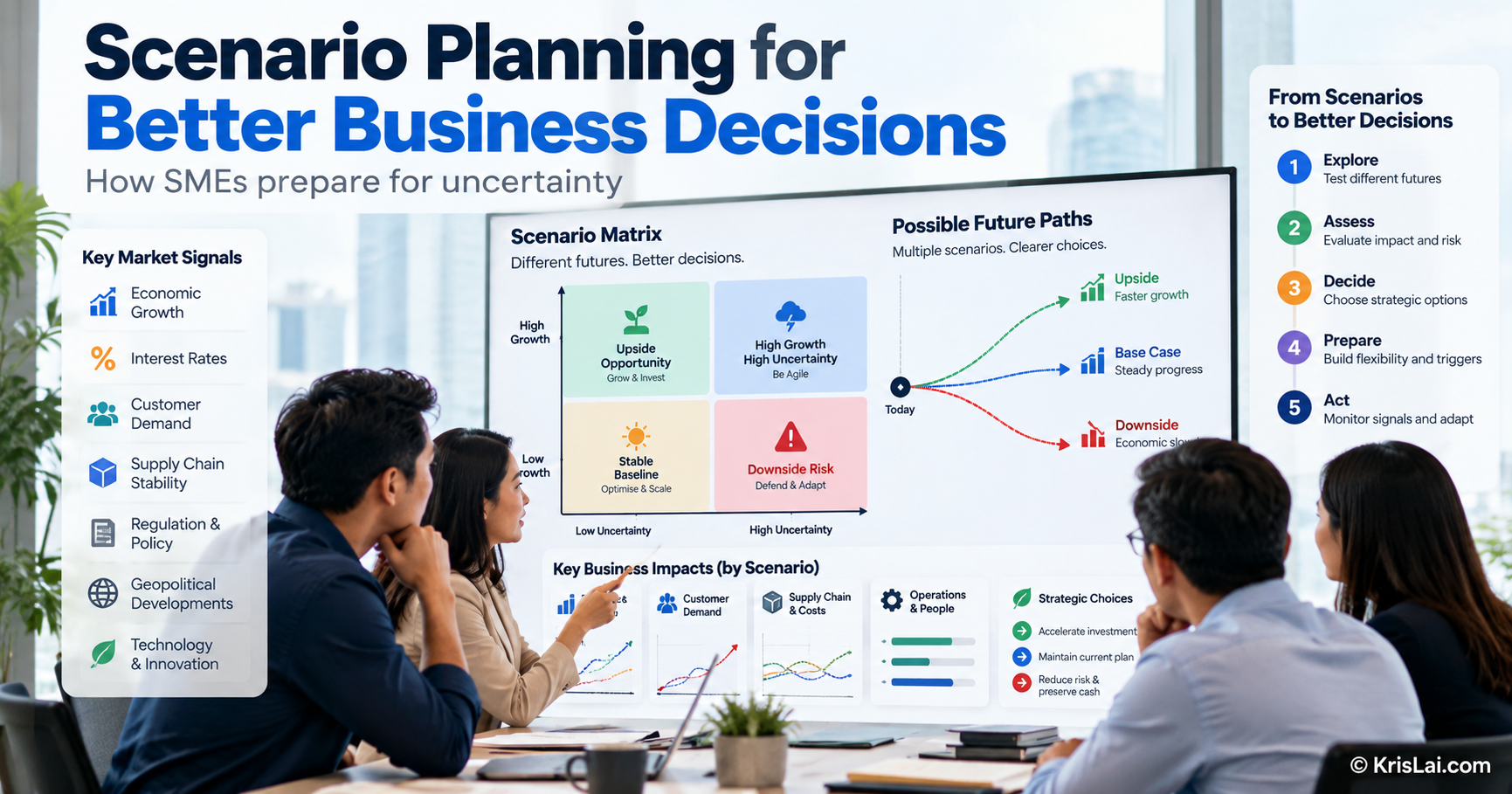
Scenario planning helps SMEs make better decisions when the future is uncertain. Instead of relying on one forecast, you build a small number of plausible futures, test your options against them, and decide which signals would make you act. This guide shows you how to do that in five practical steps, with a worked business example.
A forecast can look wonderfully precise right up until reality develops other ideas!
For a small or medium-sized business, that matters. Hiring people, taking on a large contract, investing in equipment, changing prices or adopting AI can all look sensible under one set of assumptions — and rather less clever when two of those assumptions change at the same time.
Scenario planning gives you a better way to think before that happens.
What this article covers
In this guide, I will explain:
- what scenario planning means in business
- when scenario planning is useful for SMEs
- scenario planning vs forecasting, sensitivity analysis and contingency planning
- the five practical steps in the scenario planning process
- how to identify critical uncertainties
- how to build a simple 2×2 scenario planning matrix
- a worked scenario planning example for a small business
- the main types of scenario planning
- how AI can support scenario planning
- how changing search behaviour can be treated as a strategic uncertainty
- which scenario planning tools SMEs actually need
- how to turn scenarios into signals, triggers and actions
- common scenario planning mistakes
- what research says about whether scenario planning works
- how to start your own scenario plan without turning it into a three-day strategy retreat
- What Is Scenario Planning in Business?
- When Should a Small Business Use Scenario Planning?
- Scenario Planning vs Forecasting: What Is the Difference?
- What Are the 5 Steps of Scenario Planning?
- How Do You Build a 2×2 Scenario Planning Matrix?
- Scenario Planning Example for a Small Business
- What Are the Main Types of Scenario Planning?
- How Can AI Help With Scenario Planning?
- What Scenario Planning Tools Does an SME Need?
- How Do You Turn Scenario Plans Into Practical Actions?
- The KrisLai Scenario Lens™
- Where Does Scenario Planning Go Wrong?
- Does Scenario Planning Actually Work?
- What Should You Actually Do?
- People Also Ask
- Frequently Asked Questions About Scenario Planning
- Scenario planning is not prediction. It prepares you for several plausible futures rather than betting everything on one forecast.
- Start with a decision. Do not start by creating a long list of things that might go wrong.
- Three or four useful scenarios are normally enough for an SME decision.
- Focus on high-impact uncertainties that could genuinely change what you decide.
- Stress-test your options across the scenarios instead of choosing the future you like best.
- Set signals and triggers in advance so you know when conditions are changing.
- You do not need expensive software. A spreadsheet, a simple matrix and good judgement are often enough to begin.
What Is Scenario Planning in Business?
Scenario planning is a structured way to explore several plausible futures and test how an important business decision might perform under each one. It does not try to predict exactly what will happen. Its purpose is to expose assumptions, prepare possible responses and identify signals that tell you when circumstances are changing.
Scenario planning is a decision-making method that creates a small number of plausible future situations so leaders can test choices, understand risks and opportunities, and prepare actions before uncertainty becomes urgent.
A scenario is not a forecast of what will happen. It is a structured description of what could happen and what that future would mean for the decision you face today.
That distinction matters.
A forecast might say:
“We expect sales to grow by 8% next year.”
Scenario planning asks:
“What should we do if sales grow by 8%, stay flat, fall sharply, or grow faster than our current capacity can handle?”
The first produces an estimate.
The second tests whether your decision survives uncertainty.
Organisations such as Shell have used scenario thinking for decades, but Shell itself is very clear that its scenarios are not predictions, forecasts, strategy or business plans. Their purpose is to challenge assumptions and help decision-makers consider different possible futures. Shell
The Sat-Nav, Not the Crystal Ball
Think of scenario planning like using a sat-nav before a long journey.
You know where you want to go.
You may have a preferred route.
But you also know that traffic, roadworks, weather or an accident could change what makes sense.
You do not need to predict exactly which road will become congested at 3:17 pm…
You need:
- alternative routes
- signs that tell you conditions have changed
- an idea of when to reroute
- enough flexibility to respond
That is scenario planning.
It is less like looking into a crystal ball and more like refusing to drive for four hours with your eyes fixed on yesterday’s traffic report.
There is a Finnish saying I like here:
“Ei vara venettä kaada.”
Roughly translated: “being prepared does not sink the boat”.
Scenario planning is preparation without pretending you know exactly where every wave will come from.
From possible futures to better decisions
So, if scenario planning is not really about predicting the future, what is it for?
The answer is straightforward:
It helps you make a better decision today because you have already thought about what could make that decision succeed, fail or need to change.
That is where we move from interesting stories about the future to practical business thinking.
When Should a Small Business Use Scenario Planning?
A small business should use scenario planning when a decision matters, uncertainty could materially change the outcome, and management still has time to respond. It is especially useful before decisions involving fixed costs, people, capacity, pricing, expansion, major customers, technology, suppliers or long-term commitments.
You do not need scenario planning every time someone orders a new office chair!
Use it when getting the decision wrong would be expensive, difficult to reverse or strategically important.
Situations where scenario planning becomes useful
Imagine you are thinking:
“Can we afford to hire two more people?”
That is a scenario-planning moment.
So is:
“Should we invest £60,000 in new equipment?”
Or:
“One customer now represents 35% of our sales. What happens if they leave?”
Or:
“Our supplier keeps missing deliveries. Should we change supplier or hold more stock?”
Other common situations include:
- bidding for a large new contract
- opening another location
- entering a new market
- launching a new service
- changing your prices
- signing a long lease
- increasing marketing spend
- investing in AI or automation
- depending on one large supplier
- dealing with changing regulation
- preparing for rising labour costs
- deciding how much cash reserve to keep
- responding to a competitor cutting prices
- deciding whether to recruit ahead of expected growth
In my experience, the most useful scenarios often come before a commitment.
The question is not simply:
“Could this opportunity work?”
It is:
“Under what conditions does this decision work — and what would make us change course?”
Ask four questions:
- Is the decision important enough to deserve deeper thought?
- Could uncertainty materially change the outcome?
- Would you make a different choice if circumstances changed?
- Can you identify signals that would tell you change is happening?
If most answers are yes, scenario planning is probably useful. If most are no, keep the decision process simple.
This matters because scenario planning can itself become a form of avoidance.
Sometimes the right thing to do is think.
Sometimes the right thing to do is make the small, reversible decision and learn.
Not every problem needs a matrix…
Scenario Planning vs Forecasting: What Is the Difference?
Forecasting estimates what is most likely to happen, while scenario planning explores several plausible futures and asks how your choices would perform in each. Forecasting works well when conditions are reasonably stable. Scenario planning becomes more valuable when important assumptions are uncertain or several variables could change together.
Here is the practical difference:
| Method | Main Question | Best Used For |
|---|---|---|
| Forecasting | What is most likely to happen? | Expected sales, demand, costs or cash |
| Sensitivity analysis | What happens if one variable changes? | Testing price, volume, cost or interest-rate changes |
| Scenario planning | What could happen if several important uncertainties interact? | Strategic decisions under uncertainty |
| Contingency planning | What will we do if a specific event happens? | Preparing a defined response |
| Business continuity planning | How will essential operations continue during disruption? | Keeping the business functioning |
| Strategic planning | Where are we trying to go and how will we get there? | Setting direction and priorities |
You can use several of these together.
Suppose you are considering hiring.
Your forecast might estimate next year’s sales.
A sensitivity analysis might test what happens if wage costs rise by 10%.
A scenario plan might examine what happens if demand weakens while wages rise and skilled staff become harder to find.
A contingency plan might explain what you will do if one of your key employees suddenly leaves.
They answer different questions.
SAP makes a similar distinction: forecasting tends to focus on an expected outcome using past data and trends, while scenario planning deliberately explores a range of possible futures.
A scenario does not become more useful because somebody adds three decimal places.
If the future is genuinely uncertain, false precision can make weak assumptions look much stronger than they are. Use numbers where they improve the decision, but do not confuse a detailed spreadsheet with certainty.
What Are the 5 Steps of Scenario Planning?
A practical scenario planning process has five steps: frame the decision, identify the critical uncertainties, build a small number of plausible scenarios, stress-test your choices, and define signals and actions. The sequence matters because useful scenarios start with a real decision and finish with a practical response.
I use the following structure:
The KrisLai Scenario-to-Decision Method
1. Frame the decision
2. Find the critical uncertainties
3. Build plausible scenarios
4. Stress-test your options
5. Set signposts, triggers and actions
There is no single universally accepted scenario planning method. Research shows that several schools and techniques exist, which is one reason definitions and processes can become confusing. ScienceDirect
The method below is deliberately practical.
It is designed for leaders who need to make a business decision, not become professional futurists…
The five steps work as a sequence. Start with the decision rather than the future, then narrow the uncertainty before building scenarios and deciding what would make you act.
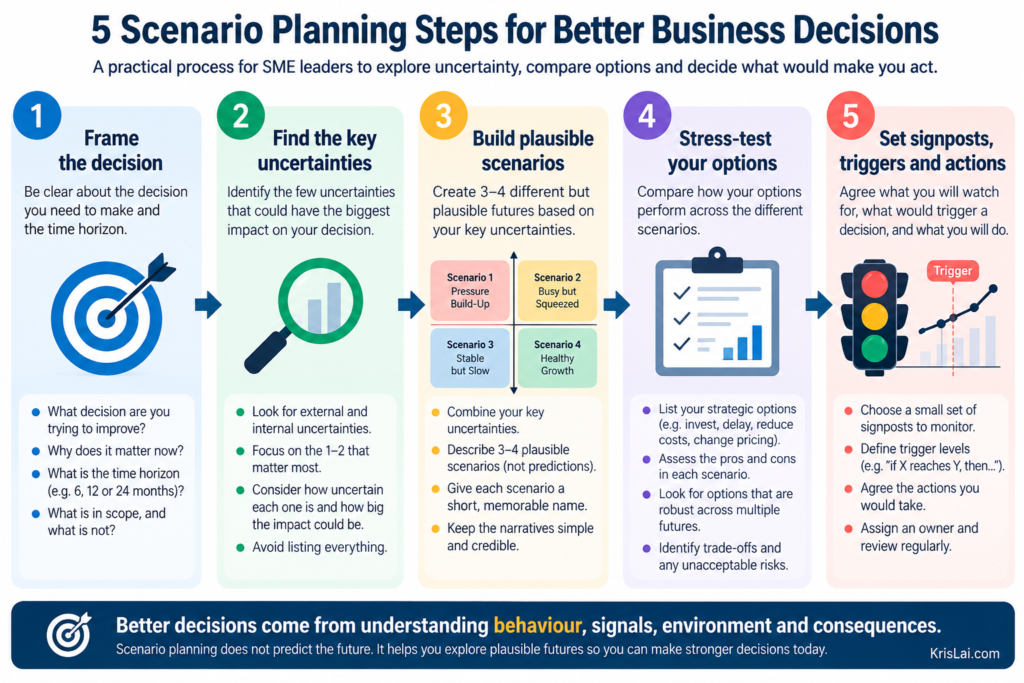
The rest of this section walks through each step in enough detail for you to use the method on a real business decision.
Step 1: Frame the Decision
Start by defining the decision clearly, because vague questions create vague scenarios. Decide what you are choosing, why the choice matters and the time period involved. A useful scenario exercise should help you compare realistic alternatives, not simply generate an impressive collection of things that might happen.
Bad question:
“What will happen to our market?”
Better question:
“Should we hire two permanent employees during the next six months to support expected contract growth?”
Or:
“Should we invest £80,000 in automation this year?”
Or:
“Should we expand into a second location during the next 18 months?”
Notice what has changed.
The question contains:
- a decision
- an action
- a time horizon
That gives the rest of the exercise something to work with.
This also reflects a wider decision-quality principle: good decisions start by framing the right problem and considering genuine alternatives. SDG
Define the options too
Do not make the mistake of comparing:
Do it / Don’t do it
when better alternatives exist.
For a hiring decision, options might include:
- recruit two permanent employees now
- recruit one and use flexible cover
- use subcontractors first
- increase overtime temporarily
- delay recruitment
- redesign the workflow before hiring
Scenario planning becomes far more useful when the alternatives are genuinely different.
Practical questions for Step 1
Ask:
- What exactly are we deciding?
- By when must we decide?
- How long will the consequences last?
- Which outcomes matter most?
- What would make this decision difficult to reverse?
- What realistic alternatives do we have?
A good decision can still produce a bad outcome because uncertainty exists.
Judge the quality of the decision by the information, alternatives, assumptions and reasoning available when you made it — not only by what happened afterwards.
That is particularly important for leaders.
Hindsight can make uncertainty look strangely obvious.
Step 2: Find the Critical Uncertainties
Critical uncertainties are the few outside or inside forces that could materially change your decision, but whose future direction you cannot confidently predict. The easiest way to find them is to list possible drivers, score each one for impact and uncertainty, then keep only those that score highly on both.
This is probably the most important step in the whole process!
It is also where people can get stuck.
The mistake is usually trying to identify everything that could affect the business.
You do not need everything!
You need the few uncertainties capable of changing the decision you defined in Step 1.
Suppose the decision is:
Should we hire two permanent employees during the next six months to support expected growth?
You might initially identify:
- customer demand
- success of a large tender
- wage costs
- availability of skilled workers
- competitor pricing
- interest rates
- fuel prices
- customer payment times
- new technology
- regulation
All could matter.
But they do not matter equally.
First, ask: could this change my decision?
Take each factor and ask:
“If this moved significantly in either direction, could it change whether, when or how we hire?”
If the answer is no, remove it.
For example:
A modest change in stationery costs probably will not decide whether you recruit two employees.
A 25% fall in expected workload probably will.
That gives you your first filter:
Decision relevance.
Next, score Impact and Uncertainty
You do not need sophisticated modelling.
Use a simple 1-to-5 score.
Impact
Ask:
How much could this factor affect the decision?
1 = very little effect
3 = noticeable effect
5 = could materially change the decision
Uncertainty
Then ask:
How confident are we about what will happen?
1 = reasonably predictable
3 = several realistic outcomes
5 = genuinely difficult to know
Now multiply the two scores.
For example:
| Driver | Impact | Uncertainty | Score |
|---|---|---|---|
| Customer demand | 5 | 5 | 25 |
| Skilled labour availability | 5 | 4 | 20 |
| Wage costs | 4 | 3 | 12 |
| Customer payment times | 3 | 3 | 9 |
| Fuel cost | 2 | 3 | 6 |
| Stationery cost | 1 | 2 | 2 |
This is not mathematics pretending to know the future.
It is simply a way to force some discipline into the conversation.
In this example, customer demand and skilled labour availability stand out.
They become good candidates for the scenario matrix because:
- both could strongly affect the hiring decision
- neither is known with confidence
- different combinations would lead to genuinely different actions
That is exactly what we want.
What about important things that are not uncertain?
Keep them in the business plan.
Do not automatically turn them into scenario axes.
For example, suppose the statutory minimum wage is already confirmed for the period you are analysing.
It may have a large financial impact.
But if the figure is already known, it is not a critical uncertainty.
Build it into your numbers instead.
This distinction saves a lot of wasted discussion.
What about uncertain things with little impact?
Usually ignore them.
An uncertain factor is not automatically strategically important.
You might have no idea what office coffee will cost next year.
That does not mean it deserves its own quadrant.
Use PESTLE as a prompt, not as the answer
If you are struggling to find drivers, scan:
Political — government policy, trade, taxation
Economic — demand, inflation, interest rates, wages
Social — customer expectations, demographics, working habits
Technological — AI, automation, new platforms
Legal — regulation, compliance, employment rules
Environmental — energy, weather, supply constraints
Then bring the discussion straight back to the decision:
Which of these could actually change what we choose to do?
That last question matters more than completing every PESTLE box.
Look for interacting uncertainties
The best scenario axes often become useful because the two variables interact.
For example:
Strong demand + easy recruitment creates one business problem.
Strong demand + difficult recruitment creates a completely different one.
Likewise:
Weak demand + low costs is different from:
Weak demand + rising costs.
The combinations change the decision.
That is what makes them good scenario variables.
The most important factors are not automatically the best scenario uncertainties.
A factor needs to be both important and genuinely uncertain. If something is important but already reasonably predictable, build it into the plan. If it is uncertain but would barely change the decision, leave it out.
A useful final test
Before choosing an uncertainty for your matrix, complete this sentence:
“If this develops differently from what we currently expect, we may need to change our decision because…”
If you cannot finish that sentence clearly, it probably does not deserve to become one of your main scenario axes.
In the hiring example
We might finish with:
Uncertainty 1: Customer demand
Weak ←————————→ Strong
Uncertainty 2: Skilled labour availability
Easy ←————————→ Difficult
Those two uncertainties now give us the four environments used in the next step:
Controlled Growth
Capacity Squeeze
Room to Wait
Margin Pressure
Now the scenario matrix is no longer an abstract strategy exercise.
It grows directly from a real business decision.
Step 3: Build Three or Four Plausible Scenarios
If Step 2 felt harder than drawing the matrix, that is normal. Choosing the right uncertainties requires judgement. Once you have them, building the scenarios becomes much easier: simply explore what happens when the two uncertainties move in different directions.
Build a small number of futures that are different enough to test your decision properly. For most SMEs, three or four scenarios are sufficient. They should be plausible, internally consistent and relevant to the decision — not simply “good”, “average” and “everything has gone horribly wrong”.
There are two practical ways to do this.
Approach 1: Financial scenarios
This works well for budgeting, cash flow and capacity.
For example:
- cautious
- expected
- optimistic
You might change:
- sales volume
- price
- labour cost
- material cost
- debtor days
- conversion rate
This is useful when the uncertainty is mainly numerical.
Approach 2: Strategic scenarios
When several forces interact, I prefer a 2×2 scenario matrix.
Choose your two strongest uncertainties.
Place one on each axis.
For example:
Customer demand: Weak ↔ Strong
and
Labour availability: Easy ↔ Difficult
Those two uncertainties produce four different environments.
That approach is also widely used in strategic scenario work; SME Strategy, for example, recommends selecting two critical uncertainties and combining them in a matrix to explore four different futures. smestrategy.net
Give each scenario a memorable name
Do not call them:
Scenario 1
Scenario 2
Scenario 3
Scenario 4
Nobody remembers Scenario 3 during a busy management meeting six months later.
Use names that capture the business condition:
Controlled Growth
Capacity Squeeze
Room to Wait
Margin Pressure
The name should remind people what kind of world they are discussing.
Make each scenario internally consistent
Ask:
- What is happening to customers?
- What is happening to costs?
- What are competitors doing?
- What happens to capacity?
- What happens to cash?
- What changes in staff behaviour?
- Which assumptions stop being true?
You do not need to write a novel.
Two or three paragraphs plus important numbers may be enough.
The job is to make the scenario specific enough that you can test a decision against it.
Step 4: Stress-Test Your Options
Stress-testing means asking how each decision option performs across the scenarios rather than choosing the scenario you believe is most likely. The aim is to identify fragile choices, flexible choices, no-regret actions and decisions that remain sensible across several different futures.
Suppose your options are:
A. Hire two employees now
B. Hire one employee and keep some flexible capacity
C. Delay hiring
Now test all three against all four scenarios.
Ask:
- Which option performs well?
- Which creates serious risk?
- Which becomes expensive to reverse?
- Which gives us flexibility?
- What opportunity might we miss?
- What does this do to cash?
- What are the second-order consequences?
This is where scenario planning becomes decision-making rather than storytelling.
Look for no-regret actions
A no-regret action helps across most scenarios.
For example:
- improve cash visibility
- cross-train employees
- shorten quotation time
- improve customer retention
- negotiate better supplier terms
- clean up your data
- fix an inefficient process
You may not know which future will arrive.
But you may already know which improvements make the business stronger in several of them.
That is valuable.
Look for contingent actions
These are moves you make only when a condition changes.
For example:
If confirmed workload exceeds 90% of available capacity for eight consecutive weeks, recruit.
Or:
If a supplier’s delivery failure rate passes our agreed threshold, move 30% of orders to the alternative supplier.
That is more useful than:
“We should keep an eye on it.”
Keeping an eye on something has prevented surprisingly few business problems.
Step 5: Set Signposts, Triggers and Actions
A scenario becomes operational when you define what you will watch, what change matters enough to trigger action, who owns the response and what happens next. Without those elements, the scenario risks becoming an interesting workshop document that quietly moves into a shared folder and enjoys a peaceful retirement.
I separate these into:
Signpost
A measure that tells you which direction conditions may be moving.
Examples:
- enquiry volume
- customer churn
- quotation conversion
- wage rates
- recruitment time
- supplier failure rate
- debtor days
- gross margin
- search traffic
- AI referral traffic
- competitor pricing
You do not need dozens of indicators. Start with a small set that can genuinely tell you whether the assumptions behind your decision are beginning to change.
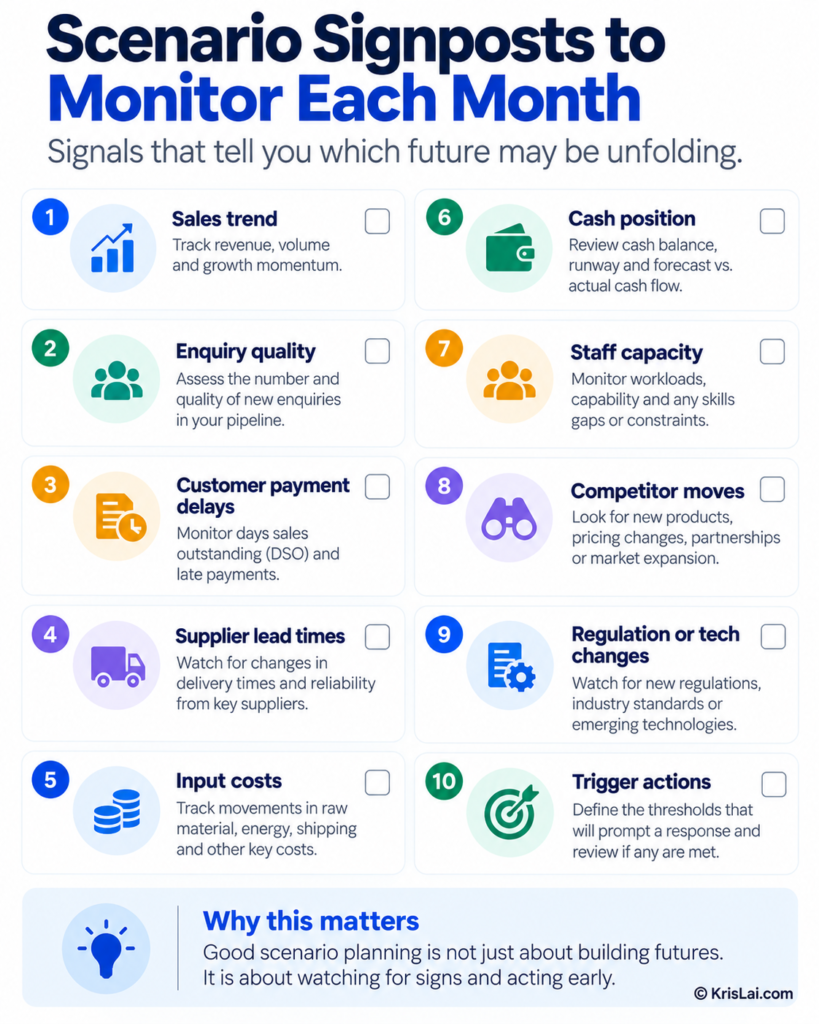
A signpost tells you that something may be changing. A trigger goes one step further: it defines when that change is important enough to require a decision or action.
Trigger
A threshold that causes a decision or review.
Example:
If three-month forward workload exceeds available capacity by 15%, start recruitment.
Action
What you have already agreed to do.
Owner
Who is responsible.
This gives us a very simple structure:
Signal → Threshold → Decision → Action → Owner
That is one of the strongest habits I would encourage an SME to take from scenario planning.
Do not wait until conditions change and then begin the argument from scratch!
A scenario without a decision trigger is mainly an interesting story.
A scenario with a signal, threshold, action and owner becomes a management tool.
How Do You Build a 2×2 Scenario Planning Matrix?
A 2×2 scenario planning matrix takes two high-impact uncertainties and places them on separate axes, creating four different combinations. Each quadrant represents a plausible future. You then describe what that environment would mean for customers, costs, capacity, competitors, cash and the decision you are considering.
Here is what that looks like in practice. Each axis represents one important uncertainty, and the combination creates four distinct business environments.
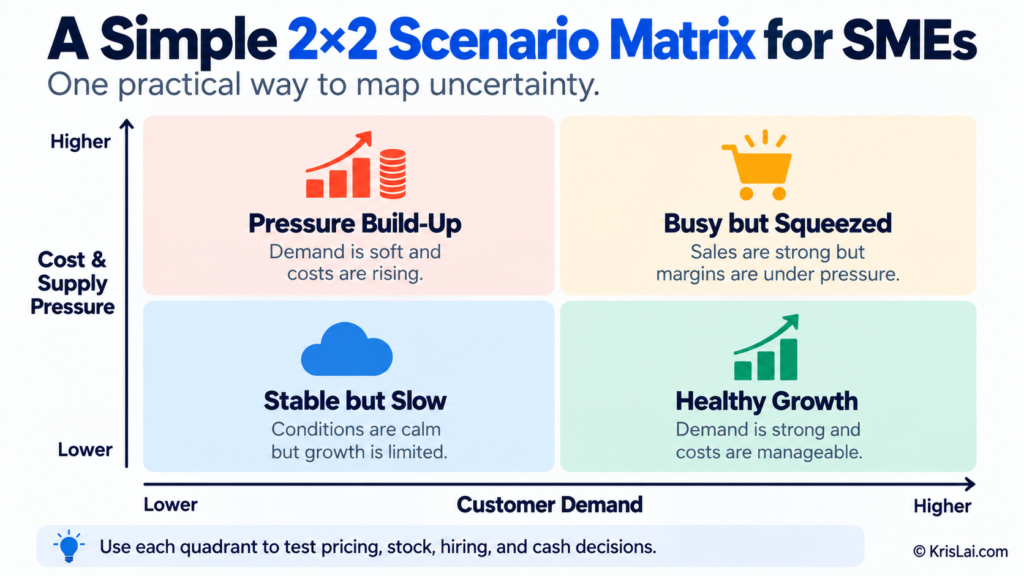
Notice that none of the four boxes is meant to be a prediction. Their value comes from forcing us to ask how pricing, staffing, investment, stock and cash decisions would change under each set of conditions.
Here is the process.
1. Write down the decision
For example:
Should we hire two permanent employees?
2. List important uncertainties
You might identify:
- future workload
- labour availability
- wage costs
- customer price sensitivity
- competitor activity
- economic demand
3. Rank them by impact and uncertainty
Suppose the strongest two are:
Future demand
and
Labour availability/cost
4. Create the matrix
| Labour Easier / Cost Manageable | Labour Difficult / Cost High | |
|---|---|---|
| Strong Demand | Controlled Growth | Capacity Squeeze |
| Weak Demand | Room to Wait | Margin Pressure |
You now have four different operating environments.
The next question is not:
“Which one do we think will happen?”
It is:
“What happens to our decision in each one?”
That is much more useful.
Scenario Planning Example for a Small Business
Consider a service business deciding whether to hire two permanent employees to support a possible increase in contract work. Demand looks encouraging, but future workload is not guaranteed and suitable labour is becoming harder to recruit. The decision affects capacity, customer service, margin and cash — ideal conditions for scenario planning.
Let us make the example more concrete…
Assume the business currently has around:
1,000 productive labour-hours of monthly capacity.
Confirmed and highly likely work currently uses approximately:
850 hours.
A possible new contract could add:
250–350 hours per month.
Two new employees would provide enough additional capacity, but would also create a significant fixed employment cost.
The owner could:
- hire two people immediately
- hire one person and keep some flexible capacity
- use subcontractors temporarily
- delay recruitment until demand becomes clearer
Now build the scenarios.
Scenario 1: Controlled Growth
Demand is strong. Labour remains reasonably available.
The new contract arrives.
Existing customers remain.
Recruitment is possible at acceptable cost.
Here, hiring may work well.
The business gains capacity without excessive wage pressure.
Possible decision: Recruit one person immediately and the second when workload reaches the agreed trigger.
Consequence: Capacity rises while some flexibility remains.
Scenario 2: Capacity Squeeze
Demand is strong. Labour becomes scarce and expensive.
Orders increase, which sounds like a nice problem to have.
Until everybody is working overtime, service quality starts slipping and recruitment agencies suddenly become very enthusiastic about their fees.
The business has demand but cannot easily convert it into profitable capacity.
Possible decisions:
- reprice new work
- recruit selectively
- use subcontractors
- redesign service specifications
- improve productivity
- decline low-margin work
Consequence: Growth remains possible, but poor staffing decisions could turn revenue growth into margin pressure.
Scenario 3: Room to Wait
Demand is weaker. Labour remains available.
The expected contract is delayed or volumes are lower.
The labour market remains manageable.
There is little reason to rush into two permanent hires.
Possible decision: Delay recruitment and retain flexible cover.
Consequence: The business protects cash without losing the ability to recruit later.
Scenario 4: Margin Pressure
Demand is weak. Labour is scarce and expensive.
This is the uncomfortable combination.
Revenue disappoints.
Wage expectations rise.
Competition may intensify.
Hiring two employees too early now creates fixed cost without enough work to absorb it.
Possible decision: Protect cash, avoid unnecessary fixed commitments, reprice weak work and improve utilisation before adding headcount.
Consequence: The company may sacrifice some growth capacity but avoids building a larger cost base on an assumption that failed.
Now add the signals
| Scenario Signal | What It May Mean | Possible Trigger | Response |
|---|---|---|---|
| Forward workload rising above available capacity | Stronger demand | Capacity exceeded for agreed period | Recruit |
| Recruitment time increasing sharply | Labour tightening | Hiring lead time exceeds limit | Recruit earlier/use flexible capacity |
| Wage offers rising above margin allowance | Labour cost pressure | Cost breaches planned ceiling | Reprice/redesign |
| Contract volumes below expected range | Demand weakening | Forward workload falls below threshold | Delay hiring |
| Overtime/rework rising | Capacity strain | Service or margin threshold breached | Add capacity/process improvement |
Notice what has happened.
We started with:
“Should we hire two people?”
We now have:
- different futures
- alternative decisions
- measurable signals
- thresholds
- planned responses
That is scenario planning doing real work.
In operational businesses, uncertainty often appears in combinations: demand rises while recruitment gets harder; sales grow while customers pay more slowly; costs rise while customers resist price increases.
In my experience, that is why a single forecast can be misleading. The difficulty is rarely one number moving neatly by itself. The real question is what happens when several conditions change together — and whether the business still has room to respond.
What Are the Main Types of Scenario Planning?
The main types of scenario planning include quantitative, operational, exploratory, normative and strategic scenarios. The labels vary between methods, and there is no single universal classification. For an SME, the important point is choosing the type that best helps with the decision rather than worrying about academic terminology.
Quantitative scenarios
These use numbers.
Useful for:
- revenue
- costs
- cash flow
- margins
- capacity
- debt
- investment returns
Example:
What happens to cash if sales fall 15%, wage costs rise 8% and customers take ten days longer to pay?
Operational scenarios
These examine how the business would function under different conditions.
For example:
- supplier failure
- staff shortages
- demand spikes
- delivery disruption
Exploratory scenarios
These ask:
What could plausibly happen?
They are useful when the future is open and uncertain.
Shell describes some of its own scenarios as exploratory scenarios built around plausible assumptions rather than a fixed desired outcome. Shell
Normative scenarios
These start with a desired future.
The question becomes:
If this is where we want to end up, what might have to happen for us to get there?
Strategic scenarios
These explore larger changes affecting the direction of the business:
- technology
- customer behaviour
- regulation
- competition
- market structure
- demographics
- geopolitical change
My advice is simple:
Do not get too attached to the labels!
The method should fit the decision.
Not the other way around.
Why Shell still matters
A industry-specific example comes from the energy sector. With increasing concerns about climate change and shifting consumer preferences towards renewable energy sources, companies in this field have embraced scenario planning to navigate future uncertainties. By exploring different scenarios such as policy changes or advancements in technology, energy companies can strategically position themselves for long-term success.
One notable example in the energy sector is Royal Dutch Shell, which utilized scenario planning in the 1970s. They anticipated the oil crisis and adjusted their strategies accordingly, positioning themselves to weather the storm better than competitors.
Shell is still one of the classic examples because it used scenarios to challenge management assumptions, not to claim certainty about the future.
Shell’s own scenario material still says its scenarios are not its strategy or business plan, but are designed to stretch management thinking.
That point still matters now…
Because the business world today is not simpler.
If anything, it gives us more reasons to prepare for several plausible futures rather than one tidy forecast.
How Can AI Help With Scenario Planning?
AI can support scenario planning by finding drivers, challenging assumptions, generating alternative futures, comparing implications and monitoring external signals. It can make the process faster and broader, but it should not be treated as a reliable predictor of the future or as a substitute for management judgement and trustworthy business data.
This is an area that is developing quickly.
Research published in 2026 specifically on AI-based scenario management for SMEs notes a familiar SME problem: smaller businesses often lack the time, expertise and tools needed for formal scenario work. The proposed answer is not fully automated decision-making but AI-supported systems that preserve human judgement, explainability and traceability. Cambridge University Press
Other research has similarly found that AI can improve scenario generation and analysis while retaining the importance of human judgement for context and final decisions. ScienceDirect
Good ways to use AI
Ask AI to:
- identify drivers you may have missed
- challenge assumptions
- suggest opposing viewpoints
- create alternative scenario narratives
- compare consequences
- propose possible signals
- organise large amounts of information
- explore “what if?” questions quickly
- summarise market or regulatory developments
For example:
“I am considering opening a second location. What high-impact uncertainties could change whether that decision works? Group them by customers, costs, people, competitors and regulation.”
Then:
“Which of these are both high impact and highly uncertain?”
Then:
“Create four contrasting but plausible scenarios using the two strongest uncertainties.”
That can be extremely useful.
Where AI can mislead you
AI can also:
- invent facts
- use outdated information
- assume your numbers are accurate
- produce plausible nonsense
- confuse possible with probable
- overcomplicate a simple decision
- sound far more certain than the evidence deserves
Use AI to expand the thinking.
Use reliable data, business knowledge and human judgement to narrow the decision.
If an AI model invents a market statistic and then builds a beautiful scenario around it, you have not created strategic foresight. You have created very well-formatted fiction.
What about AI and the Future of Search?
Scenario planning can also help businesses think about changing customer discovery.
If your business relies on Google, social platforms or online content, asking:
“Will AI replace search?”
is probably too simplistic.
Better uncertainties might be:
How quickly will customers adopt AI assistants for discovery?
and:
How much will those systems rely on identifiable, trusted source material when recommending businesses?
You can then explore different futures:
- traditional search remains dominant
- AI becomes an important additional discovery layer
- customers move heavily towards conversational discovery
- search fragments across AI tools, social platforms and conventional engines
The decision is not whether to predict the winner.
It is whether your marketing remains useful across several plausible discovery environments.
That might lead to no-regret actions such as:
- stronger first-hand content
- clearer expertise
- better structured answers
- original frameworks
- useful tools and templates
- credible citations
- recognisable brand signals
This is a good example of scenario planning applied to a real strategic uncertainty rather than a textbook exercise.
What Scenario Planning Tools Does an SME Need?
Most SMEs can start scenario planning with a spreadsheet, a whiteboard and a structured template. Specialist software becomes useful when models are complex, many departments contribute data or scenarios need frequent updates. The quality of the thinking matters far more than the price of the tool.
| Situation | Practical Tool |
|---|---|
| One important decision | Paper, whiteboard or simple template |
| Financial scenarios | Excel or Google Sheets |
| Team scenario workshop | Whiteboard or collaborative digital board |
| Connected financial planning | FP&A/planning software |
| Many changing data sources | Analytics and AI-supported tools |
| Complex enterprise modelling | Dedicated scenario/simulation platform |
You do not need specialist software to start scenario planning. I would choose the simplest tool that helps you understand the uncertainty, compare your options and make a better decision. More structured software becomes useful when the number of scenarios, people or financial variables starts to grow.
Disclosure: Some links below may be affiliate links. If you purchase through an affiliate link, I may earn a commission at no extra cost to you. I also include non-affiliate resources where I believe they may genuinely help the reader.
Excel or Google Sheets — best for getting started
For straightforward cautious, expected and optimistic scenarios, a spreadsheet may be all you need. It works particularly well when you want to test changes in sales, prices, costs, staffing, margins or cash without adding another software subscription.
Explore Microsoft Excel → | Explore Google Sheets →
MindManager — best for mapping strategic scenarios
MindManager can be useful when you want to organise drivers, critical uncertainties, possible futures and strategic options visually. It can also help teams map relationships between risks, decisions and actions before building a scenario matrix.
Explore MindManager →
Affiliate link.
LivePlan — best for financial “what-if?” scenarios
LivePlan is worth exploring when the main uncertainty is financial. It can help you compare different forecasts and examine what changes in sales, costs, hiring or investment could mean for profit and cash flow. This becomes particularly useful when a spreadsheet starts becoming difficult to maintain.
Explore LivePlan →
Currently a direct, non-affiliate link.
Creately — useful for collaborative scenario matrices
Creately is a visual collaboration option for teams that want to build 2×2 scenario matrices, map assumptions and discuss alternative futures together. It may suit businesses that prefer working visually rather than building everything inside a spreadsheet.
Explore Creately →
Currently a direct, non-affiliate link.
Do not choose the scenario planning tool with the longest feature list. Choose the simplest tool that helps you identify uncertainty, compare your options, understand the financial consequences and decide what would make you act.
For many SMEs, Excel is enough to start.
That does not mean Excel solves everything.
It means you do not need to buy another platform before you know what decision you are trying to improve.
There is a useful parallel with digital transformation here:
Do not start with the software. Start with the problem.
How Do You Turn Scenario Plans Into Practical Actions?
Turn scenario plans into action by attaching each important future to observable signals, a decision threshold, a planned response, a named owner and a review date. This creates a feedback loop. As conditions change, leaders can recognise the change earlier and respond without rebuilding the whole decision from scratch.
I use a simple Scenario-to-Decision Table:
| Scenario | Signal | What Changes? | Decision Trigger | Action | Owner |
|---|---|---|---|---|---|
| Strong demand | Enquiries/orders rise | Capacity pressure | Threshold reached | Add capacity | Operations |
| Weak demand | Pipeline falls | Revenue risk | Threshold reached | Protect cost/cash | MD/Finance |
| Labour squeeze | Vacancies stay open | Delivery risk | Lead time threshold | Reprice/flexible labour | Operations |
| Cost pressure | Input prices rise | Margin falls | Margin threshold | Reprice/redesign | Commercial |
Then set a review date.
That might be:
- monthly
- quarterly
- before the next investment stage
- when a specific signal moves
Scenario planning should not end when the scenarios are written. Once signals begin to change, the process becomes a continuing cycle of observation, decision, action and review.
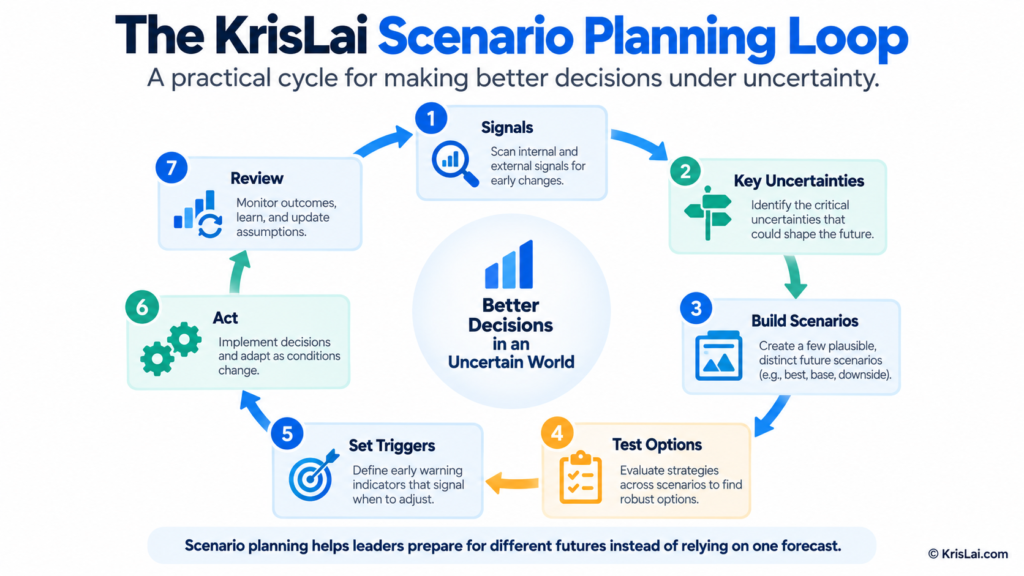
That feedback loop matters because today’s scenario eventually becomes tomorrow’s evidence. What you learn should change your assumptions, signals and decisions the next time around.
Do not review everything every day
Scenario planning can become another dashboard addiction.
Choose the few signals capable of changing the decision.
That is enough.
Use pre-agreed triggers
Triggers reduce the effect of emotion.
Imagine revenue starts falling.
Without a pre-agreed threshold, managers may:
- deny it
- panic
- wait too long
- cut too deeply
- blame marketing
- blame sales
- blame the economy
- schedule another meeting
A trigger gives the conversation a starting point.
The KrisLai Scenario Lens™
The KrisLai Scenario Lens connects scenario planning with four questions: how people may behave, which signals show the environment changing, what conditions shape the decision, and what consequences follow from each response. It helps keep scenario planning grounded in real business behaviour rather than numbers alone.
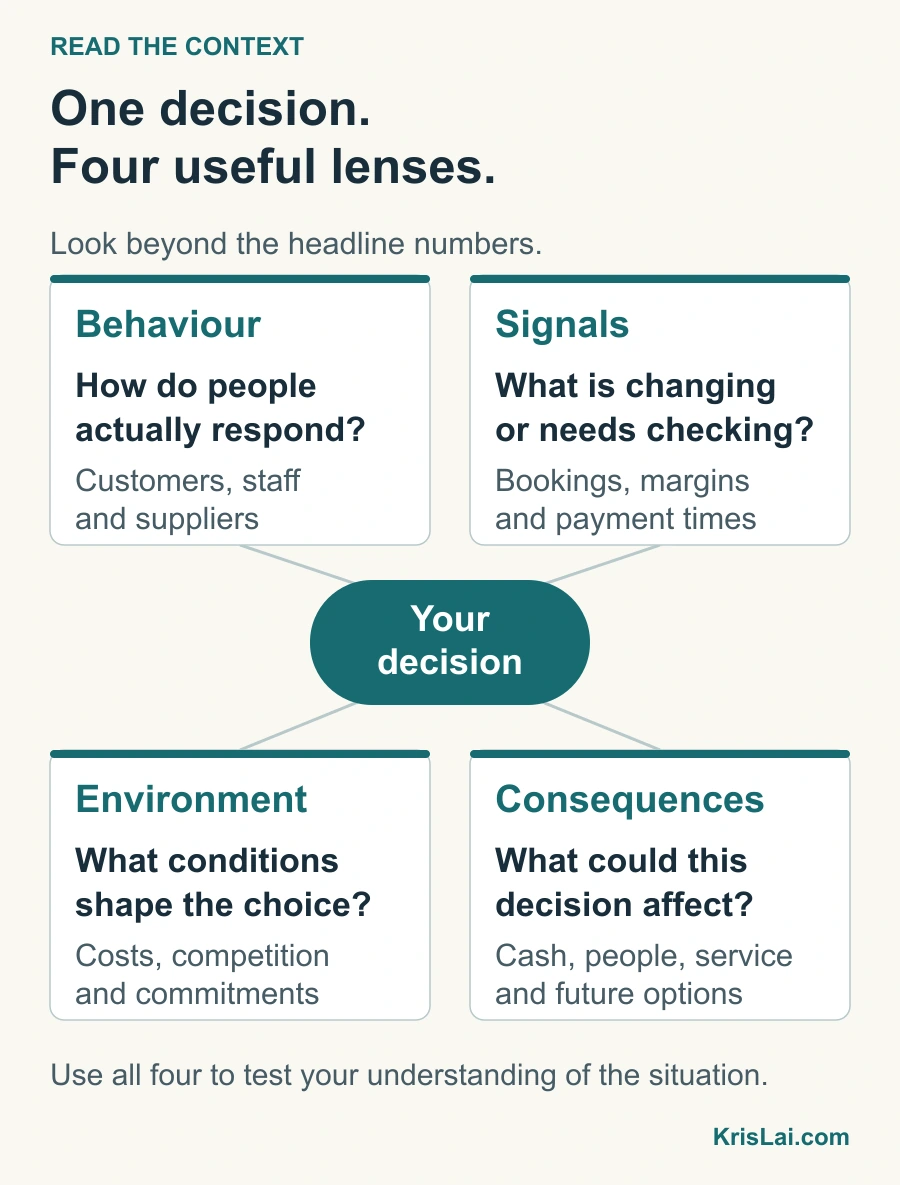
I think about each scenario through four lenses:
Human Behaviour
How might customers, employees, suppliers, competitors or regulators actually react?
A business model does not operate in a vacuum.
People adapt.
Customers delay purchases.
Staff leave.
Competitors copy.
Suppliers renegotiate.
Managers become more cautious under pressure.
Signals
What can we observe?
- enquiries
- cancellations
- search behaviour
- payment delays
- recruitment time
- complaints
- price changes
- conversion rates
- customer questions
Environment
What conditions are shaping the decision?
- economy
- regulation
- technology
- competition
- cash
- culture
- capacity
- incentives
Consequences
What happens next?
And then:
What happens after that?
A decision to cut prices may protect sales.
But what happens to margin?
Competitor response?
Customer expectations?
Future pricing power?
That is where scenario planning connects naturally with second-order thinking.
A practical model for better business decisions in complex environments. It focuses on four essential elements:
- Human Behaviour — how people actually think and decide
- Signals — what people are doing now
- Environment — the conditions shaping decisions
- Consequences — what happens next, and after that
Strong decisions consider all four — not just one.
This approach is part of the KrisLai Decision Framework, a practical method for improving business decisions.
Over time, I’ve found that good decisions rarely come from data alone. They come from understanding people, reading signals, creating the right environment, and thinking beyond the immediate outcome.
That is exactly why scenario planning fits the framework so well.
Better decisions come from understanding behaviour, signals, environment, and consequences.
Where Does Scenario Planning Go Wrong?
Scenario planning goes wrong when businesses create vague futures, choose irrelevant uncertainties, produce too many scenarios, confuse scenarios with forecasts or fail to connect them to decisions. The exercise should simplify strategic uncertainty enough to support action. If it merely produces more slides and more anxiety, something has gone wrong.
Here are the mistakes I see as most important:
1. Starting with the future instead of the decision
“Imagine the world in 2035” may be interesting.
But why?
Start with the decision.
2. Choosing uncertainties that cannot change the decision
A factor may be fascinating without being useful.
Ask:
If this changed, would we do anything differently?
If not, it probably should not dominate the exercise.
3. Building four versions of the same future
If every scenario assumes roughly the same customer behaviour, cost structure and competitive response, you have not really challenged the decision.
4. Making the worst case ridiculous
Your downside scenario does not need:
- recession
- cyber attack
- supplier collapse
- three resignations
- flood
- lawsuit
- asteroid
all on Tuesday!
The purpose is not to frighten everybody.
It is to test meaningful uncertainty.
5. Creating too many scenarios
More scenarios create more complexity.
Three or four strong scenarios are usually more useful to an SME than twelve weak ones.
6. Assigning fake probabilities
Sometimes credible probability estimates are available.
Sometimes they are not.
Do not write 23.7% probability because the spreadsheet demanded a number.
7. Ignoring behaviour
Customers, staff and competitors react to changing conditions.
A purely financial scenario may miss the most important effect.
8. Forgetting the signals
Without signposts, you may recognise the scenario only after it has already become obvious.
9. Never reviewing the plan
A scenario built in January may become irrelevant by September.
Update assumptions when the evidence changes.
10. Outsourcing judgement to AI
AI can make scenarios faster.
That does not automatically make them wiser!
Adding another worksheet, chart or decimal place can make scenario planning feel more scientific.
But a detailed model built on a weak assumption is still a weak model. Sometimes it is simply harder to notice.
Does Scenario Planning Actually Work?
Scenario planning can improve preparedness, challenge assumptions and help leaders test strategic choices, but it does not guarantee accurate predictions or better results. Research covers many different scenario methods, so evidence is stronger for some individual techniques than for scenario planning treated as one single, standardised method.
That qualification is important.
Scenario planning is popular partly because it feels sensible.
But “popular” and “proven in every setting” are not the same thing.
A 2023 review of reviews highlighted three recurring challenges in the research:
- conceptual confusion
- diversity of methods
- limited evidence on overall effectiveness
The same review found clearer evidence of impact for specific scenario techniques and better clarity within individual scenario-planning schools. ScienceDirect
I think the practical lesson for SMEs is healthy.
Do not treat scenario planning as magic.
Use it when it helps you:
- frame the decision
- expose important assumptions
- create real alternatives
- see consequences
- identify signals
- prepare action
If it does those things, it is useful.
If it mainly creates an impressive workshop photograph involving sticky notes, the return may be harder to defend…
What Should You Actually Do?
Choose one important decision you expect to make within the next 6–24 months. Write it as a clear question, identify the two uncertainties most likely to change the answer, build three or four plausible futures, then decide what you would watch and what would make you act differently.
You can start in about 30 minutes.
A 30-Minute Scenario Planning Exercise
Minutes 1–5: Define the decision
Write:
We need to decide whether to __________ by __________.
Then list two or three realistic alternatives.
Minutes 6–12: Identify uncertainties
Ask:
What would have to change for us to regret this decision?
List the answers.
Then rank them by:
Impact × Uncertainty
Minutes 13–18: Build scenarios
Choose the two strongest uncertainties.
Create a 2×2 matrix.
Give each future a memorable name.
Minutes 19–25: Stress-test the options
Ask:
- What works?
- What fails?
- What becomes risky?
- What becomes attractive?
- Which action helps in most scenarios?
Minutes 26–30: Set one trigger
Choose the most important signal.
Write:
If __________ reaches __________, we will __________.
Now you have something operational.
Not perfect!
Useful.
That matters more.
The aim of scenario planning is not to become better at predicting the future.
It is to avoid making a decision that only works if your favourite version of the future turns out to be correct.
There is also an old Chinese expression that fits this idea well:
未雨绸缪 (Wèiyǔ-chóumóu)— prepare before the rain arrives.
That, in a few words, is what scenario planning is trying to achieve.
People Also Ask
How far ahead should scenario planning look?
Use a time horizon long enough for uncertainty to matter but short enough to affect today’s decision. For many SME decisions, 12 months to three years is useful. Major investments, property, technology or market shifts may justify a longer horizon.
Who should be involved in scenario planning?
Include the people who understand the decision from different angles. That may include leadership, finance, operations, sales and frontline employees. Different viewpoints help expose assumptions that one department may overlook.
How often should business scenarios be reviewed?
Review them when important signals change and at an agreed regular interval. Quarterly may suit many strategic decisions, while fast-moving situations may need monthly review. Do not update scenarios simply to keep the spreadsheet busy.
Should you assign probabilities to scenarios?
Only when you have a reasonable evidence base. Scenario planning does not require precise probabilities. In highly uncertain situations, pretending to know the probability can create false confidence.
What is the difference between a scenario and a stress test?
A stress test usually pushes a model or decision towards an adverse condition to see where it breaks. A scenario is broader and may combine several changes in customers, markets, costs, technology or behaviour to describe a plausible future environment.
Can startups use scenario planning?
Yes. Startups often face unusually high uncertainty around demand, funding, pricing, hiring and product adoption. A lightweight scenario exercise can help founders identify which assumptions matter most and avoid treating a hopeful forecast as a fact.
Frequently Asked Questions About Scenario Planning
1. What is scenario planning in simple terms?
Scenario planning is a way to prepare for several possible futures instead of relying on one prediction. A business identifies important uncertainties, builds a few plausible scenarios and tests its decisions against them so leaders can respond more quickly if conditions change.
2. What are the five steps of scenario planning?
A practical five-step scenario planning process is: frame the decision, identify critical uncertainties, build plausible scenarios, stress-test your options, and set signals, triggers and actions. This turns future thinking into a practical decision process.
3. How many scenarios should a business create?
Most small and medium-sized businesses can work effectively with three or four scenarios. The scenarios should be meaningfully different and relevant to the decision. Too many scenarios can create complexity without improving the quality of the choice.
4. What is a scenario planning matrix?
A scenario planning matrix is usually a 2×2 grid built from two high-impact uncertainties. Each uncertainty forms one axis, creating four different future conditions. Leaders then examine what each environment would mean for their strategy and current decisions.
5. What is the difference between scenario planning and forecasting?
Forecasting estimates the most likely future based on data and trends. Scenario planning explores several plausible futures, especially where uncertainty is high. Forecasts are useful for expected conditions; scenarios are useful when important assumptions may change.
6. What is the difference between scenario planning and sensitivity analysis?
Sensitivity analysis normally changes one variable at a time to see how it affects an outcome. Scenario planning can change several connected conditions together, including factors such as customer behaviour, labour, technology, competition and regulation.
7. What are scenario planning examples for small businesses?
Examples include testing whether to hire staff if demand changes, examining supplier alternatives if disruption grows, planning cash requirements under different sales conditions, assessing expansion plans, or deciding whether an AI or automation investment still makes sense under different adoption rates.
8. What tools can small businesses use for scenario planning?
Small businesses can begin with a spreadsheet, whiteboard and structured scenario planning template. More advanced planning or simulation software becomes useful when the organisation has complex financial models, several data sources, multiple departments or a need for frequent scenario updates.
9. Can AI do scenario planning?
AI can help identify trends, challenge assumptions, generate alternative scenarios, compare implications and monitor signals. However, AI should support rather than replace management judgement. Its outputs should be checked against reliable data, business context and real operational knowledge.
10. Why is scenario planning important in strategic management?
Scenario planning helps strategic management because long-term decisions often depend on conditions leaders cannot control. Exploring several plausible futures reduces dependence on one forecast and helps businesses identify flexible options, warning signals and actions before changing conditions become urgent.
Research, Experience and Method
This article combines:
- practical business and operational experience
- independent research
- analysis and synthesis of scenario-planning methods
- decision-making research
- current work on AI-assisted scenario planning
Scenario planning has several schools and methodologies rather than one universal process. I have therefore deliberately translated the strongest common principles into a practical SME decision method rather than presenting one model as the only correct approach.
Useful research and reference sources include:
- IBM — What Is Scenario Planning?
- SAP — What Is Scenario Planning?
- Shell — Shell Scenarios
- ScienceDirect — Types of Scenario Planning and Their Effectiveness
- Strategic Decisions Group — Decision Quality
- Harvard Business Review — Use GenAI to Improve Scenario Planning
- Cambridge University Press — AI-Based Scenario Management for SMEs
I write about how better decisions are made in business — combining strategy, behaviour, and practical thinking.
I help people make better business decisions through psychology, strategy, and practical thinking.
Related Reading
Scenario planning becomes more useful when you connect it to risk, second-order consequences, business acumen and a wider decision-making framework.
- The KrisLai Decision Framework: A Better Way to Make Business Decisions
- Second-Order Thinking in Business: Why Smart Leaders Look Two Steps Ahead
- Risk Thinking: How to Make Better Business Decisions When Outcomes Are Uncertain
- Business Acumen for Managers: 7 Skills for Better Decisions
- Profit Engineering: 7 Ways to Improve Small Business Profit
Link destinations:
The KrisLai Decision Framework
Second-Order Thinking in Business
Risk Thinking and Business Decisions Under Uncertainty
Profit Engineering for Small Business
Download the Scenario Planning Decision Template
Turn one important choice into a practical plan. Define the decision, explore four plausible futures, compare your options and agree what would make you act, adjust or stop.
The eight-page PDF includes fillable worksheets, a decision record and a worked hiring example. You can complete it on screen or print it for a team discussion.
- Test a real choice against several plausible futures.
- Connect early signals to clear triggers, actions and owners.
- Keep a decision record you can revisit as conditions change.
Conclusion and Final Thoughts: Prepare for Change Without Pretending You Can Predict It
Scenario planning is useful because business decisions have to be made before the future becomes clear.
You cannot know exactly what customers, competitors, costs, technology or the wider economy will do.
You can make sure one unexpected change does not leave you with no good options.
The aim is not perfect foresight.
It is better preparedness, clearer choices and faster adaptation.
This connects closely to how I think about decisions more broadly in the KrisLai Decision Framework™.
Better decisions come from understanding behaviour, signals, environment, and consequences.
Do not try to scenario-plan your entire business.
Choose one important decision you expect to make in the next 6–24 months and use the Scenario Planning Decision Template to test it against several plausible futures.
That one exercise can show you which assumptions matter, which signals to watch and where you still have room to choose.
This approach is part of the KrisLai Decision Framework, a practical method for improving business decisions.
If you enjoy exploring the ideas behind better business decisions, you may find the Business Thinking Hub useful. Visit the Business Thinking Hub
About the author
Kris Lai is a business operator and managing director with experience in land and building surveying, facilities management, logistics, and service delivery.
Earlier in his career, he worked as a Search Engine Evaluator (via Lionbridge, supporting Google), where he assessed search result relevance, user intent, and content quality using structured evaluation frameworks. This experience gives him a rare, practical understanding of how search systems interpret signals and make ranking decisions.
In parallel, whilst working with a charity organisation, he has delivered 1000’s of structured presentations in English, Finnish, and Chinese to audiences ranging from small groups to more than 600 people, and has spent decades mentoring and developing others. This experience informs his approach to clarity, communication, and decision-making under pressure.
He writes about AI, search behaviour, business strategy, and decision-making from a practical, real-world perspective.
👉 Explore ideas connected to better business decisions:
- Digital Transformation for SMEs: 7 Questions Before You InvestDigital transformation for SMEs should start with better decisions, not more technology. This guide explains seven questions to ask before investing in AI, automation, data systems, or new software, helping you improve processes, reduce risk, and prove value before you scale.
- Cybersecurity for Businesses: 7 Decisions Leaders Must MakeCybersecurity for businesses is not just an IT issue. It is a leadership decision about protecting email, accounts, devices, backups, staff behaviour, customer data, supplier access, trust, and business continuity. This guide explains the seven cyber decisions leaders should make before a small problem becomes a costly incident.
- How AI Is Changing Search Behaviour (And What Businesses Must Do Now)AI is changing how people search, compare, and buy. Learn what this means for visibility, trust, and growth — and what businesses must do now.
- 7 Decision-Making Framework Examples for Business LeadersSeven practical decision-making frameworks for managers and business owners, with real business examples, guidance on when to use each model, a simple framework selector and a decision template.
- Business Decision-Making Framework: The KrisLai MethodMake more informed business decisions under uncertainty with the KrisLai Decision Framework. Explore four complementary lenses, follow a practical five-step process, and learn from my real pricing decision that reduced workload while increasing revenue and profit.