
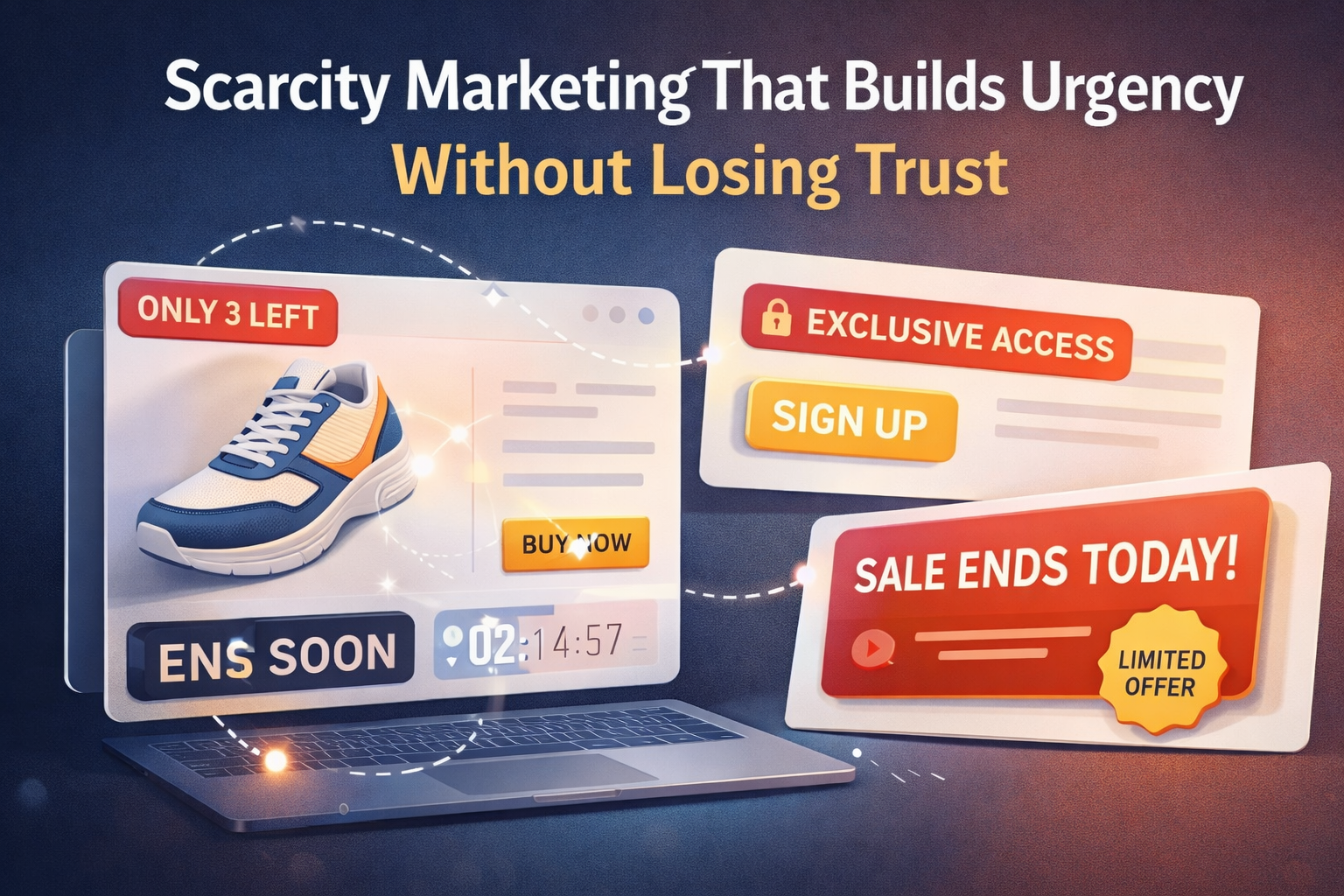
Scarcity marketing, sometimes called the scarcity selling technique, works by limiting stock, limiting time, or limiting access in order to encourage people to act sooner. In this guide, I explain how it works, why it can be so effective, when to use it, and how to avoid making it feel fake, pushy, or damaging to trust.
Disclosure: If you click on my affiliate/advertiser’s links, I am going to receive a tiny commission. AND… Most of the time, you will receive an offer of some kind. It’ s a Win/Win!
What this article covers
In this article, I will explain what scarcity marketing really means, why it works on buyers, the main types of scarcity you can use, how to apply it honestly, what real-world examples look like, and the common mistakes that make scarcity backfire.
This article is based on practical business thinking, independent research, and my own analysis and synthesis of how urgency, trust, and customer behaviour shape buying decisions.
Scarcity is powerful because it changes how people judge value.
When something may not be available later, people pay more attention to it now.
That does not mean every scarce offer works! It does not mean urgency should be forced into everything either. But when the scarcity is real, relevant, and clearly explained, it can help people stop delaying and make a decision.
That is why this topic matters.
In 2026, buyers are surrounded by more offers, more noise, more comparison, and more hesitation than ever. A good offer still matters most, but timing, trust, and decision friction matter too. Scarcity can help with that — if it is used honestly.
I do not see scarcity as a cheap trick.
I see it as a decision tool that can work well when it reflects something real:
- real stock limits
- real deadlines
- real capacity
- real access windows
I write about how better decisions are made in business — combining strategy, behaviour, and practical thinking. Better decisions come from understanding behaviour, signals, environment, and consequences.
Key ideas
- Scarcity works best when it is real.
- It can increase action because people value what may soon disappear.
- False urgency weakens trust fast.
- Scarcity cannot rescue a weak offer.
- The best use of scarcity is honest, clear, and relevant to the buyer.

What is the scarcity selling technique?
The scarcity selling technique is a way of increasing urgency by showing that an offer is limited.
That limit might be:
- time
- stock
- access
- price
- availability
- bonus value
In simple terms, it tells the buyer:
“This will not be here forever.”
That matters because many people delay decisions.
They wait.
They compare.
They hesitate.
They tell themselves they will come back later.
Scarcity changes that by making the cost of waiting feel more real.
The simple meaning of scarcity in sales
Scarcity in sales means something is limited in a way that matters to the buyer.
Common forms include:
- only a few units left
- offer ends tonight
- registration closes Friday
- only 10 places available
- members-only access
- early-bird pricing
- bonus included for a short time only
The key point is this:
real scarcity is useful
made-up scarcity is risky
That difference matters more than many marketers admit.
What is scarcity marketing, in simple terms?
Scarcity marketing is the use of real limits on time, quantity, or access to encourage faster buying decisions. It works best when the scarcity is genuine and clearly explained.

Why does scarcity work so well?
Scarcity works because buyers often want something more when they think they could miss it.
There are a few simple psychological reasons behind that:
- FOMO — fear of missing out
- loss aversion — people dislike losing opportunities
- reactance — when freedom feels limited, people often want the option more
- perceived value — rare things often feel more valuable
In plain English, people often act faster when they think:
- “I may not get another chance”
- “If I wait, I might lose this”
- “This must be valuable if it is limited”
That does not make people foolish. It just shows how decisions work in real life.

What are the main types of scarcity you can use in marketing?
Scarcity is not one thing.
Different types work in different situations.
Limited quantity scarcity
This is when the number available is limited.
Examples:
- only 3 left
- limited stock
- only 20 seats available
- one final batch
- small production run
This often works well when:
- the item is visible
- the offer is desirable
- the stock limit feels believable
- the buyer knows replacement may not be easy
Low-stock messaging is especially common in ecommerce because it is easy for buyers to understand quickly.
Limited-time scarcity
This is when the buyer has only a set amount of time to act.
Examples:
- sale ends tonight
- offer closes Friday
- bonus expires at midnight
- launch pricing ends in 48 hours
- proposal valid for 7 days
This can work well because time pressure often reduces delay.
But it only works when the deadline is believable and genuine.
If every offer ends tonight, buyers stop taking it seriously.
Exclusive-access scarcity
This is when not everyone can get in.
Examples:
- waitlist only
- invite-only access
- members-only products
- early access for subscribers
- limited private release
This type often works well for:
- premium offers
- niche communities
- launches
- brands with strong identity
- services with limited capacity
Scarcity in pricing and bonuses
Sometimes the scarcity is not the product itself, but the pricing or the added value.
Examples:
- introductory pricing
- first 50 buyers get a bonus
- early-bird rate
- free setup this week only
- bonus training available until launch closes
This can be effective because it gives buyers a reason to act now without pretending the product itself is disappearing.
A practical example
A service business with limited client capacity can use scarcity honestly by saying it only takes on three new clients each month. That is very different from pretending availability is limited when it is not. One builds trust. The other damages it.
How do you use scarcity without damaging trust?
This is the most important part of the article!
Scarcity can improve timing.
It can encourage action.
But it can also damage credibility if used badly.
Use real limits, not fake pressure
This is the golden rule.
If stock is not actually low, do not say it is.
If a deadline is not real, do not invent one.
If access is not genuinely limited, do not pretend otherwise.
People do notice patterns.
And once they stop believing the urgency, the tactic loses its power.
Worse than that, trust begins to crack.
Match the tactic to the product and the audience
Scarcity works best when it fits the offer naturally.
For example:
- handmade products with small production runs
- seasonal services with limited booking slots
- event tickets
- training programmes with limited seats
- launch bonuses that end on a real date
- proposal expiry where time and resource planning matter
It works less well when it feels forced or copied from a template.
A handmade item with only 12 available makes sense.
A generic service with a fake countdown timer does not.
Use scarcity to reduce delay, not to trap people
This is how I think about it.
Good scarcity helps a serious buyer make a timely decision.
Bad scarcity corners people.
That is a big difference.
This approach is part of the KrisLai Decision Framework, a practical method for improving business decisions.
Because if scarcity creates action but weakens trust, the long-term result may be worse.
What this means in real business
Scarcity works best when it reflects something true about the offer. It should help buyers decide sooner, not pressure them unfairly. In good business, urgency should support trust, not replace it.
Examples of scarcity selling techniques that work in the real world
A good way to understand scarcity is to look at where it appears naturally.
Low-stock messages and basket activity on ecommerce sites
You have probably seen:
- only 1 left
- 7 people are viewing this item
- this item is in 4 baskets
- low stock alert
These examples often combine scarcity with social proof.
They work because they suggest:
- the item is limited
- other people want it
- delay may carry a cost
This can be powerful, especially when the product is already attractive.
Limited-edition launches and short release windows
Brands often use:
- seasonal drops
- one-off colours
- collector versions
- short launch windows
- early access
- waitlists
This works best when the audience already cares about the product, brand, or community.
In those cases, scarcity adds energy to something desirable.
It does not create the desire from nothing.
Proposal deadlines in service businesses
This is one of the more useful business examples.
A proposal with a real expiry date can make sense because:
- pricing may change
- availability may change
- project scheduling matters
- resources may be limited
This is very different from fake urgency.
It is real operational scarcity.
Limited client capacity
Consultants, agencies, coaches, and specialists often have genuine limits.
If a business can only serve five new clients properly this month, saying so can be honest and useful.
That kind of scarcity often feels more credible because it is clearly linked to delivery capacity.
The KrisLai Scarcity Lens™
- Behaviour – how do buyers actually respond to urgency?
- Signals – what shows genuine interest and what shows hesitation?
- Environment – does the offer make scarcity believable in this market and context?
- Consequences – what happens if urgency improves conversions but weakens trust?
Better decisions come from understanding behaviour, signals, environment, and consequences.

Where does scarcity selling go wrong?
Scarcity is powerful, but easy to misuse.
Important UK warning on fake scarcity claims
In the UK, misleading scarcity and urgency tactics can create real legal risk.
The Competition and Markets Authority (CMA) has already taken action over countdown timers and other urgency claims that may have given shoppers a false impression that they needed to act quickly. More recently, stronger enforcement powers under the Digital Markets, Competition and Consumers Act 2024 have increased the pressure on businesses to get these tactics right.
If you use scarcity in marketing, make sure the limit is genuine, the wording is accurate, and the pressure is not misleading. Fake deadlines, false low-stock claims, and invented urgency may not only damage trust — they can also attract regulatory attention.
This is one more reason to use scarcity carefully, honestly, and only when the limit is real.
Overusing urgency until buyers stop believing it
This is one of the most common mistakes.
If every sale is:
- ending tonight
- almost gone
- the final chance
- disappearing in hours
then buyers learn not to believe it.
Once that happens, urgency loses its force.
Using scarcity to hide a weak offer
This is another big one.
Scarcity can improve timing.
It cannot repair:
- poor quality
- weak positioning
- bad pricing
- unclear value
- unconvincing messaging
If the offer is weak, urgency may bring a few short-term responses, but it will not create lasting trust or stronger results.
Creating pressure without enough proof
If you ask people to move fast, they usually need more reassurance, not less.
That means:
- clear value
- proof
- trust signals
- better messaging
- fewer doubts
(This topic links closely to science-based selling, behavioural economics, and trust-led marketing, all of which I have written about.)

Being technically honest but practically misleading
Sometimes the problem is not a direct lie.
Sometimes the wording is technically true but clearly designed to create a false impression.
That is still risky!
If people feel manipulated, the sale may not be worth the damage.
Where this goes wrong
Scarcity backfires when it is exaggerated, overused, or used to distract from a weak offer. If the urgency is louder than the value, buyers often notice.

How do you combine scarcity with trust, proof, and better decision-making?
This is where I think the best marketers get it right.
Scarcity should not work alone.
It should sit alongside:
- proof
- clarity
- relevance
- trust
- honest communication
That means a stronger offer usually looks like this:
- good product or service
- clear value
- believable proof
- relevant urgency
- genuine limit
This connects closely to how I think about decisions more broadly in the KrisLai Decision Framework™.
Because good scarcity is not really about pressure.
It is about helping a genuine buyer understand that waiting has a real cost.
A practical model for better business decisions in complex environments. It focuses on four essential elements:
- Human Behaviour — how people actually think and decide
- Signals — what people are trying to do right now
- Environment — whether the system supports good decisions
- Consequences — what happens next, and after that
Strong decisions consider all four — not just one.
Final thought: scarcity should sharpen decisions, not manipulate them
Scarcity works because people value what may soon be gone.
That part is real.
But the best use of scarcity is not manipulative.
It is clear, honest, and linked to something true about the offer.
That is when it feels useful instead of pushy.
That is also when it supports long-term trust instead of weakening it.
If the offer is strong and the scarcity is real, urgency can help the buyer make a decision.
If the scarcity is fake, it may win a moment but lose the relationship.
As the Finnish saying goes, rehellisyys maan perii – Honesty goes the longest way.
Final takeaway
Scarcity selling works best when the limit is real and the offer is worth buying. Use it to support good decisions, not to force weak ones. Clear urgency and honest value are far stronger together than pressure alone.

Related reading on KrisLai.com
- Related article: Science-Based Selling
- Glossary or definition article: Behavioural Economics in Business
- Pillar topic: Business Thinking Hub
- Customer Intent Marketing
- Left-Brain Marketing
- How AI Is Changing Search Behaviour
Frequently Asked Questions About Scarcity Marketing
What is scarcity marketing?
Scarcity marketing is the use of real limits on time, quantity, or access to encourage faster buying decisions. It works best when the scarcity is genuine and clearly explained.
Why does scarcity marketing work?
Scarcity marketing works because people often value things more when they believe they may miss the chance to get them later. It increases urgency and can reduce decision delay.
What is the difference between urgency and scarcity?
Scarcity usually refers to something being limited, such as stock, time, or access. Urgency is the feeling that action should happen soon. The two often work together, but they are not exactly the same thing.
Is scarcity marketing ethical?
Yes, scarcity marketing can be ethical when the limit is real and honestly communicated. It becomes unethical when businesses create fake pressure or misleading urgency.
What are common scarcity marketing mistakes?
Common mistakes include fake deadlines, false low-stock messages, overusing urgency, and trying to use scarcity to hide a weak offer or poor value.
When does scarcity selling work best?
Scarcity selling works best when the limit makes natural sense, such as limited stock, limited client capacity, a real booking deadline, or a genuine launch window.

About the author
Kris Lai is a business operator and managing director with experience in land and building surveying, facilities management, logistics, and service delivery. He writes about AI, search behaviour, business strategy, and decision-making from a practical, real-world perspective.
👉 Explore ideas connected to better business decisions:
- Digital Transformation for SMEs: 7 Questions Before You Invest
- Cybersecurity for Businesses: 7 Decisions Leaders Must Make
- How AI Is Changing Search Behaviour (And What Businesses Must Do Now)
- 7 Decision-Making Framework Examples for Business Leaders
- Business Decision-Making Framework: The KrisLai Method