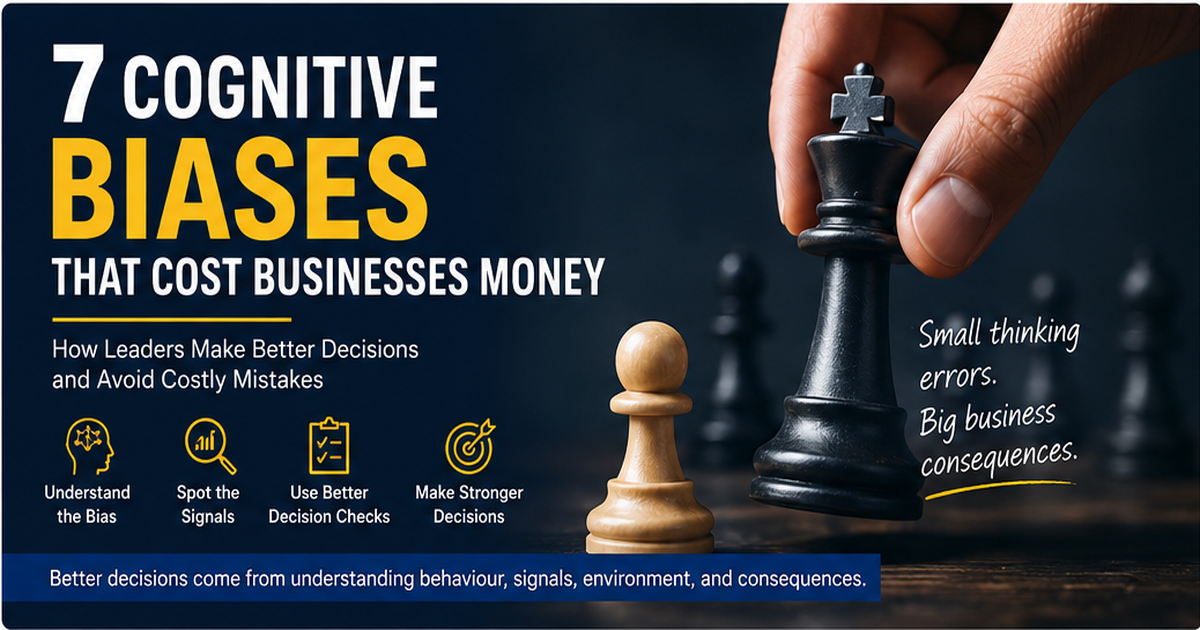
Cognitive biases are hidden thinking shortcuts that can distort business decisions. They affect how leaders read data, judge risk, allocate budgets, hire people, and respond to change. The danger is not having bias. Everyone has it. The danger is letting bias quietly become strategy.
This article explains what cognitive biases are, how they affect business decision-making, where they usually go wrong, and what leaders can do to reduce their impact. It also shows how cognitive bias connects to strategy, AI, data, leadership, and decision-making under uncertainty.
A cognitive bias is a repeated thinking pattern that can distort judgement. In business, cognitive bias can make weak evidence feel strong, familiar options feel safer than they really are, and risky decisions feel more certain than they deserve.
Put simply: cognitive bias is when the mind takes a shortcut, but the business pays the bill.
Why smart leaders still make poor decisions
Most bad business decisions are not made by foolish people.
That is worth saying early.
In my experience, poor decisions often start with intelligent people working under pressure, with limited time, incomplete information, and a strong need to “do something”.
That is exactly when cognitive biases become dangerous.
A leader may think they are being strategic. A team may think they are being data-driven. A board may think it has reached a sensible agreement. But underneath the surface, the decision may already be shaped by hidden assumptions, selective evidence, fear of loss, or the desire to avoid uncomfortable disagreement.
That is why cognitive biases in business decision making matter so much.
They do not just affect how we think. They affect what we notice, what we ignore, what we fund, what we stop, what we defend, and what we call “strategy”.
And sometimes, let’s be honest, “strategy” is just yesterday’s bad assumption wearing a clean shirt.
This article contains affiliate links. If you buy through them, I may earn a commission at no extra cost to you. I only include affiliate links where they are genuinely relevant.
What is cognitive bias?
Cognitive bias is a thinking shortcut that affects how people notice, interpret, remember, and use information.
The term is closely linked to the work of Amos Tversky and Daniel Kahneman, who studied how people make judgements under uncertainty. Their research showed that people often use mental shortcuts, known as heuristics, when making decisions in complex situations.
You can read more about their original research here:
Judgment under Uncertainty: Heuristics and Biases — Tversky and KahnemanPsychology sources such as Britannica and Verywell Mind explain cognitive bias as a pattern of thinking that can lead to errors in judgement, especially when people rely too heavily on fast, automatic thinking.
Useful background reading:
Britannica: Cognitive BiasVerywell Mind: How Cognitive Biases Influence the Way You Think and ActIn simple terms, a cognitive bias is not stupidity. It is the brain trying to be efficient.
That can be useful when the decision is simple.
It can be costly when the decision is complex.
What are cognitive biases in business decision-making?
Cognitive biases in business decision-making are hidden thinking patterns that influence commercial judgement.
They can affect decisions about:
pricing
hiring
marketing
investment
budgeting
sales strategy
customer behaviour
supplier risk
digital transformation
AI adoption
product launches
business growth
In business, cognitive bias often shows up when leaders believe they are being rational, but are actually protecting a preferred answer.
This is why data alone is not enough.
Over time, I’ve found that good decisions rarely come from data alone. They come from understanding people, reading signals, creating the right environment, and thinking beyond the immediate outcome.
Data can help. But data still needs judgement.
And judgement can be biased.
Cognitive bias becomes dangerous when leaders confuse confidence with evidence. A decision may feel right because it is familiar, popular, recent, or emotionally comfortable — not because it is actually the best choice.
Are cognitive biases always bad?
No. Cognitive biases are not always bad.
Some mental shortcuts help us act quickly. If every small business decision needed a full committee, a spreadsheet, a consultant, and three follow-up meetings, nothing would ever get done.
The problem starts when a shortcut built for speed is used for a decision that needs evidence, challenge, and reflection.
A quick judgement may be fine when choosing where to buy office coffee.
It is less fine when deciding whether to hire five people, enter a new market, change pricing, buy expensive software, or continue funding a weak project.
The issue is not whether leaders have bias.
They do.
I do.
You do.
The issue is whether the decision process is strong enough to catch it before it causes damage.
A practical model for better business decisions in complex environments. It focuses on four essential elements:
- Human Behaviour — how people actually think and decide
- Signals — what people are trying to do right now
- Environment — whether the system supports good decisions
- Consequences — what happens next, and after that
Strong decisions consider all four — not just one.
Idea Bridge: from psychology to business risk
Cognitive bias is often explained as a psychology topic.
That is useful, but it is not enough for business leaders.
In business, cognitive bias is also a risk issue.
A biased decision can lead to:
wasted marketing spend
poor hiring
weak pricing
bad forecasting
slow response to market change
failed projects
missed warning signs
bad use of AI
overconfidence in poor strategy
This is why I do not see cognitive biases as abstract theory.
I see them as business warning signals.
This approach is part of the KrisLai Decision Framework, a practical method for improving business decisions. Better decisions tend to come from understanding behaviour, signals, environment, and consequences.
The Bias-to-Bad-Decision Loop
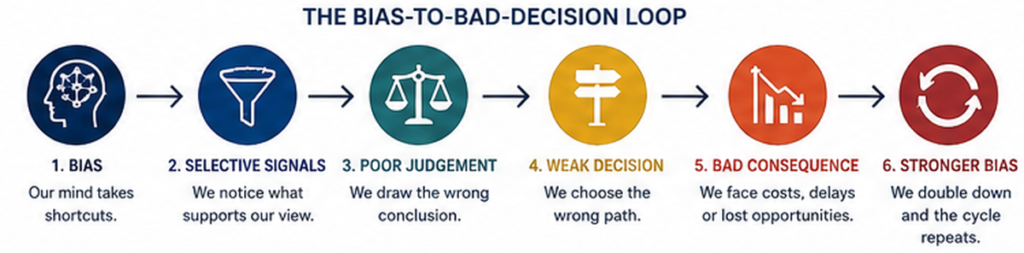
Here is the simple loop I use to explain how cognitive bias becomes a business problem:
In plain English:
A leader has a bias.
That bias affects which signals they notice.
Those selected signals shape their judgement.
That judgement leads to a weak decision.
The weak decision creates a poor result.
Then the leader explains the poor result in a way that protects the original bias.
And round we go.
Very efficient.
Also very expensive!
Bias → Selective signals → Poor judgement → Weak decision → Bad consequence → Stronger bias
The danger is not just the first biased thought. The danger is the loop that forms when leaders keep using poor results to defend poor thinking.
What this looks like in real business
A business owner keeps investing in a marketing channel because it worked well last year.
At first, this seems sensible.
The channel produced leads. The team understands it. The reports look familiar. The owner feels safe because there is history.
But this year, the numbers have changed…
Cost per enquiry has risen.
Lead quality has dropped.
Customers are taking longer to decide.
Competitors are more active.
AI search behaviour is changing how people discover answers.
The team still highlights the few good leads the channel produced. They ignore the weaker trend. They explain poor performance as a temporary dip.
That is not strategy!
That is confirmation bias wearing a nice jacket.
The behaviour is understandable. The business wants reassurance.
The signal is weak, but selected carefully.
The environment is full of pressure.
The consequence is more money going into a channel that may no longer deserve it.
This is how cognitive bias affects business decisions. It rarely arrives with flashing lights. It arrives looking like common sense.
Direct answer: how do cognitive biases affect business decisions?
Cognitive biases affect business decisions by changing how leaders interpret evidence, assess risk, judge alternatives, and respond to uncertainty.
They can make leaders:
trust familiar options too much
ignore warning signs
overvalue recent events
continue failing projects
copy competitors too quickly
avoid necessary change
accept weak data because it supports a preferred view
treat AI output as more reliable than it really is
That is why leaders need decision checks, not just more information.
More information does not always solve bias.
Sometimes it only gives bias more material to play with!
7 cognitive biases that lead to costly business decisions
The following seven cognitive biases are especially common in business decision-making.
They are not the only ones, but they are among the most damaging because they affect strategy, leadership judgement, finance, marketing, people, and execution.
1. What is confirmation bias in business?
Confirmation bias in business is when leaders look for evidence that supports what they already believe and give less attention to evidence that challenges it.
This is one of the most common cognitive biases in business decision making.
A leader may decide that a new service will work, then ask the team to “find the data”. Notice the order. The decision came first. The evidence came afterwards.
McKinsey describes confirmation bias as the tendency to look for evidence that supports a hypothesis or interpret unclear data in a way that supports it.
Useful reference:
McKinsey: Biases in decision-making

What this looks like in real business
A company launches a new service.
The owner believes it will be a winner.
The team reports three positive customer comments, two promising enquiries, and one competitor doing something similar.
Less attention is given to poor conversion, weak margins, delivery issues, or customer confusion.
Everyone feels encouraged.
The spreadsheet, sadly, remains unimpressed.
Where this goes wrong
Confirmation bias turns meetings into theatre.
People collect data to support the answer already chosen.
The business stops asking, “Is this true?”
It starts asking, “How can we prove we were right?”
What you should actually do
Ask these questions before you commit:
What would prove this idea wrong?
What evidence are we avoiding?
Who disagrees with this, and why?
What would a cautious outsider say?
What customer behaviour would challenge our view?
This is not negativity. It is decision hygiene.
2. How does anchoring bias affect business decisions?
Anchoring bias affects business decisions when the first number, idea, quote, forecast, or opinion becomes the reference point for everything that follows.
This can affect pricing, budgeting, negotiations, hiring, sales targets, and investment decisions.
What this looks like in real business
A supplier gives an opening quote of £18,000.
The business then treats £18,000 as the starting point, even if the true market rate may be much lower.
Every later conversation becomes about the discount from that number.
The anchor has done its job.
Clever little thing…
Where this goes wrong
The first figure feels more important than it deserves.
A leader may anchor on:
last year’s budget
a competitor’s price
a consultant’s estimate
an optimistic sales forecast
a first impression in an interview
the first AI-generated answer
Once the anchor is set, the team may adjust around it instead of questioning whether it was valid in the first place.
What you should actually do
Get independent estimates before discussing numbers as a group.
For important decisions, ask:
What number are we anchored to?
Where did that number come from?
Is it current?
Is it relevant?
What would the number look like if we started from zero?
Anchoring bias is not solved by being clever. It is solved by slowing down the first reference point.
3. What is overconfidence bias in business?
Overconfidence bias in business is when leaders trust their judgement, forecast, or ability more than the evidence supports.
This often happens after success.
A previous campaign worked.
A product launch went well.
A hiring decision paid off.
A market move looked clever.
The leader then starts to believe their instinct is more reliable than it really is.
What this looks like in real business
A business has one strong year.
The owner assumes the next year will be even better.
They hire early, increase fixed costs, expand too quickly, and build the budget around an optimistic sales target.
Then demand slows.
Suddenly, the “growth strategy” becomes a cash flow problem with nicer branding.
Where this goes wrong
Past success becomes proof of future success.
But business conditions change.
Customer behaviour changes.
Search behaviour changes.
Competitors change.
Costs change.
AI changes how people compare options and gather information.
A decision that worked last year may not work this year.
What you should actually do
Use three scenarios before making a major decision:
cautious
expected
optimistic
Then ask:
Which decision still makes sense in the cautious scenario?
What would need to be true for the optimistic scenario to happen?
What early signal would show we are wrong?
What cost are we locking in before we have enough evidence?
This is where decision-making under uncertainty matters. The point is not to predict the future perfectly. The point is to avoid betting the business on one version of it.
4. What is the sunk cost fallacy in business?
The sunk cost fallacy in business happens when leaders continue with a weak project because they have already spent money, time, or reputation on it.
This is one of the most painful cognitive bias examples in business.
Not because it is hard to understand.
Because it is hard to admit.
What this looks like in real business
A company spends months building a new service, system, website, campaign, or internal process.
The signs are not good.
Customers are not responding.
Staff are frustrated.
Costs are rising.
The original assumptions are no longer strong.
But stopping would feel embarrassing.
So the business continues.
Why?
Because “we have already spent so much”.
That sentence has quietly destroyed a lot of money…
Where this goes wrong
The business starts making decisions based on yesterday’s spend, not tomorrow’s value.
The real question should not be:
“How do we justify what we have already spent?”
The real question should be:
“What is the best decision from today?”
What you should actually do
Ask one clean question:
If we had not already spent this money, would we choose this again today?
If the answer is no, pause.
Then ask:
Can this be repaired?
Can it be reduced?
Can it be repurposed?
Should it be stopped?
Stopping a weak project is not failure! Sometimes it is leadership finally waking up.
The money already spent is gone. The decision now is about the next pound, the next hour, and the next consequence. Good leaders do not protect old decisions just because admitting the truth feels awkward.
5. How does availability bias affect decision-making?
Availability bias affects decision-making when recent, vivid, or emotionally strong information feels more important than it really is.
This often happens when a leader reacts to what is easy to remember instead of what is truly reliable.
What this looks like in real business
A competitor posts about a major win on LinkedIn.
Suddenly, the leadership team starts discussing whether they should copy the competitor’s approach.
The story is visible.
The post is polished.
The result looks impressive.
But the business does not know the full context.
It does not know the margin, cost, timing, customer base, or hidden problems behind that success.
Still, the example feels powerful because it is easy to remember.
That is availability bias.
Where this goes wrong
Recent stories start to feel like market truth.
Leaders may react to:
a loud customer complaint
a competitor announcement
a viral trend
a dramatic news story
one big sales success
one painful failure
one AI-generated summary
The problem is not that these signals are useless.
The problem is treating a vivid signal as a reliable trend.
What you should actually do
Separate stories from signals.
Ask:
Is this an isolated example or a pattern?
What do our own customers show?
What do the numbers say over time?
Are we reacting to emotion or evidence?
Would this still matter in three months?
This connects closely to customer intent, micro-moments, and AI search behaviour. People often act on what is visible now. Leaders must learn to separate noise from useful signals.
6. Why do leaders resist change even when the evidence is clear?
Leaders often resist change because of status quo bias and loss aversion.
Status quo bias makes the current option feel safer simply because it is familiar.
Loss aversion makes possible losses feel more painful than possible gains feel attractive.
Together, they can make a weak current situation feel safer than a better future one.
What this looks like in real business
A business keeps using an old process.
Everyone complains about it.
It wastes time.
It creates errors.
It annoys customers.
But changing it would mean training, disruption, cost, and temporary confusion.
So the business carries on.
The current process is not good.
It is just familiar.
And familiar can be very persuasive.
Where this goes wrong
Leaders compare the pain of change with the comfort of staying still.
But that is the wrong comparison.
The real comparison is:
cost of change
versus
cost of staying the same
A poor process is not free just because it already exists.
It may be costing money, time, trust, staff energy, and customer loyalty every week.
What you should actually do
Ask:
What is the cost of doing nothing?
What will this problem look like in six months?
What customer behaviour are we ignoring?
What staff frustration have we normalised?
What risk grows if we delay?
This is where second-order thinking matters. The first consequence of avoiding change may be comfort. The second consequence may be slow decline.
7. What is groupthink in business decision-making?
Groupthink in business decision-making happens when people avoid disagreement because harmony feels safer than honesty.
This is especially dangerous in leadership teams.
Silence can look like agreement.
Nodding can look like support.
A quiet room can look like alignment.
It may actually be fear, boredom, confusion, or people silently updating their CVs.
What this looks like in real business
A senior leader presents a new strategy.
Several people have doubts.
One person worries about delivery.
Another thinks the budget is unrealistic.
Someone else knows customers are asking for something different.
But nobody wants to be awkward!
So the meeting ends with “general agreement”.
The decision is recorded.
The risk is not.
Where this goes wrong
The loudest voice becomes the decision.
The most senior person becomes the evidence.
The team protects comfort instead of truth.
This is where psychological safety matters. People need to feel able to question decisions without being treated as negative, difficult, or disloyal.
What you should actually do
Use simple decision safeguards:
anonymous voting
independent written views before discussion
devil’s advocate
red-team review
pre-mortem analysis
“what are we missing?” round
clear owner for the decision
clear review date
McKinsey’s decision-making guidance also recommends methods such as looking for disconfirming evidence, using red-team and blue-team approaches, and taking an outside view when decisions are important.
Useful reference:
McKinsey: Biases in decision-makingBias becomes most dangerous when a business rewards agreement more than accuracy. If people are afraid to challenge weak assumptions, the company may look aligned while quietly walking towards a poor decision.
Where this goes wrong
Cognitive biases in business rarely cause damage in one dramatic moment.
They usually build slowly.
A small assumption goes unchallenged.
A weak signal is ignored.
A confident leader gets too much room.
A team avoids disagreement.
A dashboard is treated as truth.
AI gives a neat answer, so nobody asks a harder question.
Here are the common failure patterns I have seen.
The leader asks for data after deciding
This is one of the most common problems.
The leader has already chosen the answer. The team is then asked to provide the “evidence”.
That is not decision-making.
That is decoration.
The meeting becomes theatre.
The loudest person becomes the evidence
Confidence is useful.
But confidence is not proof.
In some organisations, the person with the strongest voice shapes the decision. That may work if the person is right. It becomes expensive when they are wrong and nobody feels able to challenge them.
Dashboards are treated as truth
Dashboards can help.
But data is still selected, grouped, labelled, framed, and interpreted by people.
A dashboard can show what happened. It does not always explain why it happened.
It also does not tell you what customers almost did, what staff are avoiding, or what weak signals are building underneath the main numbers.
Teams avoid disagreement
Some teams confuse being polite with being effective.
Of course, nobody wants a meeting full of ego, drama, and people performing leadership like it is a school play.
But healthy challenge is not drama.
It is protection.
Good disagreement can save money.
AI output is accepted too quickly
AI can be very useful.
It can help analyse options, summarise information, test assumptions, create scenarios, and challenge thinking.
But it can also sound confident when the answer is incomplete.
This creates automation bias. That means people may trust a system too much because it appears intelligent, structured, or certain.
The future of search will make this even more important.
As people use ChatGPT, Gemini, Perplexity, Claude, Google AI Overviews, and other AI tools to make decisions, businesses must become better at asking questions, checking sources, and judging the quality of answers.
AI should improve the quality of the question.
It should not replace responsibility for the decision.
How cognitive bias affects decision-making under uncertainty
Cognitive bias becomes stronger when uncertainty rises.
That is because uncertainty creates pressure.
Pressure makes people want certainty.
When people want certainty, they often grab the nearest explanation that feels comfortable.
This can affect strategy in serious ways.
A leader may:
trust an old business model for too long
copy a competitor too quickly
ignore early customer signals
overinvest in one forecast
delay change because the current path feels safer
use AI to confirm assumptions rather than challenge them
Decision-making under uncertainty does not mean pretending you know the future.
It means building decisions that can survive more than one possible future.
This is where methods such as scenario planning, pre-mortems, outside-view thinking, staged investment, and clear review triggers become useful.
For example, instead of saying:
“We believe this campaign will work.”
A better decision process asks:
“What must be true for this campaign to work?”
“What would show us early that it is not working?”
“What is our stop, change, or double-down point?”
“What would we do if customer behaviour shifts?”
That is real-world strategy.
Not textbook strategy.
- Cognitive biases are normal, but unmanaged bias is costly.
- The most dangerous bias often feels like common sense.
- Data helps only when it is challenged honestly.
- AI can support better decisions, but it can also create false confidence.
- Good decisions need evidence, challenge, review, and clear consequences.
Can data-driven decision-making reduce cognitive bias?
Data-driven decision-making can reduce cognitive bias, but only when the data is relevant, challenged, and interpreted honestly.
Data helps when it:
shows trends, not just snapshots
includes disconfirming evidence
compares options fairly
uses clear definitions
separates facts from assumptions
connects directly to the decision
is reviewed by people with different views
Data can make bias worse when it is cherry-picked.
A leader can use a chart to defend almost anything if the chart is narrow enough.
This is why I prefer the phrase “evidence-informed decision-making” rather than blindly “data-driven decision-making”.
Data should inform the decision.
It should not be used as a shield against thinking.
Can AI reduce cognitive bias in business decisions?
AI can help reduce cognitive bias in business decisions by testing assumptions, comparing options, summarising evidence, and generating alternative scenarios.
But AI cannot remove human judgement.
It can also create new risks.
These include:
automation bias
false confidence
poor prompts
weak source checking
biased training data
overreliance on neat summaries
AI can help leaders think better if it is used as a challenger.
It becomes risky when used as a rubber stamp.
Practical AI prompts for better decision-making
Try using prompts like these:
“What assumptions am I making in this decision?”
“What evidence would weaken this recommendation?”
“Give me three alternative explanations for this data.”
“What risks am I underestimating?”
“Create a pre-mortem for this decision.”
“What would a cautious finance director challenge here?”
“What would a customer see differently?”
“What would prove this strategy wrong?”
“What second-order consequences should I consider?”
“What decision triggers should I set before committing more money?”
This is where AI and changing search behaviour connect directly to leadership. The best leaders will not simply ask AI for answers. They will use AI to improve the quality of their questions.
What you should actually do
To reduce cognitive bias in business decision-making, use a simple decision process before making important choices.
This does not need to be complicated.
In fact, if the process is too complicated, people will not use it.
Here is a practical version:
Step 1: Name the decision
Ask:
What are we actually deciding?
This sounds obvious, but many meetings discuss topics without clearly naming the decision.
Are you deciding whether to launch?
Whether to test?
Whether to spend?
Whether to stop?
Whether to wait?
A clear decision is easier to challenge.
A vague decision hides bias.
Step 2: Name the uncertainty
Ask:
What do we not know yet?
This is especially important in decision-making under uncertainty.
You may not know:
how customers will respond
how competitors will react
whether costs will rise
whether the team can deliver
whether AI search will change the buying journey
whether the market signal is strong enough
Naming uncertainty is not weakness.
It is honest leadership.
Step 3: List the assumptions
Ask:
What must be true for this decision to work?
For example:
Customers must care enough to act.
The price must be acceptable.
The team must have capacity.
The market must not change too quickly.
The software must integrate properly.
The campaign must produce qualified leads.
Assumptions are where bias often hides.
Write them down.
Bias hates daylight.
Step 4: Look for disconfirming evidence
Ask:
What would prove us wrong?
This is one of the most useful questions in business.
It forces the team to look beyond reassurance.
It also helps prevent confirmation bias.
A good decision process does not only ask, “Why might this work?”
It also asks, “Why might this fail?”
Step 5: Use the outside view
Ask:
What happened in similar cases?
The outside view helps reduce overconfidence.
Instead of only asking what you believe will happen, look at what usually happens in similar situations.
How often do projects like this overrun?
How often do campaigns hit target?
How often do software changes take longer than planned?
How often do new services need more sales support than expected?
The outside view is not perfect, but it can stop a leader believing their case is magically different.
Sometimes it is.
Often, it is not.
Step 6: Run a pre-mortem
Ask:
Imagine this decision failed. Why did it fail?
This is one of the simplest and most useful tools for reducing cognitive bias.
A pre-mortem gives people permission to raise risks before failure happens.
It is much cheaper than a post-mortem.
A post-mortem says, “Well, that went badly.”
A pre-mortem says, “Let’s avoid that.”
I know which one I prefer…
Step 7: Set review triggers
Ask:
What signal would make us stop, change, or double down?
This is essential.
A decision without review triggers can become a slow-moving sunk cost trap.
Set clear signals such as:
cost per lead
conversion rate
cash flow impact
customer complaints
delivery delays
staff workload
margin pressure
search traffic change
AI search visibility
sales cycle length
If the signal changes, the decision should be reviewed.
Step 8: Record the decision
Ask:
What did we decide, why, and based on what evidence?
A short decision record helps later.
It shows:
what was known
what was assumed
who decided
what risks were accepted
what review point was agreed
This protects the business from hindsight bias.
It also helps leaders learn.
Before making an important decision, move through this filter:
Decision → Uncertainty → Assumptions → Evidence → Alternative views → Pre-mortem → Review trigger → Action
This turns cognitive bias from a hidden risk into something the team can discuss before money, time, and trust are wasted.
Cognitive bias checklist for business leaders
Before making an important business decision, ask:
Are we looking for truth or reassurance?
What evidence are we ignoring?
What was the first number or idea, and is it anchoring us?
Are we continuing because it is right, or because stopping feels painful?
Are we reacting to a recent event instead of a reliable trend?
Has anyone argued the opposite case properly?
What would make us change our mind?
Have we confused confidence with evidence?
Are we using AI as a challenger or as a rubber stamp?
What are the likely consequences if we are wrong?
This checklist is simple.
That is the point.
A checklist people use is better than a perfect framework nobody opens.
Common cognitive biases in business: quick reference table
| Cognitive bias | What it sounds like | Business risk | Better decision check |
|---|---|---|---|
| Confirmation bias | “The data supports us.” | Cherry-picked evidence | What would prove us wrong? |
| Anchoring bias | “That was the first estimate.” | Poor pricing or budgeting | What independent estimate do we have? |
| Overconfidence bias | “We know this market.” | Underestimated risk | What does the cautious scenario show? |
| Sunk cost fallacy | “We’ve spent too much to stop.” | Wasted money | Would we start this today? |
| Availability bias | “Everyone is talking about it.” | Trend chasing | Is this a signal or noise? |
| Status quo bias | “This is how we do it.” | Slow decline | What is the cost of no change? |
| Groupthink | “Everyone agrees.” | False consensus | Who has argued the opposite case? |
How cognitive bias connects to strategy
Strategy is not just choosing a goal.
It is deciding what to do, what not to do, and how to adapt when the facts change.
That means strategy is vulnerable to cognitive bias.
A biased strategy may:
protect old assumptions
overvalue past success
ignore customer change
underestimate competitors
miss weak signals
delay hard choices
turn hope into a plan
Real-world strategy needs better thinking.
That is why I write about how better decisions are made in business — combining strategy, behaviour, and practical thinking.
The best strategy is not the one that sounds clever in a workshop.
It is the one that helps people make better choices when reality becomes inconvenient.
Reality does enjoy doing that…
How cognitive bias connects to customer behaviour
Cognitive bias does not only affect leaders.
It also affects customers.
Customers use shortcuts when they:
compare options
judge trust
react to pricing
read reviews
search online
use AI tools
choose suppliers
avoid risk
This is why cognitive biases connect closely to customer intent marketing and micro-moment marketing.
A customer may not move through a neat buying funnel. They may search, compare, hesitate, ask AI, check reviews, return later, ask a colleague, and then decide based on a mix of logic, trust, timing, and emotion.
If a business misunderstands that behaviour, it may design the wrong message, target the wrong moment, or measure the wrong signal.
Better decisions come from understanding behaviour, signals, environment, and consequences well.
How cognitive bias connects to leadership
Leadership is not just about confidence.
It is also about creating an environment where better decisions can happen.
That means leaders must make it safe for people to say:
“I disagree.”
“I think we are missing something.”
“The data does not support that.”
“We may be overconfident.”
“This looks like sunk cost thinking.”
“Can we test this before committing fully?”
This is where psychological safety matters.
If people are punished for raising concerns, the business will eventually pay for the silence.
In my experience, the best leaders are not the ones who are never wrong.
They are the ones who can notice when the decision process is becoming too comfortable.
How cognitive bias connects to AI search and the future of search
AI is changing how people find answers.
Instead of only searching Google and clicking ten links, many people now ask AI tools for summaries, comparisons, recommendations, and explanations.
That changes business decision-making in two ways.
First, customers may make decisions before they even visit your website.
Second, leaders may rely more heavily on AI-generated summaries when making internal decisions.
Both trends make cognitive bias more important, not less.
Why?
Because AI can make an answer feel complete even when it is only partial.
It can summarise sources without showing enough context.
It can reflect the assumptions in the prompt.
It can give a neat answer to a messy question.
So leaders need better questions.
They need source checking.
They need decision records.
They need human judgement.
AI can help with decision-making, but it should not become the new senior manager in the room just because it writes confidently and never asks for coffee.
Direct answer: how can leaders reduce cognitive bias?
Leaders can reduce cognitive bias by using structured decision checks, inviting challenge, looking for disconfirming evidence, using pre-mortems, comparing outside examples, setting review triggers, and recording why important decisions were made.
The goal is not to remove bias completely.
That is unrealistic.
The goal is to make bias visible before it becomes expensive.
FAQ
What is cognitive bias in simple terms?
Cognitive bias is a thinking shortcut that can distort judgement. It affects how people notice information, interpret evidence, and make decisions.
What are cognitive biases in business decision-making?
Cognitive biases in business decision-making are hidden thinking patterns that affect choices about strategy, finance, hiring, pricing, marketing, risk, customers, and growth.
What is the most common cognitive bias in business?
Confirmation bias is one of the most common cognitive biases in business. It happens when leaders give more weight to evidence that supports what they already believe.
How do cognitive biases affect business decisions?
Cognitive biases affect business decisions by making leaders misread data, underestimate risk, ignore warning signs, continue weak projects, avoid change, or accept weak evidence too quickly.
How can leaders reduce cognitive bias?
Leaders can reduce cognitive bias by using decision checklists, pre-mortems, outside views, diverse perspectives, independent estimates, clear review triggers, and honest challenge.
Can AI remove cognitive bias?
No. AI cannot remove cognitive bias. It can help challenge assumptions and compare options, but it can also create false confidence if leaders accept its output too quickly.
Are cognitive biases always bad?
No. Some mental shortcuts help people act quickly. They become dangerous when leaders use shortcuts for complex decisions that need evidence, challenge, and reflection.
What is confirmation bias in business?
Confirmation bias in business happens when leaders search for, favour, or interpret evidence in a way that supports what they already believe.
What is the sunk cost fallacy in business?
The sunk cost fallacy happens when a business continues with a weak project because it has already spent money, time, or reputation on it.
How does cognitive bias affect strategy?
Cognitive bias affects strategy by making leaders protect old assumptions, overvalue past success, ignore market change, underestimate risk, and delay difficult decisions.
Cognitive bias connects closely to several wider business topics. For more practical thinking, read:
Research and experience note
This article is based on practical business experience, independent research, and analysis of how cognitive biases affect real-world decision-making.
The research behind this topic includes work on judgement under uncertainty, behavioural economics, decision psychology, and practical decision-quality methods.
Useful references include:
Tversky and Kahneman: Judgment under UncertaintyBritannica: Cognitive BiasVerywell Mind: Cognitive BiasMcKinsey: Biases in Decision-MakingThe aim is not to turn business leaders into psychologists.
The aim is simpler and more useful:
to help leaders notice when their thinking may be shaping the evidence before the evidence shapes the decision.
Final thought: if you remember nothing else…
If you remember nothing else, remember this:
Start with this one thing: before making an important decision, ask, “What would prove us wrong?”
That question is small, but powerful.
It interrupts confirmation bias.
It slows overconfidence.
It challenges groupthink.
It exposes weak assumptions.
It helps separate useful signals from comfortable stories.
This connects closely to how I think about decisions more broadly in the KrisLai Decision Framework™. Better decisions come from understanding behaviour, signals, environment, and consequences.
Cognitive bias will never disappear from business.
But it can be managed.
And when leaders manage it well, they make better decisions, waste less money, build stronger teams, and respond to uncertainty with more clarity.
That is not theory.
That is practical leadership.
If you want a practical way to think through business decisions, download my free KrisLai Decision Framework™ guide.
It will help you look at decisions through four simple lenses: behaviour, signals, environment, and consequences.
Use it before major choices about strategy, customers, marketing, operations, finance, and AI.
Enter your email below and I’ll send you the free KrisLai Decision Framework™ guide.
If you enjoy exploring the ideas behind better business decisions, you may find the Business Thinking Hub useful.
Understanding decision-making is central to behavioural economics in business, which explores how people actually make choices in organisations.
About the author
Kris Lai is a business operator and managing director with experience in land and building surveying, facilities management, logistics, and service delivery.
Earlier in his career, he worked as a Search Engine Evaluator (via Lionbridge, supporting Google), where he assessed search result relevance, user intent, and content quality using structured evaluation frameworks. This experience gives him a rare, practical understanding of how search systems interpret signals and make ranking decisions.
In parallel, whilst working with a charity organisation, he has delivered 1000’s of structured presentations in English, Finnish, and Chinese to audiences ranging from small groups to more than 600 people, and has spent decades mentoring and developing others. This experience informs his approach to clarity, communication, and decision-making under pressure.
He writes about AI, search behaviour, business strategy, and decision-making from a practical, real-world perspective.

👉 Explore ideas connected to better business decisions:
- Digital Transformation for SMEs: 7 Questions Before You Invest
- Cybersecurity for Businesses: 7 Decisions Leaders Must Make
- How AI Is Changing Search Behaviour (And What Businesses Must Do Now)
- Decision-Making Framework Examples: The KrisLai Method in Action
- The KrisLai Decision Framework: A Better Way to Make Business Decisions