Your team can be busy all day and still lose hours to waiting, repeated admin, missing information, unnecessary travel and fixing work that should have been right the first time.
That is why Lean management matters to, bot just large organisations, but also small businesses. It is not about squeezing more work out of people. It is about making good work easier to do.
Lean management helps small businesses improve flow by removing work that creates little or no customer value: waiting, repeated admin, unnecessary movement, excess stock, rework, overprocessing and poor handovers. In this guide, I show how to spot that waste, improve one process step by step, measure the result, and avoid turning Lean into blunt cost cutting.
In this article, I will explain what Lean management means in practical business terms, the five Lean principles, the seven wastes, how Lean differs from related methods, and exactly how I would introduce it, particularly, into a small business.
More importantly, I will show what Lean looks like when the problem is not a factory production line, but something much more familiar:
A team waiting for an access code.
A customer chasing an answer.
A manager approving something that did not really need approval.
Someone entering the same information into three different systems.
A van returning because one piece of equipment was forgotten.
Or a job being done twice because the handover was unclear the first time.
That is where Lean becomes useful.
About this guide: This article is based on practical business experience, independent research, and my analysis and synthesis of Lean management, small-business operations, decision-making and customer value.
- What Is Lean Management in Business?
- Is Lean Management Suitable for Small Businesses?
- When Does a Small Business Need Lean Management?
- What Are the 5 Principles of Lean Management?
- What Are the 7 Wastes of Lean?
- 7 Ways Small Businesses Can Improve Flow
- Lean Management Examples in Small Business
- Lean Management vs Lean Manufacturing, Six Sigma and Lean Startup
- How to Implement Lean Management in a Small Business
- How Do You Measure Lean Improvement?
- How Much Is Waste Costing Your Business?
- Where Lean Management Goes Wrong in Small Businesses
- Lean Management Is Not Cost Cutting
- Lean Management and Decision-Making Under Uncertainty
- Can AI Help With Lean Management?
- What You Should Actually Do First
- A 30-Day Lean Plan for a Small Business
- Frequently Asked Questions
What Is Lean Management in Business?
Lean management is a practical way to increase customer value while reducing wasted time, effort, movement, stock, waiting, rework and unnecessary work. Rather than asking people to work faster, Lean examines how the work itself happens and removes the obstacles that make good performance harder than it needs to be.
The Lean Enterprise Institute describes Lean as a way of creating needed customer value with fewer resources and less waste, supported by continuous learning and experimentation.
That definition matters because Lean is often misunderstood.
It is not:
“Do more work with fewer people.”
It is not:
“Cut everything until the spreadsheet looks happier.”
And it certainly is not:
“Put a poster about continuous improvement on the wall and hope something improves.”
Lean starts with a much better question:
What is the customer actually trying to get from us?
Then:
What work genuinely helps create that result?
Then:
What gets in the way?
Imagine your business process as a road between the customer asking for something and receiving the result.
Lean does not tell everybody to drive faster.
It looks for the roadworks, unnecessary diversions, broken signs, queues and repeated U-turns that slow the journey down.
Remove those obstacles and the work starts to flow more naturally.
For a commercial cleaning business, customer value might mean:
A clean, safe and reliable building with minimal disruption.
For a delivery business:
The correct item arriving at the promised place and time.
For a facilities business:
A problem being resolved properly and quickly.
For a professional service:
A useful answer delivered clearly, accurately and when the client needs it.
The customer does not usually care how many internal emails were sent…
They do not pay extra because somebody copied the same postcode into three spreadsheets…
And they are unlikely to be impressed by the heroic internal effort needed to overcome a process the business itself designed badly.
That is the Lean mindset.
Lean management is not about making people work harder. It is about improving the process so that good work becomes easier, faster and more reliable.
The customer should feel the improvement. The team should feel it too.
From Lean Theory to a Better Business Decision…
Lean is strongly associated with manufacturing and the Toyota Production System. That history matters, and many of the principles grew from manufacturing.
But here is the practical question:
What does any of that mean if you run a small service business, office, consultancy, maintenance company, delivery operation or growing SME?
The answer is simpler than the terminology sometimes makes it sound.
You look at how work really moves.
You notice where it gets stuck.
You ask why.
Then you make one sensible change and watch what happens.
That brings Lean directly into the way I think about business decisions.
I write about how better decisions are made in business — combining strategy, behaviour, and practical thinking.
Over time, I’ve found that good decisions rarely come from data alone. They come from understanding people, reading signals, creating the right environment, and thinking beyond the immediate outcome.
That is exactly why Lean fits so naturally with the KrisLai Decision Framework™.
Human Behaviour — How do people actually work, communicate, forget, improvise and respond to pressure?
Signals — Where do we see waiting, complaints, rework, repeated questions, late jobs or rising costs?
Environment — Do the tools, processes, schedules and instructions make good work easy or difficult?
Consequences — What happens if the waste continues? And what happens if we change the process?
This approach is part of the KrisLai Decision Framework, a practical method for improving business decisions.
Better decisions come from understanding behaviour, signals, environment, and consequences.
This is how I connect traditional Lean thinking with practical business decision-making:
Customer Value → Process Steps → Waste Signals → Root Cause → Better Decision → Improved Flow → Customer Value
This framework helps small business owners move from “something feels inefficient” to a clearer decision about what to improve first.
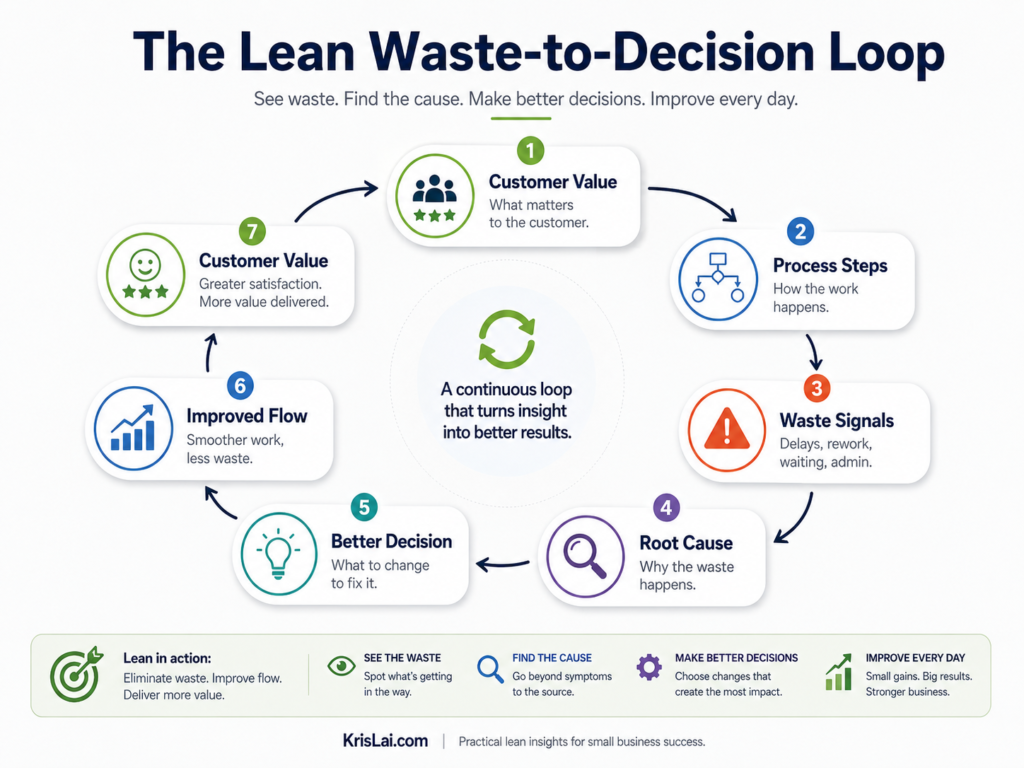
Each stage helps you see the work more clearly.
Is Lean Management Suitable for Small Businesses?
Yes! Lean management can work particularly well in small businesses because the processes are often easier to see and change than in large organisations. A small company does not need a Lean department or expensive transformation programme. It needs one real problem, a clear process, employee involvement and a practical way to measure improvement.
There is also growing research specifically around Lean implementation in SMEs.
A 2026 systematic review of 123 empirical studies found that SMEs tend to adopt Lean successfully through phased and locally adapted approaches rather than by copying one standardised model. Leadership commitment, employee involvement and organisational readiness were important enablers.
That is reassuring.
Because my advice to a small business would be:
Do not try to “implement Lean” everywhere.
Improve one important process.
Then another.
Then another.
Small businesses can actually have advantages here.
You may have:
- shorter communication lines
- fewer layers of approval
- easier access to the owner
- faster experimentation
- better visibility of customer complaints
- frontline employees who understand several parts of the process
The disadvantage is that SMEs usually have less spare time, money and management capacity.
That means the Lean approach itself needs to be Lean.
No 80-page transformation plan…
No committee to decide who should join the committee…
Start where the pain is visible.
When Does a Small Business Need Lean Management?
A small business is likely to benefit from Lean management when the same delays, mistakes, complaints or frustrations keep appearing. Warning signs include repeated admin, owner bottlenecks, jobs starting late, excess stock, frequent rework, unclear handovers, rising costs or growth that creates more confusion instead of more capacity.
This is where search intent becomes very practical.
You may not be thinking:
“I need Lean management.”
You may be thinking:
“Why are we so busy but not making enough money?”
Or:
“Why does everything need my approval?”
Or:
“Why do we keep fixing the same mistake?”
Those are Lean situations.
Margin pressure
Revenue is growing, but profit is not.
Look for:
- rework
- wasted labour
- unnecessary travel
- poor scheduling
- low-value admin
- excessive stock
- weak pricing around costly processes
The owner has become the bottleneck
Everyone waits for the owner to answer questions, approve purchases or solve routine issues.
The business may not have a people problem.
It may have a decision-flow problem.
Customers keep chasing
Customers repeatedly ask:
“Has this been done?”
“When will somebody arrive?”
“Did you receive my email?”
“Who is handling this?”
That is often a process signal.
Growth makes the business feel worse
More customers create:
- more emails
- more handovers
- more mistakes
- more meetings
- more urgent jobs
- more exceptions
Growth has exposed a weak process.
Staff keep improvising
If experienced employees can make the process work but new staff struggle, the knowledge may be living in people’s heads instead of the system.
Everybody is busy
This is one of my favourite warning signs!
Activity is not the same as value.
A business can be extremely efficient at doing things it should not be doing.
When people regularly say:
“We’re always waiting for that.”
“We have to enter this twice.”
“Ask Sarah — she’s the only one who knows.”
“That job always causes trouble.”
“The customer never gives us the right information.”
Do not dismiss those comments as normal business frustration. They may be telling you where the process is leaking time, money or customer trust.
What Are the 5 Principles of Lean Management?
The five Lean principles are value, value stream, flow, pull and the pursuit of continuous improvement. They provide a simple sequence: understand what the customer values, see how the work creates it, remove interruptions, respond to real demand and keep improving the process over time.
These principles are commonly associated with the Lean thinking framework developed by James Womack and Daniel Jones. The Lean Enterprise Institute summarises the sequence as specifying value, identifying the value stream, creating flow, establishing pull and pursuing perfection.
Here is what that means for a small business:
1. Value — What Does the Customer Actually Need?
Value means the outcome the customer genuinely wants.
For example, a cleaning customer may value:
- reliable attendance
- the correct cleaning standard
- secure working
- responsive communication
- no disruption
- problems being solved without drama
They probably do not value:
- three internal approvals
- duplicated forms
- long internal email chains
- a report nobody reads
That distinction is the beginning of Lean.
2. Value Stream — How Does the Work Actually Happen?
The value stream is the full chain of steps required to deliver the result.
Do not map how you think the process works.
Map what actually happens.
For example:
Customer enquiry
→ quotation
→ approval
→ site information collected
→ labour scheduled
→ equipment prepared
→ job completed
→ quality checked
→ customer updated
→ invoice raised
→ payment received
Then look at every handover.
Where does information stop?
Where is it entered twice?
Where do people wait?
Where do mistakes appear?
3. Flow — Where Does the Work Get Stuck?
Flow means allowing useful work to move through the process with fewer interruptions.
Poor flow looks like:
Quote waiting for approval.
Employee waiting for instructions.
Cleaner waiting outside a locked building.
Customer waiting for an update.
Invoice waiting because nobody closed the job in the system.
Good flow does not mean rushing.
It means fewer unnecessary stops.
4. Pull — Are We Responding to Real Demand?
Pull means allowing genuine customer or process demand to trigger work rather than producing work because we assume it might be needed.
In manufacturing, this often relates to production and inventory.
In service businesses, it can mean:
- stocking according to usage
- producing reports people actually use
- scheduling resources around real demand
- following up genuine buying signals
- avoiding work customers never requested
Pull stops businesses from producing activity for activity’s sake.
5. Continuous Improvement — What Can We Make Better Next?
Continuous improvement means making small, useful changes regularly rather than waiting for one giant transformation project.
This is often associated with the Japanese idea of kaizen.
Kaizen is a Japanese word often translated as “continuous improvement”.
In lean management, kaizen means making small, regular improvements to the way work is done. It is not about waiting for one big transformation project. It is about noticing waste, fixing small problems, learning from the result, and improving again.
For a small business, kaizen could be as simple as improving a handover note, reducing repeated admin, moving supplies closer to where they are used, or asking the team what slows them down each week.
You notice a problem.
You understand why it happens.
You improve it.
You check the result.
Then you improve again.
There is a Swedish saying:
“Många bäckar små gör en stor å.”
“Many small streams make a great river.”
That is a useful way to think about continuous improvement.
Small changes can compound.
Value — understand what the customer genuinely needs.
Value Stream — see every step involved in delivering it.
Flow — remove delays and interruptions.
Pull — respond to real demand.
Continuous Improvement — keep learning and improving the process.
What Are the 7 Wastes of Lean?
The seven traditional Lean wastes are transportation, inventory, motion, waiting, overproduction, overprocessing and defects. Many modern Lean practitioners add an eighth waste: unused human talent. These categories help businesses recognise work that consumes time, money or effort without increasing the value delivered to the customer.
Lean uses the Japanese word muda for waste.
The categories are sometimes remembered as TIMWOOD:
Transportation
Unnecessary movement of products, supplies, documents or information.
Small-business example:
A delivery driver returns to base because the correct item was not loaded.
Inventory
More stock, materials or work-in-progress than the business genuinely needs.
Example:
Buying six months of cleaning chemicals “because they were cheaper” while cash is tight and half the products barely move.
Motion
Unnecessary physical movement by people.
Example:
Staff repeatedly walking between floors because frequently used equipment is stored in the wrong place.
Waiting
People or work sitting idle.
Example:
An employee cannot begin because they are waiting for a manager to approve a routine decision.
Overproduction
Producing work before it is actually needed.
Example:
Preparing detailed reports every week that nobody reads.
Overprocessing
Doing more work than the customer or process requires.
Example:
Entering customer details into a CRM, spreadsheet and accounting system by hand.
If you need three systems to agree that the customer is called “Smith Ltd”, the process may be trying to tell you something.
Defects
Errors that require correction, rework or replacement.
Example:
A job needs a return visit because the specification was unclear.
Unused Talent — the Eighth Waste
Many modern approaches add unused skills, ideas and knowledge.
This matters enormously in small businesses.
The person doing the job every day often knows:
- which instruction causes confusion
- which customer always needs something different
- which tool is in the wrong place
- which form wastes time
- which approval adds nothing
Ignoring that knowledge wastes more than talent.
It wastes improvement opportunities.
The Lean Enterprise Institute describes waste broadly as activity that consumes resources without creating customer value.
I do not see waste simply as something to cut.
I see it as information.
Waiting may signal unclear authority.
Rework may signal poor instructions.
Excess stock may signal weak forecasting.
Repeated questions may signal poor communication.
The waste tells you where to investigate. The decision comes after you understand why it exists.
7 Ways Small Businesses Can Improve Flow With Lean Management
Small businesses can improve flow by reducing unnecessary movement, waiting, repeated administration, defects, excess stock, overcomplicated processes and wasted employee knowledge. These seven areas are practical because they are visible in everyday operations and can often be improved without expensive technology or a major restructuring programme.
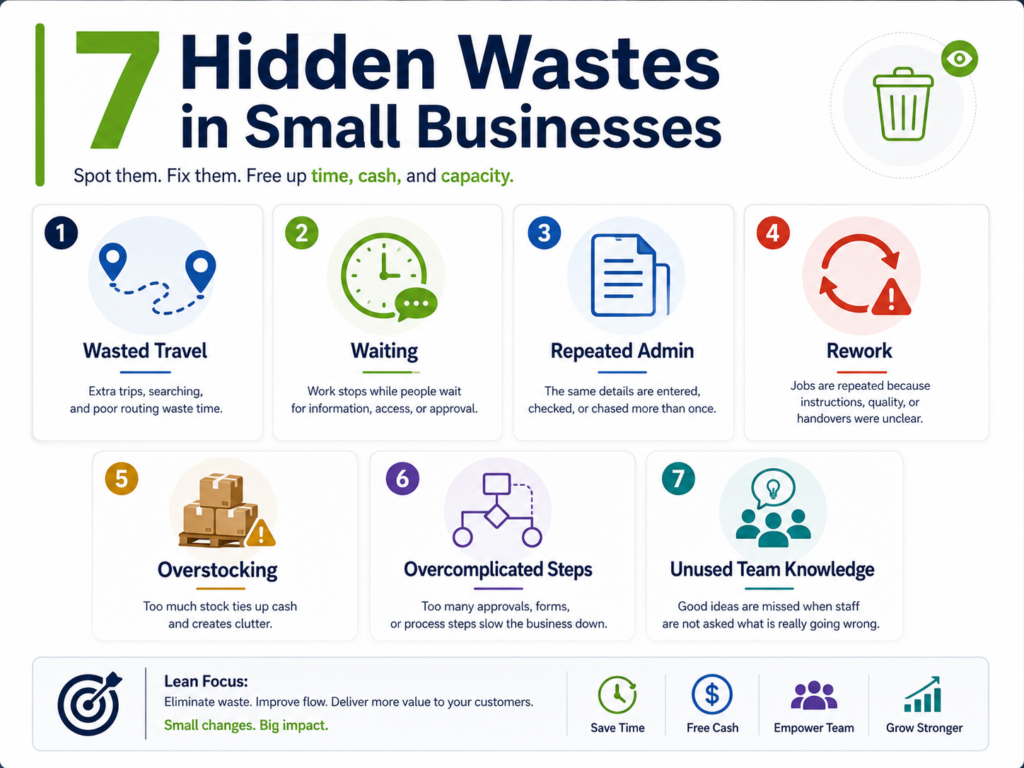
1. Reduce Wasted Movement and Travel
Unnecessary travel wastes paid time, fuel, capacity and often customer goodwill. Start by looking at every journey made because something was forgotten, poorly scheduled or stored in the wrong place. The best improvement may be a checklist, route change, stock location or better job preparation rather than simply asking people to move faster.
In my experience, waste in service businesses often hides in plain sight.
A team arrives.
They discover something is missing.
Someone drives back.
The customer waits.
The schedule slips.
The next customer is now affected too.
One forgotten item has created second-order consequences.
What you should actually do:
For one week, record every unnecessary journey.
Ask:
Why did it happen?
Was the equipment unavailable?
Was the instruction unclear?
Was preparation rushed?
Was responsibility unclear?
Then fix the cause that repeats most often.
2. Reduce Waiting and Owner Bottlenecks
Waiting often appears when staff need approval, information, access, equipment or another person’s decision before they can continue. Small businesses can reduce this waste by clarifying routine decision rights, preparing information earlier and removing approvals that no longer protect the business from a meaningful risk.
Ask your team:
“What do you regularly wait for?”
You may hear:
“The owner.”
“The customer.”
“Stock.”
“The keys.”
“The schedule.”
“Finance.”
“Someone to tell us what to do.”
Then separate necessary waiting from preventable waiting.
Not every approval is waste.
A £50,000 commitment may reasonably need the owner.
A £12 replacement mop head probably does not need a board meeting.
3. Remove Repeated Administration
Repeated admin occurs when people copy, re-enter, chase or reformat information without adding useful value. A good Lean improvement does not start by automating everything. It first asks why the duplication exists, which information is genuinely needed and whether one reliable source can replace several disconnected versions.
Look for:
- duplicate spreadsheets
- repeated customer details
- manual invoice copying
- repeated status emails
- several forms asking the same question
- reports created “because we always have”
The key word here is necessary.
Some administration protects compliance, safety, finance or customer service.
That is not automatically waste.
But even necessary administration can often be simplified.
4. Reduce Defects and Rework
Rework is one of the most expensive forms of waste because the business pays once to do the job and again to correct it. Reduce it by identifying where errors begin, improving instructions and checks at that point, and measuring whether the same problem returns after the change.
Do not only ask:
“Who made the mistake?”
Ask:
“What allowed this mistake to reach the customer?”
That question changes the conversation.
Perhaps:
- the job specification was unclear
- a new employee was never shown the standard
- the quality check happened too late
- the customer requirement changed but the team was not told
Correct the process, not just the person.
5. Control Stock Without Creating New Risks
Lean inventory management aims to reduce unnecessary stock while still protecting reliable service. Small businesses should not remove every buffer blindly. The right stock level depends on demand, supplier reliability, lead time, criticality and the cost of running out. Efficient inventory and resilient inventory are not always the same thing.
This point matters.
“Lean” does not mean:
zero stock at all costs.
Imagine a cleaning contract where a specialist chemical has a three-week supplier lead time.
Keeping a sensible buffer may be good risk management.
The better question is:
Why are we holding this stock, and what risk does it protect us from?
A buffer is only waste when it serves no useful purpose.
6. Simplify Overcomplicated Processes
Overprocessing happens when a business adds checks, reports, approvals or handovers that no longer improve the result. Simplify by asking what each step protects or creates. If nobody can explain why a step exists beyond “we have always done it”, it deserves closer examination.
Try this with one form or process.
For every field or approval, ask:
What decision depends on this?
If the answer is:
“None.”
Ask whether it should still exist.
Processes accumulate like cupboards.
Nobody notices until one day you open the door and everything falls out!
7. Use Frontline Knowledge
Unused employee knowledge is waste because the people closest to the work often see problems before managers do. Ask employees what causes delay, confusion and rework, then involve them in testing improvements. This improves the process and often increases the likelihood that the new method will actually be used.
Do not ask:
“Any ideas?”
in a room where nobody wants to criticise the process.
Ask specific questions:
- What wastes the most time?
- What do customers complain about repeatedly?
- What do new staff find hardest?
- What information is usually missing?
- Which task would you redesign first?
People often answer better when the question is concrete.
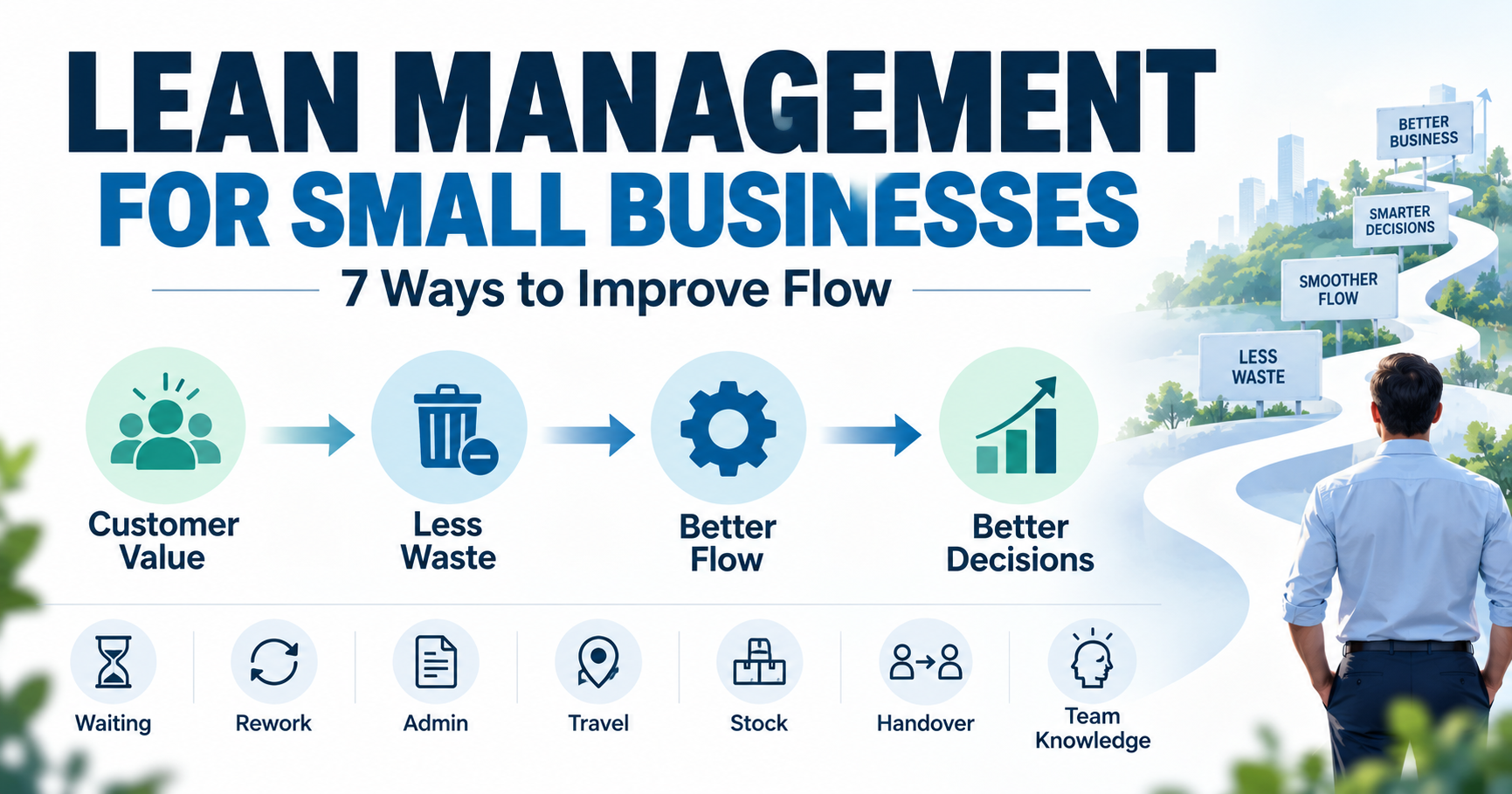
Seven common forms of waste I would look for first in a small business:
What Does Lean Management Look Like in Real Business?
Lean management in real business usually starts with an ordinary frustration rather than a formal Lean project. A late job, repeated invoice error, missing item or customer complaint reveals a process weakness. The business maps what happened, finds the cause, changes one step and measures whether the problem becomes less frequent.
Here are three examples.
Example 1: A Commercial Cleaning Handover
The team is scheduled to start at 6pm.
They arrive at 5:55pm.
Nobody has the latest access code.
The supervisor calls the office.
The office searches old emails.
At 6:20pm, access is finally sorted.
Then the team discovers that the customer requested an extra area, but the instruction never reached the cleaners.
They finish late.
One task is rushed.
The customer complains the next morning.
The team returns.
What looked like “a cleaner made a mistake” is actually a chain of process waste.
Waste:
Waiting
Poor handover
Rework
Unnecessary communication
Overtime
Root cause:
Important job information does not have one clear owner or final check.
Decision:
Introduce one pre-job handover checklist containing:
access
scope
special requests
equipment
contact details
quality checks
Consequence:
Fewer delays. Fewer calls. Better first-time quality.
That is Lean.
Example 2: An Office Quotation Process
A customer requests a quote.
Sales enters the details into a spreadsheet.
Admin copies them into a CRM.
The manager adds pricing in another document.
Finance later enters the same customer into accounting software.
Four people have touched the same basic information.
Each handover creates another opportunity for error.
Waste:
Overprocessing
Waiting
Defects
Decision:
Choose one primary customer record and redesign the process around it.
Do not automate four bad handovers.
Remove three if they are unnecessary.
Example 3: A Small Manufacturer
A small manufacturer keeps extra components because deliveries have sometimes been late.
The stock looks excessive.
An aggressive Lean approach might say:
“Reduce inventory.”
But a better analysis asks:
What causes the buffer?
If the supplier is unreliable and a missing £20 component can stop £5,000 of production, some safety stock may be rational.
The real improvement may be:
supplier reliability
reorder signals
lead-time visibility
alternative suppliers
rather than simply cutting inventory.
If the same problem keeps returning, do not only ask who made the mistake.
Ask what in the process allowed it to happen again.
That one change in question can move a business from blame to improvement.
Lean Management vs Lean Manufacturing, Six Sigma and Lean Startup
Lean management is the broader philosophy of creating customer value with less waste. Lean manufacturing applies those ideas mainly to production. Six Sigma focuses more heavily on reducing variation and defects through measurement. Lean Startup is different again: it focuses on testing business and product assumptions through rapid experiments and validated learning.
Lean Management
Best for:
Improving value, flow and waste across a business.
Lean Manufacturing
Best for:
Applying Lean principles to manufacturing and production systems.
Six Sigma
Best for:
Processes where variation, defects and statistical control are major concerns.
Lean and Six Sigma are often combined, but a small business does not need formal Six Sigma certification before improving a poor handover or duplicated form.
Lean Startup
Lean Startup is commonly associated with Eric Ries and the Build-Measure-Learn cycle used to test product and business assumptions under uncertainty. It shares Lean’s dislike of waste but solves a different problem.
Lean management asks:
How can we improve the way value is delivered?
Lean Startup asks:
How can we learn quickly whether we are building the right thing?
Those ideas can complement each other.
They are not interchangeable.
Small businesses rarely need to choose one management philosophy and swear lifelong loyalty to it.
Use the tool that fits the decision.
Lean can improve flow.
Six Sigma can reduce variation.
Lean Startup can test uncertain ideas.
The KrisLai Decision Framework™ can help you examine the behaviour, signals, environment and consequences around the decision.
How to Implement Lean Management in a Small Business
To implement Lean management in a small business, choose one troublesome process, define what the customer values, map how the work happens now, identify the main waste, find its root cause, test one small improvement, standardise what works and review the result. Start narrow, learn quickly and expand only after seeing evidence.
The full process is easier to follow when you can see how the steps connect.
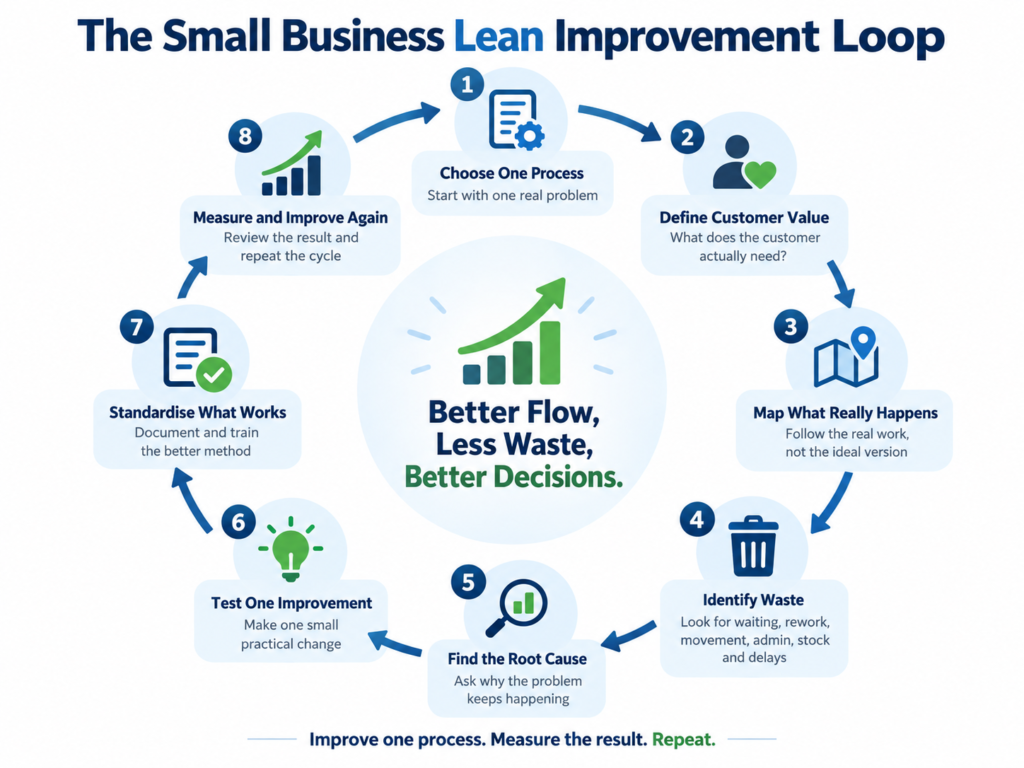
I think of Lean improvement as a loop rather than a one-off project. You choose one real process, understand what the customer needs, map what actually happens, find the waste, test an improvement and then measure whether it worked.
If it does, you standardise the better method and keep improving.
The diagram below shows that cycle at a glance:
Here is the full process I would follow:
Step 1: Choose One Process
Do not start with:
“We are going Lean.”
Start with:
“Our quotation process takes too long.”
Or:
“We keep arriving at sites without the right information.”
Choose a process that creates:
- delays
- errors
- complaints
- repeated questions
- high cost
- visible frustration
Give it a clear start and finish.
For example:
Start: customer requests a quote.
Finish: quote reaches customer.
That boundary stops the exercise spreading into everything at once.
Step 2: Define Customer Value
Ask:
What does the customer need from this process?
For a quote:
Accurate.
Clear.
Competitive.
Easy to understand.
Delivered quickly enough to help them decide.
Now distinguish that outcome from internal activity.
Customer value is not:
“We completed all seven internal forms.”
Unless those forms improve accuracy, compliance or the result, they are internal work.
Step 3: Map What Actually Happens — Not What the Procedure Says
Process mapping simply means writing down what happens from the start of a piece of work to the finish. You do not need specialist software or a complicated flowchart. A sheet of paper, whiteboard or simple spreadsheet is enough. The important thing is to record the real process, including the waiting, chasing and workarounds.
Start with the process you chose in Step 1.
Let us use a quotation process as an example.
Write the first event:
Customer asks for a quote.
Then ask:
What happens next?
Perhaps:
Customer enquiry arrives
→ admin forwards it to sales
→ salesperson reads it
→ customer is contacted for missing information
→ site visit is arranged
→ survey is completed
→ notes are emailed to the manager
→ manager works out the price
→ admin creates the quotation
→ manager checks it
→ quote is emailed to the customer
→ CRM is updated
That is the visible process.
Now add something more important:
How long does each step actually take — including the waiting between steps?
You may discover this:
Customer enquiry arrives
→ waits 6 hours
→ admin forwards it
→ waits until next morning
→ salesperson reviews it
→ waits two days for site visit
→ survey completed
→ waits another day for pricing
→ quote prepared in 20 minutes.
Now the problem looks different.
The actual work may take less than two hours.
The customer may still wait four days.
That distinction is exactly what Lean helps you see.
What to record
For each step, note four things:
Action — What happens?
Owner — Who does it?
Time spent working — How long does the task itself take?
Waiting — How long does it sit before the next step?
You can also mark anything that looks suspicious:
R = repeated work
W = waiting
E = error or rework
H = handover
A = approval
You do not need a perfect process map.
You need one that makes the delays visible.
Do not ask the manager to describe how the process is supposed to work and then treat that as reality.
Ask the people doing the work:
“What actually happens when this goes wrong?”
“Where do you normally have to chase someone?”
“What information is usually missing?”
“What do you do that is not written in the procedure?”
The unofficial workarounds are often where the most useful Lean insights are hiding.
A useful shortcut for a busy small business
If mapping the whole process still feels too much, follow one real job from start to finish.
One customer enquiry.
One delivery.
One cleaning job.
One invoice.
One complaint.
Write down what happens to that single case.
You will often learn more from following one real piece of work than from spending an hour discussing what normally happens.
In my experience, the delays are rarely hidden once you watch the work closely.
They are often sitting in plain sight.
The business has simply become used to them.
When the map is complete, do not fix anything yet.
Move to Step 4 and identify which steps create value, which are necessary support work, and which look like waste.
That prevents you from solving the first irritating problem you notice before understanding the process as a whole.
Step 4: Identify the Waste
Mark each step as:
Value-creating
Necessary but non-value-creating
or
Waste that may be removable
Some work is necessary without directly creating customer value.
Tax records.
Safety checks.
Legal obligations.
Quality assurance.
Do not remove something simply because the customer cannot see it.
Instead ask:
Could we achieve the same protection with less effort?
Step 5: Find the Root Cause
For the biggest repeated waste, ask why it happens.
A simple method is the 5 Whys.
Example:
Why was the quote late?
Because pricing was delayed.
Why?
Because the manager had not reviewed it.
Why?
Because all pricing requires the manager.
Why?
Because nobody else has clear pricing limits.
Why?
Because the business never documented them.
The first problem looked like:
“The manager is too busy.”
The deeper problem may be:
“Routine decisions have not been delegated safely.”
Do not treat the fifth answer as magic.
The purpose is to move beyond the first explanation.
Step 6: Choose One Small Improvement
Avoid changing twelve things at once.
If everything changes, you will not know what caused the result.
For the quotation example, the improvement could be:
Create pre-approved pricing bands for routine jobs.
Or:
Create one standard survey form so pricing information arrives complete.
Before testing, write down:
What do we expect to improve?
For example:
Average quote turnaround should fall from three working days to two.
That gives you something measurable.
Step 7: Test, Learn and Standardise
Run the improved process for a sensible trial period.
Do not declare victory after one successful Tuesday.
Measure enough cases to see whether the pattern has changed.
If the improvement works:
- document the new method
- train affected staff
- remove the old version
- make ownership clear
Standardisation is not about freezing the business forever.
It means:
“This is the best-known way we have found so far.”
If somebody finds a better way later, improve it again.
Step 8: Review the Result and Repeat
Compare the result with the baseline.
Did:
- waiting fall?
- quality improve?
- rework reduce?
- complaints fall?
- capacity increase?
- customer experience improve?
If yes, choose the next bottleneck.
If no, learn from it.
The aim is not to defend the improvement because somebody had a clever idea.
The aim is to discover what actually works.
1. Choose one process.
2. Define customer value.
3. Map the real work.
4. Find the waste.
5. Find the root cause.
6. Test one improvement.
7. Standardise what works.
8. Measure and improve again.
Keep it simple enough that people will actually use it.
You do not need specialist software to start improving a process. A whiteboard and a few sticky notes can be enough. But if you want to map workflows, make responsibilities visible or manage repeated improvements, these are two tools worth considering.
MindManager — for process mapping and Lean improvement
MindManager can help you turn a real business process into a visual map, including flowcharts, swim-lane diagrams and value-added process maps. It also provides templates specifically designed to support Lean management and continuous improvement.
Explore MindManager →
Trello — for simple visual workflow management
Trello can be useful when you want a simple board showing work moving through stages such as To Do → In Progress → Waiting → Complete. It can also automate repetitive workflow actions once you have simplified the process itself.
Explore Trello →
Affiliate disclosure: Some links above are affiliate links. If you choose to buy or subscribe through them, I may receive a commission at no extra cost to you. I only include tools that are directly relevant to the topic.
How Do You Measure Lean Improvement?
Measure Lean improvement by comparing a small number of process signals before and after the change. Useful measures include lead time, waiting time, rework, first-time-right performance, customer complaints, stock levels, on-time delivery, admin hours and capacity. Choose measures connected directly to the problem you are trying to solve.
Do not measure everything because you can.
Measure what helps you decide.
For a scheduling problem, track:
- late starts
- schedule changes
- overtime
- missed jobs
For a quality problem:
- defects
- return visits
- rework hours
- complaints
For an admin problem:
- processing time
- duplicate entries
- customer chasing
- error rate
For stock:
- stock-outs
- excess stock
- emergency purchases
- cash tied up
Example Lean Scorecard
Before changing a handover process, you might record:
Average job-start delay: 24 minutes
Repeat visits: 7 per month
Customer complaints: 10 per month
Rework: 18 labour hours per month
After six weeks:
Average job-start delay: 9 minutes
Repeat visits: 3
Customer complaints: 5
Rework: 8 hours
Now you have evidence.
The business is not saying:
“The new process feels better.”
It can say:
“We reduced the problem.”
SME research supports keeping measurement simple. Research on barriers to Lean implementation has identified simple KPIs, management participation, training and a learning culture among the most useful responses to common SME barriers.
How Much Is Waste Costing Your Business?
The cost of waste is usually larger than the obvious expense because wasted minutes are multiplied across people, days and downstream consequences. Estimate it by measuring the time lost, multiplying it by how often the waste occurs and applying a realistic labour or operating cost. Then add rework, travel, delay and customer consequences where relevant.
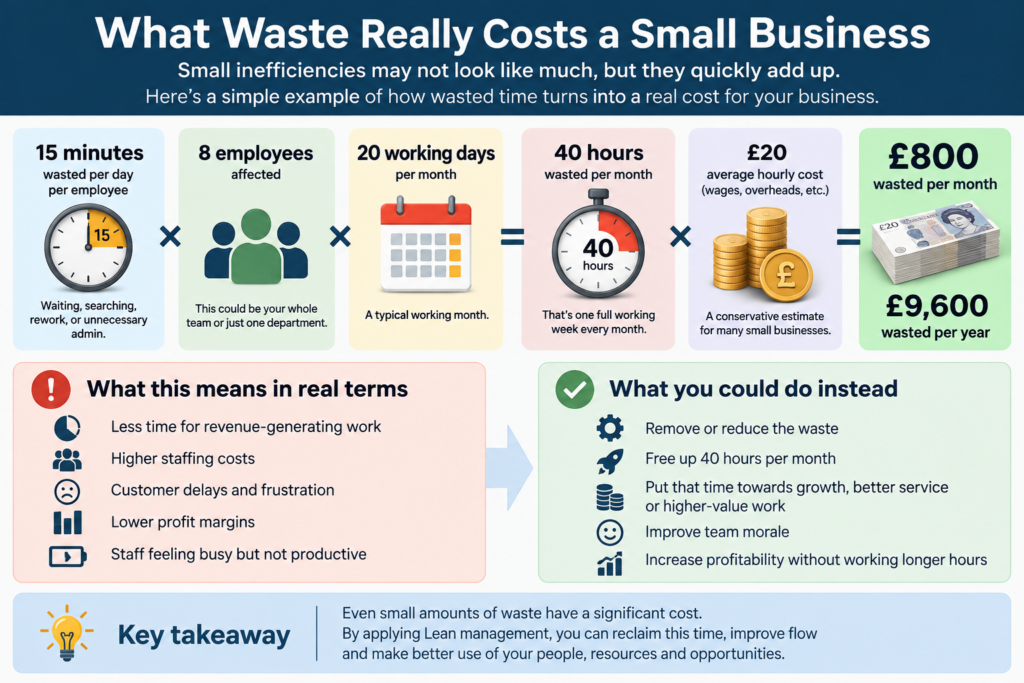
Here is a deliberately simple example.
Eight employees each lose 15 minutes every working day waiting for information.
15 minutes = 0.25 hours.
0.25 hours × 8 people = 2 hours per day.
Across 20 working days:
40 hours per month.
If the loaded cost of that time is £20 per hour:
£800 per month.
Across a year:
£9,600.
And that is only the direct time cost.
It does not include:
- delayed customers
- overtime
- management interruptions
- missed capacity
- frustration
- knock-on scheduling problems
Suddenly, a “small” daily delay looks rather less small.
This is one reason Lean connects closely to business acumen.
You are not merely looking for untidy processes.
You are asking:
What does this operational behaviour mean financially?
For more on connecting cost, volume and decisions, my article on Break-Even Analysis for Business Decisions is a useful companion.
Where Lean Management Goes Wrong in Small Businesses
Lean management usually fails in small businesses when it becomes too large, too theoretical or too disconnected from daily work. Common problems include weak leadership commitment, changing too much at once, failing to involve employees, measuring the wrong things, adopting tools without understanding the problem and expecting immediate results without allowing time to learn.
Research into SME Lean implementation consistently highlights management commitment, limited resources, poor communication, weak Lean understanding and resistance to change as important barriers.
Here is what those failures look like in practice:
Failure 1: The Owner Announces Lean but Changes Nothing
The team is told:
“We need continuous improvement.”
Then every decision still needs the owner.
Every problem still becomes urgent.
Every employee suggestion disappears into a black hole.
Leadership behaviour overrides the poster.
Failure 2: You Try to Fix the Whole Business
This usually creates meetings, documents and fatigue.
Start with one process.
Success creates credibility.
Credibility makes the next improvement easier.
Failure 3: You Buy the Tool Before Understanding the Problem
New software is purchased.
Nobody fixes the process.
The bad process now runs faster.
Congratulations. You have automated the waste!
Failure 4: You Ignore the People Doing the Work
A manager designs a beautiful process map.
The frontline team looks at it and says:
“That is not what happens.”
Listen.
They may know something useful.
Failure 5: You Standardise a Bad Process
Standardisation is powerful after improvement.
Before improvement, it can make waste more consistent.
Understand first.
Improve second.
Standardise third.
Failure 6: Lean Becomes Code for Cutting Staff
Trust disappears very quickly when employees hear:
“Tell us where the waste is.”
and translate it as:
“Help us remove your job.”
If Lean is going to work, people need to understand that the objective is better work and stronger customer value.
Failure 7: Nothing Is Measured
If you do not record the starting point, you cannot tell whether the improvement worked.
Lean fails when it becomes a slogan, a blunt cost-cutting exercise or a collection of complicated tools nobody uses.
If the improvement programme creates more forms, more meetings and more confusion than the process it is supposed to fix, the irony should not be lost on us.
Lean Management Is Not Cost Cutting
Lean management removes waste to protect and improve customer value. Cost cutting removes expenditure. Sometimes those goals overlap, but they are not the same. Cutting a pointless step can improve both cost and service. Cutting useful capacity, resilience or quality may reduce this month’s spending while creating a much larger problem later.
This distinction is crucial.
Imagine reducing stock.
That might free cash and reduce waste.
Good.
But if the stock is a critical spare part with a six-week lead time, the decision may create downtime.
That is not Lean thinking.
That is simply cutting something because the number went down.
Likewise:
Reducing training may lower today’s cost.
But if errors and staff turnover rise, tomorrow’s cost may be worse.
Removing a quality check may save ten minutes.
But if defects reach the customer, you may have saved ten minutes very expensively.
Lean should ask:
Does this activity protect or create enough value to justify its cost?
That is a much better decision question than:
“What can we cut?”
How Does Lean Management Help With Decision-Making Under Uncertainty?
Lean management helps decision-making under uncertainty by making work visible and encouraging small, measurable experiments. Instead of committing immediately to a large solution, managers can identify a problem, test a limited change, watch the signals and adapt. This reduces the risk of treating an assumption as if it were a proven fact.
This matters because the first explanation is often wrong.
A customer complaint looks like a staff problem.
But the real issue is the handover.
A late job looks like poor productivity.
But the real issue is missing equipment.
High cost looks like overspending.
But the real issue is repeated work.
A slow quotation process looks like lazy administration.
But the real issue is unclear decision authority.
The earlier decision research I use across KrisLai.com supports the same principle:
When uncertainty is high, prefer learning, testing and adaptation over false precision.
You do not need to introduce complicated probabilistic models into a ten-person company.
You can apply the principle simply.
Before making a large change, ask:
What are we assuming?
What evidence supports it?
What small experiment could test it?
What signal would tell us we were wrong?
When will we review the decision?
This connects closely to how I think about decisions more broadly in the KrisLai Decision Framework™.
Behaviour: How will people respond?
Signals: What evidence will tell us whether it is working?
Environment: What conditions could change the result?
Consequences: What happens next if we scale the change?
A Lean experiment is not a referendum on the manager who suggested it.
If the change works, keep it.
If it does not, learn from it.
The objective is not to prove that somebody was right. The objective is to improve the process.
Can AI Help With Lean Management?
Yes. AI can help Lean management by summarising complaints, spotting repeated patterns, analysing process data, drafting checklists and helping teams explore possible causes. But AI should support process understanding, not replace it. The biggest mistake is automating a wasteful process before deciding whether the process should exist at all.
That last point matters particularly now.
AI makes automation easier.
That is useful.
It is also dangerous.
Suppose a business spends four hours each week producing a report nobody uses.
AI can reduce that to ten minutes.
Wonderful.
But Lean asks one more question:
Why are we producing the report at all?
Ten automated minutes of waste is better than four manual hours of waste.
Zero minutes may be better still.
Use AI to help with:
- grouping customer complaints into themes
- summarising employee feedback
- finding patterns in support questions
- analysing delays
- drafting process maps
- generating checklist ideas
- testing possible root causes
- comparing before-and-after results
Do not let AI decide:
- what customers truly value without evidence
- which employee is “the problem”
- which safety step should disappear
- whether a process is ethical
- whether an automated recommendation is correct
AI is a tool.
Judgement remains a management responsibility.
Lean Management and the Future of Search
There is another connection worth making.
AI is changing how customers search for information.
People increasingly expect direct answers, fewer steps and less friction.
That means search behaviour itself can become a Lean signal.
If customers repeatedly search:
“How do I cancel?”
“Where is my invoice?”
“Do you serve my area?”
“What happens next?”
the waste may sit inside the customer-information process.
Customer search queries, website searches, chatbot questions, support emails and sales calls can show you where information is unclear.
That is Lean thinking applied to the customer journey.
It also connects naturally to my work on Customer Intent Marketing, where customer behaviour becomes a signal for what the business should improve.
What You Should Actually Do First
Start Lean management by choosing one process that regularly causes frustration, delay or rework. Do not start with the whole company! Follow that process from beginning to end, ask the people doing the work where it slows down, measure one or two useful signals and fix the smallest repeated cause first.
If you are wondering where to start this week, listen for these sentences:
“This keeps happening.”
“We’re always waiting for that.”
“Why do we do this twice?”
“Only John knows how that works.”
“The customer always asks us the same thing.”
“We keep running out of that.”
“That job never goes smoothly.”
Pick one.
Then ask seven questions:
- What is the customer actually trying to get?
- Where does the process start and end?
- Where does work stop or wait?
- Where is information repeated?
- Where do errors or rework occur?
- What is causing the biggest repeated waste?
- What is the smallest useful change we can test?
Then act.
This is a Finnish saying I have always liked:
“Hyvin suunniteltu on puoliksi tehty.”
“Well planned is half done.”
Lean would add one qualification:
Plan enough to understand the process.
Then test the improvement in the real world.
A 30-Day Lean Management Plan for a Small Business
A 30-day Lean plan should focus on one meaningful process rather than attempting a company-wide transformation. Use the first week to observe and map, the second to identify waste and root causes, the third to test one change, and the fourth to measure, standardise and decide what to improve next.
Week 1 — See the Work
Choose one process.
Record:
- where it starts
- where it ends
- every handover
- every wait
- every repeat step
- every common error
Talk to the people who do the work.
Do not fix anything yet.
Observe.
Week 2 — Find the Waste
Classify the problems.
Is it:
- waiting?
- motion?
- transport?
- inventory?
- overprocessing?
- defects?
- overproduction?
- unused knowledge?
Pick the one repeated issue with the clearest impact.
Measure the current baseline.
Week 3 — Test One Improvement
Choose one limited change.
Examples:
New handover checklist.
Different stock location.
Clear approval limit.
One customer record instead of three.
Revised route.
Simple visual schedule.
Define what success looks like.
Then test it.
Week 4 — Review and Standardise
Compare the result with your baseline.
Ask:
Did the waste fall?
Did service improve?
Did staff save time?
Did another problem appear elsewhere?
If the change worked, document the improved process.
If it did not, understand why.
Then choose the next improvement.
That is a Lean system beginning to form.
Not because you bought a consultancy package.
Because the business learned how to improve itself.
Do not aim to “become Lean” in 30 days.
Aim to prove that your business can identify one repeated waste, understand why it happens, improve the process and measure the result.
That habit is more valuable than a dozen Lean buzzwords.
People Also Ask
No. Certification may help people who need formal Lean expertise, but a small business can use basic Lean principles without certification. Start with customer value, process mapping, waste, root causes and simple improvement.
How long does Lean management take to work?
Small improvements can produce results within days or weeks, but Lean management is an ongoing way of improving work rather than a one-off project with a fixed end date.
Does Lean mean Just-in-Time inventory?
No. Just-in-Time is one Lean-related approach. Lean is broader and focuses on customer value, waste, flow and continuous improvement. Inventory decisions should also consider supply risk and the cost of running out.
Can Lean management work in an office?
Yes. Office waste can include repeated data entry, slow approvals, unnecessary meetings, unclear ownership, excessive reporting, poor handovers and customers waiting for information.
Is Lean only for large companies?
No. Small businesses can often change processes faster because there are fewer layers. The main challenge is usually limited management time and resources, which is why a focused, phased approach works better.
Frequently Asked Questions About Lean Management for Small Businesses
What is Lean management?
Lean management is a practical approach to improving customer value while reducing waste. It looks at how work actually moves through a business, identifies activities that consume time, effort or money without adding enough value, and improves the process through repeated learning and small changes.
What are the 5 principles of Lean management?
The five principles are value, value stream, flow, pull and continuous improvement or perfection. Together, they help a business understand what customers value, see how work creates that value, remove interruptions, respond to real demand and continue improving the process.
Is Lean management suitable for small businesses?
Yes. Lean can suit small businesses particularly well because processes are often easier to see and change. SMEs should usually start with one troublesome process, involve the people doing the work, measure a few simple results and expand only after the improvement has been tested.
What are the 7 wastes of Lean?
The seven traditional Lean wastes are transportation, inventory, motion, waiting, overproduction, overprocessing and defects. Many modern Lean approaches add unused employee talent as an eighth waste because ignoring frontline knowledge can prevent valuable process improvements.
What is an example of Lean management in a small business?
A service company might discover that teams regularly start late because access details and job instructions are incomplete. A Lean response would map the handover process, identify where information is lost, introduce one clear pre-job check and measure whether late starts and return visits fall.
What is the difference between Lean management and Lean manufacturing?
Lean management is the broader philosophy of creating customer value while reducing waste and improving flow. Lean manufacturing applies these principles specifically to production. The same Lean ideas can also be used in service companies, offices, healthcare, logistics and other non-manufacturing environments.
What is the difference between Lean and Six Sigma?
Lean focuses mainly on improving customer value, removing waste and creating smoother flow. Six Sigma focuses more heavily on reducing defects and process variation through measurement and statistical methods. Businesses can combine the two, but small firms can often begin with simple Lean improvements.
How do you implement Lean management in a small business?
Start with one process. Define what the customer values, map how the work happens now, identify the main waste, find its root cause, test one small improvement and measure what changes. If it works, standardise the better process and move to the next problem.
What Lean management KPIs should a small business track?
Useful Lean KPIs include lead time, waiting time, rework hours, defect rate, first-time-right performance, on-time delivery, stock-outs, excess inventory, customer complaints and administrative processing time. Choose only the measures that help you understand the specific process you are improving.
Can AI be used with Lean management?
Yes. AI can help analyse complaints, summarise feedback, identify repeated patterns, draft checklists and explore possible process improvements. However, businesses should understand and simplify the process before automating it. AI can accelerate a good process, but it can also accelerate waste.
Related Reading on KrisLai.com
If this article has helped you think differently about process improvement, these articles connect closely to the same decisions:
The KrisLai Decision Framework: A Better Way to Make Business Decisions — for the Behaviour, Signals, Environment and Consequences model.
Decision-Making Framework Examples — for choosing different decision tools depending on the problem.
Business Acumen for Managers: 7 Skills for Better Decisions — for connecting operations, customers, finance, capacity and risk.
Digital Transformation for SMEs: 7 Questions Before You Invest — particularly useful before automating a process that may need fixing first.
Customer Intent Marketing: How to Turn Buying Signals Into Sales — for using customer behaviour as a signal rather than relying only on assumptions.
Reference Sources and Further Reading
This guide draws on established Lean principles as well as SME-specific research and my own practical analysis.
Lean Enterprise Institute — What Is Lean? Lean as customer value, waste reduction, learning and continuous experimentation.
Lean Enterprise Institute — Lean Thinking and Practice for the five Lean principles associated with Womack and Jones.
Adobe — Lean Management for a modern overview of Lean principles and tools across different types of work.
Journal of Manufacturing Technology Management research on SMEs for implementation barriers and the importance of management involvement, measurement, training and learning culture.
2026 systematic review of Lean implementation in SMEs for evidence supporting phased and locally adapted implementation.
Planet Lean — Small Businesses, Big Impact for examples of Lean thinking applied to SMEs.
The Lean Startup for the separate Build-Measure-Learn approach used to test uncertain product and business assumptions.
Conclusion and Final Thoughts
Lean management for small businesses does not need to begin with Toyota, consultants or a wall full of process charts.
It can begin with one question:
What keeps going wrong here?
Follow the work.
Look for the waiting.
Watch the handovers.
Listen to the team.
Notice what customers keep asking.
Measure the waste.
Then improve one useful thing and see what happens.
That is real-world Lean management.
And it is also better decision-making.
I help people make better business decisions through psychology, strategy, and practical thinking.
This approach is part of the KrisLai Decision Framework, a practical method for improving business decisions.
Better decisions come from understanding behaviour, signals, environment, and consequences.
Use the Small Business Lean Waste Audit to examine one process, identify waiting, rework, unnecessary movement, repeated admin and other waste, then choose the first improvement worth testing.
Next step: Download the audit and use it on one process this week.
Lean management helps you improve how work flows. The KrisLai Decision Framework™ helps you examine the wider judgement around that improvement — human behaviour, signals, environment and consequences.
Together, they help move the conversation from “How can we work harder?” to “How can we make this work better?”
If you enjoy exploring the ideas behind better business decisions, you may find the Business Thinking Hub useful.
I write about how better decisions are made in business — combining strategy, behaviour, and practical thinking.
If you enjoy exploring the ideas behind better business decisions, you may find the Business Thinking Hub useful.
About the author
Kris Lai is a business operator and managing director with experience in land and building surveying, facilities management, logistics, and service delivery.
Earlier in his career, he worked as a Search Engine Evaluator (via Lionbridge, supporting Google), where he assessed search result relevance, user intent, and content quality using structured evaluation frameworks. This experience gives him a rare, practical understanding of how search systems interpret signals and make ranking decisions.
In parallel, whilst working with a charity organisation, he has delivered 1000’s of structured presentations in English, Finnish, and Chinese to audiences ranging from small groups to more than 600 people, and has spent decades mentoring and developing others. This experience informs his approach to clarity, communication, and decision-making under pressure.
He writes about AI, search behaviour, business strategy, and decision-making from a practical, real-world perspective.
👉 Explore ideas connected to better business decisions:
- Digital Transformation for SMEs: 7 Questions Before You InvestDigital transformation for SMEs should start with better decisions, not more technology. This guide explains seven questions to ask before investing in AI, automation, data systems, or new software, helping you improve processes, reduce risk, and prove value before you scale.
- Cybersecurity for Businesses: 7 Decisions Leaders Must MakeCybersecurity for businesses is not just an IT issue. It is a leadership decision about protecting email, accounts, devices, backups, staff behaviour, customer data, supplier access, trust, and business continuity. This guide explains the seven cyber decisions leaders should make before a small problem becomes a costly incident.
- How AI Is Changing Search Behaviour (And What Businesses Must Do Now)AI is changing how people search, compare, and buy. Learn what this means for visibility, trust, and growth — and what businesses must do now.
- 7 Decision-Making Framework Examples for Business LeadersSeven practical decision-making frameworks for managers and business owners, with real business examples, guidance on when to use each model, a simple framework selector and a decision template.
- Business Decision-Making Framework: The KrisLai MethodMake more informed business decisions under uncertainty with the KrisLai Decision Framework. Explore four complementary lenses, follow a practical five-step process, and learn from my real pricing decision that reduced workload while increasing revenue and profit.