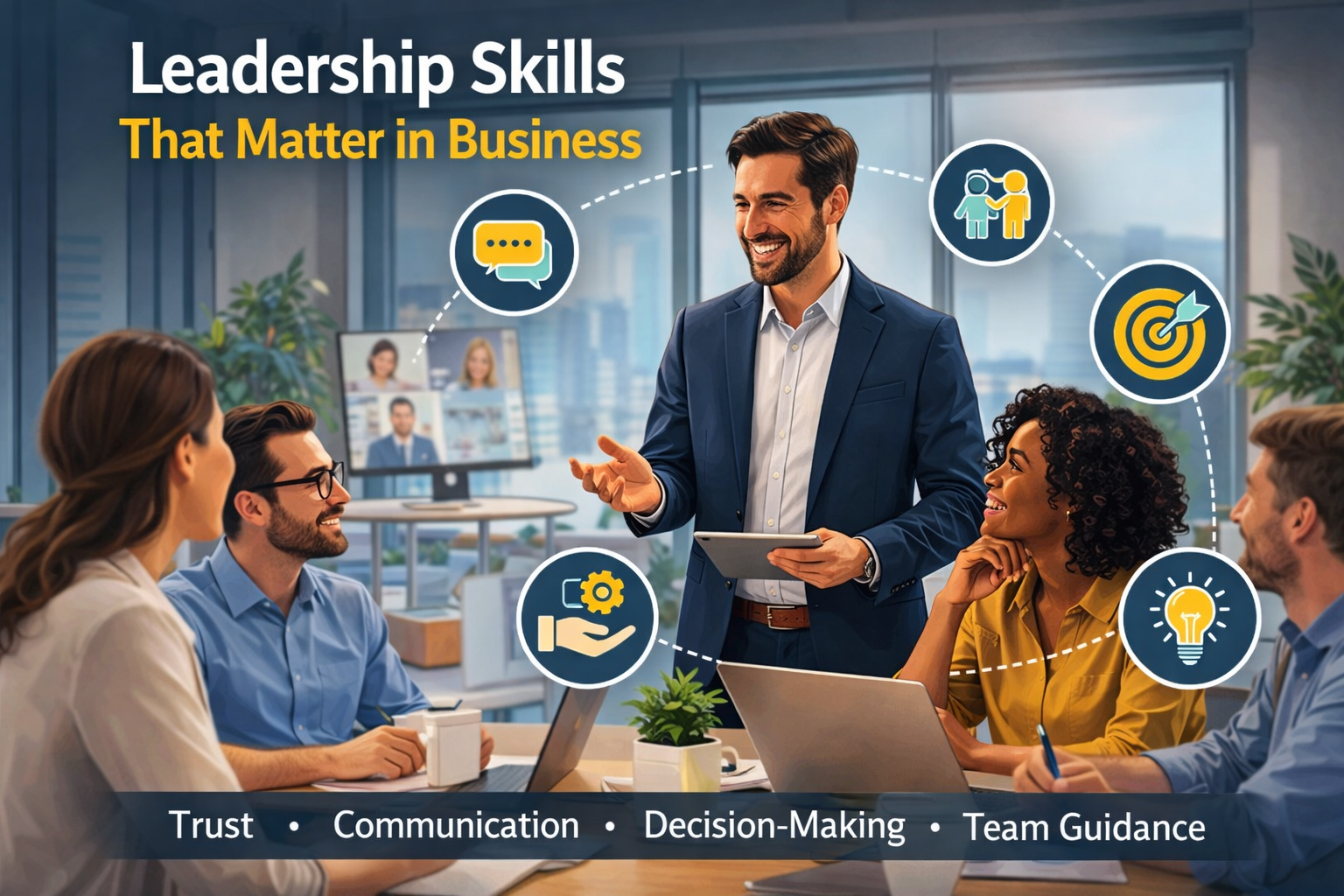
Leadership is not just about job titles or giving orders. It is about helping people do their best work, especially when things are changing fast. In modern business, strong leadership means building trust, making sound decisions, handling pressure calmly, and guiding people through uncertainty. In 2026, that also means leading hybrid teams well and using AI tools with good judgement.
Leadership skills are tested most clearly when things go wrong. That is why crisis leadership depends on calm judgement, clear communication, and the ability to protect trust under pressure.
Disclosure: If you click on my affiliate/advertiser’s links, I am going to receive a tiny commission. AND… Most of the time, you will receive an offer of some kind. It’ s a Win/Win!
What this article covers
In this article, I will explain what leadership skills really are, which ones matter most in business, how they show up in real life, where leadership often goes wrong, and how to improve these skills over time without turning leadership into a vague buzzword or a giant list of textbook advice.
This article is based on practical business thinking, independent research, and my own analysis and synthesis of how leadership affects trust, decision-making, team performance, and business results.
Leadership gets talked about far too often as if it were some kind of personal aura.
I do not see it that way.
In my experience, good leadership is much more practical than that. It shows up in how clearly someone communicates, how fairly they handle pressure, how well they listen, how they make decisions, and how they help other people move forward when the situation is unclear.
That is why leadership matters so much in business.
It is not only about managing work. It is about helping people work well together, trust the direction, and keep moving even when things get difficult.
Leadership is also not limited to the most senior person in the room. Good leadership can show up at many levels, and several current leadership organisations make that exact point.
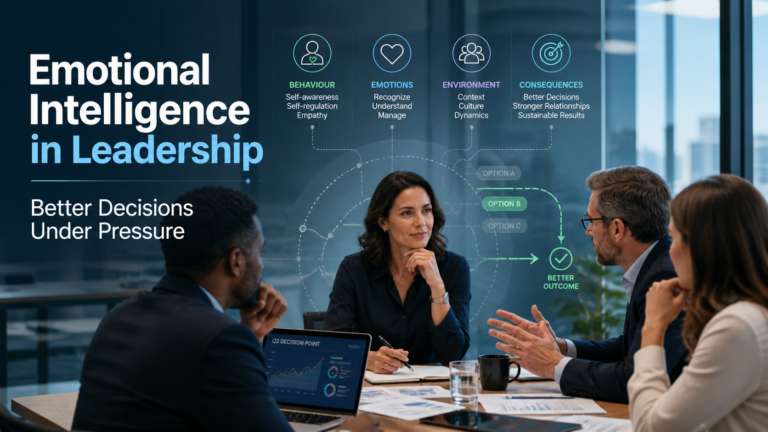
Better decisions come from understanding behaviour, signals, environment, and consequences.
I write about how better decisions are made in business — combining strategy, behaviour, and practical thinking.
Key ideas
- Leadership is not just a title. It is a set of behaviours that help people move in the right direction.
- Trust, communication, and judgement are the foundation of strong leadership.
- Modern leaders need to handle change, hybrid work, and AI-related decisions with care.
- The best leaders help other people do their best work.
- Leadership skills can be developed through practice, reflection, and real situations.


What are leadership skills?
Leadership skills are the abilities that help someone guide, support, and influence other people well.
In simple terms, they help a person:
- communicate clearly
- build trust
- make decisions
- handle conflict
- stay calm under pressure
- guide a team through change
- keep people focused on what matters
I think it is important to keep this plain.
Leadership skills are not about sounding impressive.
They are about being useful when people need direction, clarity, fairness, or encouragement.
RCN and Skills for Care both frame leadership in a way that supports this: leadership is about the skills and behaviours that help people influence and support others, and it is not only something senior people do.
Why leadership is not just a job title
This matters more than many people realise!
A person can have authority without really leading well.
And someone without a grand title can still show strong leadership by:
- staying steady under pressure
- helping others think clearly
- taking responsibility
- supporting the team
- solving problems calmly
- setting a useful example
That is one reason I prefer to think about leadership as behaviour.
Why leadership skills matter in real business
Leadership affects:
- trust
- morale
- decision quality
- team performance
- culture
- retention
- change
- communication
- accountability
When leadership is weak, teams usually feel it quickly:
People become confused.
Priorities drift.
Difficult issues are avoided.
Standards become inconsistent.
Pressure rises, and trust starts to weaken.
Leadership skills, in simple terms
Leadership skills are the abilities that help someone guide people well, build trust, make sound decisions, and keep a team moving in the right direction.

Build trust first with clear communication and emotional intelligence
Trust is where leadership starts.
Without trust, even a clever strategy feels shaky.
People are more likely to follow a leader who is clear, calm, fair, and aware of how others are feeling. IMD’s 2026 leadership view also puts strong emphasis on relationship building, motivation, decision-making, adaptability, and human connection.
Say what matters clearly, and listen just as well
One of the biggest leadership mistakes I see is people speaking too much and listening too little.
Good leaders make things clearer, not more confusing.
That means:
- saying what matters simply
- avoiding vague messages
- explaining priorities
- asking useful questions
- checking understanding
- adapting the message to the audience
This matters even more in remote and hybrid teams, because unclear communication creates friction much faster when people are not all in the same room. Current leadership commentary continues to highlight human connection and clarity as central in today’s more complex working environment.
Clear communication helps reduce:
- confusion
- duplicated effort
- frustration
- avoidable mistakes
- unnecessary tension
Use emotional intelligence to lead people, not just tasks
Emotional intelligence is often talked about too vaguely, so I prefer to keep it practical.
It means:
- noticing your own reactions
- managing yourself better
- reading the room
- understanding how others may be feeling
- responding in a way that helps rather than escalates
This matters in:
- feedback conversations
- conflict
- morale problems
- tense meetings
- change
- difficult decisions
A leader who can stay calm and respectful while still being clear often earns more trust than the loudest or quickest person in the room.
What this means in real business
In real teams, trust usually grows when people know where they stand, feel heard, and believe their leader will handle pressure fairly. Clear communication and emotional intelligence are not soft extras. They are practical tools for reducing confusion and strengthening teamwork.

Make smart decisions and stay steady when things change
Good leaders do not always have perfect answers.
But they do need judgement.
That matters because leadership often becomes most visible when something shifts, breaks, or becomes uncertain.
Balance speed, facts, and judgement when making decisions
Some leaders move too fast and miss important details.
Others wait too long and lose momentum.
The better balance is usually somewhere in the middle.
Strong decision-making often means:
- gathering enough information
- not drowning in detail
- thinking about who will be affected
- choosing a direction in time
- reviewing the result honestly afterwards
IMD still highlights decision-making and critical thinking as core modern leadership skills, and I think that makes good sense.
This approach is part of the KrisLai Decision Framework, a practical method for improving business decisions.
Better decisions always come from understanding behaviour, signals, environment, and consequences.
Stay adaptable when plans shift
Adaptability matters because no plan stays untouched forever.
Markets change.
Teams change.
Priorities change.
Technology changes.
Customer behaviour changes.
A leader who cannot adjust becomes brittle.
That does not mean changing direction every five minutes. It means staying steady enough to respond without freezing or overreacting.
Resilience matters here too.
Not as a motivational slogan, but as a practical leadership strength:
keep moving
take the hit
think clearly
recover
help others recover
Where this goes wrong
Leadership often weakens when people confuse confidence with judgement, react too fast under pressure, or become so cautious that the team loses direction. Good leaders do not need all the answers immediately, but they do need calm thinking and timely action.

Help others grow through delegation, vision, and modern leadership skills
Leadership is not only about what you do yourself.
It is also about what you help other people do.
Delegate in a way that builds confidence and accountability
Delegation is not dumping work on someone else.
Good delegation means:
- matching tasks to strengths
- being clear about ownership
- setting expectations properly
- giving enough support
- then trusting the person to get on with it
That matters because it helps:
- the leader avoid overload
- the team member grow
- the business build stronger capability over time
Poor delegation usually creates either confusion or micromanagement.
Neither helps.
Give people a clear vision they can believe in
Strategic thinking sounds grand, but in simple terms it means helping people see:
- where the team is going
- why the work matters
- what the priorities are
- what not to get distracted by
A team works better when people understand the bigger purpose behind the daily work.
Develop AI literacy and lead well across hybrid teams
This is one of the biggest modern leadership additions.
Leaders do not need to become technical experts.
But they do need enough understanding to:
- know what AI can help with
- know where human judgement still matters most
- avoid careless overreliance
- ask better questions
- guide people through the change responsibly
Current leadership commentary increasingly highlights AI fluency, human-AI judgement, and strategic agility as real leadership needs rather than optional extras.
The same is true of hybrid leadership.
Leading fairly across in-office and remote teams means:
deliberate efforts to keep people connected
regular check-ins
clear expectations
visible support
equal access to information
What I’ve seen in practice
I have often seen teams struggle not because people lacked talent, but because leadership lacked clarity. A team can survive many pressures if priorities are clear, people feel trusted, and the leader stays steady enough to guide them through the noise.

Which leadership skills matter most in real business?
A lot of articles try to cover everything.
I think it is more useful to focus here on the skills that change real outcomes.
If I had to simplify leadership skills in business, I would put them into three practical groups:
People skills
These help leaders build trust and guide relationships.
- communication
- listening
- emotional intelligence
- conflict handling
- relationship building

Judgement skills
These help leaders think clearly under pressure.
- decision-making
- critical thinking
- strategic thinking
- adaptability
- calm under uncertainty
Execution skills
These help leaders turn direction into action.
- delegation
- accountability
- team building
- motivating others
- managing change
- performance support
The KrisLai Leadership Lens™
- Behaviour – how are people actually responding to this leader?
- Signals – what are morale, conflict, feedback, and performance showing?
- Environment – what pressure, change, or uncertainty is shaping the team?
- Consequences – what happens if the leader avoids the issue, delays action, or handles it badly?
This connects closely to how I think about decisions more broadly in the KrisLai Decision Framework™.

Where leadership often goes wrong
This is a section I think many leadership articles on the net are too polite about!
Confusing confidence with clarity
Some leaders sound certain, but still leave people confused.
Confidence is not the same as clarity.
Talking more than listening
Leaders who do all the talking often miss the signals that matter.
Avoiding difficult conversations too long
This is one of the most expensive habits in management.
Small people issues grow when they are ignored.
Leading change without enough communication
A leader may know why the change is needed, but the team may still feel lost, worried, or left behind if the communication is poor.

A common leadership trap
Many leadership problems do not begin with bad intent. They begin with unclear expectations, delayed conversations, weak listening, or decisions that were made without enough thought about how other people would experience them.

How can you improve leadership skills over time?
I do not think leadership improves through theory alone.
It improves through practice, feedback, and reflection.
That can mean:
- asking for honest feedback
- practising one skill at a time
- reflecting after difficult situations
- improving how you communicate
- learning how to make better decisions under uncertainty
- getting better at delegation
- reviewing how your team actually responds to you
Small improvements matter.
You do not have to become a perfect leader overnight.
Improve one thing:
- one conversation
- one decision
- one habit
- one meeting
- one moment of pressure
That is usually how real leadership growth begins.
A practical model for better business decisions in complex environments. It focuses on four essential elements:
- Human Behaviour — how people actually think and decide
- Signals — what people are trying to do right now
- Environment — whether the system supports good decisions
- Consequences — what happens next, and after that
Strong decisions consider all four — not just one.
Final thought: leadership skills are built in real situations
Good leadership is not about having all the answers.
It is about helping people move forward with more trust, better judgement, and clearer direction.
That is why leadership skills matter so much.
They shape how a team feels, how a business responds under pressure, and how well people can do their work together.
And the encouraging part is this:
These skills can be built!
Not all at once.
Not perfectly.
But steadily.
As the Swedish saying goes, övning ger färdighet – Practice builds skill.
Final takeaway
Successful leaders are made through practice, reflection, and real situations. Start with one skill: clearer communication, better listening, steadier decision-making, or stronger delegation. Improve one at a time, and leadership becomes much more practical and achievable.
Related reading on KrisLai.com
- Related article: Negotiation Skills in Business
- Glossary or definition article: 11 Key Business Acumen Skills You Need
- Pillar topic: Business Thinking Hub
- Business Strategy Planning
- Scenario Planning in Business
- Decision-Making Framework Examples: The KrisLai Method in Action
- Public Speaking Skills for Modern Business

Frequently Asked Questions About Leadership Skills
What are leadership skills?
Leadership skills are the abilities that help someone guide, support, and influence other people well. They include communication, decision-making, emotional intelligence, adaptability, and delegation.
Why are leadership skills important in business?
Leadership skills matter in business because they affect trust, morale, decision quality, performance, teamwork, and how well people handle change and pressure.
Can leadership skills be learned?
Yes. Leadership skills can be developed through practice, reflection, feedback, and real workplace situations. Most strong leaders improve over time rather than starting out fully formed.
What leadership skills matter most today?
Some of the most important leadership skills today include communication, emotional intelligence, decision-making, adaptability, delegation, strategic thinking, and the ability to lead fairly across hybrid teams.
How can I improve my leadership skills at work?
You can improve your leadership skills by working on one area at a time, asking for feedback, practising clearer communication, handling difficult conversations better, and reflecting on how your decisions affect other people.
Why does leadership matter even if I am not a senior manager?
Leadership is not only about titles. It can be shown at many levels through how you communicate, support others, take responsibility, solve problems, and help people move forward.
If you enjoy exploring the ideas behind improving your leadership skills, you may find the Business Thinking Hub useful.
About the author
Kris Lai is a business operator and managing director with experience in land and building surveying, facilities management, logistics, and service delivery. He writes about AI, search behaviour, business strategy, and decision-making from a practical, real-world perspective.
👉 Explore ideas connected to better business decisions:
- Digital Transformation for SMEs: 7 Questions Before You Invest
- Cybersecurity for Businesses: 7 Decisions Leaders Must Make
- How AI Is Changing Search Behaviour (And What Businesses Must Do Now)
- 7 Decision-Making Framework Examples for Business Leaders
- Business Decision-Making Framework: The KrisLai Method