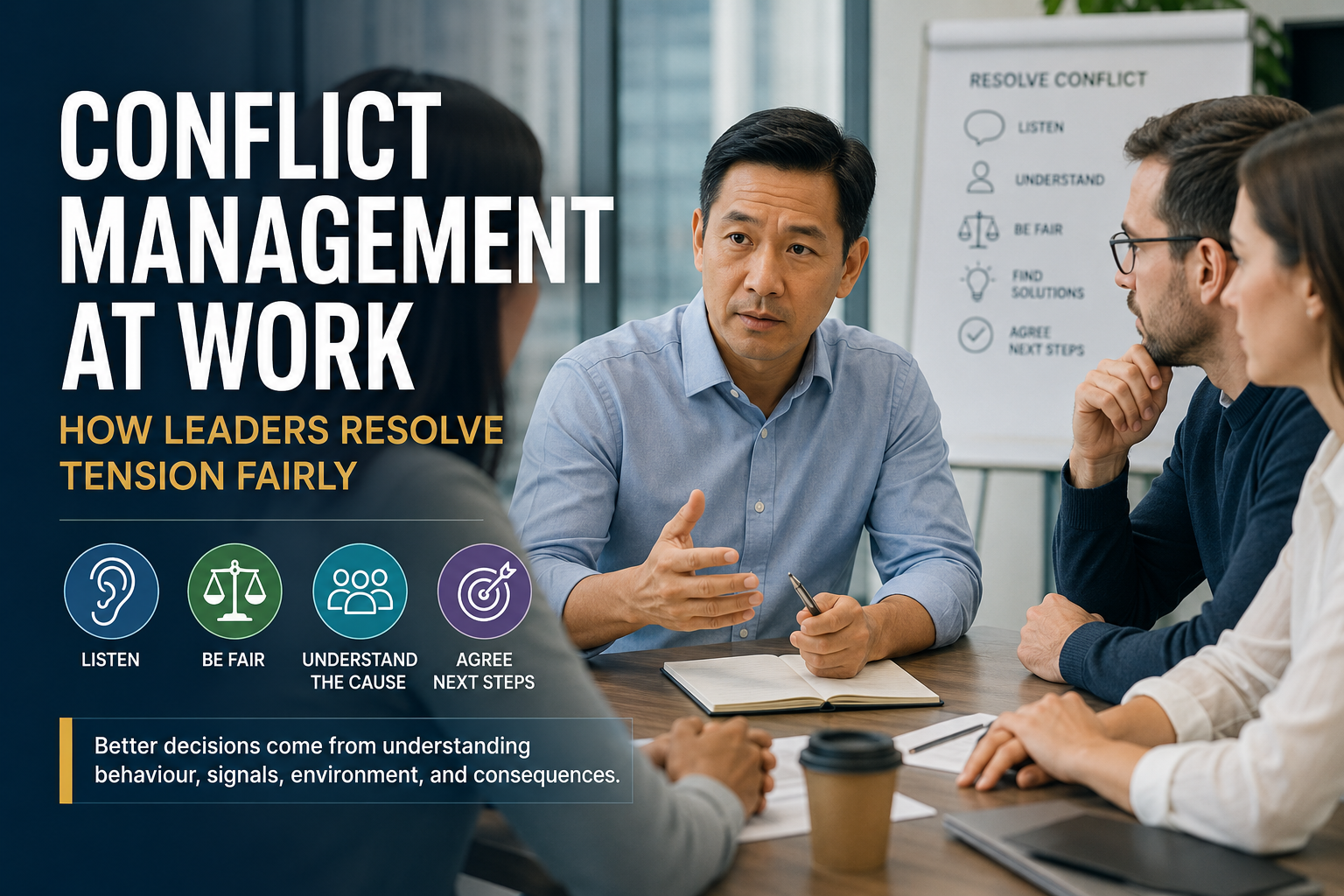
Conflict management at work is not about avoiding every disagreement. It is about handling tension early, fairly, and calmly before it damages trust, wellbeing, and performance. This guide explains how leaders can spot conflict signals, understand the real cause, and choose the right response.
Disclosure: If you click on my affiliate/advertiser’s links, I will receive a tiny commission. AND… Most of the time you will receive an offer of some kind. It’s a Win/Win!

Photo by Timur Weber
Conflict at work usually starts smaller than people think.
A sharp email.
A missed deadline.
A quiet team member.
A manager avoiding a difficult conversation.
A colleague who feels the workload is unfair.
A meeting where everyone smiles, but nobody says what they really think.
Small tension can sit quietly for a while. Then it grows.
That is why conflict management at work matters so much.
Conflict itself is not always bad. Sometimes disagreement helps a team make better decisions. A different opinion can reveal a risk, challenge a weak idea, or stop a business from sleepwalking into trouble.
The real problem is not conflict.
The real problem is poorly handled conflict.
When conflict is ignored, rushed, or handled unfairly, it can damage trust, motivation, productivity, service quality, and staff retention. It can also place extra pressure on managers who are already trying to balance people, performance, customers, costs, and constant change.
In my experience, workplace conflict is rarely just about “difficult people”. More often, it is a signal. Something is unclear, unfair, overloaded, badly communicated, or left too long.
That is why leaders need to look deeper.
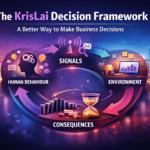
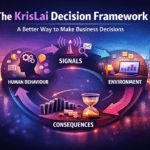
Better decision tend to come from understanding behaviour, signals, environment, and consequences.
This connects to how I approach decisions using the KrisLai Decision Framework™.
Conflict is not always a sign that something is broken. Sometimes it is a signal that expectations, communication, workload, trust, or leadership clarity need attention.
For free accounting software from Wave for small businesses click HERE
What workplace conflict looks like in day-to-day life
Workplace conflict does not always look dramatic.
It is not always shouting, formal complaints, or people refusing to work together.
Often, it looks more ordinary.
It may show up as:
- short replies in messages
- people avoiding each other
- tension in meetings
- repeated misunderstandings
- missed deadlines
- gossip
- blame
- quiet withdrawal
- reduced cooperation
- frustration about workload
- disagreement over priorities
- tension between departments
- a manager and employee not seeing eye to eye
Conflict can happen between colleagues, between a manager and an employee, across departments, or between office-based and remote workers.
Sometimes it is open and obvious.
Other times, it hides under politeness.
That hidden conflict can be especially risky because leaders may not notice it until performance has already started to suffer.
The three types of workplace conflict leaders should notice
Not all conflict is the same.
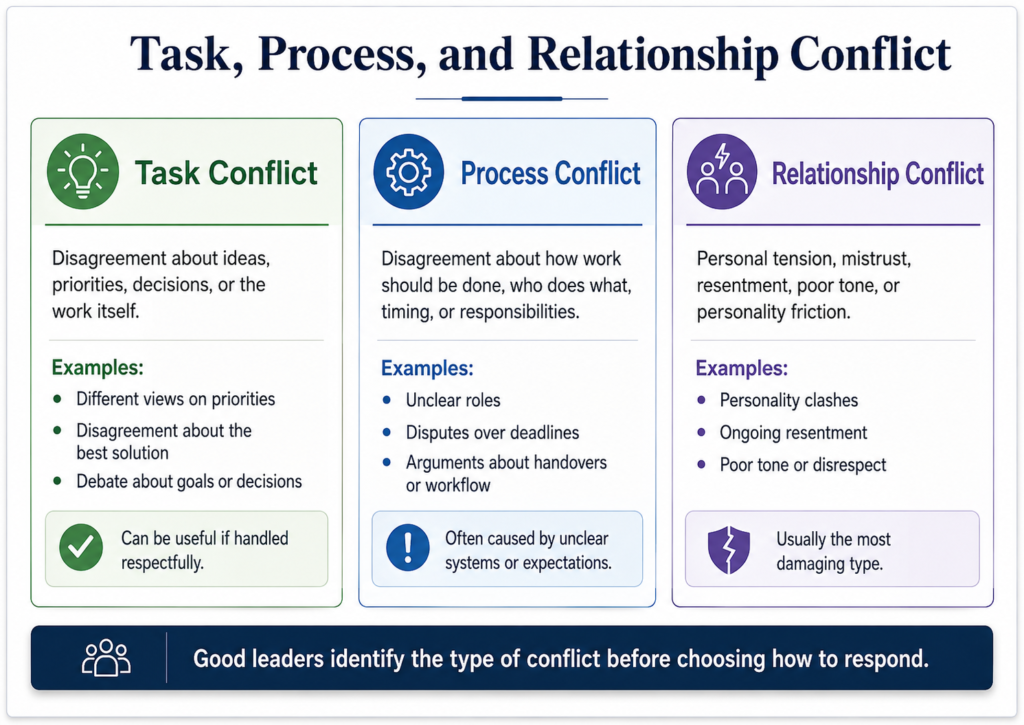
A useful way to think about workplace conflict is to separate it into three types: task conflict, process conflict, and relationship conflict.
Task conflict
Task conflict is disagreement about ideas, decisions, or priorities.
For example:
- Which project should come first?
- Which supplier should we use?
- What is the best way to serve a client?
- Should we focus on cost, speed, or quality?
Task conflict can be healthy if it is handled respectfully. It can help people challenge assumptions and improve decisions.
The danger comes when disagreement about the work turns into personal tension.
Process conflict
Process conflict is disagreement about how work should be done.
For example:
- Who is responsible?
- What is the deadline?
- Who should approve the work?
- Which system should be used?
- Why does one person always get the urgent tasks?
This type of conflict is very common because many workplace problems come from unclear roles, weak systems, or poor handovers.
People may blame each other when the real issue is the process.
Relationship conflict
Relationship conflict is personal tension.
This may involve mistrust, resentment, personality clashes, poor tone, disrespect, or a history of unresolved issues.
This is usually the most damaging type of conflict because it can affect confidence, teamwork, and psychological safety.
A team can usually cope with disagreement about ideas.
It struggles when people stop trusting each other.
The most common causes behind arguments at work
Most workplace conflict has a cause underneath it.
The visible argument is often only the surface.
Common causes include:
- poor communication
- unclear expectations
- lack of trust
- uneven workloads
- personality clashes
- different working styles
- poor management follow-through
- unclear roles
- pressure from customers or clients
- pay and working condition concerns
- lack of recognition
- unresolved previous problems
Many conflicts start small.
Someone feels ignored.
Someone feels overloaded.
Someone thinks another person is not pulling their weight.
Someone receives a blunt message and assumes bad intent.
Someone is told about a change too late.
Nothing is dealt with properly.
Then the story grows in people’s heads.
That is how a small tension becomes bigger conflict.
It is also important to be clear: bullying, harassment, discrimination, victimisation, or repeated abusive behaviour should not be treated as an ordinary disagreement. Those situations need a stronger response, clear policies, and appropriate HR or professional guidance.
How hybrid and remote work can make conflict worse
Hybrid and remote work can bring flexibility, but they can also create new misunderstandings.
A short message can sound cold.
A delayed reply can feel like avoidance.
A person working from home can feel excluded.
A person in the office can feel they are carrying more of the visible load.
Many hybrid conflicts are not really about location.
They are about expectations.
For example:
- How quickly should people reply?
- What counts as urgent?
- When should people be available?
- Which meetings need everyone present?
- Who handles tasks that appear unexpectedly in the office?
- Are remote workers being included properly?
- Are office-based workers being fairly supported?
When expectations are unclear, people fill the gaps with assumptions.
And assumptions are very good at causing conflict.
Small conflict rarely stays small when people feel ignored. The longer tension is left unspoken, the more likely it is to turn into resentment, avoidance, or a formal complaint.

Why dealing with conflict early protects people and performance
Conflict is expensive when leaders ignore it.
Not always immediately. That is the danger.
At first, unresolved conflict may only look like a bit of tension. Then it begins to affect behaviour.
People stop sharing information.
They avoid meetings.
They become defensive.
They copy more people into emails.
They do the minimum.
They stop offering ideas.
They take sides.
They leave problems for someone else.
Performance drops quietly before it drops obviously.
This is why early conflict management is not just about being nice. It is about protecting the health of the team and the performance of the business.
The effect on mental health and motivation
Ongoing conflict can wear people down.
A person may start to dread meetings. They may avoid certain colleagues. They may stop speaking up because it feels safer to stay quiet.
Over time, this can lead to:
- stress
- anxiety
- low confidence
- poor motivation
- reduced concentration
- sickness absence
- presenteeism
- emotional exhaustion
- lower trust in management
You do not need to be a psychologist to notice when someone changes.
A previously engaged person becomes quiet.
A reliable person starts making mistakes.
A team member stops volunteering.
A normally calm person becomes defensive.
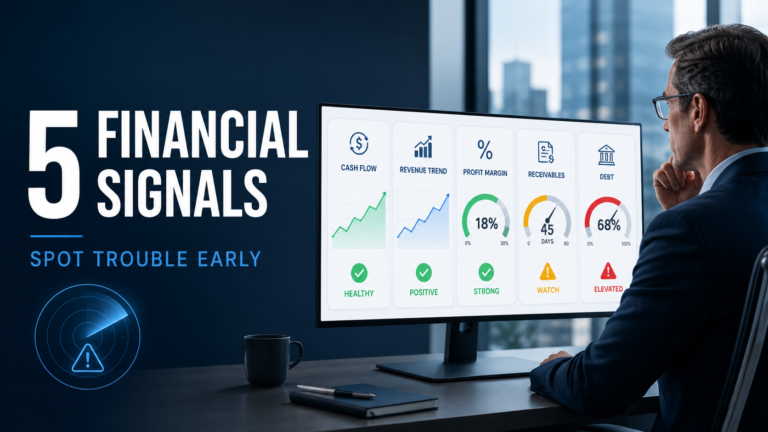
Those are signals.
Good leaders notice signals before they become serious problems.
The business cost of ignoring small problems
Workplace conflict also has a business cost.
It can lead to:
- wasted management time
- slower projects
- duplicated work
- missed deadlines
- poor handovers
- customer service problems
- lower quality
- team division
- higher staff turnover
- more HR involvement
- formal complaints
In service businesses especially, poor internal relationships can quickly affect the customer experience.
If the team is tense, communication suffers.
If communication suffers, mistakes increase.
If mistakes increase, trust weakens.
If trust weakens, the business pays the price.
What I’ve seen in practice is that leaders often underestimate the cost of “small” unresolved issues.
One avoided conversation can create weeks of quiet damage.

How to manage conflict at work in a calm and fair way
The aim of conflict management is not to prove who is right as quickly as possible.
The aim is to understand what is happening, protect fairness, and move the situation towards a better outcome.
That requires calm thinking.
It also requires courage.
Many managers avoid conflict because they do not want to make things worse. That is understandable. But avoidance usually gives the conflict more room to grow.
A better approach is to act early, listen carefully, and deal with the real issue.
Step 1 — Pause before reacting
When conflict appears, do not rush to take sides.
The first version you hear may be incomplete. It may be emotional. It may be accurate, but still missing important context.
Start by asking:
- What do I know?
- What am I assuming?
- Who is affected?
- Is anyone at risk?
- Is urgent action needed?
- Is this a one-off issue or a pattern?
- Could there be a power imbalance?
This short pause matters.
It helps you respond instead of react.
A calm pause is not weakness. It is leadership discipline.
Better decisions come from understanding behaviour, signals, environment, and consequences.
Step 2 — Listen to understand, not to win
Listening sounds simple, but it is often where conflict resolution fails.
People do not only want to be answered. They want to feel heard.
When you are dealing with conflict, listen carefully to each person’s version of events.
Use open questions:
- What happened from your point of view?
- What were you expecting?
- What did you find difficult?
- What do you think has been misunderstood?
- What would help move this forward?
Avoid blame language at the start.
Instead of saying:
“Why did you do that?”
Try:
“Can you help me understand what led to that?”
Then repeat back what you heard.
For example:
“What I’m hearing is that you felt the deadline changed without enough notice. Is that right?”
That one step can clear up many misunderstandings.
People often calm down when they realise they are actually being listened to.

Step 3 — Find the real cause, not only the loudest complaint
The loudest issue is not always the real issue.
A person may say:
“He never helps.”
But the real issue may be unclear workload.
Another may say:
“She is difficult.”
But the real issue may be different communication styles.
A manager may say:
“The team is lazy.”
But the real issue may be unclear priorities, poor systems, or unrealistic expectations.
This is where strategic thinking matters.
Do not only ask:
“What are they arguing about?”
Ask:
“What is this conflict telling us?”
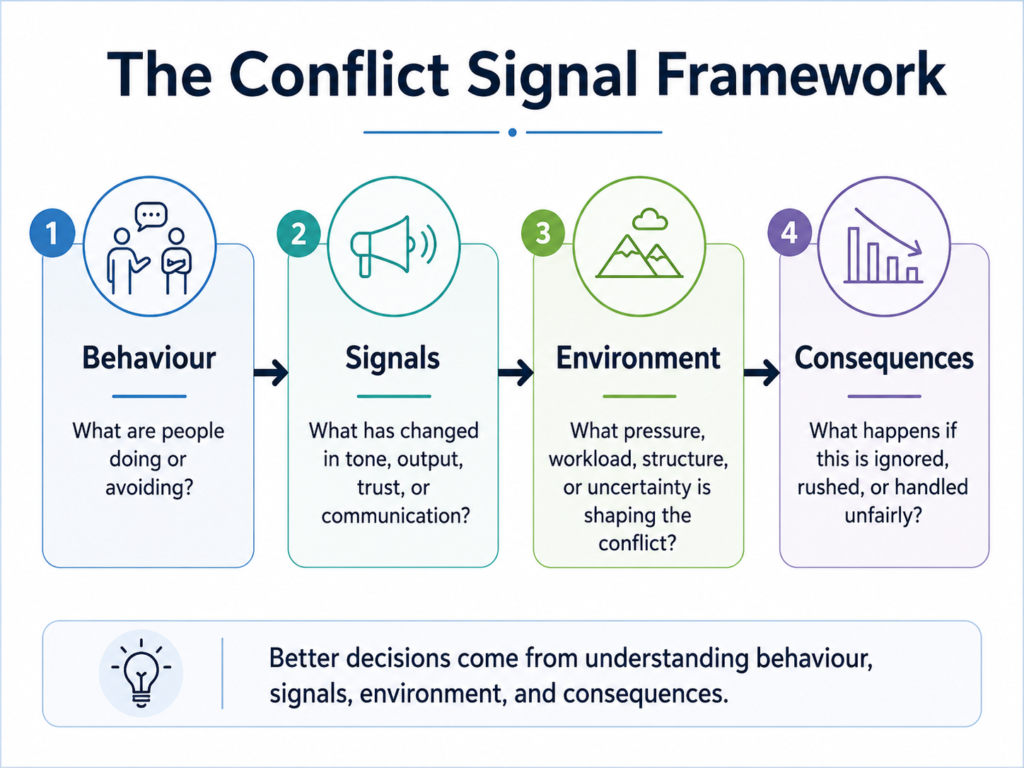
When conflict appears, look at four things:
- Behaviour: What are people doing or avoiding?
- Signals: What has changed in tone, output, trust, or communication?
- Environment: What pressure, workload, structure, or uncertainty is shaping the conflict?
- Consequences: What happens if this is ignored, rushed, or handled unfairly?
Better decisions come from understanding behaviour, signals, environment, and consequences.
This connects to how I approach decisions using the KrisLai Decision Framework™.
Step 4 — Use clear language and agree next steps
Once the issue is understood, the next step is clarity.
Vague conversations rarely solve conflict.
People need to know:
- what needs to change
- who will do what
- what standard is expected
- what support is available
- when the situation will be reviewed
Use direct but respectful language.
For example:
“Going forward, project updates need to be shared by 3pm every Friday so the team can plan properly.”
That is clearer than:
“Please communicate better.”
If behaviour needs to change, describe the behaviour. Do not attack the person’s character.
Say:
“When deadlines change, the team needs to be told clearly.”
Not:
“You are always disorganised.”
The first statement can be worked with.
The second creates defence.
Where appropriate, put agreed actions in writing. This does not need to be heavy-handed. It simply reduces misunderstanding later.
Step 5 — Know when to involve a manager, HR, or mediation
Not every conflict can or should be handled informally.
Sometimes a manager, HR support, or workplace mediation is needed.
This is especially true when:
- the behaviour is repeated
- there is bullying, harassment, or discrimination
- there is a power imbalance
- someone feels unsafe
- trust has broken down badly
- informal conversations have failed
- the manager is part of the conflict
- a formal grievance may be needed
- the issue affects wider team performance
Mediation can be useful when people are stuck but still willing to talk.
HR may be needed where policies, conduct, legal risk, or fairness are involved.
The important point is this: do not wait until the situation has become unmanageable.
Early support often prevents escalation.
What this looks like in real business
In real business, conflict rarely arrives as a neat case study.
It arrives in everyday situations.
A workload disagreement.
A client complaint.
A manager avoiding a difficult conversation.
A team member who has stopped contributing.
A quiet resentment that everyone can feel, but nobody wants to name.
In my experience, conflict often becomes expensive when leaders treat it as a personality problem too quickly.
What I’ve seen is that many conflicts are really signals.
Something is unclear.
Something is unfair.
Something is overloaded.
Something is poorly communicated.
Something has been left too long.
Here are a few practical examples.
Example 1: Workload conflict
A team member feels they are always given the urgent tasks.
At first, this may look like a personal complaint.
But the real issue may be:
- unclear priority rules
- poor workload planning
- weak delegation
- uneven skill levels
- a manager relying too much on the most capable person
Insight → real example → decision → consequence.
The insight is that workload conflict is often a fairness signal.
The real example is one person constantly carrying the urgent work.
The decision is whether to clarify priorities, rebalance tasks, improve training, or change expectations.
The consequence is either a fairer team — or quiet resentment that grows.
Example 2: Client-pressure conflict
A client keeps changing expectations.
The team becomes tense. People start blaming each other for delays.
At first, this may look like poor teamwork.
But the real issue may be that the client relationship is not being managed clearly.
The decision is not only “Who made the mistake?”
The better decision question is:
“What expectations need resetting so the team can deliver properly?”
If the leader deals only with the internal argument, the problem will return.
If the leader manages the client expectation and resets internal responsibilities, both service quality and team morale improve.
Example 3: Hybrid-working conflict
Office-based staff feel they are picking up more visible tasks.
Remote staff feel excluded from decisions.
Both sides feel misunderstood.
The issue may not be laziness or poor attitude. It may be unclear communication norms.
The decision is to agree:
- response times
- meeting rules
- task ownership
- handover standards
- when office presence matters
- how remote staff stay included
The consequence is fewer assumptions and more fairness.
That is the heart of good conflict management.
It turns tension into useful information.

Where this goes wrong
Conflict management goes wrong when leaders focus on comfort instead of clarity.
It is natural to want peace.
But peace is not the same as resolution.
A quiet team is not always a healthy team. Sometimes people are silent because they have given up trying to be heard.
Here are the common failure points:
Avoiding the conversation
This is probably the most common mistake.
The manager hopes the issue will settle down by itself.
Sometimes it does.
Often, it does not.
Avoidance sends a message, even if the leader does not mean it to.
It can make people think:
- management does not care
- poor behaviour is accepted
- speaking up changes nothing
- the loudest person wins
- the issue is not safe to discuss
The longer a difficult conversation is delayed, the harder it becomes.
A small knot becomes a rope.
Taking sides too early
Another mistake is believing the first version of events.
This is risky.
The first person to speak may be right. They may also be upset, selective, misinformed, or missing context.
Fairness requires listening before judging.
If people feel the outcome was decided before they were heard, trust suffers.
And once trust is damaged, every future decision becomes harder.
Treating symptoms as causes
This is where many leaders get trapped.
They deal with the argument, but not the cause.
For example:
- Two people argue about deadlines.
- The manager tells them to “communicate better”.
- Everyone agrees.
- Nothing changes.
Why?
Because the real issue was not communication style. It was unclear ownership, unrealistic deadlines, or too much work in the system.
If you only treat the symptom, the conflict returns.
It may return with different words, but the same root cause.
Confusing fairness with pleasing everyone
Fairness does not mean everyone gets what they want.
A fair process means:
- people are heard
- facts are checked
- expectations are clear
- decisions are explained
- behaviour standards apply consistently
- follow-up happens
Sometimes a fair decision will still disappoint someone.
That is leadership.
The aim is not to avoid all discomfort. The aim is to handle the situation with honesty, respect, and consistency.
Forgetting follow-up
A conflict conversation without follow-up is incomplete.
People may agree in the meeting because they want the discomfort to end. But if nobody checks what happens next, old patterns often return.
Follow-up shows that the decision mattered.
It also gives people a chance to adjust before the issue becomes serious again.
Strategic conflict management fails when leaders confuse speed with clarity. Acting quickly is useful only when the team understands the real problem, the trade-offs, and the consequences of the choice.
What you should actually do
If you are dealing with workplace conflict, do not start by asking:
“Who is right?”
Start by asking:
“What is really happening here?”
That question changes the conversation.
Use this simple 10-minute conflict reset:
The 10-minute conflict reset
Before stepping into a difficult conversation, write down:
- What happened?
- Who is affected?
- What do we know?
- What are we assuming?
- Is this task, process, or relationship conflict?
- Is there a power imbalance or serious behaviour issue?
- What needs to stop?
- What needs to change?
- Who owns the next action?
- When will we review?
This short exercise helps you avoid emotional guessing.
It also helps you separate facts from assumptions.
That matters because many workplace conflicts are made worse by stories people tell themselves.
“He ignored me on purpose.”
“She is trying to undermine me.”
“They do not care.”
“Management always takes their side.”
Sometimes those concerns may have truth in them.
But a leader still needs to check.
Facts first. Then judgement.
Before stepping into a conflict conversation, write down the issue in one sentence. Then separate facts, assumptions, emotions, and consequences. This stops the conversation becoming a contest of opinions.

Building a workplace where conflicts are easier to solve
Cultivating a positive work environment is essential for the success and well-being of any organisation. One key aspect of fostering a positive workplace culture is through constructive conflict resolution practices. Conflict is inevitable in any team or organisation, but how it is managed and resolved can make all the difference in creating a harmonious and productive work environment.
The best conflict management does not begin when people are already upset!
It begins earlier.
It begins with clear expectations, trained managers, fair systems, and a culture where people can speak up before problems become personal.
This is not about creating a workplace where nobody disagrees.
That would be unrealistic.
It is about creating a workplace where disagreement can be handled properly.
Set clear expectations for communication and behaviour
Many conflicts are caused by unclear expectations.
Teams need to know:
- how quickly messages should be answered
- what counts as urgent
- how meetings should be run
- how workload is shared
- how deadlines are agreed
- how concerns should be raised
- what respectful communication looks like
- when issues should be escalated
This is especially important in hybrid teams.
If some people work from home and others work on-site, assumptions multiply quickly.
Clear rules do not remove every conflict, but they reduce the confusion that feeds it.
Train managers to spot tension before it grows
Line managers are often the first people who can spot conflict.
But they need confidence, time, and support.
Early warning signs include:
- changes in tone
- people avoiding each other
- gossip
- missed work
- silence in meetings
- lower motivation
- fewer volunteers
- “them and us” language
- increased sickness absence
- defensive behaviour
- quiet withdrawal
These signals should not be ignored.
A good manager does not need to overreact to every mood change. But they should notice patterns.
One quiet meeting may mean nothing.
Several quiet meetings after a disagreement may mean something important.
Create a culture where people can speak up safely
A healthy workplace does not avoid all tension.
It makes it safer to raise issues early.
That requires trust.
People need to believe that if they speak up:
- they will be heard
- they will not be punished
- the issue will be handled fairly
- management will follow through
- disagreement will not be treated as disloyalty
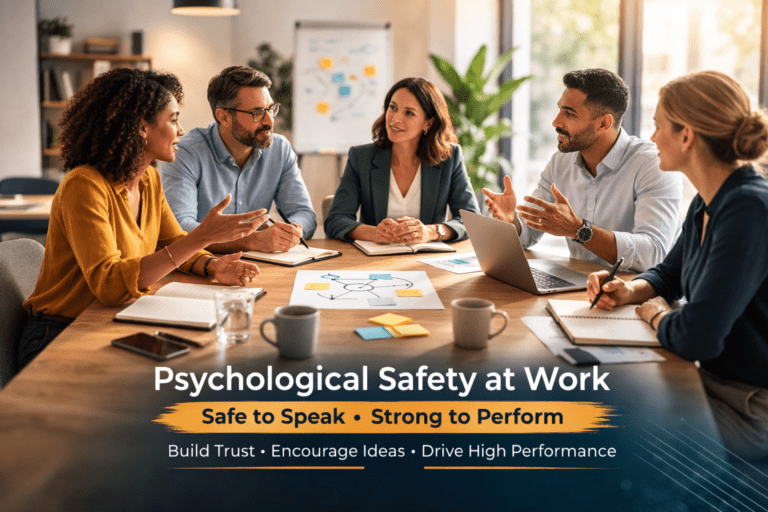
This connects closely with psychological safety.
When people feel safe to speak up, problems are easier to solve while they are still small.
When people do not feel safe, problems go underground.
And underground conflict is harder to manage because it becomes mixed with fear, gossip, and resentment.
Use formal procedures when informal action is not enough
Informal resolution is often best when the issue is small, recent, and both sides are willing to talk.
But formal procedures exist for a reason.
They may be needed when:
- behaviour is serious
- the issue is repeated
- informal steps have failed
- someone raises a grievance
- bullying or harassment is alleged
- discrimination may be involved
- there is a conduct issue
- there is a safeguarding or wellbeing concern
Leaders should not try to handle serious issues casually.
Fairness matters.
Documentation matters.
Policies matter.
And in some situations, professional HR or legal advice may be needed.
Conflict management styles: when to use each one
There are different ways to manage conflict.
No single style is right for every situation.
The best approach depends on the issue, urgency, relationship, risk, and consequences.
Here are five common conflict management styles:
Conflict Management Styles: Quick Guide
| Style | Best used when | Risk if overused |
|---|---|---|
| Avoiding | The issue is minor or people need time to cool down | Problems stay unresolved |
| Accommodating | The relationship matters more than the issue | Resentment builds |
| Competing | Urgent action or a clear decision is needed | Morale and trust suffer |
| Compromising | A workable middle ground is needed quickly | No one feels fully satisfied |
| Collaborating | The issue matters and long-term trust is important | Can take more time and effort |
The key is not to memorise styles.
The key is to choose deliberately.
Avoiding may be useful for a minor issue that needs cooling time. But avoidance becomes harmful when it is used to dodge responsibility.
Competing may be needed in a serious or urgent situation. But overused, it damages morale.
Collaborating is often best for important issues where trust matters. But it needs time, patience, and emotional control.
That is why conflict management is really decision-making.
You are not just choosing words.
You are choosing consequences.
Build deeper insight
If you want to strengthen your leadership and decision-making further, these related articles may help:
Build Deeper Insight
If you found this useful, these related articles will help you build stronger leadership and business thinking:
FAQ: Conflict Management at Work
What is conflict management at work?
Conflict management at work is the process of handling disagreements, tension, or disputes in a calm, fair, and constructive way. The aim is to understand the issue, reduce harm, agree clear next steps, and protect trust and performance.
What are the main causes of workplace conflict?
Common causes of workplace conflict include poor communication, unclear roles, uneven workload, lack of trust, personality clashes, different working styles, poor management, pay concerns, and unresolved previous issues.
What are the five conflict management styles?
The five common conflict management styles are avoiding, accommodating, competing, compromising, and collaborating. Each style can be useful in the right situation, but each can also create problems if overused.
How should a manager handle conflict between employees?
A manager should listen to both sides, stay calm, check facts, avoid taking sides too early, identify the real cause, agree clear next steps, and follow up. If the issue is serious or repeated, HR or mediation may be needed.
When should HR get involved in workplace conflict?
HR should usually be involved when there is bullying, harassment, discrimination, repeated behaviour, a formal complaint, a power imbalance, conduct concerns, or when informal resolution has failed.
How does hybrid work create conflict?
Hybrid work can create conflict when expectations are unclear. Problems may include misunderstood messages, uneven workload, exclusion from decisions, unclear availability, after-hours communication, and different views about office and remote responsibilities.
Is workplace conflict always bad?
No. Workplace conflict is not always bad. Respectful disagreement can improve decisions and reveal risks. However, conflict becomes harmful when it is ignored, personalised, handled unfairly, or allowed to damage trust.
What is the first step in resolving workplace conflict?
The first step is to pause and understand what is really happening. Separate facts from assumptions, listen to each side, and identify whether the conflict is about a task, a process, or a relationship.
Conclusion: conflict is a signal leaders should not ignore
Conflict at work is normal.
Poorly handled conflict is the real danger.
When leaders avoid it, rush it, or treat it as only a personality issue, they often miss the deeper signal. That signal may be about workload, trust, communication, expectations, systems, or pressure.
Handled well, conflict can become useful information.
It can show where a team needs clearer expectations.
It can reveal where managers need to communicate better.
It can expose weak processes.
It can help people understand each other.
It can even improve decisions.
But that only happens when leaders deal with conflict early and fairly.
The aim is not to create a workplace where nobody disagrees.
The aim is to create a workplace where disagreement does not become damage.
Remember: better decisions always come from understanding behaviour, signals, environment, and consequences.
This connects to how I approach decisions using the KrisLai Decision Framework™.
Ready to handle conflict more calmly?
Start with one unresolved tension in your team. Do not ask who is right first. Ask what behaviour, signal, environment, and consequence you need to understand.
Conflict handled early can protect trust, performance, and better decisions.
A practical model for better business decisions in complex environments. It focuses on four essential elements:
- Human Behaviour — how people actually think and decide
- Signals — what people are trying to do right now
- Environment — whether the system supports good decisions
- Consequences — what happens next, and after that
Strong decisions consider all four — not just one.
About the author
Kris Lai is a business operator and managing director with experience in land and building surveying, facilities management, logistics, and service delivery.
Earlier in his career, he worked as a Search Engine Evaluator (via Lionbridge, supporting Google), where he assessed search result relevance, user intent, and content quality using structured evaluation frameworks. This experience gives him a rare, practical understanding of how search systems interpret signals and make ranking decisions.
In parallel, whilst working with a charity organisation, he has delivered 1000’s of structured presentations in English, Finnish, and Chinese to audiences ranging from small groups to more than 600 people, and has spent decades mentoring and developing others. This experience informs his approach to clarity, communication, and decision-making under pressure.
He writes about AI, search behaviour, business strategy, and decision-making from a practical, real-world perspective.
If you enjoy exploring the ideas behind better business decisions, you may find the Business Thinking Hub useful.

👉 Explore ideas connected to better business decisions:
- Digital Transformation for SMEs: 7 Questions Before You Invest
- Cybersecurity for Businesses: 7 Decisions Leaders Must Make

- How AI Is Changing Search Behaviour (And What Businesses Must Do Now)
- Decision-Making Framework Examples: The KrisLai Method in Action
- The KrisLai Decision Framework: A Better Way to Make Business Decisions