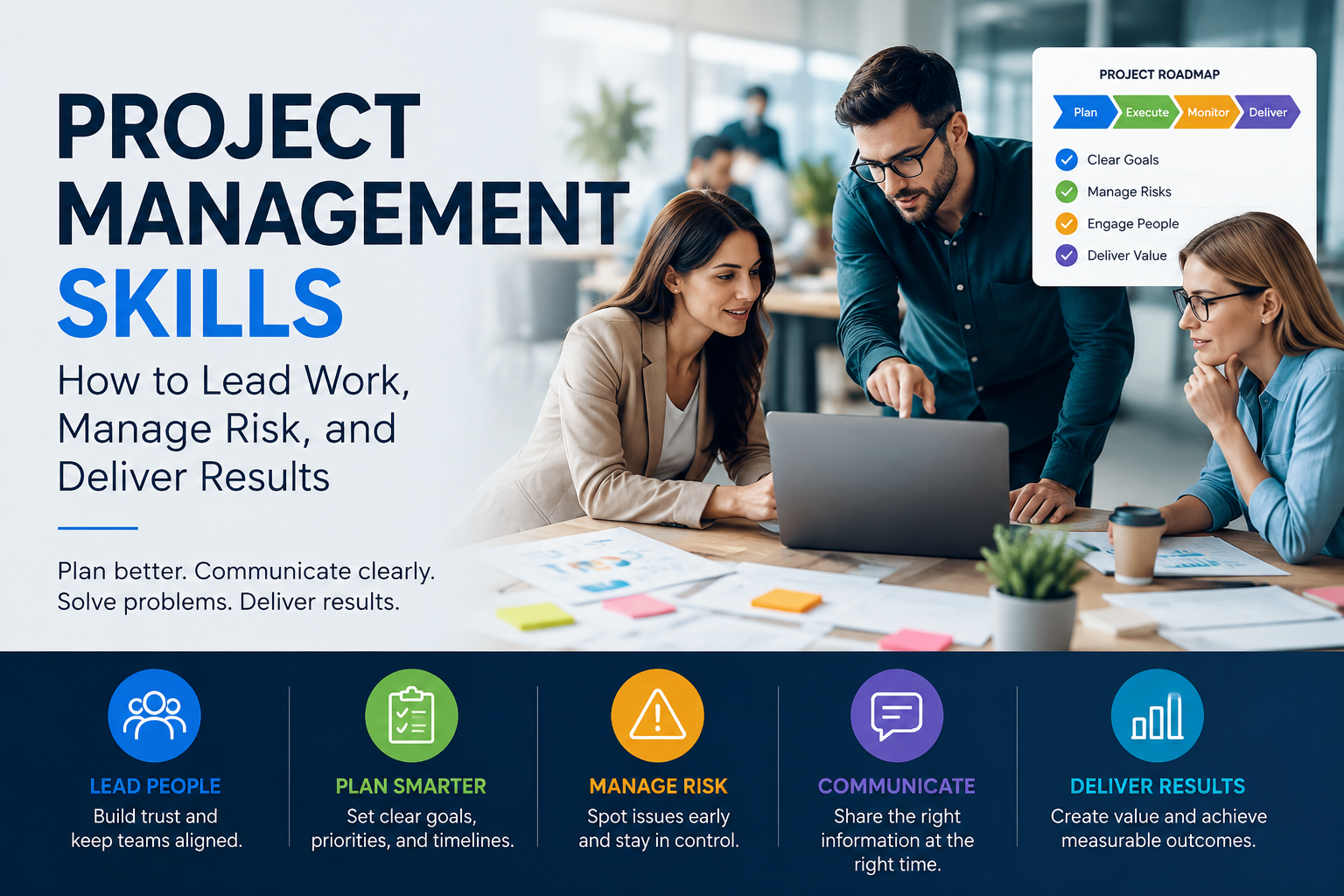
Project management skills are not just about schedules, tools, or task lists. They help managers turn unclear work into organised progress by planning well, managing risk, communicating clearly, leading people, and making better decisions when projects change. This guide explains the skills that matter most in real business.
Disclosure: If you click on my affiliate/advertiser’s links, I may receive a tiny commission. AND… Most of the time, you will receive an offer of some kind. It’ s a Win/Win!
What this article covers
In this article, I explain what project management skills are, why they matter in modern workplaces, which skills make the biggest difference, where projects often go wrong, how AI is changing project work, and how you can build stronger project management skills over time.
I will also show how project management connects to better business decisions, clearer communication, and practical leadership.
This article is based on practical business experience, independent research, and my own analysis and synthesis of how people, planning, risk, communication, and decision-making affect real project delivery.
A project does not usually fail only at the deadline.
It starts failing earlier.
A risk is ignored.
A decision is delayed.
A stakeholder quietly disagrees.
A deadline is accepted even though the resources are not realistic.
A progress report says “on track”, but everyone close to the work knows the project is drifting.
That is where project management skills matter.
Project management is not just keeping a task list updated.
It is the skill of turning messy work into controlled progress.
In modern workplaces, that matters more than ever. Teams may be hybrid. Budgets may be tighter. AI tools may create more speed, but also more noise. Stakeholders may expect faster answers. Customers may change their minds. Leaders may want results before all the details are clear.
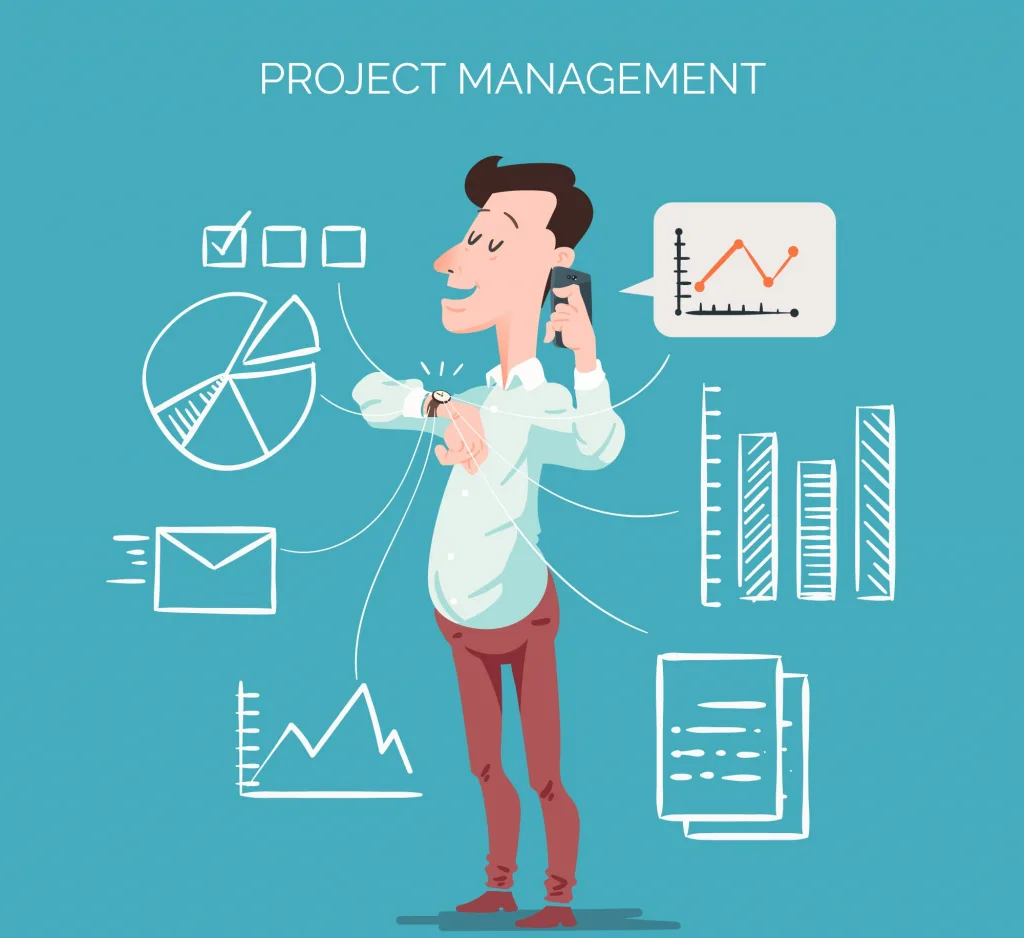
In real business, project management skills are not just about knowing the method.
They are about noticing when the plan has stopped matching reality.
Better decisions always come from understanding behaviour, signals, environment, and consequences.
I write about how better decisions are made in business — combining strategy, behaviour, and practical thinking.
Key ideas
- Project management is not just administration. It is structured delivery.
- The best project managers balance people, planning, risk, and business value.
- Projects often fail when hidden risks, weak communication, and delayed decisions are ignored.
- AI can support project work, but it cannot replace judgement, trust, or accountability.
- Strong project management keeps the project honest, not just updated.
What are project management skills?
Project management skills are the practical abilities that help someone plan work, organise resources, lead people, manage risk, communicate progress, solve problems, and deliver a project within agreed goals, time, cost, and quality expectations.
That sounds formal, but the idea is simple.
Project management skills help people get important work done properly.
They are useful in:
- business projects
- construction and facilities work
- IT projects
- marketing campaigns
- service improvements
- operational changes
- client delivery
- product launches
- process improvement
- charity and community projects
- internal team initiatives
You do not need the job title “Project Manager” to need these skills.
If you plan work, coordinate people, manage deadlines, control scope, deal with stakeholders, solve problems, or deliver outcomes, you are already using project management skills.
Project management skills, in simple terms
Project management skills are the abilities that help you plan work, organise people and resources, manage risk, communicate clearly, solve problems, and deliver useful results without losing control of time, cost, scope, or quality.
Enroll in the AI Product Manager Nanodegree Program for a comprehensive overview of AI and machine learning for business. You'll learn to build and train AI models, evaluate results, and measure success. Click HERE to get started NOW.

The three skill areas every project manager needs
The strongest project managers usually develop three types of skill:
1. Technical project skills
These are the practical planning and control skills.
They include:
- planning
- scheduling
- budgeting
- risk management
- resource management
- tracking progress
- managing scope
- using project tools
- documenting decisions
For example, a technical project skill might be breaking a large piece of work into clear milestones, dependencies, owners, and deadlines.
2. People skills
Projects are delivered by people, not charts.
People skills include:
- communication
- active listening
- stakeholder management
- conflict management
- emotional intelligence
- motivation
- influencing
- expectation-setting
For example, a people skill might be spotting that a team member is overloaded before the delay appears in the project report.
3. Strategic and business thinking skills
This is where project management becomes more than task delivery.
Strategic project skills include:
- understanding business goals
- judging value
- making trade-offs
- connecting work to outcomes
- knowing when to escalate
- recognising when a project no longer makes sense
For example, a strategic project skill might be asking whether a project is still worth doing after costs, risks, or customer needs have changed.
As the Swedish saying goes, lagom är bäst — “moderation (or “just right”) is best”.
In project management, that often means finding the right balance between ambition, resources, quality, and reality.
Why project management skills matter more in 2026
Project management skills matter more in 2026 because work is faster, more connected, and more uncertain.
Many teams now work across:
- different locations
- hybrid schedules
- digital tools
- AI-assisted workflows
- tighter budgets
- competing priorities
- higher customer expectations
- sustainability goals
- faster market change
This creates more opportunities, but also more ways for work to drift.
A project can look active without being controlled.
People can send updates without being aligned.
AI can produce drafts and summaries, but someone still needs to decide what matters.
That is why project management is becoming less about “managing the spreadsheet” and more about leading delivery with judgement.
What are the most important project management skills?
The most important project management skills are planning, communication, leadership, stakeholder management, risk management, problem-solving, budgeting, scheduling, prioritisation, and decision-making. These skills help projects stay clear, controlled, and useful when real work becomes messy.
Let us look at the skills that make the biggest difference:
The core project management skill groups
- Planning skills – define the work, scope, milestones, and success criteria.
- People skills – lead teams, manage stakeholders, and communicate clearly.
- Risk skills – spot problems early and decide what needs escalation.
- Business skills – connect delivery to value, cost, and strategic outcomes.
- Decision skills – make trade-offs when time, scope, quality, or resources clash.
Leadership and team motivation
Good project managers guide people without micromanaging them.
They keep the team focused, even when the work becomes busy or difficult.
That means:
- setting direction
- clarifying responsibilities
- creating accountability
- noticing pressure
- encouraging progress
- removing blockers
- keeping morale steady
- making sure people know why the work matters
Leadership in project management is often leadership without direct authority.
You may need to influence people who do not report to you.
That takes trust.
It also takes clarity.
A good project manager does not need to be the loudest person in the room. But they do need to make sure the room understands what needs to happen next.
Clear communication and active listening
Communication is one of the most important project management skills.
But communication is not just sending updates.
It is making sure the right people understand the right thing at the right time.
Good communication includes:
- clear meeting notes
- useful project updates
- simple status reports
- honest risk updates
- clear decision requests
- timely escalation
- plain language
- active listening
Poor communication creates mistakes, delays, rework, and frustration.
For example, if a stakeholder says, “Yes, that’s fine,” but later objects to the final deliverable, the problem may not be bad attitude.
It may be that expectations were never properly understood.
Active listening matters because people often reveal project risks in small comments before they appear in the plan.
Planning, scheduling, and prioritising work
Planning helps turn vague intention into organised action.
A good plan explains:
- what needs to be done
- who owns each part
- when it should happen
- what depends on what
- what success looks like
- what risks need watching
- what decisions are needed
Scheduling is not just choosing dates.
It is understanding sequence, capacity, dependencies, and realistic effort.
This is where many projects go wrong.
A deadline is agreed before the work is properly understood.
Then everyone spends the rest of the project pretending the date is realistic.
Good project managers protect realism early.
They break work into smaller parts, set milestones, track dependencies, and keep asking:
“Does the plan still match reality?”
Risk management and problem-solving
Risk management is the skill of spotting what could go wrong before it becomes urgent.
It includes:
- identifying risks
- assessing impact
- deciding ownership
- setting trigger points
- planning responses
- escalating early
- updating risks as the project changes
Risk management should not become paperwork theatre.
A risk log is only useful if someone acts on it.
Problem-solving also matters because every project hits friction.
The question is not whether problems will appear.
They will.
The question is whether the project manager can identify the real issue, not just treat the symptom.
For example, repeated missed deadlines may look like a time-management problem.
But the real cause might be unclear scope, too few resources, weak handovers, poor decision-making, or stakeholders changing requirements late.
This is why project management connects closely to problem-solving in business: the best project managers look for the real cause, not just the visible symptom.
Budget control and resource management
Projects use resources.
That may include:
- money
- time
- people
- tools
- equipment
- attention
- supplier support
- leadership capacity
Budget control is not just about stopping overspend.
It is about making sure the work still makes business sense.
A project can be “on time” but still waste money.
It can be “within budget” but deliver too little value.
It can be “complete” but leave the team exhausted because the resource plan was unrealistic.
Good resource management asks:
- do we have enough people?
- do they have enough time?
- are the right skills available?
- what is being delayed elsewhere?
- what will this cost if it overruns?
- is the project still worth the investment?
That is business thinking, not just project admin.

Why do projects fail even when the plan looks good?
Projects often fail even when the plan looks good because the plan stops matching reality. Scope changes, risks grow, stakeholders drift, assumptions prove wrong, and teams keep reporting progress without exposing the real blockers.
This is where project management becomes very real.
A plan can look beautiful.
The spreadsheet can be tidy.
The dashboard can be green.
The meetings can happen every week.
And still, the project may be in trouble.
Where this goes wrong
Projects often fail when people confuse activity with progress. Meetings happen, updates are sent, and tasks move around the board — but the real risks, decisions, and stakeholder tensions are not dealt with early enough.
Scope changes quietly
Scope creep is one of the most common project problems.
It often starts innocently.
Someone asks for “one small change”.
Then another.
Then a small extra feature.
Then a new reporting requirement.
Then a stakeholder says, “While we’re doing this, could we also…”
Before long, the project has changed.
But the deadline, budget, and resources have not.
That is how a project drifts.
Good project managers do not say no to every change.
But they do make the trade-off visible.
If scope increases, something else must usually change:
- time
- cost
- quality
- resources
- priority
- deliverables
If nothing changes, the pressure simply moves somewhere hidden.
Risks are recorded but not managed
Many projects have a risk log.
Far fewer have active risk management.
There is a difference.
A risk log says:
“This could happen.”
Risk management asks:
“What will we do if it starts happening?”
A useful risk should have:
- an owner
- a trigger point
- a likely impact
- a response plan
- a review date
- an escalation route
Without that, the risk log can become decoration.
What I’ve seen in practice is that teams often know a risk is growing long before leaders act on it.
The signal is there.
But nobody wants to escalate too early.
Then suddenly, it is no longer a risk.
It is a problem.
Stakeholders agree in meetings but not in practice
Stakeholder agreement can be slippery.
People may nod in meetings but still have concerns.
They may agree to the plan but not release resources.
They may approve the concept but question the details later.
They may support the deadline but quietly doubt it.
They may say nothing because they do not want to appear difficult.
Good project managers listen for weak signals.
Silence can be a signal.
Delayed feedback can be a signal.
Repeated questions can be a signal.
Late objections can be a signal.
Stakeholder management is not just keeping people informed.
It is making sure their expectations, concerns, influence, and decisions are understood before they derail the work.
Progress reports hide uncertainty
Status reporting is useful.
But only if it tells the truth.
A project can be marked green because nobody wants to explain why it is amber.
A team can report progress while hiding uncertainty.
A manager can receive comfort instead of truth.
This is dangerous.
Healthy project reporting should show:
- what is on track
- what is at risk
- what has changed
- what decisions are needed
- what support is required
- what assumptions are being tested
- what confidence level the team actually has
A report that hides uncertainty does not protect the project.
It protects the illusion.
Decisions are delayed
Many project problems are decision problems.
A supplier needs approval.
A stakeholder needs to choose between two options.
A budget question needs answering.
A risk needs escalation.
A scope change needs a decision.
But nobody owns the decision, or too many people think they do.
Delay then creates cost, confusion, and rework.
This is where decision prioritisation becomes part of project management, because not every decision has the same urgency or consequence.
Not every decision has equal weight.
Some decisions can wait.
Others block progress.
Good project managers know the difference.
What I’ve seen in practice
What I’ve seen in practice is that projects rarely fail because nobody cared. They fail because small signals were ignored for too long: unclear ownership, late decisions, quiet stakeholder resistance, unrealistic deadlines, or risks that everyone noticed but nobody acted on.
What people skills does a project manager need?
A project manager needs people skills because projects are delivered by people, not charts. The most important people skills are communication, listening, influence, conflict management, emotional intelligence, stakeholder management, and the ability to keep people aligned when pressure rises.
Technical skill matters.
But people skill is often what keeps the project moving when the plan becomes difficult.
Communication that reduces confusion
Good project communication is clear, timely, and useful.
It answers:
- what has changed?
- what is needed?
- who owns the next step?
- what is blocked?
- what decision is required?
- what risk is rising?
- what happens next?
Weak communication creates uncertainty.
And uncertainty creates delay.
A good project manager does not drown people in updates.
They give people the information they need to act.
Stakeholder management and expectation-setting
Stakeholders can include:
- clients
- senior leaders
- suppliers
- team members
- users
- finance teams
- customers
- regulators
- operational managers
- external partners
Each stakeholder may care about something different.
One cares about cost.
Another cares about speed.
Another cares about quality.
Another cares about disruption.
Another cares about reputation.
Project managers need to understand those differences.
Expectation-setting is not about making everyone happy.
It is about making the trade-offs clear before disappointment becomes conflict.
Leadership without direct authority
Project managers often need to lead people who do not formally report to them.
That requires influence.
You need to build trust, explain why the work matters, make ownership clear, and follow up without sounding like you are chasing for the sake of it.
This is a leadership skill.
Not everyone has to like every decision.
But people need enough clarity and trust to keep moving.
Conflict management and emotional intelligence
Projects create conflict because they involve trade-offs.
People may disagree about:
- priorities
- deadlines
- quality
- budget
- scope
- workload
- responsibility
- customer expectations
Conflict is not always bad.
It can reveal useful information.
But unmanaged conflict damages delivery.
This is why emotional intelligence in leadership matters so much in project work: pressure can easily turn normal disagreement into personal tension.
A project manager needs to stay calm, listen well, separate facts from emotions, and stop tension from becoming personal.
Project disagreements are normal, but they need to be handled well. For a deeper look at this, see my guide to conflict management.
Accountability without blame
Accountability is important.
Blame is usually less useful.
A project manager needs to know:
- who owns the task
- what was agreed
- when it is due
- what support is needed
- what happens if it slips
But when something goes wrong, the first question should not always be:
“Who can we blame?”
A better first question is:
“What happened, why did it happen, and what needs to change?”
That approach protects learning.
How do project managers make better decisions under pressure?
Project managers make better decisions under pressure by separating facts from assumptions, identifying the real trade-off, involving the right people, escalating early, and choosing the option that best protects value, trust, time, cost, and quality.
Project pressure often appears when something has to give.
Time, cost, scope, quality, resources, or stakeholder expectations clash.
When that happens, pretending nothing has changed does not help.
The project manager has to make the trade-off visible.
Decide what matters most when trade-offs appear
A project cannot always have everything.
If the deadline is fixed, scope may need to reduce.
If quality cannot drop, time or cost may need to change.
If budget is fixed, expectations may need adjusting.
If resources are limited, priorities need ranking.
A strong project manager does not hide these trade-offs.
They help the right people see them clearly.
This is where project management becomes decision leadership.
Escalate early, not when it is already too late
Escalation is not failure.
Good escalation is risk control.
A project manager should escalate when:
- a deadline is at serious risk
- scope has changed
- budget is under pressure
- a stakeholder is blocking progress
- resources are not available
- a decision is overdue
- quality may be affected
- the project no longer matches the original goal
Late escalation often creates fewer options.
Early escalation gives leaders time to decide.
When risks are ignored for too long, ordinary project issues can become operational problems or even require crisis management.
Use decision logs to protect clarity
A decision log is simple but powerful.
It records:
- what was decided
- who decided it
- when it was decided
- why it was decided
- what information was used
- what changes because of the decision
This helps avoid confusion later.
It also protects the project from people revisiting old decisions without understanding why they were made.
Read project signals before they become problems
Good project managers read signals.
They notice:
- repeated small delays
- unclear ownership
- vague updates
- quiet stakeholders
- rising rework
- missed handovers
- repeated questions
- overloaded team members
- changing requirements
- low meeting energy
- decisions that keep returning
These are not just annoyances.
They are signals.
And signals tell you whether a project is healthy, drifting, blocked, or at risk.
The KrisLai Project Delivery Lens™
- Behaviour – what are people actually doing, not just reporting?
- Signals – what shows the project is healthy, drifting, blocked, or at risk?
- Environment – what constraints, politics, resources, and pressures shape delivery?
- Consequences – what happens if scope, risk, communication, or decisions are handled badly?
Better project decisions come from understanding behaviour, signals, environment, and consequences.

How does AI change project management skills?
AI changes project management by making planning, summarising, reporting, and risk spotting faster. But it also makes human judgement more important, because AI cannot own accountability, manage trust, understand every stakeholder tension, or decide which trade-off is right for the business.
AI can support project managers.
But it should not replace project judgement.
What AI can help with
AI can help:
- draft project plans
- summarise meeting notes
- generate risk lists
- create status updates
- compare options
- identify repeated issues
- draft stakeholder messages
- organise actions
- prepare project briefings
- turn messy notes into clearer next steps
This can save time.
It can also make project information easier to organise.
What AI cannot replace
AI cannot replace:
- judgement
- accountability
- stakeholder trust
- ethical decisions
- conflict handling
- organisational politics
- reading the room
- knowing when a plan no longer fits reality
AI may summarise the meeting.
But it may not know that the quiet stakeholder is unhappy.
AI may draft the plan.
But it will not feel the pressure on the team.
AI may identify possible risks.
But a human still needs to decide which risk matters most.
Why AI makes project judgement more important
AI can create more output.
More drafts.
More reports.
More options.
More meeting summaries.
More possible plans.
But more output is not the same as better delivery!
Someone still has to decide:
- what matters
- what is true
- what is realistic
- what needs escalation
- what should stop
- what should change
- what decision is needed next
In an AI-shaped workplace, project management skills become more important, not less.
Because the hard part is no longer only producing information.
The hard part is turning information into controlled progress.

How can you improve project management skills?
You improve project management skills by practising on real work, learning from project reviews, building communication habits, using simple tools consistently, asking for feedback, studying proven methods, and improving how you make decisions when projects change.
Project management can be learned.
You do not need to be perfect before you start.
You improve by doing the work, reflecting honestly, and getting better one project at a time.
Start by managing a small project properly
A small project is a good training ground.
It might be:
- organising an internal process change
- improving a team workflow
- coordinating a small event
- managing a supplier change
- delivering a client task
- creating a new page on a website
- running a small marketing campaign
- improving an office or facilities process
Use the basics:
- define the objective
- name the owner
- agree the scope
- set milestones
- identify risks
- communicate progress
- review what happened
Small projects teach large lessons!
Learn from tools, templates, and feedback
Project tools can help.
Useful tools include:
- project plans
- dashboards
- Gantt charts
- Kanban boards
- RACI charts
- risk logs
- issue logs
- decision logs
- meeting notes
- action trackers
But tools only help if they support thinking.
A dashboard that nobody trusts is not useful.
A risk log that nobody acts on is not useful.
A Gantt chart that hides unrealistic assumptions is not useful.
Use tools to make reality clearer.
Not to make the project look tidy.
Build habits that make you more reliable
Strong project management often comes from simple habits.
For example:
- check priorities daily
- write down decisions
- confirm ownership
- follow up clearly
- keep notes
- update risks
- ask what has changed
- escalate early
- review progress honestly
- close loops after meetings
Reliability is built through consistency.
As the Chinese saying goes, 千里之行,始于足下 — “a journey of a thousand miles begins with a single step”.
Project management improves the same way.
One better habit at a time.
Review what worked after each project
After every project, ask:
- what went well?
- what caused stress?
- what changed during the work?
- what decision was delayed?
- what caused rework?
- where did communication fail?
- what risk did we miss?
- what would we do differently next time?
This is where improvement happens.
Not only during delivery.
After delivery too.

How do you show project management skills on a CV, in interviews, and at work?
You show project management skills by giving real examples of work you planned, problems you solved, people you coordinated, risks you managed, deadlines you met, budgets you controlled, and results you helped deliver.
Many people have project experience but do not describe it well.
They say:
“I helped with a project.”
That is too vague.
Better examples show action and result.
Turn your experience into strong examples
Instead of saying:
“I was involved in a project.”
Say something more specific:
“I coordinated a five-week office improvement project, tracked supplier deadlines, managed internal updates, and helped complete the work without disrupting daily operations.”
Or:
“I supported a customer service improvement project by gathering feedback, tracking actions, and helping the team reduce repeat complaints.”
Good examples include:
- what the project was
- what your role was
- what problem you helped solve
- what action you took
- what result followed
This works on a CV, in interviews, and in everyday workplace conversations.
Use the right words without sounding robotic
It is useful to know project management language.
Words such as:
- scope
- milestones
- risks
- stakeholders
- delivery
- dependencies
- resources
- budget
- project plan
- communication plan
- decision log
- project outcomes
But do not stuff them into your CV or interview answers unnaturally!
Use them where they help explain real experience.
The aim is not to sound like a textbook.
The aim is to show that you understand how work gets delivered.

A simple plan for improving your project management skills over time
The simplest way to improve project management skills is to choose one skill to develop first, practise it on real work, ask for feedback, review results, and then build the next skill. Progress comes from steady improvement, not trying to fix everything at once.
Pick one skill to improve first
Do not try to improve every project management skill at once.
Choose the skill that would make the biggest difference.
For example:
- communication
- planning
- risk management
- stakeholder management
- prioritisation
- budgeting
- follow-up
- decision-making
- conflict management
If your projects often drift, improve planning and scope control.
If people are confused, improve communication.
If problems surprise you late, improve risk management.
If decisions stall, improve escalation and decision tracking.
One focused improvement can change a lot.
Practise on live work
The best practice happens in real situations.
Try:
- running a clearer meeting
- writing a better project update
- creating a simple risk log
- clarifying ownership
- tracking decisions
- asking better stakeholder questions
- reviewing lessons after a deadline
- setting clearer milestones
You do not need a huge project to practise.
You need enough responsibility to apply the skill.
Ask for feedback
Ask colleagues, clients, or managers:
- Was the communication clear?
- Did you know what was expected?
- Did I follow up well?
- Were risks visible early enough?
- What would have helped you more?
- Where did the project feel unclear?
Feedback can be uncomfortable.
But it is one of the fastest ways to improve.
Build business acumen
Project management is stronger when it connects to business value.
A project can be delivered on time and still fail if it does not help the business.
So ask:
- why does this project matter?
- what problem does it solve?
- what value should it create?
- what happens if it fails?
- what trade-off are we making?
- how does this support strategy?
This is why strong business acumen skills matter in project management: delivery only counts if the work creates useful business value.
Project delivery is not only about completion.
It is about useful completion.
Final thought: project management is controlled progress
Project management is not admin.
It is not just software.
It is not simply filling in a timeline.
Project management is controlled progress.
It is the skill of helping people deliver useful work when the situation is changing, resources are limited, and not everything goes to plan.
Strong project managers combine:
- leadership
- communication
- planning
- risk management
- problem-solving
- business awareness
- decision-making
- follow-through
They do not simply keep the plan updated.
They keep the project honest.
That is what makes the difference.
A practical model for better business decisions in complex environments. It focuses on four essential elements:
- Human Behaviour — how people actually think and decide
- Signals — what people are trying to do right now
- Environment — whether the system supports good decisions
- Consequences — what happens next, and after that
Strong decisions consider all four — not just one.
If you want to improve your project management skills, start small.
Choose one project.
Clarify the goal.
Define the scope.
Listen to stakeholders.
Track risks.
Communicate clearly.
Record decisions.
Review what worked.
Then improve the next project.
You do not need to be perfect.
You need to keep learning, keep noticing, and keep turning messy work into useful progress.
Final takeaway
Project management skills help people turn unclear work into controlled progress. The strongest project managers do not only manage tasks. They manage people, risk, communication, decisions, and business value — especially when the plan starts meeting reality.

Related reading on KrisLai.com
- Related article: Problem-Solving in Business
- Glossary or definition article: Decision Prioritisation
- Pillar topic: Business Thinking Hub
- Crisis Management
- Emotional Intelligence in Leadership
- Conflict Management
- Business Acumen Skills
Further reading and references
Frequently Asked Questions About Project Management Skills
What are project management skills?
Project management skills are the abilities that help someone plan work, organise people and resources, manage risk, communicate clearly, solve problems, and deliver useful results within agreed time, cost, scope, and quality expectations.
What are the most important project management skills?
The most important project management skills include planning, communication, leadership, stakeholder management, risk management, problem-solving, budgeting, scheduling, prioritisation, and decision-making.
Why do projects fail even with a plan?
Projects can fail even with a plan because scope changes, risks are ignored, stakeholders are not aligned, decisions are delayed, resources are unrealistic, or progress reports hide uncertainty.
What people skills does a project manager need?
A project manager needs communication, active listening, emotional intelligence, stakeholder management, conflict management, influence, accountability, and the ability to keep people aligned under pressure.
How do project managers make better decisions under pressure?
Project managers make better decisions under pressure by separating facts from assumptions, identifying trade-offs, escalating early, involving the right people, and choosing the option that best protects value, time, cost, quality, and trust.
How does AI affect project management skills?
AI can help project managers draft plans, summarise meetings, create status updates, identify risks, and organise actions. But it cannot replace human judgement, accountability, stakeholder trust, conflict handling, or reading the room.
How can I improve my project management skills?
You can improve project management skills by practising on small projects, using simple tools consistently, asking for feedback, reviewing what worked, learning from mistakes, and improving one skill at a time.
About the author
Kris Lai is a business operator and managing director with experience in land and building surveying, facilities management, logistics, and service delivery.
Earlier in his career, he worked as a Search Engine Evaluator (via Lionbridge, supporting Google), where he assessed search result relevance, user intent, and content quality using structured evaluation frameworks. This experience gives him a rare, practical understanding of how search systems interpret signals and make ranking decisions.
In parallel, whilst working with a charity organisation, he has delivered 1000’s of structured presentations in English, Finnish, and Chinese to audiences ranging from small groups to more than 600 people, and has spent decades mentoring and developing others. This experience informs his approach to clarity, communication, and decision-making under pressure.
He writes about AI, search behaviour, business strategy, and decision-making from a practical, real-world perspective.
For more practical articles on strategy, leadership, behavioural insight, AI search behaviour, and decision-making, visit the Business Thinking Hub.
👉 Explore ideas connected to better business decisions:
- Digital Transformation for SMEs: 7 Questions Before You Invest
- Cybersecurity for Businesses: 7 Decisions Leaders Must Make

- How AI Is Changing Search Behaviour (And What Businesses Must Do Now)
- Decision-Making Framework Examples: The KrisLai Method in Action
- The KrisLai Decision Framework: A Better Way to Make Business Decisions