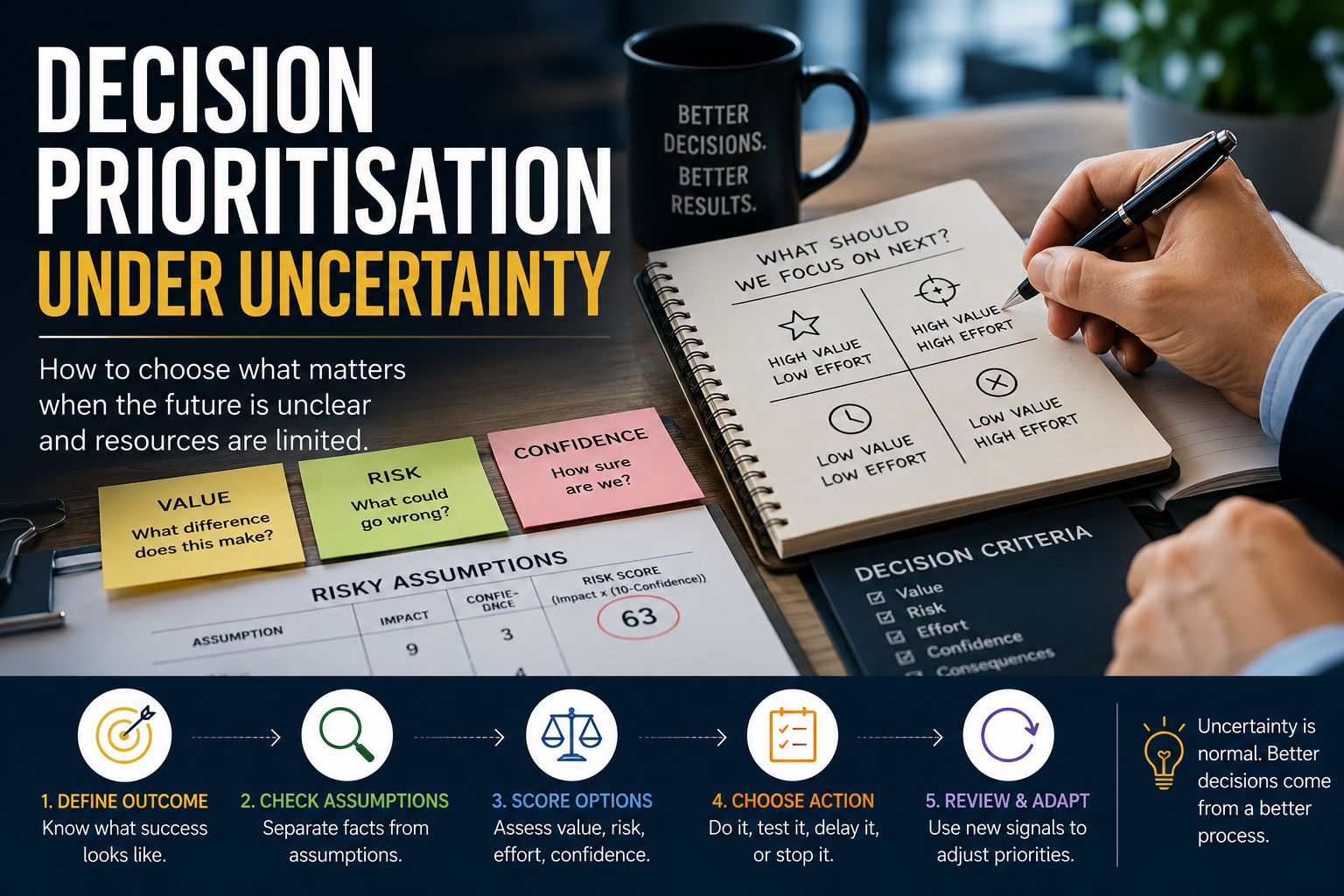
Decision prioritisation helps you choose what deserves attention first when time, information, and resources are limited. It is not about doing more tasks. It is about ranking choices by value, risk, effort, confidence, and consequences so you can act calmly when the future is unclear.
Decision prioritisation becomes even more important when pressure rises. In a serious disruption, leaders need to know which crisis management decisions must be made now, next, and later.
Disclosure: If you click on my affiliate/advertiser’s links, I am going to receive a tiny commission. AND… Most of the time, you will receive an offer of some kind. It’ s a Win/Win!
What this article covers
In this article, I explain what decision prioritisation means, why uncertainty makes priorities harder, how to rank choices using value, risk, effort and confidence, which prioritisation frameworks can help, how to reduce bias, and how to keep priorities flexible when the situation changes.
I will also show how this connects to the KrisLai Decision Framework™.
This article is based on practical business thinking, independent research, and my own analysis and synthesis of how people, pressure, uncertainty, and consequences affect real decisions.
The problem is rarely that you have no time.
The real problem is often that too many things look important at once.

Photo by Nathan Dumlao on Unsplash
That is why old-fashioned time management is not enough.
A tidy calendar can help. A to-do list can help. A productivity app can help.
But if you are working on the wrong thing, doing it efficiently does not make it wise.
In real business, priorities are not just tasks. They are choices about risk, value, timing, people, money, energy, and consequences.
Do you fix the urgent customer problem or invest in the long-term system?
Do you launch now or test first?
Do you hire, wait, outsource, automate, or simplify?
Do you chase the biggest opportunity or reduce the riskiest assumption?
These are not just time-management questions.
They are decision questions.
And they become harder when the future is unclear.
The National Audit Office’s guidance on managing uncertainty makes an important point: decision-makers still need to make good decisions even when uncertainty is hard to predict or reduce. It also warns that teams can create a false sense of certainty if they do not properly consider wider uncertainties.
That is exactly why decision prioritisation matters.
It helps you make the best possible choice with the information available now, without pretending you know everything.
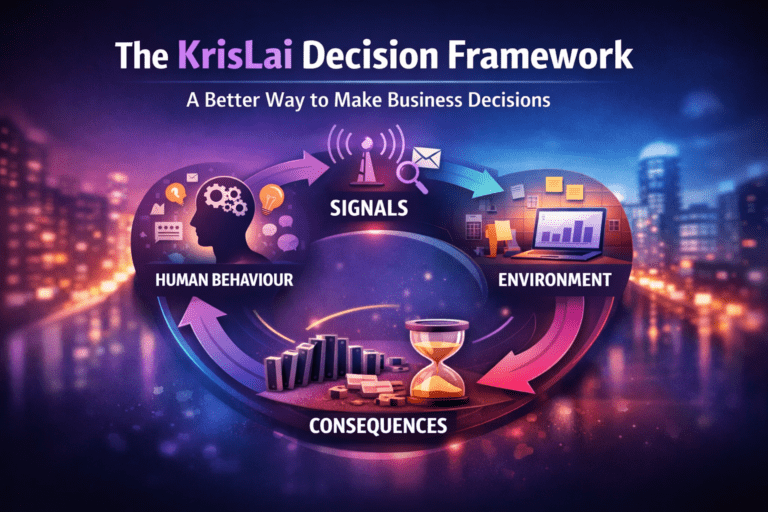
Better decisions come from understanding behaviour, signals, environment, and consequences.
I write about how better decisions are made in business — combining strategy, behaviour, and practical thinking.
Key ideas
- Decision prioritisation is not the same as time management.
- The goal is not to do more, but to choose better.
- Uncertainty makes priorities harder because outcomes are unclear.
- Good priorities balance value, risk, effort, confidence, and consequences.
- The best priority is sometimes the decision that reduces the most uncertainty first.


What is decision prioritisation under uncertainty?
Decision prioritisation under uncertainty means ranking decisions, tasks, projects, or investments when you do not yet have complete information about the future.
That sounds formal, but the idea is simple.
You have several possible things to do.
You cannot do everything.
You do not know exactly what will happen next.
So you need a practical way to decide what deserves attention first.
This could apply to:
- choosing which project to fund
- deciding which client issue to fix first
- ranking marketing ideas
- deciding whether to hire
- choosing whether to launch a product
- deciding which assumption to test
- deciding which risk to reduce
- choosing which meeting, task, or investment should wait
The goal is not perfect certainty.
The goal is a better next decision.
Decision prioritisation, in simple terms
Decision prioritisation means deciding what deserves attention first when time, resources, and information are limited. Under uncertainty, the goal is not perfect prediction. The goal is to choose the next best action using the evidence, risks, and signals available now.

How is decision prioritisation different from normal time management?
Time management asks:
“How do I fit more into the time I have?”
Decision prioritisation asks:
“What deserves the time in the first place?”
That difference matters.
If you only focus on time management, you may become very efficient at doing low-value work.
You may clear messages, attend meetings, polish small tasks, and stay busy all day.
But the bigger question remains:
Did the right work get done?
Decision prioritisation is about choosing where attention should go before your calendar fills up.
It is less about squeezing more into the day and more about protecting the decisions that matter most.
Why does uncertainty make priorities harder to judge?
Uncertainty makes prioritisation harder because the outcome is not obvious.
You may be dealing with:
- missing data
- changing customer behaviour
- unclear costs
- shifting market conditions
- new technology
- team pressure
- competing goals
- limited resources
- too many options
- fear of making the wrong call
When the future is unclear, people often do one of three things.
They delay.
They overreact.
Or they chase what feels urgent.
None of those is automatically wrong. Sometimes waiting is wise. Sometimes fast action is needed. Sometimes urgency really does matter.
But without a clear process, pressure starts making the decision for you.
That is where priorities become messy.

What are the signs that your current priorities are not working?
Poor priorities are not always obvious at first.
They often show up as friction, stress, rework, confusion, and constant firefighting.
Here are the signs I would watch for.
You are constantly firefighting
If everything is urgent, something is wrong.
Constant firefighting usually means priorities are not being ranked properly.
People jump from one pressure point to another, but the underlying decisions are not being dealt with.
A business can look busy and still be avoiding the real issue.
Goals keep shifting without clear reason
Priorities sometimes need to change.
That is normal.
But if goals keep shifting because the loudest problem, newest idea, or strongest personality takes over, the team loses direction.
People stop trusting the plan.
They start waiting for the next change instead of committing to the current priority.
Teams keep doing rework
Rework often means the wrong thing was prioritised too early.
Maybe the team built something before the need was clear.
Maybe the project moved ahead before the risky assumption was tested.
Maybe the decision was made before the right people were heard.
Rework is not always failure. Sometimes it is part of learning.
But repeated rework is often a signal that priorities are being chosen too quickly or too narrowly.
The loudest voice wins the meeting
In many teams, priorities are shaped by confidence, hierarchy, or pressure.
The most senior person speaks first.
The most forceful person dominates.
The quiet expert says nothing.
Then the team calls it agreement.
That is not good prioritisation.
That is social pressure dressed up as decision-making.
McKinsey’s advice on making decisions in uncertain times makes a useful distinction: more people may need a voice, but not everyone needs a vote. The point is to include useful perspectives without making decision-making slow or chaotic.
Urgency is confused with importance
A loud problem is not always the most important problem.
An urgent email may not matter more than a strategic customer issue.
A visible complaint may not matter more than silent customer churn.
A short-term cost may not matter more than long-term capability.
Urgency tells you something needs attention.
It does not always tell you what deserves priority.

How do you prioritise decisions when you do not have full information?
When information is incomplete, you need a process that is simple enough to use and strong enough to repeat.
Here is the practical approach I would use:
Start with the outcome that matters most
Before ranking options, define the outcome.
Ask:
- What are we trying to improve?
- Who is affected?
- What would success look like?
- What would make this decision worth making?
- What problem are we actually trying to solve?
- What happens if we do nothing?
This step sounds obvious, but it is often skipped.
People start ranking tasks before agreeing what the decision is meant to achieve.
That creates confusion.
For example, imagine a business choosing between three priorities:
- improve customer service
- launch a new offer
- reduce costs
The right priority depends on the outcome that matters most.
If the business is losing customers, service may be first.
If cash is tight, cost control may be first.
If the market is changing, the new offer may be first.
Prioritisation starts with the goal.
Not the task list.
Separate evidence from assumptions
Under uncertainty, you need to know what you actually know.
Separate:
- what is proven
- what is likely
- what is assumed
- what is unknown
- what needs testing
This is a powerful habit.
A team may say:
“Customers will want this.”
But is that evidence or assumption?
They may say:
“This will save time.”
But has it been tested?
They may say:
“This is urgent.”
But urgent for whom?
The GOV.UK Services blog gives a useful approach for large problem spaces: prioritise the riskiest assumptions, especially those with high impact and low confidence. That idea is very practical for business decisions too.
In simple terms:
If an assumption could seriously damage the decision if it is wrong, test it early.

Score each option by value, risk, effort, and confidence
You do not need a complicated scoring model.
Start with four questions:
1. Value
How useful could this be if it works?
Does it improve revenue, trust, service, efficiency, safety, learning, customer experience, or long-term capability?
2. Risk
What happens if we are wrong?
Could this waste money, damage trust, overload the team, reduce quality, or create bigger problems later?
3. Effort
What will it cost in time, money, people, attention, and energy?
A good idea may still be a poor immediate priority if it needs more capacity than you have.
4. Confidence
How strong is the evidence?
Are you working from data, customer signals, expert judgement, early tests, or hopeful thinking?
A low-confidence idea is not automatically bad.
But it may need testing before full commitment.
Prioritise the riskiest assumption before the biggest-looking idea
This is one of the most important points.
The highest-value idea is not always the first thing to build, buy, launch, or approve.
Sometimes the first priority is to test the assumption that the idea depends on.
For example:
A new service idea may look exciting.
But if the biggest assumption is “customers will pay enough for this,” then the priority may not be building the full service.
The priority may be testing willingness to pay.
A new AI tool may look promising.
But if the biggest assumption is “the team will actually use this,” then the priority may not be buying licences for everyone.
The priority may be a short pilot with one team.
A new hire may look necessary.
But if the biggest assumption is “the workload is permanent,” then the priority may be checking whether the problem is role capacity, process design, poor delegation, or temporary pressure.
Sometimes the best priority is not the biggest idea.
It is the smallest test that reduces the most uncertainty.
Decide what action fits the uncertainty
Not every option needs the same response.
Once you have looked at value, risk, effort, and confidence, you can choose an action.
Possible actions include:
- do it now
- test it first
- watch for signals
- delay it
- delegate it
- stop it
- simplify it
- revisit it after new data
- run a small pilot
- ask for more evidence
This is where prioritisation becomes calmer.
You are no longer asking:
“Is this good or bad?”
You are asking:
“What is the right next step, given what we know and do not know?”
The KrisLai Priority Filter™
- Value – what useful outcome could this create?
- Risk – what happens if we choose wrong or wait too long?
- Effort – what time, money, people, and attention will it need?
- Confidence – how strong is the evidence behind the choice?
- Consequence – what changes later because of this decision?
The best priority is not always the biggest idea. Sometimes it is the decision that reduces the most uncertainty first.
EquityNet Funding Platform for Raising Business Capital
Which prioritisation frameworks help when you need a faster answer?
Frameworks are useful when they make thinking clearer.
They are not useful when they become paperwork.
Here are a few simple tools that can help when you need a faster or fairer decision:
When is a value versus effort matrix enough?
A value versus effort matrix is a simple way to sort choices.
It works well when the decision is not too complex and the team needs to see trade-offs quickly.
The basic idea is:
- high value, low effort — quick wins
- high value, high effort — strategic bets
- low value, low effort — fill-ins
- low value, high effort — avoid or delay
This can be useful for small projects, marketing ideas, process improvements, and team tasks.
It is not perfect, but it helps people stop treating every idea as equal.
When does weighted scoring give a fairer result?
Weighted scoring helps when several criteria matter at once.
For example:
- impact
- cost
- risk
- speed
- customer value
- strategic fit
- confidence
- team capacity
You give each criterion a weight based on importance, then score each option.
This helps when people disagree because it makes the reasoning visible.
Instead of saying:
“I just think this one matters more.”
You can say:
“This option scored higher because customer impact and risk reduction matter most for this decision.”
That does not remove judgement.
But it makes judgement more transparent.

When should you use RICE, ICE, or MoSCoW?
These methods are common in product and project settings, but they can also help with broader business prioritisation.
RICE
RICE stands for Reach, Impact, Confidence, and Effort.
It is useful when you can estimate how many people an idea affects and how strong the likely impact may be.
ICE
ICE stands for Impact, Confidence, and Ease.
It is quicker and lighter than RICE.
It is useful when speed matters and you need a rough ranking.
MoSCoW
MoSCoW separates priorities into:
- Must have
- Should have
- Could have
- Won’t have for now
This is useful when teams need to separate essential work from nice-to-have work.
The danger with all these methods is false precision.
A score is not truth.
It is a structured estimate.
Use the framework to improve conversation, not to avoid judgement.
When should you use assumption mapping?
Assumption mapping is especially useful when the decision is uncertain.
The key question is:
“What assumption would hurt us most if it turned out to be wrong?”
A high-impact, low-confidence assumption should move up the priority list.
Not always as a full project.
Often as a test.
That is the difference.
You may not prioritise a full launch.
You may prioritise the experiment that tells you whether the launch is sensible.
How do you reduce bias before choosing a priority?
Uncertainty brings bias with it.
When the future is unclear, people often lean on shortcuts.
Some shortcuts are useful.
Others are dangerous.
Watch for the “loudest voice effect“
A strong personality can shape the whole priority list.
This happens easily in meetings.
People may agree because:
- they do not want conflict
- the senior person has spoken
- the argument sounds confident
- they are tired
- they assume others know more
- they do not want to slow things down
One practical fix is to score options quietly before discussion.
That gives people a chance to think before the room shapes their answer.
Check assumptions before treating them as facts
Ask:
- What evidence supports this?
- What are we guessing?
- What would prove this wrong?
- What would change our priority?
- Who has a different view?
- What data or signal are we missing?
This is especially important when a decision feels obvious.
Obvious decisions are sometimes obvious because they are right.
But sometimes they are obvious because nobody has challenged the assumption.
Avoid confusing urgency with importance
Urgency feels powerful.
It pulls attention.
But importance deserves its own test.
For example:
- an urgent email may not matter more than a strategic customer issue
- a loud complaint may not matter more than repeated silent churn
- a short-term cost saving may not matter more than long-term capability
- a senior person’s request may not matter more than a customer risk
- a quick win may not matter more than a dangerous assumption
A good question is:
“If we do this first, what important thing gets pushed back?”
That question exposes the trade-off.
Involve the right people, not every person
Good prioritisation needs useful input.
It does not need everyone debating everything.
Some people should advise.
Some should challenge assumptions.
Some should provide evidence.
Some should implement.
Some should decide.
McKinsey’s guidance on uncertain decisions makes a useful point: decision-makers need many points of view, but decisions still need clear ownership and speed.
This matters because under uncertainty, slow confusion can be as damaging as fast overreaction.
What I’ve seen go wrong
What I’ve seen go wrong is teams treating urgency as strategy. The loudest task, strongest personality, or most recent problem gets priority, while the decision that would reduce the most risk is left untouched.

How do you keep priorities flexible when the future changes?
A priority should not be a prison sentence.
Under uncertainty, new information should be allowed to change the plan.
That does not mean changing direction every five minutes.
It means building review into the decision from the start.
Set review points before you start
Do not wait until something goes wrong before reviewing.
Set review points in advance.
For example:
- review after two weeks
- review after the first customer feedback
- review after a pilot result
- review after a cost threshold
- review after a deadline is missed
- review after new market information
- review after an AI-search or traffic signal changes
- review after a sales pattern becomes clearer

This turns review into a normal part of the process.
Not a sign of failure.
Decide what would make you change course
Before starting, ask:
“What would make us change this priority?”
Useful triggers might include:
- costs rising
- deadlines slipping
- evidence weakening
- customer behaviour changing
- team capacity dropping
- supplier reliability changing
- risk increasing
- a better option appearing
- early tests failing
- new regulation or market change
This helps avoid emotional decision changes later.
The team already knows what kind of signal would justify a change.
Use signals instead of waiting for certainty
You may never get perfect certainty.
But you can watch signals.
Signals might include:
- sales enquiries
- conversion rates
- customer complaints
- repeat questions
- cash pressure
- staff workload
- project delays
- supplier problems
- competitor movement
- search behaviour
- AI search visibility
- regulatory changes
- customer hesitation
Signals are not always final proof.
But enough signals can show when a priority should move up, move down, pause, or change shape.
Treat priorities as living decisions, not permanent declarations
Decision-making under deep uncertainty often favours robust and adaptable choices rather than plans that depend on one predicted future. Research on decision-making under deep uncertainty focuses on approaches that help decision-makers act when future conditions cannot be predicted with confidence.
That is a useful mindset for business.
A good priority today may need adjusting tomorrow.
That is not failure.
It is learning.
The key is to change priorities because the evidence has changed, not because the room became louder.

How does AI change decision prioritisation?
AI changes the amount of information available.
It can summarise, compare, generate, draft, sort, and structure.
That is useful.
But it can also create more noise.
In an AI-shaped world, the hard part is not always getting ideas.
The hard part is choosing which ideas deserve attention.
AI can help sort information faster
AI can help with:
- summarising customer feedback
- comparing options
- drafting decision criteria
- identifying patterns
- generating possible risks
- creating scoring tables
- writing follow-up questions
- preparing meeting notes
- turning messy ideas into clearer options
That can save time.
It can also help teams think more broadly before they decide.
AI cannot decide what matters most for you
AI may miss:
- context
- trust
- team politics
- culture
- ethics
- customer emotion
- operational reality
- second-order consequences
- the cost of distraction
- the human meaning of the decision
It may give a neat answer to a messy problem.
That is why human judgement still matters.
AI can help you compare choices.
It cannot carry responsibility for the consequences.
The real advantage is better judgement, not more output
AI makes it easier to produce more ideas, more drafts, more summaries, more options, and more plans.
But more output is not the same as better priority.
The real advantage belongs to the person or team that can ask:
- What matters most?
- What are we assuming?
- What could go wrong?
- What would we learn fastest?
- What should wait?
- What should stop?
- What decision changes the most important future outcome?
In an AI-shaped world, prioritisation becomes even more valuable.
Because the number of possible actions grows.
But attention does not.
How does this connect to the KrisLai Decision Framework™?
Decision prioritisation is not just a productivity skill.
It is a decision-quality skill.
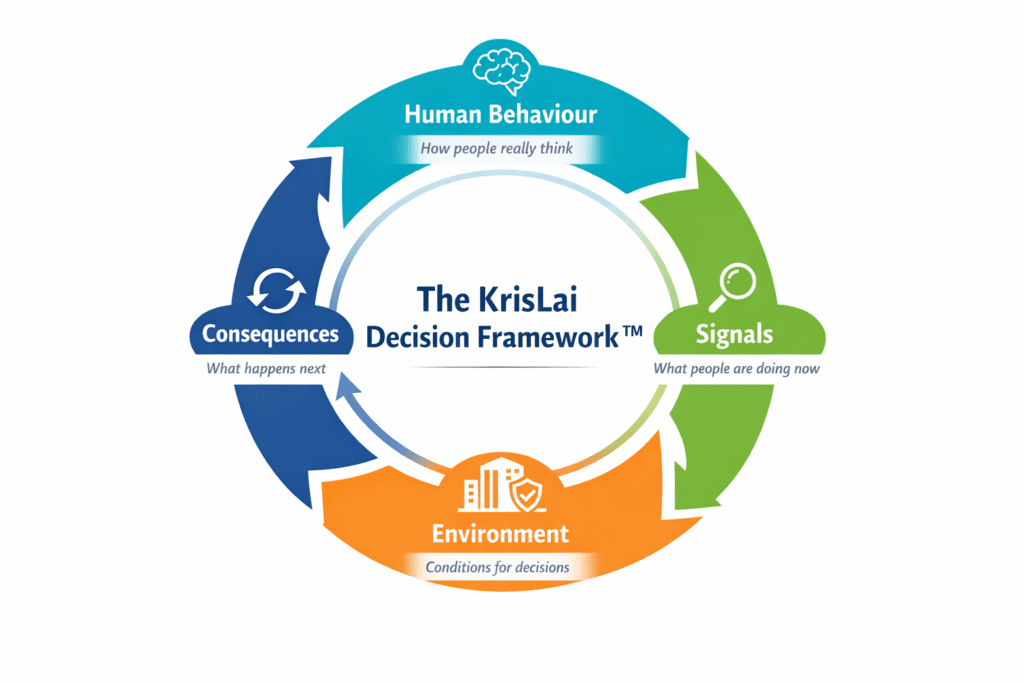
That is why it connects closely to the KrisLai Decision Framework™.
Behaviour
What are people actually doing, not just saying?
Are customers hesitating?
Are staff overloaded?
Are leaders avoiding a hard choice?
Are teams constantly firefighting?
Behaviour shows where pressure is real.
Signals
What evidence shows which priority matters most?
Look for patterns in:
- data
- feedback
- sales
- complaints
- delays
- costs
- search behaviour
- customer questions
- team capacity
Signals help you separate real priority from noise.
Environment
What conditions are shaping urgency, risk, and timing?
This might include:
- market change
- AI disruption
- regulation
- supplier pressure
- cash constraints
- customer behaviour
- internal capacity
- competitor action
The same decision can look very different in a different environment.
Consequences
What happens if this decision is made, delayed, tested, or ignored?
This is where prioritisation becomes serious.
Every priority pushes something else down the list.
So you need to ask:
“What changes next because of this choice?”
The KrisLai Decision Framework™ and prioritisation
- Behaviour – what are people actually doing, not just saying?
- Signals – what evidence shows which priority matters most?
- Environment – what conditions are shaping urgency, risk, and timing?
- Consequences – what happens if this decision is made, delayed, tested, or ignored?
Decision prioritisation improves when you stop asking only “What should I do first?” and also ask “What does this choice change next?”

Final thought: prioritisation is not about doing more
Decision prioritisation under uncertainty is not about squeezing every possible task into your week.
It is about choosing what deserves attention when the future is unclear and resources are limited.
That requires honesty.
Honesty about what you know.
Honesty about what you are guessing.
Honesty about what matters.
Honesty about what you cannot do right now.
In real business, not everything can be first.
Some things should be done now.
Some should be tested.
Some should be delayed.
Some should be watched.
Some should be stopped.
The goal is not perfect certainty.
The goal is better judgement.
Use value, risk, effort, confidence, and consequences.
Test the riskiest assumptions early.
Review priorities before they become stale.
And when everything feels urgent, pause long enough to ask the question that matters most:
“What decision would reduce the most uncertainty or create the most useful progress now?”
Do not start by asking how to fit everything in.
Start by asking what deserves to shape the next decision.
Final takeaway
Decision prioritisation helps you choose what matters when time, information, and certainty are limited. Instead of trying to do everything, rank choices by value, risk, effort, confidence, and consequences — then review your priorities as new signals appear.

Related reading on KrisLai.com
- Related article: Decision-Making Framework Examples
- Glossary or definition article: Problem-Solving in Business
- Pillar topic: Business Thinking Hub
- Scenario Planning in Business
- Business Strategy Planning
- Business Acumen Skills
- How AI Is Changing Search Behaviour

Further reading and references

Frequently Asked Questions About Decision Prioritisation
What is decision prioritisation?
Decision prioritisation means deciding what deserves attention first when time, information, and resources are limited. It helps people rank choices by value, risk, effort, confidence, and consequences.
How do you prioritise decisions under uncertainty?
Start by defining the outcome that matters most. Then separate evidence from assumptions, score options by value, risk, effort and confidence, test risky assumptions early, and review priorities as new information appears.
What is the difference between time management and prioritisation?
Time management helps you organise work and use time better. Prioritisation helps you decide which work matters most. Under uncertainty, prioritisation is more important because not every task deserves equal attention.
What is a prioritisation framework?
A prioritisation framework is a structured way to compare options. Common frameworks include value versus effort matrices, weighted scoring, RICE, ICE, MoSCoW, and assumption mapping.
How do you reduce bias when prioritising decisions?
You can reduce bias by using clear criteria, scoring options before group discussion, checking assumptions, involving the right people, and separating urgency from true importance.
How can AI help with decision prioritisation?
AI can help summarise information, compare options, generate risks, create scoring tables, and draft decision criteria. But it cannot replace human judgement, context, responsibility, or understanding of consequences.
Why should priorities be reviewed under uncertainty?
Priorities should be reviewed because conditions change. A good priority today may need adjusting when new evidence, customer behaviour, costs, deadlines, or risks change.
Automate your meeting notes. Fireflies.ai helps your team transcribe, summarize, search, and analyze voice conversations.
About the author
Kris Lai is a business operator and managing director with experience in land and building surveying, facilities management, logistics, and service delivery.
Earlier in his career, he worked as a Search Engine Evaluator (via Lionbridge, supporting Google), where he assessed search result relevance, user intent, and content quality using structured evaluation frameworks. This experience gives him a rare, practical understanding of how search systems interpret signals and make ranking decisions.
In parallel, whilst working with a charity organisation, he has delivered 1000’s of structured presentations in English, Finnish, and Chinese to audiences ranging from small groups to more than 600 people, and has spent decades mentoring and developing others. This experience informs his approach to clarity, communication, and decision-making under pressure.
He writes about AI, search behaviour, business strategy, and decision-making from a practical, real-world perspective.
If you enjoy exploring the ideas behind better business decisions, you may find the Business Thinking Hub useful.
👉 Explore ideas connected to better business decisions:
- How AI Is Changing Search Behaviour (And What Businesses Must Do Now)

- Decision-Making Framework Examples: The KrisLai Method in Action
- The KrisLai Decision Framework: A Better Way to Make Business Decisions
- Micro vs Macro Marketing: When to Target Broad Audiences vs Niche Customers
- Customer Intent Marketing: How to Turn Buying Signals Into Sales