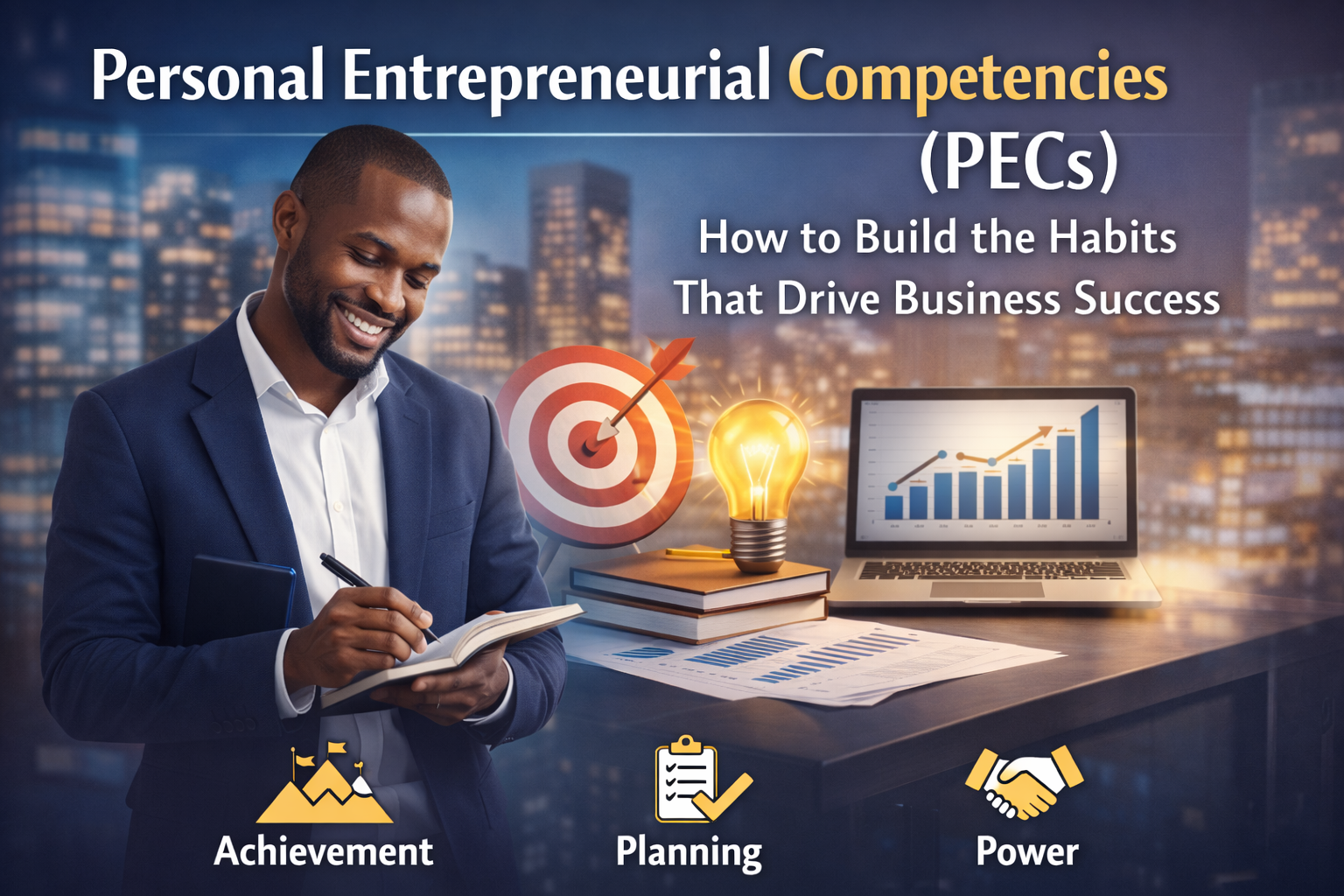
Personal entrepreneurial competencies, often called PECs, are the habits and behaviours that help people turn ideas into action. In this guide, I explain what PECs are, how the 10-competency framework works, why it still matters, and how students, founders, and small business owners can strengthen the behaviours that support better business decisions.
Disclosure: If you click on my affiliate/advertiser’s links, I am going to receive a tiny commission. AND… Most of the time, you will receive an offer of some kind. It’ s a Win/Win!
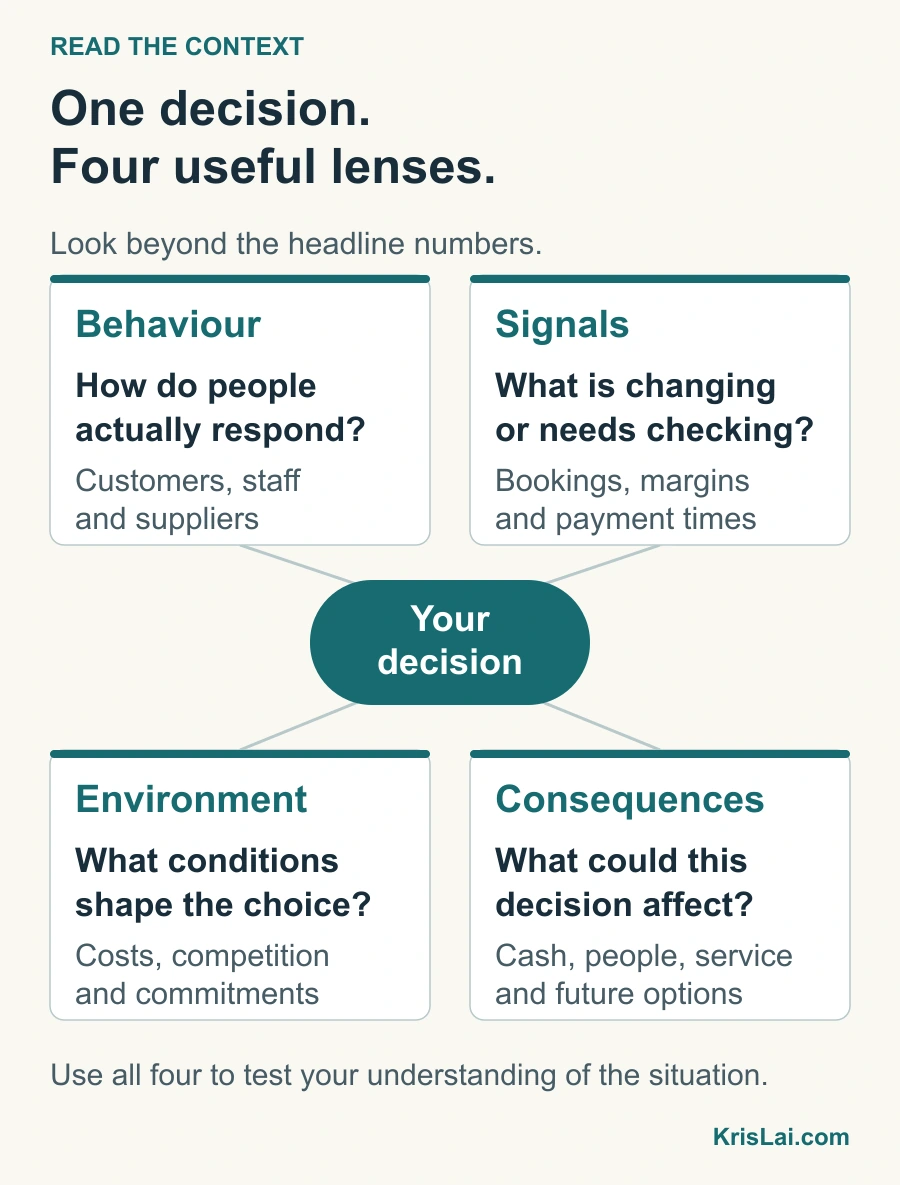
A practical model for better business decisions in complex environments. It focuses on four essential elements:
- Human Behaviour — how people actually think and decide
- Signals — what people are trying to do right now
- Environment — whether the system supports good decisions
- Consequences — what happens next, and after that
Strong decisions consider all four — not just one.
What this article covers
In this article, I explain what personal entrepreneurial competencies really are, how the three PEC clusters work, what the 10 competencies look like in real business life, and how to develop them through small daily habits. I also cover common mistakes, self-awareness, and how to turn weak spots into a practical development plan.
This article is based on practical business thinking, independent research, and my own analysis and synthesis of how entrepreneurial behaviour affects real business outcomes.
Success in business is rarely just about the idea.
It is usually about what the person behind the idea does next.
I have seen people with excellent ideas struggle because they lacked consistency, planning, persuasion, or follow-through. I have also seen more ordinary ideas do surprisingly well because the person running them was persistent, observant, organised, and willing to improve.
That is why personal entrepreneurial competencies matter.
They are not magic traits. They are practical behaviours. They shape how people spot opportunities, respond to setbacks, manage risk, build trust, and keep moving when business becomes difficult.
The widely used PEC framework is usually presented as 10 behavioural competencies grouped into three clusters: achievement, planning, and power. Studies and entrepreneurship training materials continue to describe it that way, and they commonly trace the model back to work associated with McClelland, McBer, and MSI-linked training programmes.
What I like about PECs is that they point attention in the right place.
Not just to the business plan. Not just to the market. But to the daily habits and behaviours that shape whether a person can actually execute, adapt, and improve.
Better decisions come from understanding behaviour, signals, environment, and consequences.
I write about how better decisions are made in business — combining strategy, behaviour, and practical thinking.
Key Ideas
- PECs are behaviours, not fixed personality traits.
- The 10 PECs are usually grouped into achievement, planning, and power clusters.
- Strong PECs help entrepreneurs act, adapt, persuade, and improve under pressure.
- You do not need to improve everything at once. One or two focused changes can make a real difference.
- PECs become more useful when they are linked to real business situations, not just theory.

What are personal entrepreneurial competencies, and why do they matter?
Personal entrepreneurial competencies are the behaviours that help entrepreneurs start, run, and grow a business more effectively.
In simple terms, they describe how a person approaches business challenges.
That includes things like:
- spotting opportunities
- staying persistent
- improving quality
- gathering information
- setting goals
- planning systematically
- persuading others
- building confidence through action
This framework is commonly presented in entrepreneurship education and training as a way of understanding entrepreneurial behaviour rather than treating entrepreneurship as a mysterious personality gift. Sources discussing the model describe the 10 PECs as behavioural patterns grouped into the three clusters mentioned above.
Why does that matter?
Because business success is not driven by ideas alone.
It is driven by what people do:
- when a customer hesitates
- when a launch underperforms
- when a supplier lets them down
- when cash gets tighter
- when a new opportunity appears
- when the original plan clearly needs adjusting
PECs matter because they affect daily business behaviour.
What are personal entrepreneurial competencies?
Personal entrepreneurial competencies, or PECs, are the habits and behaviours that help entrepreneurs turn ideas into action, manage uncertainty, and improve results over time.
They are best understood as learnable patterns of behaviour rather than fixed personality traits.

The three PEC clusters that shape entrepreneurial behaviour
The PEC framework is usually grouped into three broad clusters:
Achievement cluster
This cluster helps an entrepreneur act, persist, improve quality, and keep going when results are not immediate. It includes opportunity seeking, persistence, commitment, calculated risk-taking, and demand for efficiency and quality.
Planning cluster
This cluster helps an entrepreneur gather useful information, set goals, and monitor progress rather than drifting. It includes information seeking, goal setting, and systematic planning and monitoring.
Power cluster
This cluster helps an entrepreneur influence others and act with confidence. It usually includes persuasion and networking, along with self-confidence.
That grouping is useful because it shows that entrepreneurship is not one thing.
It is a mix of action, planning, and influence.
Why PECs are useful in real business situations
This is where the framework becomes more practical.
PECs affect everyday situations such as:
- noticing an unmet customer need
- improving a weak product or service
- following through after setbacks
- setting better weekly targets
- pitching an idea more clearly
- building relationships that lead to work
- staying steady when uncertainty rises
In other words, PECs matter not because they sound impressive, but because they change behaviour.
What this means in real business
PECs matter because they show up in everyday business behaviour. They affect how someone handles setbacks, improves quality, manages risk, builds trust, and keeps making progress when results are slower than hoped.

The 10 personal entrepreneurial competencies every entrepreneur should know
This is the core of the framework.
The classic PEC model is usually described as 10 competencies. Different training materials sometimes phrase one or two items slightly differently, but the standard list is broadly consistent across studies and entrepreneurship teaching resources.
Achievement competencies that help you take action and keep going
1. Opportunity seeking
This means spotting openings that others miss.
In practice, it might mean noticing:
- a customer frustration
- a service gap
- a small market niche
- a better way to deliver value
Why it matters: good entrepreneurs often act before an opportunity becomes obvious to everyone else. The PEC literature commonly describes opportunity seeking as actively finding openings in the environment that can be used to start or improve a business.
2. Persistence
This means continuing despite obstacles, delay, or rejection.
In practice, it might mean:
- trying a different route after a failed launch
- refining an offer instead of abandoning it too quickly
- following up again when the first pitch goes nowhere
Why it matters: most business efforts do not work perfectly at the first attempt.
3. Commitment to work
This means taking responsibility and following through on what needs doing.
In practice, it might mean:
- doing the hard work personally when required
- keeping promises to customers
- stepping in when something important is slipping
Why it matters: reliability builds trust.
4. Calculated risk-taking
This does not mean reckless behaviour.
It means taking risks that are thought through.
In practice, it might mean:
- testing a new offer before a full launch
- committing some budget to a promising channel
- trying a bold move, but with a fallback plan
Why it matters: entrepreneurship requires action under uncertainty, but strong entrepreneurs do not gamble blindly.
5. Demand for efficiency and quality
This means wanting to improve how work is done and how well it is delivered.
In practice, it might mean:
- refining a process
- improving customer experience
- reducing waste
- raising standards on output
Why it matters: businesses grow more sustainably when they improve quality and efficiency together.
A practical example
An entrepreneur launches a service that gets polite interest but weak conversion. Opportunity seeking helps them notice an unmet need behind the weak response. Persistence keeps them testing. Demand for efficiency and quality helps them improve the offer instead of blaming the market too quickly.

Planning and power competencies that help you stay focused and influence others
6. Information seeking
This means actively looking for useful facts, feedback, and insight.
In practice, it might mean:
- researching the market
- asking better customer questions
- checking competitor behaviour
- learning from data instead of assuming
Why it matters: weak information often leads to weak decisions.
7. Goal setting
This means choosing clear targets instead of vague intentions.
In practice, it might mean:
- setting a revenue goal
- choosing a weekly sales target
- deciding what success looks like for a launch or campaign
Why it matters: goals help focus effort.
8. Systematic planning and monitoring
This means breaking work into steps and reviewing progress consistently.
In practice, it might mean:
- planning tasks by priority
- using a weekly review
- tracking results and adjusting quickly
- spotting where progress is slower than expected
Why it matters: action without tracking often turns into drift.
9. Persuasion and networking
This means influencing people and building relationships that support progress.
In practice, it might mean:
- presenting an idea clearly
- winning trust
- asking for introductions
- building useful contacts over time
Why it matters: business rarely grows in isolation.
10. Self-confidence
This means believing you can act, learn, and improve.
In practice, it might mean:
- pitching an offer before you feel fully ready
- making a decision under pressure
- holding your ground when challenged
- trusting yourself enough to act after careful thought
Why it matters: many opportunities are lost through hesitation, not lack of ability.
The 10 PECs at a glance
- Achievement cluster: opportunity seeking, persistence, commitment to work, calculated risk-taking, demand for efficiency and quality
- Planning cluster: information seeking, goal setting, systematic planning and monitoring
- Power cluster: persuasion and networking, self-confidence
Together, these competencies describe how entrepreneurs act, plan, adapt, and influence.

How to build stronger entrepreneurial competencies in daily life
This is where the topic becomes far more useful.
PECs should not stay as labels.
They should become habits.
Many PEC resources use self-assessment tools to help people identify strengths and weak spots. The commonly referenced PEC questionnaire is often described as a 55-statement self-rating tool, used to measure the 10 competencies and support reflection and development.
That can be useful, but the point is not only to score yourself.
The real question is: what do you do next?
Simple ways to improve weak areas without feeling overwhelmed
You do not need a huge reinvention plan.
Start small.
You could:
- set one weekly growth goal
- track progress visibly
- ask for feedback after a sales conversation
- review one mistake each week without self-punishment
- practise pitching your offer more clearly
- use simple planning tools to monitor progress
And yes, many entrepreneurs now use AI tools and lightweight apps for planning, idea testing, research, note-taking, and workflow improvement. The point is not the tool itself. The point is building better behaviour around it.
How to turn self-awareness into a personal development plan
A stronger approach looks like this:
- Identify your strongest and weakest competencies
- Choose one or two to improve first
- Turn them into visible habits
- Use simple goals and reviews
- Adjust monthly
This works better than trying to improve everything at once.
SMART goals, journalling, and monthly review habits can all help — not because they are fashionable, but because they make progress easier to see.
How to build stronger PECs without getting overwhelmed
- Choose one weak area, not five
- Set one weekly behaviour goal
- Track what you actually do
- Ask for feedback from real situations
- Review progress once a month
Improvement usually becomes realistic when it is specific, visible, and repeated often enough to become a habit.

Common mistakes that hold back entrepreneurial growth
This is where people often get stuck.
Confusing confidence with preparation
Self-confidence matters.
But confidence works best when it is supported by:
- information
- preparation
- testing
- reflection
- skill building
Overconfidence can produce weak decisions. Balanced confidence produces stronger action.
Taking risks without a plan, or planning without action
This is another common trap.
Some people act fast without checking enough.
Others plan endlessly and never move.
Strong entrepreneurial behaviour usually lives in the middle:
- take a calculated risk
- monitor it
- learn quickly
- adapt without freezing
That balance is one of the most useful parts of the PEC model.
Where this goes wrong
Entrepreneurial growth often stalls when people mistake confidence for competence, take risks without enough planning, or hide behind planning instead of acting. Strong PECs require balance: thoughtful action, not random action or endless preparation.
The KrisLai Entrepreneurial Growth Lens™
If I were to simplify the whole topic into a more practical decision tool, I would use this lens:
1. Behaviour
Which entrepreneurial habits are showing up consistently?
2. Signals
What feedback, data, and real-world results suggest strength or weakness?
3. Environment
What conditions are shaping the entrepreneur’s performance — market pressure, support, resources, time, uncertainty?
4. Consequences
If these habits continue, what is likely to improve or deteriorate?
Better decisions come from understanding behaviour, signals, environment, and consequences.
That is also why PECs matter beyond entrepreneurship training.
They help people think more clearly about how behaviour shapes outcomes.
The KrisLai Entrepreneurial Growth Lens™
- Behaviour – which entrepreneurial habits are actually showing up?
- Signals – what do feedback, results, and patterns reveal?
- Environment – what conditions are helping or hindering progress?
- Consequences – what happens if these behaviours continue?
PECs become more useful when they are linked to real decisions, real habits, and real business outcomes.

Related reading on KrisLai.com
If you want to go deeper into the thinking behind PECs, these articles would be helpful:
Related reading on KrisLai.com
- Related article: Business Acumen Skills
- Glossary or definition article: Decision-Making Framework Examples: The KrisLai Method in Action
- Pillar topic: Business Thinking Hub
- How to Write an Effective Business Plan
- How to Fund a New Business
- Business Strategy Planning
- The KrisLai Decision Framework
My blog is a business-thinking publication where the content is based on my personal experience, research, and analysis.

Final thought
Entrepreneurial success is not only about the idea.
It is also about the habits behind the idea.
That is why PECs still matter.
They give people a practical way to look at how they behave under pressure, how they plan, how they influence others, and where they may be holding themselves back.
You do not need to master all ten at once.
Choose one competency.
Work on it deliberately this week.
That is often how meaningful entrepreneurial growth begins.
As the Swedish saying goes, “många bäckar små gör en stor å” – Many small streams make a great river.
Final takeaway
PECs matter because business success depends not only on ideas, but on behaviour. The 10 personal entrepreneurial competencies give founders, students, and small business owners a practical way to assess strengths, improve weak spots, and grow through better habits over time.
Frequently Asked Questions About Personal Entrepreneurial Competencies
What are personal entrepreneurial competencies?
Personal entrepreneurial competencies, or PECs, are the habits and behaviours that help entrepreneurs spot opportunities, take action, plan better, influence others, and improve business results over time.
How many personal entrepreneurial competencies are there?
The widely used PEC framework usually includes 10 competencies grouped into three clusters: achievement, planning, and power.
What are the three PEC clusters?
The three PEC clusters are the achievement cluster, the planning cluster, and the power cluster. Together, they describe how entrepreneurs act, organise, and influence.
Can personal entrepreneurial competencies be developed?
Yes. PECs are best understood as learnable behaviours rather than fixed traits. They can be improved through self-awareness, practice, feedback, planning, and repeated action in real situations.
What is the PEC self-assessment questionnaire?
The PEC self-assessment questionnaire is a commonly used self-rating tool often described as a 55-item questionnaire designed to help people identify strengths and weak areas across the 10 entrepreneurial competencies.
Why are PECs important in business?
PECs are important because they affect how a person handles opportunity, risk, persistence, planning, persuasion, and self-confidence in everyday business situations.
Develop Your Personal Entrepreneurial Competencies By…
Educating Yourself: Take courses or attend workshops to enhance your knowledge in areas relevant to your business.
Surrounding Yourself with Like-minded Individuals: Join entrepreneurial communities or networks to learn from others’ experiences.
Seeking Feedback and Learn from Failures: Embrace failure as a learning opportunity and use feedback to improve.
Setting Personal Growth Goals: Continuously challenge yourself to develop new skills and expand your competencies.
👉🏼 If you enjoy exploring the ideas behind new and better business startegies, you may find the Business Thinking Hub useful.

👉 Explore ideas connected to better business decisions:
- Digital Transformation for SMEs: 7 Questions Before You Invest
- Cybersecurity for Businesses: 7 Decisions Leaders Must Make
- How AI Is Changing Search Behaviour (And What Businesses Must Do Now)
- 7 Decision-Making Framework Examples for Business Leaders
- Business Decision-Making Framework: The KrisLai Method