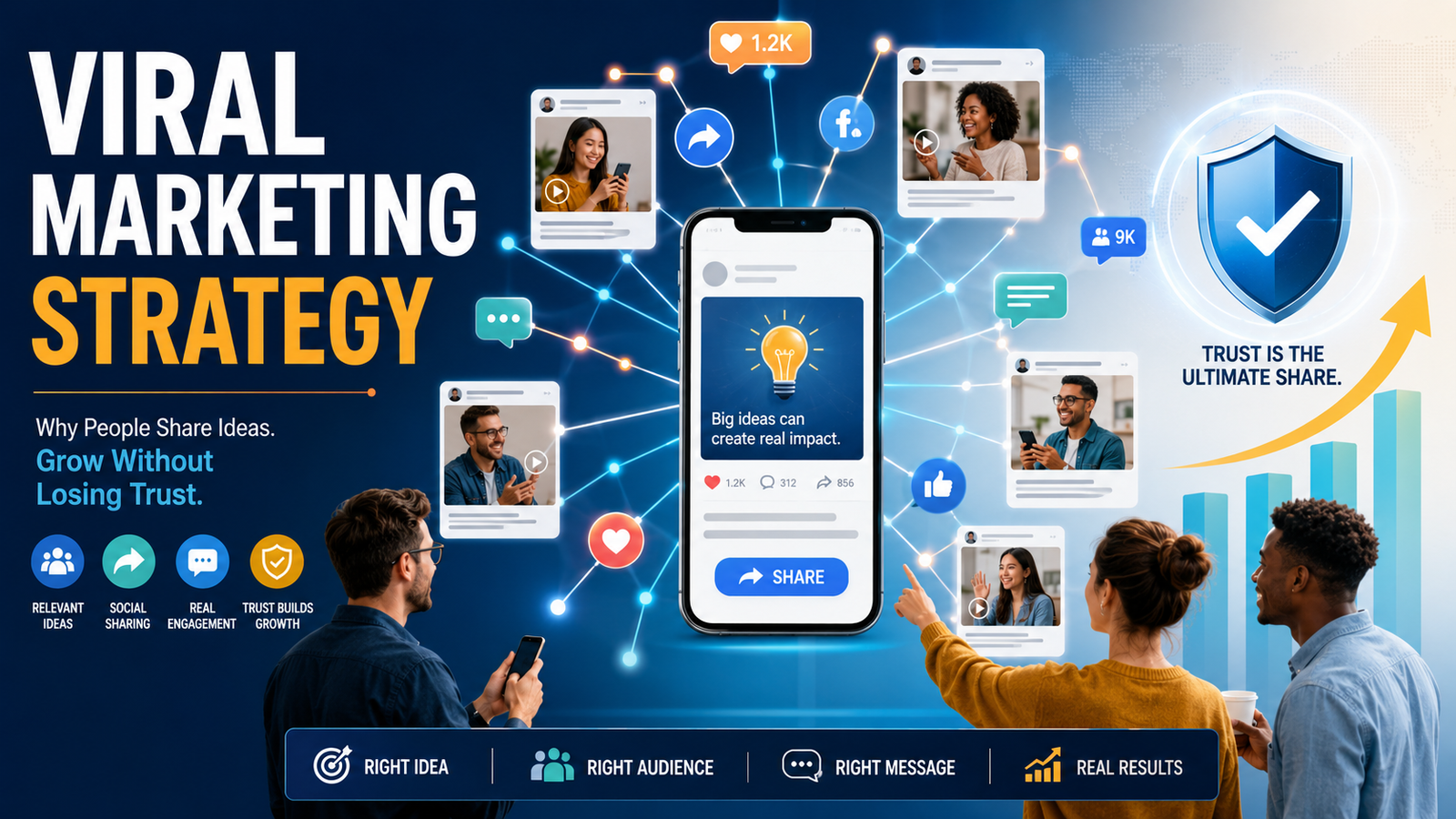
Viral marketing is not just about getting views. It works when people feel something is useful, emotional, timely, or worth sharing. This guide explains why ideas spread, how brands can increase shareability, what to measure, and how to grow attention without damaging trust.
Disclosure: If you click on my affiliate/advertiser’s links, I may receive a tiny commission. AND… Most of the time, you will receive an offer of some kind. It’ s a Win/Win!
What this article covers
In this article, I explain what viral marketing strategy really means, why people share content, how viral campaigns work, what brands should measure, and where viral marketing can go badly wrong.
I will also look at real viral marketing examples, including Hotmail, the ALS Ice Bucket Challenge, Duolingo, The Original Tamale Company, and recent concerns around AI-generated influencers.
Most importantly, I will show why viral marketing should not be treated as a shortcut. It should be treated as a trust-aware growth strategy.
This article is based on practical business experience, independent research, and my own analysis and synthesis of how behaviour, signals, social sharing, attention, trust, and decision-making affect real business outcomes.
Going viral can make a brand visible overnight.
It can also make a brand look foolish just as quickly.
That is the tension in viral marketing.
Every business would like more reach, more attention, more shares, more website visits, and more people talking about its offer. That is understandable. Attention is useful when it reaches the right people for the right reason.
But attention by itself is not a strategy.
A post can get thousands of views and create no useful business result. A video can spread widely and attract the wrong audience. A joke can travel further than expected and damage trust. An AI-generated campaign can look clever for a moment, then feel fake when people look closer.
In real business, the question is not only:
“Can this spread?”
It is:
“What happens if it does?”
That is why viral marketing strategy needs more than luck, humour, and platform tricks. It needs an understanding of people, timing, trust, context, and consequences.
People share ideas for emotional and social reasons. They share things that make them feel useful, amused, informed, seen, clever, generous, or part of something current.
The strongest viral content does not usually feel like a brand shouting:
“Please share this!”
It feels like something people want to pass on because it says something useful, funny, surprising, or meaningful.
Better decisions come from understanding this kind of behaviour, signals, environment, and consequences.
That is what I write about: how better decisions are made in business — combining strategy, behaviour, and practical thinking.
Key ideas
- Viral marketing cannot be guaranteed. You can only create the conditions that make sharing more likely.
- People share for human reasons. Identity, usefulness, humour, emotion, surprise, and belonging all matter.
- Views are not the same as business value. Measure action, trust, search demand, enquiries, and customer fit.
- AI can help create content faster. But it can also make content feel fake if the idea lacks human relevance.
- Viral marketing works best when attention supports trust. Reach without credibility can damage the brand.

What is viral marketing strategy?
Viral marketing strategy is the planned use of content, stories, offers, or experiences that people are likely to share voluntarily, helping a brand message spread beyond normal paid or owned reach.
In plain English, viral marketing happens when people help spread the message for you.
They share the video.
They send the meme.
They tag a friend.
They copy the idea.
They talk about the campaign.
They join the challenge.
They search for the brand.
They visit the website.
They repeat the phrase.
They create their own version.
That is why viral marketing is closely connected to word of mouth marketing, social sharing strategy, viral content strategy, and social proof marketing.
Investopedia defines viral marketing as a strategy that spreads information about a product or service from person to person, especially through social media and word of mouth. It also highlights three important parts of viral spread: the message, the messenger, and the environment.

Image by CreativeSpace on Freepik
That last point matters.
The environment shapes the spread.
A good idea on the wrong platform may do nothing.
A simple idea at the right time, in the right community, can travel quickly.
Viral marketing strategy, in simple terms
Viral marketing strategy means creating content, campaigns, offers, or experiences that people are likely to share voluntarily. The goal is not just reach. The goal is attention that supports trust, action, and long-term brand value.

Is viral marketing the same as word of mouth?
Viral marketing and word of mouth overlap, but they are not exactly the same.
Word of mouth marketing is often slower, more relationship-based, and built through repeated customer experience.
Someone recommends a cleaner, accountant, restaurant, consultant, software tool, or local service because they have used it and trust it.
Viral marketing is usually faster and more content-led.
It may happen through:
- short-form video marketing
- TikTok viral marketing
- creator-led marketing
- user-generated content campaigns
- referral campaigns
- memes
- challenges
- social posts
- emotional stories
- surprising demonstrations
- AI-assisted content
- public stunts
- highly shareable offers
Word of mouth is often more durable.
Viral marketing is often faster.
The best brands try to make the two work together.
A viral campaign may get attention.
A good customer experience turns that attention into trust.
Can you make something go viral?
No business can guarantee virality!
That is the honest answer.
You can improve the conditions, but you cannot fully control the result.
You can improve:
- relevance
- timing
- emotional clarity
- usefulness
- shareability
- platform fit
- creator fit
- ease of participation
- visual impact
- message simplicity
- social proof
- the next step after attention
But you cannot force people to care.
You cannot make people share something that feels flat, confusing, self-serving, or fake.
That is why “how to make content go viral” is a dangerous question if taken too literally.
A better question is:
“What would make the right people want to share this?”
That question is more useful because it starts with human behaviour.

What makes people share ideas in the first place?
People share ideas when the content helps them express identity, feel useful, entertain others, join a moment, show belonging, or pass on something surprising, emotional, or practical.
This is the human centre of viral marketing psychology.
People rarely share content only because a brand wants them to.
They share because the content does something for them socially or emotionally.
People share what says something about them
Sharing is a social signal.
When someone shares a post, video, article, meme, or campaign, they are often saying something about themselves.
They may be saying:
- “This is funny.”
- “This is useful.”
- “This is what I believe.”
- “This is my kind of humour.”
- “This is clever.”
- “This reminds me of us.”
- “This is important.”
- “This is worth knowing.”
- “This is what my industry is talking about.”
- “This says something I could not easily say myself.”
That is why identity matters.
People share things that help them express who they are, what they value, what they notice, and what group they belong to.
A brand that understands this has a better chance of creating content people want to pass on.
A brand that only talks about itself usually struggles.
The best ideas are useful, emotional, or surprising
Most viral content has at least one of these qualities.
It is useful.
It helps someone save time, avoid a mistake, learn something, compare options, or solve a problem.
It is emotional.
It makes someone laugh, feel moved, feel angry, feel hopeful, feel seen, or feel curious.
It is surprising.
It shows something unexpected, simple, strange, clever, or unusually honest.
The strongest viral social media campaigns often combine more than one.
For example, a simple video may be funny and useful.
A challenge may be emotional and social.
A product demonstration may be surprising and practical.
A customer story may be relatable and trustworthy.
What people rarely share is content that feels flat, vague, self-important, or too polished to trust.
Timing can make a good idea spread faster
Timing matters because people share things that feel current.
A useful idea may spread further when it connects to:
- a trend
- a cultural moment
- a live event
- a shared frustration
- a seasonal need
- a public conversation
- a platform format people already understand
- a sudden change in customer behaviour
This does not mean chasing every trend.
That is usually a mistake.
A trend only helps if it fits the brand, the audience, and the message.
If the link is forced, people can sense it.
In my experience, the best timing feels natural. The brand does not look like it is desperately jumping into a conversation. It looks like it belongs there.

How does viral marketing work without feeling forced?
Viral marketing works best when the idea feels natural to the audience and useful to the brand. The content should be easy to share, easy to understand, emotionally clear, and connected to a business goal beyond views.
The word “viral” can tempt businesses into chasing attention for its own sake.
That is risky.
A strong viral marketing campaign should have a clear purpose.
It might aim to:
- increase branded search
- grow an email list
- bring people to a landing page
- introduce a product
- start a conversation
- drive referrals
- build a community
- increase trust
- create customer stories
- support a product launch
- raise awareness for a cause
- move people towards enquiry or purchase
That means a viral marketing strategy should not start with:
“How do we get lots of views?”
It should start with:
“What useful action should attention lead to?”
Start with a clear next step, not just a big reach number
Views can be exciting.
But views alone do not pay the bills!
A campaign may get 500,000 views and still do very little if:
- no one remembers the brand
- no one understands the offer
- the wrong audience sees it
- the landing page is weak
- there is no next step
- the message does not connect to the product
- the content creates laughter but not trust
- the attention disappears after one day
Before creating viral content, ask:
- What do we want people to do next?
- Should they search for us?
- Visit a landing page?
- Sign up?
- Share with a friend?
- Try the product?
- Join a community?
- Request a quote?
- Watch a longer explanation?
- Read a related article?
This is where landing page strategy matters.
If viral content creates attention, the next page must convert that attention into a clearer decision.
Build content people can remix, repeat, or respond to
People share more when they feel included.
This is why user-generated content campaigns can work well.
People may:
- copy the format
- add their own version
- duet a video
- stitch a response
- join a challenge
- use a template
- share a story
- tag a friend
- respond with their own example
- turn the idea into a meme
Good viral marketing often gives people a role.
They are not just watching the brand.
They are participating.
That is one reason the ALS Ice Bucket Challenge spread so widely. It gave people a simple action, public participation, social proof, and a reason to tag others. Investopedia lists the ALS Ice Bucket Challenge as a well-known viral marketing example.
The action was easy to understand.
The participation was visible.
The cause gave it meaning.
Use short-form content to earn attention, then deepen trust elsewhere
Short-form video marketing is powerful because it can earn attention quickly.
This includes:
- TikTok
- Instagram Reels
- YouTube Shorts
- LinkedIn video clips
- Facebook Reels
- short product demos
- behind-the-scenes clips
- customer moments
- quick explainers
- trend-based responses
But short-form content is usually only the beginning.
It can create awareness, curiosity, humour, or recognition.
Then trust often needs to deepen elsewhere:
- on the website
- through email
- on a product page
- in a longer video
- in a case study
- in testimonials
- through a useful article
- through follow-up content
- on a landing page
This is especially important for service businesses and B2B brands.
A funny clip may get attention.
But the buyer may still need proof, clarity, reassurance, and a reason to act.

What this looks like in real business
In real business, viral marketing works best when attention connects to a real brand, real audience, and real next step. The examples that matter most are not just the ones with big numbers. They are the ones that show why people shared and what happened after they did.
Let us look at a few examples:
The Original Tamale Company: AI helped because the idea still felt local and human
The Original Tamale Company, a family-owned shop in Los Angeles, gained major attention with a humorous AI-assisted video. Business Insider reported that the video was created in around 10 minutes, gained more than 22 million views, and helped increase customer traffic and online attention.
The lesson is not simply:
“Use AI and you will go viral.”
That would be the wrong conclusion.
The better lesson is:
AI worked because the idea still fitted the brand, the humour, the local identity, and the audience.
The content did not feel like a random corporate experiment.
It felt playful, specific, and tied to the business.
That is the difference.
AI can support viral marketing, but it cannot replace brand fit.
Duolingo: brand personality can create attention, but strategy must mature
Duolingo became famous for its bold and sometimes chaotic social media personality, especially on TikTok.
But Business Insider reported in 2026 that Duolingo is recalibrating its “unhinged” marketing style and moving towards a more balanced, creator-supported approach as organic reach becomes harder and the brand matures.
That is a useful lesson.
A tone that creates attention at one stage may need to evolve at another stage.
What works when a brand is trying to break through may not always work when it needs to build wider trust, consistency, and long-term growth.
In other words:
Viral attention is not the end of strategy.
Sometimes it is the start of a new strategic problem.
ALS Ice Bucket Challenge: participation made the idea spread
The ALS Ice Bucket Challenge spread because it was simple, visible, social, emotional, and participatory.
People could understand it quickly.
They could take part easily.
They could nominate others.
They could publicly show support for a cause.
That combination made the campaign highly shareable.
Investopedia includes the ALS Ice Bucket Challenge as a classic viral marketing example.
The lesson is:
People share more when they can participate, not just observe.
Hotmail: the sharing loop was built into the product experience
Hotmail is often mentioned as an early example of viral marketing because its email messages included a simple sign-up line that encouraged recipients to get their own free email account.
The sharing mechanism was built into the product experience.
Every email became a small distribution channel.
Investopedia also references Hotmail as a classic viral marketing example.
The lesson is:
Sometimes viral growth comes not from one big campaign, but from a built-in sharing loop.
That is an important idea for referral marketing, product-led growth, and customer advocacy.
What this looks like in real business
Viral marketing is strongest when the idea fits the brand, the audience, the platform, and the next step. The best examples are not only widely shared. They also teach us why people shared, what signal that created, and whether the attention helped the brand afterwards.

How can brands grow without losing trust?
Brands grow without losing trust by making viral ideas feel authentic, useful, relevant, and consistent with what the brand can actually deliver. Attention should support reputation, not replace it.
This is where many brands get into trouble.
They want reach.
But they forget what kind of reach they need.
They want visibility.
But they forget what people are seeing.
They want shares.
But they forget why people are sharing.
A brand can become known for the wrong reason.
That is why trust must sit inside viral marketing strategy from the start.
Authenticity beats polish when people want the real story
Modern audiences are often sceptical of content that looks too polished, too scripted, or too obviously automated.
That does not mean everything must be rough or low quality.
It means people want signs of reality.
Useful trust-building content might include:
- behind-the-scenes videos
- real customer stories
- founder explanations
- staff moments
- honest product demonstrations
- user-generated content
- real reviews
- problem-solving content
- clear answers to common questions
Digiday reported that, after a flood of AI-generated content, creator authenticity and “messiness” are in higher demand.
That fits what many people sense already.
When content feels too smooth, people may ask:
“Is this real?”
Consistency matters more than one lucky viral hit
One viral post can create a spike.
Consistency builds trust.
A business needs to ask:
- Does this viral idea fit our real message?
- Will people recognise the brand afterwards?
- Can we deliver what the content promises?
- Does this support our wider positioning?
- Will this still make sense in six months?
- Does this attract the kind of audience we actually want?
In my experience, one viral moment rarely fixes unclear positioning.
If the brand message is confused, viral attention may simply spread the confusion faster.
Creators work best as partners, not just distribution channels
Creator-led marketing works best when creators are treated as partners, not just rented reach.
A creator knows their audience.
They understand tone, timing, humour, language, and what feels natural.
If the brand controls every word too tightly, the content may feel like an advert wearing a costume.
Good creator partnerships need:
- audience fit
- creative freedom
- clear values
- honest disclosure
- realistic claims
- mutual respect
- a message that fits both sides
A creator can help a brand sound more human.
But only if the partnership itself is genuine.

Where this goes wrong
Viral marketing goes wrong when brands chase attention without thinking about trust, audience fit, timing, message clarity, or consequences. A campaign can spread widely and still damage reputation if it feels fake, exploitative, confusing, or disconnected from the brand.
This is the part too many viral marketing articles avoid.
They talk about reach.
But not enough about regret.
What I’ve seen is that some brands become so focused on being noticed that they forget to ask whether the attention helps them.
That is dangerous!
Where this goes wrong
What I’ve seen go wrong is brands treating viral marketing as a shortcut. They chase attention, but forget audience fit, trust, timing, and consequences. A campaign can spread widely and still fail if it attracts the wrong people or damages the brand’s credibility.

Going viral for the wrong reason
Going viral is not always good.
A brand can go viral because people:
- mock it
- criticise it
- misunderstand it
- feel misled by it
- think it is tone-deaf
- find it fake
- think it exploits a serious issue
- believe it does not match the brand
- see it as a desperate trend grab
That kind of attention may create reach.
But it can damage trust.
Attention is only useful if it supports the brand you want to build.
Mistaking views for business value
Views are easy to celebrate.
But they are not enough.
A viral campaign should be judged by what changes.
Look at:
- shares
- saves
- comments
- sentiment
- branded search
- website visits
- referral traffic
- email sign-ups
- enquiries
- sales
- creator fit
- repeat engagement
- customer quality
- brand trust
A million views from the wrong audience may be less useful than 5,000 views from people who actually care.
This connects to data analysis and analytics. The right numbers matter more than the biggest numbers.
Using AI in a way that feels fake
AI viral marketing is now part of the landscape.
AI can help with:
- idea generation
- scripts
- visuals
- voiceovers
- edits
- trend adaptation
- content variations
- quick testing
- audience research
But AI can also create trust problems.
The Times reported backlash against SheerLuxe after the company introduced AI-generated influencers for beauty and styling content, with critics questioning whether AI avatars could credibly recommend products they cannot actually use.
The lesson is not “never use AI”.
The lesson is:
Use AI in ways that strengthen the idea, not in ways that replace trust.
If the audience expects human experience, human experience matters.
Chasing trends that do not fit the brand
Not every trend is your trend.
A law firm does not need to copy a meme just because a fast-food brand did.
A financial adviser does not need to sound like a prank account.
A local service business does not need to join every TikTok joke.
Trend-chasing can make a brand look insecure.
A better question is:
“Can we use this format in a way that fits our voice, audience, and offer?”
If not, leave it.
As the Finnish saying goes, ei kaikki mikä kiiltää ole kultaa — “not everything that glitters is gold”.
That applies nicely to viral marketing.
What should you measure if you want growth that lasts?
You should measure viral marketing by what it changes, not only by how many people saw it. Views matter, but useful growth also shows up in shares, saves, comments, search demand, traffic, sign-ups, enquiries, sales, sentiment, and repeat engagement.
This is where many campaigns become clearer.
If the goal is awareness, reach matters.
If the goal is trust, sentiment and repeat engagement matter.
If the goal is sales, enquiries and conversions matter.
If the goal is community, participation matters.
If the goal is brand repositioning, message recall matters.
The metric should match the decision.
Look beyond views and track action instead
Useful viral marketing metrics include:
- reach
- shares
- saves
- comments
- sentiment
- branded search
- website visits
- referral traffic
- email sign-ups
- quote requests
- demo bookings
- sales
- repeat visits
- creator engagement
- user-generated content
- customer quality
- referral activity
A view means someone saw something.
A share means they thought it was worth passing on.
A save means they may want to return.
A search means they became curious enough to look further.
An enquiry means attention became action.
A sale means the attention moved through the business.
These are not the same.
Check whether the message is landing the same way everywhere
If a viral post brings people to your website, the message must continue clearly.
Check:
- social bio
- pinned posts
- landing page
- product page
- email sign-up
- follow-up message
- Google result
- AI search result
- customer reviews
- sales page
- FAQs
- checkout or enquiry form
If the viral content says one thing and the website says another, trust drops.
This is why viral marketing should connect to your wider customer intent marketing and website strategy.
Measure trust, not just attention
Trust is harder to measure than views, but it still leaves signals.
Look for:
- positive comments
- quality of questions
- repeat engagement
- useful shares
- branded search growth
- direct traffic
- customer feedback
- better-fit enquiries
- more thoughtful conversations
- fewer misunderstandings
- improved conversion after the campaign
A viral campaign should not only create noise.
It should create useful signals.

What should you actually do?
You should treat viral marketing as a trust-aware growth experiment, not a guaranteed growth engine. Start with the audience, understand why they would share, create something useful or emotionally clear, make the next step obvious, and check whether the attention supports the brand you want to build.
This is the practical part.
Do not start with:
“How do we go viral?”
Start with:
“Why would the right person share this?”
That one question changes the whole approach.
Decision insight: what you should actually do
Do not ask only, “Will this get attention?” Ask, “Why would the right person share this, and what happens after they do?” Viral marketing is strongest when the idea spreads for a reason that also supports trust, relevance, and a useful next step.
Start with the sharing reason
Before creating the campaign, ask:
- Why would someone share this?
- What does it help them say?
- Who would they send it to?
- What emotion does it carry?
- What makes it useful?
- What makes it surprising?
- What makes it easy to repeat?
- What makes it easy to understand?
- Does it fit the brand?
- Would we still be proud of it if it spread widely?
This is a behaviour-first approach.
It keeps the strategy focused on people, not just platforms.
Create a clear path after attention
If the content spreads, where should people go?
Possible next steps include:
- landing page
- product page
- article
- email list
- free guide
- booking page
- offer page
- community
- referral link
- case study
- customer story
- explainer video
Do not let attention fall into a hole.
If someone becomes curious, give them a clear next step.
This is where viral content connects to conversion strategy, landing page strategy, and sales follow-up.
Decide the line you will not cross
Before the campaign, decide what you will not do.
For example:
- no fake claims
- no fake urgency
- no misleading AI
- no exploiting tragedy
- no pretending customers said things they did not say
- no hidden sponsorships
- no copying creators without credit
- no trend-chasing that harms trust
- no humour that punches down
- no content you would be embarrassed to explain later
This may sound cautious.
But it protects the brand.
Going viral should not require losing your judgement.

How does viral marketing connect to the KrisLai Decision Framework™?
Viral marketing connects to the KrisLai Decision Framework™ because it depends on behaviour, signals, environment, and consequences. The question is not only whether people share. The question is why they share, what that sharing signals, what context shapes it, and what happens next.
This approach is part of the KrisLai Decision Framework™, a practical method for improving business decisions in complex environments.
Viral marketing is definitely a complex environment.
You are dealing with:
- algorithms
- platforms
- creators
- timing
- culture
- humour
- emotion
- communities
- search behaviour
- AI-generated content
- audience trust
- public interpretation
- unintended consequences
That is why a simple “post more shareable content” answer is not enough.
The KrisLai Viral Spread Lens™
- Behaviour – why would someone share, comment, remix, save, or talk about this?
- Signals – what reactions show the idea is spreading for the right reason?
- Environment – what platform, timing, culture, creator, or community shapes the spread?
- Consequences – what happens if this goes viral, and does that help or harm the brand?
Attention is only useful when it supports the decision, trust, or action that matters next.
Behaviour: why would people share it?
Start with people.
What do they get from sharing?
Do they look useful?
Do they look funny?
Do they feel part of something?
Do they help someone else?
Do they express a value?
Do they show they are first to notice something?
Do they join a social moment?
If there is no clear human reason to share, the campaign is weak.
Signals: what reactions show the idea is spreading for the right reason?
Not every share is equally useful.
Look at the quality of response.
Are people:
- asking serious questions?
- tagging the right audience?
- saving the content?
- visiting the website?
- searching the brand?
- repeating the message correctly?
- creating their own versions?
- showing positive sentiment?
- talking about the offer, not only the joke?
These are better signals than views alone.
Environment: what platform, timing, culture, or creator shapes the spread?
The same idea may work differently depending on where it appears.
A LinkedIn post, TikTok video, YouTube Short, Instagram Reel, Reddit thread, WhatsApp share, or email forward all have different norms.
Platform matters.
Community matters.
Timing matters.
The creator matters.
Culture matters.
AI search behaviour also matters, because public content can now be summarised, reused, surfaced, and interpreted in ways brands do not fully control.
This connects closely to my article on how AI is changing search behaviour.
Consequences: what happens if it spreads?
This is the decision question.
If the campaign spreads:
- does it build trust?
- does it attract the right audience?
- does it increase useful search demand?
- does it create better-fit enquiries?
- does it support the brand promise?
- does it make the business easier to understand?
- does it create risk?
- could it be misread?
- could it age badly?
- could it harm credibility?
In real business, consequences matter.
Attention is not separate from reputation.

Final thought: viral marketing works best when it spreads for the right reason
Viral marketing works because people share ideas for human reasons.
They share what helps them express identity, feel useful, entertain others, join a moment, show belonging, or pass on something surprising, emotional, or practical.
That is why viral marketing should not be treated as a magic trick.
It is not a guaranteed formula.
It is not just TikTok viral marketing.
It is not just AI viral marketing.
It is not just influencer seeding.
It is not just getting lucky.
A strong viral marketing strategy starts with people.
It asks why they would share.
It makes the idea easy to understand.
It gives the right audience a reason to care.
It connects attention to a useful next step.
It measures action, not only views.
And it protects trust.
That last part matters most.
A brand can survive being unseen.
It is much harder to recover from being widely seen for the wrong reason.
So do not chase virality as if attention itself is the prize.
Create ideas worth sharing.
Make them easy to pass on.
Use AI carefully.
Work with creators honestly.
Measure what matters.
And always ask what happens next.
The best viral marketing does not just spread fast.
It spreads for the right reason.
Final takeaway
Viral marketing strategy is not about chasing attention at any cost. It is about understanding why people share, creating ideas that spread naturally, measuring useful action, and growing visibility without damaging trust.

Related reading on KrisLai.com
- Related article: Customer Intent Marketing
- Glossary or definition article: Landing Page Strategy
- Pillar topic: Business Thinking Hub
- Testimonial Marketing
- Data Analysis and Analytics
- Curiosity Marketing and Selling
- Scarcity Selling Technique
- How AI Is Changing Search Behaviour
Further reading and references
- Investopedia: Viral Marketing Explained
- Friendbuy: Viral Marketing Examples
- U.S. Chamber of Commerce: Tips for Launching Viral Marketing Campaigns
- Business Insider: The Original Tamale Company AI Video
- Business Insider: Duolingo Dials Back Its Unhinged Marketing
- The Times: SheerLuxe AI Influencer Backlash
- Digiday: Creator Authenticity and AI-Generated Content
Frequently Asked Questions About Viral Marketing Strategy
What is viral marketing?
Viral marketing is a strategy where people voluntarily share a brand message, product, idea, or campaign, helping it spread beyond the brand’s normal paid or owned reach.
What is viral marketing strategy?
Viral marketing strategy means creating content, campaigns, offers, or experiences that people are likely to share voluntarily. The goal is not only reach, but attention that supports trust, action, and long-term brand value.
Why do people share content?
People share content when it helps them express identity, feel useful, entertain others, join a moment, show belonging, or pass on something useful, emotional, surprising, or practical.
Can you make content go viral?
No business can guarantee that content will go viral. But brands can increase the chance by improving relevance, timing, emotional clarity, usefulness, shareability, platform fit, and audience understanding.
What are examples of viral marketing?
Examples of viral marketing include the ALS Ice Bucket Challenge, Hotmail’s built-in email sharing loop, Duolingo’s social media personality, and The Original Tamale Company’s AI-assisted viral video.
What are the risks of viral marketing?
Viral marketing risks include attracting the wrong audience, creating backlash, spreading the wrong message, damaging trust, relying on vanity metrics, or going viral for a reason that harms the brand.
How should you measure viral marketing?
Viral marketing should be measured by more than views. Useful metrics include shares, saves, comments, sentiment, branded search, website visits, sign-ups, enquiries, referrals, sales, repeat engagement, and trust signals.

About the author
Kris Lai is a business operator and managing director with experience in land and building surveying, facilities management, logistics, and service delivery.
Earlier in his career, he worked as a Search Engine Evaluator (via Lionbridge, supporting Google), where he assessed search result relevance, user intent, and content quality using structured evaluation frameworks. This experience gives him a rare, practical understanding of how search systems interpret signals and make ranking decisions.
In parallel, whilst working with a charity organisation, he has delivered 1000’s of structured presentations in English, Finnish, and Chinese to audiences ranging from small groups to more than 600 people, and has spent decades mentoring and developing others. This experience informs his approach to clarity, communication, and decision-making under pressure.
He writes about AI, search behaviour, business strategy, and decision-making from a practical, real-world perspective.
If you enjoy exploring the ideas behind better marketing strategies, you may find the Business Thinking Hub useful.
👉 Explore ideas connected to better business decisions:
- Digital Transformation for SMEs: 7 Questions Before You Invest
- Cybersecurity for Businesses: 7 Decisions Leaders Must Make

- How AI Is Changing Search Behaviour (And What Businesses Must Do Now)
- Decision-Making Framework Examples: The KrisLai Method in Action
- The KrisLai Decision Framework: A Better Way to Make Business Decisions