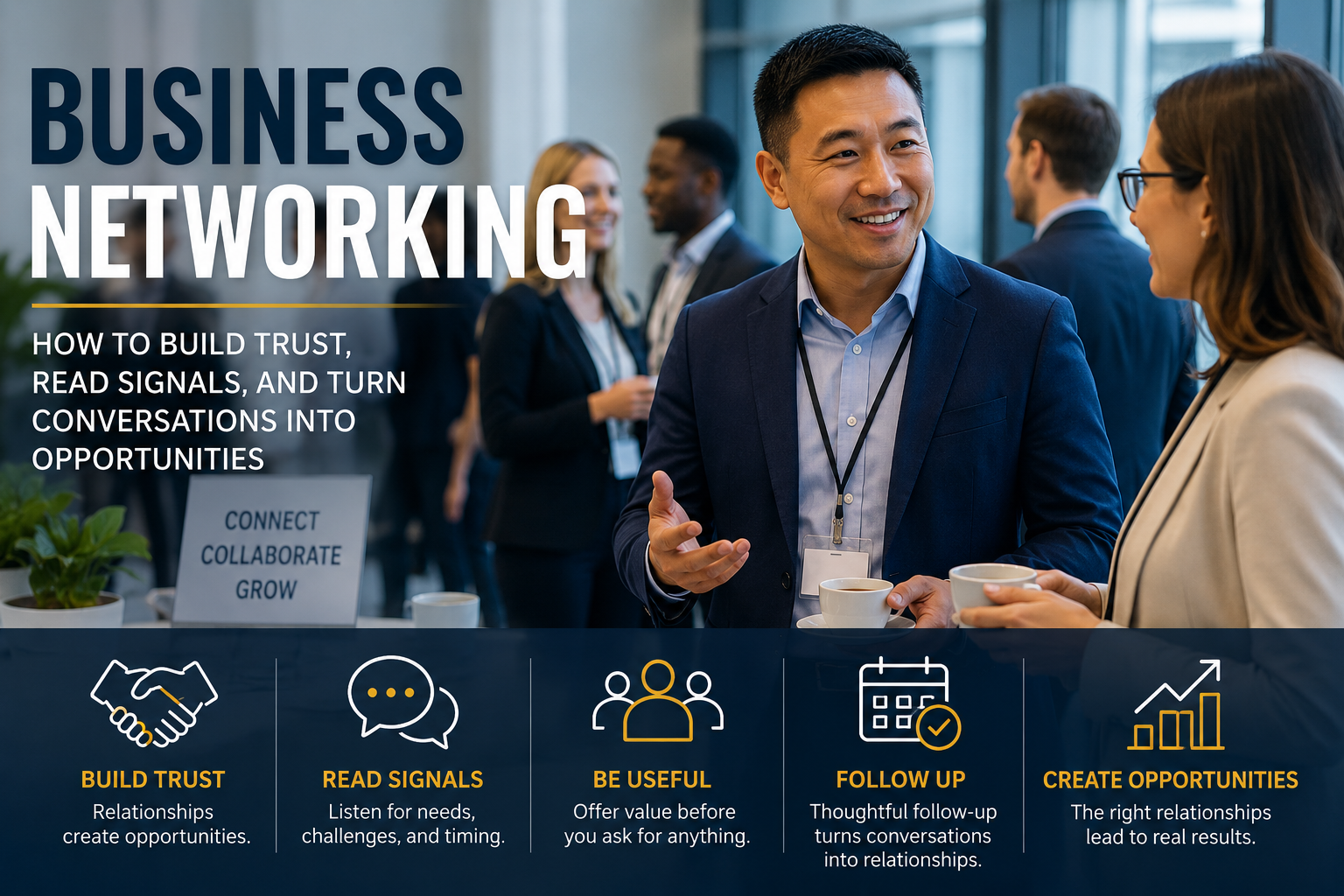
Business networking is not about collecting contacts or handing out business cards. Done well, it helps you build trust, read useful signals, create referrals, and turn conversations into real opportunities. This guide explains how to network with purpose before, during, and after each event.
This approach is part of the KrisLai Decision Framework, a practical method for improving business decisions.
Disclosure: If you click on my affiliate/advertiser’s links, I am going to receive a tiny commission. AND… Most of the time, you will receive an offer of some kind. It’ s a Win/Win!
What this article covers
In this article, I explain what business networking really means today, why trust matters more than selling, how to prepare before an event, how to start better conversations, how to follow up well, and how to avoid the networking mistakes that waste time.
I will also show how to use networking as a practical business-thinking tool, not just a social activity.
This article is based on practical business experience, independent research, and my own analysis and synthesis of how trust, behaviour, signals, and follow-up shape real business opportunities.
Business networking is not about meeting as many people as possible.
It is about becoming useful, visible, and trusted by the right people.
That is a very different thing.
The old image of networking is a room full of awkward small talk, business cards, forced smiles, and people trying to sell before they have earned any trust.

I have seen that version. It is rarely effective.
Good business networking is more thoughtful. It is about building relationships, learning what people need, understanding where opportunities may exist, and following up in a way that feels human.
In 2026, networking is also more targeted. Some of it happens in person. Some happens online. Some happens through LinkedIn, niche groups, hybrid events, webinars, workshops, local business communities, and referral networks.
AI can now help with preparation, research, and follow-up.
But it cannot build trust for you.
That part is still human.
Better decisions come from understanding behaviour, signals, environment, and consequences.
I write about how better decisions are made in business — combining strategy, behaviour, and practical thinking.
Key ideas
- Business networking is about trust, not just contacts.
- Quality matters more than quantity. A few useful relationships can be worth more than dozens of shallow conversations.
- Good networking starts before the event and continues after it.
- Follow-up is where most networking value is either created or lost.
- Networking works best when you listen for signals and look for ways to be useful.
What does business networking really mean today?
Business networking means building useful professional relationships that create trust, information, referrals, support, and future opportunities.
That is the simple version.
It is not just swapping cards.
It is not just adding people on LinkedIn.
It is not walking into a room and trying to sell to anyone who will listen.
Real business networking is about relationships.
Those relationships may lead to:
- referrals
- partnerships
- advice
- introductions
- new clients
- suppliers
- collaborators
- market insight
- local business knowledge
- future opportunities
Sometimes networking leads to business quickly.
Often, it does not.
A conversation today may become useful six months later.
That is why networking should not be treated like a one-off transaction. It is more like planting seeds in the right soil and then remembering to water them.
Business networking, in simple terms
Business networking means building useful professional relationships that create trust, information, referrals, support, and future opportunities.


Why networking is about trust, not just selling
People are far more likely to recommend, introduce, or work with someone they trust.
That trust does not usually appear because someone gave a polished pitch.
It grows when people see that you:
- listen properly
- understand what they do
- follow through
- respect their time
- are useful before you ask for something
- behave consistently
- do not push too early
In real business, reputation travels quietly through networks.
Someone may not need your service today, but they may remember you when someone else asks:
“Do you know anyone who can help with this?”
That is when trust becomes opportunity.
The mistake is trying to force that moment too soon.
Why quality matters more than quantity
A room of 100 people does not mean 100 useful contacts.
And 500 LinkedIn connections do not automatically mean a strong network.
One thoughtful conversation with the right person can be worth far more than 20 rushed introductions.
Quality matters because business relationships depend on relevance and trust.
It is better to have:
- three useful conversations
- two thoughtful follow-ups
- one real next step
than to leave with 30 names and no memory of who said what.
In my experience, the strongest networking usually comes from being selective, present, and consistent.
Not frantic.
How networking has changed with hybrid events and AI
Networking has changed, but the purpose has not.
The purpose is still human trust.
What has changed is the environment.
Today, networking may happen through:
- local business events
- trade shows
- webinars
- online communities
- hybrid conferences
- business breakfasts
- niche workshops
- industry forums
- referral groups
- podcasts and guest appearances
- short-form video and social content
Technology can support this.
AI tools can help you:
- research an event
- prepare questions
- understand a sector
- refine your introduction
- write follow-up messages
- organise notes
- spot common themes in conversations
But the human part has not disappeared.
People still decide whether they trust you.
They still notice whether you listened.
They still remember whether you followed up properly.
AI can help you prepare and follow up, but it cannot make you genuinely useful, trustworthy, or easy to talk to.
How do you prepare before a networking event?
Good networking starts before you walk into the room or log on to the call.
If you arrive without any purpose, you may still meet interesting people. But you are more likely to drift, talk to the safest person, or leave without a clear next step.
Preparation does not need to be complicated.
It just needs to make you more intentional.
Before you network, decide this
- Who do I want to meet?
- What useful conversation do I want to have?
- What can I offer before I ask for anything?
- What would make this event worth my time?
- How will I follow up afterwards?
Set one clear goal before you go
Do not try to achieve everything at once.
Before the event, set one simple goal.
For example:
- meet two local business owners
- find one potential referral partner
- understand one challenge in a sector
- reconnect with existing contacts
- speak to someone in a specific industry
- learn what customers are currently worried about
- find one useful collaboration opportunity
A clear goal changes how you listen.
It stops you from drifting from conversation to conversation with no purpose.
It also makes the event easier if you are not naturally comfortable with networking.
You are not there to impress everyone.
You are there to have a few useful conversations.
Research the room before you enter it
If the event has a speaker list, attendee list, exhibitor list, or LinkedIn event page, spend a little time looking through it.
You do not need to become a detective.
Just look for:
- who is attending
- what sectors are represented
- who is speaking
- what topics are being discussed
- which businesses may be relevant
- who you may already know
- who may be useful to meet
This helps you avoid walking in cold.
It also gives you better questions.
Instead of asking generic questions, you can say:
“I noticed your company works with local retailers. Has this year changed what they are asking for?”
That is much better than:
“So, what do you do?”
Prepare a short introduction that sounds natural
A good introduction should be simple and human.
It should not sound like a memorised pitch.
A useful structure is:
- who you are
- who you help
- what problem you help with
- what outcome you support
For example:
“I run a facilities service business and write about practical business thinking, decision-making, and how people search and choose in an AI-shaped world.”
Or, for a service business:
“We help small businesses keep their premises clean, safe, and presentable, without them having to chase or manage everything themselves.”
Keep it clear.
No jargon. No overclaiming. No lecture.
A short introduction should open a conversation, not close it.
Bring the right tools for in-person and online networking
Networking is easier when you have simple tools ready.
Useful tools include:
- a polished LinkedIn profile
- business cards, if still useful in your setting
- a QR code for quick connection
- a notes app
- a simple spreadsheet or CRM
- a calendar link, if appropriate
- a clear website or profile page
- a short follow-up message template
For in-person events, business cards can still be useful, especially with local or traditional business audiences.
For many modern settings, LinkedIn may be more useful.
The tool matters less than the follow-up.
A card in a drawer is not a relationship.
A LinkedIn connection with no message is not much better.

How do you start better networking conversations?
Many people dislike networking because they think they need to be impressive.
That is the wrong pressure.
You do not need to dominate the room.
You need to start useful conversations.
The easiest way to do that is to ask better questions and listen properly.
Use open questions that lead to real answers
Good networking questions are simple, but not empty.
Try questions like:
- What brought you to this event?
- What are you working on at the moment?
- What kind of clients do you usually help?
- What has changed most in your sector this year?
- What problem are you trying to solve right now?
- What kind of introduction would be useful for you?
- What does a good referral look like for your business?
- What are you hoping to get from today?
These questions work because they invite a real answer.
They are better than opening with a long explanation of yourself.
The aim is to create a conversation, not perform a speech.
Listen for signals, not just words
This is where networking becomes more strategic.
People reveal useful signals in conversation.
They may mention:
- a problem they are facing
- a client type they want more of
- a supplier issue
- a hiring challenge
- a new project
- a business change
- a frustration
- a referral need
- a future plan
- a repeated trend in their market
These signals matter.
They help you decide:
- whether this is a useful connection
- how you might help
- whether a follow-up makes sense
- whether an introduction would be valuable
- whether there is real opportunity or just polite conversation
This connects closely to customer intent marketing.
In both cases, the useful information is often in the signals people give before they make a direct request.
Make yourself useful before trying to sell
One of the best networking habits is simple:
Be useful before you ask.
That could mean:
- introducing someone
- sharing a relevant article
- recommending a supplier
- giving a practical suggestion
- connecting them with a contact
- sending a resource after the event
- asking a thoughtful question
- listening carefully when others rush past
You do not need to give away everything for free.
But generosity builds memory.
People remember those who help them think, connect, or move forward.
They also remember those who only talk about themselves.
How do you turn contacts into real business opportunities?
The value of networking is usually not created in the first conversation.
It is created in the follow-up.
That is where many people lose the opportunity.
They have a good conversation, say they will keep in touch, and then do nothing.
A week passes. Then a month. Then the contact becomes another forgotten name.
If you want networking to work, follow-up is not optional!
It is the bridge between conversation and relationship.
A simple follow-up formula
- Remind them where you met.
- Mention something specific from the conversation.
- Offer something useful if you can.
- Suggest one clear next step.
- Keep it short and human.

Follow up while the conversation is still fresh
A good rule is to follow up within 24 to 48 hours.
The message does not need to be long.
In fact, shorter is usually better.
For example:
“Hi Sarah, good to meet you at the business breakfast this morning. I enjoyed our conversation about local recruitment challenges. I mentioned that I knew someone who works with small firms on hiring systems, so I’ll send that introduction separately. Best, Kris.”
That works because it is specific.
It shows that you listened.
It does not feel like a copy-and-paste sales message.
Use LinkedIn and email properly
LinkedIn is useful for staying visible.
Email is useful for clearer next steps.
Use LinkedIn when:
- you want to connect quickly
- the relationship is still light
- you want to stay visible over time
- you want to engage with their content
- you want to keep the door open
Use email when:
- you promised to send something
- there is a clear next step
- you are making an introduction
- you are arranging a meeting
- you are sending a proposal or useful resource
The mistake is sending the same generic message to everyone.
Good follow-up should feel like it belongs to that conversation.
Track contacts so good opportunities do not disappear
You do not need an expensive CRM to start.
A simple spreadsheet can work.
Track:
- name
- business
- where you met
- date
- topic discussed
- useful signal
- promised action
- next follow-up date
The point is not admin for the sake of admin.
The point is memory.
If you attend several events, you will forget details unless you record them.
And details are what make follow-up feel human.
Build relationship rhythm
Not every contact needs a meeting tomorrow.
Some relationships grow slowly.
A good next step might be:
- sending a useful article
- making an introduction
- commenting on a LinkedIn post
- arranging a coffee
- inviting them to another event
- checking in after a few weeks
- referring someone when the right opportunity appears
That is how trust builds over time.
Networking is not only about the immediate lead.
It is about staying relevant, useful, and remembered.
![Get leads. Get sales. Get growing. [2]](data:image/svg+xml;base64,PHN2ZyB4bWxucz0iaHR0cDovL3d3dy53My5vcmcvMjAwMC9zdmciIHdpZHRoPSI0NjgiIGhlaWdodD0iNjAiIHZpZXdCb3g9IjAgMCA0NjggNjAiPjxyZWN0IHdpZHRoPSIxMDAlIiBoZWlnaHQ9IjEwMCUiIHN0eWxlPSJmaWxsOiNjZmQ0ZGI7ZmlsbC1vcGFjaXR5OiAwLjE7Ii8+PC9zdmc+)
What business networking looks like in real business
Let us make this practical.
Example 1: The useful connector
You meet someone at an event.
They are not a potential client.
At first glance, the conversation may not seem commercially useful.
But they know several people in your target market.
If you treat the conversation only as a sales opportunity, you may dismiss it.
But if you think in terms of relationships and signals, you may see that this person could become a valuable connector.
That does not mean using them.
It means building a genuine relationship and looking for ways to help each other.
Example 2: The slow-burn relationship
Some networking opportunities do not look important at first.
You meet someone. You have a good conversation. Nothing happens.
Then months later, they remember you.
Maybe their business changes.
Maybe a client asks for a recommendation.
Maybe they see your article on LinkedIn.
Maybe your earlier conversation suddenly becomes relevant.
This is why consistency matters.
A relationship that looks quiet may still be warming in the background.
Example 3: The learning connection
Not every networking conversation needs to produce a client, referral, or sale.
Sometimes the value is market insight.
You may learn:
- what customers are struggling with
- what competitors are offering
- what suppliers are seeing
- what sectors are slowing down
- what businesses are investing in
- what problems keep repeating
That kind of information can improve your strategy.
It can help you write better content, shape better offers, and make better decisions.
In real business, insight is valuable.
Example 4: The trust signal
People often decide whether to trust you before they ever need your product or service.
They watch:
- how you speak
- how you listen
- whether you interrupt
- whether you follow up
- whether you remember details
- whether you help others
- whether you only appear when you want something
Networking gives people a chance to observe your behaviour.
That behaviour becomes a signal.
And signals shape trust.

Common networking mistakes that waste time
Business networking can be powerful, but it can also waste a lot of time if done badly.
Here are the mistakes I would watch for.
Selling too early
This is one of the quickest ways to weaken trust.
If you pitch too soon, people feel cornered.
They may smile politely, but they often withdraw mentally.
A better approach is to understand first.
Ask questions. Listen. Look for fit. Notice whether there is any real need or relevance.
If there is, the sales conversation can come later.
If there is not, forcing it will not help.
Trying to meet everyone
Trying to meet everyone usually means connecting deeply with no one.
A few strong conversations are often more valuable than a room full of rushed introductions.
This is especially true for small business owners and independent professionals.
You do not need everyone to remember you.
You need the right people to remember you for the right reason.
Talking more than listening
Some people use networking as a stage.
They talk, explain, pitch, and present.
But they do not listen.
That means they miss the useful information.
Good networking is not only about being understood.
It is also about understanding.
Failing to follow up
This is where most networking value disappears.
A good conversation without follow-up is like writing a note and throwing it away.
If someone is worth speaking to, they are worth a thoughtful follow-up.
Even a short message can keep the relationship alive.
Attending the wrong events repeatedly
Sometimes the problem is not your conversation skill.
It is the room.
If you keep attending events where the people are not relevant to your goals, you may be working hard in the wrong environment.
Ask:
- are the right people here?
- do these events create useful conversations?
- is the group active?
- do people follow up?
- is the tone professional?
- is there trust in the room?
- does this fit my business goals?
If not, change the room!
What I’ve seen go wrong
What I’ve seen go wrong is people treating networking as a numbers game. They collect names, hand out cards, and leave with activity but no trust. In real business, a smaller number of useful relationships often matters more than a long list of weak contacts.
If you aren’t already leveraging relationship marketing for your brand, I highly recommend doing so. In fact, Ambassador can help you get started or take your current efforts to the next level.
What is relationship marketing? It’s network engagement that allows your brand to increase revenue by leveraging the power of relationships. Ambassador allows you to manage all of your relationships — influencers, affiliates, referrals, recommendations, rewards, NPS®, etc. — under one umbrella.
Check them out: getambassador.com
The KrisLai Networking Signal Framework™
Networking becomes more useful when you stop seeing it as random social activity and start reading the signals.
That does not mean being calculating or fake.
It means paying attention.
A good conversation can tell you a lot about timing, trust, relevance, and opportunity.
This is where I use a simple way of thinking: behaviour, signals, environment, and consequences.
The KrisLai Networking Signal Framework™
- Behaviour – how does this person act, listen, help, and follow through?
- Signals – what needs, interests, referrals, timing, or opportunities appear?
- Environment – where did the connection happen, and what context shaped it?
- Consequences – what should happen next, and what is the cost of no follow-up?
Better decisions come from understanding behaviour, signals, environment, and consequences.
Behaviour — how does the person act?
Pay attention to behaviour.
Do they listen?
Do they ask questions?
Do they only talk about themselves?
Do they show interest in others?
Do they follow through on what they promised?
Do they treat people well even when there is no obvious benefit?
Behaviour matters because networking is built on trust.
And trust is built through repeated behaviour.
Signals — what opportunity or need is visible?
Useful networking signals include:
- a business problem
- a growth plan
- a referral need
- a common audience
- a timing clue
- a decision coming soon
- a partnership fit
- a repeated challenge
- a content idea
- a useful introduction
Not every signal means “sell.”
Sometimes the best next step is simply to send a helpful resource or introduce someone else.
Environment — where did the connection happen?
Context matters.
A conversation at a niche industry event may have a different meaning from a casual chat at a large general event.
Think about:
- the event type
- the audience
- the purpose of the gathering
- the organiser’s reputation
- the quality of conversations
- the level of trust in the group
- whether people return regularly
Some environments are better for trust-building than others.
Smaller groups, workshops, netwalking events, and niche meetups can sometimes produce better conversations than crowded rooms.
Consequences — what should happen next?
After a conversation, ask:
- Should I follow up?
- Should I send something useful?
- Should I make an introduction?
- Should I book a call?
- Should I simply connect and stay visible?
- Should I leave it alone?
- What is the cost of doing nothing?
That last question matters.
Many opportunities are not lost because the first conversation was poor.
They are lost because nothing happened afterwards.

How AI can help with networking without replacing trust
AI can support networking, but it should not make the process feel robotic.
Used well, it can help you prepare, organise, and follow up.
Used badly, it can make you sound generic and insincere.
Use AI before the event
Before an event, AI can help you:
- research a sector
- prepare conversation starters
- refine your short introduction
- understand common industry issues
- create a list of useful questions
- summarise an event theme
- prepare for meeting a specific audience
For example, you could ask AI:
“What are five practical questions I could ask small business owners at a local networking event about their current challenges?”
That can help you feel more prepared.
Use AI after the event
After an event, AI can help you:
- draft follow-up messages
- summarise your notes
- organise contacts into groups
- create reminders
- suggest useful resources to send
- rewrite a message to sound clearer and more natural
But always personalise the result.
A follow-up that sounds copied and pasted is worse than no message at all.
Keep the human part human
This is the key point.
AI can help you prepare and follow up, but it cannot build trust for you.
It cannot listen with genuine interest.
It cannot notice subtle tension in the room.
It cannot build your reputation through consistent behaviour.
It cannot care on your behalf.
The human part still belongs to you.
Final thought: networking works best when it feels human
Business networking is not manipulation.
It is not collecting names.
It is not forcing a sales pitch into every conversation.
It is the steady work of building useful relationships with the right people.
That means preparing well, asking better questions, listening for signals, following up properly, and staying visible in a way that builds trust over time.
Good networking does not have to feel fake.
In fact, the best networking usually feels simple and human.
You meet people.
You listen.
You help where you can.
You follow up.
You remember.
You stay useful.
Over time, those small actions can turn into referrals, partnerships, clients, insight, and opportunities that would not have appeared otherwise.
Business networking works best when people remember you as useful, trustworthy, and easy to talk to — not as someone who tried to sell too quickly.
Start small:
Choose better rooms.
Have better conversations.
Follow up while the memory is fresh.
And remember: contacts are not the real asset.
Trust is.
Final takeaway
Business networking works best when it is focused, human, and followed through. Build trust before trying to sell, listen for useful signals, and turn good conversations into real relationships through thoughtful follow-up.
Related reading on KrisLai.com
- Related article: Customer Intent Marketing
- Glossary or definition article: Emotional Intelligence in Leadership
- Pillar topic: Business Thinking Hub
- Curiosity Marketing and Selling
- Conceptual Selling
- Leadership Skills in Business
- Business Acumen Skills
- Decision-Making Framework Examples
Frequently Asked Questions About Business Networking
What is business networking?
Business networking means building useful professional relationships that create trust, information, referrals, support, and future opportunities.
Why is business networking important?
Business networking is important because it helps people build trust, stay visible, create referrals, learn from others, and find opportunities that may not appear through ordinary marketing or cold outreach.
How do you prepare for a networking event?
Prepare by setting one clear goal, researching the event or attendees, preparing a short natural introduction, updating your LinkedIn profile, and planning how you will record and follow up with useful contacts.
What should you say when networking?
Start with simple open questions, such as what brought someone to the event, what they are working on, or what kind of clients they usually help. Listen carefully before explaining what you do.
How do you follow up after networking?
Follow up within 24 to 48 hours. Remind the person where you met, mention something specific from the conversation, offer something useful if appropriate, and suggest one clear next step.
What are common business networking mistakes?
Common mistakes include selling too early, trying to meet everyone, talking more than listening, attending the wrong events, failing to follow up, and treating networking as a numbers game rather than a trust-building process.
How can AI help with business networking?
AI can help with researching events, preparing questions, refining introductions, summarising notes, drafting follow-up messages, and organising contacts. But AI cannot replace genuine listening, trust, and human follow-through.
About the author
Kris Lai is a business operator and managing director with experience in land and building surveying, facilities management, logistics, and service delivery.
Earlier in his career, he worked as a Search Engine Evaluator (via Lionbridge, supporting Google), where he assessed search result relevance, user intent, and content quality using structured evaluation frameworks. This experience gives him a rare, practical understanding of how search systems interpret signals and make ranking decisions.
In parallel, whilst working with a charity organisation, he has delivered 1000’s of structured presentations in English, Finnish, and Chinese to audiences ranging from small groups to more than 600 people, and has spent decades mentoring and developing others. This experience informs his approach to clarity, communication, and decision-making under pressure.
He writes about AI, search behaviour, business strategy, and decision-making from a practical, real-world perspective.
If you enjoy exploring the ideas behind better business decisions, you may find the Business Thinking Hub useful.
👉 Explore ideas connected to better business decisions:
- Digital Transformation for SMEs: 7 Questions Before You Invest
- Cybersecurity for Businesses: 7 Decisions Leaders Must Make

- How AI Is Changing Search Behaviour (And What Businesses Must Do Now)
- Decision-Making Framework Examples: The KrisLai Method in Action
- The KrisLai Decision Framework: A Better Way to Make Business Decisions