Business strategy is not a neat document you write once a year. It is how you think, decide, and adapt when the market changes faster than your plan. In uncertain times, the winners are not always the biggest companies. They are often the clearest thinkers.
Business strategy planning, in simple terms
Business strategy planning means deciding how your business will move from where it is now to where you want it to be.
It is about making deliberate choices on customers, value, priorities, resources, and direction — not just writing down goals.
Markets do not wait for your business plan.
One month, costs are stable. The next, energy prices rise, shipping delays hit, interest rates shift, customers hesitate, and a new AI tool changes how people search, compare, and buy.
That is the world many business owners and leaders are trying to manage now.
And here is the uncomfortable truth: when the future is messy, more information does not always help. Sometimes it creates more noise.
Good business strategy is not about predicting everything perfectly. It is about thinking clearly, making calm decisions, and building a business that can adjust before pressure becomes panic.
In this article, I will show you a practical way to think about strategy in uncertain markets. Not as theory. Not as a corporate buzzword. But as a real decision system you can use when things feel unclear.
Key idea
Strong strategy is not about guessing the future. It is about preparing for several possible futures, protecting what matters, and making better decisions faster than your competitors.
Disclosure: If you click on my affiliate/advertiser’s links, I am going to receive a tiny commission. AND… Most of the time, you will receive an offer of some kind. It’ s a Win/Win!
What makes markets feel so unpredictable right now
Uncertainty is not new. Business has always involved risk.
But the pressure feels different when several shocks happen at once.
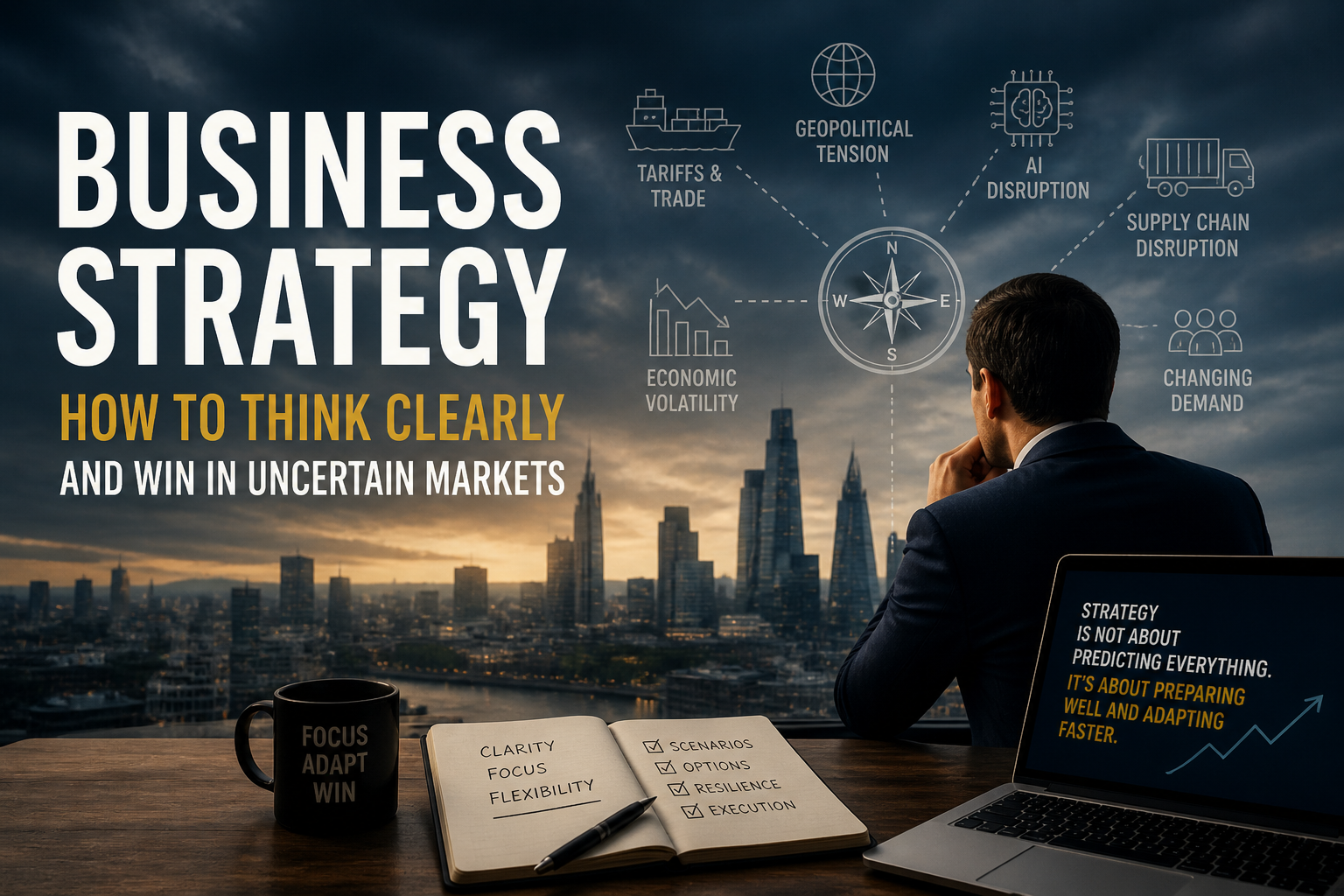
Today, many businesses are dealing with a mix of trade disruption, geopolitical tension, inflation pressure, interest rate changes, AI disruption, supply chain fragility, and uneven customer demand.
This is not just a problem for global giants. It affects small and medium-sized UK businesses too.
A cleaning business may feel it through labour costs, fuel, equipment prices, and client budget pressure. A manufacturer may feel it through imported materials and delayed components. A consultant may feel it through longer buying decisions. A retailer may feel it through weaker consumer confidence.
The details differ. The pattern is the same.
When the environment becomes unstable, old assumptions become dangerous.
The Office for National Statistics reported that 9% of UK businesses experienced global supply chain disruption in March 2026, the highest proportion since December 2022. Nearly half of those affected businesses cited conflict in the Middle East as a reason.
The Bank of England’s April 2026 business intelligence also noted that the Middle East conflict had weakened confidence, with firms worried about demand, supply chains, and input costs.


The biggest shocks businesses are dealing with today
Most business uncertainty does not come from one single event. It comes from several pressures combining.
Here are the main ones:
Tariffs and trade disruption
Tariffs and changing trade rules can alter costs quickly. A product that looked profitable last year may become less attractive if import costs rise or export demand weakens.
UK firms are exposed because many businesses depend on global trade, imported components, and cross-border supply chains. The British Chambers of Commerce has warned that more than 75% of UK manufacturing exports begin with imports, which shows how exposed firms can be to disruption.
Geopolitical tension
Conflict can affect oil, shipping, energy, insurance, and business confidence. Even if your business is local, your suppliers may not be.
That is why a shock in one region can quickly become a cost problem somewhere else.
Shipping delays and fragile supply chains
When shipping routes are disrupted, businesses may face longer lead times, higher freight costs, and lower reliability.
That matters because delay is not just an inconvenience. Delay affects cash flow, customer trust, planning, and stock availability.
Inflation, energy costs, and interest rates
Higher costs squeeze margins. Higher interest rates can make borrowing more expensive. Softer demand can make it harder to pass costs on to customers.
This is where strategy becomes practical. You cannot control the whole economy. But you can decide how much cost pressure your business can absorb before you change pricing, suppliers, service levels, or investment plans.
AI disruption
AI is changing how people search, compare, learn, and decide.
For some businesses, AI creates efficiency. For others, it creates visibility risk. If customers use AI answers, comparison tools, or summaries before visiting websites, businesses need stronger trust signals, clearer positioning, and more useful content.
This is why strategy now has to include both market reality and digital behaviour.
What this means for leaders
Uncertainty is not only an external problem. It becomes an internal problem when leaders delay decisions, chase too many priorities, or react emotionally instead of thinking clearly.
Why old planning methods break down in fast-changing conditions
Traditional planning often assumes the world will behave in a fairly predictable way.

Photo by Leah Kelley
You make an annual plan.
You set a forecast.
You allocate a budget.
You review progress later.
That can work in stable conditions.
But when the market changes every few weeks, a fixed plan can become a trap.
The danger is not planning itself. Planning is useful. The danger is believing the plan too strongly.
A business plan should be a guide, not a cage.
In uncertain markets, strategy must be flexible enough to change, but disciplined enough to stop the business drifting.
That balance is difficult.
Too rigid, and you miss important changes.
Too reactive, and you chase every signal.
Too slow, and competitors move first.
Too fast, and you make poor decisions from fear.
This is why the real skill is not just planning. It is strategic thinking.
How to think more clearly before making big decisions
Clear thinking is underrated in business.
When pressure rises, many leaders want action. That is understandable. But action without clarity can make things worse.
Before making a big decision, slow the thinking down.
Not forever. Just long enough to separate what is real from what is noise.

Separate facts, guesses, and fears
This is one of the simplest and most useful decision habits I know.
When a situation feels messy, write three headings:
Facts
What do we know?
Guesses
What do we think might be true?
Fears
What are we worried could happen?
This helps because many bad decisions happen when these three things get mixed together.
For example:
- Fact: A supplier has delayed one delivery.
- Guess: Future deliveries may also be delayed.
- Fear: We may lose clients if this continues.
Those three points are connected, but they are not the same.
If you treat a fear as a fact, you may overreact.
If you ignore a fact because it feels uncomfortable, you may react too late.
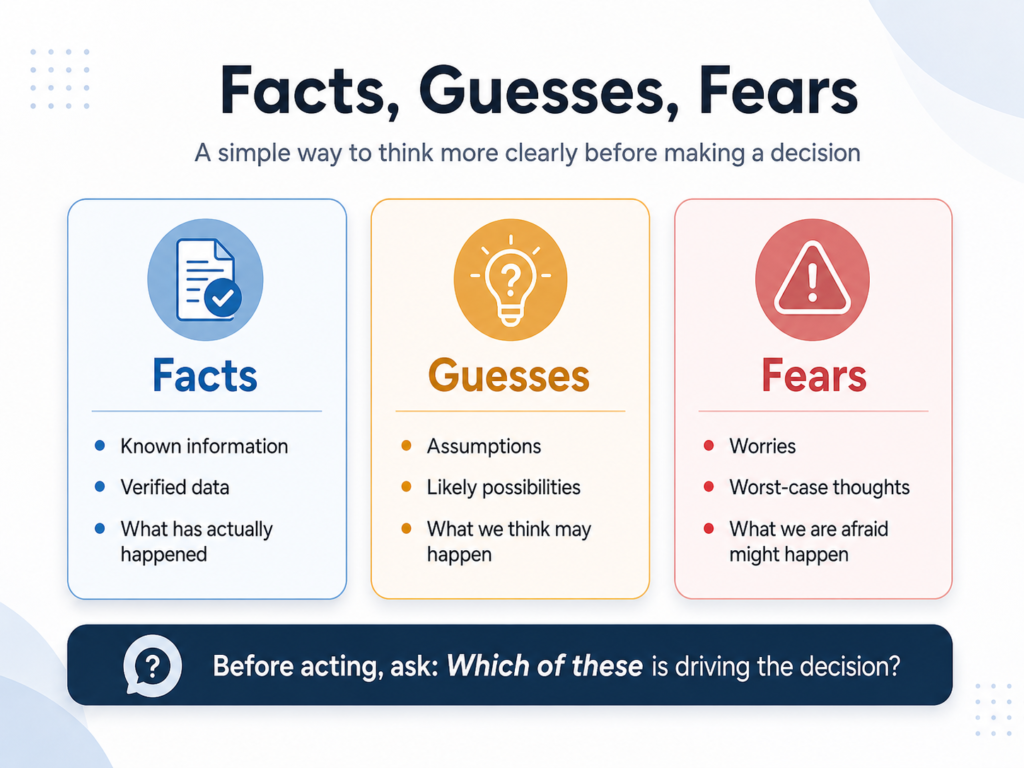
Practical decision prompt
Before a major decision, ask:
- What do we know for certain?
- What are we assuming?
- What are we afraid of?
- What evidence would change our view?
Use a few strong mental models instead of too much information
More information is not always better.
Sometimes the problem is not lack of data. The problem is lack of structure.
A few simple mental models can help.
Second-order effects
Do not only ask, “What happens next?”
Ask, “What happens after that?”
Example:
If you reduce prices, you may win more work. That is the first effect.
But the second effect could be lower margins, lower perceived value, more demanding clients, and less capacity for better opportunities.
That is why strategy must look beyond the first move.
Upside and downside risk
Every decision has possible gain and possible damage.
Ask:
- What is the best realistic outcome?
- What is the worst realistic outcome?
- Can we survive the downside?
- Is the upside worth the risk?
This is especially useful when cash flow, hiring, investment, or expansion is involved.
Base rates
Base rates mean looking at what normally happens in similar situations.
If most businesses struggle when they expand too quickly, you should not assume yours will be different without strong evidence.
Base rates keep ambition grounded.
They do not kill optimism. They protect it from fantasy.
Decide what would change your mind
One of the best ways to avoid endless debate is to agree decision triggers in advance.
A decision trigger is a clear signal that tells you when to act.
For example:
- If gross margin falls below a set level, pricing must be reviewed.
- If a supplier misses two delivery windows, alternatives must be tested.
- If customer enquiries drop for four weeks, marketing messages must be reviewed.
- If AI search traffic changes sharply, content and visibility strategy must be checked.
This matters because pressure often clouds judgement.
If you agree the trigger before the pressure arrives, the business can act more calmly.
Simple Decision Trigger Table
| Signal | Possible meaning | Action |
|---|---|---|
| Margin drops | Costs or pricing are out of balance | Review pricing and cost base |
| Supplier delays | Operational risk is rising | Test backup suppliers |
| Demand slows | Customer priorities may be shifting | Review offer and messaging |
| Team confusion | Priorities are unclear | Reset the plan and decision rules |

Build a strategy that can flex when the market shifts
A strong strategy is not a fragile document.

Image by Arek Socha from Pixabay
It is a system.
It should help the business stay focused while still adapting when conditions change.
That means your strategy needs three things:
- A clear direction
- Flexible options
- Regular review
In real business, I have often found that the best strategy is not the most impressive one on paper. It is the one people can actually understand, follow, and adjust when reality changes.
Use scenario planning to test several futures
Scenario planning is a practical way to stop pretending there is only one possible future.
You do not need to make it complicated.
Start with three scenarios:
Best case
Demand improves, costs stabilise, and the business has room to grow.
Most likely case
The business faces mixed conditions, with some pressure but manageable risk.
Worst case
Costs rise, demand weakens, suppliers struggle, or cash flow tightens.
Then ask:
- What would we do in each case?
- What would we stop doing?
- What would we protect first?
- What early signs would tell us which scenario is forming?
AI tools can help you model possibilities, summarise market signals, and compare options. But AI should not replace judgement.
The tool may process information quickly.
The leader still has to decide what matters.
KrisLai Decision Framework™
Better decisions come from understanding behaviour, signals, environment, and consequences.
In strategy, this means watching how customers behave, noticing early signals, understanding the wider market environment, and thinking carefully about the consequences of each choice.

Keep options open where possible
Uncertainty punishes businesses that lock themselves into one path too early.
That does not mean avoiding commitment. It means knowing where flexibility matters.
Useful options can include:
- Shorter contracts where appropriate
- Backup suppliers
- Pilot projects before large investment
- Flexible staffing arrangements
- Cash reserves
- Alternative customer segments
- Modular systems and tools
The point is simple.
When the market changes, options give you room to move.
Without options, you may be forced into decisions you would not choose under calmer conditions.
Protect the parts of the business that create resilience
Resilience is not just about surviving.
It is about keeping enough strength to make good choices when others are under pressure.
The most important areas to protect are usually:
Cash flow
Cash gives you time. Time gives you choices.
Supplier relationships
Good suppliers can help you manage shocks better than weak or purely transactional relationships.
Customer trust
When uncertainty rises, customers become more cautious. Trust becomes more valuable.
Pricing discipline
Cutting price may feel like the fastest answer, but it can damage the business if it becomes a habit.
Team clarity
A confused team wastes energy. A clear team can act quickly.
Where this goes wrong
Many businesses try to stay flexible by avoiding decisions. That is not flexibility. That is drift. Real flexibility means choosing a clear direction while keeping enough options to adapt if the evidence changes.
Turn uncertainty into an advantage through smarter execution
Clear strategy only matters if it changes what people do.
This is where many plans fail.
The leadership team may understand the strategy, but the people doing the work may still be unclear about priorities.
That gap creates waste.
In uncertain markets, execution must be tight, simple, and reviewed often.
Run short decision cycles and review them often
Annual reviews are too slow when the market is moving quickly.
A better approach is to use short decision cycles.
For example:
- Weekly review for urgent operational signals
- Fortnightly review for sales, demand, and cash flow
- Monthly review for strategy and positioning
The purpose is not to hold more meetings.
The purpose is to learn faster.
Ask:
- What changed?
- What did we learn?
- What needs adjusting?
- What should stay the same?
Small course corrections often prevent large mistakes.
Bring teams together around one shared plan
Strategy should not live only in the owner’s head.
Finance, operations, sales, marketing, supply chain, and customer-facing teams all see different parts of reality.
When those signals are not shared, the business becomes slow and fragmented.
A shared plan should make clear:
- The main priority
- The biggest risks
- The current decision triggers
- Who owns which actions
- What will be reviewed next
This does not need to be complicated.
In fact, the simpler it is, the more likely people are to use it.
Learn from signals in the market before your rivals do
Uncertainty produces signals before it produces obvious outcomes.
Look for:
- Customers asking different questions
- Longer decision times
- Suppliers changing terms
- Competitors discounting heavily
- Costs creeping upward
- More complaints or hesitation
- Changes in search behaviour
- AI tools summarising your market differently
These signals are not just warnings. They can become an advantage.
If you spot the shift early, you can adjust before others do.
The Bank of England’s business intelligence for April 2026 showed that firms were watching demand, input costs, and supply chains closely as confidence weakened. That is exactly the kind of signal-led thinking businesses need in uncertain markets.
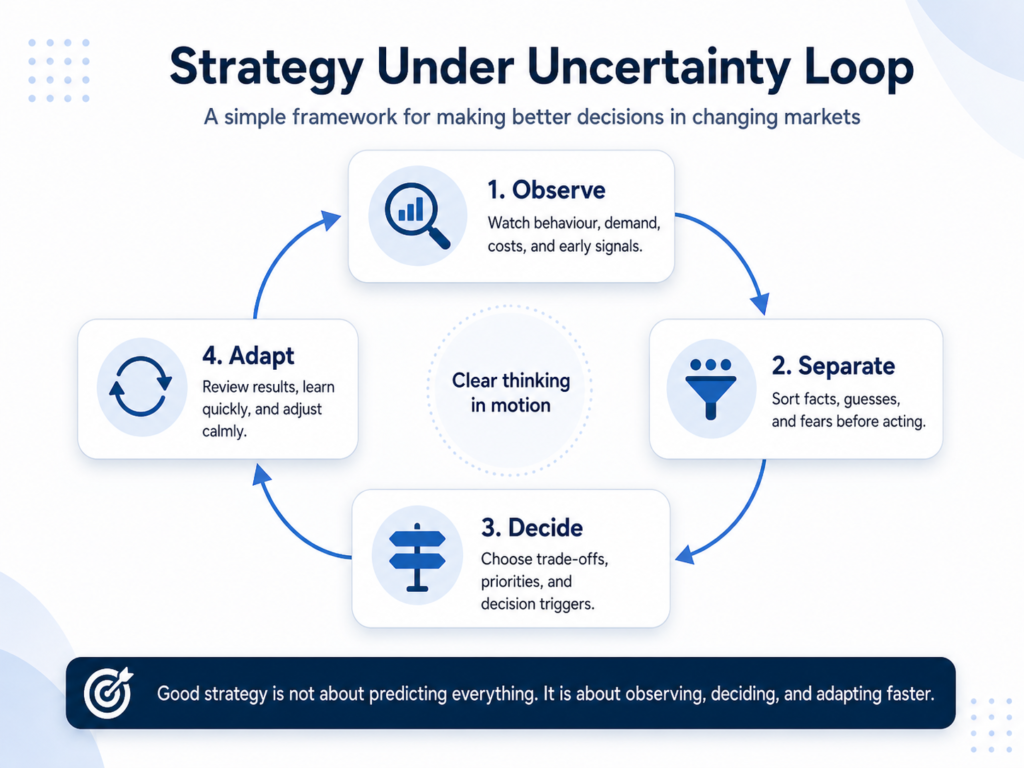
Business Strategy Under Uncertainty: Simple Visual Framework
Watch behaviour, costs, demand, and signals.
Sort facts, guesses, and fears.
Choose trade-offs and decision triggers.
Review often and adjust before pressure becomes panic.
A simple business strategy checklist
Before you update your strategy, work through this checklist.
- Do we know our most important business objective?
- Do we know what has changed in the market?
- Have we separated facts from assumptions?
- Do we know our biggest risks?
- Have we agreed what would make us change direction?
- Are we protecting cash flow?
- Are we watching customer behaviour closely?
- Do we have backup options?
- Does the team understand the current priority?
- Are we reviewing the plan often enough?
If you cannot answer these clearly, the strategy needs work.
What this means in real business
In real business, strategy is not glamorous.
It often looks like calm, disciplined choices:
- Saying no to work that does not fit
- Reviewing prices before margins collapse
- Building supplier options before you need them
- Testing small changes before making big commitments
- Talking honestly with the team about priorities
- Watching customer behaviour before competitors notice the shift
That is where strategic thinking becomes practical.
A business does not need to predict the future perfectly.
It needs to be prepared enough, calm enough, and flexible enough to respond well.

Handy Checklist for Creating a Business Strategy
Here is a very useful checklist that can help you create your all-important business strategy: (image)
Define Your Vision and Mission:
- ✔️ What is the long-term dream for your business?
- ✔️ Why does your business exist? What’s its purpose?
Conduct a SWOT Analysis:
- ✔️ Identify strengths, weaknesses, opportunities, and threats.
Set Clear Goals and Objectives:
- ✔️ What do you want to achieve in the short and long term?
- ✔️ Break goals into specific, measurable objectives.
Understand Your Target Audience:
- ✔️ Who are your ideal customers?
- ✔️ What are their needs and preferences?
Develop a Compelling Value Proposition:
- ✔️ What makes your product or service stand out?
- ✔️ How does it solve a problem or meet a need?
Identify Your Competitive Advantage:
- ✔️ How will you outperform competitors?
- ✔️ What sets your business apart?
Create Action Plans:
- ✔️ What specific steps will you take to achieve your objectives?
- ✔️ Assign responsibilities and deadlines.
Allocate Resources Wisely:
- ✔️ Where will you invest your time, money, and manpower?
- ✔️ Ensure resources align with strategic priorities.
Establish Monitoring and Evaluation Processes:
- ✔️ Regularly assess progress against goals.
- ✔️ Be ready to adapt strategies based on feedback and changing circumstances.
Remember, strategic planning is a dynamic process. Regularly revisit and adjust your strategy as your business evolves and the market changes.
What are the key parts of business strategy planning?
- Setting a clear direction
- Understanding customers and competitors
- Choosing priorities
- Using resources effectively
- Assessing risks and consequences
- Reviewing progress and adjusting when needed

Why Business Strategies Fail in the Real World
Many strategies do not fail because the people behind them are lazy or unintelligent.
They fail because the thinking behind them is incomplete.
I have seen businesses create plans that looked sensible on paper but broke down in practice for a few familiar reasons:
1. They confuse goals with strategy
Saying “we want to grow” is not a strategy. It is a goal. Strategy is how you will grow, where you will focus, and what makes your approach different or effective.
2. They ignore customer behaviour
A plan may sound brilliant internally, but if it does not match how customers actually think, compare, hesitate, or buy, it will struggle.
3. They react to noise instead of signals
Some businesses chase every trend, competitor move, or short-term pressure. That creates motion, but not always progress.
4. They try to do too much
One of the most common strategic failures is lack of focus. Businesses spread time, money, and energy too widely, then wonder why results stay weak.
5. They underestimate consequences
Every strategic choice creates trade-offs. Choosing one market, one product direction, or one growth path usually means saying no to something else. Weak strategy often ignores that.
In Swedish, there is a saying: “Den som gapar efter mycket mister ofta hela stycket.” – He who grasps at too much often loses everything.
That warning applies to strategy more often than people think!
A simple real-world example
Imagine a small business sees a competitor launch three new services and starts copying them quickly. On paper, this may look responsive. In reality, it can scatter focus, confuse customers, stretch the team, and weaken quality.
The problem is not lack of effort. The problem is weak strategic judgement.

Conclusion: strong strategy is calm thinking in motion
Uncertainty is not going away.
Tariffs, geopolitics, AI, supply chains, inflation, customer demand, and digital behaviour will keep shifting. Some changes will be temporary. Others will reshape whole markets.
The businesses that do well will not be the ones with perfect predictions.
They will be the ones that think clearly, protect what matters, and adapt faster than the market changes.
Strong strategy is not about knowing everything.
It is about making better choices with the information you have.

Image by Gino Crescoli from Pixabay
Ready to strengthen your business thinking?
Start by reviewing one decision you have been delaying. Separate the facts, guesses, and fears. Then decide what signal would make you act.
Better decisions come from understanding behaviour, signals, environment, and consequences.
Build Deeper Insight
If you found this useful, these related articles will help you continue building clearer business thinking:
FAQ: Business Strategy in Uncertain Markets
What is business strategy in simple terms?
Business strategy is the set of choices a business makes to compete, grow, and adapt. It explains where the business will focus, what it will avoid, and how it will use its resources to reach its goals.
Why is strategy important in uncertain markets?
Strategy is important because uncertainty creates noise, pressure, and risk. A clear strategy helps leaders focus on what matters, avoid panic decisions, and adapt when conditions change.
How can a business plan for uncertainty?
A business can plan for uncertainty by using scenario planning, protecting cash flow, building supplier options, watching customer behaviour, and setting clear decision triggers before pressure builds.
What is the difference between strategy and planning?
Planning is about actions, dates, and resources. Strategy is about choices, trade-offs, and direction. A plan tells people what to do. A strategy explains why those choices matter.
How often should a business review its strategy?
In stable conditions, quarterly reviews may be enough. In uncertain markets, businesses should review key signals weekly or fortnightly, while reviewing the wider strategy monthly or quarterly.
Can AI help with business strategy?
AI can help by summarising data, modelling scenarios, spotting patterns, and speeding up research. However, human judgement is still needed to choose priorities, understand context, and make final decisions.

Final takeaway
A strong strategy does not try to do everything. It helps you make clearer choices, stay focused, and move with better judgement.
Remember:
A practical model for better business decisions in complex environments. It focuses on four essential elements:
- Human Behaviour — how people actually think and decide
- Signals — what people are trying to do right now
- Environment — whether the system supports good decisions
- Consequences — what happens next, and after that
Strong decisions consider all four — not just one.
If you enjoy exploring the ideas behind better business decisions, you may find the Business Thinking Hub useful.

Read more about Kris Lai
👉 Explore ideas connected to better business decisions:
- Digital Transformation for SMEs: 7 Questions Before You Invest
- Cybersecurity for Businesses: 7 Decisions Leaders Must Make
- How AI Is Changing Search Behaviour (And What Businesses Must Do Now)
- Decision-Making Framework Examples: The KrisLai Method in Action
- The KrisLai Decision Framework: A Better Way to Make Business Decisions