Entrepreneurial decision-making is about making choices when the future is unclear, the risks are real, and the information is incomplete. This guide explains the seven business decisions entrepreneurs should test before committing money, time, people, or reputation — and how to use signals, judgement, and evidence to make better choices.
Starting and growing a business can feel exciting, stressful, and slightly mad — sometimes all before breakfast!
But the real challenge is not simply having an idea. It is making the right decisions before that idea starts draining your time, cash, energy, and confidence. It is about testing the decisions that decide whether those ideas become stronger, weaker, or very expensive lessons.
In my experience, many business problems begin long before they appear in the accounts. They start with an untested assumption, a rushed choice, or a decision made because “it feels right”. That can work. Occasionally. But so can guessing the weather by looking at a cat. I would not build a business around it!
This article is about how entrepreneurs can make better decisions under uncertainty. Not perfect decisions. Better ones.
What this article covers
- What entrepreneurial decision-making means
- Why decision-making is so important for entrepreneurs and SME leaders
- How entrepreneurial decisions differ from normal management decisions
- The seven high-stakes business decisions entrepreneurs should test first
- How to balance intuition, data, customer signals, and judgement
- How AI can support decision-making without replacing human thinking
- Where entrepreneurial decisions often go wrong
- A practical decision test you can use before making a major business move
Table of contents
- What is entrepreneurial decision-making?
- Why is decision-making important for entrepreneurs?
- How is entrepreneurial decision-making different from normal management?
- What are the 7 business decisions entrepreneurs should test first?
- What are the steps in entrepreneurial decision-making?
- Effectuation vs causation: which one should entrepreneurs use?
- How do entrepreneurs make decisions under uncertainty?
- Should entrepreneurs trust intuition or data?
- How can AI help entrepreneurial decision-making?
- What this looks like in real business
- Where this goes wrong
- What you should actually do
- People Also Ask
- Frequently Asked Questions
- Entrepreneurial decision-making happens when the future is unclear and the answer is not obvious.
- The biggest risk is often not the decision itself, but the weak assumption hiding behind it.
- Entrepreneurs should test customer demand, pricing, cash risk, hiring, funding, growth, and pivot decisions before committing too much.
- AI can help with research, options, summaries, and scenarios, but it cannot replace judgement.
- Better decisions come from understanding behaviour, signals, environment, and consequences.
Entrepreneurial decision-making is the process of making business choices when the future is uncertain, information is incomplete, and the outcome is not guaranteed. It involves judgement, customer signals, evidence, risk awareness, intuition, and the ability to act before every answer is known.
What is entrepreneurial decision-making?
Entrepreneurial decision-making is the way entrepreneurs make choices when they do not yet have perfect data, stable conditions, or guaranteed results. It means testing ideas, reading customer signals, managing risk, using judgement, and deciding what to do next when the future is still uncertain.
That matters because entrepreneurs rarely get the luxury of complete information.
A large company may have teams, budgets, market data, consultants, dashboards, and enough meetings to frighten a small village. A small business owner often has a notebook, a bank balance, a few customers, and a decision that needs making by Friday.
This does not mean entrepreneurs should guess.
It means they need a better way to think.
Entrepreneurial decision-making is not just about being bold. It is about being bold enough to act, but careful enough to test the thinking behind the action.
Research on entrepreneurial decisions often highlights uncertainty, incomplete information, intuition, imagination, and judgement. Cambridge University Press, for example, discusses how entrepreneurial decisions differ from normal managerial decisions because entrepreneurs often operate in situations where there is no clear standard answer:
Understanding Entrepreneurial Decision-MakingFor a small business owner, this becomes very practical.
You may need to decide:
- whether to start the business
- who the first customer should be
- how much to charge
- whether to hire
- whether to borrow money
- whether to launch, wait, pivot, or stop
Those are not just business decisions.
They are cash-flow decisions, customer decisions, people decisions, risk decisions, and sometimes sleep-at-night decisions.
Concept Definition: Entrepreneurial decision-making is like crossing a river
Think of entrepreneurial decision-making like crossing a river where the stones are partly hidden.
You can see the other side. You may even know where you want to go. But you cannot see every safe step from the bank.
A poor decision-maker either jumps without looking or waits forever for the water to become clear.
A better entrepreneur tests the next stone.
They look. They step carefully. They adjust. They keep their balance. They do not pretend the river is not moving.
That is what business decisions often feel like in real life.
You cannot control every condition. But you can improve how you read the signals, test the route, and manage the consequence of each step.
From business idea to business decision
So, if entrepreneurship is not just about having ideas, what should the real focus be?
It should be this:
What decision are you making, what assumption sits behind it, and what evidence would make that decision safer?
That is the bridge between excitement and execution.
A business idea may create movement. But a tested decision creates direction.
Entrepreneurial decision-making helps entrepreneurs make better choices when starting, running, or growing a business. It combines customer evidence, practical judgement, risk testing, financial awareness, and action. The aim is not to remove uncertainty completely, but to make business decisions less blind and more useful.
The easiest way to understand entrepreneurial decision-making is to see it as a loop: start with the idea, test the assumption, read the signal, manage the risk, take a small action, and then use the result to make a better decision.
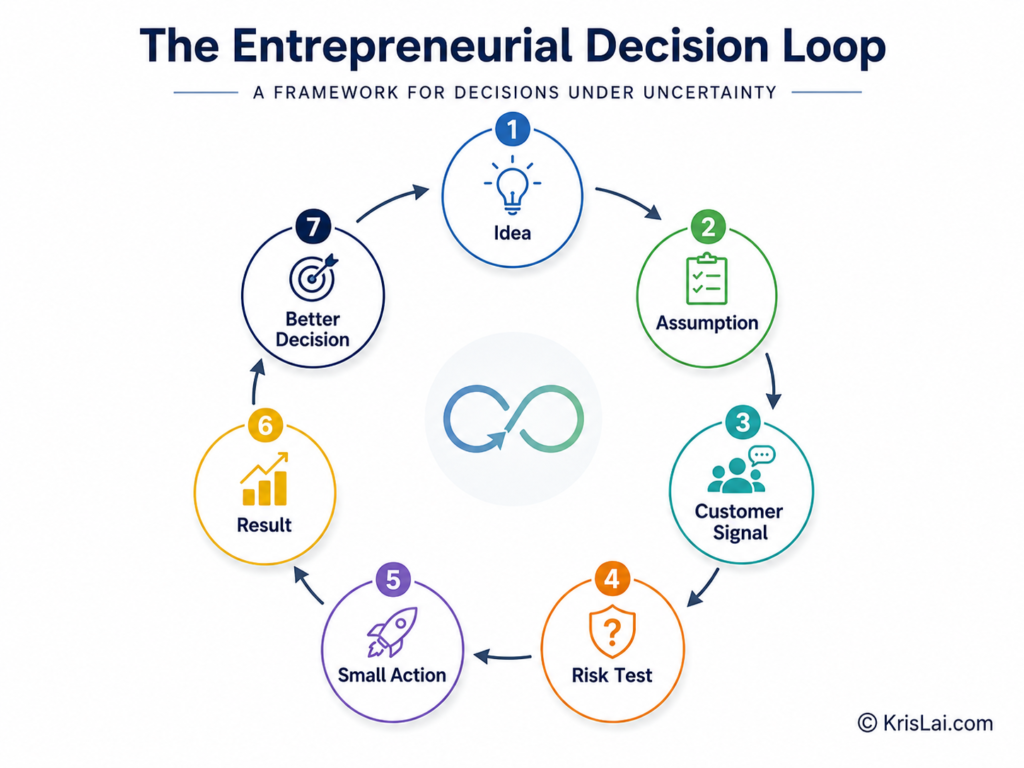
In my experience, entrepreneurs make stronger decisions when they stop treating ideas as fixed plans and start treating them as tests that can be improved by real-world evidence.
Why is decision-making important for entrepreneurs?
Decision-making is important for entrepreneurs because every major choice affects cash, customers, time, reputation, growth, and survival. A weak decision can waste resources quickly. A better decision helps the entrepreneur test assumptions, reduce risk, learn faster, and move with more confidence.
Most entrepreneurs do not fail because they lack passion.
They fail because passion is not a cash-flow strategy.
Enthusiasm helps you start. It does not always help you choose the right customer, price the work properly, manage costs, or decide when to stop pushing an idea that is clearly limping like a shopping trolley with one bad wheel.
Good entrepreneurial decision-making matters because resources are limited.
Small and medium sized businesses often have less room for error than larger firms. A wrong hire, bad loan, poor price, weak supplier, or rushed expansion can cause real pressure.
In my experience, entrepreneurs often face five types of pressure:
- Cash pressure — “Can we afford this?”
- Time pressure — “Do I need to decide now?”
- Customer pressure — “Do people really want this?”
- Emotional pressure — “Am I too attached to this idea?”
- Growth pressure — “Should we scale, or are we just making the problems bigger?”
This is where better thinking becomes a business advantage.
I write about how better decisions are made in business — combining strategy, behaviour, and practical thinking. That matters because real-world strategy is not a poster on a wall. It is the quality of the decisions people make when money, time, customers, and uncertainty are all involved.
How is entrepreneurial decision-making different from normal management?
Entrepreneurial decision-making is different from normal management because entrepreneurs often create something new, while managers usually improve something that already exists. Entrepreneurs face more uncertainty, fewer resources, weaker data, and faster feedback. They must often test, learn, and adapt before the full answer is clear.
Here is a simple comparison:
| Area | Normal management decision | Entrepreneurial decision | Better question |
|---|---|---|---|
| Information | Uses known data | Works with incomplete data | What do we still need to learn? |
| Market | Often stable or familiar | Often unclear or changing | What customer signal proves demand? |
| Goal | Improve an existing process | Create or test a new offer | What must be true for this to work? |
| Risk | Can often be estimated | May be uncertain | What can we afford to lose? |
| Action style | Plan, approve, execute | Test, learn, adjust | What is the smallest useful test? |
This is why entrepreneurial decision-making cannot rely only on a business plan.
A plan is useful. But a plan is not proof.
The market does not care how tidy your spreadsheet looks. Customers do not buy because your forecast has a pleasing font. They buy because your offer solves a problem they care about, at a price they accept, at a moment when they are ready to act.
That is why customer behaviour matters so much.
Over time, I’ve found that good decisions rarely come from data alone. They come from understanding people, reading signals, creating the right environment, and thinking beyond the immediate outcome.
What are the 7 business decisions entrepreneurs should test first?
The seven business decisions entrepreneurs should test first are: whether the problem is worth solving, who the first customer is, what business model to use, how much risk is affordable, whether to build or test, whether to hire or stay lean, and whether to persist, pivot, or stop.
These are high-stakes decisions because they shape the direction of the business.
They also affect each other.
A poor customer decision weakens your pricing decision. A poor pricing decision damages cash flow. Weak cash flow makes hiring risky. A rushed hire adds pressure. Pressure leads to worse decisions. And suddenly, the business owner is wondering why “growth” feels like being chased by a bear wearing a branded polo shirt.
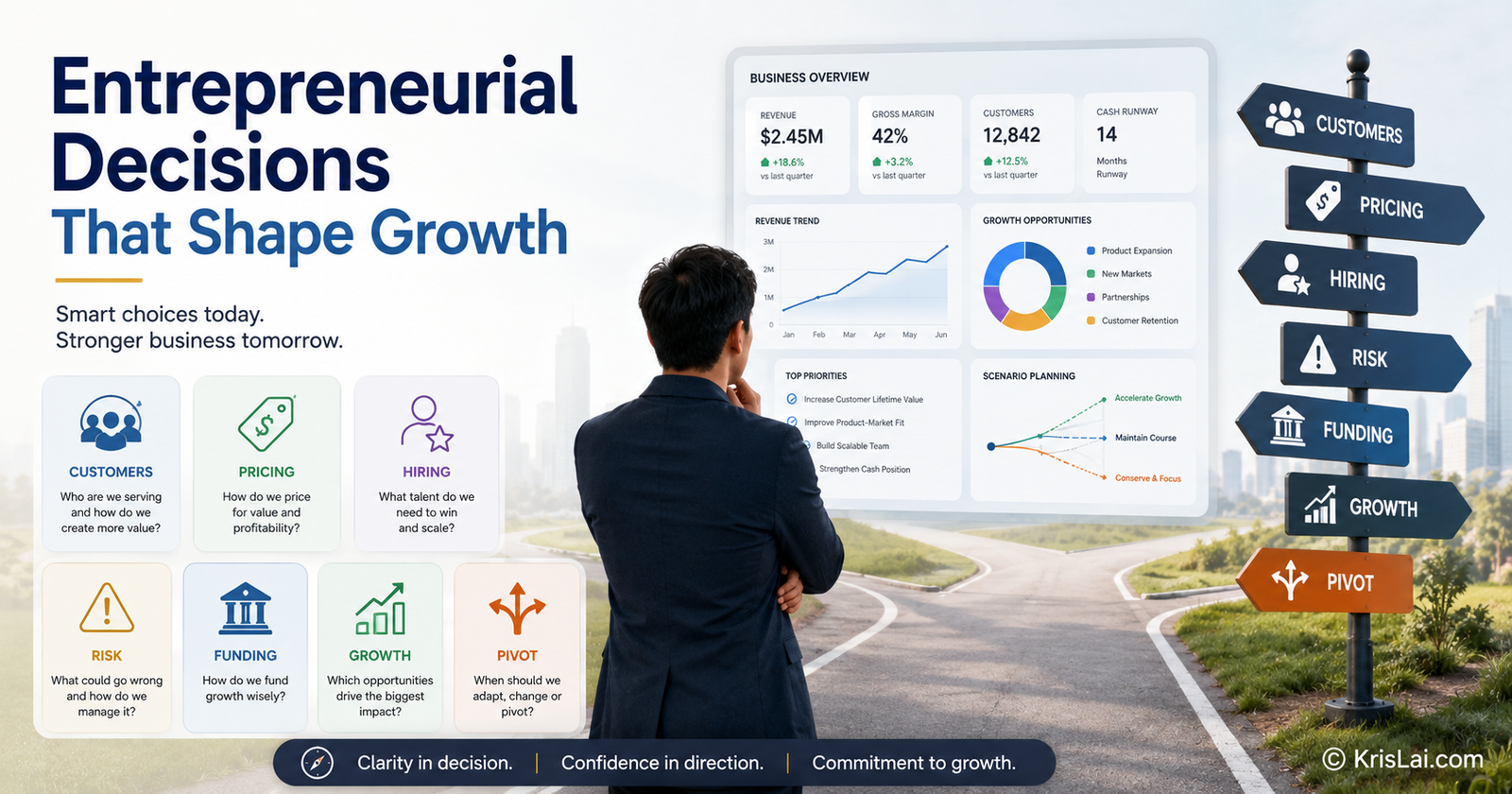
Before going deeper, here is a simple overview of the seven business decisions entrepreneurs should test before committing serious money, time, people, or reputation:
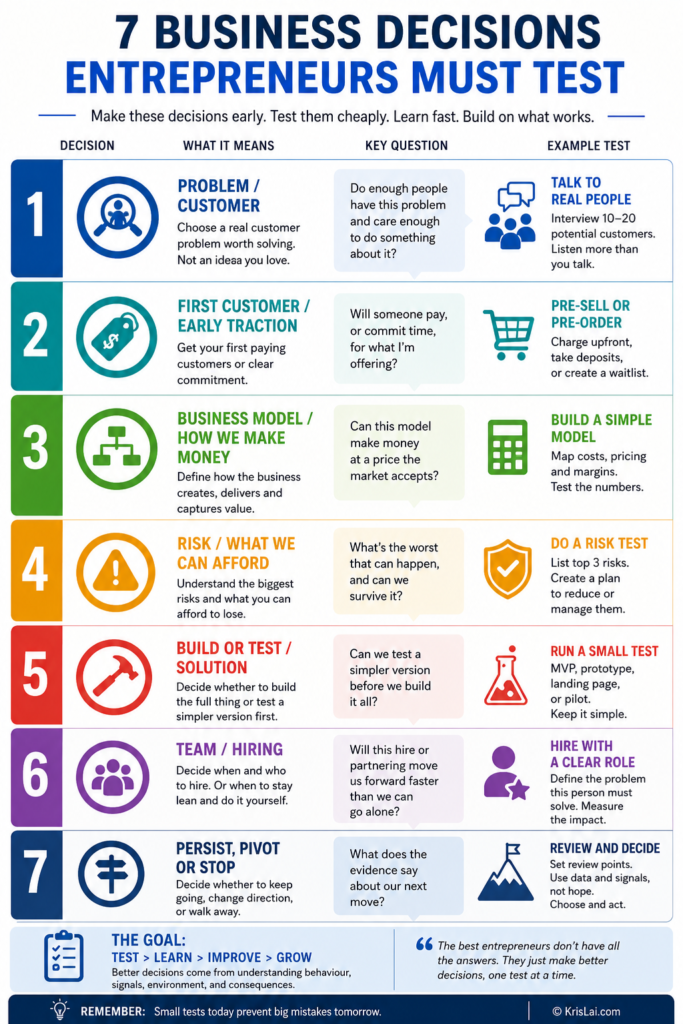
The aim is not to remove risk completely. The aim is to test the right decisions early, learn quickly, and avoid making expensive mistakes from weak assumptions.
Let’s break the seven decisions down…
1. Is this problem worth solving?
Before starting or growing a business idea, test whether the problem is painful, frequent, and important enough for people to pay for a solution. A good idea is not enough. Entrepreneurs need evidence that real customers care, act, and are willing to spend money.
This is one of the most important startup decision-making questions.
Many entrepreneurs begin with an idea they like.
A better starting point is the customer problem.
Ask:
- Who has this problem?
- How often does it happen?
- How painful is it?
- What do people currently do instead?
- Are they already spending money to solve it?
- What happens if they ignore it?
There is a big difference between:
“That sounds interesting.”
and:
“I need this, how soon can you do it?”
The first is polite conversation. The second is a business signal.
In my experience, the danger is mistaking encouragement for demand. Friends and family may support the idea because they like you. That is kind. It is also not market research…
A practical test is simple:
- Speak to 10 potential customers.
- Ask what problem they currently face.
- Ask what they have already tried.
- Ask what the problem costs them.
- Ask what would make them change.
Do not sell too early. Listen first.
This connects closely to customer intent. A business idea becomes stronger when you understand what people are already trying to do.
2. Who is the first customer?
Entrepreneurs should not try to serve everyone at the start. The first customer should be the group with the clearest pain, strongest reason to act, easiest access, and fastest feedback. A focused early customer choice helps the business learn faster and avoid wasting resources.
“Everyone” is not a target market.
It is a panic attack wearing a marketing plan!
When entrepreneurs say their product or service is for everyone, what they often mean is that they have not yet made the customer decision.
That matters because different customers have different needs, budgets, habits, fears, and buying moments.
A cleaning service for offices is not the same as a cleaning service for landlords, schools, retail units, restaurants, warehouses, or medical settings. They may all need cleaning, but the buying signals, standards, urgency, decision-makers, and risks are different.
A good first customer group should have:
- a clear problem
- a strong reason to act now
- enough budget
- easy access for you
- clear buying signals
- fast feedback
For example, a new service business might be tempted to target “local businesses”.
That is too broad.
A better early customer decision might be:
“Small offices with 10–50 staff that need reliable out-of-hours cleaning because complaints have increased.”
That gives you a clearer message, clearer offer, and clearer signal to look for.
This is where behavioural insight matters. People do not buy only because a service exists. They buy because something has changed. A complaint. A deadline. A failed supplier. A new regulation. A cost pressure. A customer expectation.
Those are signals.
3. What business model should we use?
A business idea needs a business model that can make money, deliver value, control costs, and create repeatable profit. Entrepreneurs should test how the business will charge, serve customers, manage delivery, cover costs, and produce cash before assuming the idea can grow.
A good idea can still make a poor business.
This often happens when the offer is attractive, but the model is weak.
For example:
- The price is too low.
- The delivery cost is too high.
- The work takes longer than expected.
- Customers pay too late.
- Repeat work is uncertain.
- The owner becomes the bottleneck.
That is why entrepreneurs need to test the business model, not just the product or service.
Ask:
- How will we make money?
- Will we charge once, monthly, by project, by hour, or by result?
- What does it cost to deliver?
- How quickly do customers pay?
- How much work depends on the founder?
- Can this be repeated without quality dropping?
A simple business model test might include:
- expected sale price
- direct cost
- time needed
- gross margin
- cash timing
- repeat potential
- main delivery risk
The key question is not:
“Can we sell it once?”
It is:
“Can we sell it, deliver it well, get paid, make a profit, and repeat it without breaking the business?”
That is a much better decision question!
4. How much can we afford to risk?
Entrepreneurs should not only ask what they might gain. They should ask what they can afford to lose if the decision is wrong. Affordable risk includes cash, time, stress, debt, reputation, family pressure, and missed opportunities elsewhere in the business.
This is one of the most useful ideas in entrepreneurial decision-making because it brings excitement back down to earth.
And sometimes earth is exactly where the numbers need to be!
A business decision may look attractive because the upside is exciting:
- more customers
- higher revenue
- a bigger team
- a new location
- a better website
- a new product or service
But the better question is not only:
“What could we gain?”
The better question is:
“What happens if this does not work as planned?”
That question can save a small business from a very expensive lesson.
In entrepreneurship research, this is close to the idea of affordable loss. Instead of trying to predict the perfect return, entrepreneurs ask what they can afford to risk while still staying safe enough to continue. Effectuation theory often uses this idea when explaining how entrepreneurs make decisions under uncertainty:
The Five Principles of EffectuationHere is a simple example:
Imagine a small service business is thinking about spending £12,000 on a new van, tools, branding, and local advertising to expand into a nearby town.
The optimistic version sounds good:
- new area
- new customers
- more revenue
- stronger brand
- future growth
Lovely! Put it in a brochure and add a picture of someone pointing at a graph.
But now test the downside.
Ask:
- What if it takes six months to get regular customers?
- What if enquiries come in, but the price is too low?
- What if fuel, insurance, repairs, and wages are higher than expected?
- What if the owner spends too much time managing the new area?
- What if the existing business suffers because attention is split?
- What if the new work is busy but not profitable?
Now the decision is clearer.
The issue is not whether expansion is “good” or “bad”.
The issue is whether the business can afford the test.
A safer version might be:
- test the new area with a rented van for 4 weeks
- run adverts only to one clear customer group
- set a fixed test budget of £1,000
- track enquiries, conversion rate, profit margin, travel time, and payment speed
- only commit to the full investment if the early signals are strong
That is entrepreneurial decision-making in practice.
You are not refusing growth. You are testing whether growth is real before the business pays the full price.
Do not confuse “I can pay for this” with “the business can afford the risk”. A decision may be affordable on day one but still dangerous if it weakens cash flow, distracts the owner, increases debt, or puts pressure on existing customers and staff.
Use this quick affordable risk test before committing:
| Risk area | Question to ask | Example answer |
|---|---|---|
| Cash | How much money can we lose without damaging the business? | We can risk £1,000 on a test, but not £12,000 upfront. |
| Time | How much time can we give this before it hurts existing work? | We can test for 4 weeks without affecting current customers. |
| Reputation | What happens if we cannot deliver the new offer well? | We will test with a small group before promoting it widely. |
| Debt | Can we still repay if sales are slower than expected? | We will avoid finance until the test proves demand. |
| Opportunity cost | What else could this money or time be used for? | Improving existing customer retention may be safer than expansion. |
The final decision question is:
“Can we survive being wrong?”
If the answer is yes, test carefully.
If the answer is no, reduce the risk before you commit.
That may mean starting smaller, delaying the decision, changing the offer, finding a partner, using a contractor, testing with existing customers, or setting a clear stop point.
A brave entrepreneur takes risks.
A wise entrepreneur chooses which risks the business can afford.
5. Should we build, test, or wait?
Entrepreneurs should test the smallest useful version of an idea before spending heavily on building it. This could be a pilot, prototype, landing page, customer interview, pre-order, paid trial, or minimum viable product. The goal is to learn before the cost becomes painful.
This is where many entrepreneurs waste money.
They build too much, too soon.
They invest in branding, websites, equipment, stock, systems, or software before they have enough evidence that customers want the offer!
I understand the temptation. Building feels productive. It gives you something to point at. It feels like progress…
But sometimes “progress” is just spending money with better lighting.
A better approach is to test first.
Depending on the business, that might mean:
- a simple landing page
- a small local pilot
- a trial service with three customers
- a prototype
- a pre-order offer
- a manual version of the service before software is built
- a paid discovery call
- a limited launch to one customer group
The question is:
“What is the smallest test that gives us useful evidence?”
Not the prettiest test.
Not the most impressive test.
The most useful one.
This is also where the scientific approach to entrepreneurship is helpful. Research by Arnaldo Camuffo and colleagues discusses how entrepreneurs can improve decisions by forming hypotheses, testing them, and using evidence to decide whether to continue, pivot, or stop:
A Scientific Approach to Entrepreneurial Decision-MakingIn plain English:
Do not just believe your idea.
Test it!
6. Should we hire, partner, outsource, or stay lean?
Hiring is not just a people decision. It is a cash-flow, workload, quality, trust, culture, and timing decision. Entrepreneurs should test whether the business has enough demand, margin, management time, and repeatable work before adding fixed people costs.
Hiring can be one of the best decisions an entrepreneur makes!
It can also become one of the most expensive mistakes.
The problem is that hiring often feels like the obvious answer when the founder is overloaded.
But being busy does not always mean you should hire.
Sometimes it means:
- your pricing is wrong
- your systems are weak
- you are serving the wrong customers
- you are doing low-value tasks
- your process depends too much on you
Before hiring, ask:
- Is the workload repeatable?
- Is the demand stable?
- Can the business afford the cost for at least 6 months?
- Will this person create capacity or create more management pressure?
- Could we outsource first?
- Could we improve the process before adding people?
- What happens if revenue dips?
This is where small business decision-making needs to be honest.
A new employee is not just a wage.
It is recruitment, training, supervision, equipment, systems, communication, mistakes, management, and responsibility.
That does not mean avoid hiring.
It means test the decision properly.
A good rule is:
Hire when the work is repeatable, profitable, and better done by someone else — not simply because you are tired.
Being tired is real. But it is not always a recruitment strategy.
7. Should we persist, pivot, or stop?
Entrepreneurs should persist when evidence is improving, pivot when the problem is real but the current solution is weak, and stop when the evidence shows the idea is no longer worth the cost. The key is to decide from signals, not pride.
This may be the hardest entrepreneurial decision of all!
Starting is emotional.
Stopping is even more emotional.
No founder enjoys admitting that an idea is not working. But sometimes the best business decision is not to push harder. It is to stop feeding a weak idea and move your resources somewhere better.
The challenge is knowing the difference between a temporary struggle and a failing direction.
Use this simple test:
| Decision | Use when… | Watch out for… |
|---|---|---|
| Persist | Customer interest, sales, feedback, or repeat demand is improving. | Blind optimism and ignoring weak cash flow. |
| Pivot | The problem is real, but the offer, market, price, or delivery model is wrong. | Changing direction every time things feel hard. |
| Stop | The evidence is weak, the cost is rising, and customers are not acting. | Sunk cost thinking: “We’ve already spent too much to stop now.” |
There is a Finnish saying:
“Ei kannata hakata päätä seinään.”It means: “There is no point banging your head against a wall.”
That is good business advice too!
Persistence is valuable when the evidence supports it. When the evidence does not support it, persistence can become expensive stubbornness.
What are the steps in entrepreneurial decision-making?
The steps in entrepreneurial decision-making are: define the decision, name the assumption, check the risk, look for customer signals, compare realistic options, test before committing, and review the consequence. This process helps entrepreneurs avoid guessing and make clearer choices under uncertainty.
Here is a practical seven-step process you can use:
Step 1: Define the decision
Start by naming the actual decision.
Do not begin with a vague problem like:
“We need to grow.”
That is not a decision. It is a wish with better shoes.
Make it specific:
- Should we launch this offer?
- Should we hire another person?
- Should we borrow £30,000?
- Should we raise prices by 10%?
- Should we move into a new location?
A clear decision is easier to test.
Step 2: Name the assumption
Every decision has an assumption behind it.
For example:
- If we hire, sales will support the wage.
- If we launch, customers will buy.
- If we borrow, growth will cover repayments.
- If we raise prices, customers will stay.
Write the assumption down.
This one act can change the quality of your thinking.
Step 3: Check the risk
Ask what could go wrong.
Not because you are negative. Because you are responsible.
Check:
- cash risk
- customer risk
- delivery risk
- people risk
- reputation risk
- time risk
A risk you can name is easier to manage.
Step 4: Look for customer signals
Customer signals are more useful than opinions.
Look for:
- enquiries
- repeat requests
- complaints about existing options
- willingness to pay
- pre-orders
- bookings
- behaviour that shows urgency
Interest is nice.
Action is better.
Step 5: Compare realistic options
Entrepreneurs often compare one exciting option with doing nothing.
That is too narrow.
Instead, compare at least three options:
- do it now
- test it first
- delay or stop
You may also compare:
- hire vs outsource
- borrow vs bootstrap
- launch fully vs run a pilot
- serve everyone vs focus on one customer group
This reduces the risk of false choices.
Step 6: Test before committing
Ask:
“What is the cheapest useful way to test this?”
Examples:
- run a small trial
- test a higher price with new customers
- offer a pilot service
- interview target customers
- build a simple MVP
- test demand before buying stock
- use a contractor before hiring permanently
Testing is not hesitation.
It is disciplined learning.
Step 7: Review the consequence
After the decision, review what happened.
Ask:
- What did we expect?
- What actually happened?
- What surprised us?
- What did customers do?
- What happened to cash flow?
- What should we change next time?
This is how a business gets smarter.
Not from never making mistakes, but from learning properly when reality replies.
A decision is not just a choice. It is a test of what you believe about customers, costs, timing, behaviour, and risk. The stronger your test, the less likely you are to confuse hope with evidence.
Effectuation vs causation: which one should entrepreneurs use?
Entrepreneurs should use causation when the goal is clear and the market is predictable. They should use effectuation when the future is uncertain and they need to act with available means, affordable risk, partnerships, and learning. In real business, both approaches can be useful.
This sounds academic, but the idea is simple:
Causation starts with a goal and asks:“How do we achieve this?”
“What can we do with this?”
Here is the difference:
| Question | Causation | Effectuation |
|---|---|---|
| Starting point | A clear goal | Available means |
| Main question | How do we reach the goal? | What can we do with what we have? |
| Risk approach | Expected return | Affordable loss |
| Market view | The market can be analysed | The market can be shaped |
| Best used when | Conditions are more predictable | Conditions are uncertain |
| SME example | Planning a known service expansion | Testing a new offer with existing customers |
Neither approach is always right.
If you run a stable business and are planning a known expansion, causation helps.
If you are testing a new idea in a changing market, effectuation helps.
Real-world entrepreneurship often needs both: enough planning to stay sensible, enough testing to stay flexible.
How do entrepreneurs make decisions under uncertainty?
Entrepreneurs make decisions under uncertainty by testing assumptions, watching customer behaviour, limiting downside risk, comparing options, using available resources, gathering feedback, and adjusting as evidence changes. The aim is not to predict the future perfectly, but to make the next decision more informed.
Uncertainty is not the same as risk.
Risk is when you can roughly estimate the chance of something happening.
Uncertainty is when you do not know enough yet.
Many entrepreneurs treat uncertainty like a confidence problem. They think they need more courage.
Sometimes they do.
But often they need better tests.
For example:
- If customer demand is uncertain, test demand.
- If pricing is uncertain, test price sensitivity.
- If cash flow is uncertain, model a downside case.
- If hiring is uncertain, try a contractor first.
- If growth is uncertain, run a pilot before expanding.
This is where decision-making under uncertainty becomes practical.
Ask:
- What do we know?
- What do we believe?
- What are we assuming?
- What evidence would change our mind?
- What is the smallest test we can run?
- What is the worst realistic consequence?
A useful Swedish saying is “Lagom är bäst”, which roughly means “the right amount is best”.
That applies well here.
Do not over-plan until nothing moves. Do not under-plan until everything breaks. Find the right amount of testing, evidence, and action for the decision in front of you.
Should entrepreneurs trust intuition or data?
Entrepreneurs should use intuition to notice possibilities and data to test them. Intuition can spot weak signals before they are obvious, but it can also be biased. Data can challenge assumptions, but it can also mislead if it is incomplete, outdated, or badly interpreted.
I do not think entrepreneurs should choose between intuition and data.
That is the wrong argument.
A better approach is:
Use intuition to form a question. Use evidence to test it.
Intuition can be valuable because entrepreneurs often notice patterns before they can explain them. A customer keeps asking the same question. A supplier delay repeats. A competitor changes direction. A staff member raises the same concern twice.
Those may be early signals.
But intuition has a dark side.
It can be affected by:
- overconfidence
- confirmation bias
- fear of missing out
- ego
- sunk cost
- recent success
- pressure from others
Data has its own problems too.
Data can describe the past. It does not always explain the future. It can also look more certain than it really is.
The best entrepreneurial decision-making uses both.
Ask:
- What is my gut telling me?
- What evidence supports it?
- What evidence challenges it?
- What would I believe if this was someone else’s business?
- What would make me change my mind?
That last question is powerful!
If nothing would change your mind, you may not be making a decision. You may be defending a preference.
How can AI help entrepreneurial decision-making?
AI can help entrepreneurs research markets, compare options, summarise feedback, draft financial models, test scenarios, analyse customer questions, and spot patterns. But AI should support human judgement, not replace it. The entrepreneur still owns the assumptions, context, risk, and final decision.
AI is changing how people search, compare, learn, and make business decisions.
That matters for entrepreneurs in two ways.
First, your customers are changing how they search. They may ask Google, ChatGPT, Gemini, Perplexity, Claude, or another AI tool before they ever visit your website. They may compare options faster. They may expect clearer answers. They may be less patient with vague content…
Second, entrepreneurs can use AI as a decision-support tool.
AI can help you:
- summarise customer feedback
- compare competitors
- draft interview questions
- test pricing options
- build simple scenario plans
- spot repeated objections
- create decision checklists
- review risks before committing
But here is the warning:
AI can make weak thinking sound very confident.
It can produce polished answers from poor assumptions. It can summarise without understanding your local market. It can suggest options that look clever but do not fit your cash flow, customers, team, or timing.
That is why AI should help the entrepreneur think, not do the thinking for them.
A simple AI-era decision rule is:
Let AI expand the options. Let evidence test the options. Let judgement make the decision.
This is part of the future of search and the future of business thinking. People will not only search for information. They will search for decisions, comparisons, recommendations, and next steps.
Do not let AI turn uncertainty into false confidence. AI can help you research, compare, and organise thinking, but it cannot know your full business reality unless you challenge its output with evidence, customer signals, and practical judgement.
What this looks like in real business
In real business, entrepreneurial decision-making often appears as a practical choice about customers, cash, capacity, people, or growth. The visible decision may look simple, but the hidden assumptions underneath it can decide whether the business becomes stronger or creates avoidable pressure.
Let’s use a simple example.
A small service business is thinking about buying a second van and hiring another person.
On the surface, the decision looks like growth.
But underneath, several assumptions are hiding:
- There will be enough customer demand.
- The new work will be profitable.
- The new employee will be reliable.
- The owner can manage more people.
- The extra van will be used enough.
- Cash flow will cover wages, fuel, insurance, repairs, and quieter weeks.
That is why the better question is not:
“Should we grow?”
The better question is:
“What must be true for this growth decision to work?”
The business owner could test the decision by:
- checking demand from existing customers
- testing prices on new enquiries
- using a subcontractor before hiring
- hiring a van short-term before buying
- reviewing cash flow under a slower-sales scenario
- setting a stop-loss point before committing fully
That is real-world strategy.
Not a 60-page document. Not a motivational quote on LinkedIn next to a mountain.
A practical decision made with better evidence.
What I’ve seen across different working environments is that waste, risk, and confusion often hide in plain sight. The problem is not always that leaders do not care. It is that they do not stop long enough to test the decision before the cost becomes real.
Where this goes wrong
Entrepreneurial decision-making goes wrong when entrepreneurs fall in love with the idea, ignore weak signals, confuse interest with demand, spend before testing, hire too early, borrow to cover poor margins, or keep going because they have already invested too much to stop.
Here are the most common mistakes I would watch for:
- Confusing praise with demand: “Great idea” does not mean “Here is my money.”
- Building before testing: Spending heavily before customer evidence is dangerous.
- Targeting everyone: A broad customer target makes your message weak.
- Pricing too low: Cheap pricing can create sales and still damage profit.
- Hiring too soon: A new person adds cost, responsibility, and management pressure.
- Ignoring cash timing: Profit on paper does not pay bills if customers pay late.
- Using AI without challenge: A confident answer is not the same as a correct decision.
- Refusing to stop: Sunk cost can make a weak idea more expensive every month.
One of the biggest mistakes is treating all evidence equally.
Customer behaviour is stronger than customer opinion.
A person saying “I would buy that” is useful.
A person paying a deposit is better.
A customer changing supplier is better still.
In decision-making, behaviour beats words.
This is why I keep coming back to behaviour, signals, environment, and consequences. Those four things reveal more than enthusiasm alone.
The KrisLai Decision Framework™ for entrepreneurs
A practical model for better business decisions in complex environments. It focuses on four essential elements:
- Human Behaviour — how people actually think and decide
- Signals — what people are trying to do right now
- Environment — whether the system supports good decisions
- Consequences — what happens next, and after that
Strong decisions consider all four — not just one.
This approach is part of the KrisLai Decision Framework, a practical method for improving business decisions.
For entrepreneurs, the framework works like this:
- Human Behaviour: What are customers, staff, suppliers, competitors, and the founder actually doing?
- Signals: What evidence shows demand, risk, urgency, cash pressure, or traction?
- Environment: What market, financial, operational, and competitive conditions shape the decision?
- Consequences: What happens if the decision works, fails, takes longer, or creates second-order effects?
This connects closely to how I think about decisions more broadly in the KrisLai Decision Framework™.
A business decision is rarely isolated.
A pricing decision affects customer behaviour. A hiring decision affects cash flow. A growth decision affects quality. A funding decision affects freedom. A marketing decision affects the type of customers you attract. And so on.
That is why entrepreneurs need to look beyond the first result.
Better decisions come from understanding behaviour, signals, environment, and consequences.
Practical application: the 30-minute entrepreneur decision test
A practical entrepreneur decision test helps you slow down before committing. The aim is to define the decision, identify the assumption, check the evidence, limit downside risk, and choose the next small action. This gives you clearer thinking without turning every decision into a long project.
Before making a major business decision, use this 30-minute test to slow the decision down, check the assumptions, and choose the next small action with more confidence.
Use this before any major business decision...
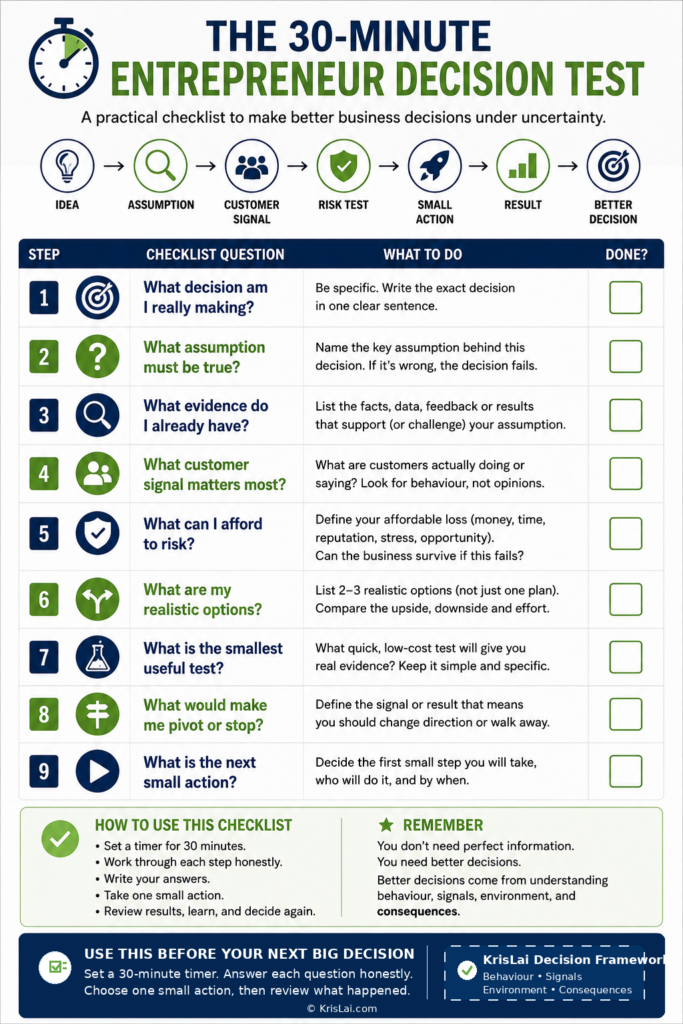
The value of this checklist is simple: it helps you turn a vague business worry into a clear decision, a testable assumption, and one practical next step.
So, set aside 30 minutes and answer these questions:
- What decision am I really making?
Write it in one clear sentence. - What assumption must be true?
Name the belief behind the decision. - What evidence do I already have?
Separate facts from opinions. - What evidence is missing?
Be honest about what you do not know. - What customer signal matters most?
Look for behaviour, not just words. - What can I afford to lose?
Include cash, time, stress, reputation, and opportunity cost. - What are my realistic options?
Compare at least three choices. - What is the smallest useful test?
Find a low-cost way to learn before committing. - What would make me pivot or stop?
Set the rule before emotion gets involved. - What is the next small action?
Choose one practical step.
This is simple, but it is powerful.
It forces the decision out of your head and onto the page.
Once it is on the page, you can challenge it. You can improve it. You can share it with someone you trust. You can stop treating a feeling as if it were a fact.
What you should actually do
Entrepreneurs should test important business decisions before committing heavily. Start by defining the choice, naming the assumption, checking customer signals, reviewing cash impact, comparing options, and running the smallest useful test. Then decide whether to commit, adjust, delay, or stop.
Here is the practical version.
Before you make your next major business decision, do this:
- Write down the decision. If you cannot state it clearly, you are not ready to decide.
- Name the assumption. Every risky decision depends on something being true.
- Check customer behaviour. What are people actually doing, not just saying?
- Review the cash impact. How does this affect money coming in, going out, and timing?
- Compare your options. Do not trap yourself between “do it” and “do nothing”.
- Run a small test. Learn before the cost becomes painful.
- Set a review point. Decide in advance when you will continue, pivot, or stop.
That is entrepreneurial decision-making in practice.
Not theory for the sake of theory.
A working method for making better choices when the answer is not obvious.
This article is based on practical business experience, independent research, and analysis of how entrepreneurs make decisions under uncertainty. It draws on entrepreneurship research, decision-making theory, SME realities, and my own experience of how business choices play out in real operational settings.
People Also Ask
What is entrepreneurial decision-making?
Entrepreneurial decision-making is the process of making business choices when the future is uncertain, information is incomplete, and the outcome is not guaranteed. It involves judgement, evidence, customer signals, risk testing, and the ability to act before every answer is known.
What are the 7 business decisions entrepreneurs must make?
Entrepreneurs should test whether the problem is worth solving, who the first customer is, what business model to use, how much risk they can afford, whether to build or test, whether to hire or stay lean, and whether to persist, pivot, or stop.
How do entrepreneurs make decisions under uncertainty?
Entrepreneurs make decisions under uncertainty by testing assumptions, watching customer behaviour, limiting downside risk, comparing options, gathering feedback, and adjusting as new evidence appears. They do not remove uncertainty completely, but they reduce blind spots before acting.
Should entrepreneurs rely on intuition or data?
Entrepreneurs should use intuition to notice possibilities and data to test them. Intuition can spot early signals, but it can be biased. Data can challenge assumptions, but it can also mislead if it is incomplete or poorly understood.
Can AI help entrepreneurs make better decisions?
AI can help entrepreneurs research markets, compare options, summarise feedback, draft scenarios, and spot patterns. But AI should support judgement, not replace it. The entrepreneur still needs to test assumptions and own the final decision.
Frequently Asked Questions
1. What is entrepreneurial decision-making?
Entrepreneurial decision-making is the process entrepreneurs use to make business choices when information is incomplete and the future is uncertain. It combines judgement, evidence, customer signals, risk awareness, intuition, and practical testing to help business owners make better decisions before committing major resources.
2. Why is decision-making important for entrepreneurs?
Decision-making is important for entrepreneurs because each major choice affects cash flow, customers, time, reputation, growth, and survival. Strong decisions help entrepreneurs reduce risk, test assumptions, learn faster, and avoid wasting money on ideas, hires, products, or strategies that are not ready.
3. How is entrepreneurial decision-making different from normal management?
Entrepreneurial decision-making is different from normal management because entrepreneurs often work with new ideas, uncertain markets, limited resources, and incomplete data. Normal management usually improves existing systems. Entrepreneurs often need to test, learn, adapt, and act before the full answer is clear.
4. What are the 7 business decisions entrepreneurs should test first?
The seven business decisions entrepreneurs should test first are: whether the problem is worth solving, who the first customer is, what business model to use, how much risk is affordable, whether to build or test, whether to hire or stay lean, and whether to persist, pivot, or stop.
5. What are the steps in entrepreneurial decision-making?
The steps in entrepreneurial decision-making are: define the decision, name the assumption, check the risk, look for customer signals, compare realistic options, test before committing, and review the consequence. This process helps entrepreneurs make clearer decisions under uncertainty.
6. What is effectuation in entrepreneurship?
Effectuation is an entrepreneurial approach that starts with available means rather than a fixed goal. Entrepreneurs ask what they can do with their current skills, contacts, resources, and affordable risk. It is useful when the future is uncertain and the market is still forming.
7. How do I know whether to pivot or persevere?
You should persevere when customer evidence, sales, feedback, or repeat demand is improving. You should pivot when the problem is real but your current solution, customer group, price, or delivery model is weak. You should stop when the evidence is poor and the cost keeps rising.
8. Can AI help entrepreneurial decision-making?
AI can help entrepreneurial decision-making by supporting research, competitor analysis, customer feedback summaries, pricing comparisons, scenario planning, and risk reviews. But AI should not replace human judgement. Entrepreneurs still need to check assumptions, understand customers, and make the final decision.
Useful reference sources
- Cambridge University Press: Understanding Entrepreneurial Decision-Making
- Camuffo et al.: A Scientific Approach to Entrepreneurial Decision-Making
- Effectuation.org: The Five Principles of Effectuation
- Duke Entrepreneurship Manual: The Entrepreneurial Process
- Asana: 7 Important Steps in the Decision-Making Process
Related reading on KrisLai.com
If you want to explore this topic further, these related articles connect closely to entrepreneurial decision-making, customer signals, behaviour, uncertainty, and better business judgement:
Conclusion and Final Thoughts: Test the decision before the business pays for it
Entrepreneurial decision-making is not about being fearless.
It is about being clear enough to act without pretending the future is certain.
If you test the problem, customer, business model, risk, offer, hiring choice, and pivot decision before committing too much, you give your business a better chance of growing without avoidable damage.
In my experience, the best entrepreneurs are not the ones who never get things wrong. They are the ones who learn faster, notice signals earlier, and are honest enough to change course when the evidence says so.
That is real-world execution.
That is leadership through better thinking.
And that is why I help people make better business decisions through psychology, strategy, and practical thinking.
Before you make your next major business decision, use the 30-minute entrepreneur decision test to check the assumption, risk, customer signal, cash impact, and next action.
Next step: Download the checklist and use it before your next high-stakes business decision.
Free Download: The KrisLai Decision Framework™
Want a simple, practical guide to making better business decisions under uncertainty?
Enter your email below and I’ll send you the free KrisLai Decision Framework™ guide, a practical model built around behaviour, signals, environment, and consequences.
It is designed to help you think more clearly, spot what matters sooner, and make better decisions in the real world.
If you enjoy exploring the ideas behind better business decisions, you may find the Business Thinking Hub useful.
About the author
Kris Lai is a business operator and managing director with experience in land and building surveying, facilities management, logistics, and service delivery.
Earlier in his career, he worked as a Search Engine Evaluator (via Lionbridge, supporting Google), where he assessed search result relevance, user intent, and content quality using structured evaluation frameworks. This experience gives him a rare, practical understanding of how search systems interpret signals and make ranking decisions.
In parallel, whilst working with a charity organisation, he has delivered 1000’s of structured presentations in English, Finnish, and Chinese to audiences ranging from small groups to more than 600 people, and has spent decades mentoring and developing others. This experience informs his approach to clarity, communication, and decision-making under pressure.
He writes about AI, search behaviour, business strategy, and decision-making from a practical, real-world perspective.
This article contains affiliate links below. If you buy through them, I may earn a commission at no extra cost to you. I only include affiliate links where they are genuinely relevant.


👉 Explore ideas connected to better business decisions:
- Digital Transformation for SMEs: 7 Questions Before You InvestDigital transformation for SMEs should start with better decisions, not more technology. This guide explains seven questions to ask before investing in AI, automation, data systems, or new software, helping you improve processes, reduce risk, and prove value before you scale.
- Cybersecurity for Businesses: 7 Decisions Leaders Must MakeCybersecurity for businesses is not just an IT issue. It is a leadership decision about protecting email, accounts, devices, backups, staff behaviour, customer data, supplier access, trust, and business continuity. This guide explains the seven cyber decisions leaders should make before a small problem becomes a costly incident.
- How AI Is Changing Search Behaviour (And What Businesses Must Do Now)AI is changing how people search, compare, and buy. Learn what this means for visibility, trust, and growth — and what businesses must do now.
- Decision-Making Framework Examples: The KrisLai Method in ActionSee the KrisLai Decision Framework in action with real business examples. Learn how behaviour, signals, environment, and consequences improve decisions.
- The KrisLai Decision Framework: A Better Way to Make Business DecisionsMaster better business decisions with the KrisLai Decision Framework. Learn how behaviour, signals, environment, and consequences shape smarter outcomes.
Similar Posts
Hard Work: The Backbone of Success in Business and Life
Hard work is the key to success. Learn how to balance effort with strategy, overcome challenges, and stay motivated with actionable tips and global insights.
Accounting Software: 7 Critical Decisions Before You Buy
Choosing accounting software is not just a software decision. It affects invoices, expenses, VAT, cash flow, reports, accountant access, migration risk, and better business decisions. This guide explains the 7 critical decisions small businesses should make before buying a tool.
Elevate Your Business: Mastering Marketing and Branding for Success
Unlock the secrets to business success with our comprehensive guide on mastering marketing and branding. Discover effective digital marketing strategies, build a memorable brand identity, enhance customer relationships with CRM, and learn from top brands. Elevate your business today!
Financial Dashboards That Help Leaders Make Better Decisions
Build a financial dashboard that helps leaders spot risk, track performance, and make better decisions with clearer KPIs, trends, and real-time insight.