Crisis management is not only about having a plan. It is about making clear decisions when time is short, information is incomplete, and trust is at risk. This guide explains how leaders can prepare, respond, communicate, recover, and learn from crises without making the situation worse.
Disclosure: If you click on my affiliate/advertiser’s links, I am going to receive a tiny commission. AND… Most of the time, you will receive an offer of some kind. It’ s a Win/Win!
What this article covers
In this article, I explain what crisis management really means, how to prepare before a crisis, what leaders should do during the crisis itself, how to communicate clearly, what mistakes to avoid, and how to recover well afterwards.
I also look at real crisis examples and explain how modern AI, search behaviour, and social media have changed the way organisations need to respond.
This article is based on practical business thinking, independent research, and my own analysis and synthesis of how leadership, communication, behaviour, uncertainty, and decision-making affect crisis outcomes.
A practical model for better business decisions in complex environments. It focuses on four essential elements:
- Human Behaviour — how people actually think and decide
- Signals — what people are trying to do right now
- Environment — whether the system supports good decisions
- Consequences — what happens next, and after that
Strong decisions consider all four — not just one.
A crisis rarely gives leaders the luxury of perfect information.
That is what makes it difficult.
People want answers before all the facts are known. Employees want direction. Customers want reassurance. Suppliers want clarity. The public may want accountability. The media may want a statement. Social media may already be moving faster than the organisation itself.
In real business, the first question is not only:
“What happened?”
It is:
“What decision must be made now, before the damage spreads?”
That is why effective crisis management is not just about writing a document and hoping it works.
It is about preparation, fast communication, flexible thinking, teamwork, and the ability to learn after each event.
A plan matters.
But in a real crisis, judgement matters even more.
Image by freepik
Better decisions come from understanding behaviour, signals, environment, and consequences.
I write about how better decisions are made in business — combining strategy, behaviour, and practical thinking.
Key ideas
- Crisis management is leadership under pressure.
- A crisis is not only an event. It is a decision environment.
- Flexible plans work better than rigid scripts.
- Communication is part of the response, not an afterthought.
- A crisis is not finished until the organisation has recovered, learned, and reduced future risk.

What is crisis management in business?
Crisis management in business means preparing for, responding to, communicating during, recovering from, and learning from serious events that threaten an organisation, its people, customers, operations, reputation, or future.
A crisis may involve:
- a cyberattack
- a product recall
- a serious accident
- a supply chain failure
- a leadership scandal
- a financial shock
- severe weather
- a public relations issue
- a health and safety incident
- major service disruption
- reputational damage
- sudden loss of key staff
- misinformation or public backlash
Some crises are sudden.
Others build slowly.
Some are caused by outside events.
Others are caused by internal weakness, poor judgement, weak systems, or ignored warning signs.
The important point is this:
A crisis is not just something that happens to a business.
It is also something the business must decide through.
Crisis management, in simple terms
Crisis management means preparing for, responding to, communicating during, recovering from, and learning from serious events that threaten a business, its people, customers, operations, reputation, or future.

What is the difference between an incident, an emergency, and a crisis?
The words are often used together, but they are not exactly the same.
An incident is a disruption.
An emergency is a serious situation that needs immediate control.
A crisis is a wider threat to trust, safety, reputation, operations, or the future of the organisation.
For example, a small IT outage may be an incident.
A fire in a workplace may be an emergency.
A major cyberattack that exposes customer data, stops operations, and damages public trust becomes a crisis.
Everbridge makes a useful point here: a crisis is often different from routine emergencies because it contains novelty. The organisation may not have seen that exact threat before, and existing plans may not fully fit the situation.
That is why crisis management requires flexible judgement.
A checklist can help.
But a checklist cannot think for you.
Why crisis management is really a leadership test
A crisis tests what a leader values.
It tests whether they:
- protect people first
- communicate clearly
- admit uncertainty
- act quickly without panicking
- avoid blame too early
- listen to the right signals
- involve the right people
- keep trust in mind
- learn afterwards
In calm times, leadership can sound impressive.
In a crisis, leadership becomes visible.
People notice what leaders do before they notice what leaders say.

What does effective crisis management really look like in 2026?
Effective crisis management in 2026 is flexible, fast, coordinated, and honest. It is not built around one fixed script. It is built around prepared people, clear roles, strong communication, reliable information, and the ability to adapt as the situation changes.
Modern crises move quickly.
Information spreads through:
- internal messages
- customer emails
- WhatsApp groups
- social media posts
- news coverage
- screenshots
- search results
- AI summaries
- review platforms
- employee comments
- supplier updates
That means organisations cannot afford slow confusion.
They need a crisis management approach that can move quickly without becoming careless.
Why flexible plans work better than fixed scripts
A fixed script can be useful for predictable situations.
But real crises are rarely tidy.
Facts change. New information appears. People react emotionally. Systems fail. Stakeholders ask different questions. One issue triggers another.
That is why a crisis plan should not try to predict every possible detail.
It should help people decide well when the details change.
A strong plan answers:
- who leads?
- who communicates?
- who gathers facts?
- who contacts staff?
- who contacts customers?
- who speaks publicly?
- who approves messages?
- who keeps a record of decisions?
- what must happen first?
- what gets escalated?
- what happens if key people are unavailable?
Protecht’s crisis management guide describes mature crisis management as integrating planning, response, recovery, and learning, supported by governance, roles, escalation pathways, scenario planning, simulations, and communication protocols.
That is the right direction.
Not a rigid script.
A decision framework people can actually use under pressure.
The four stages that keep responses organised
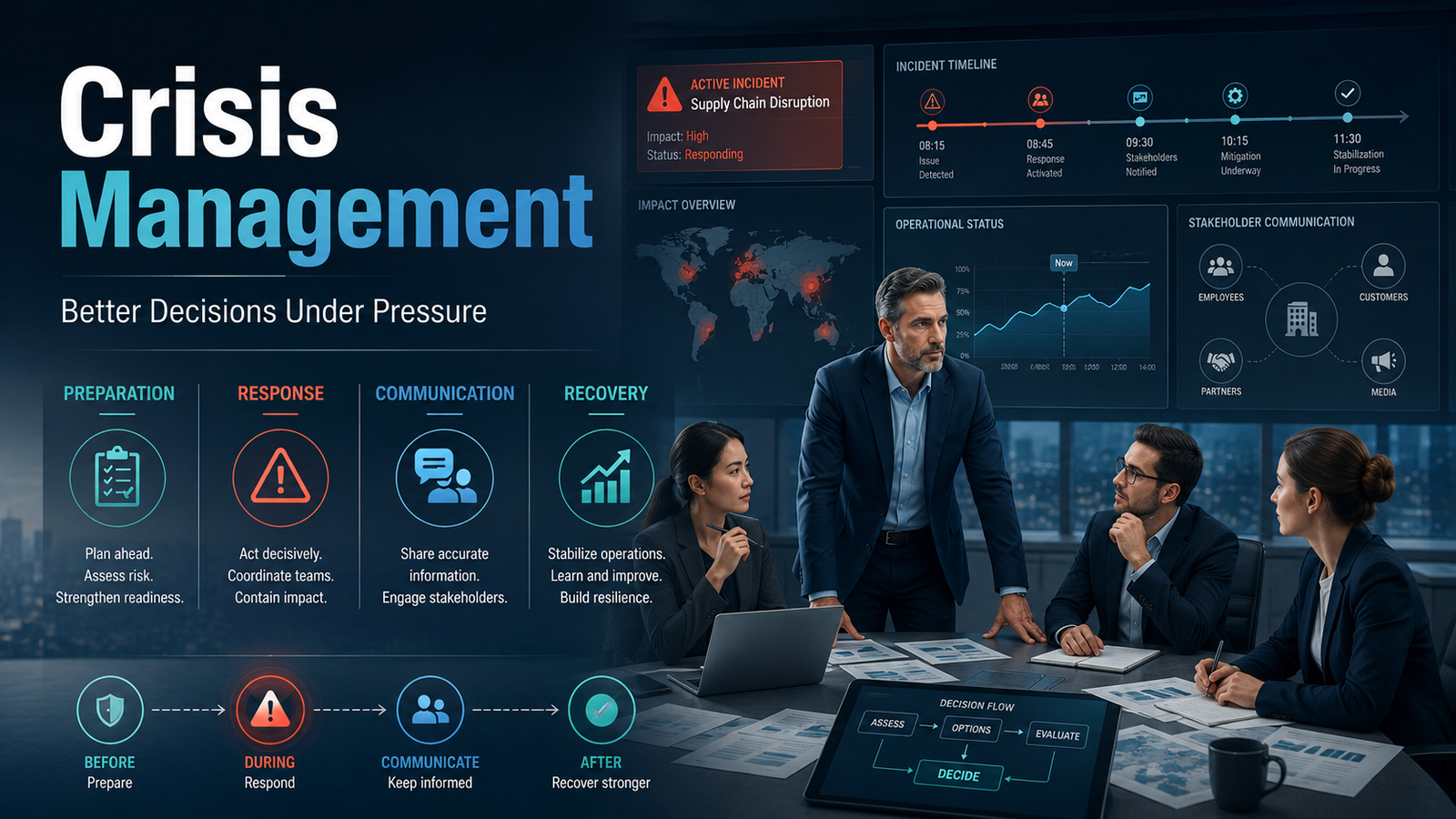
A simple way to think about crisis management is in four stages:
- Preparation — what you do before anything goes wrong
- Response — what you do when the crisis is happening
- Recovery — how you restore operations, trust, and stability
- Learning — how you improve before the next crisis
This structure helps because it stops crisis management becoming only a reaction.
A business that only starts thinking during the crisis is already late!
How do you prepare before a crisis starts?
You prepare for a crisis by identifying likely risks, setting clear roles, planning communication, testing the plan, and keeping the process alive. Preparation is not a one-off document. It is a regular discipline that improves how people respond when pressure arrives.
Good preparation does not remove uncertainty.
But it reduces confusion.
Queen Margaret University’s crisis planning guidance makes the practical point that businesses should evaluate potential risks, vulnerabilities, and possible responses before unexpected events happen.
That sounds obvious.
But many organisations only discover weak spots once the crisis has already begun.
Map risks, weak points, and likely scenarios
Start by asking:
“What could seriously disrupt us?”
Examples include:
- cyber incidents
- supplier failure
- severe weather
- financial pressure
- data breaches
- key staff absence
- health and safety incidents
- customer harm
- public complaints
- product defects
- workplace conflict
- operational failure
- regulatory issues
- negative media attention
Then ask:
- How likely is this?
- How serious would it be?
- Who would be affected?
- What would fail first?
- What warning signs might appear?
- What would we need to do quickly?
- Who outside the business would need to be involved?
This is not about being gloomy.
It is about being realistic.
As the Finnish saying goes, vara on viisautta — preparation is wisdom.
Set clear roles, decision lines, and backup contacts
During a crisis, unclear roles waste time.
People need to know:
- who leads the response
- who gathers facts
- who contacts employees
- who contacts customers
- who talks to suppliers
- who speaks publicly
- who handles legal or regulatory issues
- who approves statements
- who keeps records
- who takes over if key people are unavailable
Park University’s crisis communication guidance recommends establishing a crisis communication team with clear roles from areas such as leadership, PR, legal, HR, operations, IT, security, or customer service, depending on the organisation.
For small businesses, this may be much simpler.
But the principle is the same.
Do not wait until the crisis to decide who is responsible!
Run realistic drills and stress tests regularly
A crisis plan that has never been tested is only a theory.
Drills can reveal:
- missing contact details
- unclear decision authority
- slow escalation
- weak communication channels
- poor backup plans
- unrealistic assumptions
- gaps between departments
- overdependence on one person
- confusion about what to say publicly
A useful drill does not need to be dramatic.
It can be a simple tabletop exercise:
“What would we do if our main supplier failed tomorrow?”
“What would we do if customer data was exposed?”
“What would we do if a serious complaint went viral?”
“What would we do if a senior leader was suddenly unavailable?”
The point is not to embarrass anyone.
The point is to learn before the stakes are real.
Crisis preparation checklist
- Identify likely risks before they become urgent.
- Name the crisis team and define decision roles.
- Create escalation routes so people know when to act.
- Prepare stakeholder contact lists for fast communication.
- Draft holding statements before emotions are high.
- Practise scenarios so the plan is not just a document.

What should leaders do during the crisis itself?
During a crisis, leaders should stabilise the situation, gather facts quickly, communicate early, coordinate the right people, and make clear decisions using the best available information. Waiting for perfect certainty can be dangerous, but acting without structure can make the crisis worse.
The first few hours matter.
They shape:
- trust
- confidence
- media tone
- employee behaviour
- customer reaction
- legal exposure
- operational control
- reputational damage
A slow response can make people think the organisation is hiding something.
A rushed response can spread inaccurate information.
The aim is not to look perfect.
The aim is to be calm, clear, honest, and useful.
Activate the crisis team and gather facts fast
The crisis team should come together quickly.
Their first job is not to argue about reputation.
It is to understand the situation.
Ask:
- What has happened?
- Who is affected?
- Is anyone at risk?
- What is still happening?
- What do we know?
- What do we not know?
- What assumptions are being made?
- What must be done immediately?
- Who needs to be told now?
- What could get worse if we delay?
This is where leaders must separate facts from assumptions.
A simple crisis board can help:
- Known facts
- Likely assumptions
- Unknowns
- Immediate actions
- Decisions needed
- Next update time
That structure prevents panic from driving the response.
Communicate early, clearly, and through more than one channel
In a crisis, communication should be early, calm, and repeated.
You may not have all the answers.
But you can still say:
- what you know
- what you do not know yet
- what you are doing now
- who is affected
- what people should do
- when the next update will come
Use more than one communication channel where needed:
- text
- phone calls
- internal messaging apps
- website updates
- customer notices
- social media
- press statements
- supplier calls
- manager briefings
If one channel fails, another may still work.
Park University’s guidance also stresses internal communication, noting that employees need accurate information because they may be answering questions from customers, partners, and the public.
This is easy to underestimate.
Staff should not learn about a serious business crisis from social media before they hear it from leadership.
Work with outside partners, authorities, and key stakeholders
A crisis does not always stay inside the organisation.
Depending on the situation, you may need to coordinate with:
- emergency services
- local authorities
- regulators
- insurers
- legal advisers
- suppliers
- landlords
- IT providers
- PR advisers
- community partners
- industry bodies
- customers
- investors
One common mistake is leaving out a stakeholder who should have been informed early.
That gap can create a second problem.
In real business, crisis management is not only about what your internal team knows.
It is also about who else needs to act, approve, respond, or support.

How should leaders make decisions during a crisis?
Leaders should make crisis decisions by protecting people first, separating facts from assumptions, deciding what must happen now, and reviewing the response as new signals appear. A crisis creates pressure, but pressure should not be allowed to replace judgement.
This is the most important part of crisis management.
A crisis is not only an event.
It is a decision environment.
Time is compressed. Emotions are high. Information is incomplete. Consequences are real.
That is why the KrisLai Decision Framework™ fits crisis management so well.
The KrisLai Crisis Decision Lens™
- Behaviour – what are people doing, saying, avoiding, or misunderstanding?
- Signals – what evidence shows the crisis is growing, stabilising, or changing?
- Environment – what pressures, rules, emotions, channels, and constraints shape the response?
- Consequences – what happens if we act now, wait, say too much, say too little, or choose the wrong priority?
In a crisis, better decisions come from reading the situation quickly without pretending you know more than you do.
First, stabilise the situation
The first priority is usually harm reduction.
That may mean:
- protecting people
- stopping further damage
- isolating a system
- removing a dangerous product
- contacting emergency services
- securing a location
- pausing operations
- informing affected customers
- preventing misinformation
- stopping further exposure
Do not start with reputation management before safety, facts, and containment!
Reputation is important.
But in a serious crisis, reputation is often protected by doing the right thing first.
Separate facts, assumptions, and unknowns
This is one of the most useful crisis habits.
Do not let assumptions become facts simply because people are worried.
Ask:
- What do we know?
- How do we know it?
- What are we assuming?
- What is still unclear?
- Who can verify this?
- What would change our decision?
- What must be checked before we say it publicly?
This matters because early crisis information is often incomplete.
A leader who pretends to know everything may sound confident at first.
But if the facts change, that false confidence can damage trust.
Decide what must happen now, next, and later
A crisis can feel overwhelming because everything seems urgent.
Separate the timing.
Now: reduce harm and stabilise the situation.
Next: communicate, coordinate, and contain wider damage.
Later: recover, review, repair, and improve.
This prevents the team from trying to solve every part of the crisis at once.
It also helps people know what matters most.
Avoid decision traps under pressure
Crisis pressure creates traps.
Watch for:
- denial
- blame
- panic
- silence
- false certainty
- overconfidence
- defensive communication
- waiting too long
- saying too much too early
- making promises before facts are known
What I have seen in practice is that many crisis mistakes do not come from bad intentions.
They come from rushed judgement, unclear roles, emotional pressure, or fear of reputational damage.
That is why decision discipline matters.
Use signals to update the response
A crisis response should adapt as the situation changes.
Useful signals include:
- employee reports
- customer complaints
- supplier updates
- regulator feedback
- media questions
- social media sentiment
- operational data
- website search queries
- call centre volume
- legal advice
- safety reports
Signals help you see whether the crisis is growing, stabilising, or changing shape.
Ignoring signals is dangerous.
So is chasing every signal without judgement.
The leader’s job is to decide which signals matter.
What should a crisis communication strategy include?
A crisis communication strategy should include a clear spokesperson, accurate stakeholder lists, internal updates, holding statements, approved channels, regular update times, and simple messages that explain what is known, what is not known, what is being done, and what happens next.
Crisis communication is not an add-on.
It is part of the response.
Poor communication can become a second crisis.
Communicate early, even if you do not have every answer
Early does not mean reckless.
It means timely.
You can say:
“We are aware of the issue.”
“We are investigating.”
“Our first priority is safety.”
“We will provide another update at 4pm.”
“We are contacting affected customers directly.”
“We do not yet have all the facts, but this is what we know so far.”
That is better than silence.
Silence creates a vacuum.
In a crisis, that vacuum is usually filled by fear, rumours, screenshots, speculation, or misinformation.
A simple crisis communication rule
Say what you know, say what you do not know yet, say what you are doing now, and say when people can expect the next update.
Silence creates a vacuum. In a crisis, that vacuum is often filled by fear, rumours, screenshots, speculation, or misinformation.

Tell employees before they hear it elsewhere
Internal communication matters.
Employees may need to:
- answer customer questions
- pause certain work
- follow safety instructions
- support worried colleagues
- avoid sharing inaccurate information
- direct people to the right contact
- explain what happens next
Give staff clear guidance.
Do not leave them guessing.
A confused workforce creates inconsistent external messages.
Use one clear spokesperson and one source of truth
A crisis needs message discipline.
That does not mean hiding information.
It means avoiding confusion.
One clear spokesperson or response lead should coordinate public messaging.
One source of truth should be maintained internally.
This might be:
- a live internal document
- an incident dashboard
- a shared update log
- a crisis management platform
- a central leadership update
The format matters less than the discipline.
People need to know where the latest approved information lives.
Be honest, calm, and specific
Good crisis communication avoids:
- vague reassurance
- blame-shifting
- defensiveness
- overpromising
- jargon
- emotional coldness
- speculation
- disappearing when questions get difficult
A better message is clear and human.
It explains:
- what happened
- who is affected
- what is being done
- what people should do
- when the next update will come
- where to get reliable information
Correct misinformation quickly
In 2026, misinformation can spread fast.
A screenshot, rumour, edited clip, or misleading summary can shape public perception before the organisation responds.
That is why organisations need to monitor:
- social media
- customer emails
- search behaviour
- review platforms
- media questions
- internal rumours
- AI-generated summaries where relevant
Correction should be clear and factual.
Do not argue emotionally.
Do not mock people for being concerned.
State the accurate position and point people to the right source.
What are the most common crisis management mistakes?
The most common crisis management mistakes are denial, slow communication, unclear decision roles, poor internal coordination, defensive messaging, ignoring stakeholders, treating communication as separate from operations, and failing to learn after the crisis.
These mistakes are common because crises create pressure.
But pressure does not excuse poor judgement.
Denying the problem for too long
Denial is one of the most dangerous crisis responses.
It often appears as:
- “This is not serious.”
- “It will blow over.”
- “Nobody will notice.”
- “We do not need to tell people yet.”
- “This is only a small issue.”
- “It is not our fault.”
Sometimes a problem really is small.
But denial stops leaders from checking properly.
Katten’s crisis management paper warns that organisations can be affected by blindness and denial, especially when overconfidence prevents proper preparation.
The earlier a serious issue is recognised, the more options the organisation usually has.
Waiting until all facts are known before saying anything
You should not speculate.
But you also should not disappear.
There is a middle ground.
You can communicate the process before every answer is known.
For example:
“We are investigating the cause.”
“We have paused the affected service while checks are completed.”
“We are contacting customers who may be affected.”
“We will update again by 5pm.”
That gives people something reliable.
Letting legal caution remove human empathy
Legal advice matters.
But crisis communication that sounds cold can make people feel ignored.
A good response needs both:
- accuracy
- humanity
You can be careful and still show concern.
You can avoid speculation and still acknowledge impact.
You can protect the organisation and still speak like a human being.
Failing to coordinate internal and external messages
If customers hear one thing, staff hear another, and suppliers hear a third version, trust falls quickly.
Coordination matters.
Before sending updates, check:
- are staff briefed?
- is customer service ready?
- has the website been updated?
- do managers know what to say?
- are suppliers informed?
- has the spokesperson got the latest facts?
- has the message been approved?
Mixed messages create confusion.
Confusion increases pressure.
Treating the crisis as over too soon
A crisis may stop making headlines before the real work is finished.
There may still be:
- staff fatigue
- customer concern
- operational weakness
- legal follow-up
- supplier disruption
- reputation damage
- process changes needed
- training gaps
- emotional impact
Do not declare victory too early.
Recovery takes time.
What I’ve seen go wrong
What I’ve seen go wrong is leaders treating a crisis as only a communication problem or only an operational problem. In real business, a crisis is both. If the response is operationally weak, words will not save it. If communication is poor, even good action may be misunderstood.

What are real examples of effective and poor crisis management?
Real crisis examples show that the best crisis responses usually protect people first, communicate clearly, act decisively, and learn afterwards. Poor responses often involve delay, defensiveness, blame, weak communication, or underestimating the human impact.
Here are several well-known examples and the decision lessons they offer:
Johnson & Johnson Tylenol recall — protect people first
In 1982, seven people died after cyanide-laced Tylenol capsules were placed on shelves in the Chicago area (Time). Johnson & Johnson’s response became a widely taught crisis management example because the company warned the public, stopped production and advertising, and issued a nationwide recall of Tylenol products.
The lesson is simple:
When safety is at stake, protect people first.
Short-term cost matters.
But trust matters more.
KFC UK chicken shortage — take responsibility in the right tone
In 2018, KFC suffered a major UK supply disruption that left many restaurants without chicken. Its famous “FCK” apology campaign was widely praised because it acknowledged the problem, used a tone that fitted the brand, and did not pretend the situation was acceptable. Campaign Live described the apology ad as a clever response that turned “marketing mayhem” into a notable campaign.
The lesson is not “make jokes in a crisis.”
That would be too simple.
The lesson is:
Tone matters, but only when responsibility is clear.
Humour can work in some brand crises.
It will not work if people are harmed, ignored, or misled.
Samsung Galaxy Note 7 — act decisively when product safety is at stake
Samsung’s Galaxy Note 7 crisis involved battery defects that caused some devices to overheat, catch fire, or explode. Samsung eventually discontinued the product, and later identified battery defects linked to two battery suppliers. (Source: Wired)
The lesson is:
When product safety is involved, speed, clarity, and decisive action matter.
A slow or uncertain response can increase risk and damage trust.
BP Deepwater Horizon — poor communication can deepen reputational harm
The 2010 Deepwater Horizon disaster was an operational, environmental, legal, and reputational crisis. BP faced heavy criticism not only for the disaster itself, but also for parts of its communication response. The Guardian reported that BP’s response at times made the situation worse, including attempts to shift blame early in the crisis.
The lesson is:
In a serious crisis, defensiveness can deepen reputational damage.
People look for responsibility, competence, and human concern.
If they see blame-shifting instead, trust falls.
Cyberattacks and data breaches — speed, clarity, and customer protection matter
Cyber crises are now one of the most important modern crisis categories.
If customer data is affected, people want to know:
- what happened
- what information is involved
- what action they should take
- whether systems are safe
- when updates will follow
- who they can contact
A vague statement is not enough.
A cyber crisis needs operational response, legal care, customer support, and clear communication.
How does AI and search behaviour change crisis management?
AI and search behaviour change crisis management because public understanding now forms through search results, social posts, screenshots, reviews, AI summaries, and rapid online discussion. A crisis is no longer only what happened. It is also what people can find, share, summarise, and believe about what happened.
This is now part of the business reality.
People do not wait for the official statement before forming an opinion.
They search.
They share.
They screenshot.
They ask AI tools.
They read reviews.
They compare statements.
They watch how employees and customers speak publicly.
That means unclear communication can travel far beyond the original audience.
A crisis now spreads through search, social, screenshots, and AI summaries
In the past, a business might have had more time to control the message.
Today, the information environment moves quickly.
A crisis may appear in:
- Google results
- AI search summaries
- LinkedIn posts
- X posts
- TikTok videos
- Reddit threads
- customer reviews
- WhatsApp screenshots
- local news
- employee comments
- competitor comparisons
That means the public record matters.
Your first statements, corrections, apologies, updates, and actions may be found long after the immediate crisis has passed.
AI can help monitor signals, but it cannot own the response
AI can help with:
- summarising public feedback
- grouping customer concerns
- drafting internal updates
- preparing scenario responses
- tracking repeated questions
- analysing large volumes of messages
- identifying themes in complaints
- preparing first-draft FAQs
But AI cannot take responsibility.
It cannot judge the full human context.
It cannot decide whether an apology sounds sincere.
It cannot understand every legal, cultural, operational, or emotional consequence.
AI can support the crisis team.
It should not replace leadership judgement.
In a crisis, clarity becomes part of reputation
In an AI-shaped search environment, vague statements are risky.
People and systems summarise what is available.
If the organisation is unclear, others may define the story for it.
That does not mean saying everything before facts are checked.
It means being clear about:
- what is known
- what is unknown
- what is being done
- where people should go for updates
- when the next update is expected
Clarity protects trust.
Confusion damages it.

How do you recover well and come back stronger?
You recover well from a crisis by restoring stability, supporting affected people, reviewing what happened, repairing trust, updating the plan, and turning lessons into stronger systems. Recovery is not just returning to normal. It is improving what normal should be.
The end of the immediate event is not the end of crisis management.
Recovery should include both practical and human work.
Review what worked, what failed, and what needs to change
Hold an after-action review.
Ask:
- When did we first notice the signal?
- Did we escalate quickly enough?
- Were roles clear?
- Did people know who was leading?
- Did communication work?
- Who lacked information?
- Which decision was delayed?
- Which assumption was wrong?
- What created confusion?
- What should change before next time?
The tone should be honest, not blaming.
Blame closes learning.
Accountability improves it.
Support staff, customers, and affected communities
A crisis can leave people tired, anxious, angry, or uncertain.
Recovery may need:
- staff debriefs
- mental health support
- customer follow-up
- community engagement
- practical assistance
- compensation where appropriate
- clear updates
- leadership presence
- honest acknowledgement of impact
A business may repair the system and still fail to repair trust.
Both matter.
Use lessons learned to improve resilience for next time
Recovery should lead to improvement.
That may include:
- better training
- clearer roles
- stronger systems
- improved backup plans
- updated contact lists
- better supplier arrangements
- stronger cyber controls
- clearer communication templates
- more realistic scenario planning
- improved decision records
Protecht’s crisis management guidance includes recovery and learning as part of mature crisis management, not just initial response.
That is important.
A crisis should teach the organisation something.
Share lessons with partners where useful
Sometimes the lesson is not only internal.
If suppliers, local authorities, community partners, industry groups, or customers were involved, sharing useful lessons can strengthen wider resilience.
That does not mean sharing sensitive details carelessly.
It means recognising that crises often involve networks, not isolated organisations.
A business that learns with its partners may be stronger next time.
Crisis recovery question
After the immediate pressure passes, ask this: what did this crisis reveal about our people, systems, communication, assumptions, and decision-making?
The answer is where real resilience begins.
Final thought: crisis management is leadership under pressure
Effective crisis management is built on preparation, fast communication, flexible thinking, and learning after the event.
The plan matters.
The people matter more.
In a real crisis, leaders rarely have all the information they want. They must work with incomplete facts, emotional pressure, public scrutiny, operational disruption, and real consequences.
That is why crisis management is such a strong test of decision-making.
A good organisation prepares before pressure arrives.
A good leader communicates before silence becomes damaging.
A good crisis team separates facts from assumptions.
A good recovery process turns pain into learning.
And a good business does not simply ask:
“How do we get through this?”
It asks:
“What must we understand, fix, and strengthen so that we are better prepared next time?”
A crisis does not only test what a business has written in its plan.
It tests how clearly its leaders think when the plan is no longer enough.
Final takeaway
Crisis management works best when leaders prepare early, communicate clearly, act with judgement, and learn afterwards. The goal is not to predict every crisis perfectly. The goal is to build the people, systems, and decision habits that help the business respond well when pressure arrives.

Related reading on KrisLai.com
- Related article: Decision Prioritisation
- Glossary or definition article: Problem-Solving in Business
- Pillar topic: Business Thinking Hub
- Scenario Planning in Business
- Emotional Intelligence in Leadership
- Leadership Skills in Business
- Psychological Safety at Work
If you enjoy exploring the ideas behind better business decisions, you may find the Business Thinking Hub useful.
Frequently Asked Questions About Crisis Management
What is crisis management?
Crisis management means preparing for, responding to, communicating during, recovering from, and learning from serious events that threaten a business, its people, customers, operations, reputation, or future.
What should a crisis management plan include?
A crisis management plan should include likely risks, crisis team roles, decision authority, escalation routes, stakeholder contact lists, communication channels, holding statements, recovery steps, and review processes.
What is the first thing leaders should do in a crisis?
The first thing leaders should do is stabilise the situation. That usually means protecting people, reducing immediate harm, gathering facts, activating the crisis team, and deciding what must happen now.
Why is crisis communication important?
Crisis communication is important because silence, confusion, or mixed messages can damage trust. Clear communication helps employees, customers, suppliers, and other stakeholders understand what is happening and what they should do next.
What are common crisis management mistakes?
Common crisis management mistakes include denial, slow communication, unclear roles, poor internal updates, defensive messaging, waiting too long for perfect information, and treating the crisis as over too soon.
How can businesses recover after a crisis?
Businesses recover after a crisis by restoring operations, supporting affected people, communicating clearly, reviewing what happened, repairing trust, updating the crisis plan, and turning lessons into stronger systems.
How does AI affect crisis management?
AI can help crisis teams monitor signals, summarise feedback, draft updates, and prepare scenarios. But AI cannot replace human judgement, responsibility, empathy, or leadership during a serious crisis.

Stop guessing, start growing: Unlock actionable Shopify insights with Sirge and get 20% Off.
About the author
Kris Lai is a business operator and managing director with experience in land and building surveying, facilities management, logistics, and service delivery.
Earlier in his career, he worked as a Search Engine Evaluator (via Lionbridge, supporting Google), where he assessed search result relevance, user intent, and content quality using structured evaluation frameworks. This experience gives him a rare, practical understanding of how search systems interpret signals and make ranking decisions.
In parallel, whilst working with a charity organisation, he has delivered 1000’s of structured presentations in English, Finnish, and Chinese to audiences ranging from small groups to more than 600 people, and has spent decades mentoring and developing others. This experience informs his approach to clarity, communication, and decision-making under pressure.
He writes about AI, search behaviour, business strategy, and decision-making from a practical, real-world perspective.

👉 Explore ideas connected to better business decisions:
- Digital Transformation for SMEs: 7 Questions Before You Invest
- Cybersecurity for Businesses: 7 Decisions Leaders Must Make

- How AI Is Changing Search Behaviour (And What Businesses Must Do Now)
- Decision-Making Framework Examples: The KrisLai Method in Action
- The KrisLai Decision Framework: A Better Way to Make Business Decisions