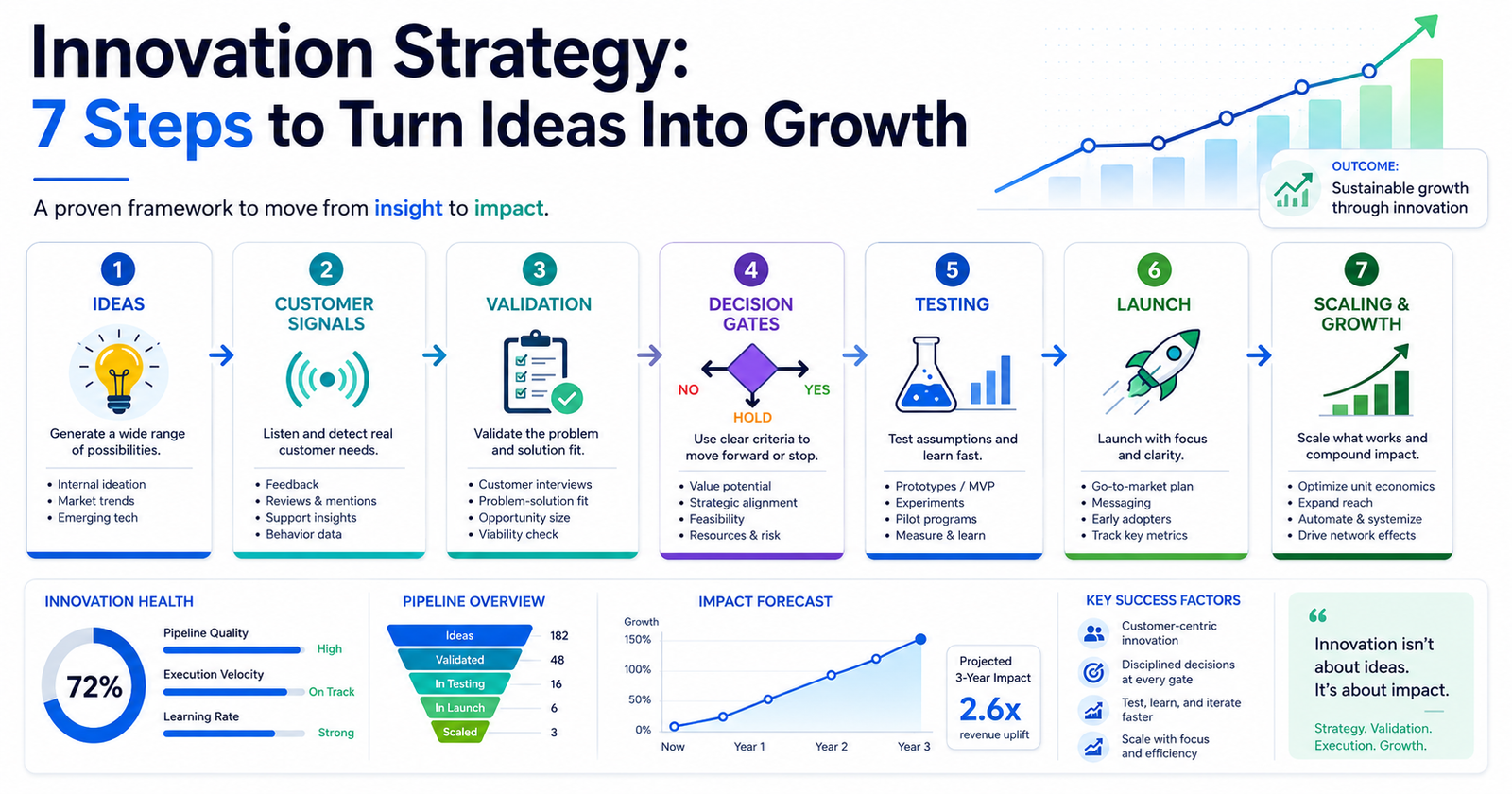
Innovation strategy helps businesses decide which ideas to create, test, fund, launch, improve, or stop. Used well, it connects customer needs, business goals, technology change, team behaviour, and evidence so leaders can turn better ideas into growth without wasting time, money, or attention.
This article explains what innovation strategy means, why ideas are not enough, how to build an innovation framework, how to create the right culture, how to validate ideas, how disruption changes business models, and how leaders can make better innovation decisions under uncertainty.
It also covers:
- what innovation strategy is
- why innovation strategy matters
- innovation strategy vs business strategy
- innovation strategy vs innovation process
- how to create an innovation strategy
- idea generation and idea validation customer validation
- MVP and prototyping
- business model innovation
- disruptive innovation
- innovation culture
- innovation metrics
- AI and changing search behaviour
- what this looks like in real business
- where innovation strategy goes wrong
- what leaders should actually do next
- Innovation strategy is not about collecting ideas. It is about deciding which ideas deserve testing, funding, launching, scaling, or stopping.
- A business does not need more ideas if it cannot decide which ideas matter.
- The best innovation strategies connect customer needs, business goals, evidence, technology change, and leadership judgement.
- Good innovation is not random creativity. It is disciplined learning under uncertainty.
- The aim is to turn useful ideas into better decisions, better customer value, and sustainable growth.
What is innovation strategy?
Innovation strategy is a practical plan for deciding which ideas a business should create, test, fund, launch, improve, or stop so innovation supports real business goals.
That matters because ideas are easy.
Useful ideas are harder.
Useful ideas that customers care about, the business can deliver, and leaders are willing to fund are harder still.
Innovation strategy helps answer simple but important questions:
What problem are we trying to solve?
Who is the customer?
What evidence do we have?
What should we test first?
What should we fund?
What should we stop?
What should we scale?
Without those questions, innovation can become a very expensive hobby.
And most small and mid-sized businesses do not need expensive hobbies. They already have enough bills!
Innovation strategy is a clear plan for how a business chooses, tests, funds, launches, improves, or stops ideas so they support real business goals.
It connects customer needs, business priorities, available resources, market change, technology, risk, and evidence-based decision-making.
Useful background reading:
Board of Innovation: What Is Innovation Strategy?IMD: What Is Innovation Strategy?
InnovationCast: Innovation Strategy
Harvard Business Review: You Need an Innovation Strategy
UK Government: UK Innovation Strategy
Why innovation strategy matters
Innovation strategy matters because ideas are cheap, but good execution, testing, timing, funding, and focus are not.
Many businesses have plenty of ideas.
New products.
New services.
New technology.
New marketing channels.
New customer offers.
New processes.
New software.
New AI tools.
New “game-changing” possibilities.
Some of those ideas may be excellent.
Some may be distractions wearing a nice jacket.
The problem is not usually the lack of ideas.
The problem is deciding which ideas deserve attention.
In my experience, innovation often goes wrong when leaders fall in love with an idea before they understand the problem. They start with “we should build this” before asking “who needs this, why now, and what evidence do we have?”
A business does not need more ideas if it cannot decide which ideas matter.
That is why innovation strategy is really a decision system.
It helps leaders choose where to place limited time, money, energy, and attention.
Innovation is not valuable because it is new. It is valuable when it solves a real problem, creates customer value, and supports a better business decision.
Idea Bridge: from raw ideas to better decisions
Most innovation advice talks about creativity, disruption, technology, and culture.
All of that matters.
But there is a missing step.
Decision-making.
A business can have a creative culture and still waste money.
A team can generate ideas and still build the wrong thing.
A leader can invest in new technology and still miss the customer problem.
Innovation strategy sits between imagination and execution.
It says:
Do not just ask, “What could we do?”
Ask, “What should we do next, based on the evidence we have?”
That small shift changes everything.
This is what I write about – how better decisions are made in business — combining strategy, behaviour, and practical thinking. From that point of view, innovation is not just about being creative. It is about creating a better future through better choices.
Or, as the Finnish saying goes: “Ei kannata mennä soitellen sotaan.” It means, roughly, “Do not go to war playing music.”
In business terms: enthusiasm is good, but do not charge into a new idea without thinking.
A catchy launch is not a strategy.
A shiny app is not a strategy.
A new AI tool is not a strategy.
A clear decision process is much closer.
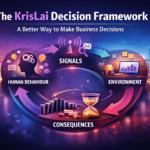
The KrisLai Decision Framework™ and innovation strategy
A practical model for better business decisions in complex environments. It focuses on four essential elements:
- Human Behaviour — how people actually think and decide
- Signals — what people are trying to do right now
- Environment — whether the system supports good decisions
- Consequences — what happens next, and after that
Strong decisions consider all four — not just one.
Innovation strategy fits this framework very well.
Human behaviour asks:
How do customers actually buy, compare, search, resist, adopt, or ignore new ideas?
How do teams react to change?
How do leaders decide under pressure?
Signals ask:
What are customers asking for?
What are they complaining about?
What are they searching for?
What are they already trying to do?
Which ideas are getting real interest, not just polite praise?
Environment asks:
What is changing in technology, competition, regulation, AI search, costs, skills, and customer expectations?
Does the business have the culture, systems, and resources to test ideas properly?
Consequences ask:
What happens if the idea works?
What happens if it fails?
What happens if we scale too soon?
What happens if we ignore it?
This approach is part of the KrisLai Decision Framework, a practical method for improving business decisions.
Better decisions always come from understanding behaviour, signals, environment, and consequences.
Innovation strategy vs business strategy
Business strategy defines where the business wants to compete and win; innovation strategy defines how new ideas, improvements, technology, and experiments will support that direction.
They are connected, but they are not the same.
Comparison: Innovation Strategy vs Business Strategy
| Business Strategy | Innovation Strategy |
|---|---|
| Defines where the business wants to compete and grow | Defines which ideas and experiments support that growth |
| Focuses on markets, positioning, advantage, and priorities | Focuses on testing, learning, technology, customer needs, and new value |
| Answers “Where are we going?” | Answers “Which ideas help us get there?” |
A business strategy may say:
“We want to grow by serving small businesses that need clearer operational support.”
An innovation strategy then asks:
What new services, tools, systems, processes, partnerships, or content could help us serve those customers better?
The business strategy sets direction.
The innovation strategy tests the possible routes.
Innovation strategy vs innovation process
Innovation strategy explains why and where the business should innovate; the innovation process explains how ideas move from concept to test, launch, and scale.
This is a common source of confusion.
A process is not enough.
You can have a neat idea process and still choose poor ideas.
You can have a stage-gate system and still fund the wrong projects.
You can have innovation workshops and still create no real value.
A process moves ideas.
A strategy decides which ideas matter.
Innovation strategy decides why, where, and how a business should innovate. The innovation process manages how ideas are collected, tested, improved, launched, or stopped.
Strategy gives direction. Process gives movement. A business needs both.
The Innovation Decision Loop
The Innovation Decision Loop is a simple way to stop ideas from becoming expensive guesses.
The loop is:
Problem → Idea → Evidence → Decision → Test → Learn → Scale or Stop
This is the centre of this article.
It keeps innovation practical.
Start with the problem.
Create or choose an idea.
Gather evidence.
Make a decision.
Run a small test.
Learn from the result.
Then decide whether to scale, improve, pause, or stop.
The point is not to fall in love with the idea.
The point is to learn fast enough to decide well.
Problem → Idea → Evidence → Decision → Test → Learn → Scale or Stop
This framework helps leaders move from raw ideas to better decisions by testing evidence before making bigger commitments.
The simplest way to make innovation more practical is to treat it as a decision loop rather than a burst of inspiration.
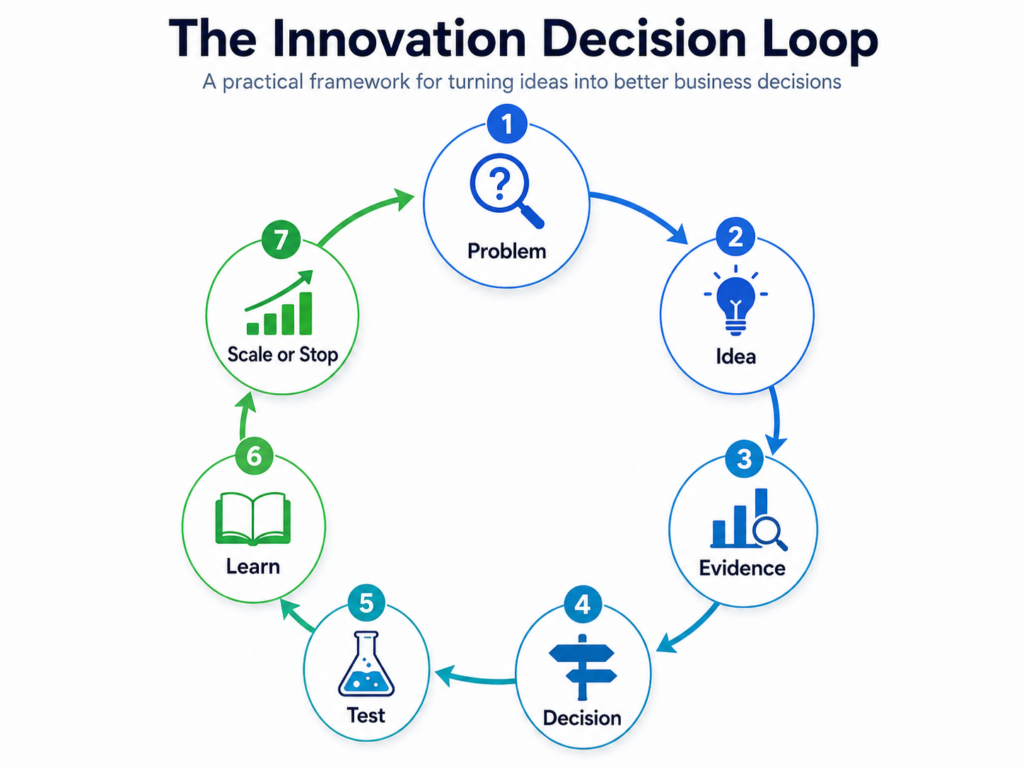
This is the centre of the article!
The Innovation Decision Loop helps leaders turn raw ideas into better business decisions by moving step by step from problem to evidence, testing, learning, and then scaling or stopping.
7 steps to turn ideas into growth
To create an innovation strategy, start with a real problem, link ideas to business goals, create the right culture, validate ideas, decide what to fund or stop, watch disruption, and scale what works.
Let’s go through the seven steps…
1. Start with the problem, not the idea
The first step in innovation strategy is to define the customer, business, or operational problem you are trying to solve.
This sounds obvious.
It is often ignored.
Many businesses start with a solution:
“We should build an app.”
“We should use AI.”
“We should launch a subscription.”
“We should create a new product.”
“We should copy what that competitor is doing.”
Maybe they should.
Maybe they should not.
The better starting point is:
What problem are we solving?
Who has the problem?
How painful is it?
How often does it happen?
What are people doing now?
What happens if we do nothing?
If the problem is weak, the idea will probably be weak too.
In my experience, a weak problem wrapped in exciting language is still a weak problem.
It just has better packaging.
Do not start innovation with “What could we build?” Start with “What problem is worth solving?”
2. Link innovation to business goals
Innovation should support a business goal.
That goal might be:
growth
profit margin
customer retention
speed
service quality
customer experience
market position
operational efficiency
new revenue
risk reduction
AI-era visibility
competitive advantage
Without a business goal, innovation becomes scattered.
One team wants new products.
Another wants automation.
Another wants a new service model.
Another wants better marketing.
Another wants to “do something with AI”, which is both popular and wonderfully vague.
The question is:
What business outcome should this idea improve?
If the answer is unclear, pause.
Innovation strategy should create focus.
It helps leaders say:
This idea supports our direction.
This idea is interesting, but not now.
This idea needs more evidence.
This idea should stop.
That last one matters.
A strong innovation strategy gives you permission to stop weak ideas.
3. Create the right conditions for ideas
A culture of innovation is not built by telling people to “think outside the box” and then punishing the first person who says something awkward.
That is not innovation.
That is theatre with biscuits.
A real culture of innovation needs:
leadership support
psychological safety
customer listening
time to think
permission to test
clear priorities
useful feedback
cross-team collaboration
learning from failure
People need to feel safe enough to raise problems and suggest better ways of working.
This does not mean every idea is accepted.
It means ideas are heard, tested, and judged fairly.
What I’ve seen is that teams often know where the problems are before leaders see them in a report.
They know which customers are frustrated.
They know which process is slow.
They know which promise is hard to keep.
They know which product feature nobody uses.
They know which “great idea” will create chaos by Friday afternoon.
If leaders do not listen, innovation becomes top-down guessing.
Useful related reading:
Psychological Safety at WorkA culture of innovation is not a room full of sticky notes. It is an environment where people can notice problems, suggest improvements, test ideas, learn from evidence, and speak honestly about what is not working.
4. Validate ideas before investing heavily
Idea validation means testing whether an idea solves a real problem for real people before you spend too much time or money building it.
This is where many businesses get into trouble.
They build first.
Then they ask customers.
That order is risky.
A better approach is to test before you invest heavily.
You can validate ideas through:
customer interviews
short surveys
landing pages
pilot offers
waiting lists
simple prototypes
minimum viable products
manual tests
early adopter feedback
small paid trials
pre-orders
usage data
customer search behaviour
The goal is not to prove that your idea is brilliant.
The goal is to find out whether the idea deserves the next level of investment.
That difference matters.
A minimum viable product, or MVP, is useful here.
An MVP is not a poor-quality version of the final offer.
It is the smallest useful version that helps you learn whether the idea creates value.
Useful related reading:
How to Develop a Successful Minimum Viable Product

5. Decide what to fund, pause, test, or stop
This is the heart of innovation strategy.
At some point, leaders must decide.
Not every idea should move forward.
Not every idea needs a full business case.
Not every idea deserves a team, budget, launch plan, and inspirational project name.
Some ideas should be tested.
Some should be paused.
Some should be improved.
Some should be stopped.
Some should be funded.
The decision should depend on signals.
| Signal | Better Decision |
|---|---|
| Strong customer pain and early evidence | Test further |
| Interest but no payment signal | Validate price and willingness to pay |
| No clear customer problem | Pause or reframe |
| High cost and weak evidence | Stop or reduce the scope |
| Strong evidence and clear strategic fit | Fund or pilot |
This is where innovation becomes practical.
The question is not:
Do we like the idea?
The question is:
What evidence supports the next decision?

6. Watch disruption and changing technology
Disruptive innovation and new technology can change how customers buy, compare, search, work, and decide.
That does not mean every business should chase every trend.
AI, automation, platforms, data tools, digital payments, online marketplaces, and changing search behaviour can all affect business models.
But technology is not strategy by itself.
A better question is:
Which customer or business problem could this technology help us solve better?
For example:
Could AI help us understand customer questions more quickly?
Could automation reduce repeated admin?
Could better data show demand earlier?
Could digital tools improve the customer journey?
Could AI search change how customers find our business?
Could a new platform create a different way to deliver value?
This is especially important now because customer behaviour is changing.
People no longer only search through traditional Google results.
They ask AI tools.
They compare reviews.
They use social platforms.
They expect faster answers.
They research quietly before speaking to a supplier.
So innovation strategy must include the future of search.
If customers discover, compare, and choose differently, your business may need to innovate not just what it sells, but how it is found, explained, trusted, and delivered.
Useful related reading:
How AI Is Changing Search BehaviourDo not ask, “Should we use AI?” Ask, “Which customer or business problem could AI help us solve better?”
Technology should serve the strategy. It should not become the strategy.
7. Scale what works and keep learning
Scaling innovation means growing an idea only after there is enough evidence that it works, customers value it, and the business can deliver it reliably.
Scaling too early is dangerous.
The idea may look promising in a small test.
But can it work with more customers?
Can the team deliver it?
Can operations support it?
Can quality hold up?
Can cash flow handle it?
Can customer service cope?
Can marketing explain it clearly?
Can the business keep its promise?
A good innovation strategy asks these questions before scaling.
A weak one celebrates too early.
Then the business grows into confusion.
Scaling should happen through feedback loops.
Launch.
Measure.
Learn.
Improve.
Then expand.
Useful related reading:
Scaling Your Startup: Strategies for Sustainable GrowthIf you strip innovation strategy down to its essentials, these are the seven decisions leaders need to make again and again:
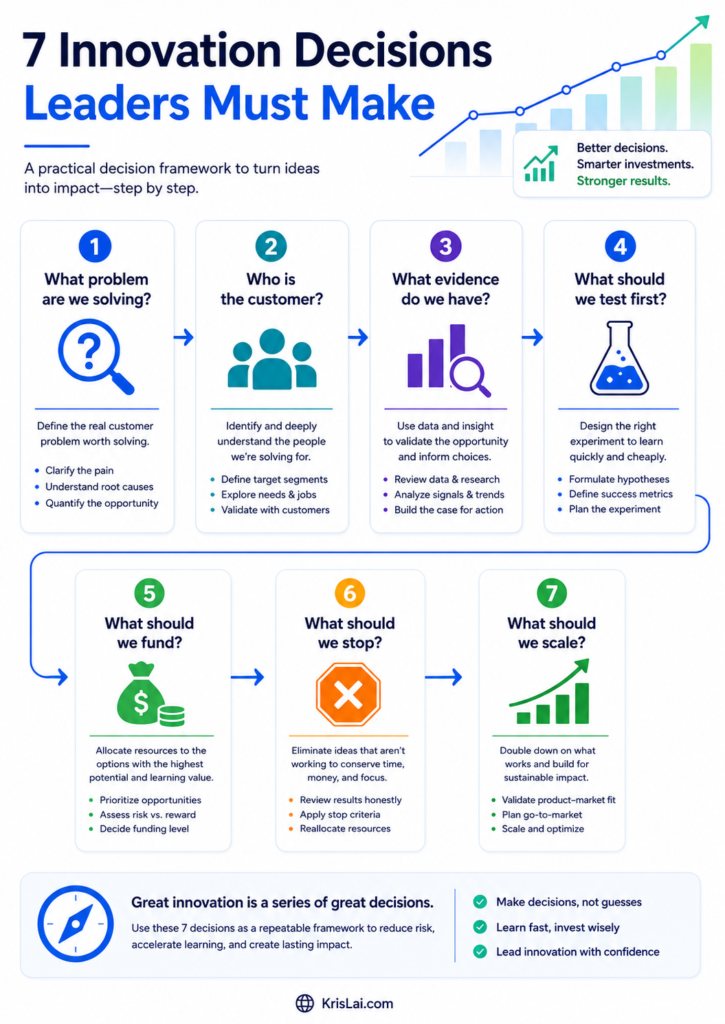
In my experience, innovation becomes much more useful when leaders treat it as a repeatable decision system rather than a one-off burst of enthusiasm.
Types of innovation strategy
The main types of innovation strategy include incremental, disruptive, radical, architectural, product, process, and business model innovation.
Here is a simple guide:
| Type | Plain English Meaning | Small Business Example |
|---|---|---|
| Incremental innovation | Improve what already works | Simpler booking process |
| Product innovation | Create or improve an offer | New service package |
| Process innovation | Improve how work is done | Better customer handover system |
| Business model innovation | Change how value is created or captured | Subscription offer instead of one-off service |
| Disruptive innovation | Change market expectations | Lower-cost digital alternative |
| Radical innovation | Create a major new solution | A new technology-led service category |
| Architectural innovation | Combine existing parts in a new way | Bundled service model with one monthly fee |
For many small and mid-sized businesses, incremental, process, product, and business model innovation are often the best places to start.
You do not always need to disrupt an industry!
Sometimes you just need to remove friction, serve customers better, and make the business easier to run.
Not as glamorous, perhaps.
Often more profitable.
What this looks like in real business
Imagine a small service business with three possible innovation ideas.
Idea one:
Launch a new subscription service.
Idea two:
Use AI chat support.
Idea three:
Redesign the customer onboarding process.
All three sound useful.
But the business has limited time and money.
So the owner uses innovation strategy instead of chasing all three at once.
They ask:
Which problem matters most?
What evidence do we have?
Which idea supports customer value?
Which idea has the lowest test cost?
Which idea could improve margin, retention, or customer trust?
What happens if we ignore it?
The evidence shows that customers are confused during onboarding.
They ask the same questions.
They delay decisions.
They misunderstand the service.
The team spends too much time explaining the basics.
The business realises that the strongest signal is not “we need AI chat support”.
The strongest signal is:
Customers need a clearer onboarding experience.
So the business runs a small test.
It creates a clearer onboarding page.
It adds a short welcome email.
It creates a simple checklist.
It tracks customer questions.
It asks new customers for feedback.
The result?
Fewer repeated questions.
Faster decisions.
Better customer confidence.
Less team frustration.
Now the business has better evidence.
Maybe AI chat support becomes useful later.
Maybe the subscription offer becomes stronger later.
But the first decision was to fix the customer journey.
That is innovation strategy.
Insight → real example → decision → consequence.
The insight is that not all ideas deserve equal attention.
The example is three possible ideas competing for limited resources.
The decision is to test the idea linked to the strongest customer signal.
The consequence is better customer experience and better evidence for the next innovation.
The best innovation idea is not always the most exciting idea. It is often the idea with the clearest customer problem, strongest evidence, and best fit with the business.
Where innovation strategy goes wrong
Innovation strategy goes wrong when businesses chase shiny technology, confuse ideas with strategy, build before validating, fund too many projects, ignore customer behaviour, punish failure, or scale too soon.
Let’s look at the common mistakes…
Chasing shiny technology
New technology can be useful.
But technology should not lead the thinking.
If the first question is “How can we use AI?” the business may be starting in the wrong place.
A better question is:
Which problem could AI help us solve?
Confusing ideas with strategy
A list of ideas is not an innovation strategy.
A brainstorming session is not an innovation strategy.
A workshop is not an innovation strategy.
A strategy includes choices.
What matters?
What does not?
What will we test?
What will we stop?
What will we fund?
Building before validating
This is a common and expensive mistake.
Businesses often build the full version before checking whether customers really want it.
Validation should reduce risk before heavy investment.
Funding too many projects
If everything is a priority, nothing is.
An innovation portfolio should be focused enough to manage properly.
Too many projects create noise, delay, and half-finished work.
Ignoring customer behaviour
Customers may say an idea is interesting.
That is not the same as buying it.
Look for behaviour, not just compliments.
Compliments are lovely.
Cash, usage, referrals, and repeat demand are more useful.
Punishing failure
If every failed test is treated as a personal failure, people will hide bad news.
Then leaders make worse decisions.
Innovation needs honest learning.
That does not mean careless risk-taking.
It means learning quickly and responsibly.
Scaling too soon
An idea that works in a small test may fail at scale.
Check systems, people, cash flow, service quality, and customer support before expanding.
Innovation fails when businesses fall in love with ideas before they understand the problem, test the evidence, or decide what success should look like.
A weak idea does not become stronger because it has a better slide deck.
Innovation strategy and decision-making under uncertainty
Innovation strategy should not pretend the future is certain. It should help leaders make better choices while the future is still unclear.
That is important because innovation is always uncertain.
You do not know exactly how customers will respond.
You do not know whether competitors will react.
You do not know whether technology will change again.
You do not know whether a small test will scale.
You do not know whether timing is right.
But uncertainty does not mean guessing blindly.
It means building evidence.
Useful methods include:
small experiments
customer validation
pre-mortems
scenario planning
staged funding
decision triggers
value-of-information thinking
quarterly review cycles
test-and-learn habits
A pre-mortem is a simple exercise where you imagine the idea failed and ask why.
This helps surface risks before the business spends too much.
Value-of-information thinking asks:
What would we pay to learn something before making a bigger decision?
For example:
Would a £500 landing page test save us from a £10,000 product mistake?
Would five customer interviews stop us building the wrong feature?
Would a small pilot reveal whether the service can be delivered profitably?
This is not overcomplication.
It is common sense with better structure.
Over time, I’ve found that good decisions rarely come from data alone. They come from understanding people, reading signals, creating the right environment, and thinking beyond the immediate outcome.
Useful decision-making reference sources:
Strategic Decisions Group: Decision QualityCloverpop: Decision Intelligence
Useful related reading:
Scenario Planning: How to Navigate UncertaintyCan AI help with innovation strategy?
AI can help innovation strategy by analysing customer feedback, spotting trends, summarising research, generating idea options, supporting prototypes, and monitoring market signals, but it should not replace human judgement.
AI can help with:
customer research summaries
competitor research
search behaviour analysis
idea generation
market trend scanning
customer complaint analysis
prototype copy
landing page drafts
survey questions
scenario options
decision support
innovation portfolio reviews
But AI also creates risks.
It can generate too many ideas.
It can sound confident when it is wrong.
It can miss context.
It can repeat common advice.
It can encourage businesses to act before thinking.
AI is useful when it improves thinking.
It is dangerous when it replaces thinking.
A good rule is this:
AI can help you generate options, but leaders still need to choose which options deserve belief, money, and action.
This is especially important in the future of search.
AI tools are changing how people find answers, compare options, and decide who to trust.
That means innovation strategy should include:
how customers discover you
what questions they ask
what buying signals they show
how content appears in AI answers
how your offer is explained online
how trust is built before contact
Useful related reading:
Customer Intent MarketingHow to measure innovation success
Measure innovation success by tracking financial impact, customer value, learning speed, pipeline health, adoption, and strategic fit.
Do not measure innovation only by how many ideas were created.
That can be misleading.
A business can generate 200 ideas and still avoid the one decision that matters.
Better innovation metrics include:
revenue from new offers
cost savings
customer adoption
customer retention
number of ideas tested
speed of learning
time from idea to test
number of ideas stopped early
customer feedback quality
conversion rate
usage rate
repeat purchases
team participation
strategic fit
profit margin
customer lifetime value
The “kill rate” can also matter.
That means how many weak ideas are stopped before they waste serious money.
Stopping a weak idea is not failure!
It can be evidence that the system is working.
Measure innovation success by looking at customer value, learning speed, adoption, financial impact, strategic fit, and whether weak ideas are stopped before they waste too much time or money.
Is innovation strategy only for large companies?
No. Small and mid-sized businesses also need innovation strategy because they have limited time, money, and attention. Clear choices matter even more when resources are tight.
What is the first step in innovation strategy?
The first step is to define the customer, business, or operational problem worth solving before choosing an idea.
How do you know if an idea is worth pursuing?
An idea is worth pursuing when it solves a real problem, has evidence of customer demand, fits the business strategy, and can be tested without taking unnecessary risk.
Should every innovation idea be scaled?
No. Some ideas should be tested, improved, paused, or stopped. Scaling should happen only when evidence shows the idea works and the business can deliver it reliably.
What is innovation theatre?
Innovation theatre is when a business looks innovative through workshops, slogans, or technology experiments but does not make meaningful decisions or create real customer value.
What you should actually do
Start with this one thing:
Pick one business problem worth solving before you pick one exciting idea.
That is the simplest practical step.
Do not begin with the technology.
Do not begin with the product.
Do not begin with the workshop.
Begin with the problem.
Then follow this process:
Write the problem clearly.
List three possible ideas.
Ask what evidence you already have.
Choose the smallest useful test.
Decide what signal means continue.
Decide what signal means pause.
Decide what signal means stop.
Review the result.
Learn before spending more.
This connects closely to how I think about decisions more broadly in the KrisLai Decision Framework™.
Innovation is not just about creativity.
It is about making better choices under uncertainty.
Start with one problem, one idea, and one small test. Decide in advance what evidence would make you continue, pause, stop, or scale.
That small habit can save a business from spending heavily on ideas that only sounded good in a meeting.
If you are not sure where to begin, use The Innovation Decision Loop: define the problem, choose one idea, gather evidence, make a small test, learn from the result, and then decide whether to scale or stop.
FAQ
What is innovation strategy?
Innovation strategy is a practical plan for deciding which ideas a business should create, test, fund, launch, improve, or stop so innovation supports real business goals.
Why is innovation strategy important?
Innovation strategy is important because it helps businesses focus limited time, money, and attention on ideas that create customer value and support growth, rather than chasing every new trend or suggestion.
How do you create an innovation strategy?
To create an innovation strategy, define the problem, link innovation to business goals, create the right culture, validate ideas, make evidence-based decisions, watch market and technology change, and scale what works.
What are the stages of innovation strategy?
The main stages are problem definition, idea generation, evidence gathering, decision-making, testing, learning, launch, scaling, and review.
What are the types of innovation strategy?
Types of innovation strategy include incremental innovation, disruptive innovation, radical innovation, architectural innovation, product innovation, process innovation, and business model innovation.
What is the difference between innovation strategy and business strategy?
Business strategy defines where the business wants to compete and win. Innovation strategy defines how ideas, experiments, technology, and improvements will support that direction.
What is the difference between innovation strategy and innovation process?
Innovation strategy explains why and where the business should innovate. The innovation process explains how ideas move from concept to test, launch, and scale.
How do you validate an innovation idea?
You validate an innovation idea by testing whether it solves a real problem for real people before investing heavily. This can include customer interviews, prototypes, MVPs, landing pages, waiting lists, pilot offers, and customer feedback.
How do you measure innovation success?
You measure innovation success by tracking customer value, adoption, financial impact, speed of learning, strategic fit, and whether weak ideas are stopped before they waste serious resources.
Can AI help with innovation strategy?
Yes. AI can help analyse customer feedback, spot trends, summarise research, generate options, support prototypes, and monitor market signals. But leaders still need to check context, judge evidence, and make the final decision.
Research and experience note
This article is based on practical experience, independent research, and analysis of how innovation strategy works in real businesses.
Useful reference sources include:
Board of Innovation: What Is Innovation Strategy?IMD: What Is Innovation Strategy?
InnovationCast: Innovation Strategy
Harvard Business Review: You Need an Innovation Strategy
UK Government: UK Innovation Strategy
Elrha Humanitarian Innovation Guide: Strategy and Support
The aim is not to make innovation more complicated.
The aim is to make innovation more useful, more focused, and more connected to better business decisions.
Innovation strategy works best when it is connected to behaviour, customer signals, psychological safety, and second-order thinking.
These articles may help you go deeper:
Useful related reading:
Business Strategy: How to Think Clearly and Win in Uncertain Markets
Scenario Planning: How to Navigate Uncertainty
How AI Is Changing Search Behaviour
Lean Management: 7 Ways Small Businesses Cut Waste
Financial Trend Analysis: 7 Financial Trends Leaders Should Watch
Conclusion and final thoughts
If you remember nothing else, remember this:
Start with the problem, not the idea.
That one habit can improve your innovation strategy immediately.
Before you build, fund, launch, automate, or scale anything, ask:
What problem are we solving?
Who has the problem?
What evidence do we have?
What is the smallest useful test?
What will make us continue, pause, stop, or scale?
Innovation strategy is not about having more ideas.
It is about making better decisions about which ideas deserve the next step.
I help people make better business decisions through psychology, strategy, and practical thinking. Innovation strategy supports that because it turns imagination into evidence, and evidence into better action.
Download the KrisLai Decision Framework™ Guide
If you want a practical way to think through business decisions, download my free KrisLai Decision Framework™ guide.
It will help you look at decisions through four simple lenses: behaviour, signals, environment, and consequences.
Use it before major choices about strategy, customers, marketing, operations, finance, innovation, and AI.
Just fill in your details below and hit Subscribe to gain immediate access to the guide.
If you enjoy exploring the ideas behind better business decisions, you may find the Business Thinking Hub useful.
About the author
Kris Lai is a business operator and managing director with experience in land and building surveying, facilities management, logistics, and service delivery.
Earlier in his career, he worked as a Search Engine Evaluator (via Lionbridge, supporting Google), where he assessed search result relevance, user intent, and content quality using structured evaluation frameworks. This experience gives him a rare, practical understanding of how search systems interpret signals and make ranking decisions.
In parallel, whilst working with a charity organisation, he has delivered 1000’s of structured presentations in English, Finnish, and Chinese to audiences ranging from small groups to more than 600 people, and has spent decades mentoring and developing others. This experience informs his approach to clarity, communication, and decision-making under pressure.
He writes about AI, search behaviour, business strategy, and decision-making from a practical, real-world perspective.
👉 Explore ideas connected to better business decisions:
- Digital Transformation for SMEs: 7 Questions Before You Invest
- Cybersecurity for Businesses: 7 Decisions Leaders Must Make

- How AI Is Changing Search Behaviour (And What Businesses Must Do Now)
- Decision-Making Framework Examples: The KrisLai Method in Action
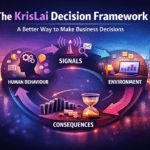
- The KrisLai Decision Framework: A Better Way to Make Business Decisions


Similar Posts
Addressing Labour Shortages and Enhancing Employee Retention: Strategies for Small Businesses
Struggling with labour shortages? Discover actionable strategies for addressing workforce challenges and enhancing employee retention. Learn how to attract talent, foster loyalty, and build a resilient workforce on Krislai.com.
Accounting Software: 7 Critical Decisions Before You Buy
Choosing accounting software is not just a software decision. It affects invoices, expenses, VAT, cash flow, reports, accountant access, migration risk, and better business decisions. This guide explains the 7 critical decisions small businesses should make before buying a tool.
Cracking the Code: Decoding Financial Statements for Profit Maximization
Unlock the secrets to profit maximization and elevate your business acumen with this comprehensive guide to decoding financial statements. Dive into the world of financial analysis, explore key metrics, and gain insights to make informed decisions. From interpreting income statements to leveraging SWOT analysis, discover how to maximize profitability and drive sustainable growth. Start your journey towards financial mastery today!
Best Financial Management Software for Small Businesses
Discover the best financial management software for small businesses in 2024. Explore top tools like QuickBooks Online, Xero, and FreshBooks to elevate your business and streamline financial operations. Learn how these solutions can enhance accuracy, save time, and drive growth.