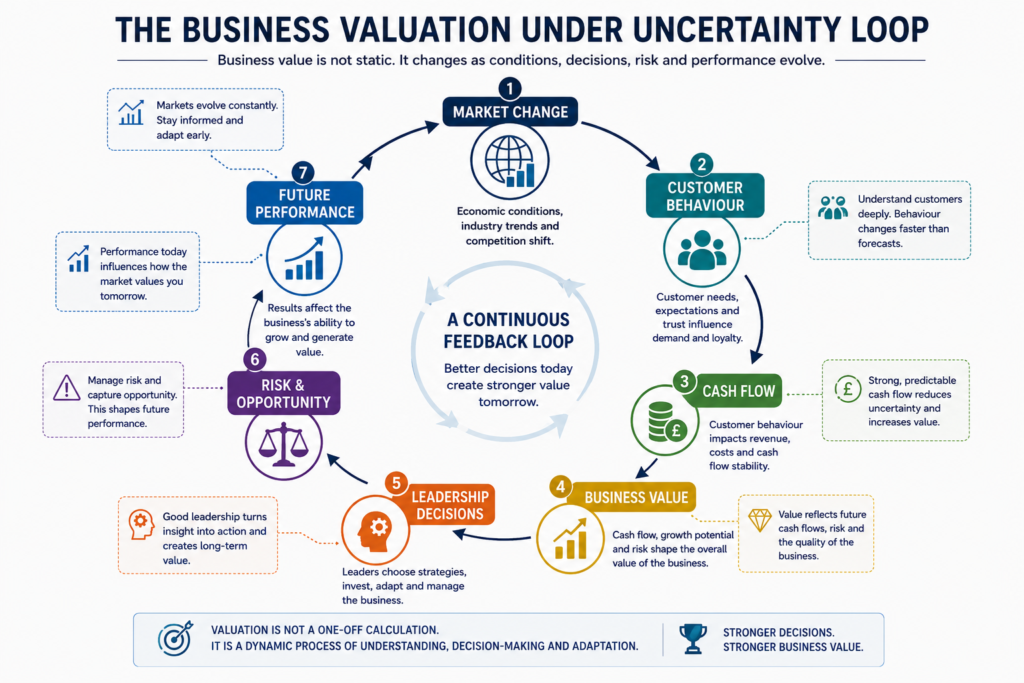
Business valuation is not just about numbers. It is about judgement. It is about understanding risk. And it is about making better decisions when the future is unclear.
Whether you are preparing to sell a business, attract investors, plan for succession, secure funding, or simply understand where your company stands today, business valuation is one of the most important exercises you can undertake.
Yet many business owners make the same mistake.
They assume there is a single “correct” value.
In reality, valuation is often a range, not a number.
Over time, I’ve found that good decisions rarely come from data alone. They come from understanding people, reading signals, creating the right environment, and thinking beyond the immediate outcome.
This connects closely to how I think about decisions more broadly in the KrisLai Decision Framework™.
Better decisions come from understanding behaviour, signals, environment, and consequences.
A practical model for better business decisions in complex environments. It focuses on four essential elements:
- Human Behaviour — how people actually think and decide
- Signals — what people are trying to do right now
- Environment — whether the system supports good decisions
- Consequences — what happens next, and after that
Strong decisions consider all four — not just one.
Business valuation is a perfect example!
Business valuation is the process of determining what a business is worth at a particular point in time.
A valuation may be needed for selling a business, attracting investment, succession planning, buying a company, tax purposes, shareholder disputes, divorce proceedings, strategic planning, or measuring business growth.
Importantly, valuation is not simply about mathematics. It also involves assumptions about future profits, risk, market conditions, leadership, customer behaviour, and economic uncertainty.
Direct Answer: What Is Business Valuation?
Business valuation is the process of estimating the economic value of a company.
The most common business valuation methods include:
- Earnings multiple valuation
- EBITDA multiple valuation
- Discounted cash flow (DCF)
- Asset-based valuation
- Revenue multiple valuation
- Market comparison valuation
- Precedent transaction valuation
Which one should you use? The answer is not simple. The most suitable method depends on the type of business, the purpose of the valuation, the quality of available information, and the level of uncertainty surrounding future performance.
Why Business Valuation Matters More Than Ever
A few years ago, many business owners could rely on stable markets, predictable customer demand, and reasonably reliable forecasts.
Today, things are different.
Interest rates move.
Supply chains change.
Artificial intelligence is reshaping industries.
Customer behaviour shifts rapidly.
Search behaviour is changing too.
Potential buyers increasingly use AI tools such as ChatGPT, Gemini, Claude, and Perplexity to research businesses before making investment decisions.
That means the value of a business increasingly depends on factors that traditional valuation models often struggle to measure:
Brand trust.
Digital visibility.
Customer intent.
Market adaptability.
Leadership capability.
These factors rarely appear neatly on a balance sheet.
Yet they can significantly affect valuation.
You’ll likely find that most articles on the internet about business valuation focus on formulas.
This article focuses on decisions.
The formulas matter.
But what matters even more is understanding why two people can look at exactly the same business and arrive at completely different valuations!
The answer almost always comes down to assumptions about risk, behaviour, and the future.
Why Do You Need a Business Valuation?
Many people search:
Why do I need a business valuation?
Because every important business decision starts with understanding where you stand today.
Common reasons include:
Selling a Business
Perhaps the most obvious reason.
Before putting a business on the market, owners want to know:
- How much is my business worth?
- What valuation can I realistically achieve?
- What would buyers pay?
Raising Investment
Investors need to understand what percentage of ownership they receive in exchange for their money.
Without a valuation, meaningful investment discussions become difficult.
Succession Planning
Family businesses often require valuation for succession planning.
The goal is to create fairness while preserving long-term business stability.
Buying Another Company
Acquisitions are often where poor valuation decisions become very expensive.
Paying too much can destroy shareholder value for years.
Strategic Planning
This is often overlooked.
A valuation exercise can reveal:
- Hidden risks
- Growth opportunities
- Weaknesses in business models
- Operational inefficiencies
In my experience, some of the best business valuation exercises occur when there is no intention to sell.
The process itself can expose issues that leadership teams have missed.
How Do You Value a Business?
This is one of the most common search queries online.
The short answer is:
There is no single formula!
Different businesses require different approaches.
A profitable manufacturing company may require one valuation method.
A technology start-up may require another.
A cleaning company may require something completely different again.
What I’ve seen repeatedly is business owners searching for a quick business valuation calculator hoping for a simple answer.
Unfortunately, business valuation calculators can only provide rough estimates.
Real valuation requires judgement.
The most reliable approach often combines multiple valuation methods.
Business Valuation Methods Explained
Let’s look at the most commonly used methods.
Earnings Multiple Valuation
This is one of the most widely used approaches for small and medium-sized businesses.
The formula is relatively simple:
Business Value = Maintainable Profit × Multiple
For example:
- Annual profit = £200,000
- Industry multiple = 4
Estimated value:
£800,000
Simple?
Not quite.
The difficult part is deciding:
- What profit should be used?
- What adjustments are necessary?
- What multiple is appropriate?
Those decisions often influence the outcome more than the calculation itself.
EBITDA Business Valuation
Many investors and buyers use EBITDA business valuation.
EBITDA stands for:
Earnings Before Interest, Tax, Depreciation, and Amortisation.
It attempts to measure operational performance without financing and accounting factors distorting the picture.
A common search query related to this is:
What is EBITDA in business valuation?
EBITDA helps buyers compare businesses more consistently.
However, EBITDA has limitations.
A business can have strong EBITDA while suffering poor cash flow.
That distinction matters enormously.
As Warren Buffett famously observed, depreciation is not merely a theoretical expense.
Assets eventually wear out.
Ignoring that reality can create misleading valuations.
Adjusted EBITDA Valuation
Professional buyers often use adjusted EBITDA valuation.
This involves removing:
- One-off expenses
- Exceptional costs
- Owner-specific expenses
- Non-recurring events
The goal is to understand what the business would earn under normal operating conditions.
This is often where significant differences emerge between owner expectations and buyer expectations.
One of the biggest business valuation mistakes is assuming turnover equals value.
A company generating £5 million in revenue can be worth less than a company generating £1 million in revenue if profitability, cash flow, customer quality, and risk are weaker!
Revenue is impressive.
Profit is useful.
Cash flow pays the bills.
Discounted Cash Flow (DCF) Valuation
Another popular search query is:
What is the DCF valuation method?
Discounted Cash Flow (DCF) valuation estimates future cash flows and then adjusts them back to today’s value.
In theory, it is highly logical.
In practice, it depends heavily on assumptions.
A small change in projected growth rates can dramatically change the valuation outcome.
This is why DCF works best when future cash flows are relatively predictable.
Under uncertainty, DCF can create an illusion of precision.
The spreadsheet may show values to the nearest pound.
The assumptions may still be wrong.
Asset-Based Valuation
Asset-based valuation focuses on what the business owns.
Examples include:
- Property
- Equipment
- Inventory
- Vehicles
- Investments
Minus:
- Debts
- Liabilities
- Financial obligations
This approach is particularly useful for:
- Property businesses
- Manufacturing firms
- Asset-heavy organisations
However, it often undervalues service businesses.
A consultancy, for example, may own very few physical assets while possessing considerable intellectual capital and customer relationships.
Revenue Multiple Valuation
Many fast-growing businesses use, what is called, a revenue multiple valuation.
This method applies a multiple to annual revenue.
Common in:
- Technology
- SaaS
- Early-stage growth businesses
But there is a danger.
Revenue multiple valuation assumes future profitability.
A business with growing sales but poor margins may not deserve a high valuation.
Growth without profit can sometimes be a warning sign rather than a strength.
Market Comparison Valuation
A common search query is:
What is market-based valuation?
This method compares your company with similar businesses that have recently sold.
It works much like property valuation.
If similar businesses sold for certain amounts, those figures provide useful benchmarks.
The challenge?
No two businesses are truly identical.
Customer quality.
Management strength.
Brand reputation.
Recurring revenue.
Competitive position.
All influence value.
That means comparison data should be treated as guidance, not gospel.
Business Valuation Framework: Looking Beyond The Numbers
Before choosing a valuation method, it helps to look at the business through a wider decision-making lens.
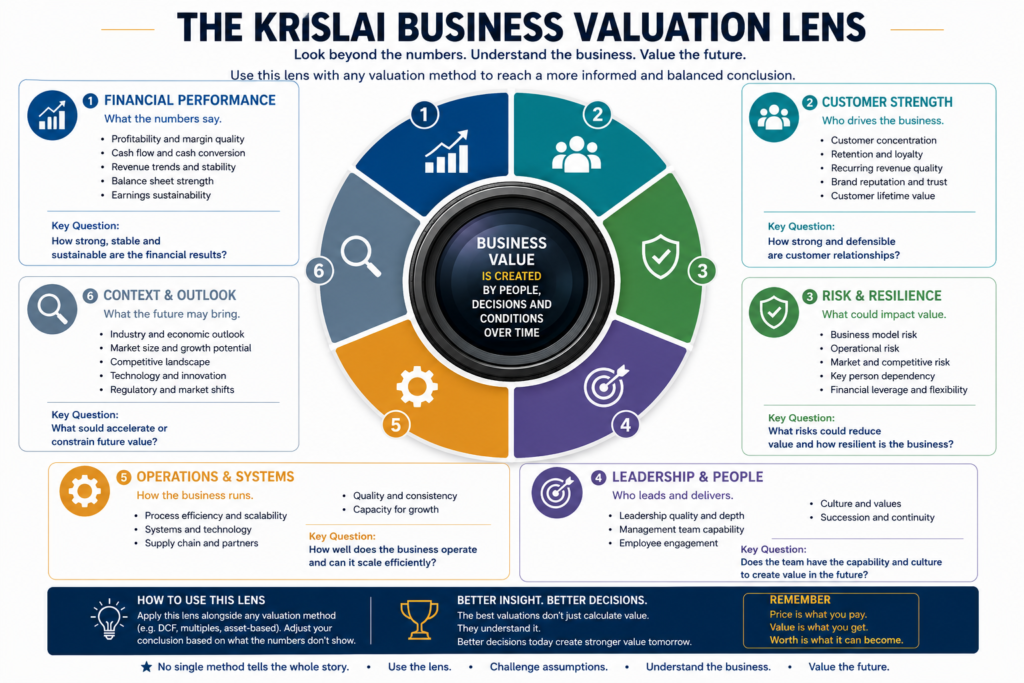
Business value is shaped by more than profit. Customers, risk, leadership, systems, and market conditions all influence what a business is really worth.
Behaviour
How are customers, employees, investors, competitors, and buyers behaving?
Signals
What do the financial numbers actually indicate?
Environment
What is happening in the wider economy, market, industry, and technology landscape?
Consequences
What happens if your assumptions prove wrong?
This approach is part of the KrisLai Decision Framework, a practical method for improving business decisions.
Because valuation is not really about today’s numbers.
It is about tomorrow’s consequences.
What Is The Best Business Valuation Method?
The honest answer?
It depends!
The best valuation method depends on:
- Industry
- Growth rate
- Profitability
- Assets
- Cash flow
- Risk
- Purpose of valuation
In my experience, relying on a single method is rarely wise.
Professional valuers often use several approaches before reaching a final conclusion.
That creates a more balanced view.
And balance matters when uncertainty is involved.
Because valuation is ultimately about making a judgement on the future.
And the future, unfortunately, refuses to read our spreadsheets.
How Much Is My Business Worth?
This is probably the most common question people ask when researching business valuation.
How much is my business worth?
The honest answer is:
Your business is worth what a willing buyer is prepared to pay, based on their view of future profit, future risk, and future opportunity.
Notice the repeated word there:
Future.
Valuation is not really about the past.
The past matters because it provides evidence.
But buyers pay for what they believe will happen next.
This is one reason why two buyers can look at exactly the same company and arrive at very different valuations.
One sees opportunity.
The other sees risk.
One sees growth.
The other sees uncertainty.
Neither may be entirely right or wrong.
They are simply making different assumptions.
In my experience, this is where many business owners become frustrated.
They see years of hard work, sacrifice, late nights, and personal commitment.
Buyers often see cash flow, customer retention, margins, contracts, and risk.
Both perspectives are understandable.
But only one usually determines the final selling price.
Business owners often value the effort invested.
Buyers value the future return they expect to receive.
The gap between those two perspectives is where many valuation disagreements begin.
What Affects Business Valuation?
Many people search:
What affects business valuation?
Several factors can increase or reduce value:
Profitability
Consistent profits generally increase valuation.
Businesses that regularly generate profit are viewed as lower risk.
Cash Flow
Cash flow forecasting often tells a more useful story than profit alone.
A business can appear profitable while struggling to pay suppliers.
Strong cash flow generally supports stronger valuations.
Customer Concentration
Imagine one customer generates 60% of your revenue.
What happens if they leave?
Buyers immediately see risk.
The greater the customer concentration, the lower the valuation tends to be.
Recurring Revenue
Subscription models, maintenance contracts, and long-term agreements provide predictability.
Predictability reduces uncertainty.
Reduced uncertainty often increases value.
Market Conditions
Economic conditions matter.
Interest rates matter.
Investor confidence matters.
Industry trends matter.
Even a great business can see its valuation affected by broader market conditions.
Owner Dependency
This is one of the most overlooked valuation factors.
If the business cannot function without the owner, buyers become nervous.
The question becomes:
“Am I buying a business, or am I buying a job?”
Those are very different things.
Brand Reputation
In the age of AI search and digital trust, reputation has become increasingly valuable.
A business with strong reviews, positive customer sentiment, and visible expertise often commands a premium.
As search behaviour evolves, digital credibility may become an even more important valuation factor.
Many traditional valuation methods struggle to account for modern business assets such as:
• Brand trust
• Customer loyalty
• Search visibility
• Digital authority
• Industry expertise
• AI discoverability
As AI search becomes more important, businesses that consistently demonstrate expertise and trustworthiness may enjoy stronger valuations than competitors with similar financial performance.
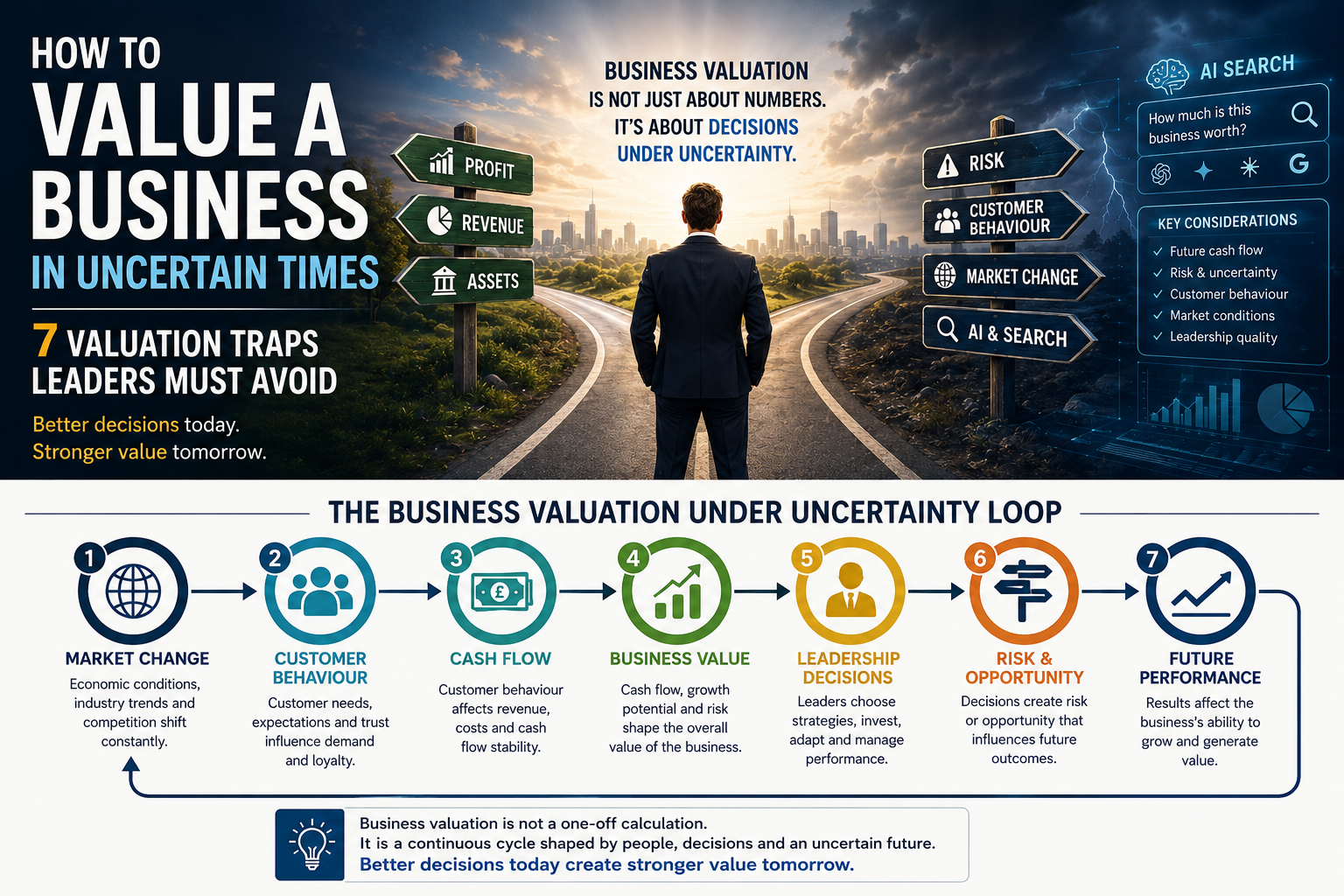
The 7 Valuation Traps Leaders Must Avoid
Most valuation mistakes are not caused by bad mathematics.
They are caused by poor assumptions.
Here are seven of the most common traps:
Valuation Trap #1: Confusing Revenue With Value
A surprisingly large number of owners still believe high turnover automatically means high value.
It doesn’t!
A company generating £10 million in revenue with tiny margins may be worth less than a company generating £2 million with strong profits and recurring customers.
Revenue attracts attention.
Profit attracts buyers.
Cash flow attracts investors.
Valuation Trap #2: Treating EBITDA As Cash
EBITDA is useful.
But EBITDA is not cash.
A business can show healthy EBITDA while requiring constant investment in equipment, inventory, or working capital.
Ignoring this can produce inflated valuations.
Valuation Trap #3: Ignoring Customer Concentration
Imagine losing your biggest customer tomorrow.
Would the business survive comfortably?
If not, buyers will discount the valuation accordingly.
The risk is obvious.
Many owners only realise this during due diligence.
Valuation Trap #4: Overvaluing The Founder
This one is common.
The owner knows every customer.
Approves every quote.
Makes every key decision.
Solves every problem.
The owner then wonders why buyers are cautious.
The answer is simple.
They are buying future earnings.
If those earnings depend entirely on one individual, the risk increases significantly.
Valuation Trap #5: Choosing The Wrong Method
Different businesses require different approaches.
A software company.
A cleaning company.
A consultancy.
A retailer.
A manufacturer.
Each has different characteristics.
Using the wrong valuation method can create wildly inaccurate conclusions.
Valuation Trap #6: Believing Online Calculators
Business valuation calculators can be useful.
But they are only starting points.
A calculator cannot fully understand:
- leadership quality
- customer relationships
- competitive advantages
- organisational culture
- future opportunities
A spreadsheet has never sat in a customer meeting.
Nor has it survived a recession.
Valuation Trap #7: Ignoring Uncertainty
This is perhaps the biggest trap of all.
Many valuations assume the future will look broadly similar to today.
History repeatedly shows otherwise.
Markets change.
Technology evolves.
Customer behaviour shifts.
Competitors adapt.
Unexpected events occur.
Ignoring uncertainty can create false confidence.
And false confidence is often expensive.
One of the most dangerous phrases in business is:
“We know exactly what will happen.”
No, we don’t!
Good leaders prepare for uncertainty.
Poor leaders assume certainty.
Valuation should always include a healthy respect for what we do not know.
What This Looks Like In Real Business
Let’s look at a practical example.
Imagine two companies…
Company A
- Revenue: £5 million
- EBITDA: £500,000
- One customer generates 70% of revenue
- Owner approves all major decisions
- Little documentation
- Weak management team
Company B
- Revenue: £3 million
- EBITDA: £450,000
- Revenue spread across 150 customers
- Strong management team
- Well-documented systems
- High customer retention
Many owners would assume Company A is worth more.
Yet many buyers would prefer Company B.
Why?
Because Company B carries less risk.
And risk is one of the biggest drivers of valuation.
In my experience, reducing risk often creates more value than increasing revenue.
That may sound counterintuitive.
But it is exactly how many investors think.
Real-World Business Example
Consider what happened during the COVID-19 pandemic.
Many businesses experienced dramatic valuation swings.
Restaurants.
Hotels.
Retailers.
Travel companies.
Some valuations collapsed almost overnight.
Yet other businesses increased in value.
Software providers.
Remote working platforms.
Logistics companies.
E-commerce businesses.
What changed?
The businesses themselves did not necessarily become better or worse overnight.
What changed was the market’s view of future risk and future opportunity.
Valuation follows expectations.
And expectations can change very quickly.
This is one reason why strategic thinking matters so much.
If you would like to explore this idea further, read:
Both topics help explain why people often make decisions based on expectations rather than objective reality.
A business valuation is ultimately a prediction.
Predictions depend on assumptions.
The quality of your assumptions often matters more than the sophistication of your spreadsheet.
Where This Goes Wrong
Most failed valuations follow a similar pattern:
Step 1
The owner becomes emotionally attached to a number.
Step 2
Evidence that contradicts that number gets ignored.
Step 3
Buyers offer less than expected.
Step 4
The owner becomes frustrated.
Step 5
The deal stalls.
I have seen versions of this happen repeatedly across different industries.
Psychologists call this confirmation bias.
We naturally seek information that supports our existing beliefs.
This connects directly to behavioural economics.
We are often less objective than we think.
The same bias affects:
- pricing decisions
- investment decisions
- hiring decisions
- acquisition decisions
- business valuations
The challenge is not recognising bias in others.
The challenge is recognising it in ourselves.
Decision Insight: What You Should Actually Do
If you are preparing for a valuation, start by asking three questions:
Question 1
What assumptions am I making?
Question 2
What evidence supports those assumptions?
Question 3
What could prove those assumptions wrong?
This simple exercise often reveals blind spots.
It also improves decision quality.
This approach is part of the KrisLai Decision Framework, a practical method for improving business decisions.
Because better decisions rarely come from certainty.
They come from understanding behaviour, signals, environment, and consequences.
Business valuation is no exception.
Before accepting any valuation, challenge the assumptions behind it.
Then challenge them again.
The goal is not to find the perfect number.
The goal is to make a better decision.
And those are not always the same thing…
Business Valuation Under Uncertainty
One reason I wanted to write this article is because uncertainty is often treated as an inconvenience rather than a central part of valuation.
But uncertainty is not a side issue.
It is the issue.
Every business valuation is really an attempt to answer a difficult question:
“What is this business likely to be worth in the future?”
Nobody knows the future with certainty.
Not business owners.
Not investors.
Not accountants.
Not economists.
And definitely not that person on LinkedIn who claims to have predicted everything perfectly!
The best we can do is make informed judgements.
This is where strategic thinking becomes valuable.
Good leaders do not try to eliminate uncertainty.
They learn to navigate it.
They prepare for multiple outcomes.
They ask better questions.
They challenge their assumptions.
And they understand that valuation is not simply a finance exercise.
It is a decision-making exercise.
Business valuation is not about finding certainty.
It is about making better decisions despite uncertainty.
The most valuable businesses are often those that can adapt, respond, and continue creating value when conditions change.
How To Value A Business When The Future Is Uncertain
Many people search:
How do you value a business in uncertain markets?
The answer is not to predict one future.
The answer is to consider several possible futures.
A useful approach is scenario planning.
For example:
Best-Case Scenario
- Strong economic growth
- New customers acquired
- Margins improve
- Market expands
Most Likely Scenario
- Moderate growth
- Stable customer retention
- Predictable performance
Worst-Case Scenario
- Customer losses
- Increased costs
- Economic slowdown
- Competitive pressure
Then ask:
How would each scenario affect valuation?
This creates a much more realistic view of risk.
If you want to explore this topic in more depth, I recommend reading my article on Scenario Planning and my article on Second-Order Thinking in Business.
Both explain how leaders can make better decisions when the future is unclear.
AI, Search Behaviour, And Business Valuation
This may sound surprising at first.
But AI is beginning to influence business valuation!
Why?
Because AI is changing how people discover, evaluate, and trust businesses.
Potential customers increasingly use:
- ChatGPT
- Gemini
- Claude
- Perplexity
Instead of traditional search engines alone.
This means businesses are no longer competing only for Google rankings.
They are competing for visibility, authority, credibility, and trust across AI-powered systems.
A business that consistently demonstrates expertise may enjoy advantages that are difficult to capture on a balance sheet.
Examples include:
- Strong brand reputation
- Trusted content
- Industry authority
- Positive customer reviews
- Thought leadership
- High customer trust
These factors increasingly influence customer behaviour.
And customer behaviour ultimately influences business value.
This is what I write about – how better decisions are made in business — combining strategy, behaviour, and practical thinking.
What we’re seeing with AI search is another example of that principle in action.
Behaviour changes.
The environment changes.
The signals change.
Valuation eventually follows.
Many valuation models were developed before AI-driven search existed.
Yet discoverability, trust, digital authority, and customer intent increasingly influence business performance.
Leaders who understand changing search behaviour may identify opportunities that competitors overlook.
For more on this topic, see:
• How AI Is Changing Search Behaviour And What Businesses Must Do Now
• Customer Intent Marketing
• Micro-Moment Marketing
Practical Business Valuation Checklist
If you are preparing for a business valuation, here are practical steps you can take:
How can I increase the value of my business?
Start here:
Improve Financial Reporting
Ensure management accounts are accurate, timely, and reliable.
Good information increases buyer confidence.
Reduce Owner Dependency
Document systems.
Delegate responsibility.
Develop leadership capability.
The less dependent the business is on one individual, the more valuable it often becomes.
Strengthen Customer Retention
Loyal customers reduce uncertainty.
Reduced uncertainty often increases valuation.
Improve Cash Flow
Cash flow forecasting is one of the most overlooked valuation tools.
Healthy cash flow provides flexibility and resilience.
Diversify Revenue
Reduce customer concentration where possible.
Spread risk across multiple customers, sectors, or revenue streams.
Build Your Brand
Trust matters.
Reputation matters.
Visibility matters.
In the future of search, they may matter more than ever.
Strengthen Leadership
A strong management team often increases buyer confidence.
Remember:
Buyers are not simply buying today’s profits.
They are buying tomorrow’s capability.
Which Business Valuation Method Should You Use?
The best method depends on the type of business and the purpose of the valuation.
| Business Type | Typical Starting Method | Key Consideration |
|---|---|---|
| Small profitable business | Earnings multiple | Profit quality |
| Service business | EBITDA multiple | Owner dependency |
| Manufacturing business | Asset plus earnings approach | Equipment and assets |
| Technology company | Revenue multiple or DCF | Growth potential |
| Start-up | Revenue multiple | Future opportunity |
| Property business | Asset-based valuation | Property value |
| Distressed business | Asset or liquidation value | Risk level |
Remember:
No method is perfect.
Most professional valuers use multiple approaches before reaching a final conclusion.
That provides a more balanced perspective.
When Should You Get A Professional Valuation?
Some situations justify professional advice.
When should I get a professional business valuation?
Consider obtaining professional assistance when:
- Selling a business
- Buying a business
- Raising investment
- Resolving shareholder disputes
- Succession planning
- Divorce proceedings
- Tax matters
- Mergers and acquisitions
- Legal proceedings
Professional valuers can provide independent perspectives and challenge assumptions that internal stakeholders may overlook.
Sometimes the greatest value comes not from the final number, but from the questions they ask during the process.
What This Means For Leaders
Leadership and valuation are more connected than many people realise.
Strong leaders create:
- Better systems
- Better cultures
- Better customer experiences
- Better strategic decisions
- Better adaptability
All of these influence business value.
This is one reason I often say that business performance is rarely just about numbers.
Numbers tell a story.
Leadership influences the story being written.
What I’ve seen repeatedly is that organisations with strong leadership often prove more resilient during periods of uncertainty.
And resilience itself has value.
Investors know this.
Buyers know this.
Increasingly, employees know it too.
Frequently Asked Questions
What is business valuation?
Business valuation is the process of estimating what a business is worth based on its financial performance, assets, future prospects, risks, and market conditions.
How do you value a business?
Businesses are commonly valued using earnings multiples, EBITDA multiples, discounted cash flow (DCF), asset-based valuation, market comparisons, and revenue multiples.
How do I value a small business?
Common approaches include earnings multiples, EBITDA multiples, asset-based valuation, discounted cash flow analysis, and market comparisons.
The most appropriate method depends on the business and the purpose of the valuation.
What is the best business valuation method?
There is no universally best method.
Different businesses require different approaches.
Most professional valuations use several methods before reaching a conclusion.
What affects business valuation?
Factors include:
- Profitability
- Cash flow
- Customer concentration
- Growth potential
- Industry conditions
- Brand reputation
- Leadership quality
- Market risk
- Economic conditions
How do you value a business in uncertain times?
Leaders should use multiple valuation methods, scenario planning, risk analysis, and sensitivity testing rather than relying on a single forecast.
Is EBITDA the same as cash flow?
No.
EBITDA measures operating performance.
Cash flow measures actual movement of cash into and out of the business.
Both matter, but they are not the same thing.
Are business valuation calculators accurate?
They can provide useful starting points.
However, they cannot fully account for risk, leadership quality, customer relationships, market position, or future uncertainty.
Why do buyers and sellers disagree on valuation?
Owners often focus on past effort and achievements, while buyers focus on future profit, future risk, and future opportunity.
How this connects to the KrisLai Decision Framework™
I often think about better decisions using a simple model: behaviour, signals, environment, and consequences.
- Behaviour – how people actually think, act, respond, and decide.
- Signals – what people, data, patterns, and situations are showing now.
- Environment – the conditions shaping the decision.
- Consequences – what happens next, and what may happen after that.
This connects closely to how I think about decisions more broadly in the KrisLai Decision Framework™.
What AI Will Never Tell You About Business Valuation
Artificial intelligence is becoming remarkably good at analysing data.
Today, AI can compare valuation methods, calculate multiples, analyse financial statements, identify industry benchmarks, and even estimate what a business might be worth based on historical information.
Those capabilities are useful.
But there is an important limitation:
AI can analyse data.
It cannot fully understand people.
And that matters because business valuation is ultimately about people.
A spreadsheet can show customer retention rates.
It cannot tell you whether those customers stay because they trust the owner personally.
A valuation model can estimate future revenue.
It cannot fully understand the strength of relationships built over ten years of face-to-face meetings, solved problems, and earned trust.
AI can measure employee turnover.
It cannot accurately measure the impact of a respected manager who quietly holds a team together during difficult periods.
The Human Factors That Influence Value
In my experience, some of the most valuable business assets rarely appear on a balance sheet.
These include:
- Customer trust
- Leadership credibility
- Team culture
- Industry reputation
- Brand goodwill
- Informal networks
- Employee loyalty
- Community relationships
These factors influence future performance.
And future performance influences valuation.
Yet they can be difficult to quantify.
That does not make them unimportant.
In many cases, it makes them even more important.
Valuation Is About Judgement, Not Just Calculation
One reason buyers often disagree about value is that they see different futures.
One buyer may see opportunity.
Another may see risk.
One may believe the leadership team can scale successfully.
Another may believe growth has already peaked.
Both buyers may have access to exactly the same data.
Yet they reach different conclusions.
That is because valuation is not merely a calculation exercise.
It is a judgement exercise.
The numbers provide evidence.
The final valuation reflects a view of the future.
The Leadership Question
When I look at business valuation, I often find myself asking a different question:
“What kind of business have we actually built?”
Have we built a business that depends entirely on one person?
Or have we built systems, processes, relationships, and leadership capability that can continue creating value regardless of who is in charge?
That question rarely appears in valuation formulas.
Yet it often sits at the heart of long-term value.
What You Should Remember
AI is an increasingly powerful tool.
It can help analyse information faster than ever before.
But AI should support judgement, not replace it.
The most effective leaders combine data with experience, analysis with observation, and logic with an understanding of human behaviour.
This connects closely to how I think about decisions in the KrisLai Decision Framework™.
Better decisions always come from understanding behaviour, signals, environment, and consequences.
Business valuation is no different.
The numbers matter.
But understanding the people, relationships, and decisions behind those numbers is often where the real value is found.
Conclusion and Final Thoughts
If you remember nothing else from this article, remember this:
Business valuation is not about finding the perfect number. It is about making better decisions.
That distinction matters.
A valuation is simply a tool.
The real objective is understanding:
- Risk
- Opportunity
- Future potential
- Strategic options
Over time, I’ve found that the most successful leaders do not become obsessed with valuation formulas.
Instead, they focus on building stronger businesses.
They improve systems.
They develop people.
They reduce risk.
They strengthen customer relationships.
And as a result, business value often follows.
This connects closely to how I think about decisions in the KrisLai Decision Framework™.
Better decisions come from understanding behaviour, signals, environment, and consequences.
Business valuation is no different.
The numbers matter.
But understanding what sits behind the numbers matters even more.
To explore the ideas behind better business decisions, I recommend:
• Behavioural Economics for Business Leaders
• Customer Intent Marketing
• Micro-Moment Marketing
• Psychological Safety at Work
• Second-Order Thinking in Business
• Scenario Planning: How To Navigate Uncertainty
• How AI Is Changing Search Behaviour And What Businesses Must Do Now
Want a practical way to make better business decisions?
Download my free guide:
The KrisLai Decision Framework™
It is a practical model for improving business decisions in complex environments.
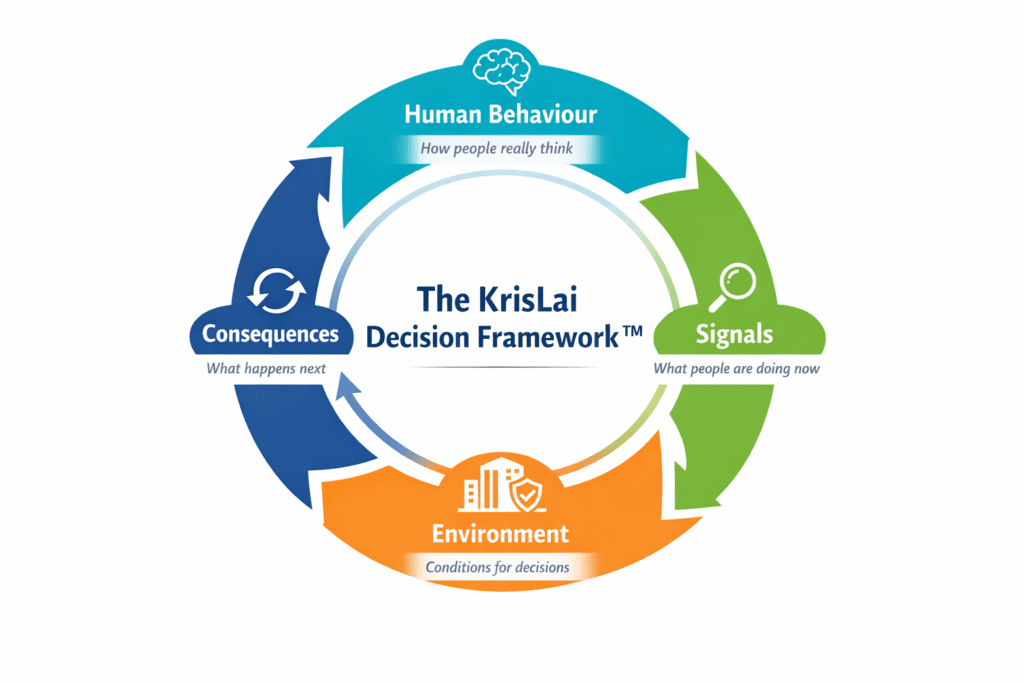
The framework helps leaders evaluate behaviour, signals, environment, and consequences before committing to important decisions.
It is designed for business owners, managers, and decision-makers who want more clarity when uncertainty is high.
Free Download: The KrisLai Decision Framework™
Want a simple, practical guide to making better business decisions under uncertainty?
Enter your email below and I’ll send you the free KrisLai Decision Framework™ guide, a practical model built around behaviour, signals, environment, and consequences.
It is designed to help you think more clearly, spot what matters sooner, and make better decisions in the real world.
If you enjoy exploring the ideas behind better business decisions, strategy, leadership, AI-era business thinking, and decision-making under uncertainty, you may find the Business Thinking Hub useful.
It brings together many of the concepts discussed across KrisLai.com into one place.
About the author
Kris Lai is a business operator and managing director with experience in land and building surveying, facilities management, logistics, and service delivery.
Earlier in his career, he worked as a Search Engine Evaluator (via Lionbridge, supporting Google), where he assessed search result relevance, user intent, and content quality using structured evaluation frameworks. This experience gives him a rare, practical understanding of how search systems interpret signals and make ranking decisions.
In parallel, whilst working with a charity organisation, he has delivered 1000’s of structured presentations in English, Finnish, and Chinese to audiences ranging from small groups to more than 600 people, and has spent decades mentoring and developing others. This experience informs his approach to clarity, communication, and decision-making under pressure.
He writes about AI, search behaviour, business strategy, and decision-making from a practical, real-world perspective.