
Some business decisions look brilliant at first — until their consequences arrive a few months later.
I once watched a company introduce a large promotional discount to “boost momentum.” At first, it worked exactly as planned. Sales jumped. The marketing team celebrated. The numbers looked good in the next quarterly report.
But a year later something strange had happened.
Customers had quietly learned to wait for discounts.
Full-price sales slowed down. Promotions had to become bigger and more frequent. Margins shrank. The strategy that once looked clever had trained customers to behave in a way the company never intended.
This is where second-order thinking becomes important.
Second-order thinking means looking beyond the immediate result of a decision and considering the consequences that follow afterwards.
The first result of a decision is rarely the final one. In business, every action sets off a chain of reactions — from customers, competitors, employees, and the wider market.
Or as a Finnish saying puts it:
“Hyvin suunniteltu on puoliksi tehty.”
Well planned is half done.
In this article, I want to explore how second-order thinking works in practice, why leaders often miss it, and how you can apply it when making everyday business decisions.
Interestingly, second-order thinking connects closely with ideas from behavioural economics. Many decisions that seem logical on paper produce unexpected outcomes because people do not behave as traditional economic models assume. Customers respond to incentives, habits, and psychological cues in ways leaders sometimes overlook.
If you’re interested in how human behaviour shapes business decisions, you may also enjoy exploring Behavioural Economics in Business: How Customers Really Make Decisions
Before we go further, it helps to define the idea clearly.
What is Second-Order Thinking?
Second-order thinking means looking beyond the immediate result of a decision and considering the consequences that follow afterwards. In business, it involves asking not only “What will happen first?” but also “What will happen next?” and “How will people respond over time?”
Leaders who practise second-order thinking try to anticipate how customers, competitors, and employees might react, helping them avoid unintended consequences and make better long-term decisions.
If you’re short on time, here are the main ideas from this article:
Key Takeaways
- Second-order thinking means considering the long-term consequences of decisions, not just the immediate result.
- Many business mistakes happen when leaders focus only on first-order effects such as short-term sales or quick cost savings.
- Asking “and then what?” repeatedly helps reveal the ripple effects of decisions.
- Second-order thinking is especially useful in areas such as pricing, incentives, strategy, and organisational policies.
- Leaders who think two or three steps ahead often avoid unintended consequences and make more resilient decisions.
Second-Order Thinking, Explained Without Jargon
Many business decisions fail not because they are foolish, but because they stop too early in their reasoning.
Leaders often focus on the first effect of a decision.
Second-order thinking asks what happens after that.
Let’s take a simple example:
Imagine a company decides to lower its prices.
At first glance, the logic is straightforward.
Lower prices → more customers → more sales.
That is the first-order result.
But second-order thinking asks what happens next.
Lower prices may bring more customers, but they can also teach customers to expect discounts. Competitors may respond by lowering their prices too. The market may slowly shift from valuing quality to valuing price.
Suddenly the company finds itself in a pricing race it never intended to join.
Second-order thinking does not mean overthinking every decision. It simply means recognising that actions often create ripple effects.
First-Order vs Second-Order Thinking: The Same Decision, Two Outcomes
To see the difference clearly, imagine the decision chain.
A company lowers its prices.
The first effect is easy to predict: more customers buy the product.
But the next steps are often overlooked.
Customers begin to associate the brand with discounts. Some delay purchases, waiting for the next promotion. Competitors match the price cuts. Profit margins shrink. The brand slowly loses its premium positioning.
The original decision may have solved a short-term problem while quietly creating a longer-term one.
In this way, the difference between first-order and second-order thinking is not intelligence. It is simply how far ahead we look.
Where Second-Order Thinking Helps Most in Business
Second-order thinking becomes particularly valuable in areas where human behaviour adapts quickly.
Pricing decisions are one example. Customers quickly learn patterns. If discounts become frequent, customers begin to expect them.
Hiring decisions are another. Rapid expansion can initially boost capacity, but if roles are poorly defined, it can create confusion and slower decision-making later.
Product changes also carry hidden consequences. A new feature might attract more users but increase customer support requests or technical complexity.
Even internal policies can create unintended incentives. A bonus system designed to encourage productivity may accidentally reward the wrong behaviour.
In each case, the first result is only the beginning of the story.
Second-order thinking is also important inside organisations. When leaders consider how policies and decisions affect behaviour over time, they often discover that trust and openness play a major role in whether teams respond constructively. This is closely related to the idea of psychological safety, which explores how workplace culture shapes decision-making and innovation.
You can read more about that here: Psychological Safety at Work
A Simple Way to Think Two Moves Ahead
A simple way to practise second-order thinking is to map the consequences of a decision step by step, as shown below:
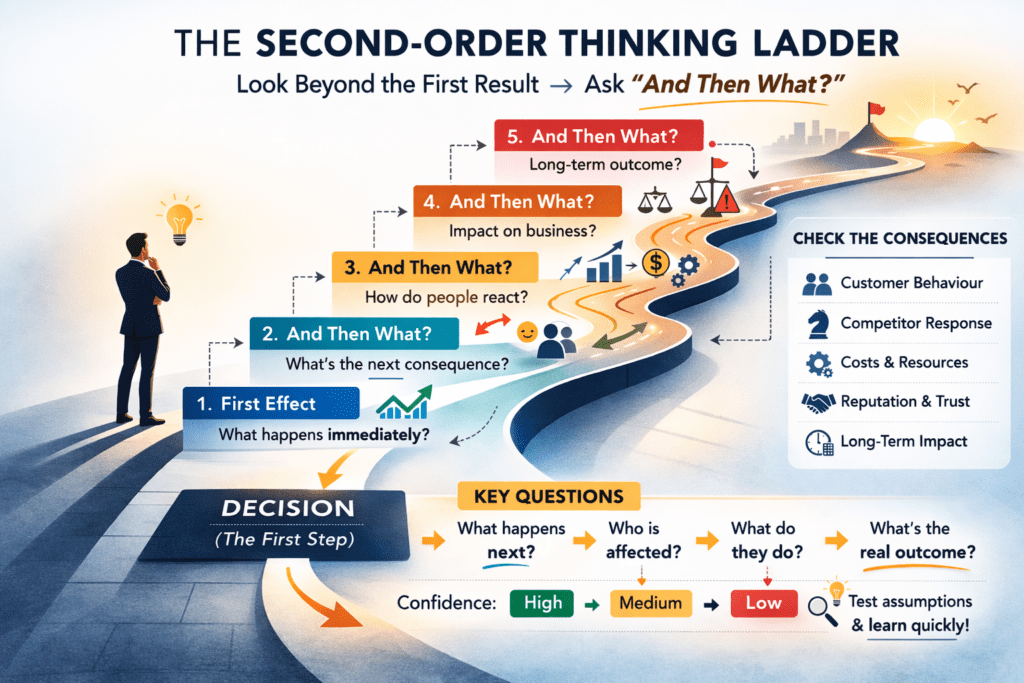
The goal is not perfect prediction. The goal is simply to push thinking beyond the obvious first result.
Second-order thinking becomes much easier when it is turned into a simple process rather than a vague idea.
One of the most useful tools I have seen is what I like to call the “and then what?” ladder.
The idea is straightforward.
Start with a decision you are considering. Write down the immediate effect you expect. Then ask one simple question:
And then what?
Take the answer you get and ask the same question again.
And then what?
Do this three or four times.
What begins as a simple decision suddenly becomes a chain of possible consequences.
The goal is not perfect prediction. It is simply to push thinking beyond the obvious.
Pressure-Test the Consequences
Once you have mapped out the likely chain of events, the next step is to pressure-test your assumptions.
This is where many teams discover things they had not previously considered.
- How might competitors respond?
- What behaviour does this decision encourage among customers or employees?
- Will this decision increase operational workload in unexpected ways?
- What happens if the change becomes permanent rather than temporary?
One of the most important lessons in business is that people adapt to incentives. Change a rule, a fee, or a reward, and behaviour often changes with it.
Sometimes in surprising ways.
Real Business Examples of Second-Order Thinking
Second-order thinking becomes much clearer when we look at real situations.
Business history is full of decisions that looked sensible at first but created unexpected consequences.
The following examples show how decisions that look sensible at first can produce unexpected consequences over time.
The Discount Trap
Many businesses fall into what I think of as the “discount trap.”
A company runs a promotion to boost short-term sales. It works. Revenue jumps during the campaign.
Encouraged by the results, the company repeats the strategy.
But over time, customers begin to recognise the pattern. Instead of buying at full price, they simply wait for the next promotion.
Sales may still occur, but they increasingly happen only when discounts appear. Profit margins shrink, and the brand slowly becomes associated with low prices rather than strong value.
What began as a tactical promotion gradually reshapes the entire business model.
Second-order thinking would ask earlier: What behaviour are we training customers to adopt?
When a Late Fee Makes the Problem Worse
A famous example comes from a daycare centre that introduced a small fine for parents who collected their children late.
The logic seemed obvious. A financial penalty should discourage lateness.
Instead, something unexpected happened.
Late pickups actually increased.
Why? Because the fine transformed a social rule into a financial transaction. Parents began to treat the fee as the price of being late rather than as a signal of inconvenience to staff!
The lesson applies to many business policies.
Cancellation fees, service penalties, or workplace rules can change behaviour in ways that leaders do not anticipate.
Policies shape behaviour. They do not simply enforce it.
Netflix and the Long-Term Bet
Second-order thinking is not always about avoiding mistakes. Sometimes it is about accepting short-term pain in order to build the future you want.
Netflix faced this moment in 2011 when it decided to separate its DVD business from its streaming service.
The move was unpopular. Customers were confused. The company faced criticism and cancellations.
From a first-order perspective, the decision looked disastrous.
But the long-term thinking behind it was clear. Streaming represented the future of media consumption.
By committing early to that future, Netflix positioned itself ahead of many competitors who remained focused on traditional distribution.
The short-term backlash was real, but the long-term strategy proved successful.
Second-order thinking sometimes requires courage.
The Hiring Surge That Slowed Decision-Making
A company experiencing rapid growth hires aggressively to keep up with demand. At first, productivity rises because more people are available to handle the workload.
But over time something else happens. Communication becomes more complicated. Meetings multiply. Decisions take longer because more stakeholders are involved.
What began as a solution to a capacity problem slowly turns into a coordination problem.
This is another reminder that decisions rarely stop at their first effect.
Common Mistakes When Applying Second-Order Thinking
Second-order thinking is powerful, but it is not magic. It can still go wrong.
One common mistake is simply stopping too early.
Teams often look one step beyond the immediate effect and then stop. But the most interesting consequences often appear two or three steps further along.
It can help to ask simple prompts such as:
What expectations does this decision create?
What happens when this scales?
What might competitors do next?
Another mistake is confusing second-order thinking with pessimism.
Thinking ahead does not mean assuming the worst. It means considering several possibilities — positive, negative, and neutral.
Good decision-makers often ask three questions:
What is the best case?
What is the worst case?
What is the most likely outcome?
Small experiments can help answer these questions when uncertainty is high.
Conclusion
Many business decisions fail not because leaders lack intelligence or effort, but because they stop thinking too soon.
First-order thinking focuses on the immediate result.
Second-order thinking asks what happens after that.
It asks how people will respond, how competitors will react, and how today’s decision might shape tomorrow’s behaviour.
The habit itself is simple.
Ask one question repeatedly:
And then what?
If you want to try this in practice, pick one decision you are currently considering — perhaps about pricing, hiring, policy, or product development.
Write down the immediate result you expect.
Then ask:
And then what?
And then what again.
You may be surprised how quickly a simple decision becomes a much richer picture.
As another Finnish saying reminds us:
“Kauas viisas katsoo.”
A wise person looks far ahead.
And in business, those who look a little further ahead often make the best decisions of all.
If you enjoy exploring the ideas behind better business decisions, you may find the Business Thinking Hub useful.
Frequently Asked Questions About Second-Order Thinking
What is second-order thinking in business?
Second-order thinking in business means considering the long-term consequences of a decision, not just the immediate result. Instead of focusing only on what happens first, leaders ask what happens next and how customers, competitors, and employees may react over time.
What is the difference between first-order and second-order thinking?
First-order thinking focuses on the immediate outcome of a decision. Second-order thinking looks at the chain of consequences that follow. For example, lowering prices may increase sales initially, but second-order thinking asks how competitors might react, how customer expectations might change, and how profit margins may evolve.
Why is second-order thinking important in business strategy?
Second-order thinking helps leaders avoid unintended consequences. Many strategies fail because they focus only on short-term results. By thinking two or three steps ahead, leaders can anticipate behavioural changes, competitor responses, and long-term strategic effects.
How can leaders practise second-order thinking?
A simple method is to ask “and then what?” repeatedly after making a decision. By mapping the chain of consequences step by step, leaders can identify hidden risks, behavioural changes, and long-term opportunities.
Can second-order thinking improve decision-making?
Yes. Second-order thinking improves decision-making by encouraging leaders to look beyond immediate outcomes and consider how actions influence behaviour, competition, and long-term strategy. It leads to more thoughtful and resilient decisions.
Build Deeper Insight
Second-order thinking is one of several ideas that help leaders make better decisions in complex situations. If you found this concept useful, you may also enjoy exploring these related articles.
- Behavioural Economics in Business: How Customers Really Make Decisions
Learn how psychological patterns influence business decisions and customer behaviour. - Psychological Safety at Work
Why teams perform better when people feel safe to speak up, challenge ideas, and admit mistakes. - Reinvent or Be Left Behind: Why Strategy Must Move at Market Speed
How organisations must adapt their strategies in fast-moving markets. - Business Thinking Hub
Explore the core ideas behind better leadership, strategy, and decision-making.
About the author
Kris Lai is a business operator and managing director with experience in land and building surveying, facilities management, logistics, and service delivery.
Earlier in his career, he worked as a Search Engine Evaluator (via Lionbridge, supporting Google), where he assessed search result relevance, user intent, and content quality using structured evaluation frameworks. This experience gives him a rare, practical understanding of how search systems interpret signals and make ranking decisions.
In parallel, whilst working with a charity organisation, he has delivered 1000’s of structured presentations in English, Finnish, and Chinese to audiences ranging from small groups to more than 600 people, and has spent decades mentoring and developing others. This experience informs his approach to clarity, communication, and decision-making under pressure.
He writes about AI, search behaviour, business strategy, and decision-making from a practical, real-world perspective.
- Digital Transformation for SMEs: 7 Questions Before You Invest
- Cybersecurity for Businesses: 7 Decisions Leaders Must Make

- How AI Is Changing Search Behaviour (And What Businesses Must Do Now)
- 7 Decision-Making Framework Examples for Business Leaders
- Business Decision-Making Framework: The KrisLai Method