

Your team has come into the office, only to spend the day on video calls. Meanwhile, a colleague working from home misses a decision that changes tomorrow’s deadline. You have people in the right places, apparently, but the work still falls through the gaps.
Managing hybrid and remote teams means making work clear across locations. These seven steps help you choose a working model, agree communication rules, build trust, measure results fairly and support your people. You will also find research, practical comparisons and a working agreement template to adapt with your team.
I write about how better decisions are made in business — combining strategy, behaviour, and practical thinking. Here, I focus on the decisions you face when your team works across different places, schedules and time zones.
This guide is for owners, entrepreneurs and managers who need work delivered reliably without treating adults like missing schoolchildren. The examples suit small and medium-sized businesses. The same questions also help leaders in larger organisations, where shared policies and responsibilities need more coordination.
We will compare the work models, look at the evidence and walk through seven practical steps. Then we will put them to work in a service-business example, examine common failures and consider where AI tools earn their place.
Keep one question beside you: what does the next person need to do their job well? It connects your choice of workplace to the everyday decisions that make teamwork work.
What are hybrid and remote teams?
Hybrid teams have people working at company premises and elsewhere, often at home. Remote teams work mainly away from a shared workplace. The main difference is where work happens. Both need clear roles, shared information and fair access to the decisions that affect their work.
A hybrid employee might work at home on Monday and in the office on Tuesday. A hybrid team might include full-time office staff, home-based colleagues and people who split their week. Those are different plans, even when everyone uses the same label.
| Working model | What it usually means | What the leader must make clear |
|---|---|---|
| On-site | Work takes place mainly at a shared workplace or customer location. | Coverage, shift handovers and access to information. |
| Hybrid | Work is split between the workplace and other agreed locations. | Who attends, when, why and how colleagues elsewhere take part. |
| Remote | Work takes place mainly away from a shared company workplace. | Availability, documentation, support and any agreed in-person activity. |
Within hybrid working, fixed days give a set pattern. Flexible plans allow more choice within agreed limits. Office-first models centre daily work on the workplace. Remote-first models make sure people elsewhere can find the information they need and take part in decisions.
Hybrid does not automatically mean “choose any day you fancy”. Specify what your business means before anyone books a train.
Think relay race: the baton has to travel
A team can have talented runners and still drop the baton. The same happens when a client promise stays in one person’s notebook or a decision disappears into a corridor conversation.
Location affects the handover. It does not replace it. A useful working agreement makes the baton visible: what was decided, who acts next and when they need to act.
What are the advantages and disadvantages of hybrid working?
Hybrid working can give people more choice, fewer commutes and quiet time, while keeping some face-to-face contact. It can also make it harder to share work, get support and be seen fairly. Results depend on the tasks, people’s needs and how the team is led.
A shorter commute is a clear benefit to an employee. The business can gain too, through good work, staff who stay or a wider choice of recruits. Check whether that happens. These gains do not arrive with the laptop…
| Potential advantage | Possible disadvantage | Decision to make |
|---|---|---|
| More control over focused work. | Home or office conditions may both be distracting. | Discuss suitable space, equipment and protected focus periods. |
| Less commuting on home-working days. | Poorly planned attendance can create travel without useful contact. | Give shared office time a clear purpose. |
| Access to people beyond the local area. | Time zones and employment arrangements add complexity. | Define feasible coverage and approved hiring locations. |
| In-person learning and relationship building. | People elsewhere may miss context or opportunities. | Make learning, decisions and development accessible across locations. |
| Flexibility for some roles. | Staff in physical roles may feel overlooked. | Explain role-based decisions and explore other forms of flexibility. |
A workshop technician, shop assistant and financial analyst face different limits. Fairness means taking those limits and each person’s needs seriously. Some tasks need more than a kitchen table.
Ask each group what causes friction. Office staff may be covering walk-ins without recognition. Remote staff may be waiting hours for an answer. Both experiences matter when you assess the arrangement.
What does the evidence say about hybrid work and performance?
Studies show that some hybrid plans can help people stay in their jobs without harming measured work results. They do not give every business an ideal schedule. Check what each study tested, then ask how well it fits your tasks, customers, people and working conditions.
A six-month randomised trial in 2021–2022 involved 1,612 graduate employees at Trip.com in China. It compared two optional home-working days with five office days.
Published in Nature in 2024, it found quit rates of 4.8% versus 7.2%. That is a drop of 2.4 percentage points, or one-third. Job satisfaction rose, with no measured harm to performance reviews over the next two years. Read the study.
This supports the hybrid plan studied at that company. It does not establish an ideal schedule for every firm or test fully remote work.
For context, the Office for National Statistics reported that 28% of working adults in Great Britain hybrid worked in January–March 2025. That is a dated British snapshot, not a worldwide figure or a measure of effectiveness. See the ONS release of 11 June 2025.
Feeling productive, sending more messages and completing accurate work are different measures. Use research to challenge your assumptions, then judge your own arrangement with delivery evidence and staff feedback. A confident opinion is still an opinion, even when it has a very expensive job title.
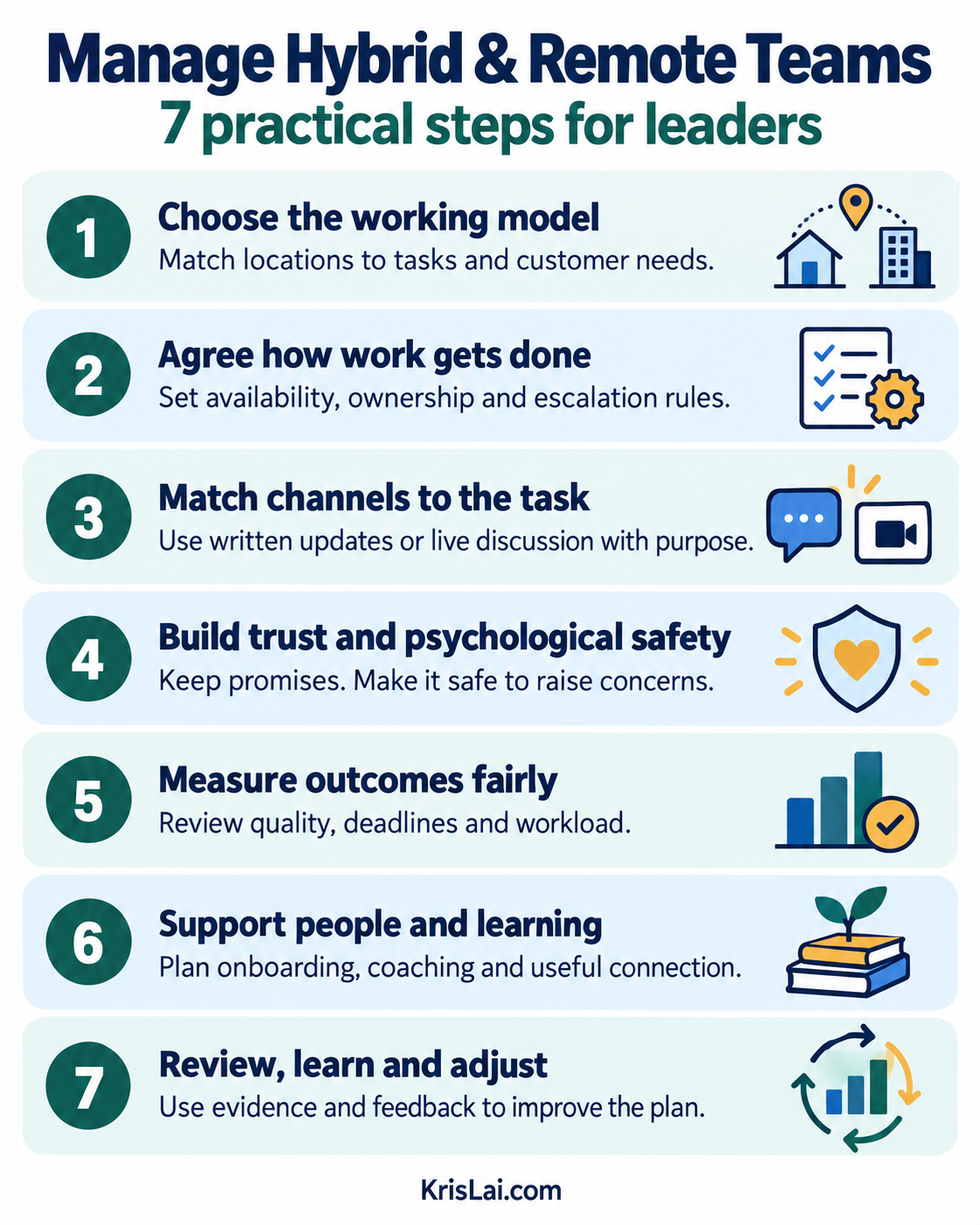
Step 1: How do you choose a hybrid or remote working model?
Choose a hybrid or remote working model by looking at the tasks, customer needs and links between people’s work. Agree what needs a shared place or time. Then test a clear plan with the team and check the results, rather than setting an office-day target first.
Start with a normal working week. List the tasks, the people involved and what they need to do the work. An owner may prefer to see everyone on Tuesday. Ask how that helps the business.
| Task | What it needs | Possible arrangement |
|---|---|---|
| Inspect equipment or receive physical deliveries. | Access to the site, safe staffing and the right equipment. | Planned on-site coverage with a named backup. |
| Write a proposal or analyse accounts. | Secure access, concentration and clear requirements. | A suitable quiet location, with review time agreed. |
| Resolve a complex design problem. | Shared context, discussion and visible materials. | A prepared workshop, in person or with effective remote participation. |
| Coach a new colleague. | Access to an experienced person and safe practice. | Planned pairing, with location chosen for the task. |
| Handle customer requests across time zones. | Coverage, ownership and reliable handovers. | Agreed shifts or overlap periods, supported by written records. |
The office day should have a job to do. If the aim is mentoring, arrange the mentor’s time. If the aim is resolving a project problem, bring the right information and people together. Attendance alone does not create either outcome.
For a small firm, start with one team and a short trial. In a larger business, check how your plan affects other teams, shared services and space on site. A flexible plan can cause trouble elsewhere if everyone assumes another team will provide the cover.
Finish this step with a plan, a clear reason for it and a list of limits. Check what you have already agreed. Get advice on local rules before changing formal terms.
Step 2: What should a hybrid team working agreement include?
A hybrid team working agreement should state where and when people work, who covers customers and how colleagues share updates. Name who makes decisions, the route for urgent problems and where records live. Include support, equipment, a review date and a way to suggest changes.
“Be available” sounds reasonable until one person means “answer immediately” and another means “I will check after lunch”. Write down what you actually need. Keep it short enough that people will use it.
Agree the rules together where possible. You still hold responsibility for service and standards, but colleagues often spot practical gaps that a manager misses.
A client may need an answer while their usual contact is off duty. Name the shared queue and backup owner. Define when the matter becomes urgent. Build a plan that works without someone checking a personal message during dinner…
Cover access and equipment too. Who helps if a laptop fails or someone cannot open a file? Who checks the workspace? Record where client data belongs and how colleagues get help.
This is an operational agreement about everyday work. It does not replace employment contracts, formal policies or individual adjustments. In the UK, Acas guidance covers role suitability, equipment, security and clear decision processes. Elsewhere, check the relevant local guidance before changing formal arrangements. Read Acas guidance on home and hybrid working policies.
You will find a copyable agreement later in this guide. Use it to make your expectations visible, then discuss any gaps before you call it agreed.
Step 3: How should hybrid and remote teams communicate?
Hybrid and remote teams should choose how to communicate based on urgency, the task and the need to talk. Use written updates when people can reply later, and live calls when quick discussion helps. Agree reply times, record decisions and name the contact for urgent issues.
Asynchronous communication means people reply at different times. Synchronous communication means they talk live. Choose the form that fits the task. A routine update rarely needs eight people in a call. A tense dispute rarely improves through a twenty-message argument…
| Situation | Channel | Illustrative expectation |
|---|---|---|
| A routine project update. | Shared task board or project document. | Update before the agreed weekly review; no immediate reply required. |
| A question blocking today’s work. | Named team channel, with the owner tagged. | During agreed coverage, acknowledge within two working hours or use the backup route. |
| A serious service incident. | Approved incident channel or telephone route. | Contact the designated on-duty person immediately; follow the incident procedure. |
| A difficult performance or relationship issue. | Private, prepared conversation. | Arrange a suitable time and confirm agreed actions afterwards. |
| A decision affecting other people. | Short decision record linked to the work. | Record the owner, choice, reason, affected people and next action. |
These rules need an owner. If nobody monitors the urgent channel, its name is merely optimistic branding.
For work across time zones, show each person’s hours with a named time zone. Check daylight-saving changes. Share the burden of awkward call times where you can. The same person should not always lose their evening.
A useful handover states: what is complete, what remains, who owns it, when it is needed and where the source material lives. Ask the receiving person to confirm ownership when the risk justifies it.
Store final decisions where people can find them. Check they have access. Chat helps people talk things through, but “it was somewhere in Tuesday’s messages” is a fairly fragile filing system.
Colorado State University’s communication agreement guidance provides another practical reference for discussing channels and response norms. Your team’s actual needs should determine the finished rules.
Step 4: How do you build trust and psychological safety in hybrid teams?
Build trust in hybrid teams by keeping promises, explaining choices and giving people help when they need it. Build psychological safety by making it safe to ask questions, raise concerns and admit mistakes without shame. Show this in how you react when work gets difficult or plans are challenged.
Trust concerns whether you can rely on someone. Psychological safety concerns whether it feels safe to take a social risk. Can you admit you are confused or raise a concern? The two ideas are linked, but they answer different questions.
The CIPD’s 2024 evidence review links trust and psychological safety with team outcomes, including learning and performance. For leaders, this means looking at relationships, working conditions and their own actions. Read the CIPD practice summary.
Picture a remote colleague saying, “I think that deadline is unsafe.” If you dismiss them and continue the room’s conversation, an invitation to “speak freely” will not carry much weight next time.
Instead, ask what they can see that the group might be missing. Check the concern. Explain the final decision. You can hold someone accountable while treating their contribution with respect.
Make hybrid meetings fair enough to contribute
- Send the purpose, decision needed and relevant material in advance.
- Check that remote participants can hear, see and access the same material.
- Pause side conversations that remote colleagues cannot follow.
- Invite written input and give people time to think before closing a decision.
- Record actions and owners where everyone affected can find them.
Watch for proximity bias: giving more weight to people because you see them often. Before you assign a key project, ask who has the skills, who needs to learn and who has had chances before. Check the pattern across locations.
What I’ve seen in business is that stated values face their real test under pressure. A calm response to unwelcome news tells people far more than a poster about openness!
For the distinction between a pleasant workplace and one where people can raise difficult issues, see Psychological Safety at Work. Respectful challenge helps you discover problems while you can still do something about them.
Step 5: How do you measure hybrid and remote team performance fairly?
Judge hybrid and remote team performance by the work agreed, its quality and when it is done. Use fair standards for each role. Check workloads and delays caused by others, discuss problems early and offer help. Online status and message counts give you a poor view of useful results.
A green dot on Teams is a poor substitute for a finished job. It tells you little about whether a customer received the right answer or a proposal was accurate.
Agree what good work looks like before assessing it. Include quality and the conditions people need to deliver. If you only count closed tickets, you may encourage quick closures that leave the customer’s problem untouched.
| Role | Useful evidence | Context to check |
|---|---|---|
| Customer support. | Correct resolution, response against agreed service levels and repeat contacts. | Case complexity, staffing, system faults and customer feedback. |
| Project delivery. | Accepted milestones, quality, rework and risks raised early. | Changes in scope, missing inputs and decisions awaiting approval. |
| Account management. | Kept client commitments, useful account plans and progress towards agreed goals. | Account maturity, market changes and dependencies on delivery teams. |
Suppose a report is late. Start with: “We agreed Friday. What got in the way?” Then check five things. Was the task clear? Was there too much work? Did someone else cause a delay? Was there a skill gap? Was it a conduct issue? Each calls for a different response.
If the employee was waiting for approval, agree an escalation point and an approver’s deadline. If the task exceeded their skill, arrange coaching and a smaller review milestone. Repeating “take more ownership” will not create an approval or teach the missing skill.
Use the same standards across locations. A senior colleague may feel good about someone they see at lunch. Check that view against the work. Give people elsewhere the same fair chance.
For UK employers, Acas recommends clear targets, review discussions and support. It also warns that excessive or intrusive monitoring can damage trust and cause stress. Explain any monitoring and check the rules that apply where your people work. See Acas guidance on monitoring performance.
My wider guide to how high-performance teams actually work explores the connection between clear expectations, behaviour and better decisions.
Step 6: How do you support culture, onboarding and wellbeing across locations?
Support hybrid and remote staff with a clear start, regular coaching, chances to learn and work they can manage. Build contact into daily work as well as social events. Ask what help people need, respect agreed hours and offer fair access to growth wherever they work.
Culture shows up in what happens when somebody needs help. Can a new starter ask a basic question? Does a manager make time for coaching? Can someone finish work without proving their dedication through late-night replies?
These questions matter more than whether the team has acquired another virtual quiz subscription...
Give a new starter a route into the team
Before their first day, check equipment, access and the first week’s schedule. Tell them who will help with work questions and who handles technical problems. Give their buddy time to perform the role.
During the first week, explain the work, customers, who can decide what and how the team shares updates. Set a small, useful task with a clear standard. Review it together, then agree the next step.
Build in observation and practice. A junior colleague may need to hear a difficult client conversation, try the next one with support and discuss what happened. Put that learning on the calendar rather than hoping it happens nearby.
The University of Washington’s remote onboarding checklist is a useful reference for preparing equipment, introductions and early support. Adapt the practical ideas to your business.
A Finnish saying fits here: “Kukaan ei ole seppä syntyessään” — nobody is born a master. A new employee cannot absorb your unwritten rules through the Wi-Fi…
Look at workload before prescribing resilience
In a one-to-one, ask: “What is taking longer than we planned?” and “What should we stop or delay?” Discuss conflicting priorities, access needs and isolation. Agree a practical change and follow it up.
Make social contact welcoming, with options that work across locations and different lives. Keep key work updates in work channels. Someone who misses the social event should still know what the team decided.
Managers can listen, change work and help people find support. They should not diagnose health conditions. If concerns persist, seek the right professional help and follow the workplace process.
For the longer view, my article on employee retention in small businesses connects day-to-day management choices with reasons people stay or leave.
Step 7: How do you review and improve a hybrid working arrangement?
Review a hybrid working plan against a clear starting point, a few useful measures and feedback from those involved. Check work quality, deadlines, workloads, inclusion and customer cover. Set a review date at the start, then decide which parts of the plan to keep, change or stop.
A 30-day review can reveal an awkward handover or unnecessary meeting. It cannot establish long-term retention effects. Match the review period to the question, and treat early findings as signals to investigate.
Before the trial, record where you are now. Pick a few things to track. These could be missed client promises, rework, blocked tasks and meeting time. Ask the team about support and access to decisions too.
Keep the measures clear. If a “missed commitment” means something different each week, the trend may tell you more about your records than your team.
Apply the four lenses of the KrisLai Decision Framework™
Over time, I’ve found that good decisions rarely come from data alone. They come from understanding people, reading signals, creating the right environment, and thinking beyond the immediate outcome.
This approach is part of the KrisLai Decision Framework, a practical method for improving business decisions. Its four lenses help you examine an arrangement from different angles:
- Behaviour: What are people actually doing? Are they sharing problems early or quietly working around them?
- Signals: What do delivery records, customer feedback and staff concerns suggest? What evidence is missing?
- Environment: Do tools, incentives, working hours and decision rights make good work easier?
- Consequences: What happens next if we keep this rule? Who gains, who carries the cost and what might we miss?
Use the lenses together, in the order that helps you think. They support the seven practical steps in this guide.
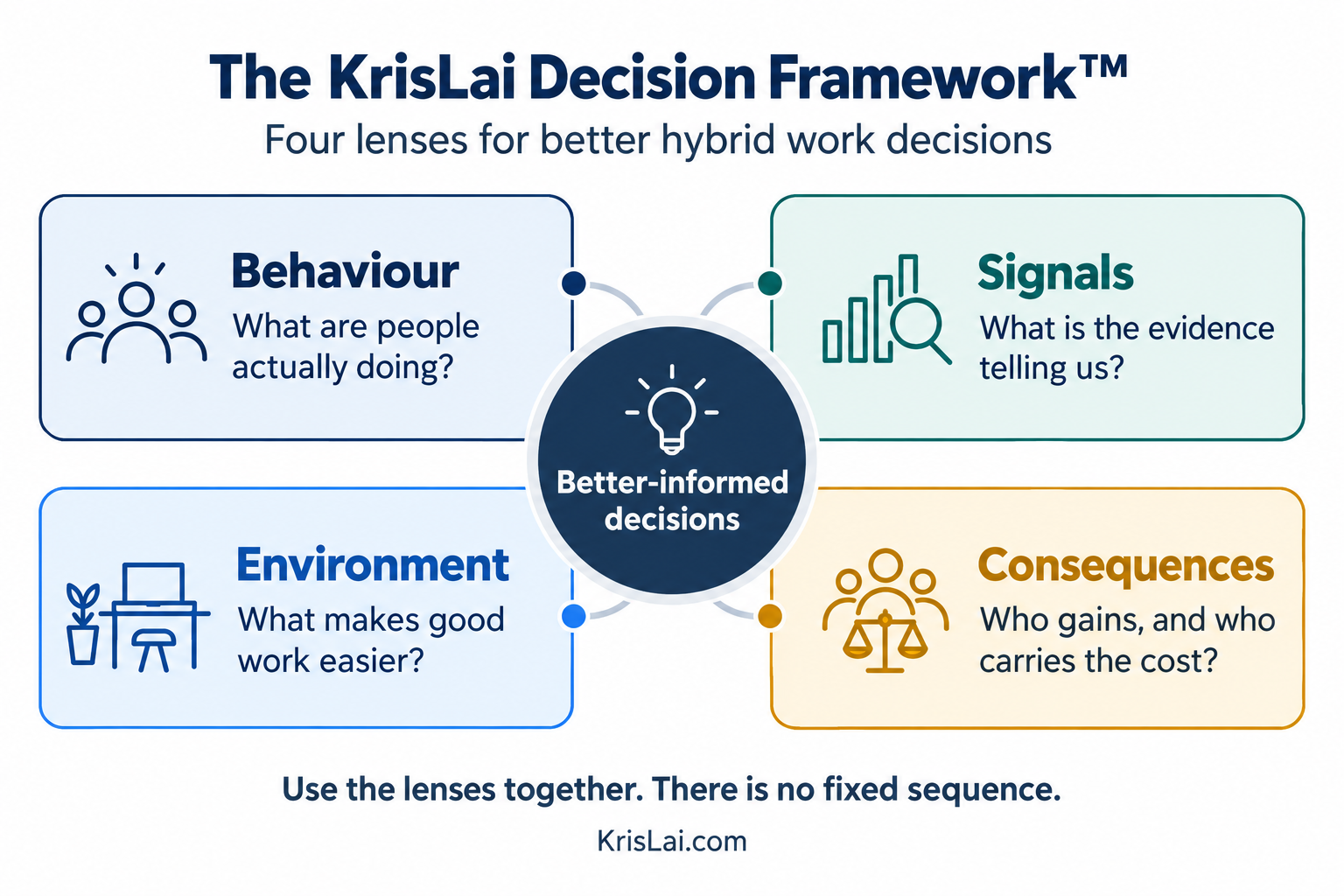
Better decisions come from understanding behaviour, signals, environment, and consequences.
If deadlines improve but overtime rises, investigate the cost of that improvement. If attendance rises but coordination stays poor, examine the handover. Change the practice that causes the problem and record why you changed it.
This connects closely to how I think about decisions more broadly in the KrisLai Decision Framework™.
What does managing a hybrid team look like in real business?
In a service business, good hybrid management keeps customer promises clear across locations. A shared record shows the owner, deadline, next action and backup. Office time has a clear purpose. A short review then checks whether the way people work helps delivery without adding hidden costs or unfair pressure.
This is a hypothetical worked example, not a reported client case: Imagine a 12-person consultancy with colleagues in Britain, Portugal and the eastern United States. Some work in a shared office. Others work remotely.
A consultant promises a client a revised proposal. An office colleague changes the scope after a conversation with the owner. The remote delivery lead sees the change too late, and the proposal misses its deadline.
The first reaction is: “We need everyone in more often.” I would ask a different question first: where did the commitment lose its owner and its shared record?
| Issue | Agreed practice | Evidence to review |
|---|---|---|
| Promises made in private conversations. | The person making a client commitment enters its owner, deadline and scope in the shared client board. | Commitments without an owner; missed dates; rework. |
| Scope changes without delivery input. | The delivery lead confirms impact before a revised date is promised. | Unapproved changes and time spent correcting proposals. |
| Unclear cover across locations. | A rota names the person covering each agreed client-service period and the backup. | Uncovered periods and customer escalations. |
| Office days without useful shared work. | Book a monthly proposal workshop with the people needed; provide effective remote access. | Decisions completed and unresolved questions afterwards. |
| A rule that drifts without review. | The owner and team review the trial after 30 days, using a recorded starting point. | Delivery, quality, meeting time and staff workload. |
The leader explains the changes and checks that everyone can use the board. A named person handles access problems. Each colleague confirms the promises they own. Now the agreement becomes part of the work.
The review could lead to several choices. Fewer missed promises with steady workloads would support keeping the process. If people need regular overtime to deliver, check staffing and workload. If little changes, check for slow approvals or a skills gap.
We have not measured a real improvement here. We have shown how to make a decision testable. The consequence you want is reliable client delivery with a working pattern people can sustain.
Where managing hybrid and remote teams goes wrong
Hybrid and remote teams run into trouble when work is unclear, decisions go unrecorded or leaders reward being seen more than getting things done. Risks also grow when meetings lack owners, work spills into personal time or staff stay silent. Find the cause before adding another rule or tool.
A useful warning sign is a problem that returns under a different label. Last month it was “poor communication”. This month it is “lack of accountability”. If the same approval still waits three days, look there first.
- Blanket attendance: people travel in, but the necessary colleague or information is elsewhere. Give shared time a purpose.
- More status meetings: everyone reports activity, yet nobody owns the next decision. Name the owner and the deadline.
- Rewarding constant availability: quick replies hide overloaded people and interrupt focused work. Agree coverage and realistic response windows.
- Tracking activity without context: keyboard activity becomes a target, while quality remains unclear. Review work and use proportionate, transparent processes.
- Publishing rules and walking away: the agreement exists, but access gaps and exceptions never get resolved. Give implementation an owner.
In my experience, a clear question is a better starting point than a long list of rules. Ask: “What failed, under what conditions, and what would have prevented it?” You may need a staffing change, training or a firmer performance conversation. You may also need to change your own approval habits.
Be careful with silence! A quiet team might be working well. It might also have learnt that raising concerns is pointless. Ask for specific examples and follow through on one practical improvement. People judge the invitation by what happens after they accept it.
Which AI tools can help hybrid and remote teams?
AI tools can help hybrid and remote teams write meeting notes, find facts, draft updates and plan time. Choose one for a clear, recurring problem, then compare it with tools you already have or a simple manual process. People must still check facts, protect data and own decisions.
Start with the job. Are decisions getting lost? Are calendars overloaded? Are updates hard to understand? Buying one tool for each frustration can leave you with an expensive collection of new frustrations.
Affiliate disclosure: If you purchase through the Fireflies link below, I may earn a commission.
| Need | Option to consider | Simpler alternative | What to test |
|---|---|---|---|
| Capture meeting discussions and draft action notes. | Fireflies offers transcription and AI summaries. | A shared agenda with a named note-taker and decision log. | Accuracy of decisions, owners and dates; permitted recording; suitable access. |
| Fit tasks and focus time into busy calendars. | Reclaim offers automated scheduling for tasks and focus time. | Shared availability, protected calendar blocks and fewer recurring meetings. | Realistic working hours, control over changes and usable focus periods. |
| Draft a clearer update or handover. | An approved AI writing assistant using information you are allowed to share. | A short update template: progress, risk, next action, owner and date. | Factual accuracy, confidentiality and whether the recipient can act. |
These are options to assess. I am not claiming to have tested every product. Check current features, plans and how they connect with your systems. You may already pay for a feature that does the job.
For meeting tools, decide which conversations may be recorded, how participants are informed, what permissions are needed and who can access or delete the record. Follow the rules that apply. Keep sensitive HR and client information out of an unapproved tool.
A human should confirm the final actions. “Alex might investigate that” and “Alex owns the fix by Friday” are very different commitments. An attractive summary does not settle the difference.
How AI search changes the management question
You might ask an AI assistant, “What is the best hybrid schedule for a 12-person consultancy?” A useful follow-up is: “What do you need to know before recommending one?”
Supply an anonymised description of tasks, service hours, dependencies and constraints. Ask for assumptions, trade-offs and links to original evidence. Check the answer against your actual work and consult the people affected.
As I discuss in How AI Is Changing Search Behaviour, people can explore a decision through a sequence of questions. For a team leader, the value lies in turning those questions into a workable agreement. An answer still needs an owner when it reaches the business.
What you should actually do: create your hybrid team working agreement
Create a useful hybrid team working agreement by choosing one recurring problem, agreeing the rules that would prevent it and naming the people responsible. Record the plan on one page, check that everyone can use it and set a review date. Start with a practical agreement you can improve.
If you have read this far, resist the urge to launch a company-wide transformation programme before lunch! Pick one situation: a missed handover, unclear client cover, an unhelpful office day or a colleague who cannot get support.
The KrisLai Hybrid Team Working Agreement Template below is a practical planning aid for making everyday expectations explicit. It is not a legal policy or a validated assessment. Copy it into a shared document and complete it with your team.
Team and agreement owner: [Name the team and the person maintaining this agreement.]
Problem we are solving: [Describe one recurring situation and its impact.]
Outcome we need: [State the service, quality or delivery result.]
Roles and agreed locations: [List role needs, attendance purposes and links to any formal arrangements. Keep private personal details elsewhere.]
Working hours and customer cover: [Use named time zones. Identify the rota, coverage owner, backup and any agreed overlap.]
Where work and decisions live: [Link the shared task board, documents and decision record.]
Communication and responses: [Name each channel’s purpose and response expectation during working hours.]
Urgent issues: [Define urgency, the contact route and the on-duty backup.]
Handover rule: [Record status, next action, owner, deadline and source material; state when receipt must be confirmed.]
Decision authority: [Who may decide what? Who approves changes to scope, cost or customer promises?]
Support and access: [Name equipment support, onboarding and coaching arrangements, plus the private route for individual needs.]
Starting point and review: [Record a few baseline measures, the trial period and the review date.]
How we change the agreement: [Who gathers feedback, checks formal requirements and communicates the agreed change?]
Read it against a real task. Ask the next person in the chain to explain what they would do. If they still need to guess the owner or search three systems for the latest version, fix that gap before adding more detail.
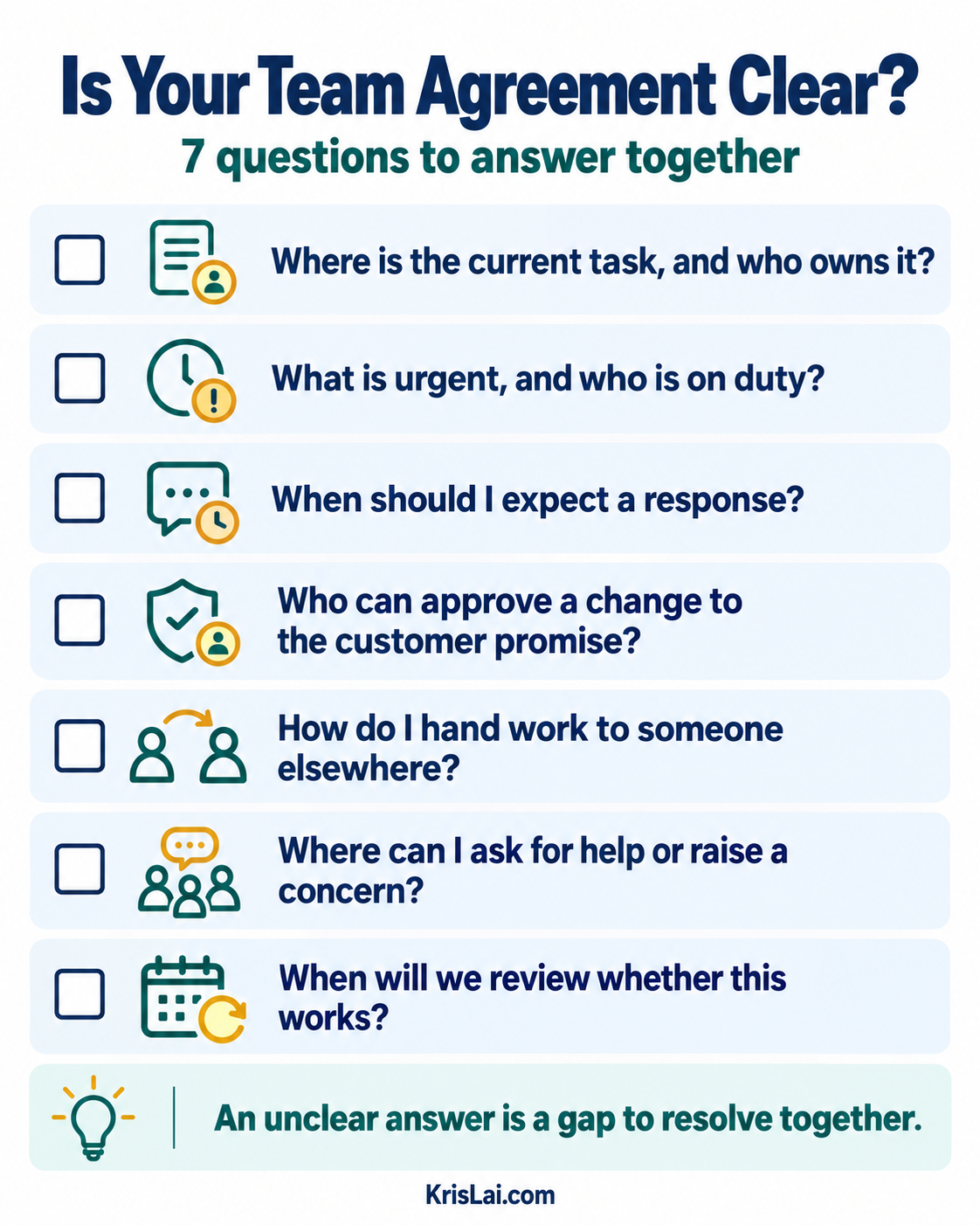
Check whether your agreement is usable
Ask a team member these questions without coaching the answers:
- Where do I find the current task and its owner?
- What does “urgent” mean, and who is on duty?
- When should I expect a response?
- Who can approve a change to the customer promise?
- How do I hand work to someone in another location?
- Where do I ask for help or raise a concern?
- When will we review whether this works?
An unclear answer is a gap to resolve together. This is a usability check, not a score of how trustworthy or capable your team is.
Calculate your team’s meeting load
Use this simple calculation to make one cost visible:
Weekly meeting load = attendees × meeting length in hours × meetings per week
For eight people attending two 45-minute meetings each week:
8 × (45 ÷ 60) × 2 = 12 person-hours per week.
That is the team’s combined attendance time, not 12 hours in each person’s diary. Add preparation and follow-up separately if you want a fuller picture. For meetings with different lengths or attendance, calculate each one and add the totals.
You can multiply person-hours by an appropriate average hourly employment cost to estimate the time’s cost. Cutting a meeting does not automatically create cash savings. It may release capacity, and the meeting may still justify its time if it resolves an important decision.
Ask what the meeting produces, who needs to attend and whether a shorter call or written update could do the job. Protect the contact that helps people learn, coordinate and raise difficult issues.
What does a co-located team mean?
A co-located team works together in the same physical place. That can make some conversations easier, but it still needs clear ownership, records and handovers. Sharing a room does not ensure that everyone has the same information.
Is a compressed working week the same as hybrid working?
No. A compressed week changes when hours are worked, often fitting agreed hours into fewer days. Hybrid working changes where work takes place. A person may have either arrangement, both or neither. Each needs its own coverage and workload discussion.
Can a hybrid team include freelancers?
Yes. A mixed-location project can include employees and external specialists. Clarify deliverables, access, confidentiality and coordination. Keep the arrangements appropriate to each person’s contractual status rather than automatically applying employee rules to everyone involved.
Frequently asked questions about hybrid and remote teams
The right hybrid arrangement depends on the role, the people and the work. These answers address common choices about office days, new starters, cameras, international working and leadership. Use them to clarify your options, then check the practical and formal requirements that apply to your team.
What are examples of hybrid jobs?
Hybrid jobs can include accounting, marketing, software development, project management and some customer-support work. Suitability depends on the tasks, data rules, customer needs and equipment. Job titles alone tell you little. Check what the person does each day and where each task can be done well.
What are the four types of work teams?
There is no single universal list of four team types. One common grouping is problem-solving, self-managed, cross-functional and virtual teams, but other classifications exist. These describe structure or collaboration, while on-site, hybrid and remote describe location. State the classification you mean before comparing teams or designing a working model.
How many days should a hybrid team spend in the office?
There is no best number of office days for every team. Start with tasks that need people together, then check client cover, learning and staff needs. Try the plan and review it. A study of one firm cannot tell you the right schedule for your business.
Is it unfair if some roles can work remotely and others cannot?
Different work patterns can be fair when they reflect real task needs and personal needs. Explain why, use a clear process and listen to concerns. For site-based roles, look at other options, such as steady shifts or suitable hours. Check that the service can support what you offer.
Can new employees start remotely?
New staff can start remotely if the job and support allow it. Set up equipment, access, introductions and a clear first-week plan. Name someone who can help. Give regular feedback and chances to watch skilled colleagues. Plan in-person learning where it helps, and check that learning takes place.
Should cameras be compulsory in remote meetings?
Choose camera rules to suit the meeting, access needs, connection quality and people’s circumstances. Explain when seeing one another helps. Offer other ways to take part where needed. Look at what people contribute and the work they do. Check local rules and policies before making cameras compulsory for everyone.
Can remote employees work from another country?
Remote work does not give staff automatic permission to work from another country. Check work rights, employment rules, tax, insurance, data security and client needs with the right specialists. Agree the place and length of stay in writing. A laptop crosses borders more easily than an employer’s duties.
How can a small business manage hybrid working without an HR department?
A small business can start with a clear team agreement, named owners and a simple review. Keep formal terms and private staff details in the right place. Use trusted local guidance. Seek qualified advice when contracts or legal issues arise. Aim for clear work and good support with manageable admin.
Can a manager work remotely while some team members are on-site?
A manager can work remotely if staff can reach them, they understand site conditions and they arrange local help. Keep coaching and chances to learn fair across locations. Name who deals with on-site incidents and urgent client needs. Being online helps little if the team cannot get practical support…
About the research and examples
This guide combines my practical business perspective with independent research and my analysis of how the findings apply to everyday leadership. Source links sit beside the claims they support. The consultancy example is hypothetical, and the tables, communication norms and template are practical suggestions to adapt with your team.
The evidence and product information were reviewed on 20 October 2026. Study dates and locations are stated because context matters. This article offers management guidance for a worldwide audience; UK guidance is labelled, and formal requirements depend on the locations and people involved.
I help people make better business decisions through psychology, strategy, and practical thinking. My aim here is to help you ask better questions and put useful answers into practice.
Credit: Images created for KrisLai.com with AI assistance. The featured image is an illustrative scene, not a photograph of Kris Lai, a client or a documented business case.
Your next step: make one handover work better
Better management of hybrid and remote teams starts with clear work, reliable handovers and fair support. You now have seven steps, a way to review the evidence and a working agreement to adapt. Use them to resolve one recurring problem before expanding the changes across your business.
Use the copyable template with your team. Start with one missed handover or unclear commitment, agree the fix and put the review date in the diary.
This may feel daunting when people already have full calendars. A small, clear agreement gives you a manageable starting point. You can improve it together as the evidence comes in.
For the wider thinking behind your agreement, the free guide is available through the sign-up form on the KrisLai Decision Framework page. Keep its four lenses beside you when a workplace decision has more than one plausible answer.
If you enjoy exploring the ideas behind better business decisions, you may find the Business Thinking Hub useful.
About the author
Kris Lai is a business operator and managing director with experience in land and building surveying, facilities management, logistics, and service delivery.
Earlier in his career, he worked as a Search Engine Evaluator (via Lionbridge, supporting Google), where he assessed search result relevance, user intent, and content quality using structured evaluation frameworks. This experience gives him a rare, practical understanding of how search systems interpret signals and make ranking decisions.
In parallel, whilst working with a charity organisation, he has delivered 1000’s of structured presentations in English, Finnish, and Chinese to audiences ranging from small groups to more than 600 people, and has spent decades mentoring and developing others. This experience informs his approach to clarity, communication, and decision-making under pressure.
He writes about AI, search behaviour, business strategy, and decision-making from a practical, real-world perspective.
👉 Explore ideas connected to better business decisions:
- Digital Transformation for SMEs: 7 Questions Before You InvestDigital transformation for SMEs should start with better decisions, not more technology. This guide explains seven questions to ask before investing in AI, automation, data systems, or new software, helping you improve processes, reduce risk, and prove value before you scale.
- Cybersecurity for Businesses: 7 Decisions Leaders Must MakeCybersecurity for businesses is not just an IT issue. It is a leadership decision about protecting email, accounts, devices, backups, staff behaviour, customer data, supplier access, trust, and business continuity. This guide explains the seven cyber decisions leaders should make before a small problem becomes a costly incident.
- How AI Is Changing Search Behaviour (And What Businesses Must Do Now)AI is changing how people search, compare, and buy. Learn what this means for visibility, trust, and growth — and what businesses must do now.
- 7 Decision-Making Framework Examples for Business LeadersSeven practical decision-making frameworks for managers and business owners, with real business examples, guidance on when to use each model, a simple framework selector and a decision template.
- Business Decision-Making Framework: The KrisLai MethodMake more informed business decisions under uncertainty with the KrisLai Decision Framework. Explore four complementary lenses, follow a practical five-step process, and learn from my real pricing decision that reduced workload while increasing revenue and profit.