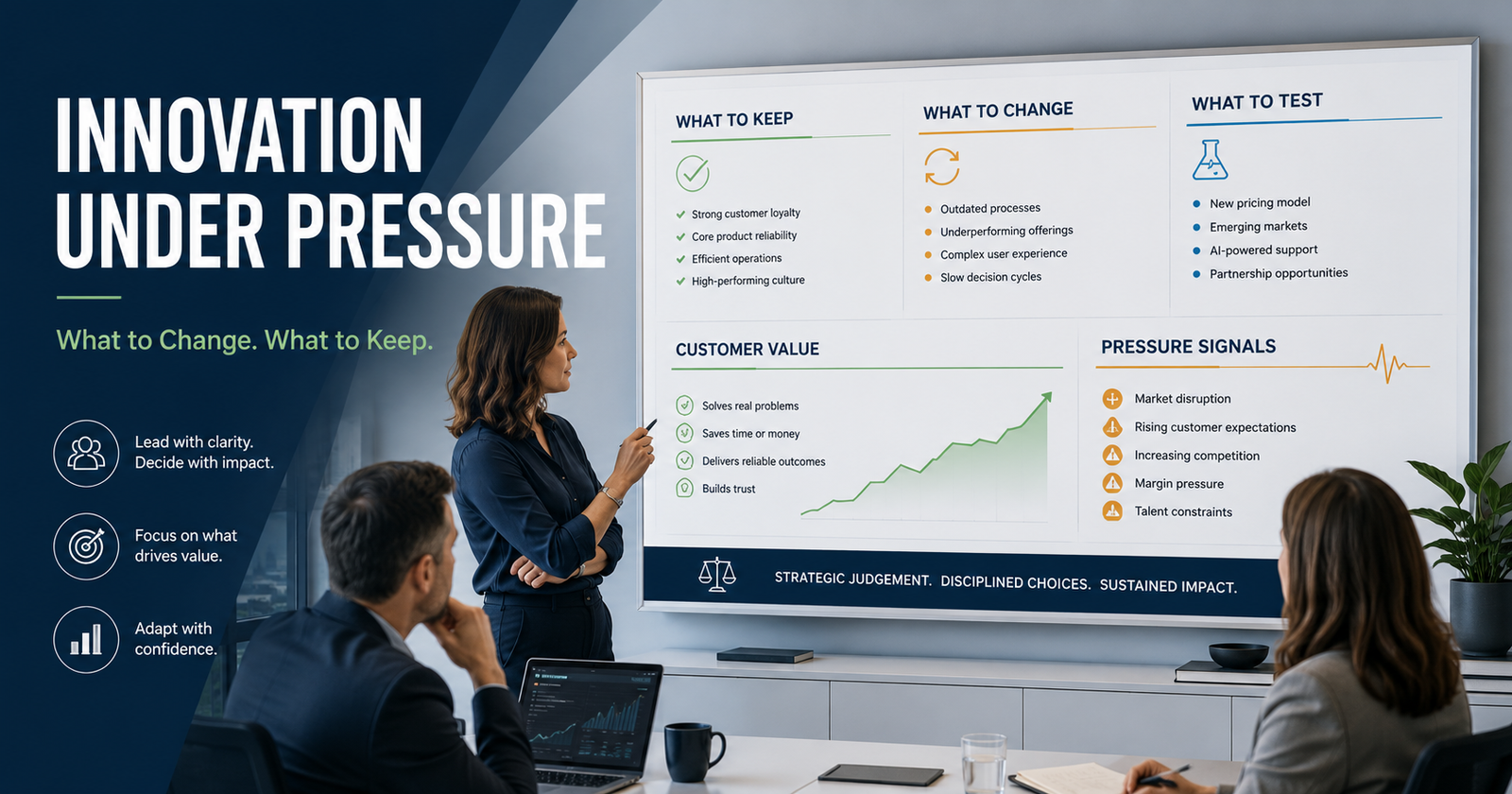
Innovation in business is not about changing everything in a panic. It is about deciding what still creates value, what is slowing the business down, and what needs testing before a bigger move is made. Under pressure, good innovation depends less on hype and more on judgement.
Innovation sounds exciting until pressure gets involved.
Then it gets messy.
In easy times, people talk about ideas, growth, and opportunity. In harder times, innovation often becomes a more uncomfortable question: what do we change, what do we keep, and how do we avoid making things worse while trying to make them better?
That is the version of innovation I care about.
In plain English, innovation in business means improving products, services, processes, or business models in ways that create real value. It does not always mean inventing something brand new. The current research is quite clear on that. McKinsey defines innovation in business as the ability to conceive, develop, deliver, and scale new products, services, processes, and business models for customers, while Harvard Business School notes that innovation can be as simple as a better process, better service, or a more useful strategy, not just a technological breakthrough.
I write about how better decisions are made in business — combining strategy, behaviour, and practical thinking. So I do not want to treat innovation as a motivational slogan or a creativity workshop with beanbags and optimistic flipcharts. I want to treat it as a leadership judgement problem.
This approach is part of the KrisLai Decision Framework, a practical method for improving business decisions. Better decisions come from understanding behaviour, signals, environment, and consequences. Innovation under pressure is exactly that. Over time, I’ve found that good decisions rarely come from data alone. They come from understanding people, reading signals, creating the right environment, and thinking beyond the immediate outcome.
Innovation in business means improving products, services, processes, or business models in ways that create real value. It is not change for its own sake.
- Innovation is not the same as invention.
- Under pressure, the real challenge is deciding what to change and what to keep.
- Good leaders protect what still creates value and change what blocks progress.
- Small tests usually beat big guesses.
- The best innovation strategy is grounded in customer needs, evidence, and real-world execution.
If you remember nothing else but this, remember this: innovation under pressure is not about changing everything. It is about protecting what still works, improving what is slowing you down, and testing what is still uncertain.
What is innovation in business?
Innovation in business means creating or improving something in a way that adds real value.
According to my research, when people search what is innovation in business, what is innovation, business innovation, or innovation definition, they usually want something simple enough to use, not just something clever enough to quote. The best current sources are fairly consistent: business innovation includes new or improved products, services, processes, and business models that help the business grow, work better, or serve customers more effectively.
What does innovate mean in plain English?
Innovate meaning in plain English is simple: to introduce useful change.
The Cambridge definition is straightforward, and in a business setting that usually means improving the way something is done, delivered, sold, or experienced.
So when people ask for innovate definition or innovation in business, I would put it like this:
Innovation means changing something in a way that makes it better, more useful, more efficient, more valuable, or more relevant.
That sounds almost too simple, but that is the point!
Innovation vs invention: what is the difference?
Innovation vs invention is one of the most useful distinctions here.
Invention is about creating something genuinely new.
Innovation is often about applying, improving, adapting, combining, or delivering ideas in ways that create value.
That is why a business can be highly innovative without inventing a world-changing device in a garage while lightning flashes outside.
Digital Leadership makes this difference clearly, and Harvard also points out that innovation does not need to be a dramatic technological breakthrough to matter.
In my experience, this matters because some leaders hear “innovation” and assume it means total reinvention. It often does not. Sometimes it means fixing the thing everybody has been quietly working around for two years.
What are the main types of innovation in business?
The main types of innovation in business usually include:
- product innovation
- service innovation
- process innovation
- business model innovation
This is one area where the current results are especially useful. Innovate UK Business Connect and WeWork both make clear that innovation can include new ideas, services, products, and processes, not just physical inventions.
That matters because a lot of businesses do not need a shiny new product. They need:
- a clearer service model
- a better workflow
- a faster approval path
- a simpler customer journey
- or a more useful way of being found in a changing search environment
Innovation becomes useful when it stops meaning “new for the sake of new” and starts meaning “change that creates value without breaking what people still trust.”
Why is innovation harder under pressure?
Innovation is harder under pressure because pressure distorts judgement.
Pressure can be useful in one sense. It reveals weak spots. It forces attention. It makes drift harder to ignore.
But pressure also makes leaders do silly things faster.
Why do urgent situations push leaders towards shortcuts?
Urgent situations push leaders towards shortcuts because fear, deadlines, investor pressure, internal politics, and competitive anxiety all make tidy answers look attractive.
That often leads to:
- copying competitors
- overreacting to one new trend
- changing visible things instead of important ones
- groupthink
- or freezing because the risk of getting it wrong feels too high
What I have seen is that some businesses under pressure either change everything at once or protect everything at once. Both are often mistakes.
A full reset is not always strategy. Sometimes it is just panic wearing expensive shoes.
How does uncertainty change the way leaders judge risk?
Uncertainty changes risk judgement because leaders are forced to act without complete information.
That does not mean doing nothing. It means:
- smaller bets
- clearer priorities
- shorter feedback loops
- more testing
- and more willingness to review what the evidence is actually saying
This connects closely to how I think about decisions more broadly in the KrisLai Decision Framework™. You rarely get perfect data at exactly the moment you want it. The question is how to move sensibly without pretending certainty you do not have.
That also links naturally to my articles on decision-making under uncertainty and Second-Order Thinking in Business.
How do leaders decide what to change and what to keep?
Good leaders decide what to change and what to keep by protecting the parts of the business that still create value and changing the parts that block speed, trust, growth, or clarity.
This is where innovation strategy becomes more useful than vague enthusiasm. It is not about constant movement. It is about intelligent selection.
What should leaders protect because it still creates value?
Leaders should protect:
- customer trust
- useful expertise
- proven services
- strong team habits
- efficient systems
- brand credibility
- the parts of the customer experience that people already value
Old does not automatically mean bad.
That is worth saying, because under pressure some people start treating everything familiar as if it must be the problem. Sometimes the core strength of the business is the one thing holding it together.
What should leaders change because it is slowing the business down?
Leaders should change what creates avoidable friction.
That usually includes:
- slow approvals
- confusing handovers
- poor customer journeys
- outdated tools
- clumsy internal processes
- weak content
- low-visibility digital discovery
- routine habits that no longer fit how customers search, compare, or buy
This is where innovation and customer needs matter more than innovation theatre. If the business is hard to understand, hard to buy from, hard to contact, or hard to trust, that is often a much better innovation target than whatever is currently exciting someone on LinkedIn.
Why should leaders test before making a big change?
Leaders should test because testing reduces guesswork.
That means:
- pilots
- prototypes
- trials
- feedback loops
- small process experiments
- phased rollout
Good leaders do not guess when they can test.
This is especially true in innovation process in business. The pressure to act quickly is real, but a small useful test is often better than a giant confident mistake.
A simple way to think about innovation under pressure is as a decision loop. The aim is not to change everything, but to protect what still works and test what needs to move.
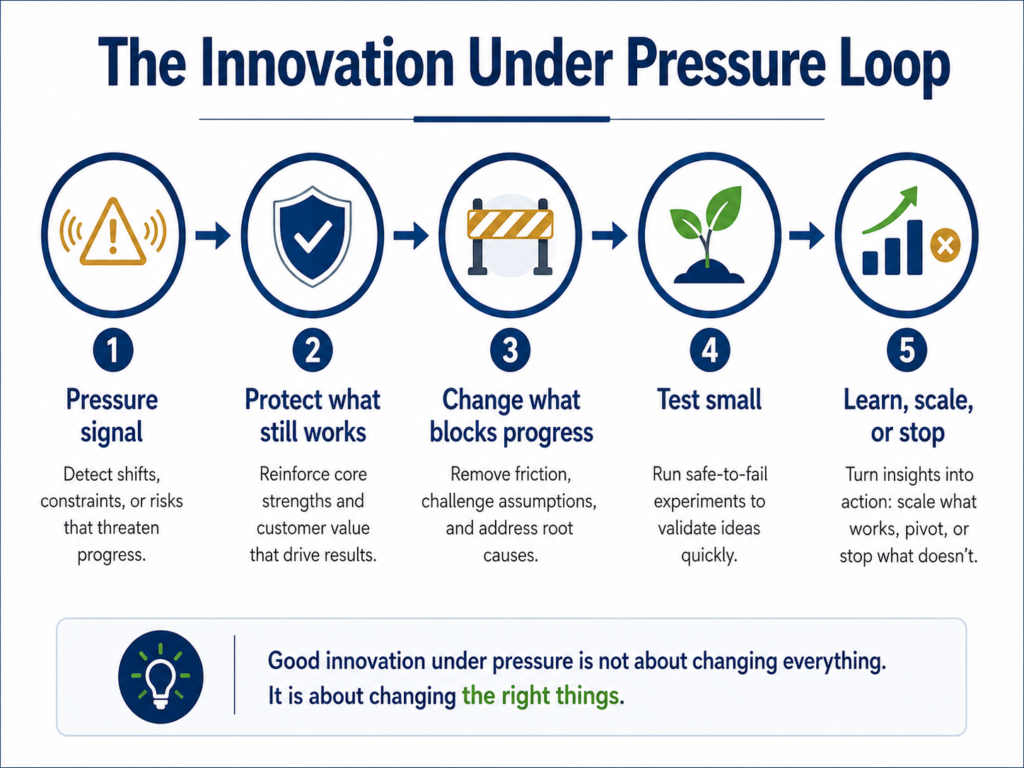
Strong innovation decisions come from reading pressure clearly, protecting core value, and testing change before scaling it.
The Innovation Under Pressure Loop
Pressure signal → decide what still works → identify what blocks progress → test small change → learn fast → scale or stop
What this looks like in real business
In real business, innovation usually looks less glamorous than the keynote slides.
How can a company improve the customer journey without rebuilding everything?
A company can improve the customer journey by keeping what customers already trust and changing the steps that create delay, confusion, or extra effort.
For example:
- a service business keeps its strong personal support but improves response speed and handovers
- a retailer keeps its trusted core offer but simplifies the online journey and makes comparisons clearer
- a B2B firm keeps its expertise but rewrites its content so prospects can understand what it does without needing a decoder ring
That is business innovation examples in the real world. Not everything has to be torn down. Often one clumsy stage is doing most of the damage.
How can a business adapt to AI and changing search behaviour without losing trust?
A business can adapt by changing discovery, content, service models, and digital visibility while keeping its promise, tone, expertise, and customer trust intact.
That means:
- clearer answer-led content
- more useful service pages
- better FAQ content
- smoother self-service where appropriate
- careful use of AI
- and a stronger understanding of how customers now search and compare
This is where innovation and AI in business matters. It is not about slapping AI onto everything like parsley on a disappointing meal. It is about using new tools where they genuinely help.
This also links directly to my article on AI & changing search behaviour.
What does innovation look like in leadership?
Innovation in leadership looks like helping the team understand what is changing, what is staying, why it matters, and how to learn without chaos.
It is not about pretending every change is exciting. Sometimes it is just necessary. Good leaders frame that honestly.
Where does innovation go wrong?
Innovation goes wrong when leaders change too much, change too little, or change the wrong thing.
What happens when leaders change the whole business when only one part is broken?
They waste time, money, trust, and energy.
This is one of the most common pressure mistakes. A real problem appears in one part of the business, and the response becomes a full reset.
What I have seen is that businesses sometimes rebuild the entire machine when only one noisy belt needed replacing.
What happens when leaders keep familiar habits even when they no longer work?
They confuse familiarity with value.
This is the opposite mistake. A team keeps:
- the same processes
- the same approval paths
- the same reporting rhythm
- the same content style
- the same service design
even though the market, the customer, and the search environment have moved on.
That is why adapting to market change matters. Comfortable is not always useful.
Why do innovation decisions fail without customer evidence or frontline input?
Because senior opinion alone is not enough.
Good innovation decisions need:
- customer evidence
- frontline insight
- behaviour signals
- search behaviour changes
- simple measures of progress
This is one reason innovation should connect to Customer Intent Marketing, Micro-Moment Marketing, and Behavioural Economics for Business Leaders. Customers are already telling you a lot through behaviour. The problem is usually not lack of signal. It is weak signal-reading.
- Leaders change the whole system when only one part is failing
- Familiar routines are protected long after they stop creating value
- Innovation decisions rely on opinion instead of customer or frontline evidence
- Pressure leads to copying competitors instead of reading the business properly
- AI is added because it sounds modern, not because it solves a real problem
What should you actually do?
Start by separating the core from the clutter.
What three questions should you ask before changing anything?
Ask:
- Does this still help us win?
- Does it protect customer trust?
- Does it create more value than it costs?
Those are simple, but in my experience they catch a surprising amount of nonsense early.
How do you separate core strengths from outdated routines?
List what the business genuinely depends on:
- trust
- expertise
- quality
- customer relationships
- useful process discipline
- brand promise
Then list what mainly adds delay, confusion, or cost.
That helps you see the difference between:
- core strengths
- and outdated routines
How do you build a repeatable test, learn, and adjust loop?
Use a simple loop:
- test
- measure
- learn
- improve
- repeat
The point is not perfect certainty. It is sensible movement.
This approach is part of the KrisLai Decision Framework, a practical method for improving business decisions. It also links to Leadership through better thinking & real-world execution, because teams need enough safety to surface what is not working honestly.
Under pressure, the smartest innovation rule is often this: keep what still creates value, change what clearly blocks progress, and test what is still uncertain.
How are AI and changing search behaviour reshaping innovation?
They are forcing businesses to rethink how they are found, understood, trusted, and served.
Today, innovation and AI in business is no longer just a back-office question. It affects:
- search visibility
- customer discovery
- service design
- help content
- decision speed
- trust
People now ask fuller questions, compare options faster, and expect useful answers sooner. That means innovation is not only about product or process. It is also about digital visibility, answer quality, and service clarity.
The businesses that adapt well usually keep the core promise and improve the path around it.
Conclusion
Innovation under pressure is really a judgement test.
That is the main point.
Leaders do not need to change everything. They need to change the right things! Strong businesses protect the core, improve what blocks progress, and test the uncertain parts before betting too heavily.
Start with this ONE thing: before changing anything important, ask whether it still creates value, protects trust, and solves a real customer or business problem.
If the answer is unclear, test first.
Innovation under pressure is not about speed for its own sake. It is about good judgement: protecting what still works, changing what clearly blocks progress, and testing what is still uncertain.
Innovation makes more sense when you connect it to customer signals, behaviour, strategy, and second-order consequences. These are the best next reads.
Want a simple, practical guide to making better business decisions under uncertainty?
Enter your email below and I’ll send you the free KrisLai Decision Framework™ guide, built around behaviour, signals, environment, and consequences.
It is designed to help leaders think more clearly, act earlier, and make better decisions in the real world.
Frequently Asked Questions
What is innovation in business?
Innovation in business means improving products, services, processes, or business models in ways that create real value for customers and the business.
What is the difference between innovation and invention?
Invention is about creating something genuinely new. Innovation often means applying, improving, adapting, or delivering ideas in ways that create value.
Why is innovation important in business?
Innovation is important because it helps businesses improve efficiency, respond to market change, meet customer needs better, and create long-term growth.
What are the main types of innovation in business?
The main types usually include product innovation, service innovation, process innovation, and business model innovation.
How should leaders innovate under pressure?
Leaders should protect what still creates value, change what is slowing the business down, and test uncertain changes before making larger moves.
This article is based on practical experience, independent research, analysis and synthesis.
If you enjoy exploring the ideas behind better business decisions, you may find the Business Thinking Hub useful.
The research behind this article consistently supports the view that business innovation is broader than invention, includes products, services, processes, and business models, and matters because it creates value, growth, and adaptability rather than change for its own sake.
About the author
Kris Lai is a business operator and managing director with experience in land and building surveying, facilities management, logistics, and service delivery.
Earlier in his career, he worked as a Search Engine Evaluator (via Lionbridge, supporting Google), where he assessed search result relevance, user intent, and content quality using structured evaluation frameworks. This experience gives him a rare, practical understanding of how search systems interpret signals and make ranking decisions.
In parallel, whilst working with a charity organisation, he has delivered 1000’s of structured presentations in English, Finnish, and Chinese to audiences ranging from small groups to more than 600 people, and has spent decades mentoring and developing others. This experience informs his approach to clarity, communication, and decision-making under pressure.
He writes about AI, search behaviour, business strategy, and decision-making from a practical, real-world perspective.
- Digital Transformation for SMEs: 7 Questions Before You Invest
- Cybersecurity for Businesses: 7 Decisions Leaders Must Make
- How AI Is Changing Search Behaviour (And What Businesses Must Do Now)
- 7 Decision-Making Framework Examples for Business Leaders
- Business Decision-Making Framework: The KrisLai Method