Emotional intelligence in leadership is not just about being calm or kind. It helps leaders understand pressure, read people, manage reactions, and make better decisions when situations are tense. This guide explains how EI supports decision-making, communication, trust, and practical leadership in real business.
Emotional intelligence matters most when the pressure rises. It is especially important in leadership during a crisis, where tone, timing, and judgement can either protect or damage trust.
Disclosure: If you click on my affiliate/advertiser’s links, I am going to receive a tiny commission. AND… Most of the time, you will receive an offer of some kind. It’s a Win/Win!
What this article covers
In this article, I explain what emotional intelligence really means in leadership, why emotions affect decision-making, how EI helps under pressure, where it makes the biggest difference in real business, and how leaders can strengthen it in simple, practical ways.
I will also show why emotional intelligence is not softness. It is decision discipline.
This article is based on practical business thinking, independent research, and my own analysis and synthesis of how emotions, behaviour, leadership, and decision-making affect real business outcomes.
Emotional intelligence is easy to praise when everything is calm.
It proves its value when pressure rises.
That is when people speak too quickly, defend too strongly, avoid difficult conversations, rush decisions, or mistake urgency for importance.
I have seen this in business, in teams, in public speaking, in mentoring, and in situations where people were under emotional pressure but still had to think clearly.
The best decisions are not made by pretending emotions do not exist.
They are made by understanding them.
Smart choices are not just about logic. They are also about noticing what pressure is doing to your judgement, your communication, and the people around you.
In my experience, emotionally intelligent leadership is not about being soft. It is about staying clear enough to make better decisions when people, pressure, and consequences collide.
Better decisions come from understanding behaviour, signals, environment, and consequences.
I write about how better decisions are made in business — combining strategy, behaviour, and practical thinking.
Key ideas
- Emotional intelligence helps leaders make better decisions under pressure.
- EI does not replace logic. It strengthens it by reducing reactive judgement.
- Strong leaders notice emotions without being ruled by them.
- Empathy and accountability can work together.
- The real test of EI is how a leader behaves when the situation becomes tense.

What emotional intelligence really means in decision-making
Emotional intelligence means recognising, understanding, managing, and responding to emotions in yourself and other people.
In leadership, it matters because emotions affect judgement.
They affect what we notice, what we ignore, how quickly we react, how we interpret other people, and how willing we are to listen.
That does not mean emotion is bad.
Emotional Intelligence
Emotional intelligence (EI) refers to the ability to recognize, understand, and manage both your own emotions and those of others effectively. Developing EI involves self-awareness, self-regulation, social awareness, and relationship management.
Emotion can be useful information.
Fear may signal risk. Frustration may show that something important is blocked. Anxiety may point to uncertainty. Anger may show that a boundary has been crossed. Empathy may help us understand the human effect of a decision.
The problem is not emotion.
The problem is unmanaged emotion.
A leader who ignores emotions can become cold, blind, or detached.
A leader who is ruled by emotions can become reactive, inconsistent, or unfair.
Emotional intelligence sits between those two extremes.
It helps leaders notice what is happening inside themselves and around them, without letting that pressure take over the decision.
Emotional intelligence in leadership, in simple terms
Emotional intelligence in leadership means noticing, understanding, and managing emotions in yourself and others so that pressure, conflict, and uncertainty do not damage judgement, communication, or trust.

The four parts of EI that affect choices
There are different ways to describe emotional intelligence, but for practical leadership, I find these four areas useful.
1. Self-awareness
Self-awareness means noticing what is happening inside you.
That includes:
- stress
- frustration
- fear
- pride
- defensiveness
- impatience
- disappointment
- excitement
A self-aware leader can say:
“I am frustrated, but I should not make this decision from frustration.”
That simple awareness can change the outcome.
2. Self-management
Self-management means choosing your response instead of letting your first reaction take over.
It does not mean pretending to be calm.
It means creating enough space to respond wisely.
That might mean pausing before replying, slowing your tone, asking one more question, or deciding not to send the email until later.
In real business, that pause can save relationships, money, time, and trust.
3. Social awareness
Social awareness means reading other people and the wider atmosphere.
It is noticing:
- who is quiet
- who is defensive
- who is anxious
- who is confused
- who is avoiding the real issue
- where tension is building
Leaders need this because people do not always say clearly what they are feeling or thinking.
Sometimes behaviour tells the story before words do.
4. Relationship management
Relationship management means using emotional understanding to communicate, influence, resolve conflict, and build trust.
It includes:
- giving feedback well
- handling disagreement
- keeping people steady during change
- repairing trust after tension
- setting boundaries without unnecessary harshness
This is where emotional intelligence becomes visible to other people.
Why emotions are part of every decision anyway
Many people like to think they make decisions using facts alone.
I do not think that is how real life works.
Facts matter. Data matters. Evidence matters.
But emotions are usually in the room too.
People worry about risk. They protect status. They avoid embarrassment. They fear failure. They want approval. They resist loss. They prefer what feels familiar.
That applies to customers, teams, managers, leaders, and business owners.
Emotion does not make a decision automatically wrong.
But if emotion is ignored, it can quietly steer the decision from behind the curtain.
That is why emotional intelligence matters.
It helps leaders ask:
“Is this a good decision, or am I reacting to pressure?”
How emotional intelligence leads to better decisions under pressure
Pressure changes how people think.
When the stakes feel high, the mind can narrow. We may focus on the most urgent issue, not the most important one. We may defend our first view. We may hear disagreement as criticism. We may overreact to bad news or avoid it altogether.
Emotional intelligence helps because it creates a pause between pressure and action.
That pause is where better judgement can enter.
Staying calm when the stakes feel high
Calm leadership does not mean passive leadership.
It means steady leadership.
A calm leader can still make difficult decisions. They can still challenge poor behaviour. They can still say no. They can still hold people accountable.
But they do it without letting stress run the meeting.
When pressure rises, a leader can ask:
- What am I feeling?
- What triggered this reaction?
- What outcome matters most?
- What do we actually know?
- What do we still need to understand?
- What decision is needed now, and what can wait?
These questions slow down the emotional rush.
They help the leader respond rather than react.
What this means in real business
Emotional intelligence helps leaders slow the first reaction, read the room, understand what people are really responding to, and choose the action that best protects the decision, the team, and the outcome.
Avoiding common decision traps caused by stress
Stress creates traps.
Here are a few I have seen often.
Trap 1: Overreacting
Something goes wrong, and the leader makes a big decision too quickly.
A customer complains, so the whole process is changed.
A team member makes one mistake, so trust is removed.
A bad month appears, so strategy is abandoned.
Sometimes action is needed. But overreaction can create more damage than the original problem.
Trap 2: Taking things personally
When leaders feel attacked, they can stop listening.
Feedback becomes insult.
Disagreement becomes disrespect.
Questions become threats.
That is dangerous because useful information often arrives in uncomfortable packaging.
Trap 3: Jumping to conclusions
A stressed leader may assume they already know the cause.
“They are lazy.”
“The customer is unreasonable.”
“The team does not care.”
“The idea failed.”
Maybe. Maybe not.
Emotionally intelligent leaders ask one more question before turning assumption into action.
Trap 4: Choosing the quickest option instead of the best one
Pressure makes speed attractive.
But the quickest decision is not always the best decision.
In real business, a rushed fix can create hidden consequences that appear later.
That is why decision-making under pressure needs both urgency and discipline.

Using empathy to make fairer people decisions
Empathy is often misunderstood.
It does not mean agreeing with everyone.
It does not mean lowering standards.
It does not mean avoiding difficult decisions.
Empathy means understanding another person’s position well enough to make a fairer and more informed judgement.
That matters in:
- hiring
- feedback
- conflict
- customer complaints
- performance management
- change management
- team communication
- leadership under pressure
For example, if a team member is underperforming, empathy helps you ask:
“What is driving this?”
It might be poor attitude.
But it might also be unclear expectations, workload pressure, lack of training, health issues, weak systems, or poor management communication.
Empathy does not remove accountability.
It improves the diagnosis.
And better diagnosis usually leads to better decisions.
Where emotional intelligence makes the biggest difference in real life and work
Emotional intelligence is useful in everyday life, but in leadership it becomes especially important because leaders make decisions that affect other people.
A leader’s emotional state can shape the room.
If the leader panics, the team often feels it.
If the leader becomes defensive, honest discussion often shuts down.
If the leader avoids discomfort, problems may grow quietly.
If the leader stays steady, people usually think more clearly.
Leadership decisions that build trust instead of fear
Leaders make trust-building or trust-damaging decisions all the time.
Sometimes in small moments.
How they respond to bad news.
How they give feedback.
How they handle mistakes.
How they explain change.
How they listen when someone disagrees.
How they behave when they are tired, embarrassed, or under pressure.
Emotionally intelligent leaders understand that people watch behaviour more than slogans.
A leader can say, “I value honesty.”
But if people are punished for raising problems, they will learn silence.
A leader can say, “We support development.”
But if mistakes are handled with blame, people will learn self-protection.
Trust is built through repeated emotional signals.
That is why emotional intelligence and leadership are so closely connected.
Team decisions that reduce conflict and improve collaboration
Teams do not need to agree on everything.
In fact, healthy disagreement can improve decisions.
But disagreement becomes harmful when people feel unheard, disrespected, or unsafe.
Emotional intelligence helps teams:
- listen before defending
- separate people from problems
- challenge ideas without attacking identity
- notice when tension is rising
- ask better questions
- repair misunderstandings early
This links closely to psychological safety.

Teams make better decisions when people can raise concerns without fear of being made to look foolish.
That does not mean every idea is accepted.
It means people can speak honestly enough for the decision to improve.

Personal decisions that match your values and long-term goals
Emotional intelligence is not only useful at work.
It also helps with personal decisions.
For example:
- whether to take a new role
- whether to say yes or no
- whether to set a boundary
- whether to have a difficult conversation
- whether to spend, save, invest, or wait
- whether to act now or pause
Sometimes a decision feels urgent because of emotion, not because of reality.
Sometimes we say yes because we fear disappointing someone.
Sometimes we avoid a necessary conversation because we want short-term comfort.
Sometimes we chase an opportunity because it flatters us, even when it does not fit our long-term goals.
Emotional intelligence helps us ask:
“Is this decision aligned with what matters, or am I being pushed by mood, pressure, fear, or ego?”
That question is powerful.
Emotional intelligence examples in real business
Let us make this practical.
Example 1: An angry client
A client is upset. Their tone is sharp. They feel let down.
An emotionally weak response might be to interrupt, defend, blame the client, or explain too quickly why they are wrong.
An emotionally intelligent response sounds different.
It might include:
- listening first
- acknowledging the concern
- asking for specifics
- separating facts from emotion
- taking ownership where appropriate
- agreeing the next step
The aim is not to “win” the conversation.
The aim is to solve the issue without making the relationship worse.
Example 2: A team member underperforming
A team member is missing deadlines.
An emotionally weak response might be to avoid the conversation until frustration builds, then react sharply.
An emotionally intelligent response is earlier and clearer.
It might sound like:
“I’ve noticed the last three deadlines have slipped. I want to understand what is happening and agree what needs to change.”
That is both human and direct.
It opens the door to understanding, but it does not avoid accountability.
Example 3: A tense strategy decision
A leadership team is divided.
One group wants to invest. Another wants to wait.
There is pressure, uncertainty, and probably some ego in the room.
An emotionally weak response might be to push through the loudest opinion or avoid the decision completely.
An emotionally intelligent response separates:
- facts
- assumptions
- risks
- fears
- trade-offs
- consequences
This is where better decision-making starts.
Not with pretending emotion is absent, but with preventing it from controlling the room.
Example 4: Leading through uncertainty
During uncertainty, some leaders pretend they know more than they do.
That rarely builds trust for long.
Emotionally intelligent leaders can say:
“Here is what we know. Here is what we do not know yet. Here is what we are watching. Here is the next decision we need to make.”
That combination of honesty and direction helps people stay steadier.
It does not remove uncertainty.
But it reduces unnecessary confusion.
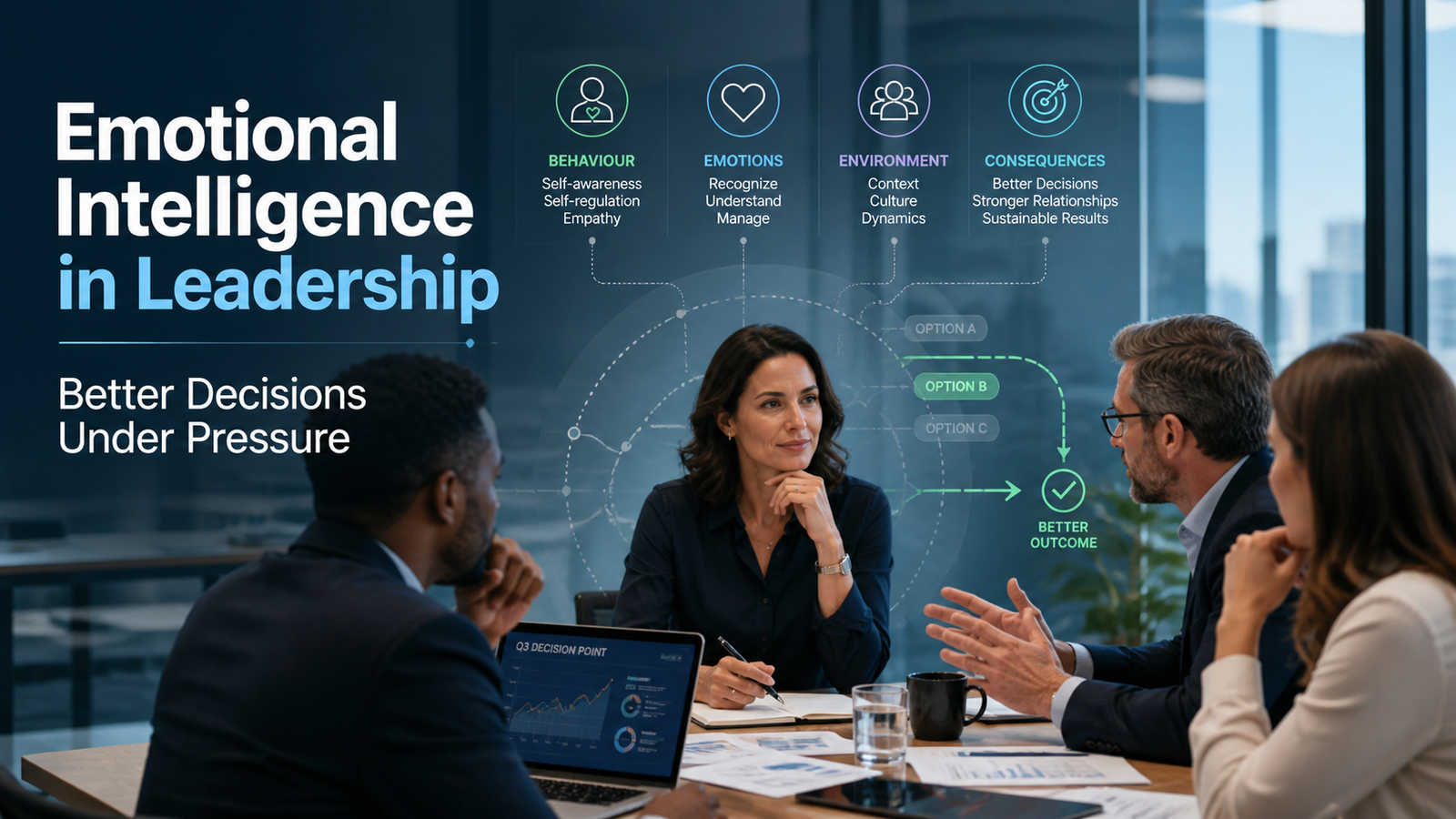
The KrisLai Emotional Decision Lens™
- Behaviour – what are people actually doing, not just saying?
- Signals – what emotions, reactions, silences, or tensions reveal pressure?
- Environment – what conditions are shaping the emotional response?
- Consequences – what happens if the leader reacts too quickly, avoids the issue, or ignores the human impact?
Better decisions come from understanding behaviour, signals, environment, and consequences.
Where emotional intelligence often goes wrong
This is important because emotional intelligence is sometimes misunderstood.
It can sound soft, vague, or overly pleasant if it is explained badly.
But real emotional intelligence is not about avoiding reality.
It is about handling reality better.
Mistake 1: Confusing emotional intelligence with being soft
This is one of the biggest misunderstandings.
Emotionally intelligent leaders are not weak.
They can make hard decisions.
They can challenge poor behaviour.
They can say no.
They can hold standards.
The difference is that they do it with control, clarity, and awareness of the human consequences.
Mistake 2: Using empathy to avoid accountability
Empathy should improve accountability, not replace it.
If someone is struggling, empathy helps you understand why.
But understanding why does not always remove the need for change.
A leader can say:
“I understand this has been difficult. I also need the work to meet the agreed standard.”
That is not harsh.
That is clear.
Mistake 3: Suppressing emotion instead of understanding it
Some leaders think emotional control means hiding emotion completely.
That can backfire.
Suppressed emotion often leaks out as:
- sarcasm
- silence
- impatience
- avoidance
- coldness
- passive aggression
- sudden overreaction
It is better to recognise emotion honestly and manage it wisely.
You do not need to share every feeling.
But you should understand what is influencing your judgement.
Mistake 4: Letting one person’s emotion dominate the room
A leader should listen to emotion.
But emotion should not automatically control the decision.
Sometimes the loudest person in the room is not the person with the clearest view.
Sometimes the most anxious person is not seeing the full picture.
Sometimes the most confident person is missing important risk.
Emotionally intelligent leaders hear people without handing the decision to the strongest emotion.
Mistake 5: Treating data as if it removes emotion
Data helps.
But data does not remove fear, politics, pride, insecurity, trust, or uncertainty.
I have seen people hide behind data when they are really avoiding a difficult judgement.
The numbers may be useful.
But leaders still need to ask:
“What are people feeling, protecting, avoiding, or assuming?”
That is often where the real decision issue sits.
What I’ve seen go wrong
What I’ve seen go wrong is leaders confusing emotional intelligence with avoiding discomfort. In real business, EI is not about dodging difficult conversations. It is about having them with enough clarity, respect, and control to improve the outcome.

Simple ways to strengthen EI before you make an important decision
Emotional intelligence can improve with practice.
It is not something you either have or do not have.
Small habits make a difference.
Pause and name what you are feeling
Before making an important decision, pause.
Ask:
- What happened?
- What am I feeling?
- Why might I be feeling this?
- What do I need right now?
- What does the situation need from me?
- What outcome matters most?
Naming the emotion can reduce its power.
“I am angry” is different from simply acting angry.
“I am anxious” is different from letting anxiety choose for you.
This small step creates space.
And space improves judgement.
Ask better questions before you act
Good questions can slow down poor assumptions.
Useful questions include:
- What else could be true?
- What is the real problem?
- What evidence do we have?
- What am I assuming?
- What might I be missing?
- Who is affected by this decision?
- What will this choice mean later?
- What happens if we wait?
- What happens if we act too quickly?
- What would a calmer version of me decide?
That last one is often useful.
Get honest feedback from people you trust
We all have blind spots.
A trusted colleague, friend, mentor, or adviser can sometimes see our patterns more clearly than we can.
Ask:
- How do I come across when I am under pressure?
- Do I listen well when challenged?
- Do I react too quickly?
- Do I avoid difficult conversations?
- Do I become too blunt?
- Do I over-explain?
- Do people feel safe being honest with me?
The answers may not always be comfortable.
But they can be valuable.
Review difficult moments afterwards
After a difficult conversation or decision, review it.
Ask:
- What triggered me?
- What did I assume?
- What did I handle well?
- What did I miss?
- What signal did I ignore?
- Did I make the decision from clarity or emotion?
- What would I do differently next time?
This is how emotional intelligence becomes practical growth.
Not theory.
Practice.
How AI can support emotionally intelligent leadership
AI can be useful here, but only if used wisely.
It can help leaders:
- draft difficult messages
- prepare for feedback conversations
- summarise employee survey comments
- identify themes in customer feedback
- create scenario questions
- simplify complex communication
- rehearse sensitive conversations
- compare possible responses
That can be helpful.
For example, if you need to write a difficult message, AI can help you make it clearer and calmer.
If you have a lot of written feedback, AI can help summarise common themes.
If you are preparing for a sensitive conversation, AI can help you think through possible reactions.
But AI cannot replace emotional judgement.
It cannot fully read the room.
It cannot know the trust history between people.
It cannot feel the tension in a meeting.
It cannot take responsibility for the human consequences of a decision.
So the wise approach is this:
Use AI to support preparation.
Use human judgement to lead the moment.
Emotional intelligence becomes more valuable in an AI-shaped workplace
As AI handles more routine tasks, human judgement becomes more important.
So do:
- trust
- empathy
- communication
- conflict handling
- ethical judgement
- decision-making under pressure
- leadership presence
This is one reason emotional intelligence is not becoming less important.
It is becoming more important.
In an AI-shaped workplace, leaders still need to understand people.
Perhaps even more than before.

Final thought: emotional intelligence is decision discipline
Emotional intelligence does not replace logic.
It strengthens it.
It helps leaders stay clear under pressure, notice human signals, reduce reactive decisions, communicate better, and make harder choices with more wisdom.
That is why I see emotional intelligence as decision discipline.
It is not soft leadership.
It is not being endlessly agreeable.
It is not avoiding discomfort.
It is the ability to stay steady enough to think, listen, decide, and lead well when the situation is emotionally loaded.
In real business, that matters.
Because many poor decisions are not caused by lack of intelligence.
They are caused by unmanaged pressure.
So start small.
Pause before the first response.
Name what you are feeling.
Ask one better question.
Listen for what is not being said.
Review the decision afterwards.
Emotional intelligence grows through practice.
And over time, it helps you make calmer, fairer, and more effective decisions.
As the Swedish saying goes, lugn i stormen.
Calm in the storm.
Final takeaway
Emotional intelligence helps leaders make better decisions under pressure by improving self-awareness, self-control, empathy, communication, and judgement. The goal is not to remove emotion from leadership, but to understand it well enough that it does not control the decision.

Related reading on KrisLai.com
- Related article: Decision-Making Framework Examples
- Glossary or definition article: Psychological Safety at Work
- Pillar topic: Business Thinking Hub
- Leadership Skills in Business
- Problem-Solving in Business
- Scenario Planning in Business
- Business Acumen Skills
Frequently Asked Questions About Emotional Intelligence in Leadership
What is emotional intelligence in leadership?
Emotional intelligence in leadership means recognising, understanding, and managing emotions in yourself and others so that pressure, conflict, and uncertainty do not damage judgement, communication, or trust.
Why is emotional intelligence important for leaders?
Emotional intelligence is important for leaders because it helps them stay calm under pressure, listen better, handle conflict, build trust, and make better decisions when people and emotions are involved.
How does emotional intelligence improve decision-making?
Emotional intelligence improves decision-making by helping leaders pause before reacting, recognise emotional pressure, understand other people’s concerns, and choose a response based on the real situation rather than the first emotional reaction.
What are examples of emotional intelligence at work?
Examples include listening calmly to an angry client, giving difficult feedback with respect, managing conflict without blame, noticing when a team is anxious, and making fair decisions during pressure or uncertainty.
Is emotional intelligence the same as being nice?
No. Emotional intelligence is not the same as being nice. It means handling emotions wisely. Emotionally intelligent leaders can still set standards, make hard decisions, challenge poor behaviour, and hold people accountable.
How can leaders improve emotional intelligence?
Leaders can improve emotional intelligence by pausing before reacting, naming what they feel, asking better questions, listening for what is not being said, seeking honest feedback, and reviewing difficult moments afterwards.
How does AI affect emotional intelligence in leadership?
AI can help leaders prepare messages, summarise feedback, and think through difficult conversations, but it cannot replace human judgement, empathy, trust, or the ability to read the room in real time.
About the author
Kris Lai is a business operator and managing director with experience in land and building surveying, facilities management, logistics, and service delivery.
Earlier in his career, he worked as a Search Engine Evaluator (via Lionbridge, supporting Google), where he assessed search result relevance, user intent, and content quality using structured evaluation frameworks. This experience gives him a rare, practical understanding of how search systems interpret signals and make ranking decisions.
In parallel, whilst working with a charity organisation, he has delivered 1000’s of structured presentations in English, Finnish, and Chinese to audiences ranging from small groups to more than 600 people, and has spent decades mentoring and developing others. This experience informs his approach to clarity, communication, and decision-making under pressure.
He writes about AI, search behaviour, business strategy, and decision-making from a practical, real-world perspective.
If you enjoy exploring the ideas behind improving your leadership skills, you may find the Business Thinking Hub useful.

👉 Explore ideas connected to better business decisions:
- Digital Transformation for SMEs: 7 Questions Before You Invest
- Cybersecurity for Businesses: 7 Decisions Leaders Must Make
- How AI Is Changing Search Behaviour (And What Businesses Must Do Now)
- Decision-Making Framework Examples: The KrisLai Method in Action
- The KrisLai Decision Framework: A Better Way to Make Business Decisions