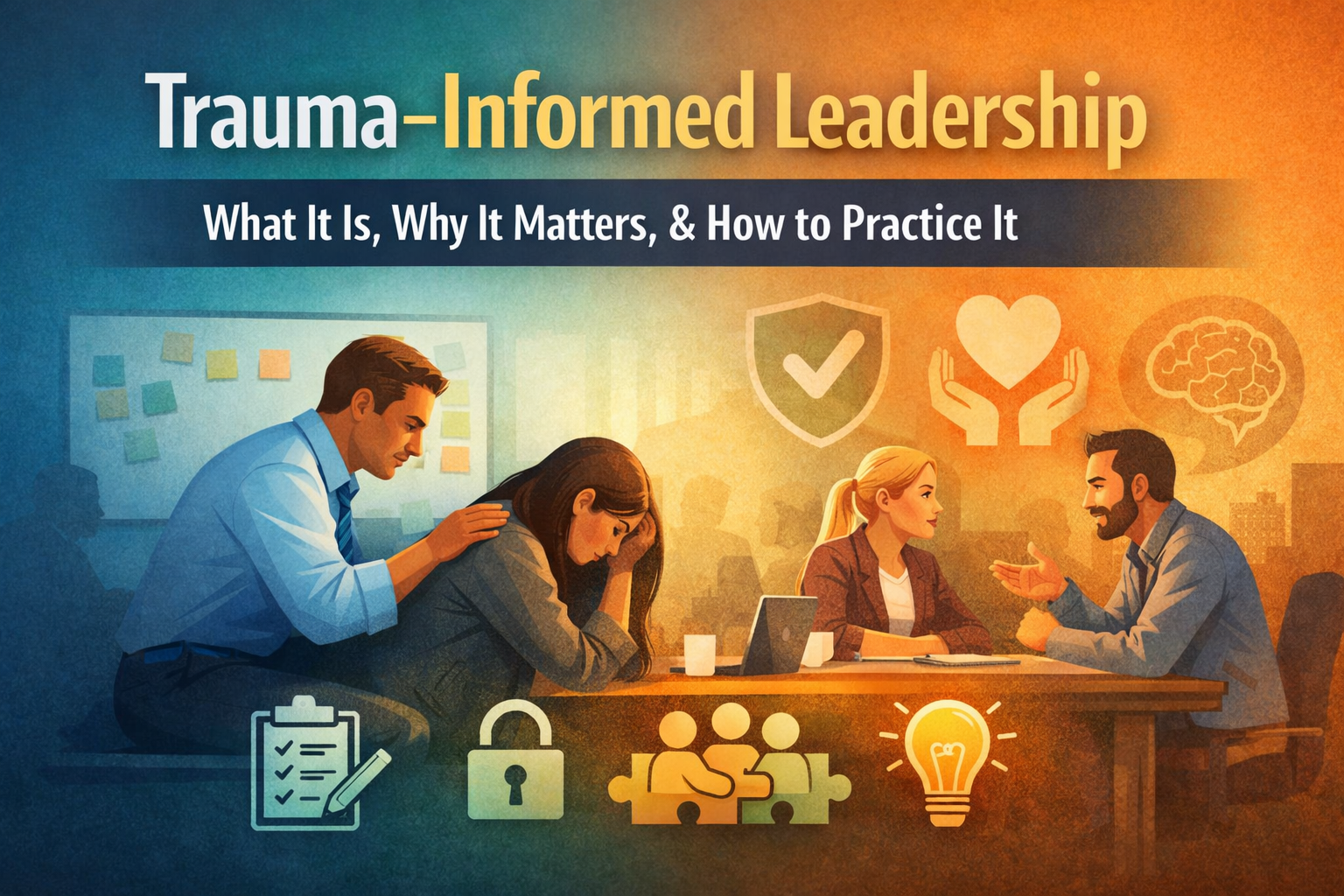
Something shifts in a room before anyone says a word.
A colleague shuts down during a meeting. Someone reacts sharply to feedback. A previously reliable team member suddenly goes off sick. These moments used to confuse me. Now I see them differently. Trauma-informed leadership: what it is, why it matters, and how to practice it has become an important lens through which I understand workplace behaviour. Not because leaders need to become therapists, but because people bring their full human experience to work — including stress, past adversity, and uncertainty.
In this article, I want to explore what trauma-informed leadership really means (and what it does not), why it matters for culture and performance, and a simple way to practise it starting today. Because leadership that reduces fear and increases trust changes everything.
As the Finnish saying goes, “Hyvin aloitettu on puoliksi tehty.”
Well begun is half done.
Disclosure: If you click on my affiliate/advertiser’s links, I am going to receive a tiny commission. AND… Most of the time, you will receive an offer of some kind. It’ s a Win/Win!
Trauma-Informed Leadership, in Simple Terms
Trauma-informed leadership means leading with the awareness that people may carry past stress or trauma, and that workplace situations can trigger threat responses in the brain and body. It involves making choices that increase psychological safety, predictability, and trust — without lowering expectations or accountability.
In everyday behaviour, trauma-informed leadership means:
- Being clear rather than ambiguous
- Being calm rather than reactive
- Being fair rather than unpredictable
- Being respectful rather than shaming
Leaders are not responsible for fixing people’s emotions. They are responsible for creating environments where people can function well.
What is Trauma-Informed Leadership?
Trauma-informed leadership is a way of leading that recognises people may carry past stress or trauma, and that work can sometimes trigger threat responses. It focuses on creating safety, clarity, fairness, and trust so people can do their best work — without lowering standards.
What trauma-informed leadership means (and what it does not)
When I first encountered the term, I wondered what does trauma informed leadership mean in practice. The answer turned out to be surprisingly straightforward.
Trauma-informed leadership is about understanding that behaviour often has context. Stress, uncertainty, or past experiences can activate a threat response — sometimes called the fight-or-flight response — which affects thinking, communication, and decision-making.
Leadership and trauma intersect whenever workplace experiences feel unsafe, unfair, or unpredictable.
But there are boundaries.
Leaders are not therapists
Trauma-informed leadership is not counselling. A leader’s job is to set conditions (clarity, fairness, safety), hold boundaries, and signpost support. If someone needs clinical help, encourage them to access professional services (for example through HR, an EAP, or a healthcare provider).
Trauma-informed leadership vs counselling
Leaders are not therapists!
Trauma-informed leadership vs counselling is an important distinction. Leaders:
- Set conditions and expectations
- Provide structure and support
- Maintain boundaries
- Signpost professional help when needed
They do not diagnose or treat psychological trauma.
I’ve noticed that even small leadership choices can shift outcomes. In meetings, for example, I now make agendas visible beforehand, invite input early, and handle disagreement calmly. These small signals reduce defensiveness and increase participation.
That is what trauma-informed leadership style looks like in practice.

The trauma informed leadership principles I rely on day to day
The trauma informed leadership principles often referenced include:
Safety — People need physical and psychological safety to function.
Trustworthiness — Consistency builds confidence.
Choice — Offering options increases autonomy.
Collaboration — Shared ownership reduces power imbalance.
Empowerment — Recognising strengths builds capability.
Cultural humility — Respecting different experiences improves inclusion.
The outcome is leadership psychological safety — where people feel able to speak, learn, and contribute.
A quick mini-checklist I sometimes use:
- Am I being clear and predictable?
- Am I reacting or responding?
- Am I inviting input or shutting it down?
- Am I addressing behaviour without attacking the person?
What trauma-informed leadership looks like when pressure is high
Pressure reveals leadership habits.
Scenario 1: Reorganisation
A traditional approach might involve secrecy and sudden announcements. A trauma-informed leadership approach explains what is known, what is not yet known, and when updates will come. Uncertainty is acknowledged rather than hidden.
Scenario 2: Performance issue
Instead of public criticism, the leader speaks privately, describes the behaviour, explains expectations, and offers support options.
Trauma informed leadership managing legacy toxicity is often about interrupting old habits — blame, secrecy, or public shaming — without attacking individuals. I focus on behaviour and impact rather than personality.
Why trauma-informed leadership matters in the workplace right now
The business and human case is strong.
Trauma informed leadership in the workplace supports:
- Lower burnout
- Better retention
- Fewer conflicts
- Improved learning
- Higher engagement
- Better change adoption
The cost of not doing it is also clear:
- Silence and fear
- Presenteeism
- Turnover
- Reduced innovation
- Distrust toward leadership
Trauma informed organisational leadership is not a soft skill. It is a culture lever.
I once observed a team recovering from a difficult restructuring. Initially, morale was low and communication guarded. Over time, consistent leadership behaviour — clear updates, fair processes, listening with follow-through — created steadier performance and renewed confidence. No dramatic intervention. Just consistent signals of safety and respect.
From stress reactions to posttraumatic growth, what good leadership makes possible
Trauma informed leadership and posttraumatic growth are linked by one principle: people grow when they feel safe.
Growth might look like:
- Greater confidence
- Stronger boundaries
- Better communication
- Learning after adversity
Leaders cannot force growth. They create conditions where it becomes possible.
I used to think resilience meant pushing through. Now I think resilience means having support while moving forward.
Mastering the Art of Project Management: Your Path to Excellence. Begin your journey HERE.
The link between organisational trauma and leadership
Organisational trauma often follows crises, restructuring, or toxic cultures. Leadership behaviour determines whether recovery happens — or whether damage deepens.
Leaders shape:
- Communication tone
- Trust signals
- Fairness perceptions
- Emotional climate
In other words, leadership and trauma are closely connected.
How I practise trauma-informed leadership: a simple playbook you can copy
Trauma informed management does not need complex programmes. I think about it in three moments: before, during, and after interactions.
Before — set expectations
- Clarify purpose and outcomes
- Share agendas
- Define decision rules
- Reduce surprises
During — run interactions well
- Regulate my own tone
- Invite input
- Respond calmly to emotion
- Offer choices where possible
After — repair and learn
- Close communication loops
- Follow up on commitments
- Address mistakes openly
- Adjust systems if needed
Trauma informed leadership training and trauma informed leadership development can help — but even without budget, small behaviour changes matter.
Develop a strong foundation in Python programming for AI, utilizing tools like NumPy, pandas, and Matplotlib for data analysis and visualization. Learn how to use, build, and train machine learning models with popular Python libraries. Implement neural networks using PyTorch. Gain practical experience with deep learning frameworks by applying your skills through hands-on projects. Explore generative AI with Transformer neural networks, learn to build, train, and deploy them with PyTorch, and leverage pre-trained models for natural language processing tasks. Designed for individuals with basic programming experience, this program prepares you for advanced studies in AI and machine learning, equipping you with the skills to begin a career in AI programming. Click HERE to get started NOW.
What are some trauma informed practices you can start this week
Practical trauma informed practices leadership approaches include:
- Use predictable meeting rhythms
- Clarify decision processes
- Ask before giving feedback
- Offer options when possible
- Correct privately, not publicly
- Pause and regulate before responding
- Name uncertainty honestly
- Close communication loops
- Use consent-based check-ins
- Set clear meeting norms
If someone becomes upset:
Slow down. Validate. Offer options. Follow up later.
That is often enough.
Quick start: 5 trauma-informed moves I use
- Make it predictable: share agendas and decision rules early.
- Be calm and clear: respond, don’t react.
- Offer choices: even small options reduce fear.
- Correct privately: protect dignity when performance slips.
- Close the loop: follow up so people don’t feel ignored.
How to build a trauma informed culture without lowering standards
A trauma informed workplace still requires performance.
I focus on:
- Clear role expectations
- Fair processes
- Consistent consequences
- Repair conversations after mistakes
Example script:
“I can see this has been difficult. The expectation is still important. Let’s look at what support you need to meet it.”
Trauma informed culture balances empathy with accountability.
When to bring in extra support
Trauma-informed leadership helps create the right conditions, but some situations need specialist support. Consider involving:
- HR — for fair processes, investigations, adjustments, or formal conflict support.
- EAP (Employee Assistance Programme) — for confidential counselling, wellbeing coaching, and practical guidance.
- Clinical support — when someone is experiencing severe distress, intrusive thoughts, panic, or ongoing symptoms that affect daily life.
If you’re unsure, a simple starting point is to offer a private conversation and share the available support routes.
When needed, I involve HR, EAP services, or professional support.
As the Swedish saying goes, “Tydlighet är vänlighet.” Clarity is kindness.
Common mistakes when trying to be trauma-informed
Some leaders misunderstand the approach.
Common mistakes include:
- Avoiding accountability
- Being overly cautious
- Ignoring performance issues
- Trying to fix emotions instead of systems
- Confusing kindness with lack of boundaries
Trauma-informed leadership skills include firmness and compassion together.
Conclusion
Trauma-informed leadership means recognising human reality at work and leading in ways that increase safety, trust, and clarity. It matters because people perform better when they feel secure, respected, and treated fairly.
If you want to begin, choose one small practice this week — clearer expectations, calmer responses, or better follow-up.
I’m trying to build workplaces that are safe, clear, accountable, and human. Not perfect — but healthier.
And progress, as always, starts with awareness.
Free accounting software from Wave for small businesses. Get yours HERE.
Latest posts:
- Trauma-Informed Leadership: What It Is, Why It Matters, and How to Practice It

- Organizational Trauma: What It Is, Signs to Watch For, and How to Heal
- Overcoming Perfectionism at Work Without Lowering Your Standards
- Why You’re Always Tired at Work (And What to Do About It)
- Reinvent or Be Left Behind: Why Dynamic Strategy Must Move at Market Speed