Business strategy planning sounds straightforward when explained in textbooks.
“Set a direction. Define your goals. Understand your market. Make a plan.“
But in real business life, strategy is rarely that neat!
Business strategy planning, in simple terms
Business strategy planning means deciding how your business will move from where it is now to where you want it to be.
It is about making deliberate choices on customers, value, priorities, resources, and direction — not just writing down goals.
I have seen businesses work hard, stay busy, and still drift because they confused activity with strategy. They had ideas, ambition, and effort, but not enough clarity about what mattered most, what the market was really telling them, or what trade-offs they were making.
That is one reason I take strategy seriously. A business strategy is not just a plan on paper. It is a set of choices about where to focus, what to prioritise, what to ignore, and how to move forward without wasting time and resources.
Better decisions come from understanding behaviour, signals, environment, and consequences.
This connects to how I approach decisions using the KrisLai Decision Framework™.
In this guide, I want to keep business strategy planning simple and practical, but also add something many beginner guides miss: real-world strategy failure patterns, better decision checkpoints, and a clearer way to think before acting.
As the Finnish saying goes, “Hyvin suunniteltu on puoliksi tehty.” – Well planned is half done.
Disclosure: If you click on my affiliate/advertiser’s links, I am going to receive a tiny commission. AND… Most of the time, you will receive an offer of some kind. It’ s a Win/Win!
Key Ideas
- A business strategy is not just a plan. It is a set of choices.
- Good strategy requires focus, not just ambition.
- Many businesses fail strategically because they misread customers, competitors, or timing.
- Strategy works best when it connects goals, behaviour, signals, environment, and consequences.
- A strong strategy should help you decide what to do and what not to do.

Definition of Business Strategy
Business strategy is the comprehensive plan and set of actions that a company undertakes to achieve specific long-term goals and objectives.
It serves asa roadmap guiding the organization towards success by aligning its resources, capabilities, and activities with the demands of the market.

Photo by Leah Kelley
At its core, a business strategy involves making deliberate choices about where to compete and how to win in the chosen markets. This entails decisions on the products or services offered, the target customer segments, the value proposition, and the distinctive capabilities that set the company apart from competitors.
In simple terms, business strategy is like a game plan that helps a company navigate the complex business environment, make smart decisions, and stay ahead in a constantly evolving market. It’s about figuring out not just what the business does but, more importantly, why it does it in a particular way to achieve sustainable success.
Stop guessing, start growing: Unlock actionable Shopify insights with Sirge and get 20% Off.
What is business strategy planning?
Business strategy planning is the process of deciding how a business will move from where it is now to where it wants to be. It involves setting clear priorities, understanding customers and competitors, using resources wisely, and making choices that support long-term goals.
Business Strategy Planning, in Simple Terms
Business strategy planning means deciding how your business will move from where it is now to where you want it to be.
It is not just about having goals. It is about making deliberate choices about customers, value, priorities, resources, and direction.
In simple terms, strategy asks four big questions:
- Where are we trying to go?
- What matters most right now?
- What are we basing our decisions on?
- What are the likely consequences of our choices?
That last point matters more than many people realise. A strategy may look clever at first, but if it ignores customer behaviour, market signals, operating conditions, or likely consequences, it can still fail.
The Importance of Business Strategy When Starting a New Business
Starting a new business is like embarking on a journey and, as mentioned earlier, a well-crafted business strategy serves as your reliable roadmap. Here’s why having a clear strategy is paramount:
Guidance in Uncertainty:
- In the early stages, uncertainties are abundant. A business strategy provides a clear direction, helping you navigate challenges by outlining your goals, target market, and how you plan to compete.
Focus on Priorities:
- A strategy helps you prioritize. With limited resources and time, it’s essential to focus on what truly matters. Your strategy ensures that your efforts align with your long-term objectives.
Competitive Edge:
- Understand your unique value proposition. A strategy defines how your business stands out in the market. It’s about offering something distinct that meets a need or solves a problem better than others.
Resource Optimization:
- Starting a business often involves working with constrained resources. A strategy assists in optimizing your resources by aligning them with your business priorities, preventing waste and inefficiency.
Adaptability to Change:
- Markets evolve, and so should your business. A strategy provides a framework for adapting to changes in the industry, consumer behavior, or the competitive landscape while keeping your core objectives intact.
Long-Term Vision:
- While day-to-day operations are crucial, a business strategy ensures that these activities contribute to a broader vision. It keeps you focused on building a sustainable business rather than merely addressing immediate concerns.
Investor Confidence:
- For those seeking external funding, a well-defined strategy instills confidence in investors. It demonstrates that you have thoroughly considered the market, competition, and potential risks, increasing the likelihood of financial support. (See my post on how to fund your new business.)
Measurable Progress:
- A strategy sets measurable goals and milestones. This not only allows you to track your progress but also provides a basis for evaluating what’s working and what needs adjustment.
In essence, a business strategy is not a luxury but a necessity for any entrepreneur. It’s your compass, guiding you through the complexities of entrepreneurship and increasing the likelihood of turning your business vision into a sustainable reality.
Basics of Strategic Planning

Image by Arek Socha from Pixabay
Strategic planning involves breaking down the big picture into manageable parts. Think of it like building a puzzle, where each piece contributes to the overall success of your business.
Here are the key components simplified:
Vision and Mission:
- Vision: Your long-term dream for the business.
- Mission: The purpose of your business, its reason for existence.
SWOT Analysis:
- Strengths: What your business does well.
- Weaknesses: Areas that need improvement.
- Opportunities: External factors to leverage.
- Threats: External factors to defend against.
Goals and Objectives:
- Goals: Broad, aspirational aims.
- Objectives: Specific, measurable steps to reach goals.
Target Audience:
- Identify and understand your ideal customers.
Value Proposition:
- Define what makes your product or service unique and valuable.
Competitive Advantage:
- Determine how you will outperform competitors.
Action Plans:
- Specific steps to achieve objectives.
Resource Allocation:
- Assign resources (time, money, people) where needed most.
Monitoring and Evaluation:
- Regularly assess progress and adapt strategies as necessary.
Why strategies often fail
Many strategies fail not because people do not care, but because they confuse goals with strategy, ignore customer behaviour, react to noise instead of signals, try to do too much, or underestimate consequences.
How I Think About Strategy Using the KrisLai Decision Framework™
When I look at a business strategy, I do not just ask whether it sounds ambitious or polished.
I ask whether it makes sense across four areas:
Behaviour
How are customers, employees, competitors, or partners likely to respond?
Signals
What is the market telling us through data, feedback, timing, patterns, or hesitation?
Environment
What conditions are shaping this decision — competition, cash pressure, economic uncertainty, internal capacity, or changing demand?
Consequences
What are the likely short-term and long-term outcomes if we follow this strategy?
Better decisions come from understanding behaviour, signals, environment, and consequences.
This is why I find strategy most useful when it becomes a thinking tool, not just a planning document.
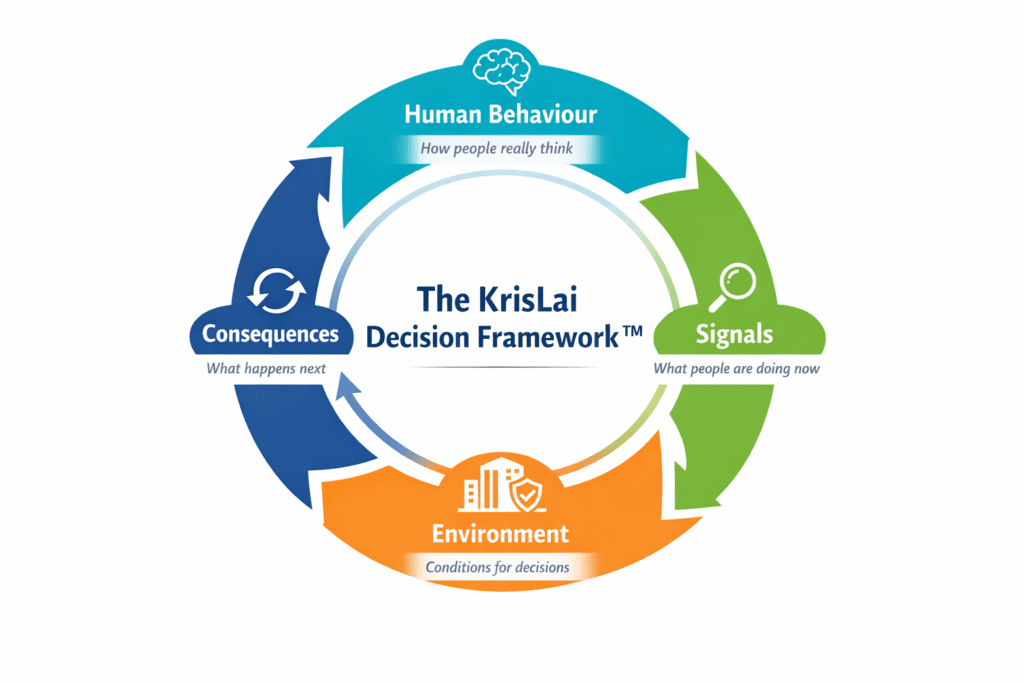
How I think about strategy using the KrisLai Decision Framework™
When I assess a strategy, I look at four things:
- Behaviour – how people are likely to respond
- Signals – what the data, feedback, and patterns are showing
- Environment – the conditions shaping the decision
- Consequences – the likely outcomes of the choice
Better decisions come from understanding behaviour, signals, environment, and consequences.

Handy Checklist for Creating a Business Strategy
Here is a very useful checklist that can help you create your all-important business strategy: (image)
Define Your Vision and Mission:
- ✔️ What is the long-term dream for your business?
- ✔️ Why does your business exist? What’s its purpose?
Conduct a SWOT Analysis:
- ✔️ Identify strengths, weaknesses, opportunities, and threats.
Set Clear Goals and Objectives:
- ✔️ What do you want to achieve in the short and long term?
- ✔️ Break goals into specific, measurable objectives.
Understand Your Target Audience:
- ✔️ Who are your ideal customers?
- ✔️ What are their needs and preferences?
Develop a Compelling Value Proposition:
- ✔️ What makes your product or service stand out?
- ✔️ How does it solve a problem or meet a need?
Identify Your Competitive Advantage:
- ✔️ How will you outperform competitors?
- ✔️ What sets your business apart?
Create Action Plans:
- ✔️ What specific steps will you take to achieve your objectives?
- ✔️ Assign responsibilities and deadlines.
Allocate Resources Wisely:
- ✔️ Where will you invest your time, money, and manpower?
- ✔️ Ensure resources align with strategic priorities.
Establish Monitoring and Evaluation Processes:
- ✔️ Regularly assess progress against goals.
- ✔️ Be ready to adapt strategies based on feedback and changing circumstances.
Remember, strategic planning is a dynamic process. Regularly revisit and adjust your strategy as your business evolves and the market changes.
What are the key parts of business strategy planning?
- Setting a clear direction
- Understanding customers and competitors
- Choosing priorities
- Using resources effectively
- Assessing risks and consequences
- Reviewing progress and adjusting when needed
Why Business Strategies Fail in the Real World
Many strategies do not fail because the people behind them are lazy or unintelligent.
They fail because the thinking behind them is incomplete.
I have seen businesses create plans that looked sensible on paper but broke down in practice for a few familiar reasons:
1. They confuse goals with strategy
Saying “we want to grow” is not a strategy. It is a goal. Strategy is how you will grow, where you will focus, and what makes your approach different or effective.
2. They ignore customer behaviour
A plan may sound brilliant internally, but if it does not match how customers actually think, compare, hesitate, or buy, it will struggle.
3. They react to noise instead of signals
Some businesses chase every trend, competitor move, or short-term pressure. That creates motion, but not always progress.
4. They try to do too much
One of the most common strategic failures is lack of focus. Businesses spread time, money, and energy too widely, then wonder why results stay weak.
5. They underestimate consequences
Every strategic choice creates trade-offs. Choosing one market, one product direction, or one growth path usually means saying no to something else. Weak strategy often ignores that.
In Swedish, there is a saying: “Den som gapar efter mycket mister ofta hela stycket.” – He who grasps at too much often loses everything.
That warning applies to strategy more often than people think!
A simple real-world example
Imagine a small business sees a competitor launch three new services and starts copying them quickly. On paper, this may look responsive. In reality, it can scatter focus, confuse customers, stretch the team, and weaken quality.
The problem is not lack of effort. The problem is weak strategic judgement.
Real-World Strategy Failure Patterns
When I think about strategy, I do not just think about successful companies. I also think about the patterns that cause good businesses to lose direction.
Here are a few common examples:
A business copies competitors instead of thinking clearly
A company sees others launching new offers, using new channels, or changing prices, so it follows along without asking whether those moves fit its own strengths, audience, or goals.
A founder builds around personal preference instead of market reality
This happens more than many people admit. The owner loves the idea, the branding, or the product, but customers do not respond in the same way.
A business grows too fast without strategic control
Growth is exciting, but unmanaged growth can create poor service, internal confusion, weak margins, and operational strain.
A company plans in a vacuum
A strategy that ignores real constraints such as time, money, staff capability, market pressure, or customer hesitation is not really a strategy. It is often just wishful thinking with bullet points.
These examples are useful because they remind us that strategy is not only about intention. It is about fit.
15 Practical Tips for Creating a Business Strategy
Implementing a business development strategy can be a challenging but rewarding process. Whether you are just starting out or whether you are a ‘seasoned’ entrepreneur, here are 15 practical tips to help translate your plans into actionable steps:
- Start with a Clear Plan:
– Tip: Develop a detailed business development plan that outlines your goals, target market, and key strategies. This plan will serve as your roadmap.
2. Break Down Goals into Smaller Tasks:
– Tip: Divide your larger goals into smaller, achievable tasks. This makes the implementation more manageable and allows for incremental progress.
3. Prioritize Tasks Based on Impact:
– Tip: Identify high-impact tasks and prioritize them. Focus on activities that will bring the most value to your business development efforts.
4. Set Realistic Timelines:
– Tip: Assign realistic deadlines to each task. Be mindful of your capacity and ensure that timelines are achievable.
5. Allocate Resources Effectively:
– Tip: Determine the resources (financial, human, and technological) required for each task. Allocate resources strategically to avoid bottlenecks.
6. Build a Competent Team:
– Tip: If you have a team, ensure they understand their roles and responsibilities. A cohesive team can significantly enhance the execution of your business development strategy.
7. Utilize Technology and Tools:
– Tip: Leverage technology and tools to streamline processes. This could include project management software, customer relationship management (CRM) tools, or marketing automation platforms. (Aff link)
8. Seek Expert Guidance:
– Tip: Don’t hesitate to seek advice from mentors, industry experts, or business consultants. Their insights can provide valuable guidance in executing your strategy. (Aff link)
9. Stay Agile and Adaptive:
– Tip: Be open to adjustments. Markets evolve, and being agile allows you to adapt your strategy based on feedback and changing circumstances.
10. Measure and Evaluate Progress:
– Tip: Establish key performance indicators (KPIs) to measure progress. Regularly assess whether you’re meeting your targets and be ready to make data-driven adjustments.
11. Celebrate Small Wins:
– Tip: Acknowledge and celebrate milestones along the way. Recognizing small victories boosts morale and motivation within your team.
12. Communicate Effectively:
– Tip: Ensure clear communication within your team. Everyone should understand the overall strategy, their roles, and how their contributions impact the bigger picture. (Int link)
13. Gather Feedback:
– Tip: Encourage feedback from team members and customers. Use this input to refine your strategy and improve your implementation process.
14. Learn from Mistakes:
– Tip: Mistakes are part of the learning process. When things don’t go as planned, analyze what went wrong, and use that knowledge to improve future strategies.
15. Stay Customer-Centric:
– Tip: Keep your customers at the forefront. Ensure that your business development strategy aligns with their needs and preferences.
Remember, successful implementation is an iterative process. Stay committed, learn from experiences and be willing to adapt your approach based on the evolving needs of your business and the market.
Strategy Decision Checkpoint
- Does this fit how customers actually behave?
- Are we responding to real signals or just reacting to noise?
- Does this strategy fit the current environment?
- What are the likely consequences if we are wrong?
- What are we choosing not to do?
Real-world Examples of Successful Business Strategies
Here are a few real-world examples of successful business strategies employed by well-known companies:
Apple Inc. – Product Differentiation:
- Strategy: Apple has excelled in product differentiation, creating a unique brand identity with a focus on design, innovation, and user experience.
- Impact: The iPhone, iPad, and Mac are examples of how Apple’s emphasis on sleek design and cutting-edge technology has allowed them to command a premium price and build a fiercely loyal customer base.
Amazon – Customer-Centric Approach:
- Strategy: Amazon’s business strategy revolves around an obsessive focus on customer satisfaction. This includes a vast product selection, convenient delivery options, and a robust customer service system.
- Impact: Amazon’s customer-centric approach has made it one of the world’s largest and most successful e-commerce companies, with customer loyalty driving sustained growth.
Tesla – Disruptive Innovation:
- Strategy: Tesla disrupted the automotive industry by prioritizing electric vehicles, renewable energy, and autonomous driving technology.
- Impact: Tesla’s innovative approach has not only reshaped the auto industry but has also influenced other sectors. The company’s success highlights the power of disruptive innovation in capturing market share.
Google – Data-Driven Decision Making:
- Strategy: Google’s business strategy is heavily reliant on data. The company collects and analyzes vast amounts of data to enhance its services and tailor its offerings to user preferences.
- Impact: Google’s data-driven decision-making has allowed it to dominate the online search and advertising markets, creating a highly profitable business model.
Coca-Cola – Global Branding:
- Strategy: Coca-Cola’s global branding strategy emphasizes consistency in its messaging and marketing. The company has successfully created a universally recognized brand with a timeless appeal.
- Impact: Coca-Cola’s global branding strategy has made it one of the most iconic and valuable brands in the world, contributing to its widespread popularity and market leadership.
Netflix – Subscription-Based Model and Content Creation:
- Strategy: Netflix transformed the entertainment industry by adopting a subscription-based model for streaming content. Additionally, the company invested heavily in original content creation.
- Impact: Netflix’s strategy has led to a massive subscriber base and positioned the company as a leader in the streaming industry. The emphasis on original content helps differentiate the platform from competitors.
Zara – Fast Fashion and Supply Chain Efficiency:
- Strategy: Zara revolutionized the fashion industry with its fast-fashion model, emphasizing rapid production cycles and efficient supply chain management.
- Impact: Zara’s strategy allows it to quickly respond to changing fashion trends, minimizing inventory costs and maintaining a high level of customer engagement.
These examples showcase the diversity of successful business strategies, emphasizing the importance of innovation, customer-centricity, data-driven decision-making, and adaptability in achieving long-term success.
Review
First, I’d like to congratulate you on beginning your exciting journey of entrepreneurship in the first place! Starting a new business venture can be really exciting 🙂
Your dreams and ideas are the driving force behind your business, and now it’s time to give them the strategic foundation they deserve.
Let me just briefly review some of the important points discussed in this post:
Why Begin Business Strategizing?
Business strategizing is not just a task; it’s your compass in the business world. It’s about envisioning your success and charting a course to get there. Here’s why it’s so crucial:

Image by Gino Crescoli from Pixabay
1. **Clear Vision**
Strategic planning gives you a crystal-clear vision of where you want your business to go. It’s like having a roadmap for your dreams.
2. **Effective Decision-Making**
With a strategy in place, decisions become clearer and more effective. You’ll know exactly where to allocate resources and energy for maximum impact.
3. **Adaptability**
The business world is dynamic, and your strategy is your tool for adaptability. It helps you adjust to changes, seize opportunities, and navigate challenges.
4. **Customer-Centric Approach**
A well-thought-out strategy puts your customers at the centre. You’ll understand their needs and preferences, building a business that truly serves them.
How to Begin?
Starting may feel overwhelming, but remember, every successful entrepreneur began with a plan. Here’s a simple guide to kickstart your strategizing journey:
1. **Define Your Vision and Mission**
– What’s the long-term dream for your business?
– Why does your business exist? What value does it bring?
2. **SWOT Analysis**
– Identify your strengths, weaknesses, opportunities, and threats.
3. **Set Clear Goals and Objectives**
– What do you want to achieve in the short and long term?
– Break these goals into specific, measurable objectives.
4. **Understand Your Audience**
– Who are your ideal customers?
– What problems or needs do they have that your business can address?
5. **Differentiate Your Business**
– What makes your product or service unique?
– How can you stand out in a crowded market?
6. **Create Action Plans**
– Break down your objectives into actionable steps.
– Assign responsibilities and set realistic timelines.

Remember, you don’t have to have all the answers right away. Business strategizing is a journey of discovery and growth. It’s about taking intentional steps toward your vision and learning along the way.
Final takeaway
A strong strategy does not try to do everything. It helps you make clearer choices, stay focused, and move with better judgement.
Remember:
A practical model for better business decisions in complex environments. It focuses on four essential elements:
- Human Behaviour — how people actually think and decide
- Signals — what people are trying to do right now
- Environment — whether the system supports good decisions
- Consequences — what happens next, and after that
Strong decisions consider all four — not just one.
Final Thought: Strategy Is About Clearer Choices
A good business strategy does not remove uncertainty.
What it does is help you face uncertainty more intelligently.
That is why strategy matters. It gives your business a clearer direction, a better filter for decisions, and a stronger sense of what deserves time, energy, and investment.
The best strategies are not always the most complicated. Quite often, they are the clearest.
They understand the people involved. They pay attention to signals. They respect the environment. And they think seriously about consequences.
That is also why strategy connects so naturally to the KrisLai Decision Framework™.
If your strategy helps you make clearer choices, avoid obvious distractions, and stay aligned with what really matters, it is doing valuable work.
As the Chinese saying goes, “运筹帷幄.” – Plan with foresight before the battle begins.
That may sound ancient, but in business it is still very modern advice.
Frequently Asked Questions About Business Strategy Planning
What is business strategy planning?
Business strategy planning is the process of deciding how a business will move from where it is now to where it wants to be. It involves setting priorities, making choices, understanding the market, and using resources in a focused way.
Why is business strategy planning important?
Business strategy planning is important because it helps a business focus on what matters most. It improves decision-making, reduces wasted effort, and gives the business a clearer direction for growth, priorities, and long-term success.
What is the difference between a business plan and a business strategy?
A business strategy explains the choices a business makes about where to compete, how to create value, and what to prioritise. A business plan is usually a broader document that may include finances, operations, marketing, and goals. In simple terms, strategy is the thinking; the plan is the document.
Why do business strategies fail?
Business strategies often fail because they confuse goals with strategy, ignore customer behaviour, react to noise instead of real signals, try to do too much at once, or underestimate the consequences of key decisions.
What are the key elements of a strong business strategy?
A strong business strategy usually includes a clear direction, a good understanding of customers and competitors, realistic priorities, sensible use of resources, and an awareness of likely risks and consequences.
How does the KrisLai Decision Framework™ connect to strategy?
The KrisLai Decision Framework™ strengthens strategy by helping leaders consider behaviour, signals, environment, and consequences before making important business choices. This can lead to more balanced and effective strategy decisions.
Call to Action:
Taking the First Steps Towards Strategic Business Growth!
🚀 Embark on a journey of success by laying the groundwork for your business’s triumphant future. It’s time to turn your dreams into a strategic reality. Here’s your call to action:
👣 Step 1: Define Your Vision. Begin by envisioning the long-term success of your business. What does it look like? What impact does it have? Your vision is the North Star guiding every strategic move.
🌐 Step 2: Understand Your Landscape. Conduct a SWOT analysis. Identify your strengths, acknowledge your weaknesses, seize opportunities, and prepare for potential threats. Knowledge is your compass.
🎯 Step 3: Set Clear Goals and Objectives. What do you want to achieve? Break it down into achievable goals with measurable objectives. Clarity is the key to effective strategy.
🤝 Step 4: Connect with Your Audience. Understand your customers deeply. What are their desires and challenges? Build a strategy that resonates with them, creating lasting connections.
🌟 Step 5: Differentiate Your Business. Discover what sets you apart. What makes your product or service unique? Let that uniqueness shine in your strategic approach.
📆 Step 6: Create Action Plans. Break down your goals into actionable steps. Assign responsibilities, set timelines, and watch your strategy come to life.
🚀 Step 7: Take the Leap. Now, it’s time to take that first step. Start implementing your strategy with determination and adaptability. Your journey toward strategic business growth begins now.
🎉 Step 8: Celebrate Progress. Acknowledge every milestone, no matter how small. Celebrate your wins, learn from your experiences, and keep pushing forward.
🔗 Step 9: Stay Connected. Connect with fellow entrepreneurs, seek guidance, and share your journey. The entrepreneurial community is here to support you.
💡 Step 10: Learn, Adjust, and Evolve. Your strategy is a living document. Learn from every experience, adjust your course as needed, and evolve with the ever-changing business landscape.
🌈 Your Success Awaits! Taking the first steps towards strategic business growth is a commitment to your success. Seize the opportunity, embrace the challenge, and watch your business flourish.
Ready to make it happen? Start now!
If you enjoy exploring the ideas behind better business decisions, you may find the Business Thinking Hub useful.
About the author
Kris Lai is a business operator and managing director with experience in land and building surveying, facilities management, logistics, and service delivery. He writes about AI, search behaviour, business strategy, and decision-making from a practical, real-world perspective.
Read more about Kris Lai
👉 Explore ideas connected to better business decisions:
- How AI Is Changing Search Behaviour (And What Businesses Must Do Now)
- Decision-Making Framework Examples: The KrisLai Method in Action
- The KrisLai Decision Framework: A Better Way to Make Business Decisions
- Micro vs Macro Marketing: When to Target Broad Audiences vs Niche Customers
- Customer Intent Marketing: How to Turn Buying Signals Into Sales