
Profit engineering is a practical way to improve the drivers behind business profit rather than simply reviewing profit after the event. It combines pricing, contribution margin, costs, customer mix, capacity, processes, and better decision-making so leaders can find profit leaks, test changes, and build stronger margins deliberately.
A business can be busy, growing, and apparently successful — yet still produce disappointing profit.
That is why revenue alone can be dangerous. More customers, more staff, more work, and more sales look impressive, but if the economics underneath them are weak, all you may have engineered is a larger problem.
In my experience, that is where profit engineering becomes useful.
It asks a much better question:
What is actually creating profit in this business — and what is quietly taking it away?
What this article covers
This guide explains:
- what profit engineering means
- where the idea came from
- how profit engineering differs from profit management
- the five numbers you need before changing anything
- where profit commonly leaks from small businesses
- the six-step KrisLai Profit Engineering Loop
- seven practical ways to improve small business profit
- how to use contribution margin and break-even analysis
- whether you should increase prices or reduce costs
- how to improve profit without increasing sales
- how to test profit decisions under uncertainty
- how AI can support profit engineering without replacing judgement
Table of Contents
- What is profit engineering?
- Where did profit engineering come from?
- Profit engineering vs profit management
- The 5 numbers you need before engineering profit
- Where does profit leak from a small business?
- How do you engineer profit?
- 7 ways to improve small business profit
- Worked small-business example
- Should you increase prices or cut costs?
- How can you improve profit without increasing sales?
- Profit engineering under uncertainty
- How can AI help with profit engineering?
- What this looks like in real business
- Where this goes wrong
- The KrisLai Decision Framework™
- What you should actually do
- People Also Ask
- Frequently Asked Questions
- Profit engineering is about changing profit drivers, not simply reporting profit.
- Revenue growth does not automatically mean profit growth.
- Contribution margin, fixed costs, break-even, and margin of safety help turn profit decisions into numbers.
- Common profit leaks include weak pricing, discounts, rework, poor customer mix, low utilisation, scope creep, and hidden cost-to-serve.
- The best profit improvement is often not “sell more”, but improve the economics of the sales you already have.
- AI can help analyse and model profit decisions, but it cannot make weak assumptions true.
Profit engineering is a practical approach to deliberately improving the drivers of profit — such as pricing, contribution margin, costs, customer mix, capacity, and processes — by measuring what is happening, identifying profit leaks, testing changes, and reviewing the financial result.
There is no single standardised modern profit-engineering framework. In this guide, I use the term to describe a decision-led approach to designing stronger profit rather than simply reporting it afterwards.
“Your P&L is the dashboard, not the engine”
Think about a car dashboard.
The speedometer tells you how fast you are travelling.
The fuel gauge tells you how much fuel remains.
The temperature warning tells you when something may be wrong.
But staring harder at the dashboard does not change how the engine performs!
That is the difference between measuring profit and engineering profit.
Your accounts tell you what happened.
Profit engineering asks what created that result.
Was the price too low?
Did labour cost rise?
Did discounts destroy contribution?
Was the customer expensive to serve?
Did poor scheduling create overtime?
Was capacity sitting unused?
Did rework eat the margin?
The numbers are the dashboard.
The business decisions underneath them are the engine.
From reporting profit to designing it
So how do we move from knowing that profit is disappointing to knowing what to change?
We stop treating profit as one final number.
Instead, we break it into the decisions and behaviours that created it.
That is where profit engineering starts.
Profit engineering works by identifying the financial and operational drivers behind profit, measuring their current performance, changing one or more drivers, and testing whether the result improves. Typical levers include price, variable costs, customer mix, service mix, capacity, retention, and process efficiency.
What is profit engineering?
Profit engineering is a decision-led method for improving how a business creates profit. Instead of waiting for the monthly accounts to reveal the result, leaders examine pricing, costs, customer behaviour, capacity, processes, and margins, then test changes that could improve the economics of the business.
The idea is simple:
Profit should not be whatever happens to remain after everyone has finished selling, spending, discounting, hiring, travelling, fixing mistakes, and adding software subscriptions.
It should be considered when those decisions are being made.
That does not mean every decision is driven only by short-term profit.
Sometimes a business deliberately accepts a lower margin because it is:
- entering a market
- building a customer relationship
- testing a service
- developing staff
- investing in future capacity
The difference is that this should be a conscious trade-off, not an accidental one.
One modern interpretation comes from Michael Kirkegaard, who describes profit engineering as a systematic way of connecting business and marketing decisions to bottom-line results rather than judging success through activity or vanity measures alone.
Michael Kirkegaard — Profit Engineering
That is directionally close to how I use the term here, but I apply it more broadly across the whole small business.
The focus is not only marketing.
It is the business economics behind:
price + cost + customer + capacity + process + decision.
Profit engineering is not another name for cost cutting. A business can cut costs and still damage profit if service quality falls, customers leave, staff performance drops, or capacity becomes too weak to support demand.
Where did profit engineering come from?
The idea of profit engineering is much older than today’s business language. Charles Edward Knoeppel published a book called Profit Engineering: Applied Economics in Making Business Profitable in 1933, and later work connected the term closely with break-even analysis, costs, prices, sales volume, and profit planning.
Knoeppel’s 1933 book shows that the phrase existed decades before Lean, Six Sigma, AI, e-commerce, or today’s growth-marketing language.
Google Books — C. E. Knoeppel, Profit Engineering
In 1950, Robert J. Barry published an article titled Profit Engineering describing the break-even chart as a management tool for improving profit.
Caltech — Robert J. Barry, Profit Engineering
The underlying question was remarkably modern:
How do changes in price, costs, and sales volume affect profit?
Technology has changed dramatically since then.
The business question has not.
Today, I would broaden the idea to include:
- pricing
- contribution margin
- customer profitability
- product or service mix
- capacity
- retention
- automation
- operational waste
- AI-supported analysis
But the principle remains familiar:
understand what drives the financial result before changing the business.
Profit engineering vs profit management: what is the difference?
Profit management mainly measures, monitors, and protects financial performance. Profit engineering goes one step further by changing the underlying drivers of profit. One tells you what happened; the other helps you test what should change next to improve future margins and profitability.
Profit Manager or Profit Engineer—Which Hat Do You Wear?
If you’re running a small business, chances are you’re wearing both hats—and switching between them more than you realise. But knowing the difference can help you focus your energy more effectively.
- Profit Managers are focused on monitoring, controlling and reporting. They protect profit.
- Profit Engineers are focused on creating, designing and optimising. They build profit.
Need both? Absolutely. But understanding which role you naturally lean towards—and which one you may need to strengthen—can give your business a real boost. Two brains are better than one, even if both live inside your head!
| Profit management | Profit engineering |
|---|---|
| Measures results | Changes profit drivers |
| Reviews the P&L | Models decisions before acting |
| Tracks margins | Tests how to improve margins |
| Controls costs | Redesigns the cost structure |
| Reports what happened | Asks what could happen next |
| Protects existing profit | Designs stronger future economics |
You need both.
Profit management without engineering can become passive.
Profit engineering without good management can become guesswork.
The strongest businesses measure what happened, understand why it happened, and then decide what to change.
The 5 numbers you need before engineering profit
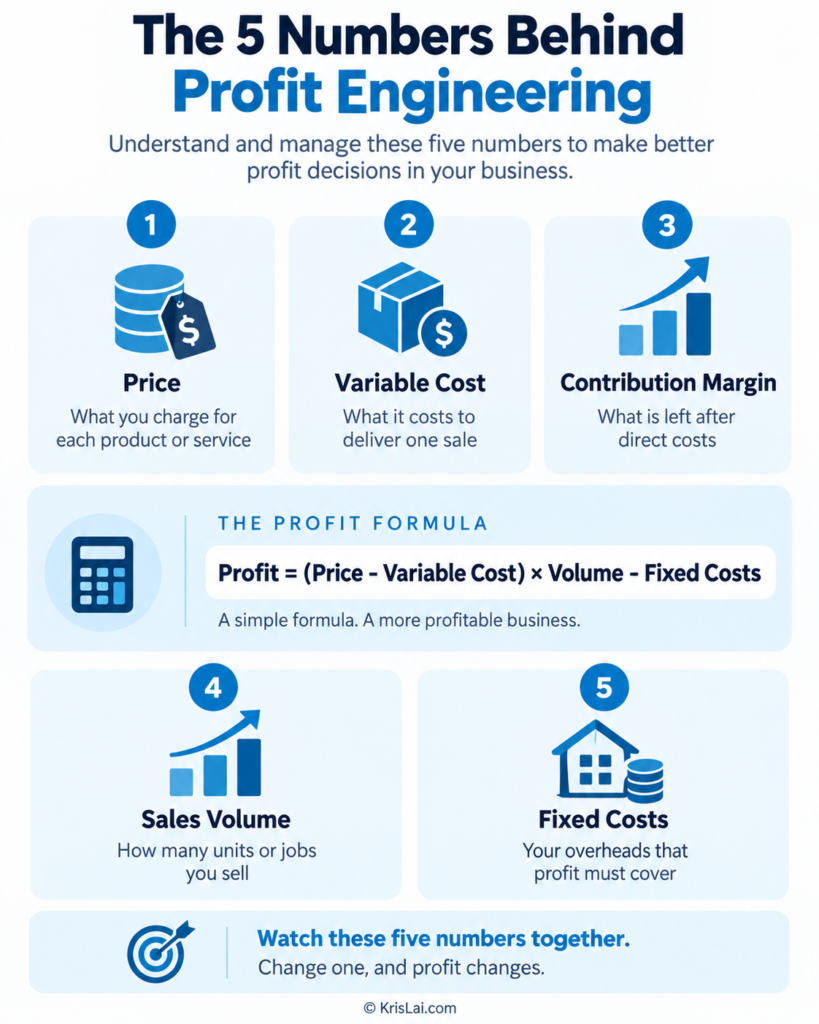
Before trying to improve profit, you need to understand five basic numbers: revenue, variable costs, contribution margin, fixed costs, and break-even. These show whether each sale contributes enough towards overhead and profit, and how much activity the business needs before it actually starts making money.
This section matters because many profit problems are really definition problems.
People say:
“Our margin is 30%.”
But which margin?!
Gross margin?
Contribution margin?
Operating margin?
Net margin?
If everyone means something different, the meeting may sound intelligent while achieving very little.
If you want to improve profit without guessing, start by tracking the few numbers that actually drive better decisions.
1. Revenue
Revenue is the money earned from sales before expenses are deducted.
It matters.
But it tells you almost nothing about whether those sales are good sales.
£100,000 of badly priced work can be less valuable than £80,000 of properly priced work.
2. Variable costs
Variable costs change as sales or delivery activity changes.
Depending on the business, these might include:
- materials
- direct labour
- shipping
- payment fees
- sales commissions
- job-specific travel
- consumables
You need to decide carefully which costs really behave this way.
Some costs are partly fixed and partly variable.
The goal is not accounting perfection. The goal is a useful decision model.
3. Contribution margin
Contribution tells you how much remains from a sale after its variable costs.
Contribution per sale = Selling price − Variable cost
Example:
Selling price = £100
Variable cost = £40
Contribution = £60
That £60 contributes towards fixed costs and, after fixed costs have been covered, profit.
You can also calculate the contribution margin percentage:
Contribution margin % = Contribution ÷ Selling price × 100
In this example:
£60 ÷ £100 = 60%
4. Fixed costs
Fixed costs do not normally move directly with each additional sale over the period being analysed.
Examples may include:
- rent
- management salaries
- insurance
- software subscriptions
- accounting fees
- office costs
- some vehicle costs
They still matter.
Contribution has to cover these costs before the business produces operating profit.
5. Break-even
Break-even is the point where total revenue and total costs are equal.
No profit.
No loss.
For a simple single-product or service model:
Break-even units = Fixed costs ÷ Contribution per unit
If:
Fixed costs = £6,000
Price = £100
Variable cost = £40
Contribution = £60
Then:
£6,000 ÷ £60 = 100 sales
The business needs 100 sales to cover those fixed costs.
The U.S. Small Business Administration uses the same basic relationship when explaining break-even analysis for small businesses.
U.S. Small Business Administration — Break-Even Point
Bonus number: margin of safety
Once you know break-even, ask:
How far above break-even are we?
If break-even is 100 jobs and you normally sell 130, you have some room.
If you normally sell 103, the business is much more exposed to:
- a lost customer
- a price increase from a supplier
- sick leave
- equipment failure
- a quiet month
That difference is strategically important.
Do not confuse markup with margin. If something costs £80 and you add 25%, the selling price is £100. The profit is £20, but £20 is only 20% of the £100 selling price. A 25% markup is therefore not a 25% margin.
What is a good profit margin for a small business?
There is no universal good profit margin for every small business. A useful margin depends on the industry, cost structure, business model, growth stage, capital requirements, and which margin you are measuring. Comparing gross, contribution, operating, and net margins is more useful than chasing one generic benchmark.
This is important.
A retailer, software business, commercial cleaning company, consultancy, manufacturer, and haulage firm should not expect identical margins.
NYU Stern’s sector data shows large differences in operating margins between industries, which is why broad claims such as “every business should make 20%” are not very helpful.
NYU Stern — Margin and Return on Capital by Sector, January 2026
Use your own economics first.
Benchmark second.
Where does profit leak from a small business?
Profit leaks when revenue is earned but unnecessary cost, discounting, waste, poor customer mix, inefficient capacity, or avoidable work reduces what remains. The leaks are often small individually, but repeated every day they can create a large gap between being busy and actually being profitable.
Profit leakage rarely announces itself with a flashing red light.
It hides in ordinary business behaviour.
| Profit leak | What it looks like | Question to ask |
|---|---|---|
| Underpricing | Prices have not changed while costs have risen | Does our price still reflect today’s cost? |
| Discounting | Sales are won by giving margin away | What contribution disappears with each discount? |
| Scope creep | Customers receive more than they pay for | What work have we quietly added? |
| Rework | Jobs are repeated because of errors or poor quality | What does getting it wrong cost us? |
| Travel and waiting | Paid time produces no customer value | Can scheduling or routing improve? |
| Poor customer mix | High-maintenance customers consume disproportionate resources | Which customers create the lowest return for the effort? |
| Low utilisation | People or equipment sit idle | Are we buying capacity we are not using? |
| Subscription creep | Software and services accumulate quietly | What are we paying for but barely using? |
There is a Finnish saying:
“Ei ne suuret tulot, vaan pienet menot.”
Roughly: it is not only large income, but small expenses that matter.
There is truth in that.
But I would add one warning.
You cannot cost-cut your way to a strong business if you remove the things customers value.
Profit engineering is not about becoming cheap.
It is about becoming economically smarter.
In my experience, profit rarely disappears in one dramatic event. It tends to leak away through small, repeated problems: weak pricing, unnecessary discounts, rising delivery costs, poor retention, low conversion, hidden overheads, or cash tied up in the wrong places. The visual below shows where those leaks often begin:
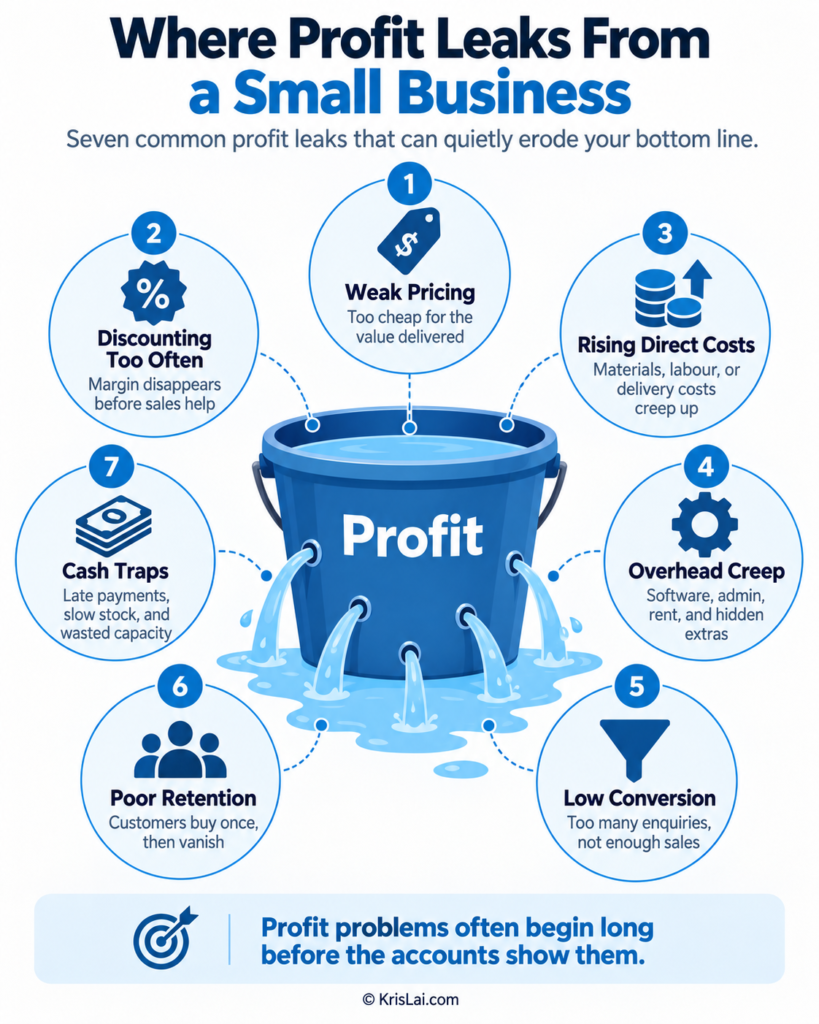
The important point is that profit leakage is usually a symptom, not the root cause. The real job is to identify which driver is weakening the result, decide which change is most likely to help, and test it without creating a new problem somewhere else. That is where profit engineering becomes a decision process rather than a cost-cutting exercise.
How do you engineer profit? The 6-step process
You engineer profit by measuring current economics, diagnosing where value is being lost, designing possible improvements, deciding which change offers the best trade-off, testing it on a controlled basis, and reviewing the financial result. The process then repeats as business conditions change.
I find it helpful to think of profit engineering as a loop rather than a one-off calculation. Each decision affects the next, and the stronger the loop, the better the result.
I call this:
The KrisLai Profit Engineering Loop
Measure → Diagnose → Design → Decide → Test → Review
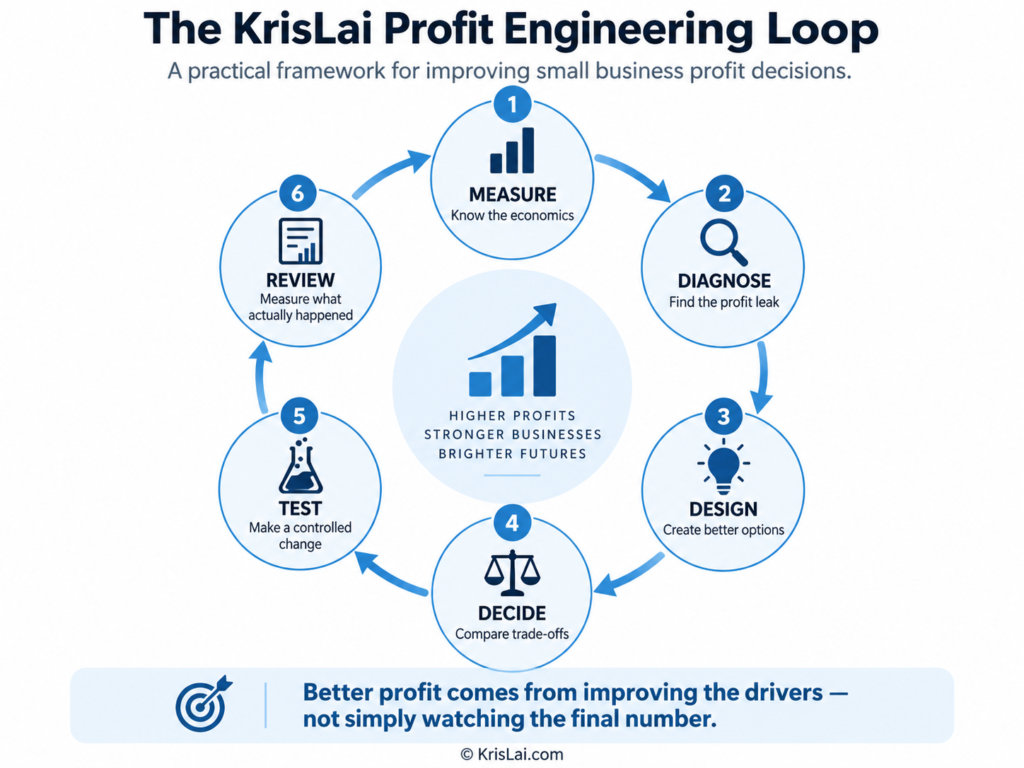
This connects closely to how I think about decisions more broadly in the KrisLai Decision Framework™: better decisions come from understanding behaviour, signals, environment, and consequences.
Step 1: Measure
Start with reality.
Measure:
- revenue
- variable costs
- contribution
- fixed costs
- break-even
- customer or job profitability where possible
Do not begin with:
“I think this is a good customer.”
Begin with:
“What do the numbers and the operational evidence tell us?”
Step 2: Diagnose
Look for the gap between what should happen and what actually happens.
Ask:
- Where is contribution falling?
- Which jobs take longer than quoted?
- Which customers generate complaints or extra administration?
- Where are we giving discounts?
- Where are people waiting, travelling, repeating, or fixing?
- Which services are busy but weak-margin?
The goal is not to find someone to blame.
It is to find the economic leak.
Step 3: Design
Now create possible changes.
Examples:
- raise price
- change minimum order or job size
- reduce discounting
- redesign a service specification
- change scheduling
- alter customer terms
- remove low-value steps
- use different equipment
- automate repetitive administration
Do not assume the first idea is the answer.
Create alternatives.
Step 4: Decide
Compare the choices.
Ask:
- What is the likely upside?
- What could go wrong?
- How much uncertainty is involved?
- What will customers notice?
- What second-order effect might appear?
- Is there a smaller version we can test?
This is where profit engineering becomes business judgement rather than spreadsheet manipulation.
Step 5: Test
Change one thing where possible.
For example:
Test a new price on new quotations.
Change scheduling in one area.
Review one customer group.
Trial one process change.
This makes cause and effect easier to see.
If you change price, staffing, software, customer terms, marketing, and service design all on Monday, Friday’s numbers will not tell you which decision worked.
That is not testing.
That is business soup.
Step 6: Review
Measure the outcome.
Ask:
- Did contribution improve?
- Did customer behaviour change?
- Did quality improve or fall?
- Did staff workload change?
- Did cash flow improve?
- Was the result worth the effort?
Then feed the result into the next decision.
Profit engineering is a loop, not a one-off project. Costs change. Customers change. Competitors change. Capacity changes. What worked last year may not be the best decision today.
What are the 7 best ways to improve small business profit?
The seven strongest profit levers for many small businesses are pricing, variable cost, customer mix, product or service mix, capacity utilisation, retention, and process efficiency. The best lever depends on the current constraint, so diagnose the problem first rather than trying to improve everything at once.
1. Improve pricing
Price is often the most powerful profit lever because a price improvement can increase contribution without requiring the same percentage increase in customers, staff, equipment, or delivery activity. The challenge is understanding customer value and testing what happens to demand when prices change.
Imagine:
Price = £100
Variable cost = £40
Contribution = £60
Increase the price to £105 while cost remains £40.
Contribution becomes £65.
That is an 8.3% increase in contribution from a 5% price rise.
The important question is not:
“Will anyone complain?”
Someone probably will. Someone once complained because free delivery took too long.
The better question is:
“How much customer demand would we need to lose before this price change becomes worse financially?”
That is a decision you can model.
2. Reduce variable cost without reducing value
Variable-cost improvement increases contribution on every sale, but it should come from smarter purchasing, better processes, less waste, lower rework, or better resource use — not simply removing things customers value and hoping nobody notices.
Look at:
- material usage
- payment fees
- delivery costs
- waste
- rework
- job travel
- supplier terms
A 3% reduction repeated across hundreds of transactions can matter.
Stop Doing It All Yourself
This might sound counterintuitive when you’re trying to save money—but outsourcing the right things can actually increase your profit margin. Why? Because you’re freeing yourself up to do higher-value work.
Use a virtual assistant, hire a freelance accountant, or get a copywriter to fine-tune your sales page. You’re not “losing” money—you’re building a stronger engine. As we say in Finland: “Hyvä työkalu puolittaa työn”—A good tool halves the work.
3. Improve customer mix
Not all customers create equal profit. Some buy regularly, pay quickly, follow agreed processes, and require little additional support. Others negotiate hard, pay late, change scope constantly, and consume management time. Customer profitability looks beyond revenue to the real cost of serving each account.
This can be uncomfortable.
Your biggest customer may not be your best customer.
Revenue can hide a great deal.
Ask:
- Who pays late?
- Who asks for unpaid extras?
- Who generates rework?
- Who needs constant management?
- Who gives predictable repeat business?
Sometimes better profit comes from changing terms.
Sometimes price needs changing.
Sometimes the correct decision is to walk away.
4. Improve your product or service mix
A business can increase profit by selling more of the products or services that generate stronger contribution and less of those that consume capacity without enough return. Product mix matters because two sales with the same revenue can produce very different financial outcomes.
Imagine two services both sell for £500.
Service A costs £200 to deliver.
Service B costs £400.
Revenue looks identical.
Contribution does not.
That is why sales targets based only on revenue can encourage the wrong behaviour.
5. Improve capacity and utilisation
Capacity utilisation measures how effectively your existing people, equipment, space, or systems are being used. Before hiring more staff or buying additional equipment, check whether poor scheduling, waiting, downtime, travel, or workflow design is reducing output from the capacity you already pay for.
This is particularly important in service businesses.
Paid time may disappear into:
- travel
- waiting
- poor scheduling
- missing information
- rework
- handoffs
Selling more work into a poorly designed system can make the business busier without making it much more profitable.
6. Improve customer retention and repeat business
Repeat customers can improve profit when they reduce acquisition costs, create predictable revenue, make capacity easier to plan, and require less selling effort. But retention is valuable only when the customer relationship itself is economically sound; retaining consistently unprofitable work does not improve the business.
Do not measure retention in isolation.
Measure:
retention + contribution + cost-to-serve.
A loyal loss-making customer is still loss-making.
Repeat Customers = Repeat Profits
It costs 5–7x more to get a new customer than it does to keep an existing one. So, if you’re focused only on new sales, you’re missing a trick. Retention is profit engineering gold.
Create easy ways for people to buy from you again—subscriptions, loyalty bonuses, “next step” offers. Make your service unforgettable, and they’ll keep coming back without needing another sales pitch.
7. Improve process efficiency
Process efficiency improves profit by reducing unnecessary time, mistakes, rework, waiting, duplication, and administration. The best process improvements remove cost or increase useful capacity without harming the customer outcome. Automation can help, but automating a bad process simply allows the mistake to happen faster.
Look for:
- repeated data entry
- unclear handovers
- unnecessary approvals
- manual invoicing delays
- poor scheduling
- avoidable complaints
- tasks nobody can explain why they still do
That final category is surprisingly popular!
Automate First, Then Optimise
One of the fastest ways to engineer profit is to reduce friction. That’s where automation comes in. From invoicing and appointment booking to email follow-ups and course delivery—automated systems can save hours every week.
And you don’t have to go all-in at once. Start by automating one small task that drains your energy. As your confidence grows, layer in more. Before you know it, you’ve got a lean, efficient engine that runs even while you sleep. (Yes, really!)
Changing price, costs, staffing, customer terms, marketing, and processes at the same time makes it difficult to know what actually improved the result. Diagnose the main constraint, test the strongest lever, and measure the consequence.
Worked example: engineering profit in a service contract
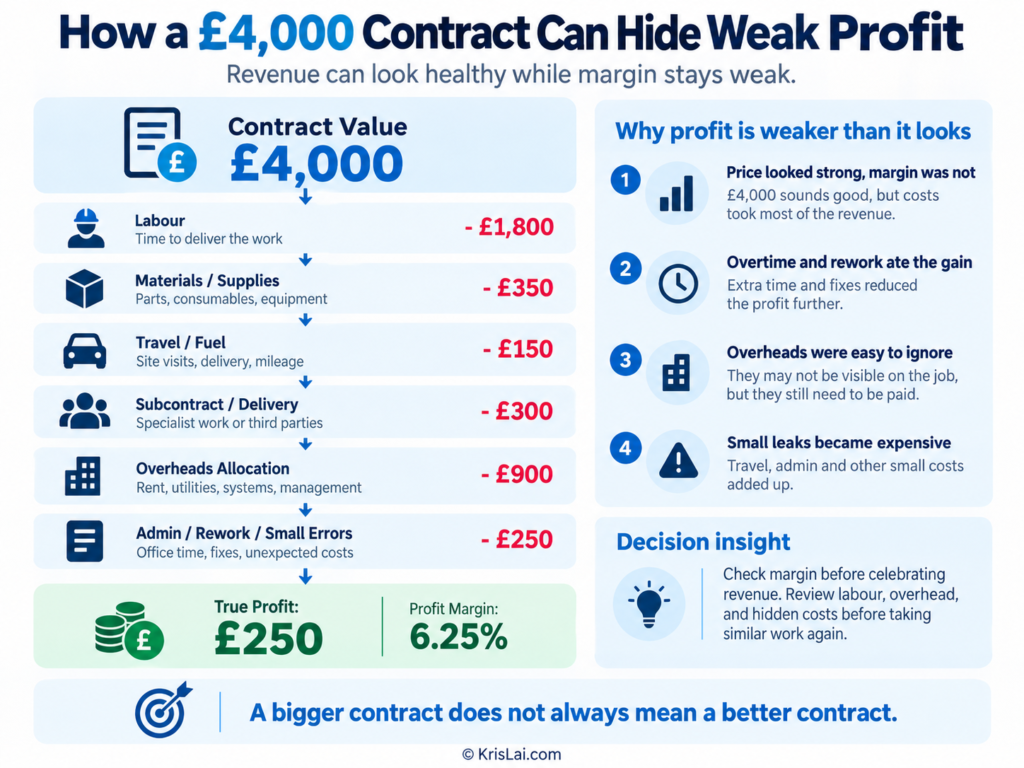
A service contract can look profitable because the headline revenue is attractive, but the real result depends on labour, consumables, travel, supervision, equipment, absence cover, rework, and administration. Profit engineering exposes those hidden costs before deciding whether to reprice, redesign, renew, or leave the contract.
Suppose a monthly commercial service contract generates:
Revenue: £4,000
The owner initially sees:
£4,000 revenue.
Good customer.
Regular work.
Looks profitable.
Now let us expose the economics.
For this simplified example, assume these costs vary with, or are directly attributable to, delivering the contract:
| Contract cost | Monthly amount |
|---|---|
| Direct labour | £1,850 |
| Employment-related direct costs | £280 |
| Consumables | £180 |
| Travel | £160 |
| Equipment / direct maintenance allowance | £120 |
| Supervision linked to the contract | £200 |
| Rework and absence cover | £210 |
| Total directly attributable / variable cost | £3,000 |
Contribution:
£4,000 − £3,000 = £1,000
Contribution margin:
£1,000 ÷ £4,000 = 25%
Now remember:
That £1,000 still has to contribute towards central fixed costs such as management, insurance, accounting, office costs, software, and other overhead.
Suddenly, “£4,000 of monthly business” looks rather different.
Now engineer the decision
Instead of saying:
“We need more contracts.”
Ask:
“What could improve the economics of this contract?”
Options might include:
- increase the contract price
- reduce unnecessary scope
- change service frequency
- improve staff scheduling
- reduce travel
- use equipment that improves productivity
- reduce rework
- renegotiate unreasonable extras
Suppose an 8% price increase moves monthly revenue from:
£4,000 to £4,320
If delivery costs remain £3,000:
New contribution:
£4,320 − £3,000 = £1,320
Contribution increased from £1,000 to £1,320.
That is a 32% increase in contribution from an 8% price increase.
That does not mean every business should simply raise prices by 8%.
It means a relatively small change in the right profit driver can have a much larger effect on the amount that reaches the bottom line.
Now you have a decision worth testing!
Should you increase prices or cut costs?
Whether you should increase prices or cut costs depends on where the profit problem originates. Price increases often have a powerful effect on contribution, while cost reductions can improve every sale. The best choice protects customer value while addressing the specific financial constraint causing weak margins.
| Profit lever | Potential advantage | Main risk | Best question |
|---|---|---|---|
| Raise price | Can improve contribution quickly | Customer resistance or lower demand | How much demand can fall before contribution worsens? |
| Reduce variable cost | Improves contribution per sale | Quality may fall | Can cost fall without reducing customer value? |
| Reduce fixed cost | Lowers break-even | May weaken future capability | What cost no longer earns its place? |
| Redesign service | Can improve both value and efficiency | Poor execution may confuse customers | Which activities create cost without enough value? |
| Improve customer mix | Capacity moves towards better work | Short-term revenue may fall | Which customers deserve scarce capacity? |
My preference is normally:
diagnose before cutting.
Cost reduction feels decisive.
But cutting indiscriminately is easy.
Knowing which cost creates customer value is harder.
That is where judgement matters.
How can a business improve profit without increasing sales?
A business can improve profit without increasing sales by increasing contribution on existing revenue. This may come from better pricing, lower variable costs, less discounting, better customer mix, reduced rework, stronger retention, better capacity use, or removing unnecessary activities that increase cost without increasing customer value.
This is one of the most useful mindset shifts in profit engineering.
When profit disappoints, many leaders instinctively think:
“We need more sales.”
Perhaps.
But suppose the real problem is:
- each sale is underpriced
- discounts are excessive
- jobs overrun
- poor-quality work creates rework
- customers pay for 10 units of effort but receive 12
- travel and waiting consume capacity
More volume could make the problem worse.
A business with weak unit economics does not always need more customers.
Sometimes it needs better economics.
Revenue tells you how much business passed through the company. Contribution tells you how much those sales gave the business to work with. When sales rise but contribution does not, the business may be growing activity faster than value.
Quality vs Quantity: Which One Builds Better Profits?
This is one of the big decisions every small business owner faces: do you go for fewer, high-value clients who pay more and expect more? Or do you focus on volume—charging less but serving more people in less time?
There’s no one-size-fits-all answer, but here’s the profit engineering take: quality creates stronger margins, but quantity can create momentum. If you’re confident in your skills and can deliver deep value, then raising your prices, working with fewer clients, and improving your service might give you more profit and more breathing room.
On the other hand, if your offer is scalable (like templates, digital products, or low-touch services), then a quantity-driven model can be highly profitable—if your systems are efficient and your margins are strong.
In short: design your offer to suit your strengths. You don’t need to burn out doing more, and you don’t need to feel guilty for charging what your work is worth. That balance—that’s what a good profit engineer figures out over time.
How does profit engineering work under uncertainty?
Profit engineering under uncertainty means testing how profit changes when assumptions change. Instead of relying on one forecast, leaders model different prices, costs, sales volumes, customer responses, and capacity levels. Scenario and sensitivity analysis reveal which assumptions matter most before money, people, or resources are committed.
This is where I believe profit engineering becomes especially useful.
Consider the earlier example:
Price = £100
Variable cost = £40
Contribution = £60
At 100 sales:
Total contribution = £6,000
Now suppose you increase the price to £110.
Variable cost remains £40.
New contribution per sale:
£70
If you still sell 100:
Total contribution = £7,000
But customers may react.
So test the decision.
To generate the original £6,000 contribution at £70 per sale, you need about:
86 sales
That means sales could fall by roughly 14% before total contribution dropped below the previous £6,000 level.
That is a much better decision discussion than:
“Do you think customers will accept £110?”
Maybe they will.
Maybe they will not.
But now you know the financial boundary.
Use three scenarios
For important decisions, I recommend:
Best case
What happens if the change works better than expected?
Base case
What seems reasonably likely?
Downside case
What happens if demand falls, costs rise, or implementation takes longer?
Then ask:
- Can the business survive the downside?
- At what point should we reverse the decision?
- What signal tells us the assumption was wrong?
- What is the cheapest useful test?
This is decision-making under uncertainty.
You are not predicting the future perfectly.
You are understanding the consequences before the future arrives.
How can AI help with profit engineering?
AI can support profit engineering by analysing costs, comparing customer profitability, spotting anomalies, modelling scenarios, summarising trends, forecasting demand, and identifying process waste. But AI should support financial judgement rather than replace it because incorrect assumptions, incomplete data, or poor cost allocation can produce confidently wrong answers.
I think AI will make profit analysis much easier for smaller businesses.
Tasks that once needed considerable spreadsheet work can increasingly be supported by AI.
For example, AI can help:
- categorise transactions
- analyse sales by customer
- compare margins
- identify unusual cost changes
- summarise monthly trends
- model price scenarios
- analyse customer feedback
- find repeated operational problems
- draft questions for a management review
Modern decision-intelligence platforms are also applying AI to areas such as pricing, inventory, forecasting, and scenario planning.
Peak — AI Decision Intelligence
But there is an important warning.
AI can make a weak profit model faster. It cannot make the assumptions true.
If your labour cost is wrong, AI will calculate the wrong result beautifully.
If you allocate overhead badly, the answer may look scientific while pointing you towards the wrong customer.
If you confuse revenue with contribution, the dashboard may become more attractive while the decision remains poor.
That is why human judgement still matters.
AI search changes profit decisions too
Customers increasingly use AI search tools to compare suppliers, products, prices, reviews, and alternatives.
That can make markets more transparent.
It may also change:
- customer acquisition costs
- price comparison
- brand discovery
- which content influences buying decisions
For me, the lesson is simple:
Do not measure digital activity only through impressions, clicks, or traffic.
Measure whether it attracts customers and revenue that create useful contribution.
That is much closer to the profit-engineering mindset.
What this looks like in real business
In real business, profit engineering often starts with a confusing signal: sales are rising, staff are busier, but profit or cash feels weaker. Rather than immediately chasing more revenue, leaders investigate pricing, workload, costs, customer mix, capacity, and process behaviour to find what changed.
A contract can look attractive when you only look at the headline revenue. In my experience, the real picture often changes once you include labour, travel, materials, supervision, overhead, admin, rework, and other hidden costs. This example shows why a £4,000 contract can still produce a surprisingly weak profit.
Imagine this situation.
Sales are up 12%.
Excellent.
Staff hours are up 18%.
Travel costs are up 20%.
Overtime has increased.
Discounting has increased because the team wanted to “win the work”.
Complaints are also rising because capacity is stretched.
The headline says:
Growth.
The economics say:
Pressure.
The instinctive response might be:
“We need even more sales so we can cover the extra costs.”
Profit engineering asks:
“Do we need more sales — or better economics on the sales we already have?”
That one question changes the conversation.
Now we investigate:
- which jobs create strong contribution
- which customers require excessive support
- whether prices reflect current labour costs
- where overtime is being created
- whether scheduling causes unnecessary travel
- whether discounts are actually necessary
We may discover that one customer segment looks attractive on revenue but produces weak contribution because jobs are fragmented across several locations.
Decision:
Reprice the work or redesign the route.
Consequence:
Perhaps revenue falls slightly.
But contribution, capacity, and service reliability improve.
That is profit engineering.
Not “make more money somehow”.
A specific business signal.
A diagnosis.
A decision.
A measurable consequence.
Where this goes wrong
Profit engineering goes wrong when businesses chase revenue instead of contribution, cut costs without understanding customer value, use outdated numbers, confuse markup with margin, ignore owner time, misallocate overhead, change too many variables at once, or trust a financial model more than the real business behaviour behind it.
- Revenue obsession: More sales do not guarantee more profit.
- Blind cost cutting: Removing value can damage retention and revenue.
- Using old costs: Pricing based on last year’s labour or supplier costs gives false confidence.
- Ignoring owner time: “I do that myself” does not make the work free.
- Confusing margin and markup: The numbers are not interchangeable.
- Treating all customers equally: Revenue does not reveal cost-to-serve.
- Changing everything at once: You lose the ability to understand cause and effect.
- Automating bad processes: Technology can scale waste as easily as value.
- Ignoring cash flow: Accounting profit and available cash are not the same thing.
Profit is not cash
This deserves emphasis.
A business can show profit while suffering cash pressure.
Customers may pay late.
Tax may be due.
Stock may absorb cash.
Loan repayments may fall due.
Growth may require staff or materials before customers pay.
That is why profit engineering should be used alongside cash-flow management, not instead of it.
The KrisLai Decision Framework™ and profit engineering
A practical model for better business decisions in complex environments. It focuses on four essential elements:
- Human Behaviour — how people actually think and decide
- Signals — what people are trying to do right now
- Environment — whether the system supports good decisions
- Consequences — what happens next, and after that
Strong decisions consider all four — not just one.
This approach is part of the KrisLai Decision Framework, a practical method for improving business decisions.
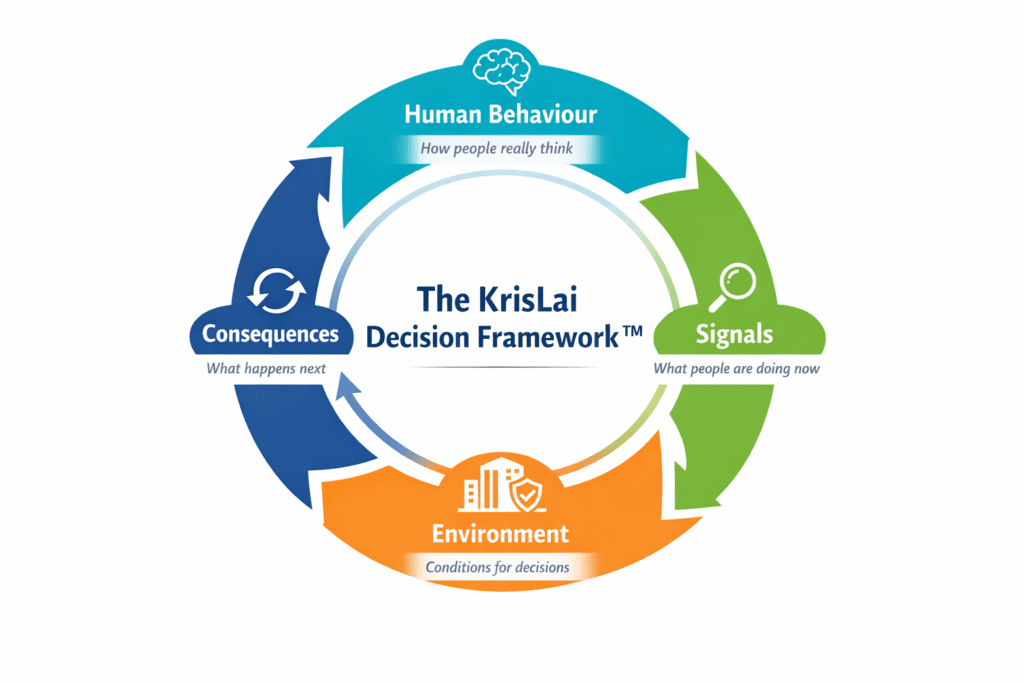
Applied to profit engineering:
Human Behaviour
How do customers respond to price?
Why do staff discount?
Why does scope creep continue?
Why do managers tolerate weak-margin work?
Signals
What are margins, complaints, overtime, utilisation, rework, customer churn, and debtor days telling us?
Environment
What is happening to labour costs, competition, capacity, supplier pricing, customer expectations, and technology?
Consequences
What happens immediately after the decision — and what happens next?
A price reduction may win a contract.
But does it create enough contribution?
A cost cut may improve this month’s result.
But does it damage service quality?
A new employee may increase capacity.
But does the demand justify the fixed cost?
Over time, I’ve found that good decisions rarely come from data alone. They come from understanding people, reading signals, creating the right environment, and thinking beyond the immediate outcome.
Better decisions come from understanding behaviour, signals, environment, and consequences.
What you should actually do
To start profit engineering, choose one product, service, customer, or contract rather than analysing the entire business at once. Calculate its real economics, find one important profit leak, choose one improvement, model the likely outcomes, test the change, and review the result before expanding it.
Try this 30-minute profit engineering review.
Step 1: Choose one area
Pick:
- one product
- one service
- one customer
- one contract
- one location
Keep it small enough to understand.
Step 2: Calculate real revenue
What are you actually receiving after discounts, refunds, rebates, or credits?
Use the real figure.
Step 3: Calculate variable or direct delivery cost
Include what genuinely changes or is directly consumed when the work is delivered.
Step 4: Calculate contribution
Revenue − Variable costs = Contribution
Now you have a much more useful starting point.
Step 5: Find one profit leak
Perhaps it is:
- price
- discount
- travel
- overtime
- waste
- rework
- payment fee
- customer support
Choose the one that matters.
Step 6: Design one change
What could you do differently?
Be specific.
Not:
“Improve efficiency.”
Instead:
“Reduce unnecessary travel between the first and second job by grouping customers by postcode.”
Step 7: Model three outcomes
Create:
- best case
- base case
- downside case
Ask what assumption matters most.
Step 8: Test the change
Start small enough that you can learn without creating unnecessary risk.
Step 9: Measure the result
Did contribution improve?
Did quality change?
Did customer behaviour change?
Did cash improve?
Step 10: Decide again
Keep it.
Adjust it.
Reverse it.
Or test the next lever.
That is how a business learns.
Do not begin profit engineering by asking, “How can we make more profit?” That is too broad. Ask, “Which one profit driver is weakening our result right now, and what is the smallest useful change we can test?”
People Also Ask
What is profit engineering?
Profit engineering is a practical approach to improving the drivers of profit, including pricing, costs, contribution margin, customer mix, capacity, and processes. Businesses measure current economics, diagnose profit leaks, design changes, test them, and review whether profitability improves.
Is profit engineering a recognised business discipline?
The term has a long history but does not have one universally standardised modern framework. C. E. Knoeppel published a book called Profit Engineering in 1933, and later work linked the idea closely with break-even, price, cost, volume, and profit planning.
What is the difference between profit engineering and profit management?
Profit management mainly measures and controls financial performance, while profit engineering focuses on changing the underlying drivers of that performance. Profit management asks what happened; profit engineering asks what pricing, cost, customer, capacity, or process decision should change next.
What is contribution margin?
Contribution margin is the amount left from a sale after variable costs are deducted. That contribution first covers fixed costs and then contributes to profit. It helps leaders compare products, services, customers, pricing decisions, and break-even requirements.
How can a business improve profit without increasing sales?
A business can improve profit on existing revenue through better pricing, reduced variable costs, less discounting, lower rework, improved customer mix, stronger capacity utilisation, better retention, and more efficient processes. The aim is to increase the contribution generated by existing activity.
Frequently Asked Questions
1. What is profit engineering for small business?
Profit engineering for small business is a practical method for deliberately improving profitability by analysing pricing, variable costs, contribution margin, customers, capacity, and processes. The business measures its current economics, identifies profit leaks, tests improvements, and reviews whether the financial result becomes stronger.
2. What does a profit engineer do?
A profit engineer analyses what drives profitability and tests ways to improve it. Depending on the business, this may involve pricing, cost structure, contribution margins, product or service mix, customer profitability, operational efficiency, capacity, forecasting, and scenario analysis. It is more a business approach than one standard job description.
3. What is the difference between profit engineering and profit management?
Profit management focuses mainly on measuring, monitoring, and protecting current profit. Profit engineering focuses on redesigning the drivers that create future profit. It uses financial and operational evidence to test changes to price, costs, customer mix, capacity, services, and processes.
4. What is contribution margin?
Contribution margin is the money remaining after variable costs are deducted from sales. For example, if a service sells for £100 and its variable cost is £40, the contribution is £60. This money contributes towards fixed costs and then profit once those fixed costs are covered.
5. What is break-even analysis?
Break-even analysis calculates the level of sales at which total revenue equals total costs. A simple formula is fixed costs divided by contribution per sale. It helps leaders understand how much they must sell before making profit and how pricing or cost changes affect that threshold.
6. What is a good profit margin for a small business?
There is no single good profit margin for every small business. Appropriate margins vary by industry, cost structure, capital requirements, growth stage, and business model. Leaders should also distinguish between gross margin, contribution margin, operating margin, and net margin before comparing performance.
7. How do you identify profit leakage?
Profit leakage can be found by reviewing pricing, discounts, rework, overtime, travel, waste, customer support, product or service mix, utilisation, payment fees, and scope creep. The key is to compare revenue with the real cost and effort required to deliver that revenue.
8. Should I raise prices or cut costs to improve profit?
The better choice depends on the source of the problem. Raising prices can improve contribution quickly, while reducing variable costs improves the economics of every sale. Cutting costs is useful when waste exists, but harmful if it reduces customer value or weakens future capability.
9. Can profit increase without sales increasing?
Yes. Profit can increase without higher sales if the business improves pricing, reduces variable costs, limits unnecessary discounts, reduces waste and rework, improves customer mix, uses existing capacity better, or redesigns inefficient processes. The aim is to produce more contribution from the revenue already being earned.
10. Can AI help with profit engineering?
AI can support profit engineering by analysing transactions, comparing customer profitability, modelling scenarios, forecasting demand, spotting cost anomalies, and identifying patterns in operations. However, business leaders still need to validate the underlying data and assumptions before acting on AI-generated recommendations.
Research and experience note
This article combines practical business experience, independent research, financial analysis, and synthesis of historical and modern thinking about profitability. The aim is not to present profit engineering as one universally standardised discipline, but to turn useful financial and operational ideas into a practical decision method for small-business leaders.
Useful reference sources
- C. E. Knoeppel, Profit Engineering: Applied Economics in Making Business Profitable, 1933.
- Robert J. Barry, Profit Engineering, Engineering and Science, 1950.
- U.S. Small Business Administration — break-even analysis and contribution relationships.
- NYU Stern — sector margin and return-on-capital data.
- Michael Kirkegaard — modern Profit Engineering approach to bottom-line decision-making.
Related reading on KrisLai.com
Profit engineering connects closely to pricing, break-even, budgeting, financial trends, uncertainty, and second-order effects. You may also find these articles useful:
- Break-Even Analysis for Business Decisions
- Small Business Budgeting: How to Build an Annual Budget That Improves Decisions
- Financial Trend Analysis: How Leaders Spot Warning Signals
- How to Read Financial Statements for Better Business Decisions
- Second-Order Thinking in Business
Conclusion and Final Thoughts: Profit should be designed, not discovered by accident
Profit engineering does not require a complicated financial model.
It starts by understanding what creates contribution, where value leaks away, and which decision is most likely to improve the economics of the business.
Measure.
Diagnose.
Design.
Decide.
Test.
Review.
Then repeat.
That approach turns profitability from a monthly surprise into something leaders can actively influence.
I write about how better decisions are made in business — combining strategy, behaviour, and practical thinking.
And this is a good example of why.
The numbers matter.
But the numbers only become useful when they lead to a better decision.
Use the Profit Engineering Toolbox to review contribution, break-even, profit leaks, pricing decisions, and the business assumptions affecting your margins.
Next step: Choose one product, service, customer, or contract and complete one 30-minute Profit Engineering Review today.
Download: Profit Engineering Toolbox (PDF)
Explore Better Business Thinking
If you enjoy exploring the ideas behind better business decisions, you may find the Business Thinking Hub useful.
I help people make better business decisions through psychology, strategy, and practical thinking.
About the author
Kris Lai is a business operator and managing director with experience in land and building surveying, facilities management, logistics, and service delivery.
Earlier in his career, he worked as a Search Engine Evaluator (via Lionbridge, supporting Google), where he assessed search result relevance, user intent, and content quality using structured evaluation frameworks. This experience gives him a rare, practical understanding of how search systems interpret signals and make ranking decisions.
In parallel, whilst working with a charity organisation, he has delivered 1000’s of structured presentations in English, Finnish, and Chinese to audiences ranging from small groups to more than 600 people, and has spent decades mentoring and developing others. This experience informs his approach to clarity, communication, and decision-making under pressure.
He writes about AI, search behaviour, business strategy, and decision-making from a practical, real-world perspective.
👉 Explore ideas connected to better business decisions:
- Digital Transformation for SMEs: 7 Questions Before You InvestDigital transformation for SMEs should start with better decisions, not more technology. This guide explains seven questions to ask before investing in AI, automation, data systems, or new software, helping you improve processes, reduce risk, and prove value before you scale.
- Cybersecurity for Businesses: 7 Decisions Leaders Must MakeCybersecurity for businesses is not just an IT issue. It is a leadership decision about protecting email, accounts, devices, backups, staff behaviour, customer data, supplier access, trust, and business continuity. This guide explains the seven cyber decisions leaders should make before a small problem becomes a costly incident.
- How AI Is Changing Search Behaviour (And What Businesses Must Do Now)AI is changing how people search, compare, and buy. Learn what this means for visibility, trust, and growth — and what businesses must do now.
- 7 Decision-Making Framework Examples for Business LeadersSeven practical decision-making frameworks for managers and business owners, with real business examples, guidance on when to use each model, a simple framework selector and a decision template.
- Business Decision-Making Framework: The KrisLai MethodMake more informed business decisions under uncertainty with the KrisLai Decision Framework. Explore four complementary lenses, follow a practical five-step process, and learn from my real pricing decision that reduced workload while increasing revenue and profit.