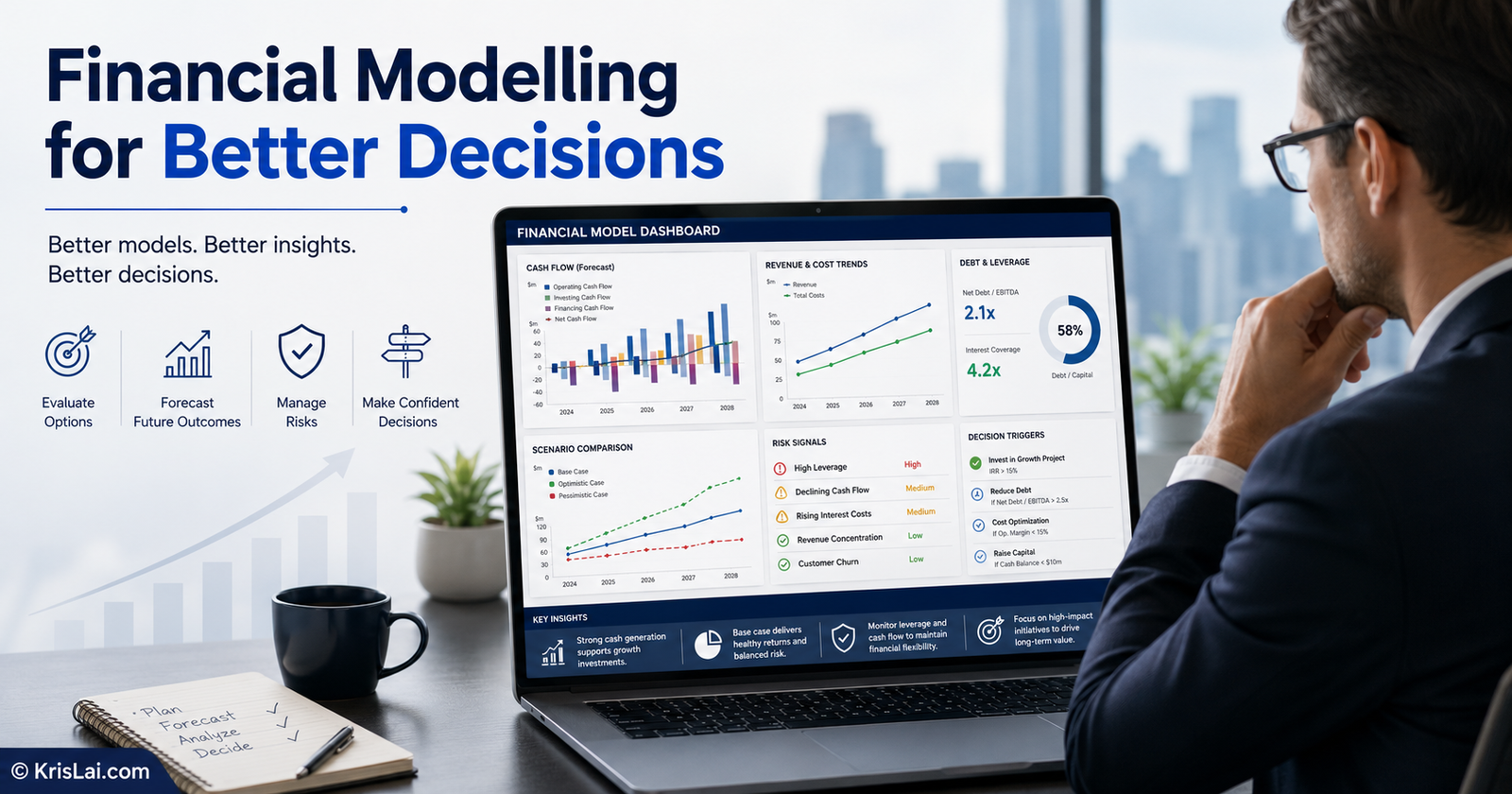
A practical guide to using financial models to test cash flow, growth, hiring, pricing, debt, valuation, and risk before committing money, time, or people.
Financial modelling helps leaders test business decisions before they commit. A good model shows how assumptions about revenue, costs, cash flow, debt, working capital, pricing, and growth affect future outcomes. This guide explains how financial modelling works, which decisions to test first, and why AI makes judgement more important, not less.
A financial model is not a crystal ball!
It will not tell you exactly what will happen next year. If it could, we would all be sitting on a beach somewhere, pretending to “check emails”.
A good financial model does something more useful. It helps you test what could happen before you commit money, time, people, or reputation.
What this article covers
- what financial modelling means
- how financial models work
- what financial modelling is used for
- common types of financial models
- how to build a simple financial model in Excel
- the 7 decisions leaders should test first
- what makes a financial model reliable
- common financial modelling mistakes
- whether AI will replace financial modelling
- CFA vs financial modelling
- whether business leaders need a financial modelling course how
- financial modelling supports better decisions under uncertainty
Table of Contents
- What is financial modelling?
- What is financial modelling used for?
- What are the main types of financial models?
- Financial modelling vs budgeting vs forecasting
- How do you build a financial model in Excel?
- 7 decisions leaders should test first with financial modelling
- What makes a financial model reliable?
- What are common financial modelling mistakes?
- Will AI replace financial modelling?
- CFA vs financial modelling: which is better?
- Do business leaders need a financial modelling course?
- What this looks like in real business
- Where this goes wrong
- The KrisLai Decision Framework™ and financial modelling
- Financial modelling under uncertainty
- What you should actually do
- People Also Ask
- FAQ
- Financial modelling is a decision simulator, not a crystal ball.
- The model is only as useful as the assumptions behind it.
- Leaders should use financial models to test decisions before committing money, time, or people.
- Scenario analysis and sensitivity testing matter more when conditions are uncertain.
- AI can speed up financial modelling, but it cannot replace leadership judgement.
- What happens if sales grow?
- What happens if sales fall?
- Can we afford to hire?
- Can we afford more debt?
- Will this project make money?
- How much cash runway do we have?
- What happens if customers pay late?
- What is the business worth?
- What decision should we make next?
- What if sales are lower?
- What if costs rise?
- What if customers pay late?
- What if we hire too early?
- What if the project takes longer?
- What if the loan repayments are harder than expected?
- cash-flow planning
- hiring
- pricing
- business growth
- debt
- fundraising
- investment
- project planning
- budgeting
- valuation
- business sale preparation
- acquisition decisions
- cost reduction
- stock and working capital planning
- scenario planning
- Can we afford this growth plan?
- Can we survive if sales are 20% lower?
- Can we take on this loan?
- Is this new contract profitable?
- How long will our cash last?
- What happens if wages increase?
- What happens if we increase prices?
- What if our best customer delays payment?
- a cash-flow forecast model
- a hiring model
- a pricing model
- a debt repayment model
- a project investment model
- a valuation model
- a scenario model
- A budget says what you plan to happen.
- A forecast says what now looks likely to happen.
- A financial model shows what could happen if assumptions change.
- Can we afford to hire?
- Can we take on this loan?
- Should we raise prices?
- Should we open another location?
- Can we invest in new equipment?
- How much cash runway do we have?
- What happens if sales slow down?
- sales
- gross margin
- direct costs
- overheads
- wages
- debt repayments
- tax
- stock or working capital
- customer payment timing
- supplier payment timing
- cash balance
- budget vs actual results
- expected sales growth
- conversion rate
- customer payment timing
- price increase
- wage increases
- cost inflation
- marketing spend
- gross margin
- debtor days
- tax timing
- loan interest
- repayment terms
- wages linked to headcount
- delivery costs linked to orders
- materials linked to sales volume
- software linked to users
- rent linked to locations
- finance costs linked to debt
- marketing linked to campaign spend
- stock purchases linked to demand
- customers may pay after 30, 45, or 60 days
- suppliers may need paying before customers pay
- stock may need buying before sales happen
- VAT and tax may be due later
- growth may use cash before it creates cash
- loan amount
- interest rate
- repayment period
- monthly repayments
- security
- fees
- covenant or lender requirements
- opening cash balance
- cash received
- cash paid out
- tax payments
- debt repayments
- investment spend
- closing cash balance
- cautious case
- expected case
- stretch case
- What if sales are 20% lower?
- What if customers pay later?
- What if costs rise?
- What if the project is delayed?
- What if a key customer leaves?
- What if the hire takes longer to become productive?
- What happens if gross margin drops by 3%?
- What happens if conversion rate falls from 20% to 15%?
- What happens if wages rise by 8%?
- What happens if debtor days move from 30 to 45?
- What happens if interest rates rise?
- formulas
- links
- totals
- assumptions
- dates
- signs
- debt repayments
- tax timing
- cash flow
- version control
- hidden hardcoded numbers
- sales change
- costs change
- payment timing changes
- debt changes
- tax changes
- customer behaviour changes
- market conditions shift
- new information arrives
- Start with the decision.
- Gather reliable historical data.
- List assumptions clearly.
- Build revenue drivers.
- Build cost drivers.
- Add working capital and cash timing.
- Add tax and debt where relevant.
- Build the cash-flow view.
- Add cautious, expected, and stretch scenarios.
- Run sensitivity tests.
- Check the model for errors.
- Review and update it regularly.
- hire more people
- buy more stock
- increase marketing
- extend credit to customers
- upgrade systems
- buy equipment
- increase management time
- fund longer payment cycles
- sales growth
- gross margin
- staff costs
- customer payment timing
- supplier payments
- stock or materials
- tax
- debt
- working capital
- cash balance
- salary
- National Insurance and payroll costs
- pension
- recruitment fee
- training
- equipment
- software
- supervision time
- productivity delay
- expected revenue contribution
- cash-flow effect
- downside scenario
- What revenue must this hire support?
- How long before the hire pays back?
- What happens if sales are slower?
- What happens if the hire does not work out?
- What happens if cash gets tight in month three?
- 1,000 units sold
- price: £100
- variable cost: £60
- contribution per unit: £40
- total contribution: £40,000
- price rises to £110
- variable cost stays £60
- contribution per unit becomes £50
- 850 × £50 = £42,500
- loan amount
- interest rate
- repayment period
- monthly repayment
- fees
- security
- tax impact
- debt service cover
- cash-flow impact
- downside case
- Can we pay this loan if sales are 15% lower?
- Can we pay it if customers pay later?
- Can we pay it if costs rise?
- What cash balance remains after repayments?
- What other options do we lose by taking this debt?
- What is the upfront cost?
- What is the monthly cost?
- What revenue could it create?
- What margin could it create?
- When does cash come back?
- What could go wrong?
- What else could this money do?
- What is the payback period?
- What is the downside case?
- £8,000 extra monthly contribution
- £2,000 extra monthly running cost
- net monthly benefit: £6,000
- What if extra sales take three months to build?
- What if running costs are £3,500?
- What if the equipment needs training?
- What if cash is needed for tax?
- What if demand is lower?
- customer payments
- tax
- supplier timing
- debt repayments
- stock purchases
- seasonality
- delayed projects
- unexpected costs
- expected runway
- downside runway
- severe downside runway
- revenue forecast
- EBITDA
- profit
- cash flow
- working capital
- debt
- growth rate
- risk
- valuation multiple
- DCF assumptions
- buyer expectations
- easy to understand
- easy to update
- easy to check
- linked to the decision
- based on clear assumptions
- built on reliable data
- able to show scenarios
- able to show cash impact
- not hiding important risks
- sales growth
- prices
- wages
- costs
- payment timing
- interest rates
- tax
- debt
- stock
- marketing spend
- revenue
- profit
- cash flow
- cash balance
- debt
- margin
- break-even point
- valuation
- runway
- cautious
- expected
- stretch
- severe downside
- delayed growth
- higher cost case
- balance sheet balances
- cash does not go negative without warning
- formulas copy correctly
- totals match
- dates align
- debt repayments are included
- tax is not forgotten
- no hidden hardcoded figures
- Building the model to justify a decision already made
- Using over-optimistic sales assumptions
- Ignoring customer payment timing
- Forgetting working capital
- Leaving out tax
- Underestimating costs
- Ignoring debt repayments
- Using hidden hardcoded numbers
- Making formulas too complex
- Failing to include a downside scenario
- Not testing key assumptions
- Using poor version control
- Not checking formulas
- Trusting AI output without review
- Treating the model as certainty
- sales growth is too high
- customer payment timing is too fast
- costs are too low
- hiring works too smoothly
- the project starts too quickly
- customers behave perfectly
- cash pressure is ignored
- formulas
- summaries
- model structure
- data clean-up
- scenario drafting
- chart creation
- error checking
- documentation
- explaining outputs
- comparing assumptions
- drafting model structure
- checking formulas
- explaining variances
- summarising scenarios
- creating charts
- testing assumptions
- spotting missing items
- improving documentation
- judgement
- ownership
- data quality
- assumption review
- scenario thinking
- professional advice
- common sense
- Excel modelling basics
- cash-flow forecasting
- three-statement models
- budgeting and forecasting
- valuation
- scenario analysis
- sensitivity analysis
- model auditing
- startup modelling
- debt modelling
- investor-ready models
- How financial statements connect
- Cash-flow forecasting
- Revenue and cost drivers
- Working capital
- Scenario analysis
- Sensitivity analysis
- Debt and tax impact
- Valuation basics
- Model checking
- AI-assisted modelling and review
- fundraising
- bank finance
- business sale
- acquisition
- major investment
- restructuring
- board decision
- legal or tax-sensitive decision
- complex debt
- investor due diligence
- hire two people
- increase marketing
- buy new equipment
- take on a business loan
- improve systems
- expand into a new area
- customers pay after 45 days
- hiring costs arrive before revenue improves
- marketing takes three months to convert
- loan repayments start immediately
- equipment creates upfront cash pressure
- tax is due in the same quarter
- one large customer accounts for 30% of revenue
- the model is built after the decision has already been made
- assumptions are not challenged
- there is no downside case
- cash flow is ignored
- tax is forgotten
- working capital is missing
- AI output is trusted without review
- formulas are too complex
- nobody owns the model
- the model is not updated
- version control is poor
- leaders focus on profit and ignore cash
- Human Behaviour — how people actually think and decide
- Signals — what people are trying to do right now
- Environment — whether the system supports good decisions
- Consequences — what happens next, and after that
- cash flow
- gross margin
- conversion rate
- debtor days
- customer retention
- cost increases
- debt repayments
- working capital
- cash runway
- forecast variance
- customer behaviour
- supplier pressure
- AI-driven market change
- lender expectations
- inflation
- competition
- hiring difficulty
- payment timing
- uncertainty
- cash shortfall
- hiring too early
- weak debt cover
- missed opportunity
- delayed investment
- pressure on staff
- damaged trust
- slower growth
- cautious case
- expected case
- stretch case
- What if sales are 20% lower?
- What if costs rise by 10%?
- What if customers pay later?
- What if funding takes longer?
- What if a key customer leaves?
- What if the model is wrong?
- price
- margin
- conversion rate
- wages
- debtor days
- interest rate
- customer retention
- sales volume
- hire only if revenue stays above a set level for three months
- increase marketing only if conversion rates hold
- take on debt only if cash stays above a minimum level
- delay expansion if debtor days rise
- pause investment if margin falls below target
- Should we hire a new operations manager?
- Should we take on a £100,000 loan?
- Should we raise prices by 8%?
- Should we buy new equipment?
- Should we open another location?
- sales growth
- pricing
- customer demand
- conversion rate
- payment timing
- costs
- wages
- debt
- tax
- working capital
- project timing
- revenue
- direct costs
- gross profit
- overheads
- net profit
- cash in
- cash out
- closing cash balance
- cautious
- expected
- stretch
- What if sales are lower?
- What if costs are higher?
- What if customers pay late?
- What if the hire takes longer to pay back?
- What if the project starts slowly?
- Does the decision still work?
- What is the cash-flow risk?
- What could make it fail?
- What information do we need?
- What should we monitor?
- What trigger tells us to pause?
- proceed
- delay
- reduce the scale
- run a pilot
- gather more information
- change the timing
- get expert advice
- reject the decision
- What decision is the model testing?
- Who owns the model?
- What historical data is being used?
- What assumptions drive the result?
- How are revenue and costs calculated?
- Is working capital included?
- Are tax and debt included where relevant?
- Does the model show cash flow?
- Are there cautious, expected, and stretch scenarios?
- Has sensitivity testing been done?
- Have formulas and links been checked?
- What trigger tells us to pause or review?
- What action follows from the model?
- which assumptions matter
- what risks to test
- what information to trust
- what trade-offs to accept
- what action to take
- Cash Flow Forecasting as an Early-Warning Decision Tool
- Small Business Budgeting: 7 Steps to Build a Smarter Budget
- Financial Mistakes: 10 Warning Signs That Hurt Cash Flow
- Financial Trend Analysis: 7 Financial Trends Leaders Should Watch
- EBITDA Explained: 7 Uses and 5 Risks for Business Leaders
- Business Valuation Under Uncertainty
- what must be true
- what could go wrong
- what changes the outcome most
- how cash flow is affected
- where uncertainty sits
- what action makes sense next
- Digital Transformation for SMEs: 7 Questions Before You Invest
- Cybersecurity for Businesses: 7 Decisions Leaders Must Make
- How AI Is Changing Search Behaviour (And What Businesses Must Do Now)
- Decision-Making Framework Examples: The KrisLai Method in Action
- The KrisLai Decision Framework: A Better Way to Make Business Decisions
Data-Driven Marketing: How Logic, Proof, and Clear Decisions Improve Results
Learn how data-driven marketing uses logic, proof, structure, and evidence to improve trust, reduce friction, and strengthen marketing decisions and conversions.
Risk Thinking: How to Make Better Business Decisions When Outcomes Are Uncertain
Risk thinking helps leaders make better business decisions when outcomes are uncertain. It is not about avoiding every risk. It is about weighing upside, downside, assumptions, timing, inaction, and consequences so you can act with more clarity.
Adapting to the New Work Era: Managing Hybrid and Remote Teams Successfully
Master the art of managing hybrid and remote teams successfully. Discover strategies to improve communication, build trust, and boost productivity in the new work era. Learn more on Krislai.com.
Innovation and Entrepreneurship: How to Develop a Successful Minimum Viable Product (MVP)
Learn how to develop a successful Minimum Viable Product (MVP) to bring your innovative ideas to market. Discover key strategies for validation, prototyping, and scaling to ensure business success.
How to Blog with AI: Tools, Techniques, and Creative Storytelling
Discover how to blog with AI and elevate your content. Explore AI blogging tools, storytelling techniques, and ways to tailor AI to health, travel, and historical blogs.
Innovation and Entrepreneurship: Fostering a Culture of Innovation in Your Organization
Learn how we can foster innovation in your organisation with practical strategies for leadership, collaboration, and customer insights. Elevate your business with a culture of innovation and entrepreneurial thinking.
What is financial modelling?
Financial modelling is the process of building a structured forecast that shows how a business may perform in the future. It usually links revenue, costs, cash flow, profit, working capital, debt, and assumptions so leaders can test decisions before committing resources.
In simple terms, financial modelling helps you answer questions such as:
Investopedia describes financial modelling as creating a spreadsheet summary of a company’s expenses and earnings to calculate the impact of a future event or decision. (Source: investopedia.com)
That definition is useful, but for business leaders I would put it like this:
Financial modelling is a way to test “what could happen if…” before real money is spent.
It is not about building a spreadsheet that looks clever.
It is about improving the quality of the decision.
Financial modelling is a structured way to test what could happen if a business makes a decision. It helps leaders understand possible outcomes before committing money, time, people, debt, or other resources.
A financial model is like a business flight simulator
A financial model is like a flight simulator for business decisions.
Pilots do not use flight simulators because they know exactly what will happen in the sky.
They use them to practise what could happen under different conditions.
Bad weather.
Engine trouble.
Navigation errors.
Pressure.
A business leader uses a financial model for a similar reason.
The model lets you test decisions before real cash, people, and risk are involved.
You can ask:
That is why financial modelling matters.
It helps you practise the decision before the business has to live with the consequence.
From spreadsheet to decision…
The value of financial modelling is not in the spreadsheet itself.
The value is in the questions the spreadsheet helps you ask.
A model should help leaders move from:
“We think this will work”
to:
“Here is what has to be true for this to work.”
That is a very different level of thinking.
The easiest way to understand financial modelling is to see it as a decision loop: define the decision, test the assumptions, review the risks, and then make a better choice.
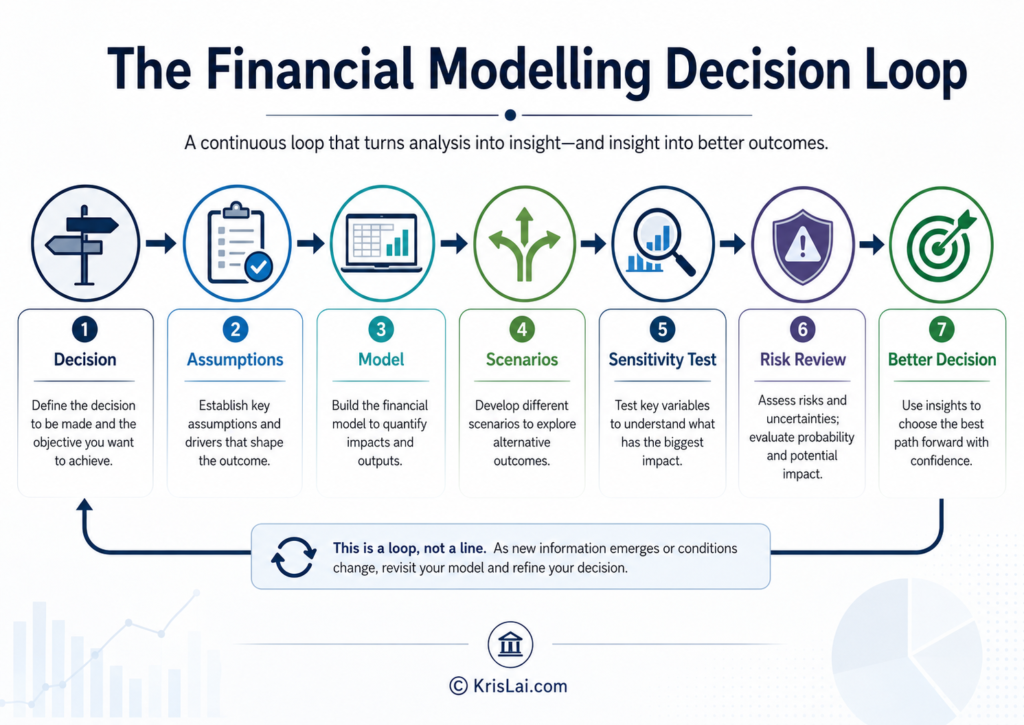
In my experience, financial models become far more useful when leaders treat them as living decision tools, not one-off spreadsheets created and forgotten.
What is financial modelling used for?
Financial modelling is used to forecast performance, test decisions, raise finance, value a business, plan cash flow, assess projects, compare scenarios, and understand risk. For business leaders, its main purpose is to improve judgement before money or resources are committed.
Financial modelling can support many decisions, including:
CFA Institute describes financial modelling as a practical skill used to analyse financial data and test strategic scenarios. Its financial modelling module includes revenue forecasting, cost modelling, working capital, debt schedules, and scenario analysis.
Source: CFA Institute, Financial ModelingFor SME leaders, the most useful financial models are usually not the most complex.
The most useful model is the one that helps you answer a real business question.
For example:
A good model does not remove uncertainty.
It helps you see uncertainty more clearly.
Financial modelling helps leaders test decisions before they act. It is used for cash-flow forecasting, budgeting, business valuation, debt planning, hiring, pricing, project investment, fundraising, and scenario analysis. A good financial model shows how assumptions change future outcomes.
What are the main types of financial models?
The main types of financial models include cash-flow forecast models, three-statement models, budget models, scenario models, valuation models, DCF models, startup models, project models, M&A models, and debt models. SMEs usually need simpler models focused on cash, profit, risk, and decisions.
Not every business leader needs every financial model.
A small service business probably does not need a leveraged buyout model.
A private equity team might.
A growing SME may need something much more practical:
Wall Street Prep lists several common financial model types, including three-statement models, DCF models, merger models, and LBO models.
Source: Wall Street Prep, Financial Modeling GuideThe CFO also explains common model types, including three-statement, DCF, M&A, LBO, sum-of-the-parts, and consolidation models.
Source: The CFO, Types of Financial ModelsFor your business, the question is not:
“How many model types do we know?”
The better question is:
“Which model helps us make the next important decision?”
| Model type | What it does | Best used for | SME relevance |
|---|---|---|---|
| Cash-flow model | Shows money coming in and going out. | Liquidity and cash pressure. | Very high. |
| Three-statement model | Links profit and loss, balance sheet, and cash flow. | Full business forecasting. | High for larger SMEs. |
| Budget model | Sets the financial plan. | Annual planning and control. | High. |
| Scenario model | Tests different futures. | Uncertainty and risk. | Very high. |
| DCF model | Values future cash flows. | Business valuation. | Medium to high. |
| Startup model | Tests runway, growth, and funding needs. | Fundraising and early growth. | High for startups. |
| Debt model | Tests repayment ability. | Borrowing and finance applications. | High. |
| Project model | Tests one project or investment. | Equipment, expansion, or new service decisions. | High. |
Financial modelling vs budgeting vs forecasting
Budgeting sets the planned financial target. Forecasting updates what is likely to happen. Financial modelling connects assumptions, drivers, and scenarios so leaders can test decisions before acting. All three are useful, but they do different jobs.
These terms are often used together.
That can make them confusing.
Before going deeper, here is a simple side-by-side comparison of budgeting, forecasting, and financial modelling so you can quickly see what each one is really for:
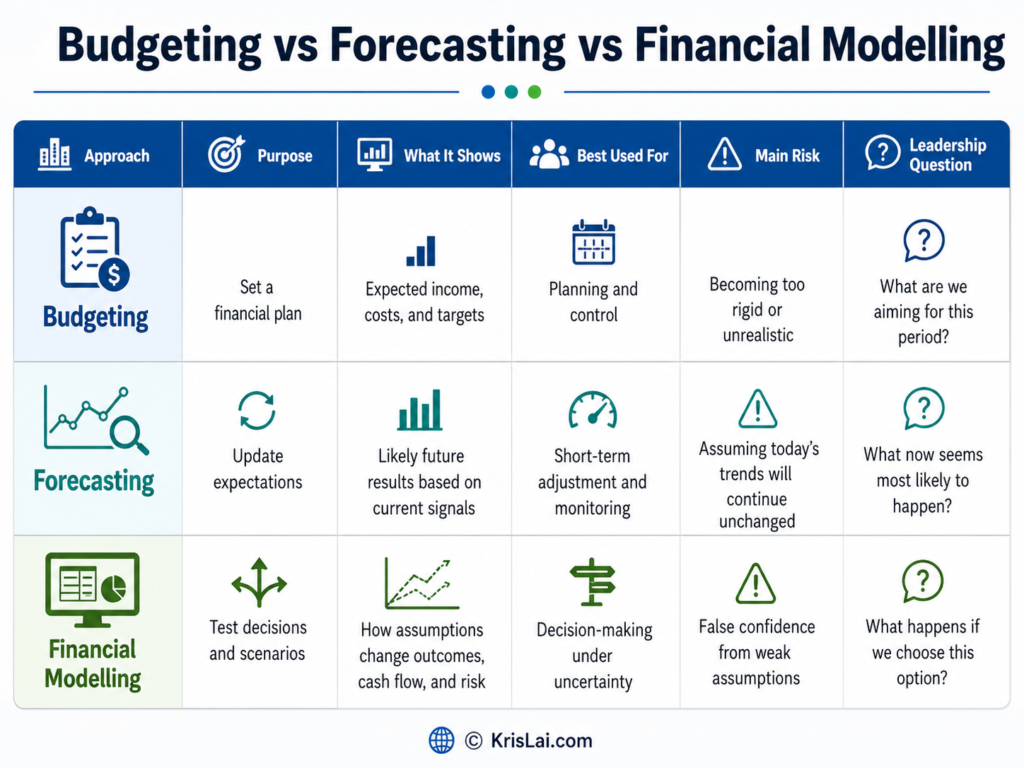
In my experience, many leaders mix these three together, and that is where confusion starts. Each one has a different job, and better decisions come from using the right tool for the right question.
Here is the simple difference:
That last part matters.
Because business decisions rarely happen in perfect conditions!
| Tool | Purpose | Best used for | Leadership question |
|---|---|---|---|
| Budget | Sets the plan. | Targets and spending control. | What are we aiming for? |
| Forecast | Updates expected results. | Current business outlook. | What now looks likely? |
| Financial model | Tests decisions and assumptions. | Scenario planning, risk, and decision support. | What happens if we act? |
A budget can tell you the target.
A forecast can tell you where you are heading.
A financial model can help you decide whether to change course.
That is why leaders should use all three, but not confuse them.
How do you build a financial model in Excel?
To build a financial model in Excel, start with the decision, gather historical data, list assumptions, forecast revenue, forecast costs, model cash flow, link key statements where needed, add scenarios, test sensitivities, and check the model for errors before using it.
You do not need to build an investment banking model to get value from financial modelling.
For many SME decisions, a simpler model is better.
The goal is not to impress another spreadsheet enthusiast.
The goal is to support a decision.
Step 1: Start with the decision
Do not start with Excel.
Start with the question.
For example:
A model without a decision often becomes a spreadsheet looking for a purpose.
That rarely ends well…
Step 2: Gather historical data
Use recent, reliable information.
Gather:
You do not need perfect data.
But you do need honest data.
A clean-looking model built on weak numbers is still weak.
It just has better formatting.
Step 3: List your assumptions
Assumptions are the heart of the model.
Examples include:
GOV.UK’s financial model guidance says figures, assumptions, and forecasts should be transparent, defensible, and grounded in real-world data.
Source: GOV.UK, Financial Model EssentialsThat is exactly the standard leaders should aim for.
Step 4: Build revenue drivers
Revenue should not just be one guessed number.
Break it into drivers.
For example:
Revenue = Number of customers × Average order value × Purchase frequency
Or:
Revenue = Number of contracts × Monthly contract value × Retention rate
Or:
Revenue = Leads × Conversion rate × Average sale value
This helps you see what actually drives growth.
Step 5: Build cost drivers
Costs should also be linked to real drivers.
For example:
This gives you a model that changes when the business changes.
Step 6: Add working capital
Working capital is where many models become too optimistic.
You need to include timing.
For example:
This is where many businesses get caught.
They forecast profit.
But they forget cash timing.
Useful related reading:
Cash Flow Forecasting as an Early-Warning Decision ToolStep 7: Add debt and tax where relevant
If the decision involves borrowing, add:
If the decision affects tax, add a tax estimate.
A model that ignores tax and debt may make a decision look better than it really is.
That is not modelling.
That is wishful thinking with columns.
Step 8: Build the cash-flow view
The cash-flow view should show:
The cash-flow line is often the most important line in the model.
Profit is useful.
Cash keeps the business alive.
Step 9: Add scenarios
At minimum, use:
Ask:
Step 10: Add sensitivity testing
Sensitivity analysis tests which assumptions change the result most.
For example:
This helps leaders see which assumptions matter most.
Step 11: Check the model
Before using the model, check:
Wall Street Prep’s financial modelling guidance stresses best practices, auditability, clear model structure, and avoiding overly complex formulas.
Source: Wall Street Prep, Financial Modeling GuideStep 12: Review and update
A model is not finished when it is built.
It should be reviewed when reality changes.
Update it when:
A model that is not reviewed becomes a historical document.
Very tidy. Very calm. Not always useful.
7 decisions leaders should test first with financial modelling
Leaders should use financial modelling to test decisions about cash flow, hiring, pricing, growth, debt, investment, and valuation. These decisions can change the financial health of the business quickly, so they should be tested before resources are committed.
Before going deeper, here is a simple overview of the seven decisions leaders should test with financial modelling before committing money, time, people, or resources:
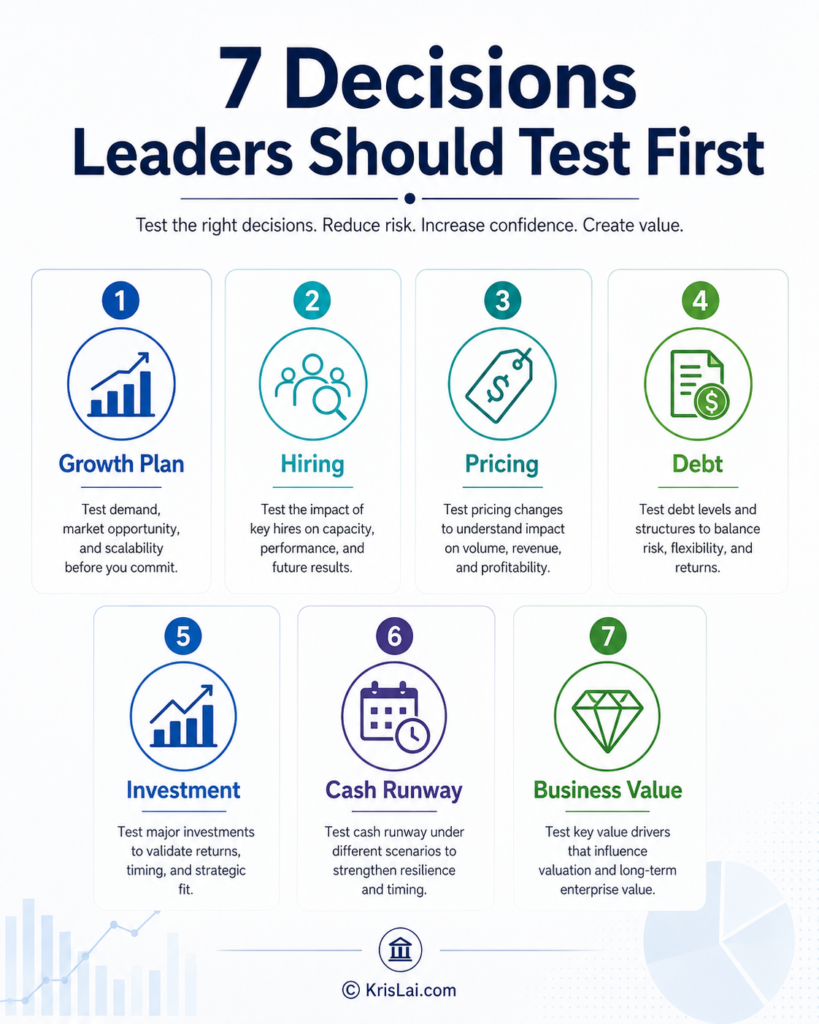
The key point is simple: a financial model becomes useful when it helps leaders test real decisions, not just produce tidy forecasts.
Yes, a financial model becomes useful when it supports a real decision.
Here are the seven decisions I would test first:
Decision 1: Can we afford this growth plan?
Growth can use cash before it creates cash. A financial model helps leaders test whether higher sales will need more staff, stock, marketing, equipment, working capital, or finance before cash comes back into the business.
Growth sounds positive.
And it can be.
But growth can also create pressure.
A business may need to spend before it earns:
What this looks like in real business:
A business wins more work.
The leader hires quickly.
Costs rise.
Customers pay after 45 days.
Cash gets tight.
The profit forecast looks fine.
The bank balance disagrees.
The model should test:
Decision insight:
Do not ask only, “Will growth increase revenue?”
Ask:
“Can we afford the cash timing of this growth?”
Useful related reading:
Financial Mistakes: 10 Warning Signs That Hurt Cash FlowDecision 2: Can we afford to hire?
A hiring model should test salary, payroll costs, equipment, training, management time, productivity delay, expected revenue contribution, and cash-flow impact. The key question is not only whether the person is needed, but whether the timing is financially safe.
Hiring decisions are often emotional.
The team is busy.
Everyone is stretched.
Customers are waiting.
The leader thinks:
“We need someone now!”
That may be true.
But the model should test the cost before the commitment.
Include:
Example:
A new hire costs £38,000 salary.
The full cost may be closer to £48,000–£55,000 after payroll costs, equipment, training, software, and management time.
If the hire takes six months to become fully productive, the early cash impact may be heavier than expected.
The model should answer:
Decision insight:
A hiring decision is not just a people decision.
It is a cash-flow decision.
Decision 3: Should we change our pricing?
A pricing model helps leaders test how price changes affect revenue, margin, customer demand, profit, and cash flow. A price rise may improve margin even if some volume is lost, but leaders should model the trade-off before acting.
Pricing is one of the most powerful decisions in business.
It is also one of the most avoided.
Many leaders fear that customers will leave if prices rise.
Some might.
But the model helps you see how much volume you can afford to lose before the price rise becomes a problem.
Example:
Current situation:
New price:
If volume falls to 850 units:
Even with fewer sales, total contribution improves.
That does not mean every price rise works.
It means you should test the maths before relying on fear.
Decision insight:
A pricing model helps leaders move from “customers might leave” to “how many could leave before this becomes a bad decision?”
Useful related reading:
Customer Intent MarketingDecision 4: Can we take on more debt?
A debt model helps leaders test whether the business can afford repayments under normal and difficult conditions. It should include interest, fees, repayment timing, cash-flow pressure, downside scenarios, and how debt affects flexibility.
Debt can be useful.
It can fund equipment, growth, working capital, or acquisition.
But debt also creates fixed commitments.
The lender still expects payment when sales are slow, customers pay late, or costs rise.
Funny how lenders are not always moved by “the market felt strange this quarter”.
A debt model should include:
Ask:
Decision insight:
Debt should be tested against cash flow, not just confidence.
Useful related reading:
Business Credit Score: 7 Ways to Build Borrowing PowerDecision 5: Is this project or investment worth it?
A project model helps leaders test whether an investment is likely to return enough value for the cash, time, and risk involved. It should include upfront cost, expected income, running costs, payback period, cash timing, risks, and opportunity cost.
A new project can look exciting.
New equipment.
New system.
New location.
New product.
New service.
New market.
A new reason to hold another meeting…
But the model needs to ask:
Example:
A business wants to spend £60,000 on equipment.
Expected benefit:
Simple payback:
£60,000 ÷ £6,000 = 10 months
That looks good.
But now test:
Decision insight:
A project model should not only show the upside.
It should show what has to be true for the upside to happen.
Decision 6: How much cash runway do we have?
A cash runway model shows how long the business can operate before cash becomes too tight. It should include cash in the bank, expected receipts, monthly spending, customer payment timing, debt, tax, planned investment, and different sales scenarios.
Cash runway is not only for startups.
Any business can benefit from knowing how long cash will last under different conditions.
The basic formula is:
Cash Runway = Cash Available ÷ Monthly Net Cash Burn
Example:
Cash available: £120,000
Monthly net cash burn: £20,000
Runway:
£120,000 ÷ £20,000 = 6 months
But be careful.
That simple formula only works if cash burn is steady.
In real business, cash changes because of:
So build three scenarios:
Decision insight:
Cash runway is not a panic number.
It is an early warning signal.
Useful related reading:
Cash Flow Forecasting as an Early-Warning Decision ToolDecision 7: What is the business worth?
A valuation model helps leaders estimate business value using future cash flows, EBITDA, profit, growth, risk, debt, and market assumptions. It is useful for selling a business, raising investment, buying another business, or understanding value drivers.
Business valuation can feel mysterious.
But at its heart, valuation is about future value, risk, and evidence.
A model may include:
A simple valuation model might use:
Estimated Enterprise Value = EBITDA × Valuation Multiple
But a more detailed valuation may use discounted cash flow, often called a DCF model.
The important point is this:
A valuation model is only as credible as its assumptions.
If the forecast is too optimistic, the valuation will be too optimistic.
If cash flow is weak, the valuation may suffer.
If customer concentration is high, risk increases.
Decision insight:
A valuation model should not only ask, “What is the business worth?”
It should ask:
“What would make the business worth more or less?”
Useful related reading:
EBITDA Explained: 7 Uses and 5 Risks for Business LeadersBusiness Valuation Under Uncertainty
What makes a financial model reliable?
A reliable financial model is clear, transparent, consistent, easy to audit, and built around defensible assumptions. It should separate inputs, calculations, outputs, and scenarios so leaders can understand what changed, why it changed, and what it means for the decision.
A model does not need to be beautiful.
It needs to be useful.
Useful means:
GOV.UK’s financial model guidance stresses that a robust model should be transparent, defensible, and grounded in real-world data.
Source: GOV.UK, Financial Model EssentialsI would use this simple structure:
Inputs
These are the assumptions you can change.
Examples:
Calculations
These are the formulas.
They should be clear and consistent.
Avoid hiding important logic inside overly complex formulas.
If a formula needs a small map and a snack break to understand, it may need simplifying.
Outputs
These are the results.
Examples:
Scenarios
These show different futures.
Examples:
Checks
These help catch errors.
Examples:
A reliable financial model does not make the future certain. It makes the assumptions, risks, and trade-offs easier to see.
What are common financial modelling mistakes?
Common financial modelling mistakes include weak assumptions, over-optimistic forecasts, broken formulas, hidden hardcodes, no cash-flow view, no downside scenario, poor version control, circular references, and treating the model as certainty rather than a decision-support tool.
Financial models can be helpful.
They can also be dangerous.
A bad model can give leaders confidence in a poor decision.
That is worse than having no model at all!
At least with no model, you know you are guessing.
With a bad model, you may think you are being analytical.
Very dangerous. Very spreadsheet-shaped.
Common financial modelling mistakes to avoid
A financial model supports a decision. It does not make the decision for you. Leaders still need to challenge assumptions, review risks, and judge whether the result makes sense in the real business environment.
The mistake I see most often
In my experience, the biggest mistake is not a broken formula.
It is weak assumptions.
The model may be mathematically correct but commercially unrealistic.
For example:
The model says the plan works.
Reality says, “Interesting theory.”
Will AI replace financial modelling?
AI will not remove the need for financial modelling. It will speed up parts of the work, such as formula building, summaries, data handling, and draft models. But leaders still need judgement, assumptions, review, scenario thinking, and accountability for the decision.
AI is already changing financial modelling.
Tools such as Microsoft Copilot, Claude in Excel, and AI-assisted finance tools can help with:
ICAEW has discussed how AI can augment financial modelling in Excel as Copilot and Claude-style tools become more advanced.
Source: ICAEW, Augmenting Financial Modelling with AICFI also now teaches AI financial modelling with Claude in Excel, including model structure, valuation, sensitivity analysis, and audit best practices.
Source: CFI, AI Financial Modeling with Claude in ExcelBut AI does not remove responsibility.
AI can help build the model.
It does not know whether your sales assumption is sensible.
It does not know whether your customers will pay late.
It does not know whether your team can deliver the project.
It does not know whether a supplier is becoming unreliable.
It does not know whether the decision fits your strategy.
That is still leadership work.
How leaders should use AI in financial modelling
Use AI to help with:
Do not use AI as a replacement for:
The future of financial modelling is not “AI instead of leaders”.
It is better models, faster checks, and stronger human judgement.
That is the opportunity.
AI can help build and explain financial models, but leaders must still check the assumptions, formulas, data, and outputs. A polished model can still be wrong if the business logic is weak.
CFA vs financial modelling: which is better?
CFA and financial modelling serve different purposes. CFA is a broad professional finance qualification covering investment knowledge, ethics, analysis, and portfolio management. Financial modelling is a practical skill for building forecasts, valuations, cash-flow models, and decision-support tools. The better choice depends on your goal.
This is a common comparison.
But it is not really a fair “which is better?” question.
It depends on what you need.
| Option | What it is | Best for | Best question to ask |
|---|---|---|---|
| CFA | A broad finance and investment qualification. | Investment careers, analysis, portfolio management, and professional finance knowledge. | Do I need a recognised finance qualification? |
| Financial modelling | A practical skill for building decision-support models. | Forecasting, valuation, cash flow, fundraising, debt, pricing, and business planning. | Do I need to test real business decisions? |
For most SME leaders, the practical skill matters more than the credential.
You do not need to become a professional analyst to use financial modelling well.
But you do need to understand enough to ask better questions.
That is the leadership skill.
Do business leaders need a financial modelling course?
A financial modelling course can help if leaders need to understand forecasts, cash flow, valuation, fundraising, or business planning. But the best course is not always the most advanced one. Leaders should choose based on the decisions they need to make.
Instead of asking:
“Which is the best financial modelling course?”
Ask:
“What decision do I need to understand better?”
A course may help if you need to learn:
But leaders should not confuse course completion with decision skill.
A course gives you tools.
Real business gives you consequences.
Both matter.
What to learn first
If you are a business leader, I would learn in this order:
When to get expert help
Get help if the model supports:
A leader does not need to build every model personally.
But the leader should understand the assumptions well enough to challenge the model.
That is where decision quality improves.
What this looks like in real business
A growing business may use financial modelling to test whether it can hire, invest, borrow, or expand without creating cash pressure. The model should show how the decision affects revenue, costs, cash flow, risk, and timing under different scenarios.
Imagine a growing service business.
Sales are rising.
The owner wants to:
The plan sounds sensible.
But the model shows a few risks:
Insight:
The plan may still be good, but the timing is risky.
Real example:
The leader originally planned to do everything in one quarter.
The financial model shows cash could go negative in month four if sales are 15% lower than expected or customers pay late.
Decision:
The leader stages the plan.
First, improve marketing conversion.
Then hire one person.
Then buy equipment after cash targets are met.
Debt is delayed until the cash-flow forecast is stronger.
Consequence:
Growth is slightly slower, but safer.
The business avoids a cash crunch, protects confidence, and makes decisions from signals rather than pressure.
A financial model should not be used to prove that a preferred decision is right. It should be used to test whether the decision still works when reality becomes less convenient.
Where this goes wrong
Financial modelling goes wrong when leaders use the model to justify a decision they already want to make. Weak assumptions, missing cash-flow timing, no downside case, too much faith in AI, and poor review can turn a useful model into a confident mistake.
What I’ve seen is that models often fail for human reasons before they fail for technical reasons.
People want the decision to work.
So the assumptions become friendly.
Sales grow smoothly.
Costs behave politely.
Customers pay on time.
The new hire performs quickly.
Debt feels manageable.
The project starts on schedule.
The spreadsheet becomes a very charming optimist.
The problem is that business does not always behave like that.
Common ways financial models go wrong
If a model only confirms what leaders already wanted to do, it is not being used properly. A useful financial model should challenge the decision, not simply decorate it.
The KrisLai Decision Framework™ and financial modelling
A practical model for better business decisions in complex environments. It focuses on four essential elements:
Strong decisions consider all four — not just one.
Financial modelling fits the KrisLai Decision Framework very well.
Human Behaviour
Leaders can become overconfident.
They can avoid bad news.
They can look for numbers that support the decision they already like.
They can fear missing out.
They can trust a polished model too quickly.
Signals
A financial model should help leaders read signals such as:
Environment
The model should reflect real conditions, such as:
Consequences
A poor financial decision can lead to:
This approach is part of the KrisLai Decision Framework, a practical method for improving business decisions.
Better decisions come from understanding behaviour, signals, environment, and consequences.
This connects closely to how I think about decisions more broadly in the KrisLai Decision Framework™.
Financial modelling under uncertainty
Financial modelling is most useful when the future is uncertain. Leaders should use scenarios, sensitivity analysis, pre-mortems, value-of-information thinking, and regular reviews to test decisions under different conditions before committing cash, people, debt, or time.
Business decisions rarely happen in calm conditions.
AI is changing search behaviour.
Customers compare more.
Costs move.
Markets shift.
Talent is harder to find.
Lenders ask sharper questions.
Cash timing matters.
That is why a single forecast is not enough.
Use the model to test different futures.
Scenario planning
Build at least three cases:
Ask:
Sensitivity analysis
Test which assumptions matter most.
Examples:
Pre-mortem thinking
Before committing, ask:
“If this decision fails, what probably caused it?”
That question helps reveal hidden risks.
Value of information
Ask:
“What information would reduce uncertainty enough to improve the decision?”
Sometimes the best decision is not “yes” or “no”.
It is:
“Find out more before committing.”
Monitor-and-adapt reviews
Set trigger points.
For example:
As the Swedish saying goes: “Lagom är bäst.”
It means, “The right amount is best.”
That is a useful idea for financial modelling.
Do not overcomplicate the model.
Do not ignore the model.
Use enough detail to improve the decision.
What you should actually do
Start with one decision, not a blank spreadsheet. Decide what you need to test, list the assumptions, build simple revenue and cost drivers, model cash flow, add scenarios, test the key risks, and review the model before committing resources.
This is the practical process I would follow.
Step 1: Write down the decision
Use one clear sentence.
Examples:
Step 2: List the assumptions
Write down what must be true.
Include:
Step 3: Build a simple model
Start with:
Add detail only where it improves the decision.
Step 4: Add scenarios
Use:
Do not only model the future you want.
Model the future you may get.
Step 5: Test the most sensitive assumptions
Find out what changes the result most.
Ask:
Step 6: Review the result
Ask:
Step 7: Decide the next action
Possible actions:
Before using a financial model to make a decision, check:
Financial modelling and AI search
AI tools can now answer “what is financial modelling?” very quickly.
They can explain model types, list formulas, and suggest templates…
That means a basic definition alone is no longer enough.
Useful content must help people act.
That matters here.
Financial modelling can influence debt, hiring, valuation, investment, cash flow, and business survival.
That is why I have not just explained modelling.
The aim was to help leaders use modelling responsibly.
AI can draft a model.
But leaders still need to decide:
Over time, I’ve found that good decisions rarely come from data alone. They come from understanding people, reading signals, creating the right environment, and thinking beyond the immediate outcome.
That is why I write about how better decisions are made in business — combining strategy, behaviour, and practical thinking.
Research and experience note
This article is based on practical experience, independent research, and analysis and synthesis of financial modelling, business forecasting, cash-flow planning, AI-assisted modelling, and decision-making under uncertainty.
Useful reference sources include:
Investopedia: Financial Modeling Explained
GOV.UK: Financial Model Essentials
CFA Institute: Financial Modeling
Wall Street Prep: Financial Modeling Guide
Corporate Finance Institute: AI Financial Modeling with Claude in Excel
ICAEW: Augmenting Financial Modelling with AI
People Also Ask
What is meant by financial modelling?
Financial modelling means building a structured forecast that shows how a business may perform under different assumptions. It helps leaders test decisions about revenue, costs, cash flow, debt, valuation, and risk before committing resources.
What is financial modelling used for?
Financial modelling is used for cash-flow forecasting, budgeting, business valuation, fundraising, debt planning, pricing, hiring, project investment, scenario analysis, and risk review. Its main purpose is to improve decision-making before action is taken.
What are the four types of financial models?
Four common financial models are cash-flow forecast models, three-statement models, valuation models, and scenario models. Other types include DCF models, startup models, debt models, project models, and M&A models.
How do you build a financial model in Excel?
To build a financial model in Excel, start with the decision, gather data, list assumptions, build revenue and cost drivers, model cash flow, add scenarios, test sensitivities, and check the model before using it.
What is sensitivity analysis in financial modelling?
Sensitivity analysis tests how changes in key assumptions affect the result. For example, it can show what happens if sales fall, costs rise, customers pay later, margins shrink, or interest rates increase.
Will AI replace financial modelling?
AI will speed up parts of financial modelling, such as formulas, summaries, data checks, and draft models. But it will not replace judgement, assumptions, scenario thinking, review, or leadership accountability.
Which is better, CFA or financial modelling?
CFA and financial modelling serve different goals. CFA is a broad finance and investment qualification. Financial modelling is a practical skill for building forecasts, valuations, cash-flow models, and decision-support tools.
Do business leaders need financial modelling?
Business leaders do not need to become professional analysts, but they should understand financial modelling well enough to test decisions, challenge assumptions, review cash-flow impact, and avoid relying on blind optimism.
FAQ
What is financial modelling?
Financial modelling is the process of building a structured forecast that shows how a business may perform in the future. It links assumptions about revenue, costs, cash flow, debt, working capital, and profit so leaders can test decisions before committing resources.
What is financial modelling used for?
Financial modelling is used for cash-flow forecasting, budgeting, business valuation, fundraising, debt planning, pricing, hiring, project investment, scenario analysis, and risk review. Its main purpose is to help leaders make better decisions before spending money or committing resources.
What are the main types of financial models?
The main types of financial models include cash-flow forecast models, three-statement models, budget models, scenario models, DCF models, valuation models, startup models, debt models, project models, M&A models, and LBO models. SMEs usually need models focused on cash, profit, risk, and decisions.
How do you build a financial model in Excel?
To build a financial model in Excel, start with the decision, gather historical data, list assumptions, build revenue and cost drivers, include working capital, add cash flow, create scenarios, test sensitivities, check formulas, and review the outputs before acting.
What is a three-statement financial model?
A three-statement financial model links the income statement, balance sheet, and cash-flow statement. It helps leaders see how revenue, costs, profit, assets, liabilities, debt, working capital, and cash flow interact over time.
What is sensitivity analysis in financial modelling?
Sensitivity analysis tests how changes in key assumptions affect the model’s results. For example, it can show how profit or cash flow changes if sales fall, costs rise, margins shrink, customers pay later, or interest rates increase.
What are common financial modelling mistakes?
Common financial modelling mistakes include weak assumptions, over-optimistic forecasts, broken formulas, hidden hardcodes, missing cash-flow timing, no downside scenario, poor version control, no model review, and treating the model as certainty rather than decision support.
Will AI replace financial modelling?
AI will not fully replace financial modelling. It will speed up formula building, summaries, data handling, model drafting, and error checks. But leaders still need judgement, assumption review, scenario thinking, business context, and accountability for the final decision.
Is CFA better than financial modelling?
CFA and financial modelling are different. CFA is a broad finance and investment qualification. Financial modelling is a practical skill for building forecasts, valuations, cash-flow models, and decision-support tools. The better choice depends on your goal.
Do business leaders need a financial modelling course?
A financial modelling course can help business leaders understand forecasts, cash flow, valuation, fundraising, and decision support. But leaders should choose a course based on the decisions they need to make, not just the course brand or technical complexity.
Financial modelling connects closely to cash flow, forecasting, budgeting, valuation, business credit, EBITDA, and decision-making under uncertainty.
These related articles may help you go deeper:
Financial modelling is not only a finance skill. It is also a decision-making skill. These articles support the wider thinking behind better business decisions:
Conclusion and final thoughts: use the model to test the decision
A financial model is not there to predict the future perfectly.
It is there to help leaders test decisions before they become expensive.
Used well, financial modelling helps you see:
The best leaders do not use financial models to avoid judgement.
They use them to improve judgement.
I help people make better business decisions through psychology, strategy, and practical thinking. Financial modelling fits that perfectly because it sits at the point where numbers, assumptions, behaviour, risk, and action meet.
Choose one important decision and model it before you commit.
Pick one decision about hiring, pricing, debt, growth, investment, cash runway, or valuation. Write down the assumptions, build a simple cash-flow view, and test cautious, expected, and stretch scenarios.
This one step will help you move from hope to evidence before money, time, or people are committed.
If you want a practical way to think through business decisions, download my free KrisLai Decision Framework™ guide.
It will help you look at decisions through four simple lenses: behaviour, signals, environment, and consequences.
Use it before major choices about cash flow, growth, hiring, pricing, debt, valuation, investment, marketing, operations, and AI.
Financial pressure rarely begins with one dramatic event. It usually starts with small signals that are easy to miss.
Enter your email below and I’ll send you the free KrisLai Decision Framework™ guide, a practical model for understanding behaviour, signals, environment, and consequences before problems become more expensive.
It is designed to help leaders think more clearly and act earlier when timing, pressure, and uncertainty begin to build.
If you enjoy exploring the ideas behind better business decisions, you may find the Business Thinking Hub useful.
If you enjoy exploring the ideas behind different marketing strategies, you may find the Business Thinking Hub useful.
About the author
Kris Lai is a business operator and managing director with experience in land and building surveying, facilities management, logistics, and service delivery.
Earlier in his career, he worked as a Search Engine Evaluator (via Lionbridge, supporting Google), where he assessed search result relevance, user intent, and content quality using structured evaluation frameworks. This experience gives him a rare, practical understanding of how search systems interpret signals and make ranking decisions.
In parallel, whilst working with a charity organisation, he has delivered 1000’s of structured presentations in English, Finnish, and Chinese to audiences ranging from small groups to more than 600 people, and has spent decades mentoring and developing others. This experience informs his approach to clarity, communication, and decision-making under pressure.
He writes about AI, search behaviour, business strategy, and decision-making from a practical, real-world perspective.
👉 Explore ideas connected to better business decisions: