

Conceptual selling is a buyer-first sales approach. In simple terms, it means understanding what the buyer is really trying to achieve, how they see the problem, and what a good outcome looks like to them before you rush into a product pitch. In this guide, I explain how the method works, why it still matters, and how to use it in a practical, trust-building way.
Disclosure: If you click on my affiliate/advertiser’s links, I am going to receive a tiny commission. AND… Most of the time, you will receive an offer of some kind. It’ s a Win/Win!
What this article covers
In this article, I explain what conceptual selling means in plain English, where the method came from, why it works, how to use it step by step, where it helps most, and the common mistakes that weaken it. I will also show how it fits modern B2B and SaaS sales where buyers are often cautious, better informed, and surrounded by options.
This article is based on practical business thinking, independent research, and my own analysis and synthesis of how buying decisions, trust, and customer understanding shape real sales outcomes.
A lot of selling still starts in the wrong place.
It starts with the seller’s product, the seller’s pitch, and the seller’s need to explain.
Conceptual selling starts somewhere better.
It starts with the buyer.
That is one reason I think it still matters.
Most buyers are not really buying a list of features. They are buying their own idea of what a better outcome looks like. They are buying less friction, more growth, lower risk, more time, more control, or fewer mistakes. The product matters, of course. But what matters first is what the buyer believes the product will help them achieve.
That shift — from product-first selling to buyer-first selling — is where conceptual selling becomes useful.
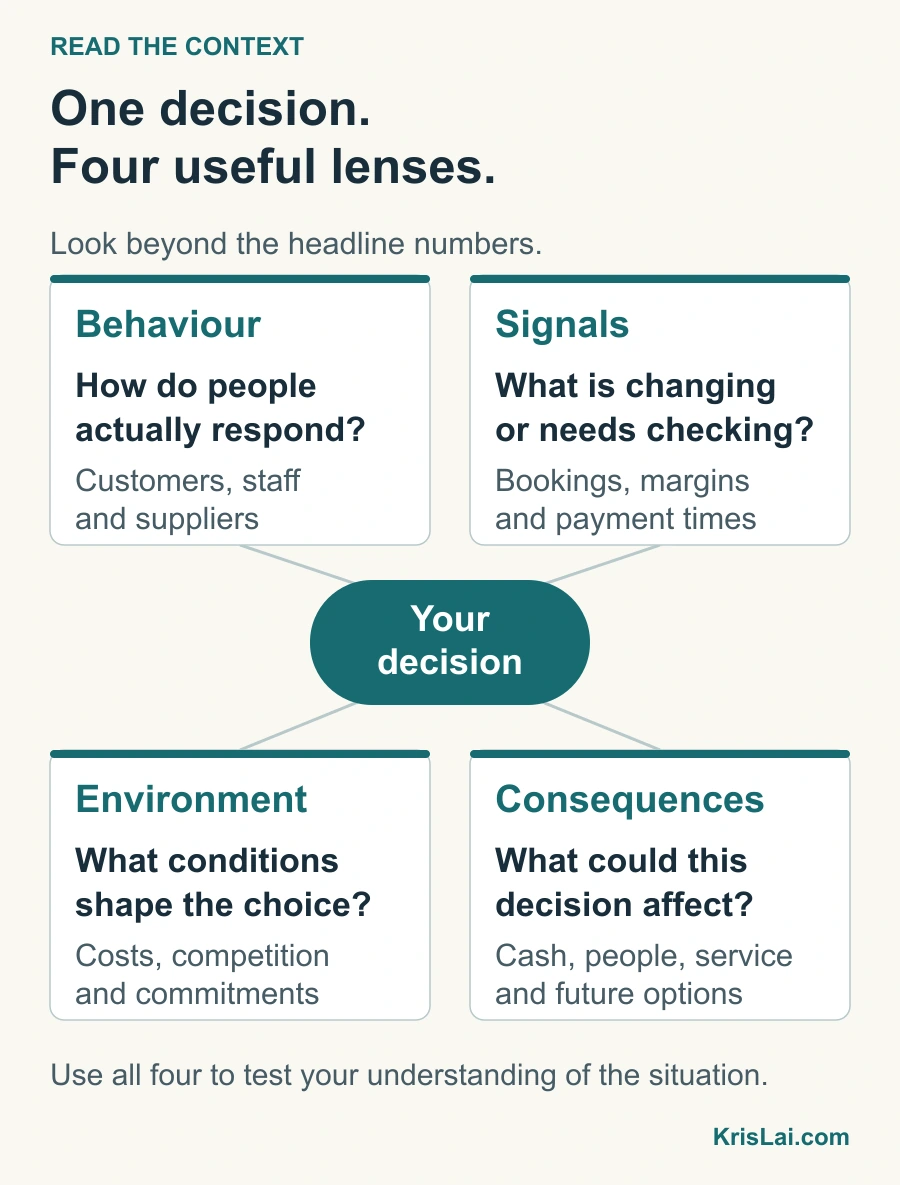
This approach is part of the KrisLai Decision Framework, a practical method for improving business decisions.
Better decisions usually come from understanding behaviour, signals, environment, and consequences.
I write about this – how better decisions are made in business — combining strategy, behaviour, and practical thinking.
Key ideas
- Conceptual selling starts with the buyer’s view, not the seller’s script.
- People usually buy outcomes, not lists of features.
- Good questions and good listening sit at the centre of the method.
- This works especially well in more complex B2B and SaaS sales.
- The goal is not to sound clever. The goal is to understand the buyer better and position the offer more wisely.
What does conceptual selling mean in plain English?
Conceptual selling means selling in a way that starts with the buyer’s concept of success.
That means asking:
- What does the buyer want to achieve?
- What problem are they trying to solve?
- What does a good result look like to them?
- What is stopping progress at the moment?
- How will they judge whether the solution is worth buying?
That is the heart of it.

Photo by Olav Ahrens Røtne on Unsplash
Modern summaries of conceptual selling still describe it this way: focus less on the product itself and more on the customer’s idea of the solution, their buying process, and the results they want. (revenue.io)
A practical model for better business decisions in complex environments. It focuses on four essential elements:
- Human Behaviour — how people actually think and decide
- Signals — what people are trying to do right now
- Environment — whether the system supports good decisions
- Consequences — what happens next, and after that
Strong decisions consider all four — not just one.
The buyer buys a result, not a list of features
This is one of the simplest and most important ideas in selling.
A buyer usually does not wake up wanting:
- a dashboard
- a software feature
- a reporting module
- a service specification
They wake up wanting:
- less wasted time
- fewer errors
- better visibility
- faster delivery
- more confidence in decisions
- stronger results
So if you lead too quickly with the product, you may miss what the buyer actually cares about.
That is why conceptual selling is so useful. It moves the conversation away from “Here is what we do” and towards “Here is what you need, and here is how this fits.”
Conceptual selling, in simple terms
Conceptual selling is a buyer-focused sales approach that starts with the customer’s idea of the desired result, rather than a product-first pitch.

Where this sales method came from, and why it caught on
Conceptual selling is widely associated with Robert Miller and Stephen Heiman, and current sales sources still credit them with developing the methodology. The approach became well known because it offered a more structured way to sell in longer, more complex, more consultative sales situations. Walnut, Revenue.io, and later summaries all still frame it that way. (walnut.io)
It caught on because it made practical sense:
- ask better questions
- understand the buyer properly
- do not force a generic pitch
- match the offer to what the buyer actually values
That is still good advice now.
What are the core principles that make conceptual selling work?
A lot of methodology articles overcomplicate this.
I think the core ideas are simpler than they sound:
Start with questions, then listen harder than you talk
This is one of the clearest strengths of conceptual selling.
The method works because it slows the rush to pitch.
Instead of trying to impress the buyer with product detail too early, it asks the seller to understand:
- the goal
- the problem
- the urgency
- the decision process
- the meaning of success
That builds trust faster because buyers feel understood, not handled.
Understand each person’s view of a successful outcome
This matters even more in B2B deals.
Different people often want different things.
For example:
- finance may care about cost control
- operations may care about speed and reliability
- leadership may care about growth
- users may care about ease and workflow
- compliance may care about risk
Conceptual selling works better when those different views are uncovered early.
That is one reason the method is often seen as a strong fit for complex deals with several stakeholders. Modern B2B commentary still frames it that way. (kornferry.com)
What this means in real business
In real sales, different stakeholders often want different things. Conceptual selling helps you uncover those views early, so the conversation becomes more relevant and the solution is easier to position in a way that makes sense to the buyer.
How does the conceptual selling process work from first call to next step?
This is where the method becomes practical.
You do not need to memorise a rigid script.
But you do need a better flow.
Prepare before the meeting so your questions are sharper
Preparation matters because better questions usually come from better context.
That might include:
- basic company research
- likely stakeholders
- industry pressure
- recent changes
- possible priorities
- likely pain points
The point is not to make assumptions.
The point is to avoid asking lazy questions.
Use discovery to uncover pain points, priorities, and decision criteria
This is the heart of the conversation.
You want to learn:
- what they want to improve
- what is not working now
- what success looks like
- how they make decisions
- what risks they care about
- who else matters in the process
Good questions might be:
- “What made this worth looking at now?”
- “What is the biggest difficulty in the current process?”
- “What would a good result look like six months from now?”
- “Who else needs to feel comfortable with this decision?”
- “What matters most when you compare options?”

Image by Gerd Altmann from Pixabay
Match your solution to the buyer’s concept of success
This is where many salespeople go wrong!
They hear one pain point and jump into a generic pitch.
Conceptual selling works better when you position the solution using the buyer’s own language and priorities.
That means:
- less feature dumping
- more relevance
- more outcome-led explanation
- more connection between the offer and the buyer’s stated goals
Confirm agreement and set a clear next step
A good sales conversation should not end in vagueness.
You need to confirm:
- what matters most
- what they understood
- what needs clarifying
- what happens next
This keeps the sale moving without pressure.
A practical example
Instead of saying, “Our software has advanced reporting and automation,” a conceptual seller might say, “You mentioned that delays and poor visibility are making decisions harder. Let me show you how this could reduce both.” That feels more relevant because it starts from the buyer’s goal, not the feature list.

Why does conceptual selling help teams win better deals?
This is where the method earns its place.
It can improve trust, deal quality, and long-term fit
When a buyer feels properly understood, a few things often improve:
- trust
- conversation quality
- deal fit
- relevance
- fewer avoidable objections
- stronger long-term customer match
That matters because not every deal should be won at any cost.
A strong sale should also be a good fit.
It works especially well in complex B2B and SaaS sales
This is one reason the method is still useful now.
In more complex sales:
- there are often several decision-makers
- needs are not always obvious
- risk matters more
- the buyer may need internal buy-in
- the product may be difficult to judge from features alone
That is why conceptual selling often fits B2B, SaaS, consulting, and more layered service sales better than simple transactional environments. Current sources continue to describe it as particularly useful in complex sales settings. (kornferry.com)
AI tools may help with research, preparation, and call review in 2026, but they do not replace listening, judgement, or human understanding.
The KrisLai Conceptual Selling Lens™
- Behaviour – how is the buyer responding, hesitating, or leaning in?
- Signals – what words, concerns, priorities, and patterns reveal the real need?
- Environment – what business context, pressure, and stakeholders are shaping the decision?
- Consequences – what happens if the problem stays unsolved or the wrong decision is made?
I often think about this using a simple decision framework: behaviour, signals, environment, and consequences.
These behavioural patterns also appear in customer intent marketing, where buying signals reveal when customers are ready to make decisions.


What common mistakes weaken conceptual selling?
This is an important section, because the method can sound better than it feels if used badly.
Talking too soon about the product
This is one of the most common mistakes.
The seller gets excited, moves too fast, and starts explaining features before the buyer’s priorities are clear.
That usually weakens the conversation.
Treating every buyer the same
Copy-paste messaging is especially weak in conceptual selling.
If different buyers want different outcomes, the same pitch will not land equally well with all of them.
Forgetting to confirm what the buyer actually means
This is another big one.
A buyer says they want “efficiency” or “visibility” or “better reporting.”
But what does that mean in their business?
If you do not check, you may build your whole pitch on the wrong understanding.
Confusing understanding with progress
A seller can ask good questions and still fail if the conversation never moves towards relevance, fit, and a clear next step.
Curiosity matters. Listening matters. But they have to lead somewhere useful.
Where this goes wrong
Conceptual selling becomes weak when sellers ask scripted questions without real listening, treat every buyer the same, or stay so abstract that the buyer never sees how the offer actually fits their goals.

How does conceptual selling connect to trust, value, and better decisions?
This is where I think the method becomes more than a sales technique.
It becomes a better way to think.
Because good selling is not really about saying more.
It is about understanding more.
This approach is part of the KrisLai Decision Framework, a practical method for improving business decisions.
Better decisions come from understanding behaviour, signals, environment, and consequences.
This connects closely to how I think about decisions more broadly in the KrisLai Decision Framework™.
That is one reason conceptual selling fits so naturally with:
- customer intent marketing
- science-based selling
- behavioural economics
- buyer psychology
- better business judgement
Final thought: successful selling starts with the buyer’s view, not the seller’s script
That, to me, is the heart of conceptual selling.
Not clever words.
Not polished slides.
Not early feature dumping.
Just a stronger starting point.
If you understand what the buyer is really trying to achieve, what matters most to them, and how they define success, you are far more likely to position your offer wisely.
That leads to better conversations.
Often, it leads to better deals too.
A simple practical takeaway is this:
Ask better questions.
Listen fully.
Check your understanding.
Then connect the offer to the buyer’s idea of success.
That is a much stronger rhythm than pitching first and hoping the fit appears later.
Final takeaway
Conceptual selling works because it helps you understand buyers better before you try to persuade them. Start with their view of success, ask better questions, listen carefully, and connect your recommendation to what matters most to them.

Related reading on KrisLai.com
- Related article: Customer Intent Marketing
- Glossary or definition article: Behavioural Economics in Business
- Pillar topic: Business Thinking Hub
- Science-Based Selling
- Curiosity Marketing and Selling
- Negotiation Skills in Business
- Decision-Making Framework Examples

Frequently Asked Questions About Conceptual Selling
What is conceptual selling?
Conceptual selling is a buyer-focused sales methodology that starts with understanding the customer’s idea of the desired result before pitching a product or service.
How is conceptual selling different from product-led selling?
Product-led selling starts by explaining features. Conceptual selling starts by understanding what the buyer wants to achieve, what matters most to them, and how they define success.
Who created conceptual selling?
Conceptual selling is widely associated with Robert Miller and Stephen Heiman, and it remains a well-known sales methodology in more complex B2B selling environments.
Why does conceptual selling work?
Conceptual selling works because buyers respond better when they feel understood. Good discovery, strong listening, and outcome-led positioning usually create more relevant and more trusted sales conversations.
Where does conceptual selling work best?
It often works best in complex B2B sales, SaaS, consulting, and other sales environments where several stakeholders may be involved and the buyer’s goals are not always obvious at first.
What is a common mistake in conceptual selling?
A common mistake is talking too soon about the product before the buyer’s goals, concerns, and decision criteria have been properly understood.
If you enjoy exploring the ideas behind better business decisions, you may find the Business Thinking Hub useful.

About the author
Kris Lai is a business operator and managing director with experience in land and building surveying, facilities management, logistics, and service delivery.
Earlier in his career, he worked as a Search Engine Evaluator (via Lionbridge, supporting Google), where he assessed search result relevance, user intent, and content quality using structured evaluation frameworks. This experience gives him a rare, practical understanding of how search systems interpret signals and make ranking decisions.
He writes about AI, search behaviour, business strategy, and decision-making from a practical, real-world perspective.
👉 Explore ideas connected to better business decisions:
- Digital Transformation for SMEs: 7 Questions Before You Invest
- Cybersecurity for Businesses: 7 Decisions Leaders Must Make
- How AI Is Changing Search Behaviour (And What Businesses Must Do Now)
- 7 Decision-Making Framework Examples for Business Leaders
- Business Decision-Making Framework: The KrisLai Method