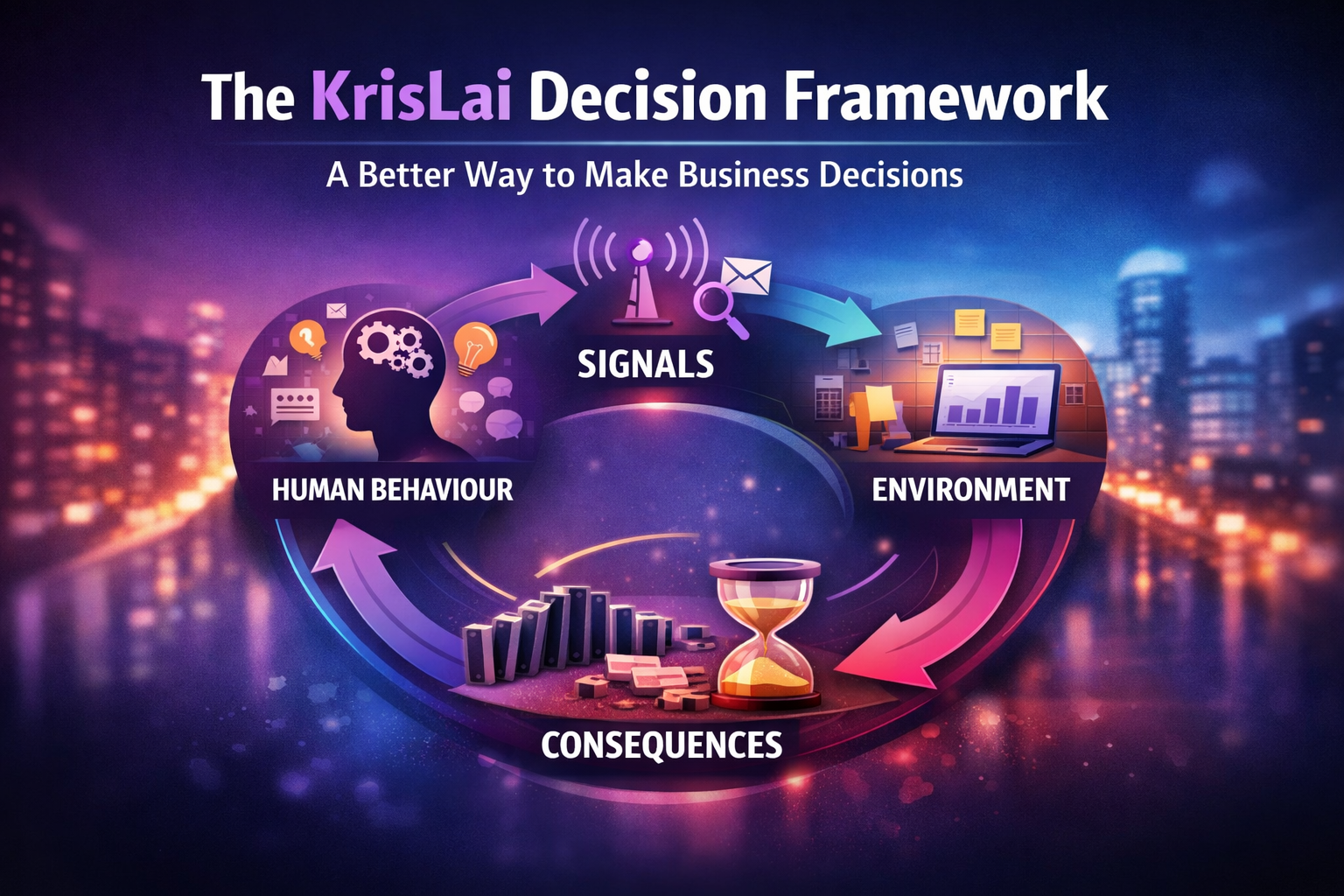
The KrisLai Decision Framework™ brings together my thinking on strategy, leadership, marketing, and behavioural economics.
Most business decisions don’t fail because of bad data.
They fail because we miss something more human.
I’ve seen it in meetings where the numbers looked solid, yet the outcome still felt off. A pricing change that made sense on paper but annoyed customers. A strategy shift that seemed logical but quietly drained team morale.
Over time, I’ve come to realise that good decisions rarely come from analysis alone. They come from seeing the full picture — not just what’s happening now, but how people think, what signals they give, the environment they operate in, and what happens next.
That’s what led me to develop what I now call the KrisLai Decision Framework™ — a simple, practical way to make better decisions in complex business situations.
What is the KrisLai Decision Framework?
The KrisLai Decision Framework™ is a practical model for better business decision-making. It focuses on four key elements: human behaviour, signals, environment, and consequences.
By considering how people think, what they are doing, the conditions around decisions, and what happens next, leaders can make more informed, balanced, and effective decisions.
What Is the KrisLai Decision Framework?
The KrisLai Decision Framework™ is a four-part model that helps leaders make better decisions by focusing on what really drives outcomes.
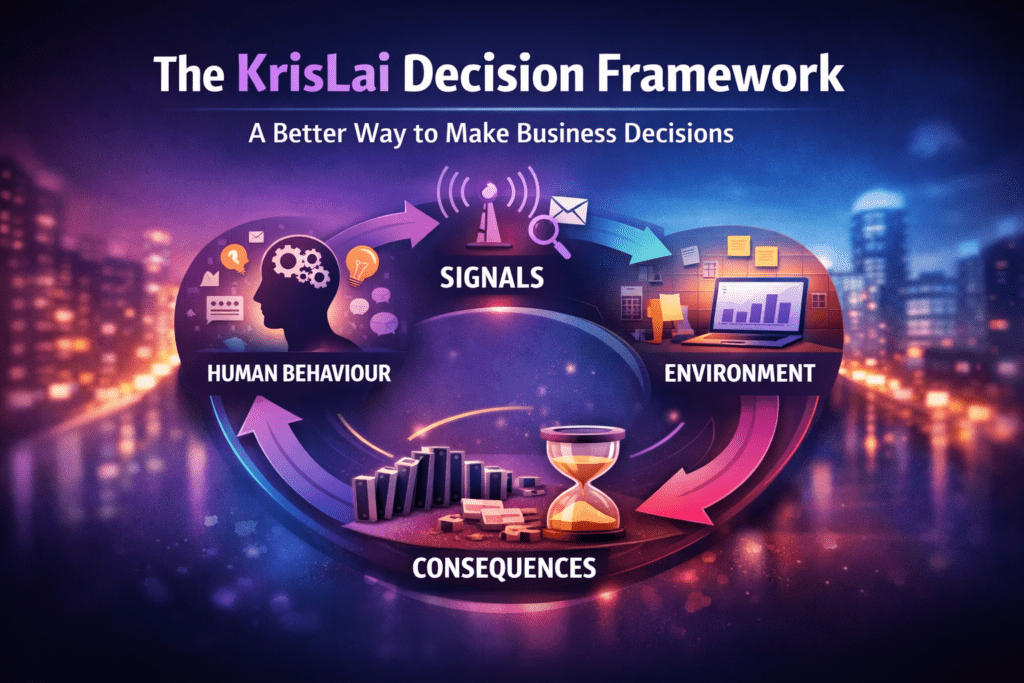
It brings together four essential elements:
- Human Behaviour — how people actually think and decide
- Signals — what people are trying to do right now
- Environment — the conditions shaping decisions
- Consequences — what happens next, and after that
The key idea is simple:
Strong decisions consider all four — not just one.
A practical model for better business decisions in complex environments.
- Human Behaviour — how people actually think
- Signals — what people are doing now
- Environment — conditions for decisions
- Consequences — what happens next
Why Most Business Decisions Go Wrong
In my experience, most poor decisions come from focusing too narrowly.
We might:
- rely too heavily on data and ignore behaviour
- react to signals without understanding context
- change strategy without fixing the environment
- focus on short-term outcomes and ignore long-term effects
There’s a Finnish saying:
“Kukaan ei ole seppä syntyessään.”
No one is born a master.
Decision-making is no different. It improves when we use better mental models.
The Four Elements Explained
🧠 1. Human Behaviour — How People Really Decide
People are not perfectly rational.
We rely on shortcuts, emotions, habits, and social cues.
Customers don’t just compare features — they look for reassurance.
Employees don’t just follow logic — they respond to tone, trust, and leadership behaviour.
If we ignore human behaviour, even the best strategy can fail.
This is something I explored more deeply in my work on behavioural economics and customer decision-making.
🔍 2. Signals — What People Are Doing Right Now
People are constantly telling us what they need.
Through:
- search behaviour
- clicks and page visits
- questions they ask
- objections they raise
These are signals — and they are often more valuable than opinions.
For example:
Someone reading a general blog post is curious.
Someone comparing pricing pages is ready to decide.
Understanding signals is at the heart of effective marketing and customer insight.
🏗️ 3. Environment — The Conditions That Shape Decisions
Even capable people make poor decisions in the wrong environment.
I’ve seen situations where:
- teams stayed silent because it didn’t feel safe to speak up
- good ideas were ignored due to hierarchy
- poor processes created confusion and delay
This is where leadership matters.
Concepts like psychological safety and trauma-informed leadership are not “soft” ideas — they directly affect decision quality.
If the environment is wrong, decisions will suffer.
🔁 4. Consequences — What Happens Next
This is where many decisions break down.
We focus on the immediate result…
…but forget what that result will cause next.
A discount increases sales —
…but trains customers to wait.
A cost cut improves margins —
…but reduces service quality.
This is where second-order thinking becomes critical.
As a Swedish saying goes:
“Man ska inte ropa hej förrän man är över bäcken.”
Don’t celebrate too early.
How the Framework Works in Practice
What I’ve found useful is to treat decisions as a loop, not a one-off event.
Before making a decision, I ask:
- How will people respond? (Behaviour)
- What signals are we seeing? (Signals)
- Does the environment support this? (Environment)
- What happens next? (Consequences)
Even a quick version of this can improve outcomes.
A Simple Example
Imagine a company considering a price increase.
At first glance, it seems straightforward.
But through the framework:
- Behaviour → will customers feel pushed away?
- Signals → are customers already price-sensitive?
- Environment → can support teams handle complaints?
- Consequences → will this affect long-term loyalty?
The decision becomes clearer — and more grounded.
Why This Framework Matters Today
Business environments are becoming:
- faster
- more complex
- more human-driven
Data is abundant. Attention is limited. Trust is fragile.
In this context, decision-making needs to be:
- practical
- human-aware
- forward-looking
This framework is not about perfection.
It’s about making better decisions more consistently.
Frequently Asked Questions
What is the KrisLai Decision Framework?
The KrisLai Decision Framework is a practical model for better business decision-making. It focuses on four key elements: human behaviour, signals, environment, and consequences, helping leaders make more balanced and effective decisions.
Why is human behaviour important in business decisions?
Human behaviour shapes how customers, employees, and stakeholders respond. Even the best strategy can fail if it does not align with how people actually think, feel, and act in real situations.
What are signals in decision-making?
Signals are the actions and patterns that show what people are trying to do, such as searches, clicks, questions, or buying behaviour. They provide real-time insight into customer intent and priorities.
How does the environment affect decisions?
The environment includes culture, leadership style, processes, and systems. A supportive environment improves decision quality, while a poor environment can lead to hesitation, mistakes, or missed opportunities.
What are second-order consequences?
Second-order consequences are the longer-term effects of a decision. Instead of focusing only on immediate results, this approach considers what happens next and how outcomes evolve over time.
How can I apply this framework in my business?
Start by applying it to one decision. Consider how people will behave, what signals you are seeing, whether the environment supports the decision, and what the likely consequences will be. Writing this down can improve clarity and outcomes.
How to Start Using It This Week
You don’t need to overhaul your process.
Start small.
Pick one decision this week and ask:
- What behaviour are we assuming?
- What signals are we seeing?
- Is the environment helping or hindering?
- What happens next?
Write the answers down.
That alone will improve clarity.
Free Download: The KrisLai Decision Framework™
Want a simple, practical version of this framework you can use in your own business?
Enter your email below and I’ll send the free PDF guide to your inbox.
Build Deeper Insight
Conclusion
Better decisions rarely come from data alone.
They come from understanding people, reading signals, shaping the right environment, and thinking beyond the immediate outcome.
That’s what the KrisLai Decision Framework™ is designed to do.
This week, try applying it to one real decision.
You may find that what seemed simple at first becomes clearer — and far more effective — when you look at the full picture.
If you’re interested in improving how you think about business decisions, you can explore more articles like this at:
About the author
Kris Lai is a business operator and managing director with experience in land and building surveying, facilities management, logistics, and service delivery.
Earlier in his career, he worked as a Search Engine Evaluator (via Lionbridge, supporting Google), where he assessed search result relevance, user intent, and content quality using structured evaluation frameworks. This experience gives him a rare, practical understanding of how search systems interpret signals and make ranking decisions.
In parallel, whilst working with a charity organisation, he has delivered 1000’s of structured presentations in English, Finnish, and Chinese to audiences ranging from small groups to more than 600 people, and has spent decades mentoring and developing others. This experience informs his approach to clarity, communication, and decision-making under pressure.
He writes about AI, search behaviour, business strategy, and decision-making from a practical, real-world perspective.