
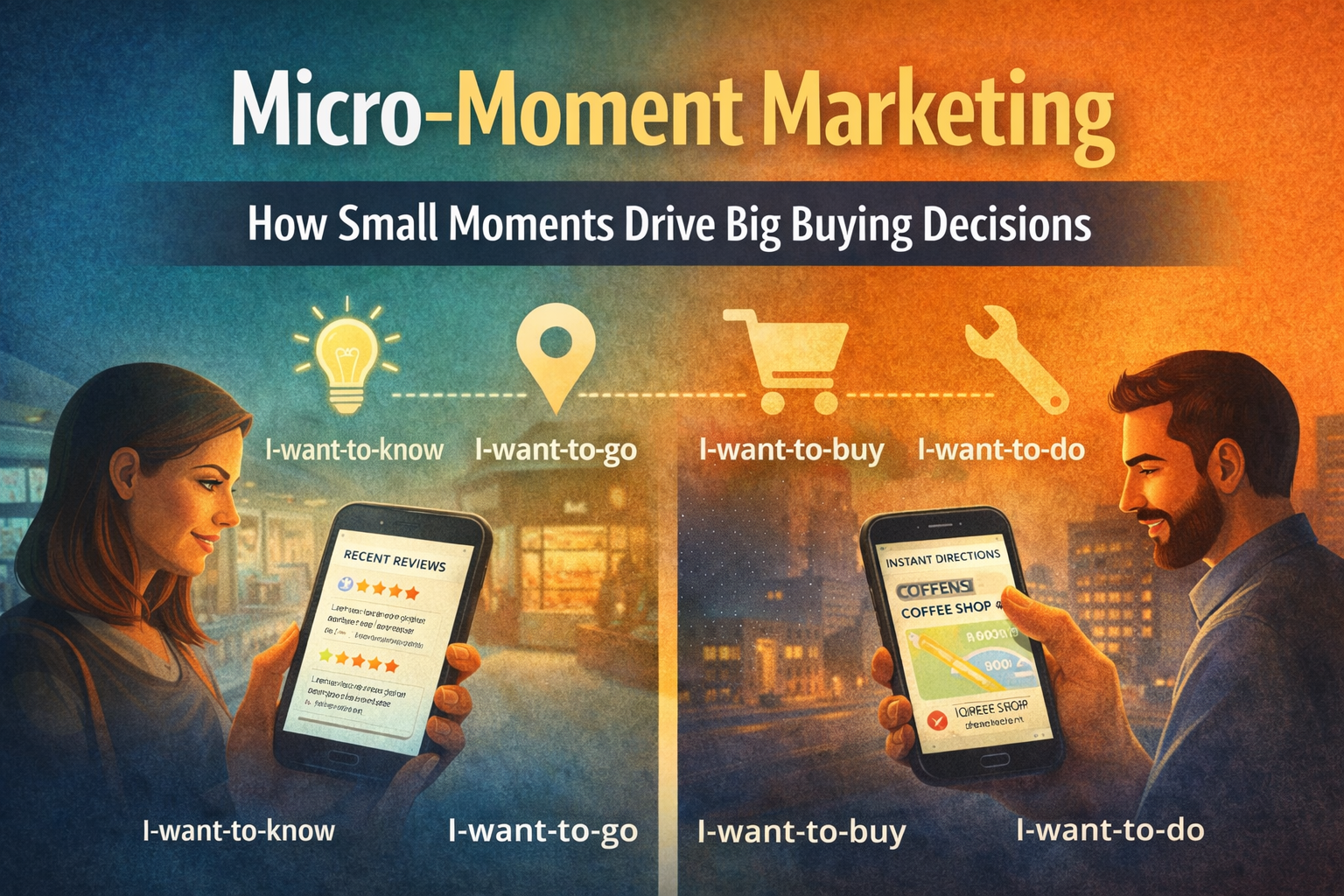
Decisions happen faster than we think.
I notice it in my own behaviour all the time — standing in a shop, checking a quick review on my phone, searching “near me,” or looking up a how-to video before making a choice. These tiny decision windows are exactly where micro-moment marketing lives. Micro-moment marketing is about meeting people with fast, helpful answers when they have a strong need and very little time.
In this article, I want to explore what micro-moment marketing really means, why these moments matter so much for business, and how you can build a practical micro moments marketing strategy that works in today’s digital environment — including AI search and short-form video in 2026. Because when you understand these small moments, you start to see buying behaviour very differently.
As the Finnish saying goes, “Pienistä puroista syntyy suuri joki.” Small streams create a big river.
Disclosure: If you click on my affiliate/advertiser’s links, I am going to receive a tiny commission. AND… Most of the time, you will receive an offer of some kind. It’ s a Win/Win!
Micro-Moment Marketing Definition and How It Fits Modern Marketing
So what is micro moment marketing in simple terms?
Micro-moment marketing means responding to customer needs at the exact moment they arise — usually through digital channels — with relevant, immediate information that helps them decide or act.

These micro-moments are short bursts of intent. Someone wants to know something, go somewhere, do something, or buy something — right now.
This concept connects closely with micromarketing, which focuses on targeting specific customer segments or situations rather than broad audiences. A micro marketing definition might describe it as tailoring marketing efforts to small, well-defined groups based on context, behaviour, or location.
In modern marketing, the difference is speed.
Micro-moment marketing is about timing as much as targeting.
What counts as a micro-moment, and why they drive quick decisions
Micro-moments are high-intent moments when people turn to a device — usually a smartphone — to act on a need immediately.
They often last only a few seconds. Research has suggested attention windows as short as 6 to 10 seconds before a user decides whether to continue or move on.
These moments differ from long research phases. They are action-focused, not browsing-focused.
The idea originally gained attention around 2015 when Google described how smartphones were changing decision behaviour. By 2026, the landscape includes AI assistants, voice search, short-form video platforms, and always-on mobile apps, making micro moments digital marketing even more important.
The 4 classic micro-moments (know, go, do, buy) in plain English
Most micro-moments fall into four categories:
I-want-to-know — quick information
Example: “best running shoes for beginners”
Goal: understanding options.
I-want-to-go — location-based search
Example: “coffee shop near me open now”
Goal: finding somewhere quickly.
I-want-to-do — practical help
Example: “how to fix leaking tap”
Goal: solving a problem.
I-want-to-buy — purchase readiness
Example: “iPhone 15 price UK”
Goal: making a purchase decision.
Cheat sheet: the 4 micro-moments
- I-want-to-know → quick facts, comparisons, “best”, “review”.
- I-want-to-go → “near me”, opening hours, directions, availability.
- I-want-to-do → how-to steps, demos, troubleshooting, checklists.
- I-want-to-buy → price, stock, delivery, returns, trust signals.
Tip: Match the content format to the moment, not the other way around.
These simple patterns form the foundation of most micro moment marketing examples.
Why speed and usefulness beat clever slogans in these moments
One important insight I’ve learned is that creativity alone does not win micro-moments.
Speed and usefulness do.
Customers are not looking for entertainment in these moments. They are looking for answers.
Three rules matter most:
- Be there — show up in search or platforms
- Be useful — answer the exact question
- Be fast — remove friction and load quickly
In the attention economy, value per second is the real competition.
Micro Marketing vs Macro Marketing — What’s the Difference?
Traditional marketing often focuses on broad audiences — sometimes called macro marketing.
Micro marketing vs macro marketing is essentially the difference between:
Macro marketing: large campaigns targeting wide groups
Micro marketing: targeted efforts focused on specific segments or moments
Micro marketing segmentation allows businesses to tailor messages based on:
- Location
- Behaviour
- Needs
- Timing
- Demographics
Micro-moment marketing builds on this by focusing specifically on intent and immediacy.
The Micro Marketing Environment — Why Context Matters
The micro marketing environment includes all the contextual factors influencing customer decisions in the moment:
- Location
- Time of day
- Device
- Urgency
- Previous behaviour
- Situation or need
For example, someone searching for food at 11:30 pm has a very different context from someone browsing recipes on a Sunday afternoon.
Understanding context improves targeting and relevance.
How to find your best micro-moments before you make any content
A good micro moments marketing strategy starts with identifying where customer intent already exists.
The biggest mistake businesses make is trying to cover everything instead of focusing on the moments most likely to lead to action.
Start with real questions: search terms, support tickets, reviews, and chats
Useful sources include:
- Google Search Console queries
- Website search data
- Customer support logs
- Live chat transcripts
- Product reviews
- Social media comments
- “People also ask” search themes
Look for “now” language such as:
- near me
- best
- price
- open now
- how to
- compare
- review
These signals reveal high-intent micro-moments.
Pick moments that matter: intent, urgency, and business value
I like using a simple scoring approach:
- Intent strength
- Urgency
- Ability to answer better than competitors
- Business impact
This helps prioritise efforts and avoid vanity traffic.
Winning the moment: what to publish, where to show up, and what to fix on your site
Micro-moment success comes from practical execution, not theory.
You need to decide:
- What content to create
- Where to appear
- How to remove friction
Modern micro moments digital marketing also includes AI summaries, short video platforms, and contextual signals like location.
Create fast answers for each moment type (pages, FAQs, short video, and checklists)
Content patterns that work:
Know moments:
Clear explainers, FAQs, quick guides.
Go moments:
Location pages, opening hours, directions.
Do moments:
Step-by-step tutorials, short demonstrations.
Buy moments:
Comparison tables, pricing clarity, reviews, guarantees.
Short-form video with strong hooks in the first few seconds is increasingly effective.
Be easy to choose: remove friction on mobile in under 10 seconds
The 10-second mobile checklist
If a customer lands on your page from a micro-moment, can they do the next step in under 10 seconds?
- Loads fast (no waiting, no jumping layout).
- Clear headline that answers the query immediately.
- One obvious action (call, book, directions, buy).
- Trust signals (reviews, guarantees, delivery/returns).
- Low-friction forms (short, mobile-friendly, autofill).
Critical factors include:
- Fast loading speed
- Simple navigation
- Clear action buttons (call, book, buy)
- Trust signals (reviews, guarantees)
- Easy forms
- Accurate contact details
Local businesses especially benefit from “near me” optimisation with consistent name, address, and phone information.
Real-World Micro-Moment Marketing Examples
Some practical micro marketing examples include:
- A restaurant appearing in “open now near me” searches
- A retailer showing stock availability locally
- A SaaS company offering quick comparison pages
- A service provider offering emergency booking buttons
- An e-commerce site displaying reviews prominently
Many successful micro marketing company strategies focus on making decisions easier rather than louder.
Quick wins for small businesses (low effort, high impact)
- Fix your “go” moment basics: accurate opening hours, phone number, and directions everywhere.
- Create one “buy” page: pricing, delivery, returns, and reviews in one place.
- Turn FAQs into content: publish the top 10 real customer questions as short answers.
- Make one short video per week: a 6-second hook + 20–40 seconds of help.
- Improve one page speed bottleneck: compress images, reduce pop-ups, simplify the page.
Rule of thumb: start with one moment type and one key action — then expand.
How to measure micro-moment marketing, and what “good” looks like in 2026
Success is not just about clicks.
It is about completed actions within short sessions.

Track actions, not just traffic (calls, directions, sign-ups, and sales)
Useful metrics include:
- Conversion rates
- Click-to-call
- Direction requests
- Bookings
- Add-to-basket
- Checkout completion
- Sign-ups
- Assisted conversions
Segment by device and intent for deeper insight.
Optimise in small loops: A/B tests, content refreshes, and AI visibility checks
Continuous improvement matters.
You can:
- Test headlines and calls to action
- Refresh FAQs
- Improve speed
- Update local details
- Repurpose content into video
For AI search visibility, clear structure and direct answers near the top help significantly.
Common Mistakes in Micro-Moment Marketing
Some pitfalls I’ve seen include:
- Trying to cover too many moments at once
- Slow mobile experiences
- Ignoring customer intent
- Focusing on branding instead of usefulness
- Measuring vanity metrics
Micro-moment marketing works best when it is focused and practical.
Conclusion
Micro-moment marketing wins by being present, helpful, and fast when people need something now.
The process is simple:
- Identify key customer moments
- Create quick-answer content
- Remove mobile friction
- Measure actions and improve
If you want to start this week, pick:
- One moment type
- One channel
- One action to improve
Small improvements in the right moments can produce surprisingly large results.
And in business, timing is often everything.
Frequently Asked Questions About Micro-Moment Marketing
What is micro-moment marketing?
Micro-moment marketing is a strategy that focuses on responding to customer needs at the exact moment they arise, usually through mobile or digital channels. These moments are short, high-intent situations where someone wants to know, go, do, or buy something quickly.
What are micro-moments in marketing?
Micro-moments are brief decision-making moments when people turn to their devices for immediate answers. They typically involve searching for information, locations, instructions, or products and often lead directly to action.
What are some micro-moment marketing examples?
Examples include searching for “restaurants near me,” checking product reviews in a shop, watching a quick how-to video before making a purchase, or comparing prices online. Businesses that provide fast, useful answers during these moments are practising micro-moment marketing.
How does micro-moment marketing differ from micromarketing?
Micromarketing focuses on targeting small customer segments based on characteristics such as location or behaviour. Micro-moment marketing focuses specifically on timing — reaching customers at the exact moment they have a need or intent to act.
What is the difference between micro marketing and macro marketing?
Macro marketing targets large audiences with broad campaigns, while micro marketing focuses on smaller, more specific segments or contexts. Micro-moment marketing goes further by concentrating on immediate intent and real-time decision points.
Why are micro-moments important in digital marketing?
Micro-moments are important because many modern buying decisions happen quickly on mobile devices. Customers often expect immediate answers, and businesses that provide them gain a competitive advantage in visibility, trust, and conversions.
How can small businesses use micro-moment marketing?
Small businesses can focus on key customer questions, optimise local search presence, ensure fast mobile websites, and provide clear information such as prices, availability, and contact details. Even simple improvements can capture valuable customer moments.
How do you measure success in micro-moment marketing?
Success is measured through actions rather than just traffic. Metrics include phone calls, bookings, direction requests, purchases, sign-ups, and conversion rates, particularly from mobile users or high-intent searches.

My latest posts:
- Psychological Safety at Work: What It Is, Why It Matters, and How to Build It
- Micro-Moment Marketing: How Small Moments Drive Big Buying Decisions
- Trauma-Informed Leadership: What It Is, Why It Matters, and How to Practice It
- Organizational Trauma: What It Is, Signs to Watch For, and How to Heal
- Overcoming Perfectionism at Work Without Lowering Your Standards