
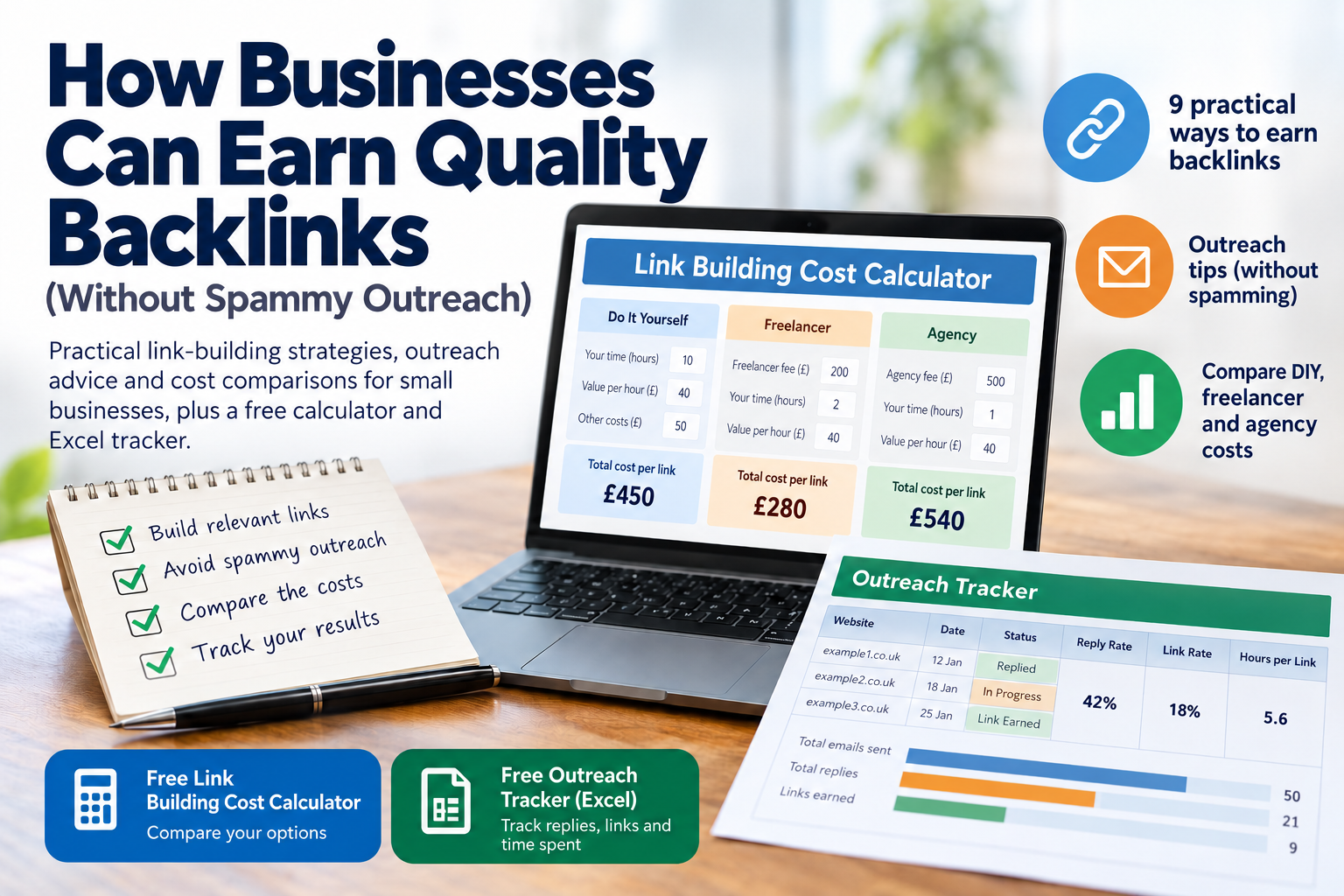
Quality backlinks are links from relevant, trustworthy websites that appear naturally inside useful content. For a business, the safest way to earn them is through genuine relationships, useful assets and personalised outreach, not bulk emails or bought packages. This guide shows SME owners, leaders and entrepreneurs how to do it, with real costs, real response rates and free tools first.
Some links in this guide are affiliate links, marked (affiliate). If you buy through them I may earn a small commission at no extra cost to you. See my affiliate disclosure.
By Kris Lai · Last updated 23 October 2026 · About 15 minutes to read
Picture the scene. Your website looks good and your service is solid, yet a weaker competitor sits above you in Google. Then an email arrives: “Guaranteed high-authority backlinks, only £50.”
Tempting, isn’t it?
This is the moment where most small businesses get link building wrong. They either send generic mass emails that nobody reads, or they pay for cheap links that put their reputation at risk.
Neither builds the kind of authority a serious business needs!
The more useful question is not:
“How many links can we get?”
It is:
“Who would genuinely benefit from our expertise, and how do we earn that conversation?”
That changes everything…
Key takeaways
- Quality beats quantity: relevance, trust, natural placement and natural anchor text matter more than any single authority score.
- Backlinks still matter for Google rankings, and brand mentions matter for AI answers, so aim for both.
- Do not buy links that pass ranking credit. Paid or sponsored links need a rel=“sponsored” or nofollow tag.
- Realistic cold-outreach results range from about 3% to 17% of emails earning a link. Plan for the low end unless you are already well known.
- Bought editorial links in the UK commonly cost £150 to £1,000 each. Doing it yourself costs time instead of cash.
- Expect three to twelve months before links visibly move your rankings.
In this guide
- What are quality backlinks?
- Do backlinks still matter in 2026, and for AI search?
- How many backlinks does a small business need?
- How do I check if a backlink is good?
- How do I get quality backlinks? Nine ways
- Are guest posts still worth it?
- How do I write an outreach email that gets replies?
- Can I use AI for link building outreach?
- Is it OK to buy backlinks?
- How much does link building cost in the UK?
- DIY, freelancer or agency?
- How long do backlinks take to work?
- What should I do about toxic or spammy backlinks?
- Backlinks vs brand mentions: what gets you cited by AI tools?
- A 30/60/90-day link plan
- Frequently asked questions
What are quality backlinks?
Short answer: A quality backlink is a link to your website from a relevant, trustworthy site, placed naturally inside useful content by someone who chose to include it. Relevance, trust, editorial placement and natural anchor text matter more than any single authority score.
Think of a backlink as a recommendation. A link from your trade association or a respected industry publication says, “this business is credible.” A link from a page that exists only to sell links says nothing, or worse.
Six signals separate a good link from a poor one:
| Signal | What good looks like | Red flag |
|---|---|---|
| Relevance | The page and site cover topics close to yours | Unrelated topics, such as a casino blog linking to a plumber |
| Trust | Real authors, a real audience, ranks for its own topics | Thin “write for us” sites that publish anything |
| Editorial placement | Link sits in the main text, in context | Footer, sidebar or sitewide link, or a page linking out to hundreds of sites |
| Anchor text | Natural: your brand, your URL or a descriptive phrase | The same exact-match keyword repeated |
| Link attribute | A normal (dofollow) link. A nofollow link from a relevant, trusted page can still be worth having for visibility and referrals | A paid link with no sponsored or nofollow tag |
| Real audience | The page gets readers who could become customers | A page nobody reads |
A note on authority scores. Ahrefs’ Domain Rating and Semrush’s Authority Score are each tool’s own estimate, not figures Google uses. Treat them as a rough guide. Ahrefs itself says nobody outside Google can state exactly how link quality is measured.
What good and bad look like for a UK business
- Good: a local newspaper feature on your business; your trade association’s member page; a supplier or partner case study; a useful guest article on a respected industry site; an industry report that cites your original data.
- Bad: sitewide footer links on unrelated sites; spammy blog comments; directories that accept anyone; private blog networks; “100 links for £20” packages; link swaps with unrelated sites.
Try it: the KrisLai Link Quality Scorecard. Answer eight quick questions to rate any link.
KrisLai Link Quality Scorecard
Rate any backlink in about a minute. Pick the answer that fits best for each question.
Answered 0 of 8. Answer all eight to see your verdict.
A rule-of-thumb framework, not a Google metric. 13 to 16 means pursue or keep, 8 to 12 means accept if easy, 0 to 7 means avoid. By Kris Lai, krislai.com.
How it scores: each question scores 0 to 2, for a total out of 16. A total of 13 to 16 means pursue or keep the link, 8 to 12 means accept it if it is easy, and 0 to 7 means avoid it. A zero on how you got the link, or on risk signals, is a red flag whatever the total.
Do backlinks still matter today, and for AI search?
Short answer: Yes. Backlinks remain a core Google ranking signal, and Google rankings influence which pages AI tools find and cite. In AI answers, though, brand mentions and clear, original content appear to matter at least as much as raw link counts, so earn both.
The evidence is mixed, and much of it comes from SEO vendors, so treat it as directional:
- A study of 75,000 brands by Ahrefs, as reported by third parties, found brand mentions correlated roughly three times more strongly with AI visibility than backlinks did.
- Seer Interactive’s study of 10,000 AI answers found page-one Google rankings were the strongest predictor of brand mentions (a correlation of about 0.65), while backlink counts mattered little.
- A Semrush study of 1,000 domains found backlinks matter for AI visibility, but quality and authority count far more than quantity.
- Pitchbox found a moderate positive correlation between links from stronger sites (DR35+ and DR65+) and where B2B software tools ranked in AI recommendations. It cautions that other industries may differ.
The practical reading: backlinks help indirectly by lifting your Google rankings, while being talked about on relevant, trusted sites helps directly.
Search behaviour is shifting too. Seer Interactive’s data, reported by Search Engine Land, shows pages cited in a Google AI Overview earning about 2.1% click-through, against about 0.9% for uncited pages and about 3.3% where no Overview appears. I explain what this means for businesses in How AI Is Changing Search Behaviour.
How many backlinks does a small business need?
Short answer: There is no fixed number. The practical answer is enough relevant links to match or beat the pages already ranking for your target search. Local and long-tail searches usually need far fewer links than competitive national terms.
How to work out your own number:
- Pick the one search you most want to win, for example “accountant in Reading”.
- Look at the top three to five pages and count their referring domains (the number of different sites linking to each page).
- Compare with your own page. The gap is your target, adjusted for how strong and relevant those competing links look.
- Aim for steady, natural growth rather than a sudden spike, which can look manipulative.
Some guides quote around 50 links to a homepage and 100 to individual pages. Treat that as a loose generalisation, not a goal.
How do I check if a backlink is good?
Short answer: Start free. Google Search Console’s Links report and Ahrefs Webmaster Tools show who links to your own site. Then judge each link against the six signals above. Paid tools become useful when you want to study competitors’ links.
| Tool | Cost | Best for |
|---|---|---|
| Google Search Console (Links report) | Free | Seeing who links to your own site |
| Ahrefs Webmaster Tools | Free for sites you verify | Your own backlink report with extra data |
| SEO SpyGlass (affiliate) | Free plan with basic analysis; paid plans add competitor comparison | Backlink audits, including toxic-link flags |
| Mangools LinkMiner (affiliate) | Paid, part of the Mangools suite | Studying competitors’ backlinks with link-strength metrics |
| Ahrefs or Semrush (full versions) | Paid | The deepest data, for larger budgets |
Free tools show data for sites you verify. To see a competitor’s backlinks you need a paid tool. If you only want to understand your own profile, you do not need to pay.
How do I get quality backlinks? Nine ways, ranked for small businesses
Short answer: Start with people who already know you (customers, suppliers, partners and trade bodies), then add journalist requests, useful assets and careful outreach. Avoid anything that promises links in bulk or guaranteed rankings.
| Method | Typical cost | Effort | Risk | Best for |
|---|---|---|---|---|
| 1. Customers, suppliers and partners | Your time | Low | Very low | Everyone; the easiest first links |
| 2. Trade bodies, chambers of commerce, local directories | Often memberships you already pay for | Low | Low | Local and regulated businesses |
| 3. Journalist requests | Free (Source of Sources) to paid (Featured, from around $49 a month, as reported) | Medium | Low | Experts with a story to tell |
| 4. Guest posts on relevant sites | Your time | High | Medium if done at scale | Exposure and brand mentions |
| 5. Linkable assets (data, calculators, templates) | Your time, or a no-code tool | High up front | Low | Earning links for years |
| 6. Unlinked brand mentions | Your time | Low | Very low | Anyone with press or citations |
| 7. Broken-link outreach | Your time | Medium | Low | Content-led sites |
| 8. Podcasts, events and awards | Your time | Medium | Low | Founders and leaders |
| 9. Digital PR campaigns | About £610 per link on average in one survey (see the cost section) | High | Low | Larger budgets |
1. Start with people who already know you. Ask customers, suppliers and partners to mention you. A case study, partner page or testimonial page often comes with a link, and the relevance is naturally high.
2. Use the organisations you already belong to. Your trade association, local chamber of commerce and industry bodies often list members on pages that can link to you.
3. Answer journalist requests. Connectively closed at the end of 2024 and Featured took over the HARO brand as a paid service, as reported. Today’s options include Source of Sources (free), Qwoted, Featured and the #journorequest hashtag on X and Bluesky (BuzzStream compares the options). Reply quickly with a specific, quotable answer.
5. Build something worth linking to. Original data, free calculators and templates earn links because other sites find them useful. If you would rather not code, involve.me (affiliate) lets you build calculators and quizzes without code and has a free plan.
6. Reclaim unlinked mentions. Search Google for “your brand name” -site:yourwebsite.com to find articles that mention you without linking, then politely ask.
7. Offer a replacement for broken links. If a relevant site links to a page that no longer exists and you have a genuinely useful equivalent, tell them.
8 and 9. Podcast guesting, awards and events build credibility and brand mentions. Digital PR can work but is usually priced for larger budgets.
Are guest posts still worth it?
Short answer: Yes, if you write something genuinely useful for a relevant audience. Treat the value as exposure, referral traffic and brand mentions rather than guaranteed ranking power. Google asks site owners to tag links in guest posts as nofollow, and large guest-post campaigns with keyword-rich anchors count as link spam (Search Engine Journal’s summary of Google’s guidance).
How to find opportunities
- Search for “[your topic] write for us”, “[your topic] guest post guidelines” and “submit a guest post”.
- Read the site’s recent posts and check it has a real audience before you pitch.
- Look at who your customers already read: industry publications, associations and newsletters.
How to do it properly
- Follow the submission guidelines exactly, including word count and format.
- Pitch a specific idea, not “can I write for you?”.
- Offer original, unpublished content and accept edits graciously.
- Link to your brand or homepage with natural anchor text, not an exact-match keyword.
- Mention yourself sparingly. The article should help the reader first.
How do I write an outreach email that gets replies?
Short answer: Keep it short, personal and specific, with one clear ask and an obvious benefit to the reader. Mention something real about their work, explain why your resource helps their audience, and make it easy to say yes. Do not offer reciprocal link swaps.
What realistic results look like
| Source | What happened |
|---|---|
| Ahrefs, 111 personalised emails to hand-picked prospects | 41% replied and 17% resulted in a link, helped by the Ahrefs brand name |
| Authority Hacker, 600,000 outreach emails | The link rate rose from 3% to 4.5% once a personalisation error was fixed |
Ahrefs described anything above 10% as a decent result when you are not paying for links. Without a well-known brand, plan for the lower end.
Template 1: suggest a useful resource
Subject: Quick idea for your [page title] guide
Hi [Name],
I read your guide to [topic] and especially liked [specific detail].
One thing I noticed: [the link to X no longer works / the section on Y does not cover Z]. I recently published [resource title], which covers [specific benefit] for [their audience]. If it is useful, you might like to add it. Either way, thank you for a great guide.
Best wishes,
[Name, role, business, website]
Template 2: reclaim an unlinked mention
Subject: Thank you for mentioning [Business]
Hi [Name],
Thank you for mentioning [Business] in [article title]. Would you consider linking the mention to [URL] so readers can find us easily? Happy to share the article with our [audience] too.
Best wishes,
[Name]
Send one polite follow-up after about a week, then stop.
Free download: track every email, reply and link in one place. The outreach tracker works out your reply rate, link rate and hours per link, and works in Excel and Google Sheets.
Can I use AI for link building outreach?
Short answer: Yes, for research, drafting and organising, but not for mass-sending unreviewed emails or pretending you have read someone’s work. Google’s link spam policy covers automated link building, so use AI to personalise better, not to send more.
Good uses of AI
- Summarise a prospect’s last few articles so your compliment is specific.
- Suggest three angles where your expertise adds something to their page.
- Tighten your wording and draft a short follow-up.
- Turn a rough list of criteria into a shortlist of sites to check by hand.
Tools: general assistants such as ChatGPT, Claude and Gemini work well. Dedicated AI writing tools include RyterAI (affiliate) and Writecream (affiliate), the latter aimed at marketing and sales emails. For finding contact details, Hunter is a popular option.
Four prompts to try
- “Summarise the main argument of this article in three bullet points: [paste text].”
- “Suggest three specific ways [my expertise] could add to this article without repeating it.”
- “Rewrite this email in 90 words, friendly and direct, with one clear ask.”
- “Draft a polite one-paragraph follow-up that adds a new useful detail.”
Read every email aloud before sending. If it could be sent to anyone, rewrite it.
Is it OK to buy backlinks?
Short answer: Buying links that pass ranking credit breaks Google’s link spam policy. Paid or sponsored placements are acceptable only when the link carries a rel=“sponsored” or nofollow tag, and then they are worth having for exposure, not rankings. Cheap bulk packages are the riskiest option.
| Type of link | Allowed? | What you get |
|---|---|---|
| Earned (an editor chooses to link) | Yes | Ranking credit and trust |
| Sponsored placement, tagged | Yes, with rel=“sponsored” or nofollow | Exposure and referral traffic, little ranking effect |
| Paid dofollow link or link package | No: link spam | Risk of devaluation or a manual action |
| Large-scale link swaps | No: excessive link exchange | The same risks |
Five questions to ask any provider
- Where exactly will the links appear, and can I see live examples?
- Are the sites real, with real audiences, or do they exist to sell links?
- Will paid placements be tagged as sponsored?
- What happens if links are removed?
- Do you promise rankings or a fixed number of links? (If yes, walk away.)
The same rule applies to me: affiliate links in this guide are tagged as sponsored, as Google asks.
How much does link building cost in the UK?
Short answer: Agencies commonly price editorial links at about £150 to £1,000 each, and published UK price lists for bought links run from roughly £72 to £456 by authority tier. Managed campaigns cost about £2,500 to £14,000 a month, and a survey of mostly UK digital PR providers put the average at about £610 per link. Doing it yourself costs mainly your time.
| Route | Typical UK cost | Notes |
|---|---|---|
| DIY | No cash cost; your hours | Time is the real cost |
| Marketplace or freelancer | About £72 to £456 per link on published UK price lists, by authority tier | Cheap links carry policy risk, so vet carefully |
| Agency, single editorial link | £150 to £1,000 per placement | Published by one UK agency |
| Digital PR | About £610 per link on average | BuzzStream survey, majority UK sample; least predictable of the options |
| Managed agency campaign | About £2,500 to £14,000 a month | Published UK prices, August 2026 |
Most of these figures are compiled by UK research firm Whito in its link building costs and UK link building statistics pages (August 2026). A BuzzStream survey of digital PR providers, with a majority UK sample, put the average UK cost per link at about £610 ($818), against about £260 ($350) in the US. An Editorial.link survey of 518 SEO professionals put the average acceptable price for a high-quality link at about £380, and 80.9% expected costs to rise. These figures come from agencies and surveys with limited samples, so treat them as indicative.
Do not confuse these numbers with a general SEO retainer. Whito reports that UK small businesses typically pay about £500 to £2,000 a month for all their SEO work, of which link building is only part.
Try it: the UK Link Building Cost Calculator. Compare the three routes with your own numbers.
UK Link Building Cost Calculator
Compare doing it yourself, hiring a freelancer and paying an agency. Change any number to match your situation.
| Route | Cash cost | Your hours | Your time, priced | Total cost | Per link |
|---|
Defaults are indicative. £380 per agency link is the average acceptable price in an Editorial.link survey of 518 SEO professionals. The 4.5% link rate comes from Authority Hacker’s analysis of 600,000 outreach emails; Ahrefs reported 17% in a small test of hand-picked prospects. The freelancer figure and the hours are assumptions, so replace them with real quotes. Price is not quality: judge every link before you pay for it. By Kris Lai, krislai.com.
How it works: for each route the calculator adds the cash cost to the value of your time, then divides by the number of links. The defaults are indicative: replace them with real quotes and your own hourly value.
A worked example (illustrative). Say you want six good links in six months. At £380 each through an agency, that is about £2,280 in fees. Doing it yourself at five hours per link and £40 an hour of your time comes to £1,200 in time, with no cash cost. Which is cheaper depends on what your time is worth and whether the quality matches.
DIY, freelancer or agency?
Short answer: Choose DIY if you have more time than budget and real expertise to share. Choose a freelancer for specific tasks such as research and outreach admin. Choose an agency when you need ongoing, larger-scale campaigns and can check their methods.
| DIY | Freelancer | Agency | |
|---|---|---|---|
| Cash cost | Lowest | Medium | Highest |
| Control | Most | Medium | Least |
| Speed | Slow to start | Faster | Fastest to scale |
| Risk | Lowest if you follow the rules | Depends on vetting | Depends on their methods |
| Best for | Small budgets, expert founders | Defined tasks | Larger budgets, ongoing campaigns |
Marketplaces such as Fiverr (affiliate) can work well for research, list building and outreach admin. I have used Fiverr for general business work, such as logo design for several of my sites, and was happy with the results. The language barrier can sometimes create extra work and delay, so allow time and be very specific in your brief. For links themselves, ask for live examples and avoid anything promising guaranteed rankings or instant links.
How long do backlinks take to work, and how do I measure them?
Short answer: Usually three to twelve months to see a clear effect on rankings (see Blue Whale Media and SureOak for typical timelines). A new link must first be found and indexed, which can take a week or two, and ranking changes often follow weeks or months later. New websites generally wait longer than established ones.
What to track
- Referring domains: new sites linking to you, in Search Console or Ahrefs Webmaster Tools.
- Referral traffic: visits from linking sites, in Google Analytics or Site Kit.
- Rankings: the positions of the specific pages you built links for.
- Branded search: more people searching your business name is an early sign.
- AI citations: a monthly prompt test (see below).
What should I do about toxic or spammy backlinks?
Short answer: Usually nothing urgent. Random spammy links are common and are normally ignored, so look first at links you built or bought yourself. Act when you see a pattern you caused, or a manual action message in Search Console.
- Check Search Console for manual actions.
- Export your links and look for patterns: sudden spikes, unrelated domains, repeated exact-match anchors.
- Ask site owners to remove links you paid for.
- Use the disavow tool only as a last resort. Google describes it as an advanced feature, so read its current documentation first.
- SEO SpyGlass’s free plan can flag suspicious links to review.
Backlinks vs brand mentions: what gets you cited by AI tools?
Short answer: Both help. AI tools favour sources that are clear, original, well structured and mentioned across trusted sites. Earned media is reported to make up most citations in tools like ChatGPT, Gemini and Claude, so being quoted on relevant third-party sites matters as much as links.
Make your own pages easy to quote
- Open each section with a direct, standalone answer.
- Publish original data, even a small survey of your own.
- Name your frameworks so others can cite them.
- Use comparison tables and clear headings.
- Show dates, author credentials and real experience.
- Use the same brand and author name everywhere.
A ten-minute monthly AI visibility test. Ask ChatGPT, Gemini, Perplexity and Claude questions your customers would ask, for example “who are the best [your service] providers in [your area]?” or “how do I choose a [your service]?”. Log whether your business or site is mentioned, then repeat monthly.
A 30/60/90-day link plan for a small business
Days 1 to 30: foundations
- Verify Google Search Console and Ahrefs Webmaster Tools.
- List who already links to you and who mentions you without a link.
- Ask five customers, suppliers or partners for a mention.
- Join Source of Sources and choose one linkable asset to build.
Days 31 to 60: outreach
- Send 30 targeted, personalised emails and log each one in the free outreach tracker.
- Pitch one guest article to a relevant site.
- Reclaim unlinked mentions.
- Answer a few journalist requests each week.
Days 61 to 90: measure and double down
- Review replies, links earned and hours spent.
- Repeat what worked and drop what did not.
- Run your AI visibility test and note the results.
- Decide whether to keep going DIY or get help.
Frequently asked questions
What is a quality backlink? A link from a relevant, trustworthy site, placed naturally in useful content by someone who chose to include it. Relevance, trust, placement and natural anchor text matter more than one authority score.
Do nofollow links help? They pass little or no ranking credit, but a nofollow link from a relevant, trusted page can still bring visitors, brand mentions and credibility.
How many backlinks do I need? There is no fixed number. Compare the referring domains of pages already ranking for your target search and aim to close the gap with relevant links.
How long do backlinks take to work? Typically three to twelve months for a clear ranking effect, depending on your site, competition and the strength of the links.
Are paid backlinks allowed? Only if tagged rel=“sponsored” or nofollow. Paid links that pass ranking credit break Google’s link spam policy.
Is guest posting dead? No, but treat it as exposure and brand-building rather than a ranking shortcut, and avoid large campaigns with keyword-rich anchors.
Do backlinks help me appear in AI answers? Indirectly. They lift Google rankings, while mentions on relevant trusted sites and clear, original content appear to help directly.
How can I check my backlinks for free? Use Google Search Console’s Links report and Ahrefs Webmaster Tools for sites you own.
Quality over noise
Earning good links is slower than buying bad ones, and it is worth it. The links that last come from relevance, usefulness and relationships, and a good reputation travels in outreach just as it does everywhere else.
As the Finns say:
Hyvä kello kauas kuuluu, paha vielä kauemmas.
A good bell is heard far away, a bad one even farther.
So make sure what you send out into the world is worth hearing.