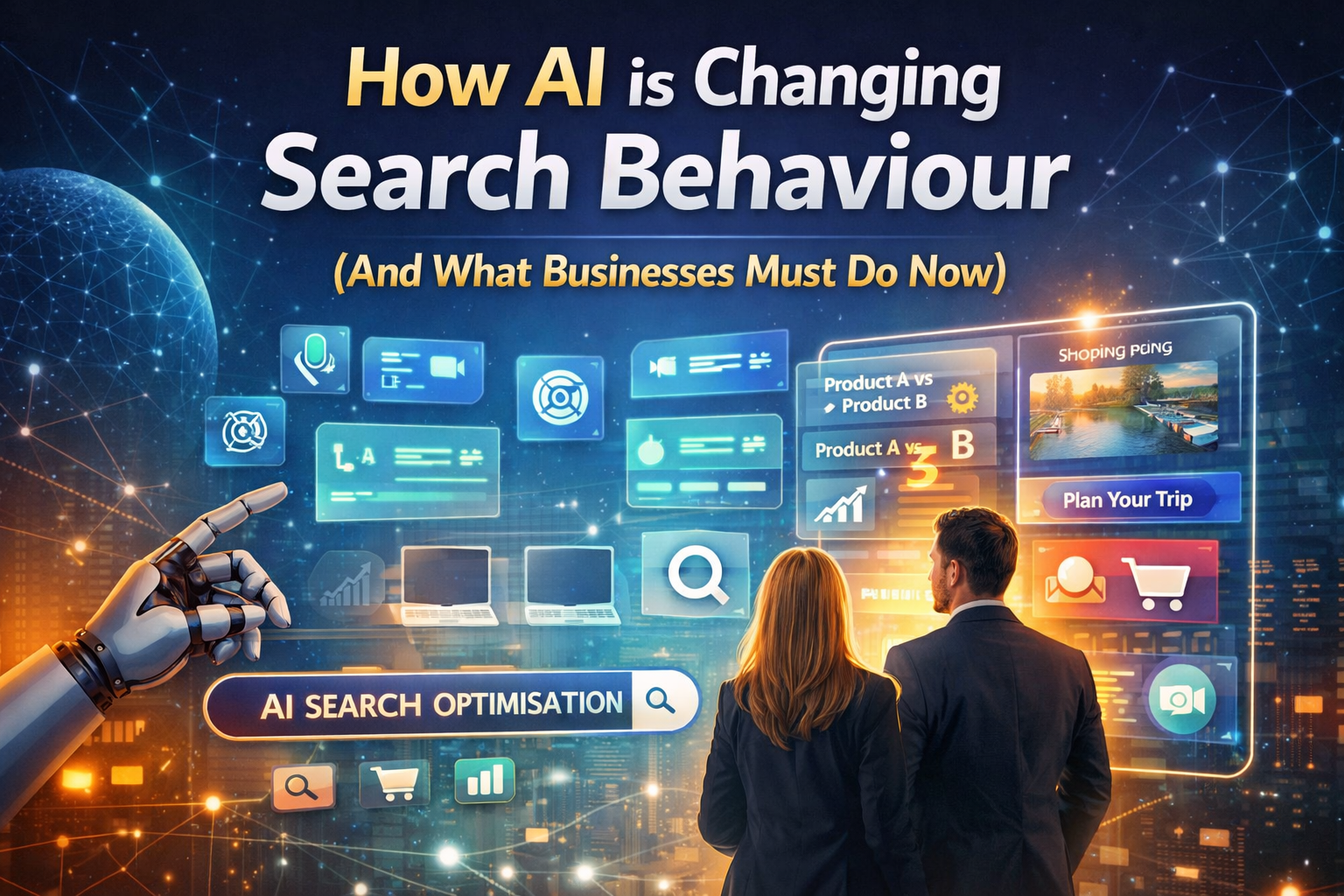
Search is no longer just a list of links. AI tools now answer questions directly, compare options, and shape buying decisions before a person ever visits a website. That shift is changing how businesses are discovered, judged, and trusted.
Search used to feel simple.
You typed a few words, scanned a page of blue links, and chose where to click next.
Now, more and more often, people just ask a question and get an answer back straight away. Sometimes they ask a follow-up. Sometimes they upload a picture. Sometimes they speak instead of type. Sometimes the tool does part of the comparison for them before they ever reach a website.
That is a very big shift.
There is a Swedish saying: “Den som lever får se” — “the one who lives will see”. In business, though, I do not think it is wise to simply wait and see. By the time a change feels obvious, the firms that moved early are often already ahead.
AI search optimisation is the practice of making your content easy for AI systems to find, understand, trust, and use when they generate answers.
In practice, that means thinking beyond old-fashioned SEO. It is no longer only about getting a page to rank. It is about becoming a reliable source of clear, useful, well-structured information that can be surfaced inside AI-driven search experiences. That changes what good content looks like, what authority looks like, and how success should be measured.
This article is not a beginner’s SEO checklist. It is a leadership view of what is changing. Google AI Overviews, ChatGPT Search, Perplexity, and newer AI agents are all pushing search towards answers, summaries, comparison, and action. That affects how customers discover, evaluate, trust, and buy.
- People are moving from keywords to full questions and conversations.
- Search is becoming more multimodal, personal, and task-led.
- AI answers can reduce clicks, but still increase your influence.
- Clear expertise and trustworthy signals are becoming easier to spot.
- AI search optimisation is now a business capability, not just an SEO task.
What AI Is Doing to Search Behaviour Right Now
The simplest way to explain the change is this: people are no longer searching mainly for links. They are searching for answers.
That may sound like a small wording change, but it is not. It changes how people ask questions, what they expect back, how much effort they are willing to spend, and when they decide to click through to a site at all.
In plain English, people are starting to search in a way that feels more like speaking to a helpful person than typing commands into a machine. They ask fuller questions. They add context. They ask follow-up questions. They compare options inside the same thread. They use voice. They use images. And in some cases, they let the tool do part of the legwork for them.
This is not some distant theory about the future of search marketing. It is already changing how discovery works now.
| Older Search Behaviour | AI-Led Search Behaviour |
|---|---|
| Short keyword phrases | Full questions and conversational prompts |
| User scans several links | User often starts with one synthesised answer |
| Manual comparison across tabs | AI compares and summarises options |
| Mostly text-based searching | Text, voice, image, and mixed-input journeys |
| Clicks are the main sign of visibility | Citations, summaries, and branded recall also matter |
| SEO focused mainly on ranking pages | Search strategy must also consider answer engines and AI agents |
For years, many businesses treated search as a traffic channel. Increasingly, it is becoming a visibility layer that shapes opinion before traffic even happens.
People Are Moving from Keywords to Conversations
One of the clearest changes is that people no longer search in such a clipped, robotic way.
They used to type things like:
“best crm software”
Now they are more likely to ask:
“What is the best CRM for a small B2B company with a long sales cycle and a limited admin team?”
And then they may follow up with:
“Compare HubSpot and Salesforce for that situation.”
And then:
“Which one would be easier to roll out without a dedicated RevOps team?”
That is a very different kind of search behaviour. It is not just one query. It is a sequence. It is a conversation. It is often more specific, more realistic, and more closely tied to genuine buyer intent.
This matters because content strategy now has to answer intent, not merely match phrases. A page that loosely repeats a keyword may still exist in the index, but that does not make it helpful. If a page cannot answer the real question clearly, quickly, and with enough context, it is less likely to be useful in an AI-led search journey.
I have seen this same pattern in leadership discussions too. People rarely come to a problem with one neat label. They come with a messy situation, a few constraints, and a real-life question. Search is starting to look more like that. In some ways, it is becoming more human.

Search Is Becoming Multimodal, Personal, and Agent-Led
Search is also becoming more than typing.
A person might start with a voice query while driving. Later, they might upload an image to identify a product. Then they may ask an AI tool to compare prices, features, reviews, or locations. Finally, they may ask for a shortlist or next step.
In other words, text, voice, image, comparison, and decision support can now sit in one joined-up journey.
This is where the rise of AI agents becomes especially important. Some tools are starting to do more than retrieve information. They are starting to support tasks. That may include helping a person compare products, narrow options, plan a trip, shortlist software, or organise a buying decision.
A customer sees a chair they like in a hotel lobby, takes a photo, uploads it, asks for similar styles under a certain budget, compares materials, then asks where to buy one that ships quickly to their area.
The business that wins may not be the one with the best old-fashioned keyword page. It may be the one with the clearest product information, strongest trust signals, and most usable data for AI systems to work with.
This is one reason site visits may become less linear. Some buyers will still visit your site, of course. But they may arrive later in the journey, after more of the discovery, comparison, and filtering has already taken place elsewhere.
Why This Shift Matters for Traffic, Trust, and Growth
It is tempting to treat this as a technical search story. I think that would be a mistake.
This is really a business story about how visibility, trust, and choice are changing.
If AI tools answer more of the question upfront, some clicks will disappear. If they compress comparison into one conversation, parts of the buyer journey may speed up. If they surface clearer sources more often, trust may consolidate around brands that look easier to understand and harder to doubt.
That affects traffic, yes. But it also affects perception, recall, lead quality, and growth.
| Business Area | What May Change |
|---|---|
| Traffic | Some informational clicks may fall as answers are shown earlier. |
| Click-through rate | Traditional CTR may weaken on queries answered directly by AI. |
| Lead quality | Visitors who do click may arrive with stronger intent. |
| Visibility | Being cited or referenced may matter as much as ranking in some cases. |
| Brand discovery | People may meet your brand first inside an AI summary, not your homepage. |
| Growth strategy | Search, content, brand, product information, and trust signals become more tightly linked. |
Zero-click behaviour simply means the searcher gets what they need without clicking through to a website.
That is not completely new. Featured snippets, maps, and knowledge panels have been doing some of this for years. What is changing is the scale and quality of the answer layer.
If an AI overview, AI answer, or conversational summary gives enough help upfront, fewer people may feel the need to click for basic information. That can feel alarming if you are still judging search success mainly through old ranking reports and raw traffic trends.
But there is a more useful way to look at it. Losing a click does not always mean losing influence.
If your brand becomes part of the answer, cited inside the summary, remembered during evaluation, or surfaced repeatedly across related questions, you may still be shaping the decision. In some cases, you may even be doing so more efficiently than before.
That means leaders need to rethink KPIs. Rankings still matter. Traffic still matters. But so do assisted conversions, direct visits, branded search lift, high-intent engagement, and the simple question of whether your firm is visible at the moment people are forming an opinion.
The practical response is not panic. It is capability-building.
AI search optimisation should not be treated as a one-off technical fix or a small side project for one person in marketing. It is closer to a modern visibility discipline. It touches website content, product information, brand clarity, internal knowledge, and measurement.
Put simply: if search behaviour has changed, your visibility system must change with it.
Zero-Click Answers Are Changing What Success Looks Like
What Businesses Must Do Now to Stay Visible in AI Search
Action
Why It Matters
Who Owns It
Improve content clarity
Helps AI systems extract accurate answers
Content / Marketing
Strengthen trust signals
Makes your brand easier to believe and cite
Leadership / Brand / SEO
Sharpen product and service pages
Supports comparison and decision-stage visibility
Marketing / Product / Sales
Use structured data properly
Makes your content easier to interpret
SEO / Technical
Update reporting
Reflects visibility beyond clicks and rankings
Analytics / Leadership
Build Content That Answers Real Questions Clearly and Fast
If I could give only one piece of advice, it would be this: write to answer the real question quickly.
Too many pages still circle around the point. They sound polished, but they do not actually help. That was already risky. In AI-led search, it is even riskier.
Strong pages now tend to have a few common features:
- a clear definition near the top
- a short summary under the headline
- plain subheadings that match real questions
- scannable paragraphs
- examples that make the point concrete
- comparison sections where relevant
- FAQ blocks for common follow-up questions
This structure helps people, but it also helps answer engines extract useful material.
It is especially important to map content to buyer intent. A person in the awareness stage may need a clean definition and a simple explanation. Someone in evaluation may need comparison content, case studies, pricing context, or implementation detail. A decision-stage buyer may need reassurance, proof, and clarity on the next step.
Businesses that organise content around those real needs are more likely to stay useful in an AI-shaped search journey.
If you sell software, do not stop at a broad “what is workflow automation?” page. Also create pages such as:
- workflow automation examples for finance teams
- manual vs automated approvals compared
- common workflow bottlenecks and how to fix them
- how to choose workflow software for a growing team
That is the kind of content that supports real decision paths, not just rankings.
Strengthen the Signals That Help AI Trust Your Brand
The second priority is trust.
AI systems do not “trust” in the human sense, of course. But they do respond to signals that suggest reliability, clarity, and consistency.
Useful trust signals often include:
- clear authorship and visible expertise
- structured data that describes your content properly
- accurate business details across your site and the wider web
- original research, case studies, or first-hand examples
- consistent brand language and named concepts
- a coherent topical footprint rather than random disconnected posts
One practical way to think about this is to compare a weak page with a strong one.
Weak page: “Top Marketing Tips for 2026”
Stronger page: “How to Read Customer Buying Signals Before a B2B Purchase”
The stronger page is more focused, more useful, and more likely to earn trust if it includes a short definition, a clear framework, practical examples, and internal links to related topics such as customer intent, behavioural economics, and decision-making.
In my experience, businesses often overestimate how clear they already are. Inside the company, everyone knows what the product is, what the terms mean, and how the process works. Outside the company, that clarity may be missing. AI search is unforgiving when clarity is assumed rather than provided.
Measure Visibility Beyond Clicks and Rankings
The third priority is measurement.
If search behaviour has changed, reporting must change too.
Senior leaders do not need a forest of dashboards. But they do need a better view of what search visibility now means.
In addition to rankings and traffic, it is worth watching:
- branded search demand
- direct traffic changes
- assisted conversions from content
- engagement quality on landing pages
- referral patterns from AI tools where visible
- which pages tend to attract high-intent visits
- whether your most important topics are consistently well covered
Some of this will still feel messy for a while. That is normal. New behaviour usually shows up in reporting later than it shows up in real life.
But the answer is not to ignore it. The answer is to start measuring what matters, even if the view is not yet perfect.
In leadership terms, this is familiar territory. You do not wait for perfect visibility before improving the system. You improve the system while visibility is still emerging.
One trap I would avoid is shiny-object thinking.
Every few weeks there seems to be a new term, a new feature, a new interface, or a new promise. Answer engine optimisation. Generative engine optimisation. AI search optimisation. Agentic discovery. Omnichannel discoverability.
Some of these labels are useful. Some are just rebranding familiar ideas. Either way, the deeper point is the same: firms that win will usually be the ones that become clearer, more useful, and more trustworthy across the whole customer journey.
That means improving the underlying quality of your digital presence rather than chasing every new trick.
Search intent mapping still matters. Clear site architecture still matters. Strong product pages still matter. Helpful comparison content still matters. Consistent brand language still matters. Good customer insight still matters.
AI has not made these things less important. It has made them more exposed.
Most firms do not need a grand transformation programme to get started. They need a practical plan.
Here is a sensible 90-day approach.
This is realistic for most business teams. It does not require perfection. It requires focus.
This is the point I think matters most.
AI search is not just a marketing matter. It touches product, sales, customer service, analytics, knowledge management, and leadership judgement.
Why? Because visibility is now shaped by the whole truth of the business. If your product information is weak, your search visibility suffers. If your sales team hears the real objections but that insight never reaches content, your search visibility suffers. If customer service sees recurring confusion but nobody updates the website, your search visibility suffers.
In other words, AI-led discovery rewards joined-up businesses.
There is a Finnish saying: “Hyvin suunniteltu on puoliksi tehty” — “well planned is half done”. I agree with it, but only partly. In this case, well aligned may be even more important than well planned.
The firms that adapt best will usually be the ones that learn quickly across teams, improve clarity continuously, and treat search as part of customer understanding rather than as a narrow technical channel.
How to Prepare for the Future of Search Marketing Without Chasing Every New Tool
Create a Simple 90-Day Plan Your Team Can Act On
Days 1 to 30: Audit and Prioritise
Days 31 to 60: Improve the Core Assets
Days 61 to 90: Update Measurement and Build the Next Layer
Treat AI Search as a Leadership Issue, Not Only a Marketing Task
AI is changing how people ask, compare, trust, and buy.
Search is no longer just about who ranks. It is increasingly about who helps. Who explains clearly. Who looks trustworthy. Who becomes part of the answer.
For businesses, that means the old playbook is no longer enough. Visibility now depends on content quality, information clarity, brand consistency, and better measurement.
The practical next step is not complicated. Review your most important pages. Strengthen weak answers. Improve trust signals. Update your reporting. And make sure the knowledge inside your business is actually visible outside it.
The question leaders should ask now is not simply, “How do we get more clicks?”
It is: Are we easy to discover, easy to understand, and easy to trust in an AI-shaped search world? That is the question that matters now.
AI search optimisation is the process of making your content easy for AI-driven search tools to find, understand, trust, and use when they generate answers or recommendations.
People are using fuller questions, follow-up prompts, voice, images, and conversational tools. They are also expecting direct answers and faster comparison, rather than doing all the work manually across many links.
It can reduce some clicks, especially for simple informational searches. But it can also increase influence and improve lead quality if your brand becomes visible and trusted inside AI-generated answers.
Start by reviewing your most important pages. Make them clearer, more structured, more useful, and more trustworthy. Then improve internal linking, FAQs, comparison content, and reporting.
No. It affects marketing, product, sales, customer service, analytics, and leadership. Search visibility now depends on how clearly the whole business communicates what it knows.
Conclusion
Frequently Asked Questions
What is AI search optimisation?
How is AI changing search behaviour?
Will AI search reduce website traffic?
What should businesses do first?
Is this only an SEO issue?
If you enjoy exploring the ideas behind better business decisions, you may find the Business Thinking Hub useful.





Similar Posts
Second-Order Thinking in Business: Why Smart Leaders Look Two Steps Ahead
Second-order thinking in business helps leaders anticipate consequences beyond the first result. Learn how to make better decisions by thinking two moves ahead.
- Behavioural Economics & Decision Psychology | Marketing & Customer Behaviour | Strategy & Business Thinking
Micro-Moment Marketing: How Small Moments Drive Big Buying Decisions
Micro-moment marketing helps you reach customers exactly when they’re ready to act. Learn the strategy, examples, and practical steps to win these moments.
Behavioural Economics in Business: How Customers Really Make Decisions
Behavioural economics in business explains how psychology shapes customer decisions. Learn practical ways to improve pricing, marketing, and product design.
Mastering Business Judgment: The Foundation of Smart Decisions
Master the art of business judgment with actionable strategies. Learn to balance data with intuition, avoid common pitfalls, and make smarter decisions for long-term success.
Mastering the Business Skill for Effective Decision Making: A Practical Guide
Master the business skill for effective decision making with this practical guide. Learn how to use data, intuition, and strategy to make better choices and achieve business success.
Overcoming Cognitive Biases in Business Decision Making
“Learn how to overcome cognitive biases in business decision making to improve strategic thinking, make better decisions, and drive business success. Discover practical tips to sharpen your leadership skills today.