
Some of the most expensive problems in business begin with silence.
A team member notices something that does not look quite right — a risk in a project, a flaw in a product, or a concern about a strategy. They hesitate. The meeting moves on. The idea stays unspoken.
Weeks or months later, the issue becomes visible to everyone.
In many cases the problem was never a lack of intelligence or expertise. It was a lack of psychological safety — the sense that it is safe to speak up, question ideas, and admit mistakes without fear of embarrassment or punishment.
Teams rarely become psychologically safe by accident. They become safe because leaders create the conditions for it.
In a previous article I explored what psychological safety at work means and why it matters. But one insight becomes clearer the longer I observe organisations:
Teams rarely become psychologically safe by accident.
They become safe because leaders create the conditions for it.
This is why psychological safety leadership matters so much. The behaviour of leaders — often in small everyday moments — determines whether people feel able to contribute honestly.
Or, as a Finnish saying reminds us:
“Luottamus kasvaa hitaasti mutta katoaa nopeasti.”
Trust grows slowly, but it can disappear very quickly.
Before going further, it helps to define the idea clearly:
What Is Psychological Safety Leadership?
Psychological safety leadership refers to leadership behaviours that create an environment where people feel safe to speak up, share ideas, ask questions, and admit mistakes without fear of embarrassment or punishment.
Leaders build psychological safety by responding constructively to feedback, encouraging honest discussion, and treating mistakes as opportunities for learning rather than blame. Over time, these behaviours help teams collaborate more openly and perform more effectively.
If you’re short on time, these are the key ideas from this article:
Key Takeaways
- Psychological safety leadership is the practice of creating an environment where people feel safe to speak up, ask questions, and admit mistakes.
- Teams rarely develop psychological safety by accident. It usually emerges from consistent leadership behaviour.
- Leaders shape psychological safety through everyday actions such as how they respond to mistakes, feedback, and disagreement.
- High psychological safety often leads to earlier problem detection, stronger collaboration, and better organisational learning.
- Small leadership habits — curiosity, openness to feedback, and calm responses to bad news — can significantly strengthen psychological safety in teams.
Psychological Safety Leadership Begins With Everyday Behaviour
When people talk about workplace culture, they sometimes imagine it as something abstract — a set of values on a poster or statements in an employee handbook.
In reality, culture often reflects something much simpler: the behaviour leaders tolerate and demonstrate every day.
This is where psychological safety leadership becomes visible.
Leaders create safety through how they respond when:
- someone raises a concern
- a mistake becomes visible
- an idea challenges the current plan
- uncomfortable feedback appears
A leader who reacts defensively teaches the team one lesson very quickly: keep quiet.
A leader who responds with curiosity teaches a very different lesson.
In practice, psychological safety is rarely built through grand speeches. It is built through small signals that repeat over time.
Small Leadership Signals That Shape Psychological Safety
One of the most interesting observations I have made in organisations is how quickly teams learn the emotional “rules” of a workplace.
People pay attention to moments such as:
- how a leader reacts to bad news
- whether someone who challenges an idea is respected or dismissed
- whether questions are welcomed or seen as incompetence
These signals travel quickly through teams.
If someone speaks up and receives a harsh reaction, others notice. Silence becomes safer than honesty.
But the opposite is also true.
When leaders respond calmly to mistakes and show interest in different viewpoints, people gradually become more willing to contribute.
That is psychological safety leadership in action.
Why Psychological Safety Leadership Improves Performance
At first glance, psychological safety can sound like a “soft” concept.
But in practice it is deeply connected to performance.
When people feel safe to speak up, several important things happen.
Problems are detected earlier. Ideas appear more frequently. Teams become better at learning from mistakes rather than hiding them.
Psychological safety leadership often creates a reinforcing cycle within teams. The process can be visualised in the simple loop below:
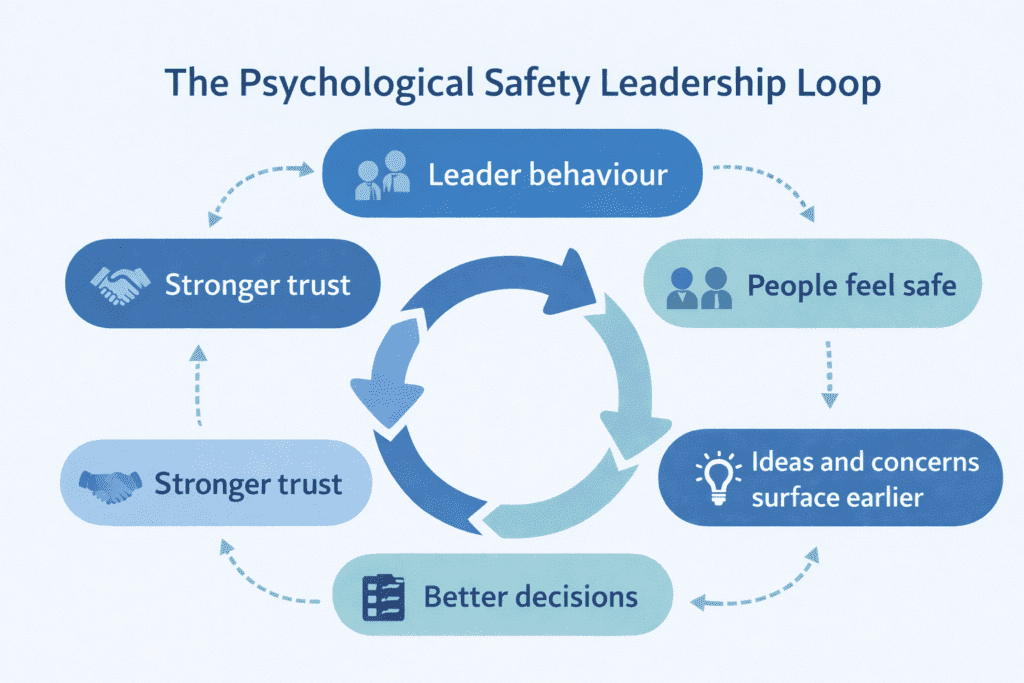
When leaders consistently model openness and curiosity, this cycle strengthens over time.
In contrast, when psychological safety is missing, teams often develop what might be called a culture of quiet compliance.
Meetings appear smooth because nobody disagrees. Projects seem to progress without friction.
But the absence of disagreement can hide serious problems.
Many major failures — in business, healthcare, and engineering — have been traced back to situations where people noticed issues but did not feel safe raising them.
Real-World Application: Google’s Project Aristotle
A well-known example of psychological safety leadership comes from Google’s internal research project known as Project Aristotle.
Google studied hundreds of teams to understand why some groups consistently performed better than others. Researchers initially expected the most successful teams to have the smartest individuals or the strongest technical skills.
Instead, the most important factor behind high-performing teams turned out to be psychological safety — the feeling that team members could speak openly, ask questions, admit mistakes, and challenge ideas without fear of embarrassment.
Teams where leaders encouraged open discussion and responded constructively to mistakes were far more likely to share ideas, solve problems early, and learn from failures.
You can read more about the research here: Google Re:Work — The Five Keys to a Successful Google Team.
The lesson is clear: leadership behaviour strongly influences whether people feel safe contributing their full thinking.
When People Feel Safe, They Speak Earlier
One of the most practical benefits of psychological safety leadership is that problems surface earlier.
In high-trust teams, people raise concerns while issues are still small.
In low-trust teams, problems are often hidden until they become unavoidable.
Over time this difference can have major consequences for organisations.
In fact, environments where people feel unsafe to speak honestly can gradually develop deeper cultural problems.
In my article on organizational trauma, I explored how repeated experiences of fear, blame, or silence can eventually shape the emotional climate of a workplace. Once this happens, rebuilding trust becomes much harder.
Psychological safety leadership helps prevent organisations from drifting into that kind of environment in the first place.
Psychological Safety Leadership Behaviours That Build Trust
Fortunately, creating psychological safety does not require complicated programmes or expensive training.
In most cases it begins with a handful of leadership habits.
The first is admitting mistakes.
When leaders acknowledge their own errors, they signal that mistakes are part of learning rather than something to hide. This often encourages others to be more open about challenges.
Another important behaviour is inviting different viewpoints.
Many leaders say they welcome feedback, but the real test is how they respond when feedback challenges their own ideas.
Teams notice the difference immediately.
Responding Well to Bad News
One moment that reveals the quality of psychological safety leadership is how leaders respond to bad news.
If a leader reacts with anger or blame, people quickly learn that reporting problems is risky.
But when leaders respond with curiosity — asking what happened and what can be learned — the effect is very different.
Over time, this builds an environment where people focus on solving problems rather than hiding them.
Interestingly, this principle also connects with ideas from trauma-informed leadership, which emphasises the importance of creating environments where people feel safe and respected rather than threatened or shamed.
Making It Safe to Challenge Ideas
Another important element of psychological safety leadership is separating ideas from identity.
Healthy teams learn to challenge ideas without attacking the person behind them.
This may sound simple, but it requires practice.
One useful technique is for leaders to actively invite dissent.
In meetings, for example, a leader might ask:
“What might we be missing?”
or
“Is there another way to look at this?”
When this becomes normal behaviour, teams gradually become more comfortable exploring different perspectives.
Real-World Application: Pixar’s “Braintrust” Meetings
Pixar provides another fascinating example of psychological safety leadership in practice.
During the development of films such as Toy Story, Finding Nemo, and Inside Out, Pixar uses a process known as the Braintrust. In these meetings, directors and creative teams present unfinished work and invite honest feedback from colleagues.
The key rule is that people are encouraged to challenge ideas openly — but not attack the person presenting them. Feedback is candid, constructive, and focused on improving the work.
Ed Catmull, Pixar’s co-founder, has often explained that the goal is to create an environment where people feel safe raising concerns early, before problems become difficult to fix.
You can read more about Pixar’s approach in Ed Catmull’s discussion of the Braintrust here: Harvard Business Review — How Pixar Fosters Collective Creativity.
This kind of open dialogue is a powerful example of psychological safety leadership: leaders create structures that allow honest feedback to surface without fear.
When Psychological Safety Is Missing
The absence of psychological safety leadership often reveals itself through subtle signals.
Meetings become unusually quiet. The same few people speak each time. Questions appear less frequently.
Over time, innovation slows down.
Mistakes may still occur, but they are discovered later — sometimes much later.
Another warning sign is a culture of blame. When problems appear, energy is spent finding someone responsible rather than understanding what happened.
In the long run this environment discourages experimentation and learning.
Building Psychological Safety Leadership in Practice
The encouraging news is that psychological safety can grow surprisingly quickly when leaders change small habits.
One simple practice is modelling curiosity.
Instead of responding immediately with answers, leaders can ask more questions. This encourages exploration rather than defensiveness.
Another useful habit is closing the feedback loop.
If someone raises a concern or suggestion, it helps to acknowledge it publicly and explain what action will follow. This signals that speaking up has value.
Over time these small actions accumulate.
Gradually, teams begin to trust that honest conversation will not be punished.
Or, as another Finnish proverb reminds us:
“Kukaan ei ole seppä syntyessään.”
No one is born a master.
Teams learn these habits through practice, and leadership behaviour sets the tone.
Conclusion
Psychological safety is often described as a feature of healthy teams.
But in reality it is often the result of leadership behaviour.
Leaders influence psychological safety through small everyday moments — how they react to mistakes, how they invite feedback, and how they handle disagreement.
This is why psychological safety leadership matters so much.
It shapes whether people remain silent or speak honestly.
And in complex organisations, the difference between silence and honesty can determine whether problems grow quietly or are solved early.
If you would like to experiment with this idea, try a simple step in your next meeting.
After discussing an important decision, ask one question:
“What might we be missing?”
You may discover that the most valuable insights often appear when people feel safe enough to share them.
Frequently Asked Questions About Psychological Safety Leadership
What is psychological safety leadership?
Psychological safety leadership refers to leadership behaviours that create an environment where people feel safe to speak up, ask questions, admit mistakes, and challenge ideas without fear of embarrassment or punishment. It is built through everyday actions such as listening well, responding calmly to bad news, and treating mistakes as opportunities for learning.
Why is psychological safety leadership important?
Psychological safety leadership is important because teams perform better when people feel safe to raise concerns, share ideas, and admit problems early. This improves learning, innovation, trust, and problem-solving, while reducing silence, blame, and hidden mistakes.
How do leaders create psychological safety in teams?
Leaders create psychological safety by responding constructively to mistakes, inviting different viewpoints, thanking people for raising concerns, and showing curiosity instead of blame. Small, consistent behaviours often matter more than formal policies.
Is psychological safety the same as being nice?
No. Psychological safety is not about avoiding disagreement or lowering standards. Teams can still challenge ideas, give honest feedback, and hold each other accountable. The difference is that people do not fear being mocked or punished for speaking openly.
What are signs that a team lacks psychological safety?
Common signs include quiet meetings, the same few people doing all the talking, hidden mistakes, limited feedback, blame culture, and concerns being raised only after meetings rather than during them. These behaviours often suggest people do not feel fully safe speaking up.
Can psychological safety leadership improve performance?
Yes. Psychological safety leadership can improve performance by encouraging earlier problem detection, better decision-making, stronger collaboration, and more honest communication. Teams often work more effectively when people feel safe to contribute their full thinking.
If you’d like to explore the wider ideas behind psychological safety leadership, these related articles are a good next step:
Build Deeper Insight
Psychological safety leadership is closely connected to several other ideas explored on krislai.com. If this article resonated with you, these related pieces may help deepen the picture.
- Psychological Safety at Work
Explore what psychological safety means more broadly, why it matters, and how it affects team performance. - Trauma-Informed Leadership
Learn how leaders can reduce fear, create trust, and respond more thoughtfully in emotionally demanding workplaces. - Organizational Trauma
Understand how fear, silence, and unresolved workplace harm can shape culture and performance over time. - Business Thinking Hub
Browse the wider collection of articles on leadership, strategy, behavioural economics, and better business decision-making.
If you enjoy exploring the ideas behind better business decisions, you may find the Business Thinking Hub useful.
About the author
Kris Lai is a business operator and managing director with experience in land and building surveying, facilities management, logistics, and service delivery.
Earlier in his career, he worked as a Search Engine Evaluator (via Lionbridge, supporting Google), where he assessed search result relevance, user intent, and content quality using structured evaluation frameworks. This experience gives him a rare, practical understanding of how search systems interpret signals and make ranking decisions.
In parallel, whilst working with a charity organisation, he has delivered 1000’s of structured presentations in English, Finnish, and Chinese to audiences ranging from small groups to more than 600 people, and has spent decades mentoring and developing others. This experience informs his approach to clarity, communication, and decision-making under pressure.
He writes about AI, search behaviour, business strategy, and decision-making from a practical, real-world perspective.