
Business Thinking Hub: Strategy, Leadership & Behavioural Economics | krislai.com
The KrisLai Decision Framework™
If you want to make better business decisions, this is where I suggest starting.
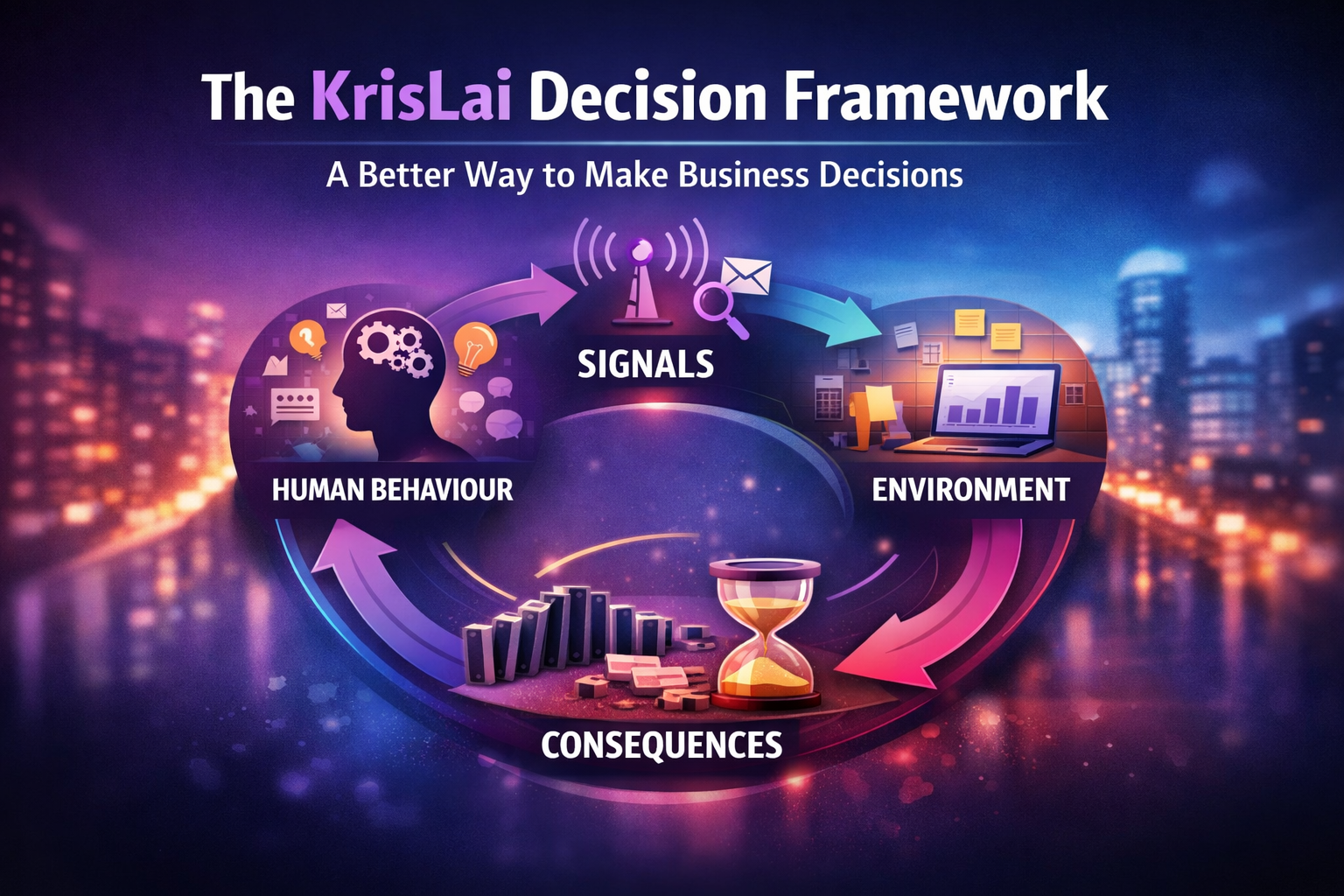
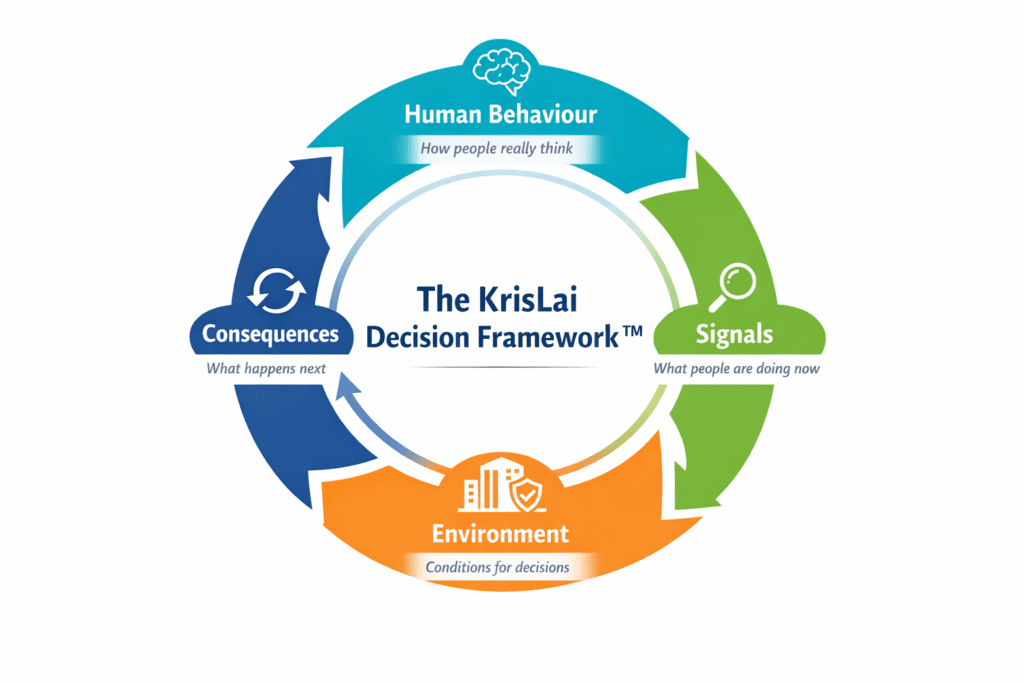
Over time, I’ve found that most decisions improve when we look at four things: how people think, what signals they’re giving, the environment they operate in, and what happens next.
I’ve brought these together into a simple model: The KrisLai Decision Framework™.
Explore Business Thinking by Area
Each area below connects to one part of the decision-making process.
- Behavioural Economics & Decision Psychology → Understanding how people actually think and decide
- Marketing & Customer Behaviour → Reading signals and customer intent
- Leadership & Organisational Culture → Creating environments where good decisions can happen
- Strategy & Business Thinking → Thinking beyond immediate outcomes and long-term consequences
Business Thinking: Ideas That Shape Better Decisions
Good business decisions rarely come from instinct alone. They are shaped by how people think, how organisations behave, and how leaders respond to complexity and uncertainty.
A practical model for better business decisions in complex environments. It focuses on four essential elements:
- Human Behaviour — how people actually think and decide
- Signals — what people are trying to do right now
- Environment — whether the system supports good decisions
- Consequences — what happens next, and after that
Strong decisions consider all four — not just one.
At krislai.com, I explore practical ideas that help business leaders think more clearly and act more wisely. Many of the articles below explore practical frameworks that help leaders make better decisions, including behavioural economics, psychological safety, and concepts like second-order thinking.
Below you’ll find the core themes that run through the site. Each section gathers articles that explore an important aspect of business thinking.
What is Business Thinking?
Business thinking refers to the ability to understand how organisations work, how decisions affect outcomes, and how strategy, leadership, and customer behaviour interact in real-world business environments. It combines strategic thinking, behavioural insight, and practical judgement to help leaders make clearer, wiser decisions.
These ideas appear throughout the articles below.
Latest Insight
Customer Intent Marketing: How to Turn Buying Signals Into Sales
Many companies create content that attracts attention but not customers. This article explains how to recognise real buying signals and align marketing content with what customers are trying to do in the moment.
How I Think About Business Decisions
Behavioural Economics & Decision Psychology
Understanding how people actually make decisions is one of the most valuable skills in modern business.
Traditional economic models assume people act rationally. In reality, our decisions are influenced by mental shortcuts, emotions, context, and social signals. Behavioural economics helps explain these patterns and shows how businesses can design better choices for customers and teams.
Articles
Behavioural Economics in Business: How Customers Really Make Decisions
(Coming soon)
• The Psychology of Pricing: Why Customers Perceive Prices Differently
• Cognitive Biases in Business Decisions
Leadership & Organisational Culture
Leadership is not only about strategy and performance. It also shapes the emotional climate of an organisation.
When people feel safe to speak up, share ideas, and admit mistakes, teams learn faster and innovate more effectively. When fear, silence, or unresolved organisational trauma dominate, performance quietly suffers.
These articles explore how leadership behaviours influence trust, safety, and organisational resilience.
Articles
Psychological Safety Leadership: How Leaders Build High-Trust, High-Performance Teams
Psychological Safety at Work: What It Is, Why It Matters, and How to Build It
Trauma-Informed Leadership: What It Is, Why It Matters, and How to Practice It
Organizational Trauma: What It Is, Signs to Watch For, and How to Heal
Strategy & Business Thinking
Strategy used to be something organisations planned once every few years. Today it is an ongoing process of learning, adapting, and responding to changing markets.
Effective leaders combine long-term thinking with the flexibility to adjust quickly when conditions change. Strategic thinking also requires understanding second-order effects — the consequences that follow after initial decisions.
These articles explore the mental models and frameworks that support better strategic thinking.
Articles
Reinvent or Be Left Behind: Why Strategy Must Move at Market Speed
Strategic thinking is not only about planning — it also involves understanding the ripple effects of decisions. Concepts like second-order thinking help leaders anticipate consequences before they appear.
Second-Order Thinking in Business: Why Smart Leaders Look Two Steps Ahead
(Coming soon)
• Decision Fatigue in Business: Why Smart Leaders Make Poor Decisions Late in the Day
Marketing & Customer Behaviour
Modern marketing happens in moments of intent. Customers search, compare, and decide quickly, often within seconds.
Understanding how attention works — and how customers behave in those small decision moments — helps businesses communicate more clearly and design better customer experiences.
These articles explore how marketing, psychology, and technology intersect in today’s digital marketplace.
Customer Behaviour, Trust, and Value
- Customer Intent Marketing — how to read buying signals and turn customer intent into better sales decisions.
- Customer Centricity — how to build loyalty, improve customer experience, and grow long-term value.
- Customer Personas — how to understand who your customers are, what they need, and how they decide.
- Customer Lifetime Value — how to measure the long-term financial value of customer relationships.
Explore ideas connected to better business decisions:
Micro-Moment Marketing: How Small Moments Drive Big Buying Decisions
Second-Order Thinking in Business: Why Smart Leaders Look Two Steps Ahead
Customer Intent Marketing: How to Turn Buying Signals Into Sales
Micro vs Macro Marketing: When to Target Broad Audiences vs Niche Customers
Start Here
If you’re new, I suggest reading these in order:
Why These Ideas Matter
Many business problems look technical on the surface but are actually human problems.
Poor decisions, stalled strategies, and ineffective marketing often stem from misunderstandings about how people think, communicate, and respond to incentives.
By exploring ideas from behavioural economics, organisational psychology, and strategy, we can make better decisions — both as individuals and as organisations.
These articles are part of an ongoing exploration of business thinking — how leaders understand complexity, make decisions, and guide organisations through change.
Latest Insights in Business Thinking
New insights are added regularly as the blog explores practical ideas that help leaders improve business judgement and strategy.
Here are the latest articles exploring practical ideas for better business decisions, leadership, strategy, and customer behaviour:
- Digital Transformation for SMEs: 7 Questions Before You Invest
- Cybersecurity for Businesses: 7 Decisions Leaders Must Make
- How AI Is Changing Search Behaviour (And What Businesses Must Do Now)
- 7 Decision-Making Framework Examples for Business Leaders
- Business Decision-Making Framework: The KrisLai Method
Connect
If these ideas resonate with you, feel free to connect on LinkedIn where I occasionally share new articles and reflections.