Persuasion happens every day in business, whether people notice it or not. The real question is not whether you influence people, but how. Ethical persuasion helps people understand a choice, weigh it clearly, and decide with confidence. Bad persuasion hides trade-offs, creates pressure, and damages trust.
Persuasion is already happening in your business!
That is worth saying plainly.
It happens in sales calls, pricing pages, onboarding flows, hiring conversations, internal change meetings, customer support, product design, and even in the way a button is labelled on a website. The question is not whether persuasion exists. The question is whether it helps people decide well, or simply pushes them where you want them to go.
That difference matters.
In plain English, ethical persuasion in business means helping people make a better-informed choice through clarity, trust, and fair framing, while still leaving them genuinely free to choose. Plymouth’s business commentary makes this point very clearly: persuasion needs to be ethical, evidence-based, and distinct from coercion. If the other person cannot meaningfully say no, it is not persuasion.
I write about how better decisions are made in business — combining strategy, behaviour, and practical thinking. That is exactly how I want to treat this subject. Not as a bag of tricks. Not as “how to influence others to get what you want.” And definitely not as a polite disguise for manipulation.
This approach is part of the KrisLai Decision Framework, a practical method for improving business decisions. Better decisions come from understanding behaviour, signals, environment, and consequences. That applies here too. Over time, I’ve found that good decisions rarely come from data alone. They come from understanding people, reading signals, creating the right environment, and thinking beyond the immediate outcome.
Ethical persuasion in business means using honest framing, clear information, and fair influence to help people decide well — without pressure, deception, or hidden traps.
- Persuasion is part of everyday business, whether you plan for it or not.
- Helpful persuasion supports choice. Manipulation weakens it.
- Framing matters because the same facts can feel very different depending on how they are presented.
- Trust is often more valuable than pressure.
- The best persuasion helps people decide with more clarity, not less freedom.
If you remember nothing else but this, remember this: ethical persuasion helps people understand a choice more clearly. Manipulation makes the choice harder to judge properly.
What is ethical persuasion in business?
Ethical persuasion in business is the use of honest, respectful influence to help people understand a choice and decide without being misled or trapped.
That is the direct answer.
The broad search results for the power of persuasion, power of persuasion meaning, and what does power of persuasion mean are mixed, but the more business-focused results converge on a practical truth: persuasion is a normal business skill, but it needs ethics, communication, and an audience-centred approach. University of Plymouth is particularly useful because it stresses that persuasion must have an ethical basis and leave space for refusal.
So when I talk about persuasion in business, I do not mean pushing harder! I mean helping someone think more clearly about a real decision.
What does persuasion in business mean in plain English?
In plain English, persuasion in business means influencing how people understand a choice.
That happens in:
- sales conversations
- negotiation
- leadership communication
- hiring
- product pages
- pricing decisions
- customer support
- onboarding
- internal change
So yes, persuasion skills for leaders matter. So do persuasion in sales and negotiation, persuasion in leadership, persuasion in customer support, and persuasion in onboarding.
The point is not that persuasion is everywhere and therefore suspicious. The point is that it is everywhere and therefore worth doing properly.
Persuasion vs manipulation
Persuasion vs manipulation is the most important distinction in this whole article.
Persuasion says:
- here is the choice
- here is why it may help
- here are the trade-offs
- here is why it may or may not fit
- you are still free to choose
Manipulation says:
- here is the pressure
- here is the partial truth
- here is the fake urgency
- here is the missing downside
- please decide before thinking too hard
Plymouth’s explanation is very helpful here. It argues that ethical persuasion must allow an “escape route” and that if someone cannot truly say no, the process becomes coercive rather than persuasive.
That is the line.
Why is persuasion part of everyday business?
Persuasion is part of everyday business because businesses are always framing choices, whether they realise it or not.
A product description frames a choice.
A pricing page frames a choice.
A change briefing frames a choice.
A sales call frames a choice.
A refund policy frames a choice.
Even silence frames a choice, usually badly.
In my experience, businesses sometimes act as if persuasion is only something sales people do. It is not. It is built into the way choices are presented across the whole organisation.
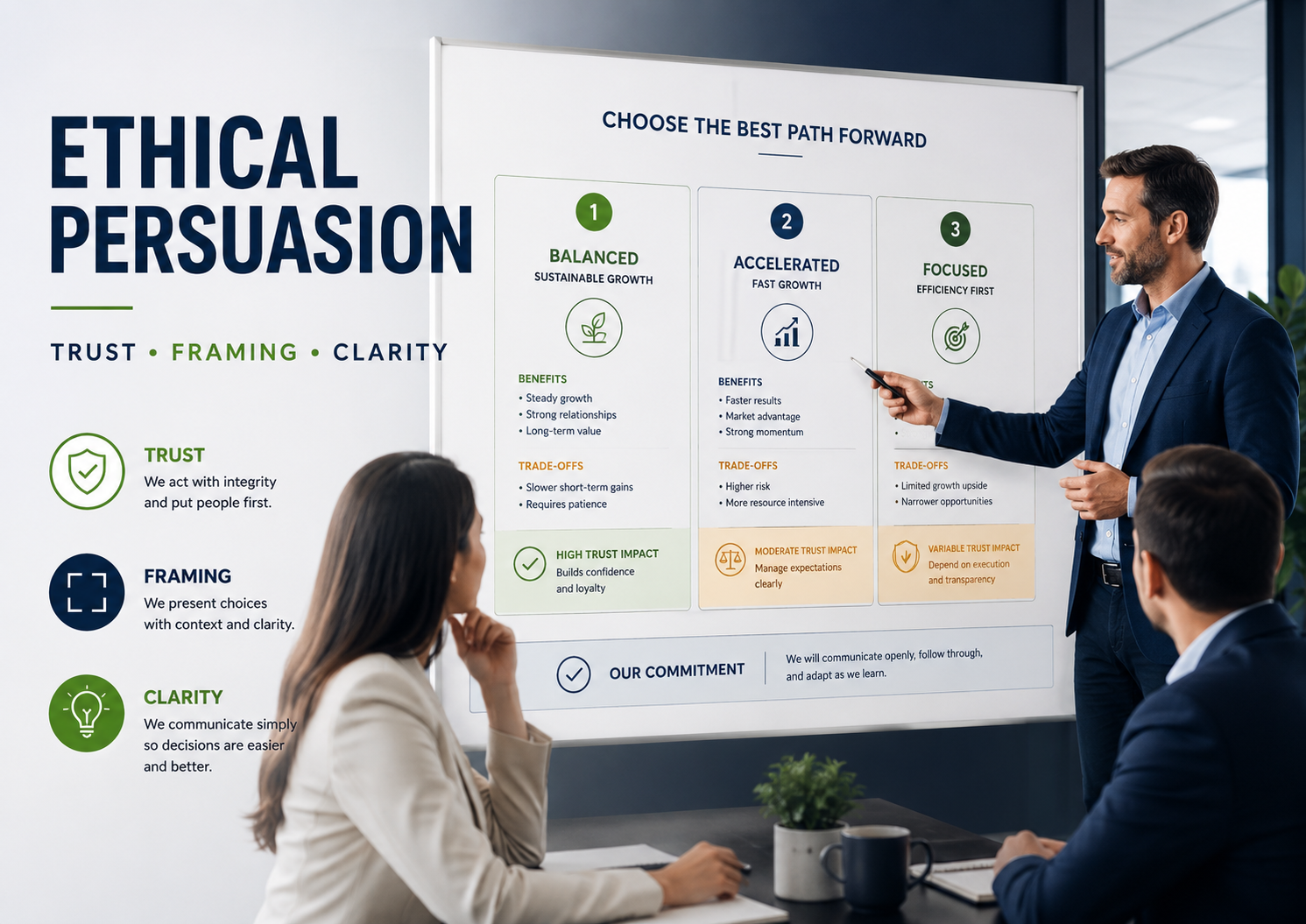
Persuasion becomes ethical when it stops trying to win the moment and starts helping the other person make a better decision. That is where framing, trust, and clarity matter most.
How does framing affect the way people decide?
Framing affects the way people decide because the same facts can feel different depending on how they are presented.
This is where framing in business decisions becomes so important. You can present one option as:
- a gain
- a loss
- a risk
- a default
- a safer step
- a more flexible route
- a quicker win
- or a more stable long-term choice
The facts may stay the same. The attention changes.
Why can the same facts lead to different choices?
The same facts can lead to different choices because people do not respond to information in a perfectly neutral way.
For example:
- 95% success rate feels different from 5% failure rate
- save £50 a month feels different from pay £600 a year
- cancel anytime feels different from 12-month commitment with exit conditions buried in paragraph seven
The facts may not have changed. The emotional feel has.
That is one reason how framing affects decisions matters so much in business. It changes what people notice first, what they fear, what they value, and how risky something feels.
What do behavioural insights tell us about real people?
They tell us that real people do not make decisions like spreadsheets in shoes.
People use shortcuts. They rely on cues. They respond to:
- trust
- relevance
- social proof
- defaults
- clarity
- emotional tone
- perceived risk
- decision fatigue
This is where behavioural economics and persuasion becomes useful. Not as a clever trick, but as a way of understanding how real people actually decide.
For example:
- loss aversion means people often care more about avoiding a bad outcome than gaining an equal benefit
- social proof in persuasion matters because people look at what others do when uncertainty is high
- decision fatigue means even good offers can fail if the choice feels too hard or too cluttered
- credibility in persuasion matters because unclear or exaggerated claims reduce safety
This links directly to Behavioural Economics for Business Leaders, Customer Intent Marketing, and Micro-Moment Marketing.
A simple way to think about ethical persuasion is as a decision loop. Good framing should make the choice clearer, not make resistance harder.
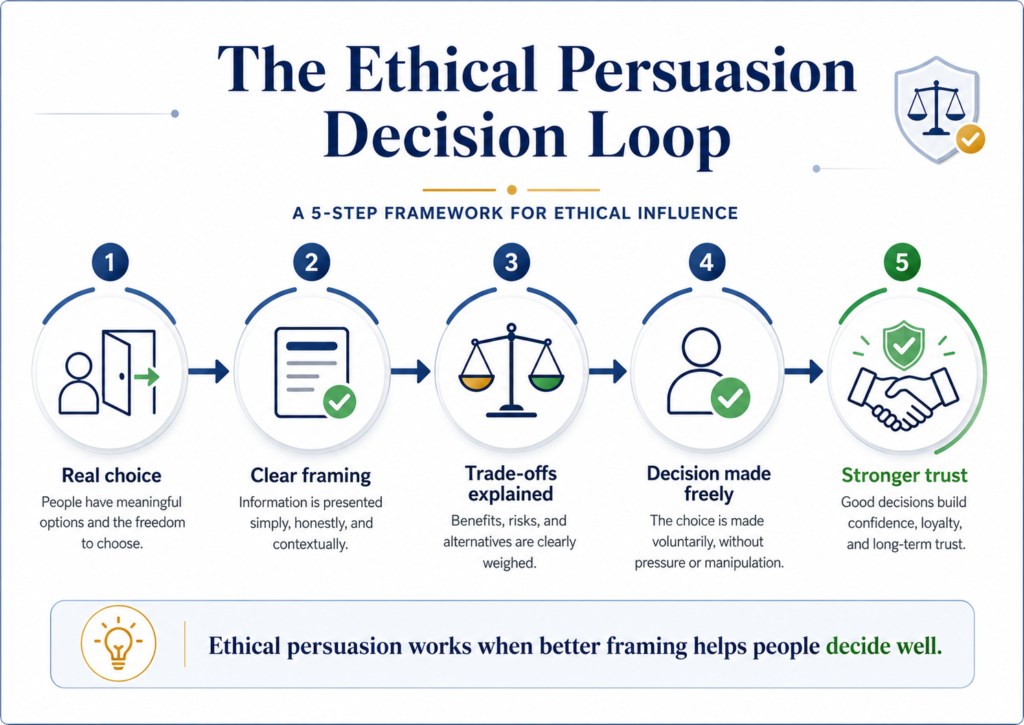
When choices are framed honestly and trade-offs are clear, people are more likely to decide with confidence and trust.
Why does trust matter more than pressure?
Trust matters more than pressure because pressure can force a short-term decision, but trust supports a better long-term one.
Pressure may get a yes.
Trust gets a better yes.
And sometimes trust also gets a respectful no, which is still more useful than forcing someone into the wrong fit and cleaning up the mess later.
That is one reason persuasion and trust in business belong together. If the method weakens trust, the persuasion may have succeeded only in the shortest possible sense.
What this looks like in real business
In real business, ethical persuasion looks like choices being made easier to understand, not harder to resist.
What does a sales conversation look like when it informs instead of pressures?
A good sales conversation explains fit, trade-offs, price, and next steps clearly enough that the buyer can decide without being cornered.
That means:
- clear explanation
- honest limits
- no fake urgency
- no “offer ends in 14 seconds” theatre
- no pretending every product is perfect for every person on Earth
In my experience, ethical sales influence works better because it reduces the buyer’s fear of being trapped. A clear sales conversation says:
- here is who this is for
- here is who it is not for
- here is the upside
- here is the downside
- here is the likely outcome
That feels safer, and people often decide better when they feel safe.
What does a product or service page look like when it makes the choice easier?
A good page uses clear wording, fair comparison, honest benefits, and sensible structure to reduce effort.
This is where persuasion in product pages matters.
A clear product page:
- answers the real question
- shows what the thing does
- explains who it helps
- makes pricing understandable
- does not hide important limits
- uses social proof in persuasion carefully and truthfully
It does not read like a hostage note written by a conversion optimiser.
What does persuasive leadership look like during difficult change?
Persuasive leadership during change means framing the truth honestly enough that people can understand why the change matters, what the risks are, and what the likely consequences will be.
That is where persuasion in change management becomes important.
A leader does not need to “spin” the change. They need to explain:
- why it is happening
- what problem it solves
- what the trade-offs are
- what people can expect
- and what support exists
This links closely to Psychological Safety at Work. People are more likely to support a difficult change when they are treated like adults, not managed like suspicious luggage.
The Ethical Persuasion Loop
Real choice → clear framing → understood trade-offs → safer decision → stronger trust → better long-term outcome
What this looks like in real business
The real-world version is usually less glamorous and more useful than people expect.
A founder rewrites the pricing page so buyers can see what is included and what is not, rather than forcing them into a “book a call to decode the mystery” process.
A support team replaces vague reassurance with clear next steps, realistic timing, and honest limits.
A manager frames a difficult change by explaining what is driving it, what it will improve, and what the team is likely to find hard, instead of pretending everybody is thrilled and deeply inspired by a new reporting structure.
A salesperson says, “This is probably not the right fit for you if your team needs X,” and earns more trust than the person who tries to close at all costs.
That is power of persuasion examples in a business setting when handled well.
Where this goes wrong
Persuasion goes wrong when framing becomes misleading, trade-offs are hidden, and pressure replaces clarity.
Which persuasion tactics break trust fastest?
The ones that make the decision look safer, easier, or more urgent than it really is.
That includes:
- false scarcity
- fake urgency
- hidden costs
- vague claims
- inflated results
- hard cancellation paths
- untrue defaults
- irrelevant testimonials
- dodgy emotional appeal in persuasion
- and selective silence about the downside
Redcliffe’s business training advice is useful here too: it highlights that overpromising and being pushy damage credibility.
These tactics may work once. They are still bad strategy.
What is the long-term cost of unfair persuasion?
The long-term cost is trust erosion.
That shows up as:
- churn
- complaints
- poor reviews
- weaker word of mouth
- harder renewals
- lower internal trust
- weaker leadership credibility
- and more expensive selling later
What I have seen is that unfair persuasion often creates “wins” that the business then has to spend time undoing.
How can AI make persuasion better or worse?
AI can make persuasion better when it improves clarity, timing, relevance, and effort reduction.
It can make persuasion worse when it:
- sounds robotic
- misreads context
- creates creepy targeting
- pushes fake personalisation
- or uses ambiguity to steer people into choices they do not really understand
This matters more now because AI and changing search behaviour are shaping how people discover, compare, and judge businesses. People increasingly expect useful, direct answers. That is one reason ethical persuasion now overlaps with How AI Is Changing Search Behaviour.
If your AI support flow makes the choice faster but less honest, that is not progress. It is just quicker confusion.
- Fake urgency replaces honest timing
- Trade-offs are hidden to protect conversion
- Defaults and social proof are used in sneaky ways
- AI reduces cost but increases customer confusion
- The business wins the moment and loses long-term trust
What you should actually do
Use persuasion to improve understanding, not reduce freedom.
What simple persuasion test should you use before making the call?
Use this simple test:
- Does this help someone understand the choice?
- Does it leave them genuinely free to choose?
- Does it make the trade-offs clear?
- Would I be comfortable if this framing were used on me?
- Would I still respect this decision process if the answer were no?
That is my favourite practical filter for how to persuade without manipulation.
How do you frame choices clearly and fairly?
Use:
- plain language
- short explanation
- real upside
- real downside
- clear comparison
- honest fit
- honest limit
This is where framing in business decisions becomes helpful rather than slippery.
Clarity is a form of respect.
How do you use defaults, testimonials, and social proof without being sneaky?
Use them truthfully, relevantly, and with easy opt-out.
That means:
- defaults should be helpful, not trapping
- testimonials should be real and representative
- social proof in persuasion should support understanding, not create false pressure
- comparisons should be fair
- and people should be able to change course without feeling tricked
This connects closely to how I think about decisions more broadly in the KrisLai Decision Framework™. Better decisions come from understanding behaviour, signals, environment, and consequences. That includes the consequences of how a choice is presented.
Ethical persuasion begins with one simple shift: stop asking “How do we get them to say yes?” and start asking “How do we help them decide well?”
Why is ethical persuasion really better decision support?
Because it reduces confusion, protects trust, and improves the quality of the decision.
That is the bigger point.
Ethical persuasion is not soft. It is not weak. It is not anti-sales. It is simply better aligned with long-term business health.
It helps:
- better-fit customers choose
- teams support change more honestly
- buyers compare options more clearly
- organisations avoid expensive trust damage
- leaders persuade without hollow spin
This connects directly to Second-Order Thinking in Business. Short-term pressure can produce immediate compliance. But the second-order effects may be churn, regret, resistance, or damaged trust.
How are AI and changing search behaviour changing persuasion?
They are making clarity, answer quality, and lower-friction trust much more important.
People now:
- ask fuller questions
- expect direct answers
- compare options faster
- use AI assistants
- and lose patience more quickly when a business makes understanding unnecessarily hard
That means ethical persuasion now includes:
- better explanation
- clearer content
- honest positioning
- helpful defaults
- and answer-led discoverability
The companies that do this well will often sound less “persuasive” in the old salesy sense and more useful in the modern sense. That is a good thing!
Conclusion and Final Thoughts
Ethical persuasion in business is not about making people do what you want.
It is about helping people decide with more clarity, trust, and confidence.
That is the main point.
The best persuasion uses better framing to make the choice easier to understand, not harder to resist. It respects freedom, shows trade-offs, reduces confusion, and strengthens trust.
If you remember nothing else but this, remember this:
Start with this one thing: make the next important choice easier to understand, not harder to resist.
That single habit will improve your sales, leadership, product communication, and customer trust more than most “persuasion tactics” ever will.
Ethical persuasion works best when it helps people decide well. Clear framing, honest trade-offs, and real freedom of choice build stronger trust than pressure ever will.
Persuasion makes more sense when you connect it to behaviour, intent, trust, and long-term consequences. These are the best next reads.
Want a simple, practical guide to making better business decisions under uncertainty?
Enter your email below and I’ll send you the free KrisLai Decision Framework™ guide, built around behaviour, signals, environment, and consequences.
It is designed to help leaders think more clearly, act earlier, and make better decisions in the real world.
Frequently Asked Questions
What is ethical persuasion in business?
Ethical persuasion in business means using honest framing, clear information, and fair influence to help people make better-informed choices without pressure, deception, or hidden traps.
What is the difference between persuasion and manipulation?
Persuasion helps people understand a choice and decide freely. Manipulation hides trade-offs, creates false urgency, or uses pressure to steer people into decisions they may not make if everything were clear.
Why does framing matter in business decisions?
Framing matters because the same facts can feel different depending on how they are presented. Good framing improves clarity. Bad framing distorts judgement.
Can persuasion be ethical in sales and leadership?
Yes. Ethical persuasion in sales and leadership is possible when the information is honest, the trade-offs are clear, and the other person remains free to choose without coercion.
How can AI affect persuasion and trust?
AI can improve persuasion by making information faster and clearer, but it can also damage trust if it feels robotic, hides context, or pushes people through poorly explained choices.
This article is based on practical experience, independent research, analysis and synthesis.
If you enjoy exploring the ideas behind better business decisions, you may find the Business Thinking Hub useful.
About the author
Kris Lai is a business operator and managing director with experience in land and building surveying, facilities management, logistics, and service delivery.
Earlier in his career, he worked as a Search Engine Evaluator (via Lionbridge, supporting Google), where he assessed search result relevance, user intent, and content quality using structured evaluation frameworks. This experience gives him a rare, practical understanding of how search systems interpret signals and make ranking decisions.
In parallel, whilst working with a charity organisation, he has delivered 1000’s of structured presentations in English, Finnish, and Chinese to audiences ranging from small groups to more than 600 people, and has spent decades mentoring and developing others. This experience informs his approach to clarity, communication, and decision-making under pressure.
He writes about AI, search behaviour, business strategy, and decision-making from a practical, real-world perspective.
👉 Explore ideas connected to better business decisions:
- Digital Transformation for SMEs: 7 Questions Before You Invest
- Cybersecurity for Businesses: 7 Decisions Leaders Must Make

- How AI Is Changing Search Behaviour (And What Businesses Must Do Now)
- Decision-Making Framework Examples: The KrisLai Method in Action
- The KrisLai Decision Framework: A Better Way to Make Business Decisions