Customer-centricity is not a poster on the wall or a line in a strategy deck. It only matters when it changes real choices: what you build, how you serve, what you simplify, what you measure, and how quickly you fix friction. In practice, customer-centricity works best as a decision system, not a branding slogan.
Customer-centricity sounds lovely on a slide.
That is often the problem.
Most companies are happy to say they care about customers. Far fewer are willing to let customer needs shape the awkward decisions: what gets fixed first, what gets cut, what gets simplified, what gets explained more clearly, and what internal convenience has to give way.
That is why I think customer centricity in business is not really about slogans. It is about choices.
In plain English, customer centricity means putting the customer at the centre of how the business makes decisions, not just how it talks. Current leading explainers consistently define it as a business strategy or operating approach that puts customer needs and value at the heart of product, service, processes, and support.
I write about how better decisions are made in business — combining strategy, behaviour, and practical thinking. So in this article, I want to move the topic away from generic “customer-first” language and towards something more useful:
customer-centricity as a decision system
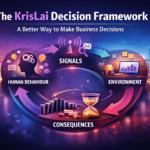
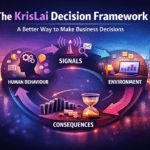
This approach is part of the KrisLai Decision Framework, a practical method for improving business decisions. Better decisions tend to come from understanding behaviour, signals, environment, and consequences. Customer-centricity fits that perfectly, because customers leave signals everywhere: in questions, hesitation, drop-offs, complaints, clicks, repeat contacts, buying behaviour, and silence.
Over time, I’ve found that good decisions rarely come from data alone. They come from understanding people, reading signals, creating the right environment, and thinking beyond the immediate outcome.
Customer centricity means making business decisions in a way that puts customer needs, effort, outcomes, and trust at the centre — not just saying that customers matter.
- Customer centricity is not a slogan. It is a way of making choices.
- A customer centric strategy should shape product, pricing, support, content, and operations.
- Customer centricity vs customer service is not the same thing: service is one function, centricity is a wider operating rule.
- AI can improve customer experience, but it can also damage trust if it becomes cold, wrong, or too automatic.
- The businesses that win usually make life easier, clearer, faster, and fairer for customers.
If you remember nothing else but this, remember this: customer centricity works only when it changes what the business does next. If it does not change decisions, it is just decoration.
This article contains affiliate links. If you buy through them, I may earn a commission at no extra cost to you. I only include affiliate links where they are genuinely relevant.
What is customer centricity?
Customer centricity (or customer-centricity) is the practice of making business decisions around customer needs, outcomes, and effort rather than around internal convenience alone.
That is the simplest answer to “what is customer centricity”.
The top pages in the search results say much the same thing. SuperOffice describes it as a business strategy that puts the customer at the heart of everything from product development to post-sale support. Vypr says it goes beyond meeting expectations and uses feedback to shape strategy, culture, and operations.
So the real customer centricity meaning is not “we say nice things about customers.” It is:
“we use customer reality to guide business choices”.
What does customer centricity mean in plain English?
In plain English, it means asking:
- does this make life easier for the customer?
- does this make the offer clearer?
- does this reduce friction?
- does this build trust?
- does this help the customer get the result they actually want?
That is a much more useful test than “do we have a values slide somewhere saying we care?”
Why is customer centricity important?
Customer centricity is important because it improves trust, loyalty, retention, repeat business, and long-term resilience.
That is not just soft language. Multiple current sources tie customer-centricity to stronger retention, better reputation, and more sustainable growth.
But I would frame it one step further.
In my experience, customer centricity benefits the business most when it reduces wasted effort and poor internal decisions. A business that keeps making customers work too hard usually creates:
- more complaints
- more support load
- more drop-off
- weaker trust
- and slower growth
That is why “why is customer centricity important” is really a question about execution, not only brand.
Customer centricity vs customer service
Customer centricity vs customer service is a useful distinction.
Customer service is one part of the business.
Customer centricity is the wider operating logic.
A company can have polite support staff and still make customers suffer through:
- confusing forms
- messy handovers
- bad onboarding
- unclear pricing
- slow replies
- robotic AI
- or content that answers the wrong question
So yes, customer centric service matters. But customer centricity is bigger than that. It reaches across product, pricing, marketing, support, content, operations, and leadership.
Customer centricity becomes useful when it stops being a value statement and starts becoming an operating rule: what decision helps the customer most right now, without damaging the health of the business?
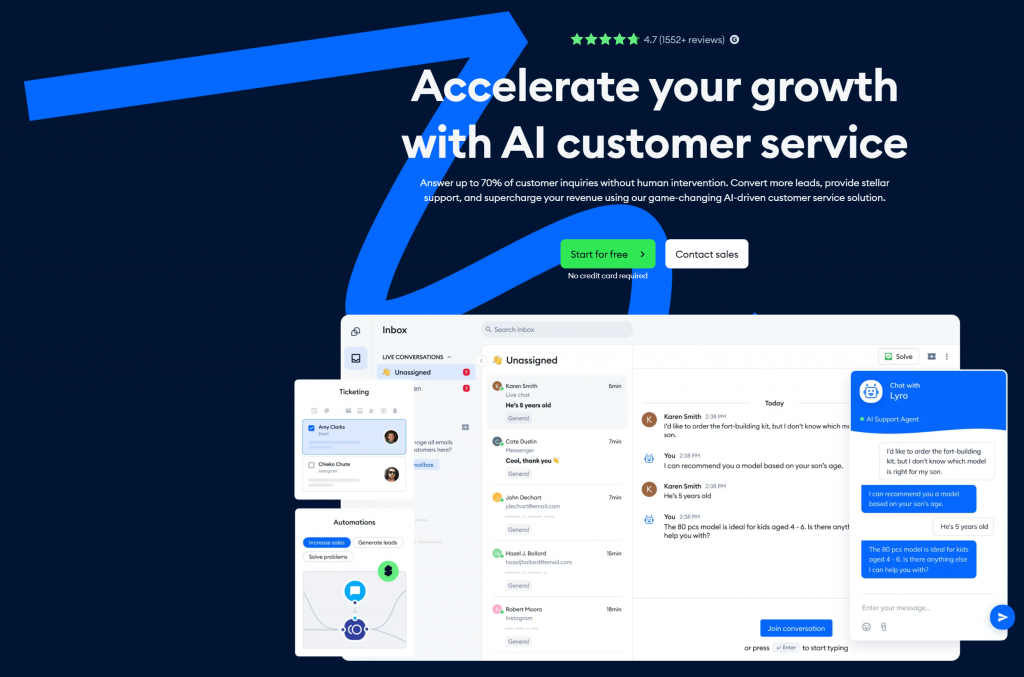
What does customer-centricity as a decision system mean?
Customer centricity as a decision system means using customer needs, behaviour, feedback, and friction signals to guide real choices across the business.
That is the practical answer.
A customer centric approach becomes meaningful only when it shapes what teams actually do:
- which problem to fix first
- which feature to build
- which process to simplify
- which message to rewrite
- which tool to use
- which friction to remove
This connects closely to how I think about decisions more broadly in the KrisLai Decision Framework™. A decision system is not about having kind intentions. It is about using signals well.
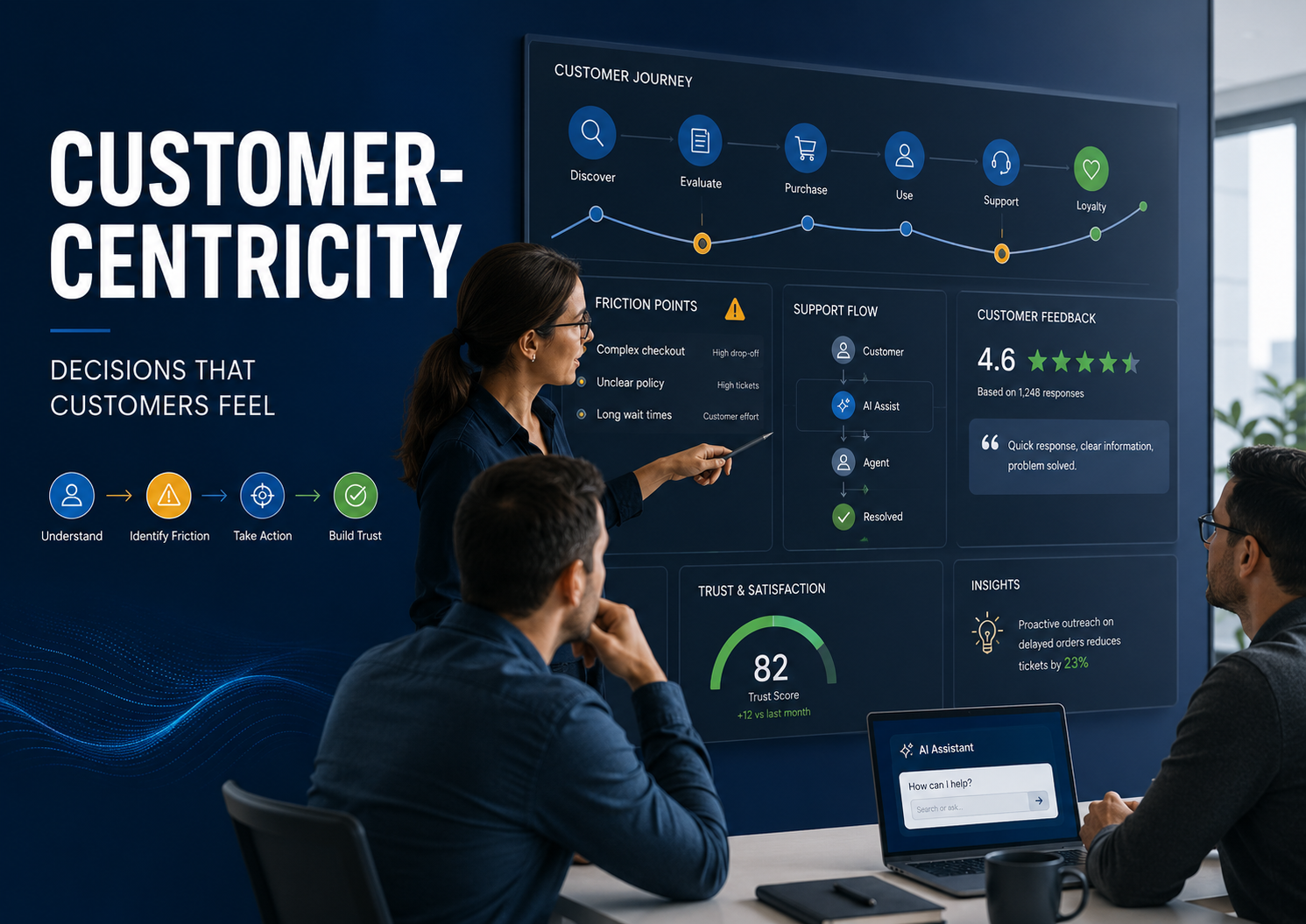
A simple way to think about customer-centricity is as a decision loop. Customer signals should shape what the business does next, not just what it says.
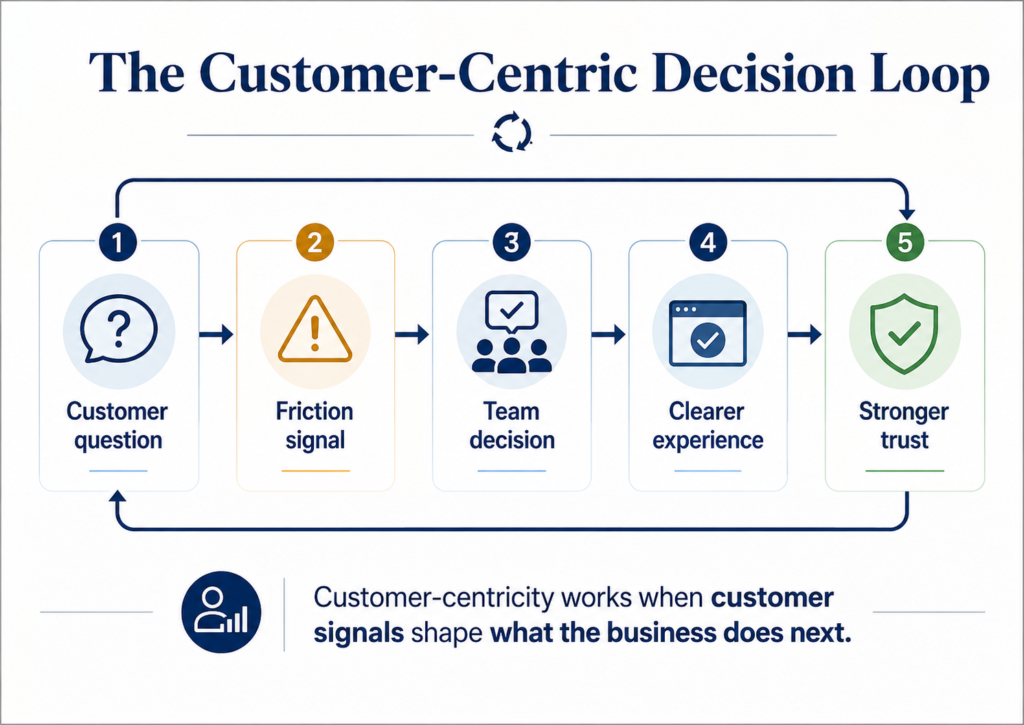
When customer questions and friction signals guide better decisions, customers feel the difference in speed, clarity, and trust.
From values statement to operating rule
A values statement becomes an operating rule when it changes prioritisation, trade-offs, and behaviour.
Good intentions are not enough if the business still favours:
- internal convenience over customer effort
- short-term targets over long-term trust
- clever wording over clear help
- fast automation over good judgement
That is where many so-called customer centric organisations go wrong. They sound caring in public and remain awkward in practice.
Which business decisions should be customer-led?
The main decisions that should be customer-led are:
- customer centric product design
- pricing and packaging
- customer centric marketing
- support and service
- forms and onboarding
- website content and help content
- handovers between teams
- customer centric operations
- AI and self-service tools
- overall customer centric digital strategy
That is what I mean by customer centric decision making.
Not every decision should blindly give the customer everything they ask for. That would be chaos in a cardigan. But the best decision usually takes customer reality seriously instead of treating it as an optional afterthought.
How to build a customer centric strategy
To build a customer centric strategy, you need to make customer reality part of how the business chooses priorities, not just how it writes copy.
That means:
- joining up customer signals
- reducing internal silos
- designing for effort, clarity, and trust
- and making customer outcomes part of real operating decisions
That is also very close to what the better competitor pages emphasise: customer-centricity works when strategy, process, and organisation are built to deliver value across the customer journey.
How to be customer centric without becoming vague
How to be customer centric without becoming vague is a fair question.
The answer is: use simple decision rules.
For example:
- Does this make life easier for the customer?
- Does this reduce effort?
- Does this make the answer clearer?
- Does this build trust?
- Does this solve a real problem or just make us feel modern?
That last question is especially useful in the AI era.
Customer centric mindset and customer centric culture
A customer centric mindset is the habit of seeing the business from the customer’s point of view before making the call.
A customer centric culture is what happens when that habit becomes normal across the organisation, not just inside one team.
That is where customer centric leadership matters. Leaders shape what gets prioritised, measured, tolerated, and rewarded.
What does customer centricity look like in real business?
Customer centricity in real business looks like fewer friction points, clearer answers, faster help, and better joined-up decisions.
That is the practical answer.
How do joined-up customer signals help teams make better decisions?
Joined-up signals help because they show the customer journey more honestly.
When customer information is split across teams, the business often misses obvious patterns:
- customers asking the same question repeatedly
- people dropping out at the same step
- support chasing issues marketing accidentally created
- product teams building features while customers just want the basics to work properly
This is where customer centric data matters. Not because more dashboards always help, but because better visibility reduces guesswork.
What I have seen is that once teams can see the same pattern, they argue less about symptoms and more about fixes.
What do customers notice first?
Customers usually notice:
- fewer steps
- clearer explanations
- less repetition
- faster replies
- smoother handovers
- easier forms
- better problem resolution
That is the visible face of a customer centric business.
A customer does not usually say, “What a marvellous cross-functional transformation programme you have there.”
They notice:
- “this was easy”
- “I got the answer quickly”
- “I didn’t have to explain myself three times”
- “this company seems to understand what I need”
That is what customer effort reduction looks like!
Customer centric customer journey
A customer centric customer journey is one where the business removes unnecessary friction rather than adding it.
That includes:
- discovery
- comparison
- buying
- onboarding
- support
- renewal
- problem resolution
If one stage feels smooth and the next feels like a hostage negotiation with a badly designed form, the journey is not really customer-centric.
The Customer-Centric Decision Loop
Customer question → friction signal → team decision → clearer experience → stronger trust → better feedback → better next decision
What this looks like in real business
In real business, customer centricity shows up in ordinary choices, not in grand speeches.
A software company rewrites its onboarding because new customers are dropping out at the same step.
A service firm simplifies its enquiry form because people were abandoning it halfway through.
A retailer improves support handovers because customers kept explaining the same problem to three different people.
A B2B team notices that clients are not confused by the product. They are confused by the way pricing is explained. So they fix the explanation instead of blaming the market.
That is customer centricity examples in real life.
How teams make better choices when customer data is joined up
When teams can see the same customer signals, they usually make better trade-offs faster.
For example:
- support sees repeated complaints
- marketing sees weaker conversions
- product sees abandonment
- operations sees rework
- leadership sees trust starting to wobble
Separately, those look like different issues. Together, they point to one problem worth fixing.
That is one reason customer-centricity works better as a system than as a slogan.
Customer centric company examples
The best customer centric company examples are usually not the ones shouting about it the loudest.
They are the ones making life easier in visible ways:
- faster answers
- fewer steps
- less repetition
- clearer choices
- better timing
- more useful AI
- less nonsense
Sometimes the most customer-centric thing a business can do is simply stop making people jump through hoops that only exist because the internal process likes them.
Where this goes wrong
Customer centricity goes wrong when the business says “customer first” but still makes decisions mainly for internal convenience, short-term targets, or silo priorities.
That is the direct answer.
What happens when internal goals beat customer needs?
When internal goals beat customer needs, the customer usually feels the damage before the dashboard does.
This often shows up as:
- too many steps
- unclear pricing
- slow approvals
- poor handovers
- forms that ask for information the business already has
- automated messages that feel like they were written by a toaster
Many organisations optimise for:
- clicks
- speed
- internal efficiency
- quarterly targets
and then act surprised when trust weakens.
What I have seen is that customer centric marketing often sounds excellent right up until the customer actually has to do something!
How can AI help or harm customer trust?
Customer trust and AI is now one of the most important practical questions in this space.
AI can help by:
- speeding up replies
- surfacing patterns
- improving routing
- personalising help
- reducing repetitive support work
That is the useful side of AI and customer experience.
But AI can also harm trust when it:
- misreads context
- gives the wrong answer confidently
- feels cold or robotic
- creates creepy over-personalisation
- blocks access to a real human when the issue clearly needs one
So the question is not “should we use AI?”
It is “does this AI use make life easier, clearer, faster, or fairer for the customer?”
If the answer is no, then it is not customer-centric. It is just fashionable.
Why do some businesses say the right words but still feel difficult to deal with?
Because the lived experience does not match the promise.
That gap is usually caused by:
- silos
- unclear ownership
- weak handovers
- poor internal incentives
- and decisions that optimise for the business’s internal comfort more than the customer’s actual effort
That is where trust quietly erodes.
- The company says “customer first” but still optimises for internal convenience
- AI is used to remove cost, not reduce customer effort
- Teams collect feedback but do not let it change decisions
- Customer-centricity is treated like marketing language instead of an operating rule
- The journey feels joined up on a slide and fragmented in real life
What should leaders actually do?
Leaders should turn customer centricity into a repeatable decision habit.
That is the practical answer.
What simple customer test should you use before making the call?
Use a simple question set:
- does this make life easier?
- does this make the answer clearer?
- does this reduce effort?
- does this make the experience faster?
- does this feel fair from the customer’s side?
That is a practical version of customer feedback decision making.
It is not perfect. It does not need to be. It just needs to be used.
What should you measure besides revenue and clicks?
Measure what the customer feels as well as what the business counts.
That includes:
- effort
- trust
- satisfaction
- repeated friction
- repeat contact rate
- resolution speed
- abandonment points
- content usefulness
- handover quality
Because what gets measured shapes behaviour.
If you only measure internal speed or short-term revenue, do not be shocked when the business becomes “efficient” in ways that irritate people.
How do you make good customer-led decisions under uncertainty?
You make the best call you can with the evidence you have, then you learn fast.
This connects closely to my work on decision-making under uncertainty and second-order thinking in business. Good leaders do not wait for perfect data. They use the signals available, make a grounded choice, and then pay attention to the consequences.
This approach is all part of the KrisLai Decision Framework, a practical method for improving business decisions.
How are AI and changing search behaviour reshaping customer-centricity?
They are making speed, clarity, trust, and useful answers more important than ever!
That is the direct answer.
People now search differently:
- they ask fuller questions
- they expect direct answers
- they use AI assistants
- they want lower effort
- they often judge a business before even speaking to it
That means customer centric digital strategy now includes discoverability, answer quality, clarity, and trust.
Why do customers now expect direct answers and lower effort?
Because the wider search environment has trained them to expect it.
This links directly to my article on how AI is changing search behaviour. When people can ask a full question and get a fast answer elsewhere, they become less tolerant of businesses that still make everything harder than it needs to be.
What does a customer centric business need to do now?
It needs to:
- answer clearly
- reduce effort
- design content for real questions
- remove unnecessary steps
- provide trusted information
- use AI carefully
- respect the customer’s time and context
This also links naturally to customer intent marketing, micro-moment marketing, and behavioural economics for business leaders. If you understand what customers are trying to do, when they are trying to do it, and what makes the decision easier, your strategy becomes much more grounded.
Why is customer-centric leadership really better thinking in action?
Because customer-centric leadership forces the business to deal with reality, not just internal assumptions.
That is the bigger point.
It is not soft. It is not vague. It is not about being endlessly agreeable.
It is about:
- seeing behaviour clearly
- using signals well
- creating the right environment
- thinking about consequences
- and making choices that work better in the real world
That is why this topic connects naturally to psychological safety at work. Teams make better customer decisions when they can speak honestly, surface friction, and challenge poor assumptions without fear.
Over time, I’ve found that good decisions rarely come from data alone. They come from understanding people, reading signals, creating the right environment, and thinking beyond the immediate outcome.
Customer-centricity becomes powerful when it changes one thing in the room: the question people ask before they decide. Not “what suits us most?” but “what helps the customer most, without harming the health of the business?”


Conclusion and Final Thougths
Customer-centricity works when it becomes the way decisions are made, not just the words a company uses.
That is the main point.
The real payoff is not only stronger loyalty or a better brand line, though those matter. It is better execution. Clearer priorities. Lower friction. Sharper judgement. Less waste. More trust.
In a world shaped by AI and faster search, the businesses that win will usually be the ones that make life easier for customers in the moments that matter.
Start with this ONE thing: before the next important decision, ask whether it makes life easier, clearer, faster, or fairer for the customer.
If the answer is no, you probably have more thinking to do.
Customer-centricity is not a slogan, a campaign, or a service script. It is a decision system. When it shapes real choices across product, content, support, operations, and AI use, customers feel the difference and the business performs better.
Customer-centricity makes more sense when you connect it to behaviour, intent, trust, and better decision-making. These are good next reads.
Want a simple, practical guide to making better business decisions under uncertainty?
Enter your email below and I’ll send you the free KrisLai Decision Framework™ guide, built around behaviour, signals, environment, and consequences.
It is designed to help leaders think more clearly, act earlier, and make better decisions in the real world.
Frequently Asked Questions
What is customer centricity?
Customer centricity means making business decisions in a way that puts customer needs, effort, outcomes, and trust at the centre, rather than treating customers as an afterthought.
Why is customer centricity important?
Customer centricity is important because it improves trust, loyalty, retention, and the overall quality of execution. It helps businesses reduce friction and make decisions that better match real customer needs.
How is customer centricity different from customer service?
Customer service is one function in the business. Customer centricity is a wider operating approach that shapes product, pricing, support, content, operations, and leadership decisions.
What does a customer centric strategy look like?
A customer centric strategy uses customer needs, behaviour, feedback, and friction points to guide priorities across the business. It focuses on making life easier, clearer, faster, and fairer for customers.
Can AI improve customer centricity?
Yes, AI can improve customer centricity when it helps customers get faster, clearer, and more useful support. But it can also damage trust if it feels robotic, misreads context, or creates more friction instead of less.
This article is based on practical experience, independent research, analysis and synthesis.
If you enjoy exploring the ideas behind better business decisions, you may find the Business Thinking Hub useful.
About the author
Kris Lai is a business operator and managing director with experience in land and building surveying, facilities management, logistics, and service delivery.
Earlier in his career, he worked as a Search Engine Evaluator (via Lionbridge, supporting Google), where he assessed search result relevance, user intent, and content quality using structured evaluation frameworks. This experience gives him a rare, practical understanding of how search systems interpret signals and make ranking decisions.
In parallel, whilst working with a charity organisation, he has delivered 1000’s of structured presentations in English, Finnish, and Chinese to audiences ranging from small groups to more than 600 people, and has spent decades mentoring and developing others. This experience informs his approach to clarity, communication, and decision-making under pressure.
He writes about AI, search behaviour, business strategy, and decision-making from a practical, real-world perspective.
👉 Explore ideas connected to better business decisions:
- Digital Transformation for SMEs: 7 Questions Before You Invest
- Cybersecurity for Businesses: 7 Decisions Leaders Must Make

- How AI Is Changing Search Behaviour (And What Businesses Must Do Now)
- Decision-Making Framework Examples: The KrisLai Method in Action
- The KrisLai Decision Framework: A Better Way to Make Business Decisions