
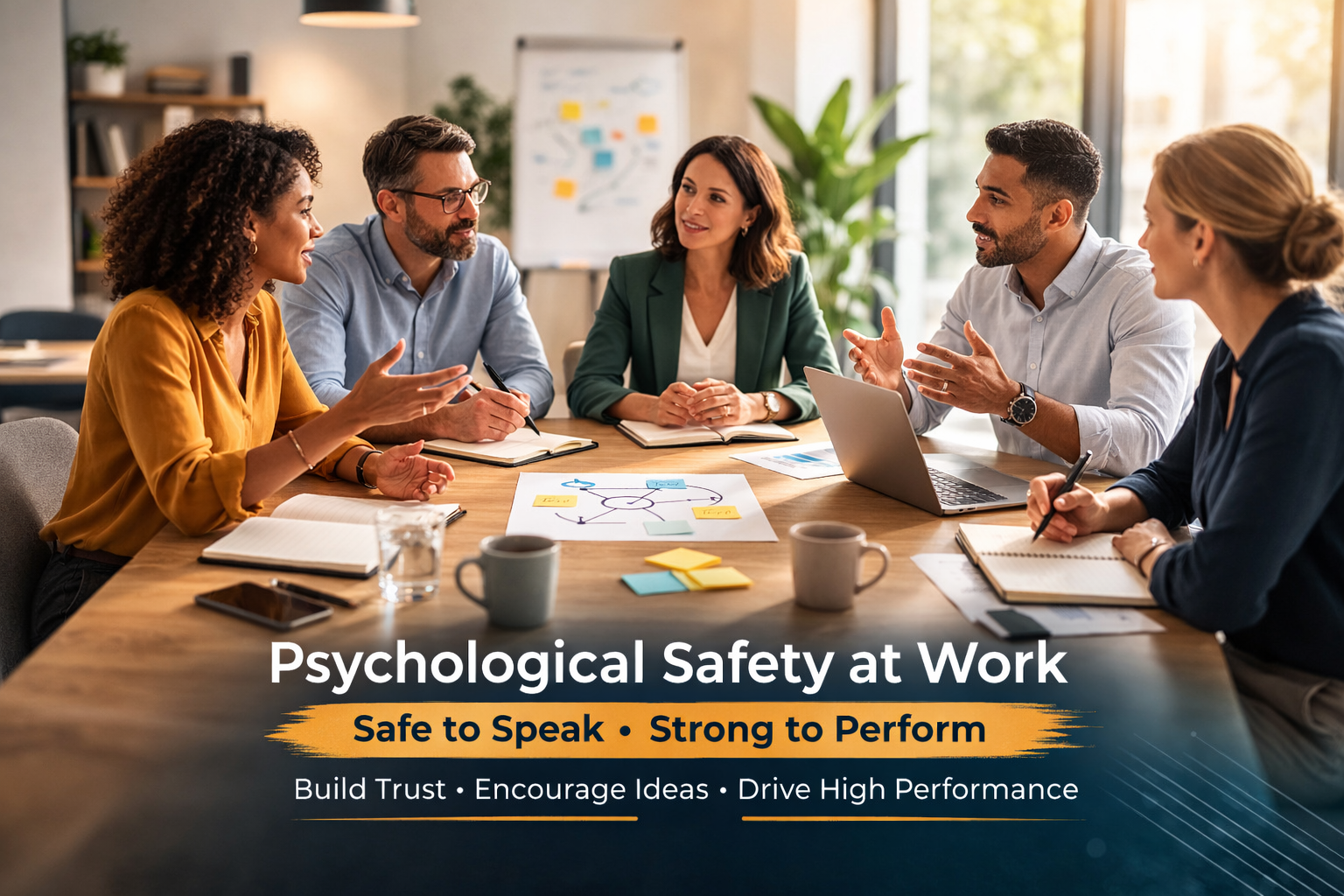
The idea never gets said.
You can see it in the meeting. Someone hesitates. A better suggestion forms, but it stays unspoken. The team moves on. The decision gets made. Weeks later, a problem appears that might have been avoided.
That small moment — the one where someone chose silence — is often where performance quietly slips. This is why psychological safety at work matters more than many leaders realise. Psychological safety is simply the sense that it is safe to speak up, ask for help, admit mistakes, or disagree respectfully without fear of embarrassment or punishment.
In this article, I want to explore what psychological safety really means, why it directly affects performance, and how leaders and teams can build it in practical, everyday ways. Because high performance does not come from pressure alone. It comes from honest conversations.
As the Finnish saying goes, “Rehellisyys maan perii.” (Honesty inherits the land.)
Disclosure: If you click on my affiliate/advertiser’s links, I am going to receive a tiny commission. AND… Most of the time, you will receive an offer of some kind. It’ s a Win/Win!

Psychological Safety at Work Definition (In Plain English)
Psychological safety at work means people feel safe to take interpersonal risks.
That includes:
- Sharing ideas
- Asking questions
- Raising concerns
- Admitting errors
- Challenging decisions respectfully
It does not mean everyone agrees. It means disagreement can happen without humiliation.
In simple terms:
Psychological safety is the belief that speaking up will not lead to punishment or ridicule.
Psychological safety means people feel safe to speak up, ask for help, admit mistakes, and disagree respectfully — without fear of embarrassment or punishment.
Quick test: If someone spots a problem, do they feel safe saying it out loud?
That belief changes how teams behave — and how well they perform.

What psychological safety at work really means, and what it is not
Psychological safety is often misunderstood.
Some assume it means being comfortable all the time. Others assume it lowers standards. Both are incorrect.
Psychological safety is not being nice all the time
Teams can still have high standards and tough feedback.
The difference is tone and intent.
Imagine a colleague saying:
“I see a risk in this timeline. If we launch next week, we may miss testing gaps.”
That is not negativity. It is contribution.
In a psychologically safe environment, that comment improves the plan rather than damaging the person who spoke up.
High standards and open challenge can coexist.

It is about reducing fear, not removing accountability
Psychological safety reduces fear of speaking up. It does not remove responsibility.
In fact, accountability often improves.
When people feel safe:
- Small issues are raised early
- Mistakes are admitted quickly
- Lessons are shared openly
Clear expectations plus safe speaking up prevent small problems from becoming expensive failures.
Psychological safety vs trust vs comfort — what’s the difference?
These terms are often mixed together.
Trust is confidence in someone’s reliability.
Comfort is personal ease.
Psychological safety is about permission — permission to speak honestly without social risk.
You can trust someone’s competence and still feel unsafe disagreeing with them.
Safety focuses on interaction, not personality.

How psychological safety drives high performance (and what the data says in 2026)
Leaders care about results. So does safety really affect performance?
Yes.
Research over the past decade — including large workplace studies — has consistently shown that teams with higher psychological safety demonstrate:
- More innovation
- Faster learning
- Better quality control
- Lower turnover
- Reduced burnout
One pattern that stands out in 2026 data is the gap between senior leaders and frontline workers. Senior leaders often rate their workplace as highly safe. Frontline or hourly employees frequently report lower safety levels.
That gap matters.
When those closest to customers or operational risks feel unsafe speaking up, performance suffers quietly.
Speaking up improves decisions, innovation, and problem solving
The mechanism is simple.
When more voices are heard:
- More ideas surface
- Risks are identified earlier
- Assumptions are challenged
- Blind spots shrink
I have seen near-miss incidents avoided because someone felt able to say, “Something doesn’t look right.”
Innovation is rarely born from silence.

Safety lowers burnout and helps people stay, even under pressure
Studies in healthcare and other high-pressure sectors have shown that workers who feel psychologically safe report lower burnout and greater resilience during crisis periods.
When people feel supported and heard:
- Stress reduces
- Engagement increases
- Loyalty strengthens
In a world where burnout remains a serious concern, safety becomes a stabiliser of performance.
Supported workers are less likely to disengage.
The hidden warning signs your team does not feel safe
Psychological safety is visible in behaviour.
You do not need surveys to spot early signals.
- People ask “basic” questions without apologising.
- Bad news travels fast (and doesn’t get punished).
- Disagreement happens respectfully — and improves decisions.
- Mistakes are discussed as learning, not personal failure.
- Quieter voices still get airtime in meetings.
What this creates: better decisions, faster learning, fewer nasty surprises.

Meetings are quiet, and the same few people do all the talking
Warning signs include:
- No questions after complex decisions
- Quick agreement without discussion
- Jokes at someone’s expense
- Conversations happening after meetings
- People saying “fine” but appearing tense
A simple self-check I often use:
“What did we not say out loud today?”
If nothing comes to mind, that itself may be a signal.
Mistakes get hidden, and feedback only travels upwards
Other signs:
- Blame language
- Defensive reactions to bad news
- Permission-seeking for minor issues
- Low incident reporting
- Frontline concerns rarely reaching leadership
Power distance and shift pressure often make it harder for hourly workers to speak openly. That gap can create unseen risk.
Around one in three employees still report hesitating to speak up in certain contexts. This is common — and fixable.

How to build psychological safety day to day, without slowing the work down
Safety is built in small moments, not posters on walls.
It lives in daily behaviour.
- Invite dissent: “What am I missing?” / “Who sees it differently?”
- Thank the risk-raiser: reward the behaviour you want repeated.
- Respond calmly to bad news: your tone becomes the culture.
- Admit small mistakes: it gives others permission to be honest.
- Close the loop: share what changed (or why it didn’t).
Rule of thumb: safety grows when speaking up is safe and useful.
Leader behaviours that make it safer to speak up
Practical moves I have seen work:
- Admit your own small mistakes openly
- Ask for dissenting views
- Thank people for raising risks
- Respond calmly to bad news
- Follow up publicly on what changed
Simple scripts help:
- “What am I missing?”
- “What is the risk we are not naming?”
- “Who sees this differently?”
Regular check-ins about workload and wellbeing also matter. They signal that people are seen.

Team routines that protect safety
Safety can be designed into routines.
Examples:
- Round-robin input in meetings
- Written brainstorming before discussion
- Rotating meeting chairs
- Clear rules for handling disagreement
- Anonymous channels (with encouragement for named input where safe)
In hybrid settings, I’ve found it helpful to:
- Invite remote voices first
- Use chat for questions
- Summarise decisions clearly
Structure reduces uncertainty.
Measure it, spot the gaps, and act fast
Measurement does not need to be complicated.
Short pulse surveys can track:
- Comfort speaking up
- Confidence raising concerns
- Perceived fairness
- Workload pressure
Segment results by role level. Leaders often rate safety higher than others.
Leading indicators include:
- Idea submissions
- Near-miss reporting
- Speaking-time balance in meetings
Most important is closing the loop:
Share what you heard.
Share what will change.
Share what will not change — and why.
That builds credibility.
When it goes wrong: repairing trust after a blame moment
No team is perfect.
If someone is dismissed or mocked in a meeting, repair quickly.
If someone gets dismissed, mocked, or blamed in public, repair quickly. Silence teaches the team that it’s safer to stay quiet next time.
- Name it: “That comment shut the conversation down.”
- Own impact: “That wasn’t ok, and I’m sorry.”
- Reset expectations: “We challenge ideas, not people.”
- Re-open the issue: “Let’s hear the concern properly.”
A simple 24-hour reset plan:
- Name what happened
- Apologise for the impact
- Restate expectations for respectful dialogue
- Agree on a better process
For example:
“Yesterday’s comment came across as dismissive. That was not the standard we want. We value challenge here. Let’s reset and hear that concern properly.”
Repair builds more trust than silence.
Conclusion
Psychological safety drives performance because it unlocks learning, honesty, and speed.
It allows problems to surface early. It encourages innovation. It reduces burnout. It strengthens retention.
It is not built through slogans. It is built in everyday conversations.
If you want to begin this week, choose:
- One behaviour to model
- One meeting routine to improve
- One question to invite honest input
And in your next meeting, try asking:
“What are we not seeing yet?”
High performance rarely comes from fear.
It comes from clarity, courage, and trust — practised daily.
If this topic resonates, these related posts on krislai.com go well with it:
- Trauma-Informed Leadership — practical behaviours that reduce fear and improve trust.
- Organizational Trauma — how shared workplace wounds shape culture, silence, and performance.
- Micro-Moment Marketing — how small decision windows drive outsized results (a useful mindset shift for leaders too).
- Tiredness at Work — how fatigue affects performance, decision quality, and wellbeing.
Tip: Read the trauma-informed leadership post next — it’s the most direct “how-to” companion to psychological safety.
Frequently Asked Questions About Psychological Safety at Work
What is psychological safety at work?
Psychological safety at work means people feel safe to speak up, ask questions, admit mistakes, and disagree respectfully without fear of embarrassment or punishment. It allows teams to share ideas and concerns openly while maintaining accountability and standards.
Why is psychological safety important for performance?
Psychological safety improves performance because it encourages people to raise risks early, share ideas, and learn from mistakes. Teams with higher psychological safety often show better decision-making, more innovation, lower burnout, and stronger retention.
Is psychological safety the same as being nice?
No. Psychological safety is not about avoiding disagreement or lowering standards. Teams can challenge ideas and give honest feedback. The difference is that people are not mocked or punished for speaking up.
How can leaders build psychological safety?
Leaders can build psychological safety by inviting dissenting views, responding calmly to bad news, admitting their own small mistakes, thanking people for raising concerns, and clearly following up on what changes as a result of feedback.
How do you measure psychological safety?
Psychological safety can be measured through short pulse surveys, feedback on comfort speaking up, and behavioural indicators such as idea submissions, near-miss reporting, and the spread of speaking time in meetings. Segmenting results by role level helps identify gaps.
What destroys psychological safety in a team?
Psychological safety can be damaged by public blame, ridicule, ignoring concerns, punishing bad news, inconsistent behaviour from leaders, or failing to act on feedback. Even small dismissive moments can reduce people’s willingness to speak up.