Good ideas are easy to agree with.
Good decisions are harder to make.
I’ve sat in meetings where everyone nodded along to a plan—only for it to unravel weeks later. Not because the idea was wrong, but because something important had been missed.
Usually, it wasn’t the data.
It was something more human.
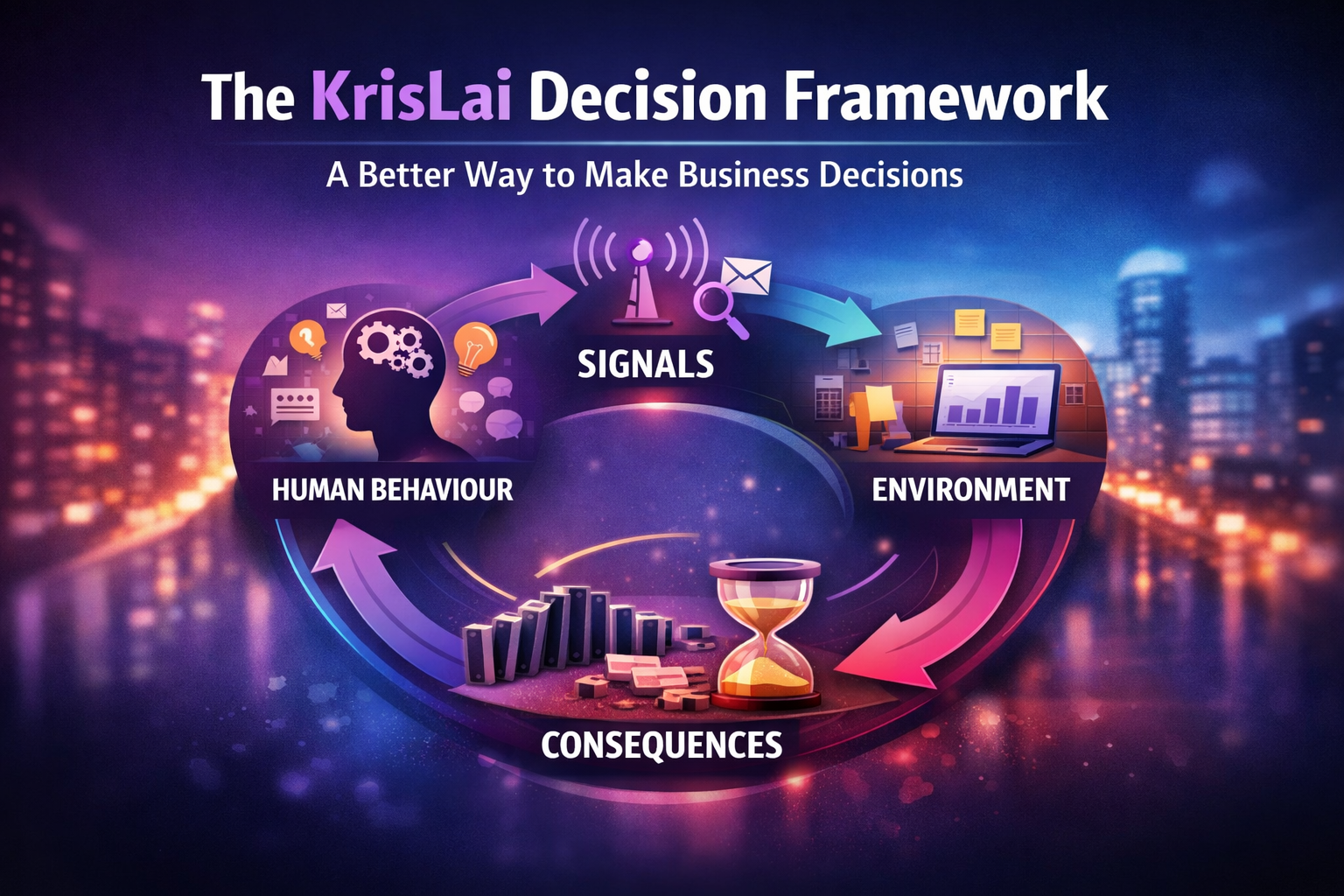
That’s why I started using what I now call the KrisLai Decision Framework™—a simple way to step back and look at decisions more completely.
In this article, I want to show how it works in practice, using real-world style examples. Not theory—just the kinds of decisions most businesses face every day. I explore decision-making framework examples using the KrisLai Decision Framework™. This approach looks beyond quick wins and helps leaders consider behaviour, signals, environment, and consequences before acting.
You’ll see real business situations where better thinking leads to better outcomes — and how you can apply the same approach in your own decisions.
How does a decision-making framework work in real business situations?
A decision-making framework improves business decisions by helping leaders consider four key factors:
- Human behaviour – how customers and teams will respond
- Signals – what data and actions reveal about intent
- Environment – the conditions shaping decisions
- Consequences – the short- and long-term outcomes
By applying these four elements together, businesses can move beyond quick assumptions and make more balanced, effective decisions in real situations.
Let’s look at how this works in real business situations.
Decision-Making Framework Examples in Real Business Situations
Let’s look at how a structured decision-making framework works in practice, using real-world business scenarios that leaders face every day.
At its core, the framework asks four simple questions:
- How will people behave?
- What signals are we seeing?
- Does the environment support this?
- What happens next?
On paper, that sounds straightforward.
In practice, it changes decisions in subtle but important ways.
Free Download: The KrisLai Decision Framework
Want a simple, practical version you can use immediately?
Example 1: Pricing Decision That Looked Right (But Wasn’t)
A business decides to increase prices to improve margins.
The numbers look solid.
First-order thinking:
- Higher prices → higher revenue per sale
But when we apply the framework:
🧠 Behaviour
Customers don’t just react to price—they react to perceived fairness.
🔍 Signals
Recent customer feedback shows increasing price sensitivity.
🏗️ Environment
Support teams are already stretched—complaints will be harder to manage.
🔁 Consequences
Short-term revenue increase…
but long-term trust may drop.
What changed?
Instead of a simple price increase, the business:
- introduced tiered pricing
- improved value communication
- tested changes with a smaller segment first
👉 Same goal, better outcome.
Example 2: Marketing Campaign That Didn’t Convert
A company runs a large awareness campaign.
Traffic increases significantly.
Sales don’t.
First-order thinking:
- More traffic → more customers
Applying the framework:
🧠 Behaviour
Visitors are exploring, not ready to buy.
🔍 Signals
High bounce rate on pricing pages
Low return visits
🏗️ Environment
Landing pages don’t guide users clearly
🔁 Consequences
Budget spent…
but little conversion
What changed?
The business shifted to:
- more targeted messaging
- clearer customer intent alignment
- better conversion-focused pages
👉 This connects closely with how I’ve explored customer intent marketing and micro-moment marketing.
Example 3: Leadership Decision That Affected Team Performance
A leader introduces tighter controls to improve performance.
At first, it seems reasonable.
First-order thinking:
- More control → better results
Applying the framework:
🧠 Behaviour
People become more cautious and less willing to take initiative.
🔍 Signals
Fewer ideas shared
Less open discussion in meetings
🏗️ Environment
Psychological safety drops
🔁 Consequences
Short-term control…
long-term performance decline
What changed?
The leader:
- clarified expectations
- encouraged input
- responded more constructively to mistakes
👉 This links directly to psychological safety and trauma-informed leadership.
Example 4: Cost-Cutting That Created Bigger Costs
A company cuts costs by reducing customer support resources.
First-order thinking:
- Lower costs → improved margins
Applying the framework:
🧠 Behaviour
Customers become frustrated and less loyal
🔍 Signals
Increase in complaints
Negative reviews
🏗️ Environment
Remaining staff are overloaded
🔁 Consequences
Churn increases
Brand reputation weakens
What changed?
Instead of cutting blindly, the company:
- improved support efficiency
- prioritised high-value customers
- invested in better self-service tools
👉 A more balanced decision.
What These Examples Have in Common
Across all these cases, the pattern is similar.
The initial decision wasn’t necessarily wrong.
It was incomplete.
The framework doesn’t replace judgement—it sharpens it.
What is a decision-making framework in business?
A decision-making framework is a structured way to evaluate choices by considering data, human behaviour, context, and likely outcomes. It helps leaders move beyond instinct and make more consistent, effective decisions.
A Simple Way to Apply This in Your Own Business
You don’t need a workshop or a long process.
Start with one decision.
Ask:
- What behaviour are we assuming?
- What signals are we seeing?
- Is the environment helping or hindering?
- What happens next?
Write the answers down.
Even that small step often changes the direction of the decision.
Real-World Insight
In many organisations, decisions are made quickly under pressure. The challenge is not a lack of intelligence—but a lack of perspective.
The KrisLai Decision Framework™ helps widen that perspective by bringing behaviour, signals, environment, and consequences into view.
Even a brief pause to consider these four elements can significantly improve outcomes.
Build Deeper Insight
Frequently Asked Questions
What does the KrisLai Decision Framework look like in practice?
In practice, the KrisLai Decision Framework helps businesses look at decisions through four lenses: human behaviour, signals, environment, and consequences. Instead of relying only on data or assumptions, it encourages leaders to consider how people will respond, what the current signals show, whether the environment supports the decision, and what happens next.
Why are real examples important in decision-making?
Real examples make decision-making frameworks easier to understand and apply. They show how abstract ideas work in everyday business situations, such as pricing changes, marketing campaigns, leadership decisions, and cost-cutting measures.
How can the KrisLai Decision Framework improve business decisions?
The framework improves decisions by widening the view. It helps leaders think about people, context, and consequences rather than focusing only on immediate results. This often leads to better judgement, fewer unintended effects, and stronger long-term outcomes.
What types of business decisions can this framework be used for?
The framework can be used for many kinds of decisions, including strategy, pricing, marketing, customer experience, leadership, organisational culture, and operational changes. It is especially useful when decisions affect both people and long-term outcomes.
What are second-order consequences in business decisions?
Second-order consequences are the effects that appear after the immediate result of a decision. For example, a price increase may improve margins in the short term but reduce trust or loyalty over time. The framework helps leaders think beyond the first outcome.
How do I start applying this framework in my own business?
Start with one decision. Ask how people are likely to behave, what signals you are seeing, whether the environment helps or hinders the decision, and what consequences might follow. Writing down these answers can improve clarity and decision quality very quickly.
In conclusion…
Most business decisions don’t fail because they are wrong.
They fail because they are too narrow.
In today’s AI-driven world, strong decision-making is not just about having more data — it is about interpreting signals correctly and understanding how people respond to change.
The KrisLai Decision Framework™ is simply a way of widening the view—just enough to see what might otherwise be missed.
This week, try it on one decision.
You may find that the answer doesn’t change completely.
But it becomes clearer—and far more robust.
Free Download: The KrisLai Decision Framework
Want a simple, practical version you can use immediately?
Before your next business decision, pause and ask:
- What will people actually do?
- What signals am I seeing?
- What happens next?
- And then what?
That small shift in thinking can be the difference between a good decision — and a great one.
If you want to understand the full model behind these examples:
👉 https://www.krislai.com/the-krislai-decision-framework-a-better-way-to-make-business-decisions/