Many marketing teams celebrate traffic.
More visitors.
More page views.
More impressions.
But sales remain stubbornly unchanged.
I have seen this happen more than once. A company publishes a steady stream of articles and social posts. The analytics look healthy. Yet the sales team still complains that the leads are weak.
The problem is often simple: the content matches keywords, but not intent.
Customer intent marketing means aligning your content with what people are actually trying to do right now — learn something, compare options, make a decision, or solve a problem.
When marketing follows intent instead of vanity metrics, something interesting happens. Content stops being noise and starts becoming helpful at the moment people need it most.
In this article we will explore how to recognise real buying signals, how to match them with the right content, and how to measure what truly drives revenue.
These signals often appear in short decision windows — what marketers sometimes call micro-moments, when customers search for information at the exact moment they need it.
What is customer intent marketing?
Customer intent marketing means aligning your content, offers, and calls to action with what a buyer is trying to do right now — whether they are learning, comparing, deciding, or renewing.
Instead of chasing traffic for its own sake, intent marketing focuses on recognising real buying signals and responding with the most helpful next step.
Disclosure: If you click on my affiliate/advertiser’s links, I am going to receive a tiny commission. AND… Most of the time, you will receive an offer of some kind. It’ s a Win/Win!
Customer Intent Marketing Explained in 60 Seconds
Customer intent marketing focuses on understanding what a buyer is trying to accomplish at a specific moment and aligning marketing content with that goal.
Instead of creating content based only on keywords, intent marketing looks for signals that someone is actively researching, comparing options, or preparing to buy.
These signals can appear in:
- Search queries that include product comparisons or pricing
- Visits to product pages, pricing pages, or demo pages
- Repeat visits to a website within a short period
- Engagement with case studies, reviews, or implementation guides
When businesses recognise these signals and provide the right information at the right moment, marketing becomes more helpful — and conversion rates often improve.
Customer Intent Marketing Explained (Without Marketing Jargon)
At its core, customer intent simply means the reason behind a click, search, or action.
When someone searches online, opens an email, or visits a website page, they usually have something specific in mind. They might want information, reassurance, or a solution.
Intent marketing focuses on understanding that motivation.
One helpful way to visualise customer intent is to think of it as a progression from curiosity to purchase:
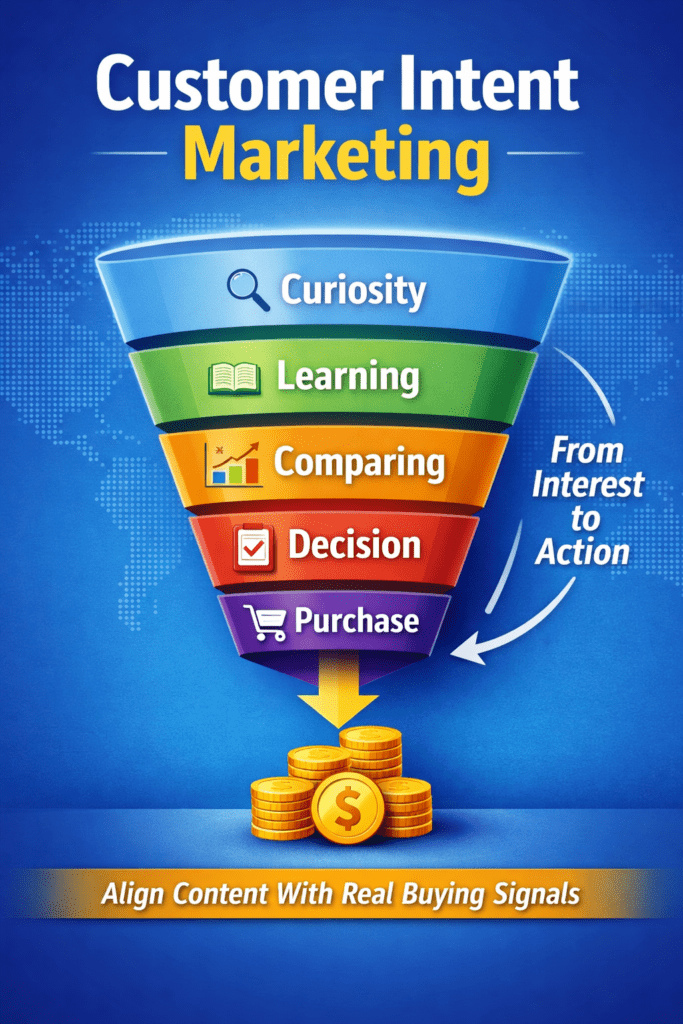
Each stage above reflects a different question the buyer is trying to answer.
Instead of asking:
“What keywords should we target?”
A better question is:
“What is this person trying to accomplish right now?”
This difference may sound subtle, but it changes how marketing works.
Traditional awareness marketing tries to reach as many people as possible. Intent marketing focuses on helping people who are already moving toward a decision.
Intent signals can appear in many places:
- search queries
- website behaviour
- email interactions
- social media engagement
- advertising clicks
- sales conversations
When we begin paying attention to these signals, marketing becomes less about guessing and more about understanding real behaviour.
The Four Intent Levels That Matter Most
In practice, most customer journeys fall into four useful intent stages.
Learn
This is the early exploration stage.
People want to understand a topic.
Typical searches might include:
“what is CRM software”
“how to improve customer retention”
At this stage, helpful content includes:
- guides
- explainers
- introductory articles
The goal is clarity, not persuasion.
Compare
Now people are evaluating options.
Typical searches might include:
“best CRM software for small business”
“HubSpot vs Salesforce”

Buyers want to understand differences between solutions.
Content that works well here includes:
- comparison pages
- alternatives pages
- feature breakdowns
Clarity and honesty matter far more than hype.
Decide
At this stage the buyer is close to making a decision.
Searches often become more specific:
- pricing
- reviews
- implementation details
- trial options
Content that supports this stage includes:
- pricing explanations
- ROI calculators
- case studies
- demo pages
Here the buyer is looking for reassurance that they are making the right choice.
Renew or Expand
Intent does not stop once someone becomes a customer.
Existing customers also evaluate whether to stay, upgrade, or expand their usage.
This is where customer relationship marketing becomes important.
Content at this stage includes:
- advanced tutorials
- product updates
- customer success stories
Companies that support this stage well often enjoy stronger loyalty.
Buying Signals vs Curiosity Clicks
Not all traffic means the same thing.
Quick checklist: signs of stronger buying intent
- Searches that include product names, pricing, reviews, or comparisons
- Visits to pricing pages, comparison pages, or demo pages
- Repeat visits within a short time frame
- Time spent on case studies or implementation pages
- Form starts, demo requests, or quote requests
- Questions that signal evaluation rather than curiosity
Important: not all traffic is buying traffic. Students, competitors, and casual browsers can look interested without being ready to act.
Some visitors are genuinely exploring a purchase. Others are simply browsing.
A few quick signals can help distinguish the two.
Strong buying signals often include:
- searches with product or brand names
- visits to pricing pages
- comparison-page views
- repeat visits within a short time
- demo requests or form starts
These actions usually indicate customer purchase intention.
Curiosity clicks look different.
They may come from:
- students researching a topic
- job seekers exploring a company
- competitors analysing content
High traffic can look impressive in reports, but what matters far more is intent.
Many of these signals reflect predictable human behaviour, something explored in more depth in behavioural economics in business.
How Customer Intent Marketing Works (Simple Example)
Customer intent marketing works by recognising the stage a buyer is in and providing the information that helps them move to the next step.
Let me illustrate the idea with a very simple scenario.
Imagine someone is looking for project management software.
At first, their search might be something broad like:
“What is the best project management software for small teams?”
At this point, their intent is learning. They are exploring the landscape and trying to understand the options.
A helpful article or guide works best here. Something like:
- “Best Project Management Tools for Small Teams”
- “How to Choose the Right Project Management Software”
But a few days later, the same person searches again:
“Asana vs Trello pricing”
Now the intent has changed. The person is no longer exploring the category — they are comparing specific solutions.
This is where many businesses make a mistake.
Instead of offering a clear comparison page, they continue pushing general content. That creates friction for the buyer.
Good customer intent marketing recognises the shift.
At the comparison stage, the most helpful content might be:
- a comparison chart
- a pricing breakdown
- a short product demo
- real customer case studies
Finally, the search changes again:
“Asana pricing for 10 users”
Now the intent is very strong. The buyer is close to making a decision.
At this stage, the most useful page is often simply:
- clear pricing
- transparent features
- quick answers to common concerns
In other words, the buyer does not want another article.
They want confidence to proceed.
One way to understand customer intent is to visualise the journey buyers go through as their questions become more specific:
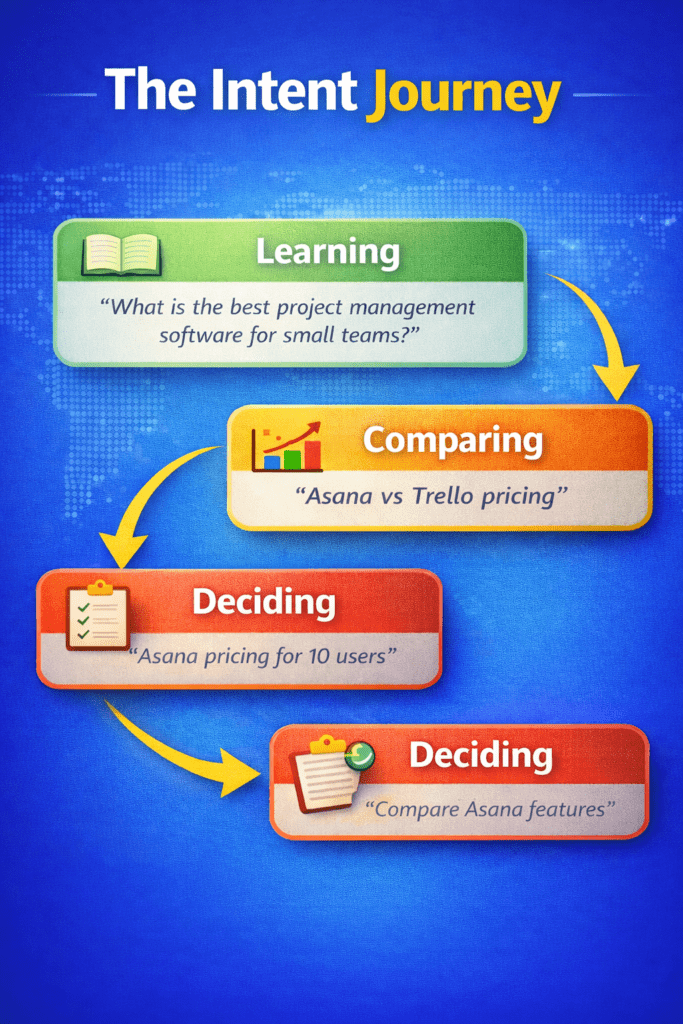
As buyers move through these stages, the information they need becomes more specific and practical.
This is the core principle of customer intent marketing:
The job of marketing is not just to attract attention.
It is to provide the right information at the right moment in the decision journey.
When businesses align their content with these real buying signals, something interesting happens.
Traffic becomes more valuable.
Sales conversations become easier.
And customers feel that the company actually understands what they are trying to do.
Business Insight
Customer intent changes faster than most marketing teams realise.
Someone reading a beginner guide today may be comparing vendors tomorrow and requesting pricing a week later. When businesses fail to recognise these shifts, they often present the wrong information at the wrong moment.
The result is friction. Buyers leave the page, continue searching, or turn to a competitor who answers their question more directly.
Effective customer intent marketing works differently. It listens for buying signals and adjusts the message accordingly — guiding the customer from curiosity to confident decision.
As the Finnish saying goes:
“Hyvin suunniteltu on puoliksi tehty.”
A task well planned is half done.
In marketing, understanding intent is often half the work.
How to Identify Customer Intent Using Data You Already Have
One of the most encouraging discoveries for many organisations is this: the signals already exist.
You do not always need expensive software or complicated data science.
Often the best insights come from sources closest to real customers.
The Intent Signal Toolkit
Search Data
Tools like Google Search Console reveal the actual queries people use when finding your site.
These queries often show clear intent.
For example:
“CRM pricing”
“best CRM for small teams”
Both signals indicate buyers evaluating options.
Website Behaviour
Website analytics can reveal patterns that signal decision-making.
Important events may include:
- pricing page visits
- demo clicks
- product page depth
- comparison page views
These behaviours often appear shortly before a purchase decision.
Sales Conversations
Sales calls and chat transcripts are often the richest sources of intent insight.
Customers reveal their concerns openly:
- pricing worries
- integration questions
- timing constraints
Marketing teams that listen to these conversations often create far more effective content.
Customer Feedback
Support tickets, product reviews, and user communities reveal the obstacles people face.
These signals help identify the friction that prevents decisions.
Creating a Simple Intent Score
One helpful way to visualise these signals is to map how customer actions move from search behaviour to sales action:

Each signal above on its own may seem small, but together they often reveal strong purchase intent.
Intent signals can also be organised into a simple scoring system.
For example:
Pricing page visit → +3
Comparison page → +2
Return visit → +2
Case study read → +2
Demo request → +5
Unsubscribe → –3
When a lead reaches a certain score, the response can change.
For example:
Score 6 → sales outreach
Score 3–5 → nurture content
Score 1–2 → educational material
Of course, a score should guide judgement, not replace it.
Simple intent score example
A basic scoring model can help teams prioritise follow-up without overcomplicating the process:
- Pricing page visit = +3
- Comparison page = +2
- Return visit = +2
- Case study read = +2
- Demo request = +5
- Unsubscribe = -3
Use scores as a guide, not a substitute for judgement. A number can help you spot patterns, but context still matters.
As the Swedish proverb reminds us:
“Lagom är bäst.”
Moderation is best.
Numbers help, but context still matters.
Turning Buying Signals Into Content That Converts
Once buying signals are understood, the next step is alignment.
Effective intent marketing requires three things:
- the right message
- the right proof
- one clear next step
The intent alignment framework
When a buyer shows intent, effective marketing usually does three things well:
- Right message — speak to the question or concern they have now
- Right proof — provide evidence, examples, or comparisons that build confidence
- Right next step — offer one clear action, such as a demo, case study, trial, or quote
Good intent marketing reduces friction. It helps buyers move forward instead of making them work harder to understand what to do next.
When these elements align, decisions become easier.
Thinking about intent in this way requires a bit of second-order thinking, where businesses consider not just the immediate click but the longer decision journey.
High-Intent Content That Drives Conversions
Some content formats are particularly effective when people are evaluating options.
Examples include:
- comparison pages
- alternatives pages
- pricing explanations
- ROI calculators
- implementation guides
- security documentation
- case studies
These pieces work because they answer the real questions buyers ask before committing.
One common mistake is publishing vague thought-leadership articles when potential customers are searching for practical details.
When someone is ready to buy, clarity is far more valuable than cleverness.
Building a Clean Intent-Driven Customer Journey
Intent marketing works best when the journey feels natural.
A typical path might look like this:
High-intent search
→ comparison page
→ case study
→ demo offer
→ follow-up email
Each step answers the next question in the buyer’s mind.
Retargeting can reinforce this journey.
For example:
Visitors to pricing pages may see case studies next.
Cart abandoners may see reassurance content or FAQs.
Consistency across ads, pages, and emails helps create a smooth experience.
Intent Marketing Metrics That Show Real Business Impact
One reason intent marketing works well is that it connects directly to business outcomes.
Instead of measuring only traffic, it focuses on behaviour that leads to revenue.
Metrics That Matter
Important metrics include:
- conversion rate by intent level
- demo-to-close rate
- pipeline influenced by content
- time to close
- win rate for high-intent leads
- cost per qualified lead
Supporting signals may include:
- pricing-page to demo click rate
- repeat visits
- depth of engagement
These metrics reveal how marketing contributes to real decisions.
Common Mistakes That Reduce Results
Even strong marketing teams sometimes make avoidable mistakes.
Common problems include:
Treating all leads the same
Sending early-stage content to late-stage buyers
Hiding pricing information
Weak proof or outdated case studies
Slow pages
Too many calls to action
Fortunately, the fixes are straightforward.
Clear comparison tables help buyers evaluate options.
Fast page speeds reduce frustration.
Focused CTAs guide visitors toward the next step.
Small improvements often produce meaningful results.
What Is Customer Intent Marketing?
Customer intent marketing is the practice of aligning marketing content and offers with the specific goals a buyer is trying to achieve at a given moment in their decision journey.
Instead of broadcasting messages to a broad audience, intent marketing focuses on recognising signals that someone is actively researching, comparing, or preparing to buy.
Customer intent marketing is the practice of aligning marketing content and offers with the specific goals a buyer is trying to achieve at a given moment in their decision journey.
When marketing responds to those signals with helpful information and clear next steps, conversion rates typically improve.
In fast-moving markets, aligning marketing with real buyer behaviour is part of a broader shift toward dynamic business strategy.
Marketer’s Checklist: Turning Customer Intent Into Action
If you want to apply customer intent marketing this week, start with these simple steps:
- Identify real buying signals. Look at search queries, pricing page visits, comparison searches, and repeat website visits.
- Map intent stages. Separate early learning queries from comparison and decision-stage searches.
- Match content to intent. Educational articles for early research, comparison pages and case studies for evaluation, clear pricing and product details for decision stages.
- Reduce friction. When someone shows strong intent, make the next step obvious — demo, trial, quote, or purchase.
- Measure outcomes. Track conversions, demo requests, pipeline influence, and revenue rather than traffic alone.
The goal is simple: recognise what customers are trying to do, and help them do it.
Before we finish, here is a quick summary of the core ideas:
Key Insight
Customer intent marketing works because it aligns marketing with real buyer behaviour. Instead of creating content for keywords alone, businesses look for signals that someone is actively researching, comparing, or preparing to buy.
Key Takeaways
- Intent reveals motivation. A search query, page visit, or email click often shows what someone is trying to achieve.
- Not all traffic is equal. Buying signals such as pricing views, comparison searches, and repeat visits usually indicate stronger purchase intent.
- Content should match intent. Educational guides help early learners, while comparison pages, case studies, and pricing explainers support buyers close to a decision.
- Use simple intent scoring. Tracking behaviours like demo requests or return visits can help prioritise leads and content.
- Measure outcomes, not just traffic. Conversion rates, pipeline influence, and win rates reveal whether intent-driven marketing is working.
Conclusion
Good marketing does not interrupt decisions.
It helps people make them.
Customer intent marketing works because it starts with signals rather than assumptions. When businesses understand what buyers are trying to accomplish, they can provide the right information at the right moment.
If you want to experiment with this approach, try a simple exercise this week:
- 1. Choose one product or service.
- 2. List the ten strongest buying signals your customers show.
- 3. Map those signals to three pieces of content — perhaps a comparison page, a pricing explanation, and a case study.
Then watch what happens over the next thirty days.
Sometimes the most powerful improvement in marketing is not more content.
It is better alignment with real intent.
As the Finnish proverb says:
“Hyvin suunniteltu on puoliksi tehty.”
Well planned is half done.
Frequently Asked Questions
What is customer intent marketing?
Customer intent marketing focuses on understanding what a buyer is trying to accomplish at a particular moment and aligning marketing content with that goal. Instead of targeting keywords alone, businesses look for signals that someone is researching, comparing products, or preparing to make a purchase.
What is intent-based marketing?
Intent-based marketing is a strategy that uses behavioural signals such as search queries, website visits, and engagement patterns to identify potential buyers and deliver relevant content or offers that match their current stage in the buying journey.
How can businesses identify customer purchase intention?
Customer purchase intention can often be identified through signals such as repeated website visits, searches that include product comparisons or pricing, visits to pricing or demo pages, and engagement with case studies or implementation guides.
What is the difference between customer intent marketing and traditional marketing?
Traditional marketing often focuses on reaching a broad audience, while customer intent marketing focuses on recognising and responding to signals that someone is already interested in a product or solution. This allows businesses to deliver more relevant content and increase conversion rates.
How does intent marketing improve conversion rates?
Intent marketing improves conversion rates by aligning content and offers with what buyers need at each stage of their decision process. When businesses provide the right information at the right moment, buyers can move forward with greater confidence and less friction.
This article forms part of the broader Business Thinking Hub, which explores practical ideas for better decision-making in business.