A practical guide to behavioural economics for business leaders, marketers, and anyone curious about why customers don’t always decide logically.
Business leaders often expect customers to make rational choices.
Compare the options. Consider the price. Choose the best value.
In reality, people rarely decide that way.
Most customers rely on quick mental shortcuts — small cues in the environment that guide decisions without much conscious thought. A recommended option on a pricing page. A “limited offer” badge. A review from someone who looks like them. These signals shape decisions far more than spreadsheets of features and benefits.
This is where behavioural economics in business becomes useful.
Disclosure: If you click on my affiliate/advertiser’s links, I am going to receive a tiny commission. AND… Most of the time, you will receive an offer of some kind. It’ s a Win/Win!
Behavioural economics studies how psychology influences economic decisions. It explains why people sometimes buy things they did not plan to buy, hesitate over simple choices, or choose a familiar brand even when a cheaper option exists.
For business leaders, understanding these patterns can improve pricing, marketing, product design, and customer experience.
It matters even more in today’s environment. Trust is fragile, shoppers are increasingly deal-savvy, and many customers now use AI tools to research products before buying. At the same time, income pressures mean loyalty can shift quickly if value is unclear.
The good news is that these decision patterns are often predictable. Once you understand them, you can design better experiences that help customers choose with confidence.
Behavioural economics in business studies how psychological factors influence customer decisions. Instead of always making perfectly rational choices, people rely on mental shortcuts, emotions, and contextual cues when evaluating products, prices, and marketing messages.
For business leaders, understanding behavioural economics helps improve pricing strategies, marketing communication, product design, and customer experience by aligning decisions with how people actually think and behave.
Why behavioural economics matters for modern business leaders
In Brief: What Business Leaders Should Know
- Customers rarely make perfectly rational decisions — mental shortcuts often guide choices.
- Behavioural economics explains how context, framing, and design influence buying behaviour.
- Reducing choice overload and simplifying decisions can significantly improve conversions.
- Social proof and identity signals help customers feel confident about their choices.
- Transparent pricing, clear comparisons, and ethical design build long-term trust.
- AI is becoming part of the decision journey, so businesses must manage recommendations responsibly.
Understanding these patterns helps leaders design better products, pricing, and customer experiences.
What Behavioural Economics in Business Really Means
Traditional economic theory assumes people behave rationally.
In other words, they carefully weigh costs and benefits before making a decision.
But behavioural economics shows that real people behave differently.
Instead of perfect analysis, people rely on mental shortcuts, sometimes called heuristics. These shortcuts help us make quick decisions when time, attention, or information is limited.
Think about a simple everyday decision: choosing a coffee.
Most people do not compare every option in detail. Instead, they rely on cues such as:
- the most popular drink on the menu
- a recommendation from the barista
- a familiar brand name
- a slightly discounted “bundle” offer
In a business context, these cues shape how customers evaluate products, services, and prices.
This is why behavioural economics has become increasingly relevant in areas such as consumer behaviour in managerial economics. Leaders need to understand not only theoretical demand curves but also the psychological forces behind real purchasing behaviour.
Behavioural economics explains how psychological factors influence economic decisions. Instead of analysing every option rationally, people rely on mental shortcuts shaped by context, emotions, and how choices are presented.
For businesses, this means that small details — pricing structure, recommendations, reviews, and design — can strongly influence customer decisions.
The Hidden Forces Behind Most Buying Decisions
When customers make decisions, several psychological patterns often influence them.
These are not irrational mistakes. They are practical ways the human brain simplifies complex choices.
For businesses, the key insight is that each pattern connects to a design decision — how an offer is presented, how information is structured, or how choices are framed.
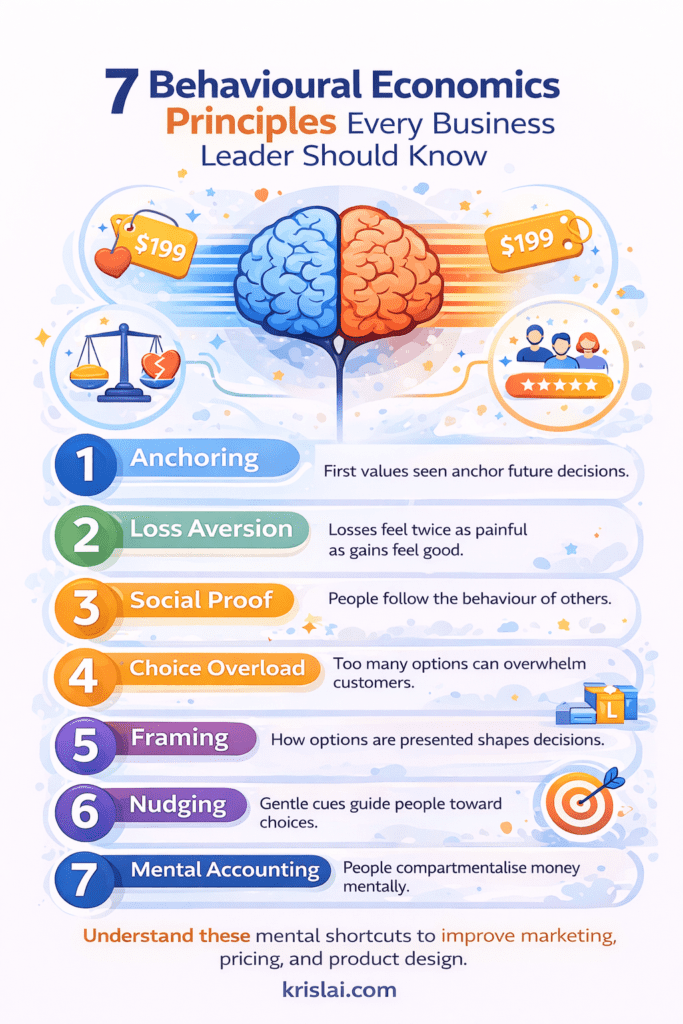
To make these ideas easier to visualise, here are seven behavioural economics principles every business leader should know.
Fast thinking wins, especially under stress and choice overload
Modern consumers face an enormous number of decisions every day.
Because attention is limited, people often rely on fast thinking rather than careful analysis.
One consequence is choice overload.
When customers face too many options, they may struggle to decide at all.
For example, imagine a software company offering ten different subscription plans. Instead of helping customers choose, the complexity may cause them to postpone the decision.
A simpler structure often works better.
Many successful companies use three clear options:
- a basic plan
- a recommended plan
- a premium plan
By highlighting one option as “most popular” or “best value,” the decision becomes easier.
A useful rule of thumb is simple:
If customers must think too hard about the next step, they often delay the decision.
Reducing steps, simplifying choices, and clearly guiding customers can significantly improve conversion.
How reference points shape value: anchors, price framing, and the pain of paying
Another powerful concept in behavioural economics is anchoring.
People often evaluate prices relative to a reference point rather than in absolute terms.
For example, if a product is presented as:
“Was £120 — now £79”
the original price becomes the mental anchor that shapes how the discount feels.
Another related concept is loss aversion.
People tend to feel the pain of losing money more strongly than the pleasure of gaining value.
This is why small additional fees can feel more frustrating than a slightly higher all-inclusive price.
Behavioural economics also highlights the role of mental accounting.
Customers mentally separate different types of spending. A person might hesitate over a £40 monthly subscription but feel comfortable spending £40 on dinner with friends.
For businesses, the practical lesson is clear:
- Use honest reference points
- Avoid hidden fees
- Frame prices clearly and transparently
When pricing feels fair and predictable, trust grows.
- Anchoring – people rely heavily on the first price or reference point they see.
- Loss aversion – losses feel more painful than gains feel rewarding.
- Social proof – customers follow the choices of others.
- Choice overload – too many options can reduce sales.
- Mental accounting – people categorise spending differently depending on context.
Understanding these patterns helps leaders design clearer offers and customer experiences.
Trust, Identity, and Social Proof
Buying decisions are rarely based purely on logic.
Often the emotional decision happens first, and the logical explanation follows later.
This is why trust signals and social proof matter so much.
In recent years, many customers have become more sceptical of large corporate messaging while placing greater trust in individuals — creators, reviewers, and customers who share their experiences openly.
People follow people: the “someone like me” effect
One of the strongest behavioural patterns is social proof.
People look to others for guidance when deciding what to buy.
But not all social proof is equally persuasive.
Specific examples work better than generic claims.
Instead of simply stating “Thousands of customers trust us,” it can be more powerful to show:
- reviews from customers in similar industries
- testimonials describing real use cases
- stories explaining how someone solved a problem using the product
Customers naturally ask themselves:
“Is this relevant for someone like me?”
When the answer is yes, confidence increases.
Identity-based choices: buying what reflects who we are
Another key insight from behavioural economics is that purchases often reflect identity.
People buy products that align with how they see themselves or how they want to be seen.
For example:
- environmentally conscious buyers may choose sustainable brands
- professionals may pay more for tools that signal competence
- enthusiasts may value craftsmanship and quality
Interestingly, customers can be both price-sensitive and value-driven at the same time.
Someone who carefully compares grocery prices might happily spend more on running shoes or a favourite coffee brand.
The important point is that values and identity shape perceived value.
However, authenticity matters.
Vague purpose claims without evidence can quickly damage trust.
Designing Decisions That Help Customers Choose
One of the most useful lessons from behavioural economics is that the environment around a decision matters just as much as the options themselves.
Businesses can help customers choose by making the path clearer.
This does not require manipulation. In fact, ethical design often improves both customer satisfaction and long-term trust.
Make the best choice easy
Several design principles consistently improve decision clarity.
Defaults are one example.
If a helpful option is pre-selected, many customers will accept it because it reduces effort.
Reducing friction is another important factor.
Examples include:
- shorter forms
- faster checkout processes
- clearer product descriptions
- helpful comparison tables
When customers understand the differences between options quickly, they feel more confident about their decision.
Clear information also reduces returns and buyer’s remorse.
Smarter promotions: when discounts work
Discounts can attract attention, but overusing them creates new problems.
If customers expect constant promotions, they may delay purchases until the next sale.
Behavioural economics highlights two related effects:
- scarcity, where limited availability increases perceived value
- urgency, where time pressure encourages faster decisions
Used responsibly, these can help customers act when the timing is right.
However, fake countdown timers or exaggerated “limited stock” messages can damage credibility.
A healthier approach includes:
- value-based bundles
- limited-time bonuses
- transparent price guarantees
Customers are often willing to pay full price when they clearly understand the value.
- Reduce unnecessary friction in the buying journey.
- Highlight the most helpful option clearly.
- Provide honest price comparisons.
- Avoid misleading urgency or fake scarcity.
- Make cancellations and changes easy.
Behavioural economics should help customers choose with confidence — not manipulate them.
AI Is Now Part of the Decision Journey
Another major shift in consumer behaviour is the growing role of artificial intelligence in purchase research.
Many customers now use AI tools to:
- compare products
- gather reviews
- summarise options
- discover alternatives
This means that AI recommendations increasingly influence what people notice and consider.
In effect, AI has become another kind of storefront.
Businesses cannot control every recommendation, but they can influence how trustworthy and understandable their information appears.
Explain the “why” behind recommendations
Customers tend to trust recommendations more when the reasoning is clear.
Simple explanations can help.
For example:
- “Recommended because you bought X.”
- “Popular among customers who use Y.”
- “Works well with Z.”
Providing context helps people understand the relevance of a suggestion.
Transparency also matters.
Customers should always be able to recognise when recommendations are AI-driven.
Use first-party data responsibly
Personalisation can improve customer experiences, but it must be handled carefully.
First-party data — information customers voluntarily share — allows businesses to offer relevant recommendations without excessive tracking.
Good practices include:
- clear consent choices
- simple privacy explanations
- preference centres where customers can adjust settings
Many people appreciate personalisation, but they also want control.
Balancing relevance with transparency builds long-term trust.
Conclusion
Behavioural economics reminds us that customers do not make decisions in perfectly rational ways.
Instead, choices are shaped by context, trust, identity, and the way options are presented.
For business leaders, this insight is powerful.
Rather than trying to force customers into complicated decision processes, we can design experiences that make the right choice easier.
- Simplify choices – fewer options often improve decisions.
- Frame value clearly – explain benefits in relatable terms.
- Use social proof – real customer stories build confidence.
- Design helpful defaults – guide customers toward sensible options.
- Build trust – transparent pricing and honest messaging matter more than ever.
A few practical principles stand out:
- reduce unnecessary choice overload
- frame prices clearly and honestly
- build authentic social proof
- improve product clarity and comparisons
- be transparent when using AI recommendations
Small improvements in these areas can have surprisingly large effects.
A Simple Next Step
If you want to start applying behavioural economics today, choose one customer journey in your business.
For example:
- your pricing page
- your checkout process
- your onboarding experience
Then ask yourself:
- Where might customers feel confused or overwhelmed?
- What signals build trust?
- How could the next step be made clearer?
Run a small experiment, measure the results, and learn from what happens.
Behavioural economics is not about tricking customers.
At its best, it helps businesses create experiences that are clearer, fairer, and easier for people to navigate.
And when decisions become easier, everyone benefits.
Frequently Asked Questions About Behavioural Economics in Business
What is behavioural economics in business?
Behavioural economics in business explains how psychology influences customer decisions. Instead of purely rational choices, people rely on mental shortcuts shaped by context, trust, and how options are presented.
Why do customers make irrational decisions?
Customers are not truly irrational — they simply rely on shortcuts to save time and mental effort. Behavioural economics studies these patterns and helps businesses design clearer decision environments.
What are examples of behavioural economics in marketing?
Examples include social proof (customer reviews), anchoring (showing a higher original price), simplifying choices (three pricing tiers), and framing value clearly.
What is mental accounting in behavioural economics?
Mental accounting refers to how people mentally categorise money. The same amount may feel easier to spend in one context than another.
How can businesses use behavioural economics ethically?
Businesses can apply behavioural insights to simplify choices, improve transparency, and reduce friction — helping customers make confident decisions rather than manipulating them.
Explore More on Business Psychology and Decision-Making
If you found this exploration of behavioural economics useful, these related articles on krislai.com go deeper into how psychology, leadership, and strategy shape real-world business decisions:
- Micro-Moment Marketing — how small decision windows shape modern buying behaviour.
- Psychological Safety at Work — why people speak up (or stay silent) and how that affects team performance.
- Organizational Trauma — how workplace experiences influence trust, culture, and decision-making.
- Trauma-Informed Leadership — leadership practices that reduce fear and improve organisational resilience.
Insight: understanding how people think and decide — whether customers or colleagues — is one of the most powerful ways to improve business strategy.